instrument panel OLDSMOBILE SILHOUETTE 1997 Owner's Guide
[x] Cancel search | Manufacturer: OLDSMOBILE, Model Year: 1997, Model line: SILHOUETTE, Model: OLDSMOBILE SILHOUETTE 1997Pages: 436, PDF Size: 21.87 MB
Page 202 of 436

Defogging and Defrosting
To rapidly defrost the windshield, turn the temperature
control knob all the way clockwise (to the red area) and
turn the mode knob to
DEFROST.
Adjust the fan to the highest speed.
To keep the windshield clear and bring in heated air
through the heater ducts,
turn the mode knob to DEFOG.
When the temperature outside is above freezing, the air
conditioner compressor will run in these settings to help
remove moisture from the air.
Your vehicle is equipped with side window defogger
vents located on the top of the instrument panel. For
additional side window defogging, turn the mode knob
to the
BI-LEVEL setting and adjust the fan to the
highest speed. Aim the side vents on the instrument
panel toward the side windows. For increased airflow to
the side vents, close the center vents.
Rear Window Defogger
Press REAR (the light
will glow) to
warm the
defogger grid
on the
rear window.
The rear window defogger will turn
off automatically
after about
10 minutes of use. If you turn it on again, the
defogger will operate for about five minutes.
You can
also turn the defogger
off by turning off the ignition or
pressing the switch again.
Do not attach a temporary vehicle license across the
defogger grid on the rear window.
ProCarManuals.com
Page 263 of 436
Turn Signals When Towing a Trailer
When you tow a trailer, your vehicle has to have extra
wiring and a different turn signal flasher.
The arrows on your instrument panel will flash
whenever you signal a turn or lane change. Properly
hooked up, the trailer lamps will also flash, telling other
drivers you’re about to turn, change lanes or stop.
When towing a trailer, the arrows on your instrument
panel will flash for turns even if
the bulbs on the trailer
are burned out. Thus, you may think drivers behind you
are seeing your signal when
they are not. It’s important
to check occasionally to be sure the trailer bulbs are
still working.
Driving On Grades
Reduce speed and shift to a lower gear befure you start
down a long or steep downgrade.
If you don’t shift
down, you might have to use your brakes
so much that
they would get hot and
no longer work well.
On a long uphill grade, shift down and reduce your
speed to around
45 mph (70 km/h) to reduce the
possibility of engine and transaxle overheating.
If you are towing a trailer that weighs more than
1,000 lbs.
(454 kg), you may prefer to drive in
THIRD
(3) instead of AUTOMATIC OVERDRIVE (D)
(or, as
you need to, a lower gear). This will minimize
heat build-up and extend the life of your transaxle.
Parking on Hills
You really should not park your vehicle, with a trailer
attached, on a
hill. If something goes wrong, your rig
could start to move. People can be injured, and both
your vehicle and the trailer can be damaged.
But
if you ever have to park your rig on a hill, here’s
how to do it:
1.
2.
3.
4.
5.
Apply your regular brakes, but don’t shift into
PARK
(P) yet.
Have someone place chocks under
the trailer wheels.
When
the wheel chocks are in place, release the
regular brakes
until the chocks absorb the load.
Reapply the regular brakes. Then apply your parking
brake, and then shift
to PARK (P).
Release the regular brakes.
4-37
ProCarManuals.com
Page 276 of 436
Engine Overheating
You will find a coolant temperature gage on your
Oldsmobile’s instrument panel. See “Engine Coolant
Temperature Gage”
in the Index. You also have a low
coolant level light on your instrument panel. See “Low
Coolant Light” in the Index.
Overheated Engine Protection
Operating Mode
Should a low coolant condition exist, an overheat
protection mode which alternates firing groups of three
cylinders helps prevent engine damage. In this mode,
you will notice
a significant loss in power and engine
performance. The low coolant light may come on and
the temperature gage will indicate an overheat condition
exists. This emergency operating mode
allows your
vehicle to be driven to
a safe place in an emergency.
Towing
a trailer in the overheat protection mode should
be avoided.
I NOTICE:
After driving in the overheated engine protection
operating mode, to avoid engine damage, allow
the engine to cool before attempting any repair.
The engine oil
will be severely degraded. Repair
the cause of coolant loss and change the oil. See
“Engine Oil, When to Change” in the Index.
5-12
ProCarManuals.com
Page 301 of 436
Adding Equipment to the Outside of
Your Vehicle
Things you might add to the outside of your vehicle can
affect the airflow around it. This may cause wind noise
and affect windshield washer performance. Check with
your Oldsmobile retailer before adding equipment to the
outside
of your vehicle.
Fuel
Use regular unleaded gasoline rated at 87 octane or
higher. At
a minimum, it should meet specifications
ASTM D4814
in the United States and CGSB 3.5-M93
in Canada. Improved gasoline specifications have been
developed by the American Automobile Manufacturers
Association (AAMA) for better vehicle performance
and engine protection. Gasolines meeting the AAMA
specification could provide improved driveability and
emission control system protection compared to
other gasolines.
Be sure the posted octane is at least 87. If the octane is
less than
87, you may get a heavy knocking noise when
you drive. If it’s bad enough, it can damage your engine.
If you’re using fuel rated at 87 octane or higher and you
still hear heavy knocking, your engine needs service.
But don’t worry if you hear
a little pinging noise when
you’re accelerating or driving up
a hill. That’s normal,
and you don’t have
to buy a higher octane fuel to get rid of
pinging. It’s the heavy, constant knock that means
you have
a problem.
If your vehicle is certified to meet California Emission
Standards (indicated on
the underhood tune-up label),
it is designed to operate on fuels that meet California
specifications.
If such fuels are not available in states
adopting California emissions standards, your vehicle
will operate satisfactorily on fuels meeting federal
specifications, but emission control system performance
may be affected. The malfunction indicator lamp on
your instrument panel may turn on and/or your vehicle
may fail
a smog-check test. If this occurs, return to
your authorized Oldsmobile retailer for diagnosis
to determine
the cause of failure. In the event it is
determined that
the cause of the condition is the type of
fuels used, repairs may not be covered by your warranty.
Some gasolines that are not reformulated for
low
emissions contain an octane-enhancing additive called
methylcyclopentadlenyl manganese tricarbonyl (MMT);
ask your service station operator whether or not his fuel
contains
MMT. General Motors does not recommend the
use of such gasolines.
If fuels containing MMT are used,
spark plug life may be reduced and your emission
control system performance may be affected. The
malfunction indicator lamp on your instrument panel
may turn on.
If this occurs, return to your authorized
Oldsmobile retailer for service.
/A
ProCarManuals.com
Page 308 of 436
Pull forward on the hood prop to release it from its
storage clip. Then put the end of
the hood prop into the
slot in the underside of the hood.
Before closing the hood, be sure all the filler caps are on
properly.
Then lift the hood to relieve pressure on the
hood prop. Remove the hood prop from the slot
in the
hood and return the prop to its retainer. Then just let
the
hood down and close it firmly.
Underhood Lamp
Your underhood lamp will go on when you open the hood.
Engine Oil
LWEL
If the Low Oil Level light on
the instrument panel comes
on, it means you need to
check your engine oil level
right away. For more information, see “Low Oil
Level Light”
in the Index.
You should check your
engine oil level regularly;
this is an added reminder. It‘s
a good idea
to check your engine oil every time you
get
fuel. In order to get an accurate reading, the oil must
be warm and the vehicle must be on level ground.
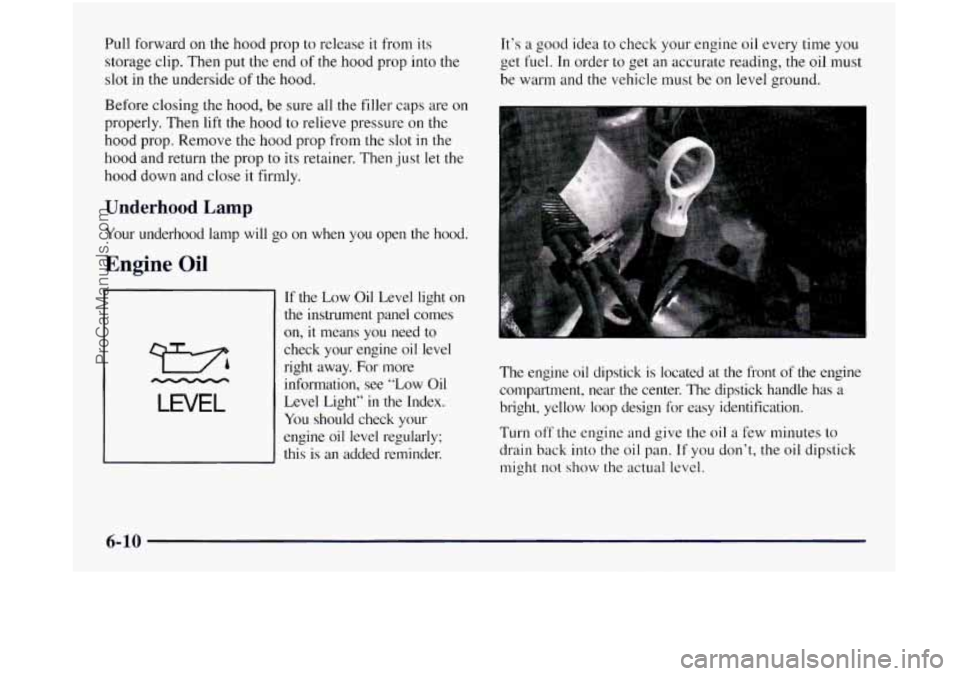
The engine oil dipstick
is located at the front of the engine
compartment, near the center. The dipstick handle has
a
bright, yellow loop design for easy identification.
Turn
off the engine and give the oil a few minutes to
drain back into the oil pan. If you don’t, the oil dipstick
might not show the actual level.
6-10
ProCarManuals.com
Page 347 of 436
Cleaning Leather
Use a soft cloth with lukewarm water and a mild soap or
saddle soap.
0 For stubborn stains, use a vinylAeather cleaner. See
your retailer for this product.
0 Never use oils, varnishes, solvent-based or abrasive
cleaners, furniture polish or shoe polish on leather.
0 Soiled leather should be cleaned immediately.
If dirt is allowed to work into
the finish, it can harm
the leather.
Cleaning the Top of the Instrument Panel
Use only mild soap and water to clean the top surfxes
of the instrument panel. Sprays containing silicones or
waxes may cause annoying reflections
in the windshield
and even make
it difficult to see through the windshield
under certain conditions.
Cleaning the Built-In Child
Restraint Pad
The built-in child restraint pad is attached to the seat
frame
with fastener strips. You can remove the pad and
hand wash
it with mild soap and water.
Care of Safety Belts and Built-in
Child Restraint Harness
Keep the safety belts and the built-in child restraint
harness clean and dry.
Do not bleach or dye safety belts or the built-in
child restraint harness. If you do, they may be
severely weakened. In
a crash, they might not be
able to provide adequate protection. Clean the
safety belts and the child restraint harness only
with mild soap and lukewarm water.
6-48
ProCarManuals.com
Page 352 of 436
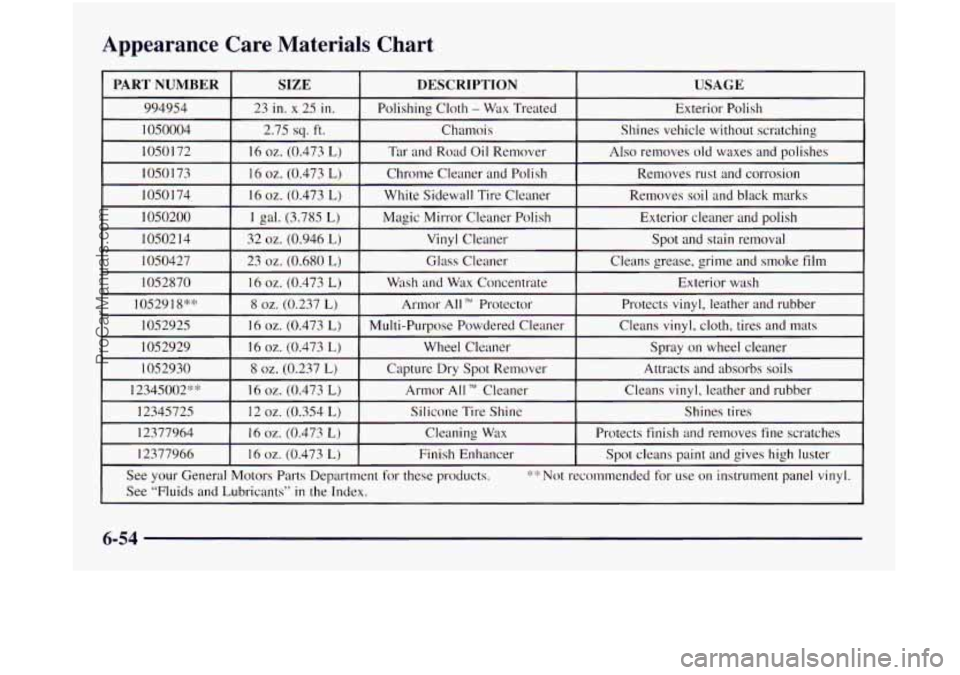
Appearance Care Materials Chart
PART NUMBER
I IO50 17:
I 10501 73
I 1050 174
~--
SIZE DESCRIPTION I USAGE
23 in. x 25 in. Polishing Cloth - Wax Treated Exterior Polish
2.75
sq. ft. Chamois Shines vehicle without scratching
16 oz. (0.473 L) Tar and Road Oil Remover Also removes old waxes and polishes
16
oz. (0.473 L)
Exterior cleaner and polish
Magic
Mirror Cleaner Polish 1 gal. (3.785 L) Removes
soil and black marks White Sidewall Tire
Cleaner
16 oz. (0.473 L)
Removes rust and corrosion
Chrome Cleaner and Polish
32
oz. (0.946 L) I Vinyl Cleaner
Spot and stain removal
1050427
Exterior wash Wash and
Wax Concentrate
16 oz. (0.473 L) 1052870 Cleans grease,
grime and smoke film
Glass Cleaner 23 02. (0.680 L)
1052918""
Cleans
vinyl, cloth, tires and mats
Multi-Purpose
Powdered Cleaner 16 oz. (0.473 L) 1052925 Protects
vinyl, leather and rubber Armor All TM Protector
8 oz. (0.237 L)
I 1052929 I 16 OZ. (0.473 L) I Wheel Cleaner I Spray on wheel cleaner I
1052930
Cleans
vinyl, leather and rubber Armor All TM Cleaner 16 oz. (0.473 L) 12345002"" Attracts and
absorbs soils Capture
Dry Spot Remover
8
oz. (0.237 L)
I 12345725 I 12 02. (0.354
L) I Silicone Tire Shine I
~~
Shines tires I I I I
t 12377964 I 16 oz. (0.473 L) I Cleaning Wax I Protects finish and removes fine scratches I
I 12377966 I 16 oz. (0.473 L) I Finish Enhancer I SDot cleans paint and gives high luster I ~
See your General Motors Parts Department for these products. 'i':kNo\
t recommended for use on instrument panel vinyl.
See "Fluids and Lubricants" in the Index.
6-54
ProCarManuals.com
Page 353 of 436
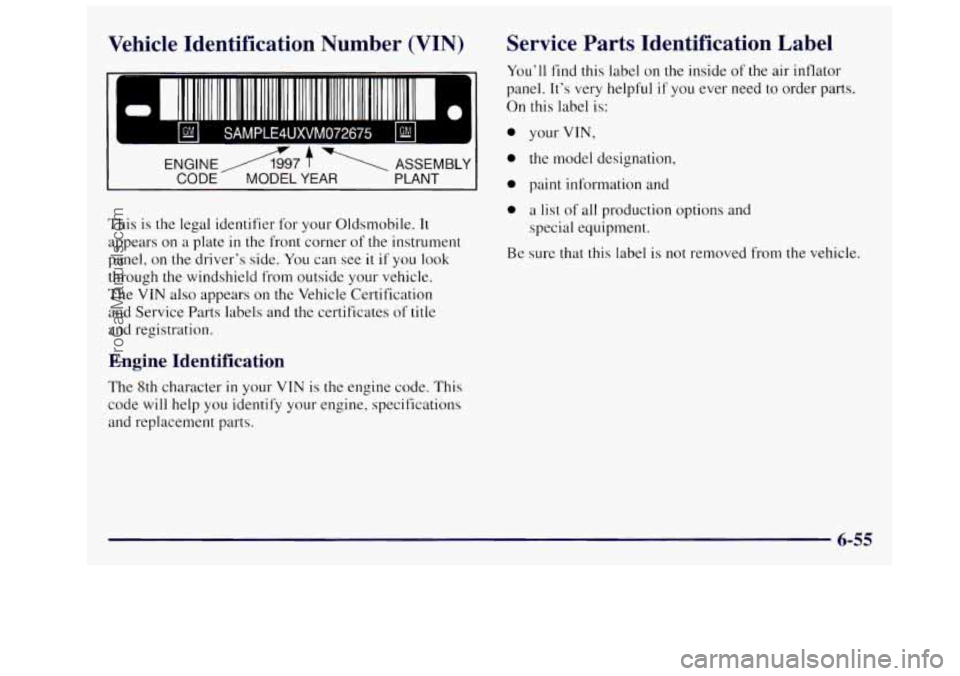
Vehicle Identification Number (VIN)
ENGINEA7 f ASSEMBLY
CODE MODEL YEAR PLANT
This is the legal identifier for your Oldsmobile. It
appears on a plate in the front corner of the instrument
panel, on the driver’s side. You can see
it if you look
through the windshield from outside your vehicle.
The
VIN also appears on the Vehicle Certification
and Service Parts labels and
the certificates of title
and registration.
E1 ,ine Identification
The 8th character in your VIN is the engine code. This
code will help you identify your engine, specifications
and replacement parts.
Service Parts Identification Label
You’ll find this label on the inside of the air inflator
panel. It’s very
helpful if you ever need to order parts.
On this label is:
0 your VIN,
0 the model designation,
0 paint information and
0 a list of all production options and
special equipment.
Be sure that this label is not removed from the vehicle.
6-55
ProCarManuals.com
Page 355 of 436
Fuses and Circuit Breakers
The wiring circuits in your vehicle are protected from
short circuits by a combination of fuses, circuit breakers
and fusible thermal links.
Look at the silver-colored band inside the fuse. If the
band
is broken or melted, replace the fuse. Be sure you
replace a bad fuse with a new one of the identical size
and rating.
If you ever have a problem on the road and don’t have a
spare fuse,
you can borrow one that has the same
amperage
or use one of the spare fuses in the underhood
fuse and relay center. Just pick some feature of your
vehicle that you can get along without
-- like the radio
or cigarette lighter -- and use its fuse, if it is the right
amperage. Replace it as soon as you can.
There are two fuse blocks in your vehicle: the
instrument panel fuse block and the underhood fuse and
relay center.
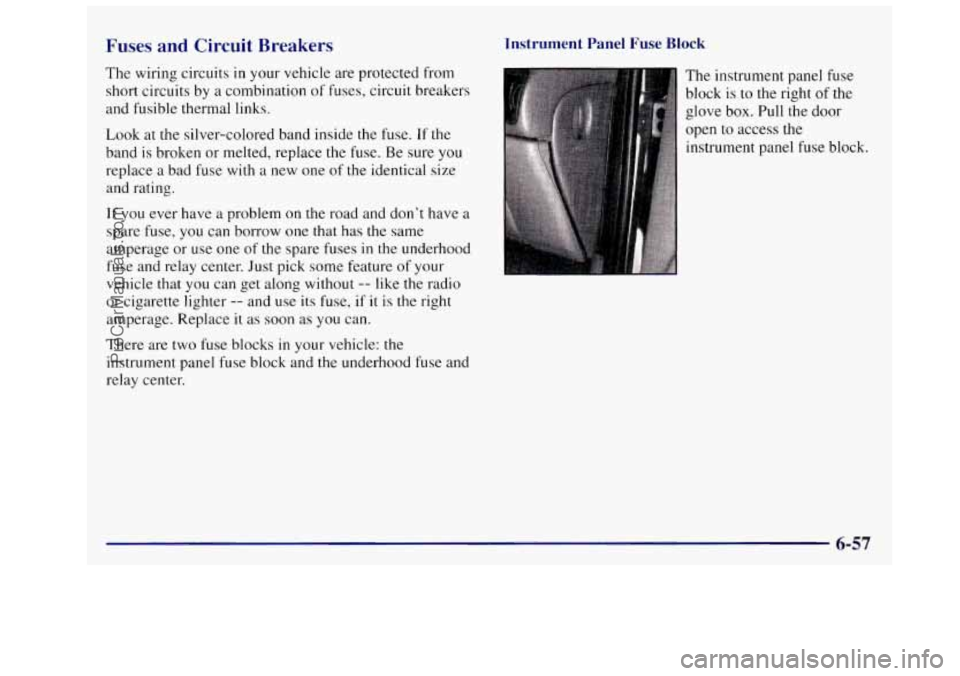
Instrument Panel Fuse Block
The instrument panel fuse
block
is to the right of the
glove box. Pull the door
open to access the
instrument panel fuse block.
ProCarManuals.com
Page 357 of 436
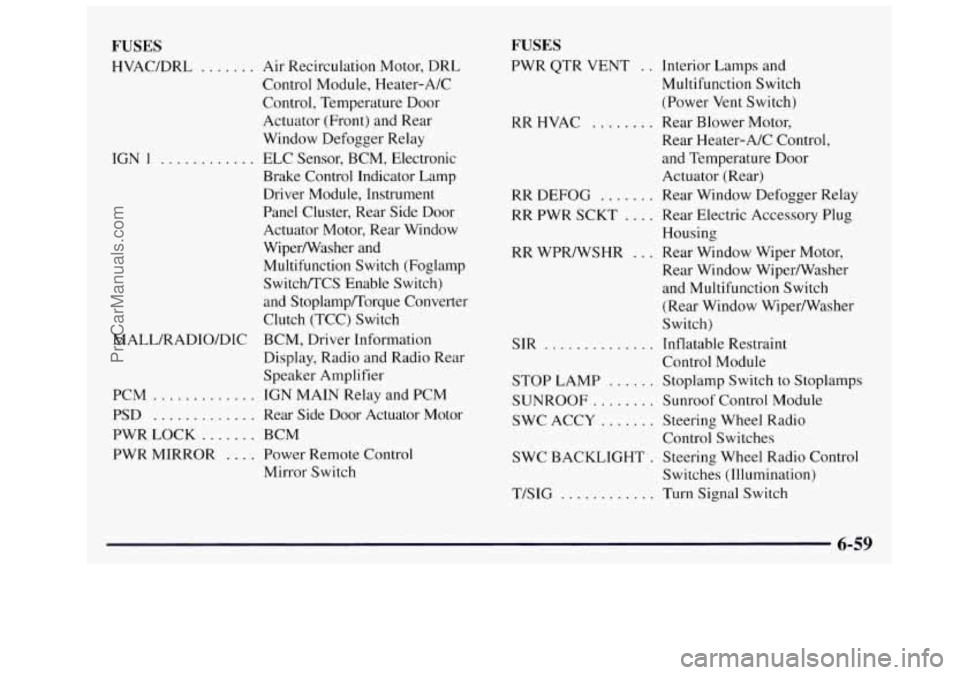
FUSES
HVAC/DRL ....... Air Recirculation Motor, DRL
IGN
1 ...........
MALL/RADIO/DIC Control Module, Heater-A/C
Control,
Temperature Door
Actuator (Front) and Rear
Window Defogger Relay
ELC Sensor, BCM, Electronic
Brake Control Indicator Lamp
Driver Module, Instrument
Panel Cluster, Rear Side Door
Actuator Motor, Rear Window
Wiperwasher and
Multifunction Switch (Foglamp
Switch/TCS Enable Switch)
and Stoplamp/Torque Converter
Clutch (TCC) Switch
BCM, Driver Information
Display, Radio and Radio Rear
Speaker Amplifier
PCM
............. IGN MAIN Relay and PCM
PSD
............. Rear Side Door Actuator Motor
PWR LOCK
....... BCM
PWR MIRROR
.... Power Remote Control
Mirror Switch
FUSES
PWR QTR VENT . . Interior Lamps and
Multifunction Switch
(Power
Vent Switch)
RR HVAC ........ Rear Blower Motor,
Rear Heater-A/C Control,
and Temperature Door
Actuator (Rear)
RR
DEFOG ....... Rear Window Defogger Relay
RR PWR SCKT .... Rear Electric Accessory Plug
Housing
Rear Window Wiper/Washer
and Multifunction Switch
(Rear Window Wiper/Washer
Switch)
Control Module
RR WPR/WSHR
... Rear Window Wiper Motor,
SIR
.............. Inflatable Restraint
STOP LAMP ...... Stoplamp Switch to Stoplamps
SUNROOF
........ Sunroof Control Module
SWC ACCY
....... Steering Wheel Radio
SWC BACKLIGHT
. Steering Wheel Radio Control
T/SIG ............ Turn Signal Switch
Control
Switches
Switches (Illumination)
6-59
ProCarManuals.com