engine oil OLDSMOBILE SILHOUETTE 2003 Owner's Manual
[x] Cancel search | Manufacturer: OLDSMOBILE, Model Year: 2003, Model line: SILHOUETTE, Model: OLDSMOBILE SILHOUETTE 2003Pages: 466, PDF Size: 21.55 MB
Page 336 of 466
Cooling System
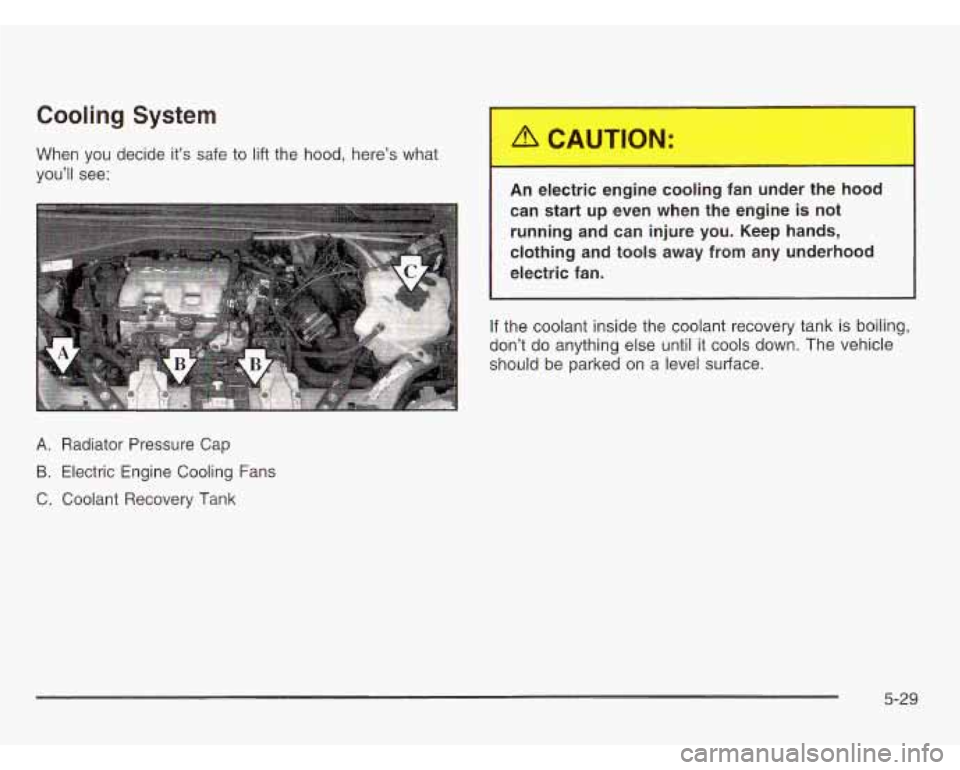
When you decide it’s safe to lift the hood, here’s what
you’ll see:
A. Radiator Pressure Cap
B. Electric Engine Cooling Fans
C. Coolant Recovery Tank An electric
engine cooling far. -..-er the hood
can start up even when the engine is not
running and can injure you. Keep hands,
clothing and tools away from any underhood
electric fan.
If the coolant inside the coolant recovery tank is boiling,
don’t do anything else until it cools down. The vehicle
should be parked on a level surface.
5-29
Page 338 of 466
Notice: Engine damage from running your engine
without coolant isn’t covered by your warranty.
See “Overheated Engine Protection Operating
Mode” in the Index for information on driving to
a safe place in an emergency.
Notice: When adding coolant, it is important that
you use only
DEX-COOL@ (silicate-free) coolant.
If coolant other than DEX-COOL@
is added to the
system, premature engine, heater core or radiator
corrosion may result. In addition, the engine coolant
will require change sooner
- at 30,000 miles
(50 000 km) or 24 months, whichever occurs first.
Damage caused by the use of coolant other
than DEX-COOL@ is not covered by your new
vehicle warranty.
How to Add Coolant to the Coolant
Recovery Tank
If you haven’t found a problem yet, but the coolant
level isn’t at
or above the FULL COLD mark, add a
50/50 mixture of clean, drinkable waterand DEX-COOL@
engine coolant at the coolant recovery tank. See Engine
Coolant on page
5-23 for more information.
Adding only plain water to your cooling
system can be dangerous. Plain water, or
some other liquid such as alcohol, can boil
before the proper coolant mixture will. Your
vehicle’s coolant warning system
is set for the
proper coolant mixture. With plain water or the
wrong mixture, your engine could get too hot
but you wouldn’t get the overheat warning.
Vn~lr en~ine mt1ld catch fire and YOU or others
could be burned. Use a 50/50 mixture of clean,
drinkable water and DEX
COOL@ coolant.
5-31
Page 348 of 466
h the wrong kind of fluid in ur brake
system, your brakes may not work well, or they
may not even work at all. This could cause a
crash. Always use the proper brake fluid.
Notice:
Using the wrong fluid can badly damage brake
system parts. For example, just a few drops of
mineral-based oil, such as engine oil,
in your
brake system can damage brake system
parts
so badly that they’ll have to be replaced.
Don’t let someone
put in the wrong kind of fluid.
0 If you spill brake fluid on your vehicle’s painted
surfaces, the paint finish can be damaged.
Be careful not to spill brake fluid on your
vehicle. If you do, wash
it off immediately.
See “Appearance Care” in the Index.
Brake Wear
Your vehicle has front disc brakes and rear drum brakes.
Disc brake pads have built-in wear indicators that make
a high-pitched warning sound when the brake pads are
worn and new pads are needed. The sound may come
and
go or be heard all the time your vehicle is moving
(except when you are pushing on the brake pedal firmly).
The brake wear warning sound means that soon
your brakes won’t work well. That could lead
to
an accident. When you hear the brake wear
warning sound, have your vehicle serviced.
Notice: Continuing to drive with worn-out brake
pads could result
in costly brake repair.
Some driving conditions or climates may cause a brake
squeal when the brakes are first applied or lightly
applied. This does not mean something is wrong with
your brakes.
5-41
Page 412 of 466
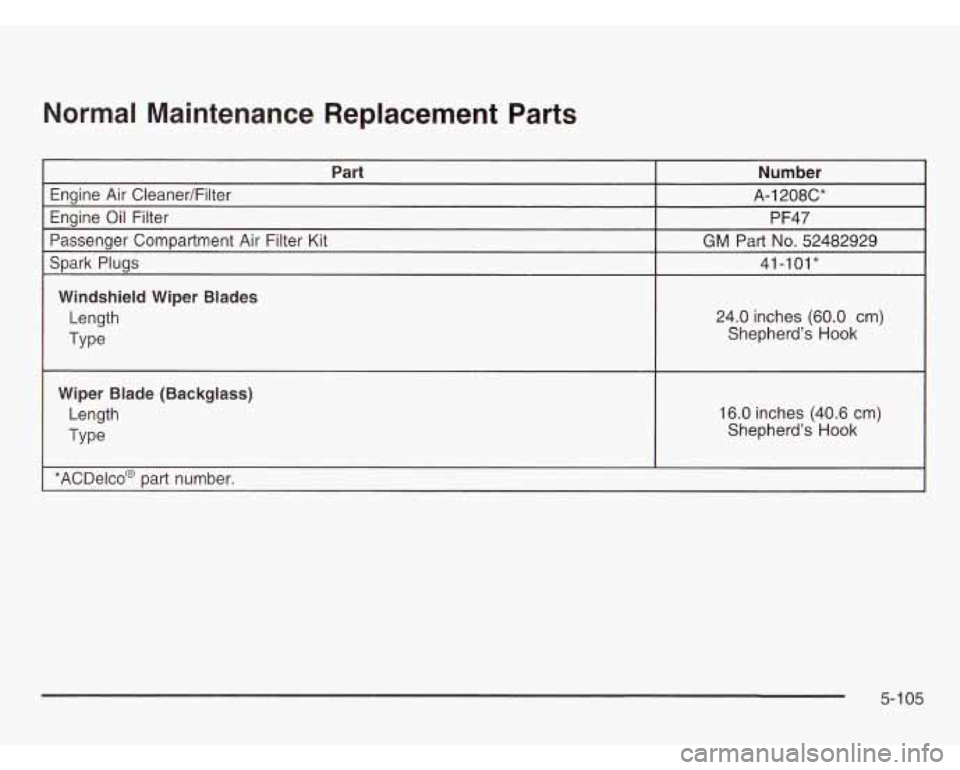
Normal Maintenance Replacement Parts
Part
Engine Air Cleaner/Filter
Engine Oil Filter
Passenger Compartment Air Filter Kit
Spark Pluas
Windshield Wiper Blades
Length
Type
Wiper Blade (Backglass) Length
TY Pe
*ACDelco@ part number. Number
A-I 208C*
PF47
GM Part No. 52482929
41
-1 01 *
24.0 inches (60.0 cm)
Shepherd’s Hook
16.0 inches (40.6 cm)
Shepherd’s Hook
5-1 05
Page 415 of 466
Maintenance Schedule
Introduction
I
KEEP ENGINE OIL
AT THE PROPER
-EVEL AND CHANGE
AS I
RECOMMENDED ~
Your Vehicle and the Environment
Proper vehicle maintenance not only helps to keep your
vehicle in good working condition, but also helps the
environment. All recommended maintenance procedures
are important. Improper vehicle maintenance can
even affect the quality of the air we breathe. Improper
fluid levels or the wrong tire inflation can increase
the level of emissions from your vehicle.
To help protect
our environment, and to keep your vehicle in good
condition, please maintain your vehicle properly.
Maintenance Requirements
Maintenance intervals, checks, inspections and
recommended fluids and lubricants as prescribed in this
manual are necessary to keep your vehicle in good
working condition. Any damage caused by failure
to follow recommended maintenance may not be
covered by warranty.
Have you purchased the GM Protection Plan? The Plan
supplements your new vehicle warranties. See your
Warranty and Owner Assistance booklet or your dealer
for details.
6-2
Page 417 of 466

Part A: Scheduled Maintenance
Services
This part contains engine oil and chassis lubrication
scheduled maintenance which explains the engine oil
life system and how
it indicates when to change
the engine oil and filter. Lubricate chassis components
with each
oil change. Also, listed are scheduled
maintenance services which are to be performed at the
mileage intervals specified.
Using Your Maintenance Schedule
We at General Motors want to help you to keep your
vehicle in good working condition. But we don’t know
exactly how you’ll drive it. You may drive short distances
only a few times a week. Or you may drive long distances
all the time in very hot, dusty weather. You may use your
vehicle in making deliveries. Or you may drive it to work,
to do errands or in many other ways.
Because of all the different ways people use their
vehicles, maintenance needs vary. You may need more
frequent checks and replacements.
So please read
the following and note how you drive. If you have any
questions on how to keep your vehicle in good condition,
see your dealer. This part tells
you the maintenance services you
should have done and when you should schedule them.
When you go to your dealer for your service needs,
you’ll know that GM-trained and supported service
people will perform the work using GM parts.
The proper fluids and lubricants to use are listed in
Part
D. Make sure whoever services your vehicle uses
them.
All parts should be replaced and all necessary
repairs done before you or anyone else drives the
vehicle.
This schedule is for vehicles that:
carry passengers and cargo within recommended
limits. You will find these limits on your vehicle’s
Certificationflire label. See
Loading Your Vehicle
on page 4-34.
driving limits.
are driven on reasonable road surfaces within
use the recommended fuel. See Gasoline Octane
on page
5-5.
6-4
Page 418 of 466
Scheduled Maintenance
The services shown in this schedule up to 100,000 miles
(1 66 000 km) should be repeated after 100,000 miles
(1 66 000 km) at the same intervals for the life of
this vehicle. The services shown at
150,000 miles
(240 000 km) should be repeated at the same interval
after
150,000 miles (240 000 km) for the life of this
vehicle.
See
Part 5: Owner Checks and Services on page 6-10
and Part C: Periodic Maintenance Inspections on
page
6- 14.
Footnotes
t The U.S. Environmental Protection Agency or the
California Air Resources Board has determined that the
failure to perform this maintenance item will not nullify
the emission warranty or limit recall liability prior to
the completion of the vehicle
's useful life. We, however,
urge that all recommended maintenance services be
performed at the indicated intervals and the
mainienance
be recoraea.
+ A good time to check your brakes is during tire
rotation. See Brake System Inspection
on page 6-15.
Engine Oil and Chassis Lubrication
Scheduled Maintenance
Change engine oil and filter as indicated by the GM
Oil Life System (or every 12 months, whichever
occurs first). Reset the system.
Your vehicle has a computer system that lets you know
when to change the engine oil and filter. This is based on
engine revolutions and engine temperature, and not on
mileage. Based on driving conditions, the mileage at
which an oil change will be indicated can vary
considerably. For the oil life system to work properly,
you must reset the system every time the
oil is changed.
When the system has calculated that oil life has been
diminished, it will indicate that an oil change is
necessary.
A change engine oil message will come on.
Change your oil as soon
as possible within the next
two times you stop for fuel. It
is possible that, if you are
driving under the best conditions, the oil life system may not indicate that an oil change is necessary for over
a year. However, your engine oil and filter must be
changed at least once a year and at this time the system
must be reset. It is also important to check your oil
regularly and keep it at the proper level.
6-5
Page 419 of 466
If the system is ever reset accidentally, you must
change your oil at
3,000 miles (5 000 km) since your
last oil change. Remember to reset the oil life system
whenever the oil is changed. See
Engine Oil on
page
5-74 for information on resetting the system.
An Emission Control Service.
Lubricate chassis components with each engine oil
and filter change.
Lubricate the suspension, steering linkage, transaxle
shift linkage and the underbody contact points and
linkage.
After the services are performed, record the date,
odometer reading and who performed the service on the
maintenance record pages in Part
E of this schedule.
7,500 Miles (12 500 km)
0 Rotate tires. See Tire lnspection and Rotation on
page 5-62
for proper rotation pattern and additional
information.
(See footnote +.)
15,000 Miles (25 000 km)
0 Inspect engine air cleaner filter if you are driving in
dusty conditions. Replace filter if necessary.
An Emission Control Service. (See footnote t.)
0 Replace passenger compartment air filter. If you
drive regularly under dusty conditions, the filter may require replacement more often.
Cl Rotate tires. See Tire Inspection and Rotation on
page 5-62
for proper rotation pattern and additional
information.
(See footnote +.)
22,500 Miles (37 500 km)
0 Rotate tires. See Tire Inspection and Rotation on
page
5-62 for proper rotation pattern and additional
information.
(See footnote +.)
6-6
Page 423 of 466
Part B: Owner Checks and Services
Listed in this part are owner checks and services
which should be performed at the intervals specified to
help ensure the safety, dependability and emission
control performance of your vehicle.
Be sure any necessary repairs are completed at once.
Whenever any fluids or lubricants are added to your
vehicle, make sure they are the proper ones, as shown
in Part D.
At Each Fuel Fill
It is important for you or a service station attendant to
perform these underhood checks at each fuel fill.
Engine Oil Level Check
Check the engine oil level and add the proper oil if
necessary. See Engine Oil on page 5-14 for further
details.
Engine Coolant Level Check
Check the engine coolant level and add DEX-COOL@
coolant mixture
if necessary. See Engine Coolant
on page 5-23
for further details.
Windshield Washer Fluid Level Check
Check the windshield washer fluid level in the windshield
washer tank and add the proper fluid
if necessary. See
Windshield Washer Fluid on page 5-38 for further details.
At Least Once a Month
Tire Inflation Check
Make sure tries are inflated to the correct pressures.
Don’t forget to check your spare tire. See
Tires on
page 5-60
for further details.
Cassette Tape Player Service
Clean cassette tape player. Cleaning should be done
every
50 hours of tape play. See Audio Systern(s)
on page 3-63 for further details.
At Least Twice a Year
Restraint System Check
:s , Make sure the safety belt reminder light and all your bell
buckles, latch plates, retractors and anchorages are
working properly. Look for any other loose or damaged
safety belt system parts.
If you see anything that might
keep a safety belt system from doing its
job, have it
repaired. Have any torn or frayed safety belts replaced.
6-1 0
Page 428 of 466
Throttle System Inspection
Inspect the throttle system for interference or binding,
and for damaged or missing parts. Replace parts
as needed. Replace any components that have high
effort or excessive wear.
Do not lubricate accelerator
and cruise control cables.
Transfer Case (Power Transfer Unit)
and Carrier Assembly-Differential
(Rear Drive Module) All-Wheel Drive
Inspection
Every 12 months or at engine oil change intervals,
check rear differential and transfer case and add
lubricant when necessary.
A fluid loss could indicate
a problem; check and have it repaired,
if needed.
Check vent hoses at transfer case and differential for
kinks and proper installation.
Brake System Inspection
Inspect the complete system. Inspect brake lines and
hoses for proper hook-up, binding, leaks, cracks,
chafing, etc. Inspect disc brake pads for wear and rotors
for surface condition.
Also inspect drum brake linings
for wear and cracks. Inspect other brake parts, including
drums, wheel cylinders, calipers, parking brake, etc.
Check parking brake adjustment.
You may need to
have your brakes inspected more often
if your driving
habits or conditions result in frequent braking.
6-1 5