ignition OLDSMOBILE SILHOUETTE 2003 Owner's Manual
[x] Cancel search | Manufacturer: OLDSMOBILE, Model Year: 2003, Model line: SILHOUETTE, Model: OLDSMOBILE SILHOUETTE 2003Pages: 466, PDF Size: 21.55 MB
Page 127 of 466
Torque Lock
If you are parking on a hill and you don’t shift your
transaxle into PARK (P) properly, the weight of the
vehicle may put too much force on the parking pawl in
the transaxle. You may find it difficult to pull the shift
lever out of PARK (P). This is called “torque lock.”
To prevent torque lock, set the parking brake and
then shift into PARK (P) properly before you leave the
driver’s seat. To find out how, see
Shifting lnto Park (P)
on page 2-40.
When you are ready to drive, move the shift lever out of
PARK (P)
before you release the parking brake.
If torque lock does occur, you may need to have another
vehicle push yours a little uphill to take some of the
pressure from the parking pawl in the transaxle,
so you
can pull the shift lever out of PARK (P).
Shifting Out of Park (P)
Your vehicle has an automatic transaxle shift lock
control system. You have to fully
apply your regular
brakes
before you can shift from PARK (P), when
the ignition is in RUN.
As you step on the brake pedal, while in PARK (P),
you may hear a click from the solenoid of the system.
This ensures that the system is operating properly.
See
Automatic Transaxle Operation on page 2-36.
If you cannot shift out of PARK (P), ease pressure on
the shift lever by pushing the shift lever all the way into
PARK (P) as you maintain brake application. Then try
to move the shift lever into the gear you want. If you
ever hold the brake pedal down but still can’t shift out
of PARK (P), try this:
1. Turn the ignition key to OFF
2. Apply and hold the brake until the end of Step 4.
3. Shift to NEUTRAL (N).
4. Start the engine and then shift to the drive gear
you want.
5. Have the vehicle fixed as soon as you can.
2-42
Page 148 of 466
Entering Programming Mode
To program features, your vehicle must be in the
programming mode. Follow these steps:
1. The content theft-deterrent system must be
disarmed. See
Content Theft-Deterrent on
page
2-27.
2. Remove the BCM PRGRM fuse from the instrument
panel fuse block, located to the right of the glove
box. See Fuses and Circuit Breakers on page 5-96.
3. Close the driver’s door
4. Turn the ignition key to ACCESSORY.
5. Count the number of chimes you hear. You will
hear two to four chimes depending on the features
your vehicle is equipped with. Refer to the chart
shown previously.
You can now program your choices.
To exit the programming mode, follow the steps listed
under
Exiting Programming Mode on page 2-71.
Delayed Illumination and
Exit Lighting
This feature allows you to customize the interior lamps
when entering and exiting the vehicle.
Programmable Modes
Mode 1: Both Features Off (The interior lamps will
turn on or
off at the same instant that a door is opened
or closed.)
Mode
2: Delayed Illumination Only (The interior lamps
will stay on for about
25 seconds after all the doors
and liftgate are closed, or until you lock the doors.)
Mode
3: Exit Lighting Only (The interior lamps will
come on whenever you remove the key from the
ignition and stay on for about
25 seconds, or until
you lock the doors.)
Mode
4: Both Features On (This combines
Modes 2 and 3.)
2-63
Page 149 of 466
Before your vehicle was shipped from the factory,
it was programmed in Mode
4. The mode to which the
vehicle was programmed may have been changed since
it left the factory.
To determine the mode to which your
vehicle is programmed or to program your vehicle
to a different mode, do the following:
1. Follow the instructions for “Entering Programming
Mode” earlier
in this section.
2. Turn the interior lamps on by turning the instrument
panel brightness control all the way up.
3. Count the number of chimes you hear.
The number of chimes indicates the vehicle’s
current programmed mode. (If you do not wish to
change the current mode, you can either exit
the programming mode by following the instructions later in this section or program the next feature
available on your vehicle.)
4. Turn the interior lamps off to change the
current mode.
5. Turn the interior lamps from on to off until you hear
the number of chimes corresponding to the mode
selection you want.
The mode you selected is now set.
You can either exit
the programming mode by following the instructions
later in this section or program the next feature available
on your vehicle.
Automatic Door Locks
This feature allows you to customize the automatic
locking and unlocking of the doors when using the
shift lever.
Programmable Modes
Mode 1: Both Features Off (Automatic door locking
and unlocking is disabled. You will always need to
lock your doors manually before driving to increase
occupant safety.)
Mode
2: Automatic Door Locking Only
The automatic door unlock feature is turned off.
Shift out of PARK (P) with the ignition on and the
driver’s door closed; all doors will lock automatically.
Turn off the ignition with the transaxle in PARK (P);
Shift out of PARK (P) with the ignition on and the
Mode
3: Automatic Unlocking with the Ignition
Off
all doors will unlock automatically.
driver’s door closed; all doors will lock automatically.
Mode
4: Automatic Unlocking with Transaxle in
PARK (P)
Shift into PARK (P) with the ignition on; all doors
Shift out of PARK (P) with the ignition on and the
will unlock
automatically.
driver’s door closed; all doors will lock automatically.
2-64
Page 150 of 466
Before your vehicle was shipped from the factory,
it was programmed in Mode
3. The mode to which the
vehicle was programmed may have been changed since
it left the factory.
To determine the mode to which
your vehicle is programmed or to program your vehicle
to a different mode, do the following:
1. Follow the instructions for Entering Programming
Mode on page 2-63.
2. Press LOCK on the power door lock switch.
3. Count the number of chimes you hear.
The number of chimes indicates the vehicle’s
current programmed mode. (If you do not wish to
change the current mode, you can either exit
the programming mode by following the instructions
later in this section or program the next feature
available on your vehicle.)
4. Press LOCK to change the current mode.
5. Press LOCK until you hear the number of chimes
corresponding
to the mode selection you want.
The mode you selected is
now set. You can either exit
the programming mode by following the instructions
later in this section or program the next feature available
on your vehicle.
Last Door Locking and Lockout
Deterrent
This feature allows you to customize the automatic
locking of the doors when exiting the vehicle.
Programmable Modes
Mode 1: Both Features Off (Doors will always lock
immediately when you press LOCK on the power door
lock switch or the remote keyless entry transmitter.)
Mode
2: Lockout Deterrent Only (If you leave your key
in the ignition with the driver’s door open, you won’t
be able to lock the doors with the power door locks.)
Mode
3: Last Door Closed Locking Only (If the power
door lock switch or the remote keyless entry transmitter
is used to lock the vehicle while any door or the
liftgate is open, you will hear three chimes. The doors
will not lock. Five seconds after the last door is
closed, all doors and the liftgate will lock.)
Mode
4: Both Features On (This combines
Modes
2 and 3.)
2-65
Page 155 of 466
Arming and Disarming the Content
Theft-Deterrent System
To arm or disarm the content theft-deterrent system,
the system must be turned on by using Modes
1, 2 or 4
listed previously.
This feature allows you to customize the arming and
disarming of the content-theft deterrent system.
Programmable Modes
Mode 1: Power Door Lock Switch Arming Off
The system will arm when you lock the doors
with your key or remote keyless entry transmitter.
The key must be removed from the ignition
when you lock the doors or the content
theft-deterrent system will not arm.
The system will disarm when you unlock the doors
with your key or remote keyless entry transmitter.
Mode
2: Remote Keyless Entry Transmitter
Arm/Disarm Only
0 The system will arm when you lock the doors with
your remote keyless entry transmitter. The key
must be removed from the ignition when you lock
the doors or the content theft-deterrent system
will not arm.
0 The system will disarm when you unlock the doors
with your remote keyless entry transmitter. While
this mode provides increased security, it can be
a problem
if your remote keyless entry transmitter
is damaged, lost
or if it fails to operate for any reason
while the content theft-deterrent system is armed.
The content theft-deterrent system must be disarmed
for the engine to run while in Mode
2; your key can
no longer disarm the system.
If your vehicle is equipped with the Onstar@ system,
Onstar@ will not be able to remotely unlock your vehicle
if it has been programmed to Mode 2.
Mode 3: Standard Arming and Disarming
0
0
0
The system will arm when you lock the doors using
either power door lock switch while any door or the
liftgate is open and the key is removed from the
ignition.
The system will arm when you lock the doors with
your key or remote keyless entry transmitter and
the key is removed from the ignition.
The system will disarm when you unlock the doors
with your key or remote keyless entry transmitter.
2-70
Page 162 of 466
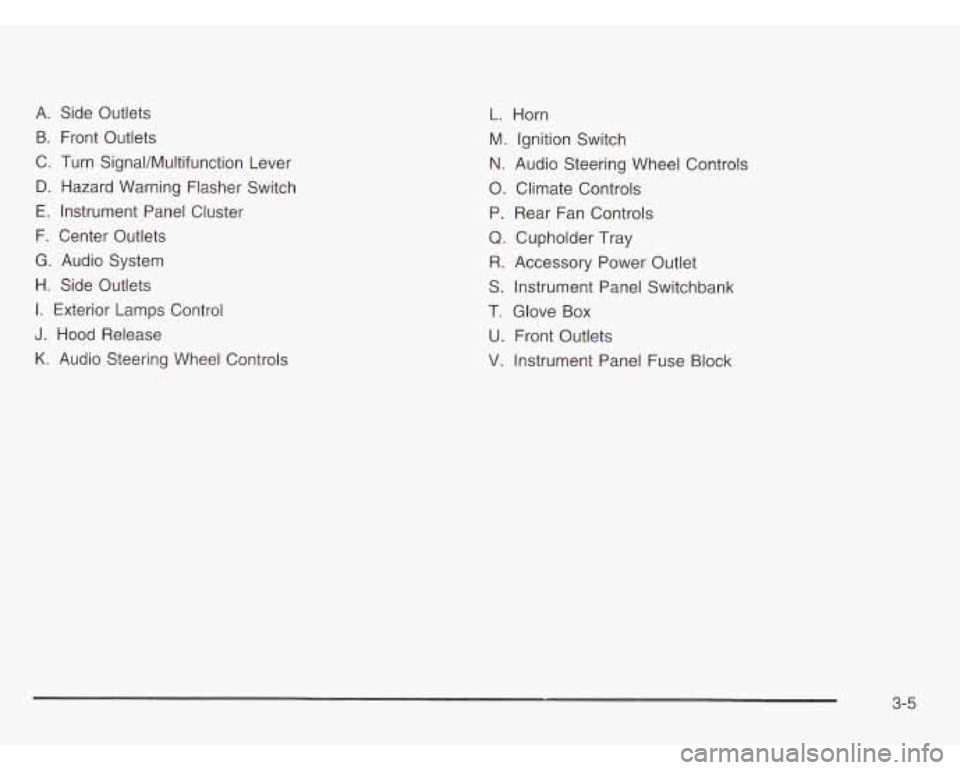
A. Side Outlets
B. Front Outlets
C. Turn SignaVMultifunction Lever
D. Hazard Warning Flasher Switch
E. Instrument Panel Cluster
F. Center Outlets
G. Audio System
H. Side Outlets
I. Exterior Lamps Control
J. Hood Release
K. Audio Steering Wheel Controls
L. Horn
M. Ignition Switch
N. Audio Steering Wheel Controls
0. Climate Controls
P. Rear Fan Controls
Q. Cupholder Tray
R. Accessory Power Outlet
S. Instrument Panel Switchbank
T. Glove Box
U. Front Outlets
V. Instrument Panel Fuse Block
3-5
Page 170 of 466
0 Move the cruise switch from ON to R/A. Hold it there
until you get up to the speed you want, and then
release the switch. (To increase your speed
in very
small amounts, move the switch to
R/A briefly and
then release it. Each time you do this, your vehicle
will go about 1 mph (1.6 km/h) faster.)
The accelerate feature will work whether or not you
have set an initial cruise control speed.
Reducing Speed While Using
Cruise Control
There are two ways to reduce speed while using
cruise control:
0 Press the SET button at the end of the lever until you
reach the lower speed you want, then release
it.
0 To slow down in very small amounts, press the
SET button briefly. Each time you do this, you’ll go
about 1 mph (1.6 km/h) slower.
Passing Another Vehicle While Using
Cruise Control
Use the accelerator pedal to increase your speed.
When you take your foot
off the pedal, your vehicle will
slow down to the cruise control speed you set earlier.
Using Cruise Control on Hills
How well your cruise control will work on hills depends
upon your speed, load and the steepness of the
hills. When going up steep hills, you may have to
step on the accelerator pedal to maintain your speed.
When going downhill, you may have to brake or shift
to a lower gear to keep your speed down. Of course,
applying the brake takes you out of cruise control.
Many drivers find this to be too much trouble and don’t
use cruise control on steep hills.
Ending Cruise Control
There are two ways to turn off the cruise control:
0 Step lightly on the brake pedal, or
- -. ,- LL- -.-. .:-- -... :L-L +- nrr IIIWVt 11 It bIUlDG DVVlLbl I LU VI I .
Erasing Speed Memory
When you turn off the cruise control or the ignition,
your cruise control set speed memory is erased.
3-1 3
Page 171 of 466
Exterior Lamps
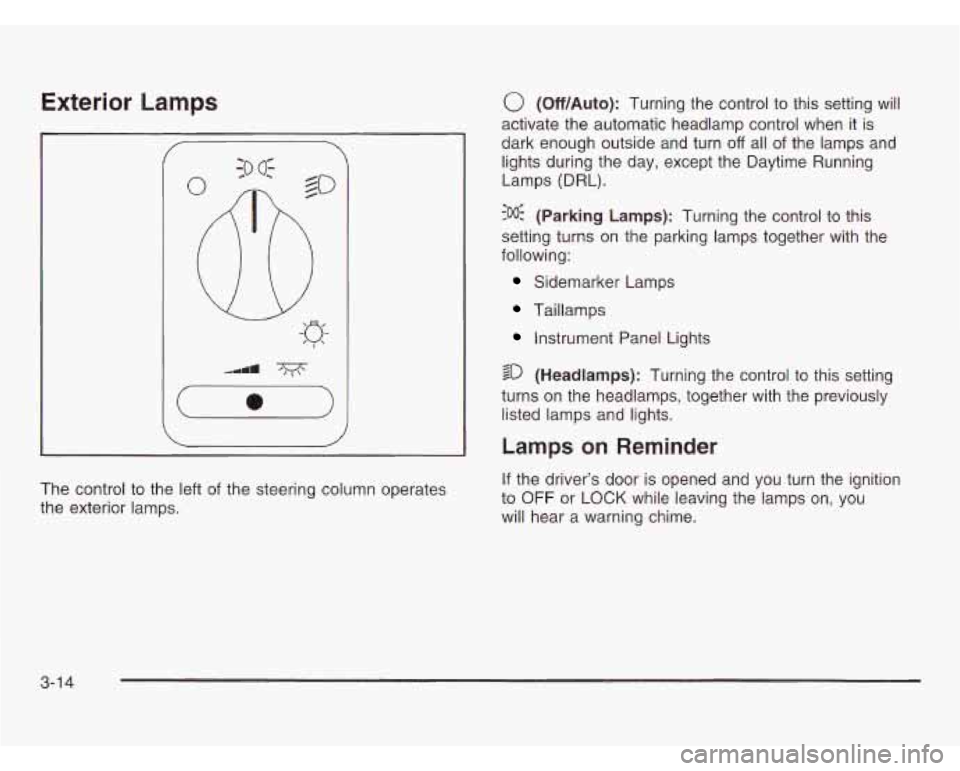
The control to the left of the steering column operates
the exterior lamps.
0 (Off/Auto): Turning the control to this setting will
activate the automatic headlamp control when it is
dark enough outside and turn
off all of the lamps and
lights during the day, except the Daytime Running
Lamps (DRL).
?% (Parking Lamps): Turning the control to this
setting turns on the parking lamps together with the
following:
Sidemarker Lamps
Taillamps
Instrument Panel Lights
sD (Headlamps): Turning the control to this setting
turns on the headlamps, together with the previously
listed lamps and lights.
Lamps on Reminder
If the driver’s door is opened and you turn the ignition
to
OFF or LOCK while leaving the lamps on, you
will hear a warning chime.
3-1 4
Page 172 of 466
Daytime Running Lamps/Automatic
Headlamp System
Daytime Running Lamps (DRL) can make it easier for
others to see the front of your vehicle during the
day. DRL can be helpful in many different driving
conditions, but they can be especially helpful
in the short
periods after dawn and before sunset. Fully functional
daytime running lamps are required on all vehicles
first sold in Canada.
A light sensor on top of the instrument panel makes
the
DRL work, so be sure it isn’t covered. The DRL
system will make your front parking and turn signal
lamps come on in daylight when:
The ignition is on,
the exterior lamps control is off, and
the parking brake is released.
When the DRL are on, only your front parking and turn
signal lamps will be on. Your instrument panel won’t
Le I:+ . .- ue 111 up.
When it’s dark enough outside, the exterior lamps will
come on automatically. When it’s bright enough outside,
the exterior lamps will turn
off and the DRL will turn
on. Of course, you may still turn on the headlamps any
time you need to.
If you start your vehicle in a dark garage, the automatic
headlamp system will come on immediately. Once
you leave the garage, it will take approximately
one minute for the automatic headlamp system to
change to DRL
if it is light outside. During that delay,
your instrument panel cluster may not be as bright
as usual. Make sure your instrument panel brightness
control is in the full bright position. See “Instrument
Panel Brightness Control’’ under
lnterior Lamps
on page
3-17.
To idle your vehicle with the DRL and automatic
headlamp control
off, set the parking brake while the
ignition is in OFF or LOCK. Then start the vehicle.
The DRL and automatic headlamp control will stay
off
until you release the parking brake.
As with any vehicle. you should turn on the reuular
headlamp system when you need
it.
3-1 5
Page 175 of 466
Entry Lighting
With entry lighting, the interior of your vehicle is
illuminated
so that you can see inside before you enter
your vehicle. The lamps will come on for
40 seconds
if you unlock your door using your key or the remote
keyless entry transmitter and the ignition is in LOCK or
OFF. After 40 seconds have passed, the interior lamps
will slowly fade out. The lamps will turn
off before
the
40 seconds if you:
Lock all the doors using the key,
press LOCK on the power door lock switch, or
press LOCK on the remote keyless entry
transmitter.
When any door is opened, entry lighting is cancelled.
The interior lamps will stay on while any door or liftgate
is open, and slowly fade out when all doors and the
liftgate are closed.
The interior lamps may stay on for up to
25 seconds
after all doors have been closed
if they have not been
locked. See “Delayed Lighting’’ following.
To turn the entry lighting feature
off or on, see Vehicle
Personalization on page
2-62.
Delayed Lighting
The delayed lighting feature will continue to illuminate
the interior for
25 seconds after all doors have been
closed
so that you can find your ignition and buckle your
safety belt at night. Delayed lighting will not occur
while the ignition is in RUN or ACCESSORY. After
25 seconds have passed, the interior lamps will slowly
fade out. The lamps
will fade out before the 25 seconds
have passed
if you:
Turn the ignition to RUN or ACCESSORY,
lock all doors using the remote keyless entry
transmitter, or
lock all the doors using the power door lock switch
or the key.
To turn the delayed lighting feature off or on, see
Vehicle Personalization on page 2-62.
3-1 8