crank OPEL 1900 1973 User Guide
[x] Cancel search | Manufacturer: OPEL, Model Year: 1973, Model line: 1900, Model: OPEL 1900 1973Pages: 625, PDF Size: 17.22 MB
Page 38 of 625

STARTING SYSTEMlB- 17
7. Seal area between solenoid and frame. See FigurelB-17.
8. With brushes and spring in housings held in place
with a 29 @llimeter socket, slide frame assembly in
position.
9. Install i+ulating sleeves in field frame.
10. Install knd frame and replace through bolts and
tighten bolts.
11. Install bolt holding field frame to solenoid.
SPEClFltjATlONS
Starter SpecificationsStarterNumber. . . .
.._.._..._...........................RatedVoltage
. . . . . . . . . . . . . . . . . . . . . . . . .No voad Test:
...............................................EF 12V0 .8 PS
.....................................................................12Volts
................................................................................................................................10.6Amperes
........................................................................................................................30-50RPM
......................................................................................................................7300-8500Cranking Amperes Test (InCar-Engine atOperating Temp.)
..................................175-205
Lock Test:
Volts
............................................................................................................................6 Min.
Amperes
....................................................................................................................280-320Volt$geRequiredtoCloseSolenoidContacts
....................................................................7.5MinimumDiameterof Commutatorin
Inches................................................................1.46Brush Spring Pressure in Ounces
....................................................................................40-46Minimum Length of Brushes in Inches...............................................................................2812. Check starter on bench before installing.
Starter Installation
1. Hold starter in position.
2. Install two bolts, one nut and lockwashers.
Tighten securely.
3. Install support bracket. To ensure a stress-freeintitallation, install bolt and two nuts only finger
tight. First tighten the bolt at the engine, then tighten
the two nuts at the starter end frame.
Page 41 of 625
I
ilC- 201973 OPEL SERVICE MANUAL
There is also a plastic hood slipped over the distrivu-tar cap with an outlet for the ignition cables as an
added protection against moisture from the outside.
See Figure lC-2.
Figure lC-2 Ignition Distributor With Hood Installed
MAINTENANCE AND ADJUSTMENTS
CONTACT POINT REPLACEMENT
Removing Contact Points1. Remove contact support lock
,screw and remqve
contact point support. If condenser is to be replaced,
it will be necessary to replace condenser and
1eads;asan assembly.
Installing Contact Points1. Lightly lubricate distributor cam with high tein-perature cam and ball bearing lubricant. Excessive
lubricant will throw off into contact points.
:
,
2. Position support on breaker plate and install lock
screw leaving slightly loose for later adjustment..
3. Plug breaker arm wire in.
4. Adjust breaker point gap to ,016”.
/
DWELL ANGLE ADJUSTMENT
1. Connect dwell meter.
2. Remove distributor cap. Remove rotor. Loosen
breaker point set screw approximately
l/8 turn.
3. Insert screwdriver in notch of stationary breaker
point. Observe dwell meter while cranking engine.
Twist screwdriver as required to obtain a reading of
50 degrees plus or minus 3 degrees.4. Tighten breaker point set screw, then recheck
dwell.
5. Install rotor and cap.~Start engine and recheck
dwell. It is important that dwell be rechecked, as
instal~lation of rotor and cap will sometimes change
the dwell angle.
IGNITION TIMING ADJUSTMENT
Preliminary Timing (Engine Won’t Run)To time the ignition on any engine which will run,
use subparagraph b only. However, if the timing of
an engine is completely off, the following procedure
must first be used to get the engine to run.
1. With rocker arm cover removed, rotate crankshaft
in a clockwise direction until both valves for No. 1
cylinder are closed and the timing marks line-up.
(Valves are completely closed if rocker arms can be
“rocked” slightly.)
2. Install distributor in engine so that vacuum ad-
vance unit is in original position and notch in dis-
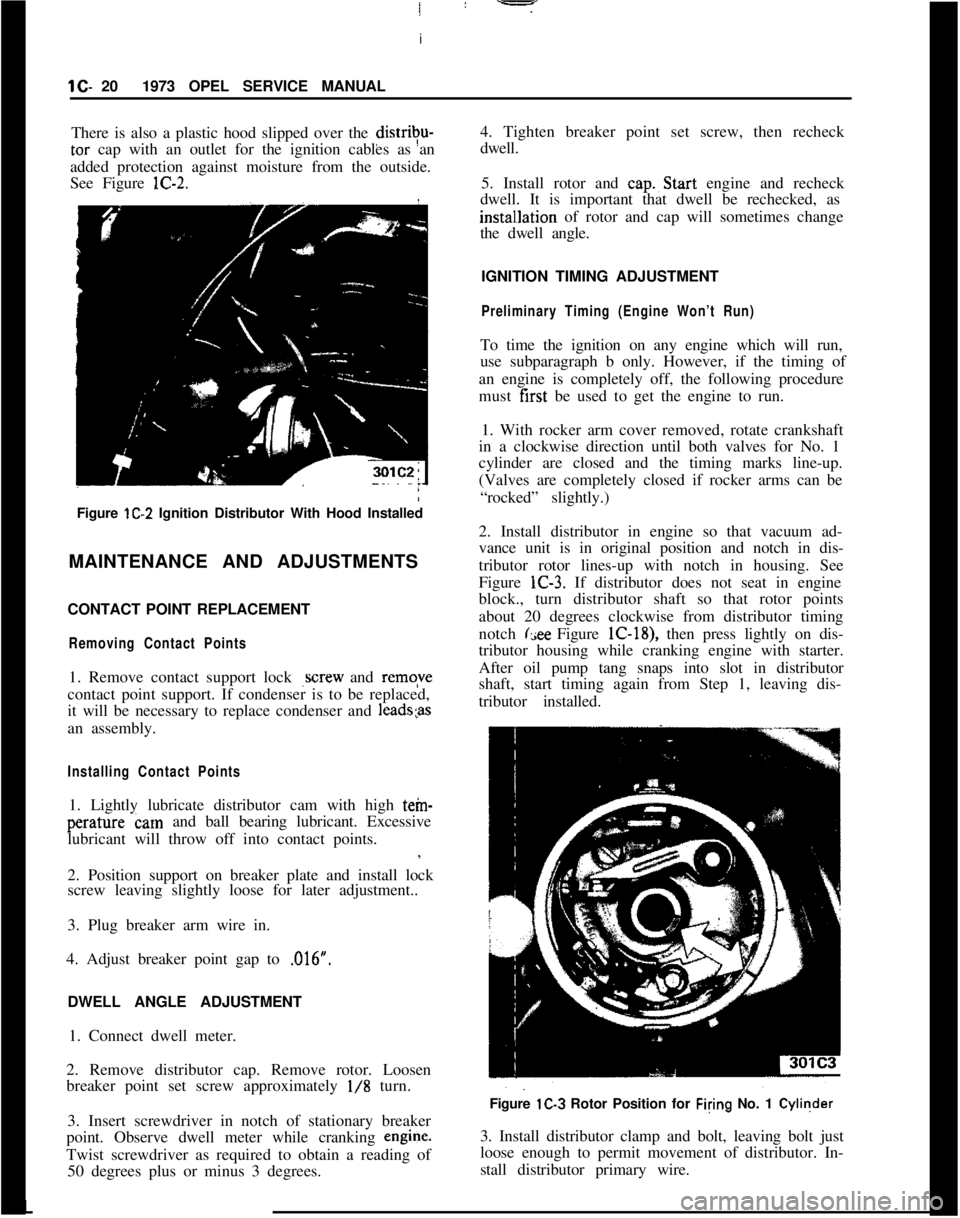
tributor rotor lines-up with notch in housing. See
Figure lC-3. If distributor does not seat in engine
block., turn distributor shaft so that rotor points
about 20 degrees clockwise from distributor timing
notch
(see Figure lC-18), then press lightly on dis-
tributor housing while cranking engine with starter.
After oil pump tang snaps into slot in distributor
shaft, start timing again from Step 1, leaving dis-
tributor installed.
Figure lC-3 Rotor Position for Filing No. 1 Cyliqder
3. Install distributor clamp and bolt, leaving bolt just
loose enough to permit movement of distributor. In-
stall distributor primary wire.L
Page 42 of 625
IGNITION SYSTEMlC-214. Rota&distributor counterclockwise slightly until
contact pbints just start to open. This must be done
very carefully or engine will not start.
5. Install distributor cap. Make sure spark plug wires
are correctly installed in distributor cap, through clip
and on spark plugs.
Finish TimingIContact boint gap
(.016” at widest gap) or dwell 50
degrees plus or minus 3 degrees should always be
checked before adjusting ignition timing.
1. Connekt timing light to No. 1 spark plug.
2. Disconnect and plug vacuum advance unit and
retard u$it hoses.
3. Connect a tachometer from distributor side of coil
to
groun$l.4. Start dngine. Set idle speed to 900 RPM.
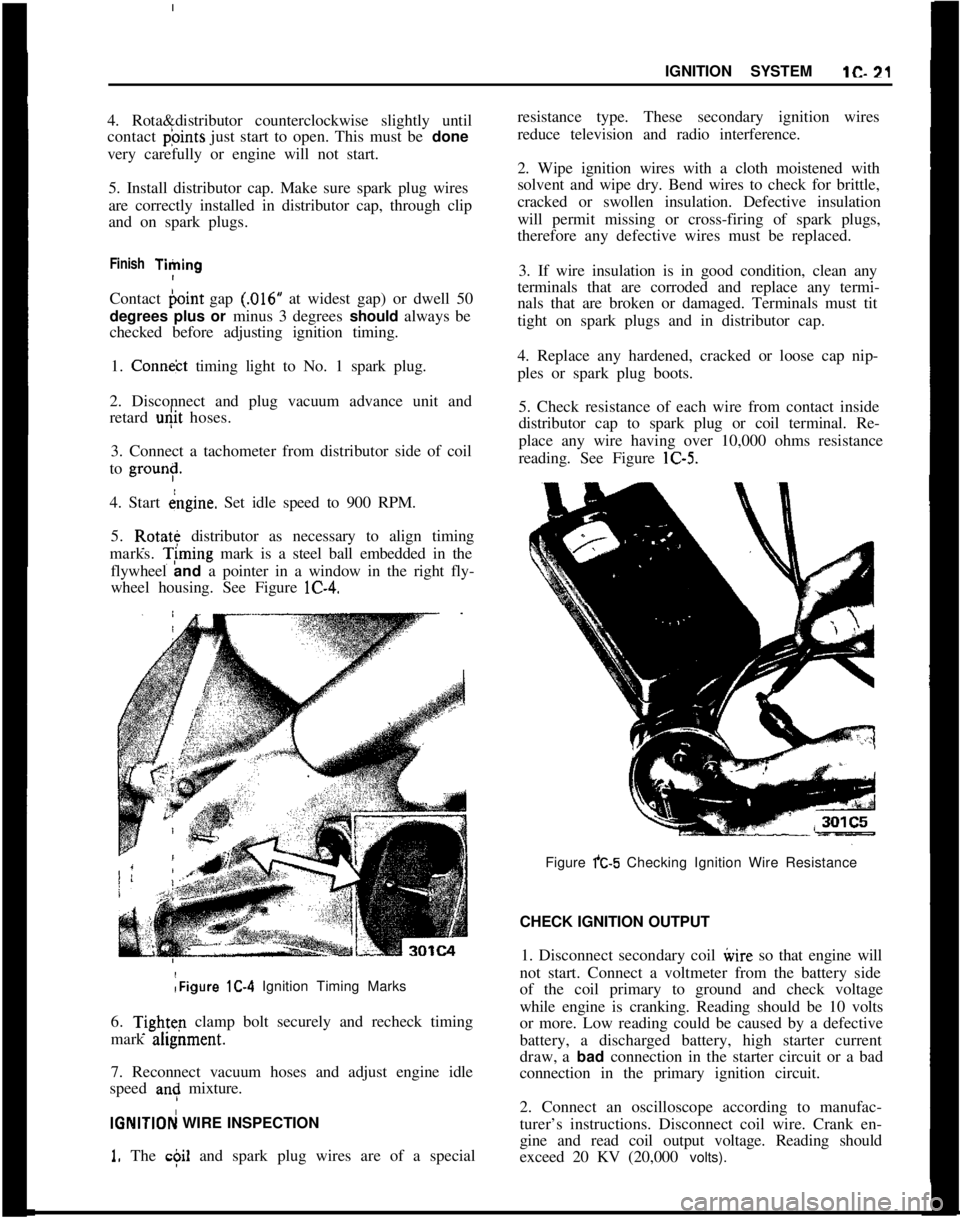
5. Rotate distributor as necessary to align timing
marks. T;ming mark is a steel ball embedded in the
flywheel and a pointer in a window in the right fly-
wheel housing. See Figure lC-4.:Figure lC-4 Ignition Timing Marks
6.
Tightq clamp bolt securely and recheck timing
mark ahgnment.
7. Reconnect vacuum hoses and adjust engine idle
speed
an: mixture.
IGNlTlOFj WIRE INSPECTION
1. The c$il and spark plug wires are of a specialresistance type. These secondary ignition wires
reduce television and radio interference.
2. Wipe ignition wires with a cloth moistened with
solvent and wipe dry. Bend wires to check for brittle,
cracked or swollen insulation. Defective insulation
will permit missing or cross-firing of spark plugs,
therefore any defective wires must be replaced.
3. If wire insulation is in good condition, clean any
terminals that are corroded and replace any termi-
nals that are broken or damaged. Terminals must tit
tight on spark plugs and in distributor cap.
4. Replace any hardened, cracked or loose cap nip-
ples or spark plug boots.
5. Check resistance of each wire from contact inside
distributor cap to spark plug or coil terminal. Re-
place any wire having over 10,000 ohms resistance
reading. See Figure lC-5.
Figure fC-5 Checking Ignition Wire Resistance
CHECK IGNITION OUTPUT
1. Disconnect secondary coil ivire so that engine will
not start. Connect a voltmeter from the battery side
of the coil primary to ground and check voltage
while engine is cranking. Reading should be 10 volts
or more. Low reading could be caused by a defective
battery, a discharged battery, high starter current
draw, a bad connection in the starter circuit or a bad
connection in the primary ignition circuit.
2. Connect an oscilloscope according to manufac-
turer’s instructions. Disconnect coil wire. Crank en-
gine and read coil output voltage. Reading should
exceed 20 KV (20,000 volts).
Page 44 of 625
IGNITION SYSTEMlC- 23
9. Install:spark plugs using a 13/16 deep socket, an
extension and a torque wrench. Tighten to 22-29Ib.ft. 1
MAJOR REPAIRDlSTRlBtiTOR OVERHAULDistributbr Removal
1. Remove fuel pump. This is necessary because the
fuel
punp will block the distributor drive gear,
thereby preventing removal of the distributor. See
Figure lC-6.
2. Set No; 1 cylinder at firing point by turning engine
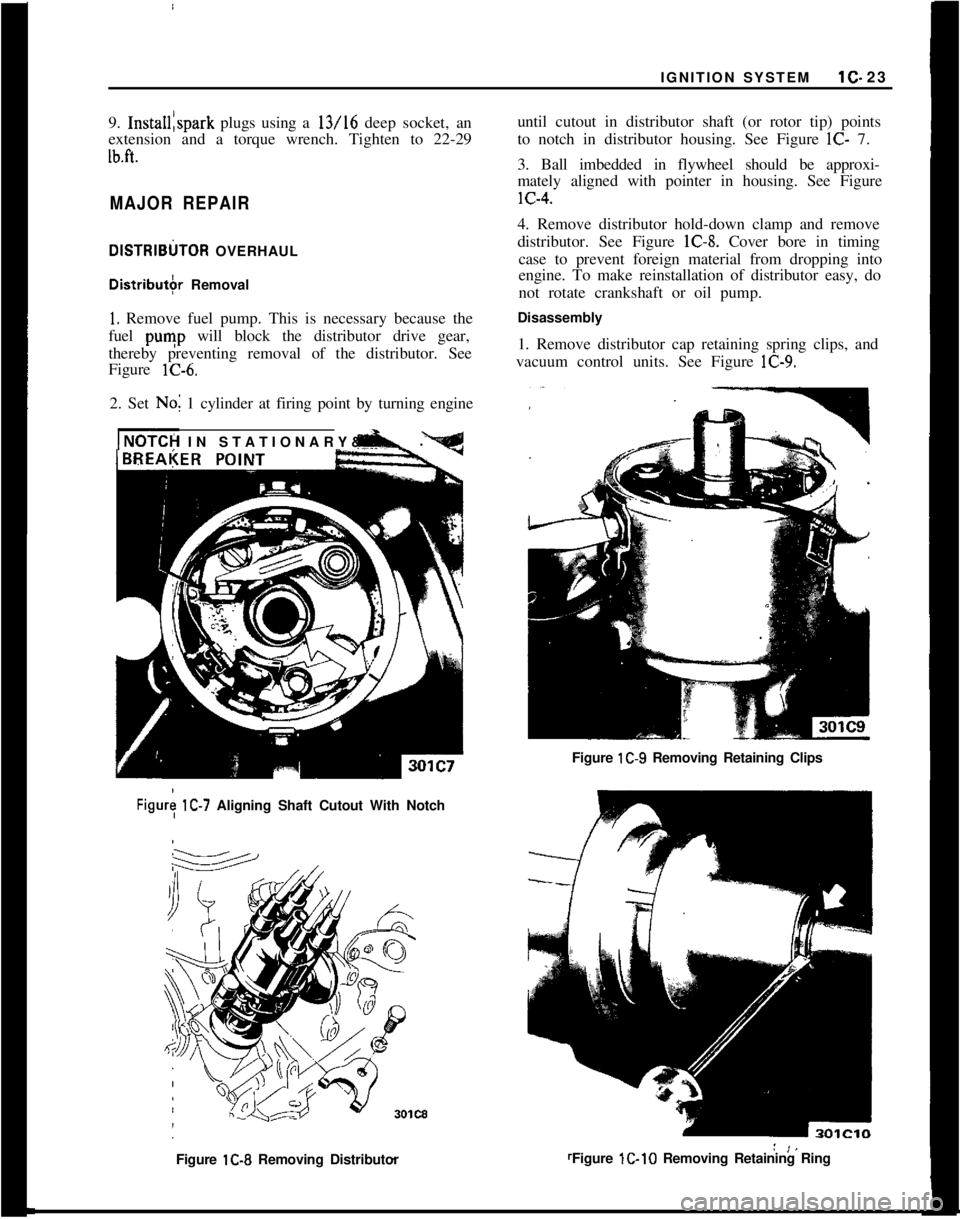
INOTCH IN STATIONARY& -.until cutout in distributor shaft (or rotor tip) points
to notch in distributor housing. See Figure
lC- 7.
3. Ball imbedded in flywheel should be approxi-
mately aligned with pointer in housing. See FigurelC-4.
4. Remove distributor hold-down clamp and remove
distributor. See Figure lC-8. Cover bore in timing
case to prevent foreign material from dropping into
engine. To make reinstallation of distributor easy, do
not rotate crankshaft or oil pump.
Disassembly
1. Remove distributor cap retaining spring clips, and
vacuum control units. See Figure lC-9.
Figure lC-9 Removing Retaining Clips
Figury lC-7 Aligning Shaft Cutout With Notch
Figure lC-8 Removing DistributorFigure lC-10 Removing Retaining Ring
Page 58 of 625

WINDSHIELD WIPERSlE- 37WINDSHEILD WIPERS
ALL MODELS
CONTENTS
Subject
DESCRIPTION AND OPERATION:
Windshield Wiper Motor. . . . . . . . . . . . . . . . . . . . . . . . . . . . . . . . . . . . . . . . . . . . . . .DIAGNOSIS:
Windshield Wiper
. . . . . . . . . . . . . . . . . . . , , . . . . . . . . . . . . . . . . . . . . . . . . . . . . . . . . . . . . . . . . .MAINTENANCE AND ADJUSTMENTS: (Not
Applicable)
MAJOR REPAIR:Wiper Transmission
- 1900 and Manta. . . . . . . . . . . . . . . . . . . .W/per Transmission
- GT. . . . . a.* . . . . . . . . . . . . . . . . . . . . . . . . . . . . . . . . . . . . . . . .Disassembly of Wiper Motor
. . . . . . . . . . . . . . . . . . . . . . . . . . . . . . . . . . . . . . . .Cleaning and Inspection of Parts
. . . . . . . . . . . . . . . . . . . . . . . . . . . . . . .Assembly of Wiper Motor
. . . . . . . . . . . . . . . . . . . . . . . . . . . . . . . . . . . . . . . . . . . . . .Installation
. . . . . . . . . . . . . . . . . . . . . . . . . . . . . . . . . . . . . . . . . . . . . . . . . . . . . . . . . . . . . . . . . . . . . . . . . . . .SPECIFICATIONS:
GeneralSpecifications
. . . . . . . . . . . . . . . . . . . . . . . . . . . . . . . . . . . . . . . . . . . . . . . . . . . . . .Torque Specifications
. . . . . . . a.. . . . . . . . . . . . . . . . . . . . . . . . . . . . . . . . . . . . . . . . . . . . .
DESCRIPTIOfV AND OPERATION
GENERAL;DESCRlPTlDNThe two-sbeed wiper consists of a round shaped per-
manent magnet type motor and speed reduction gear
box. IOPERATldN
=The wipei motor is controlled through a dash
mounted &itch on all cars. The Rallye and GT, in
addition tb the dash mounted switch, also have a
switch moimted in conjunction with the windshield
washer fodt pump. Depressing the washer pump will
allow the bipers to operate while the pump is de-
pressed. i
DIAGNO;SIS
PRELIMINj9RY INSPECTION
1. Make
c&in of firm wire connections at wiper
motor fuse block and wiper switch.
Page No.
1 E-37
1 E-37E-38
E-38
E-40
E-41
E-4 1E-42
1 E-43
1 E-432. Check to see that the fuse is not blown.
3. Be sure wiper motor is not loose on fire wall.
4. With the yellow wire disconnected from terminal
No. 53 on the
wi@er motor, turn the ignition switch
and wiper switch to the on position and check volt-
age available to the wiper motor. There should be 12
volts available at the durple wire with a properly
charged battery.
Checking Wiper Operation1. Turn ignition switch on and engage wiper switch
to see if wiper motor will operate.
2. If wiper action is slow or inoperative, turn swit-
ches off and detach wiper control
inn from crank
arm.3. Operate wiper manually checking for excessive
bind in linkage. Correct if necessary.
Page 59 of 625

1 E- 381973 OPEL SERVICE MANUAL
4. Turn switch on to see if wiper niotor will function
with wiper linkage’detached. If wiper motor will ndt
run, disconnect connector at wiper motor and co?-
nect hot lead from battery to terminal No. 53 onwiper motor. If wiper motor runs, the wiper switch
is faulty or there is an break in the lead wire. If wiper
motor still will not run, remove and bench test.
MAJOR REPAIRWIPER TRANSMISSIONS
Removal (1900 and Manta)1. Remove wiper blade (2).
2. Remove the wiper transmission retaining nut,
washer, and rubber seal ring. See .Figure lE-1.
Figure lE-1 Crank Arm Retaining Nut3. Remove instrument cluster housing.
If only left wiper transmission is to be serviced, it can
be done without removing any ‘other instrument
panel components. If the right side, or both, trans-
missions are to be serviced, then
it will be necessary
for complete instrument panel removal. On the Ral-
lye models, the gauge carrier must also be remove&Qn all
1900 and Manta Models the defroster ducts
are secured to the instrument panel cover, by two (‘2)
spring clips, and should not be removed from
dayhcover. Remove cover and duct as, a unit.
4. Remove retaining clips from transmission co;-netting rod pins. Pull connecting rods off pins. See
Item “A”, Figure lE-2.
5. Remove the screws securing the wiper transmis-
sion to the inner side of the cowl (Items “B”, Figuie
13), and remove the transmission assemblies.I
Figure lE-2 Connecting Rod Retaining Clips
Installation1. Place wiper transmissions into position at cowl
and install holding screws.
2. Push connecting rods onto transmission cranking
arm pins and install retaining clips. See Figure lE-2,
Item “A”.
3. Reinstall dash and instrument cluster parts.
4.
1nst:all the rubber seal ring, washer, and transmis-
sion retaining nut. See Figure IE-1.
5. Install wiper blades and check the position of the
blades in the park position. See Figure lE-3.
Figure lE-3 Wiper Blades in Park Position
Removal and Installation of GT W/per Transmission1. Remove nuts and remove both wiper
arms. See
Figure lE-4.
2. Remove three (3) bolts from each windshield
Page 60 of 625
WINDSHIELD WIPERSlE- 39
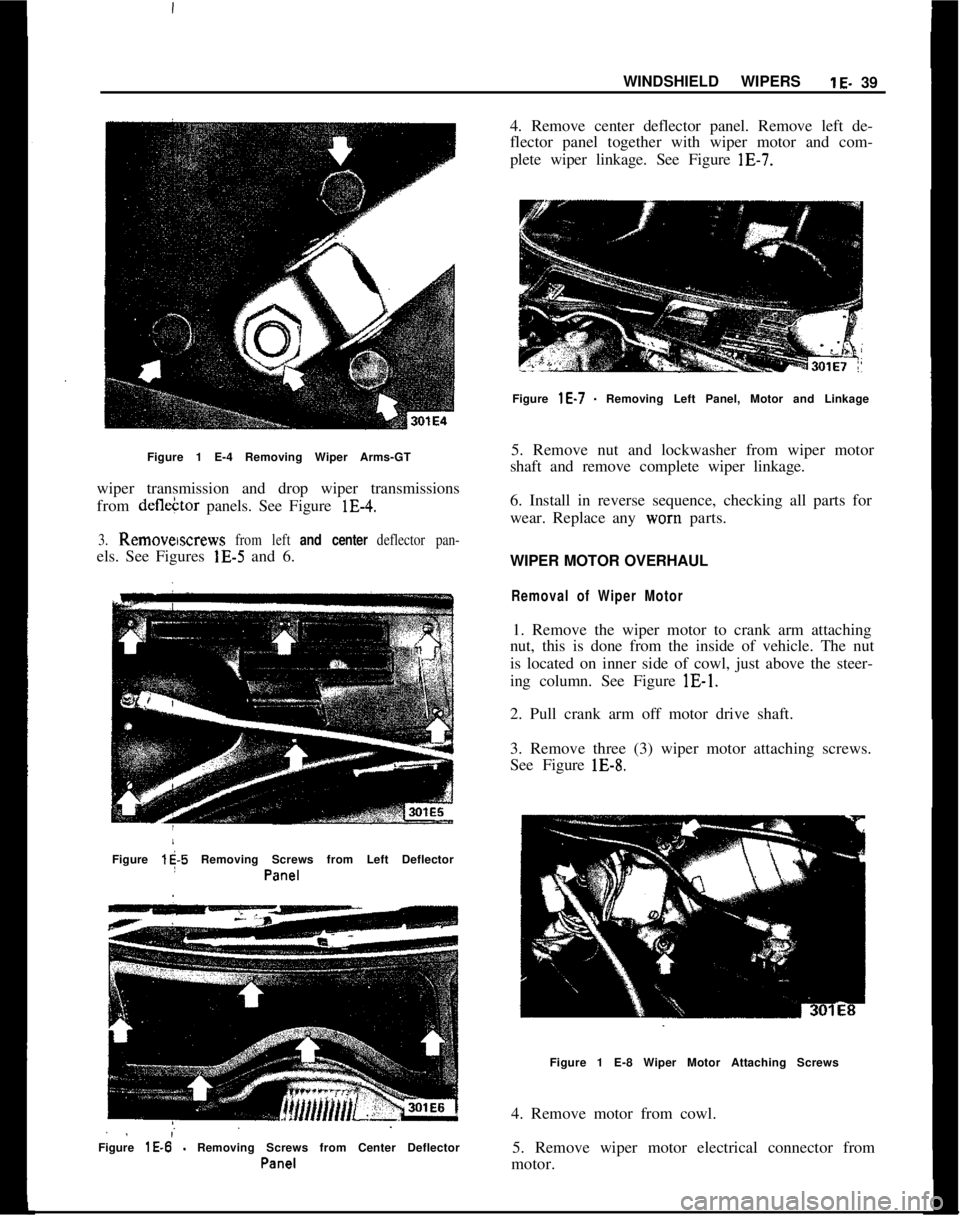
Figure 1 E-4 Removing Wiper Arms-GT
wiper transmission and drop wiper transmissions
from defleCtor panels. See Figure lE-4.3. Remowscrews from left and center deflector pan-els. See Figures lE-5 and 6.
Figure
l$-5 Removing Screws from Left Deflector
I
Pa%?1
. .;Figure
lE-6 - Removing Screws from Center Deflector
Pall-Z!14. Remove center deflector panel. Remove left de-
flector panel together with wiper motor and com-
plete wiper linkage. See Figure lE-7.
Figure
lE-7 - Removing Left Panel, Motor and Linkage
5. Remove nut and lockwasher from wiper motor
shaft and remove complete wiper linkage.
6. Install in reverse sequence, checking all parts for
wear. Replace any worn parts.
WIPER MOTOR OVERHAUL
Removal of Wiper Motor1. Remove the wiper motor to crank arm attaching
nut, this is done from the inside of vehicle. The nut
is located on inner side of cowl, just above the steer-
ing column. See Figure lE-1.
2. Pull crank arm off motor drive shaft.
3. Remove three (3) wiper motor attaching screws.
See Figure lE-8.
Figure 1 E-8 Wiper Motor Attaching Screws
4. Remove motor from cowl.
5. Remove wiper motor electrical connector from
motor.
Page 63 of 625
1 E- 421973 OPEL SERVICE MANUAL
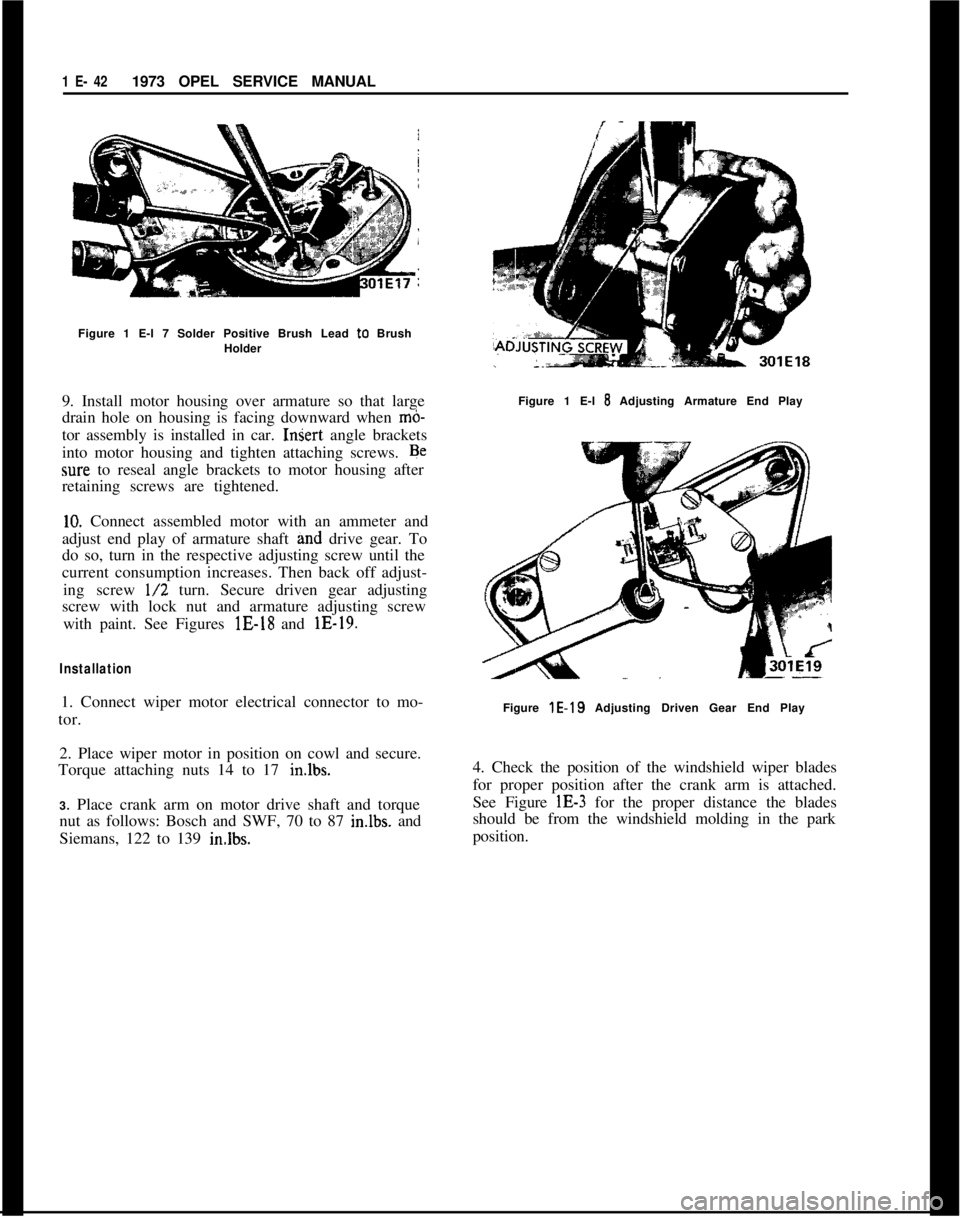
Figure 1 E-l 7 Solder Positive Brush Lead to Brush
Holder
9. Install motor housing over armature so that large
drain hole on housing is facing downward when
mb-tor assembly is installed in car.
InSert angle brackets
into motor housing and tighten attaching screws. Be
sure to reseal angle brackets to motor housing after
retaining screws are tightened.
10. Connect assembled motor with an ammeter and
adjust end play of armature shaft grid drive gear. To
do so, turn in the respective adjusting screw until the
current consumption increases. Then back off adjust-
ing screw
l/2 turn. Secure driven gear adjusting
screw with lock nut and armature adjusting screw
with paint. See Figures lE-18 and lE-19.
Installation1. Connect wiper motor electrical connector to mo-
tor.
2. Place wiper motor in position on cowl and secure.
Torque attaching nuts 14 to 17 in.lbs.
3. Place crank arm on motor drive shaft and torque
nut as follows: Bosch and SWF, 70 to 87 imlbs. and
Siemans, 122 to 139 in.lbs.Figure 1 E-l
8 Adjusting Armature End Play
Figure
lE-19 Adjusting Driven Gear End Play
4. Check the position of the windshield wiper blades
for proper position after the crank arm is attached.
See Figure lE-3 for the proper distance the blades
should be from the windshield molding in the park
position.
Page 64 of 625

WINDSHIELD WIPERSlE-43SPEhFlCATlONS
IGENEPAL SPECIFICATIONSiRated Voltage .
..__.,,,.,,,......................................,.,,... ~ __..__...__...._..................................... 12 VDC
,Test Voltage ___..................................................,...................,..,..................................... 13 VDC
Current Draw (Amps)
;No Load_, Low Speed
..__...__..__..,_,,..,,,.,,,,..,....................,,.................................................................. 1.5
I Hieh
SDeed .___,,...,,..,,._.._..............,...............................,,,..,,,.............................................. 2.2lLock:d
’
:Low Speed ___.,._,,,..,,,....................................,,.........,,..,,,.,,,,..................,,,........................... 16
,
High Speed . . . . . . . ..___.._........................................................................................................... 17
~Minimum Commutator Diameter __.................,,,,........................................................... .86 in.
‘Brush Spring Pressure
:New Brush
. . . . . . .._...__...................................................................................... 6.35 to 8.47 oz.Used Brush
..__,,,...,,.,,..................,...............................,,.,,,,.,,....................... 3.5 oz. minimum‘MinimumBrushLength
. . . . . . . . . . . . . . . . . . . . . . . . . . . . . . . . . . . . . . . . . . . . . . . . . . . . . . . . . . . . . . . . . . . . . . . . . . . . . . . . . . . . . . . . . . . . . . . . . .24in.The windshield wiper motor instead of field coils has a permanent magnet
(oxide magnet). This motor design is sturdier and consumes less current.TORQirE SPECIFICATIONS
‘CrankArmtoMotorDriveShaft. . . . . . . . . . . . . . . . . . . . . . . . . .70to87in.lbs.iper Motor to Cowl
,
,.,,,.,,,,..,,............,..,,.,,.........................................14 to 17 in.lbs.
Page 147 of 625
2F-241973 OPEL SERVICE MANUAL
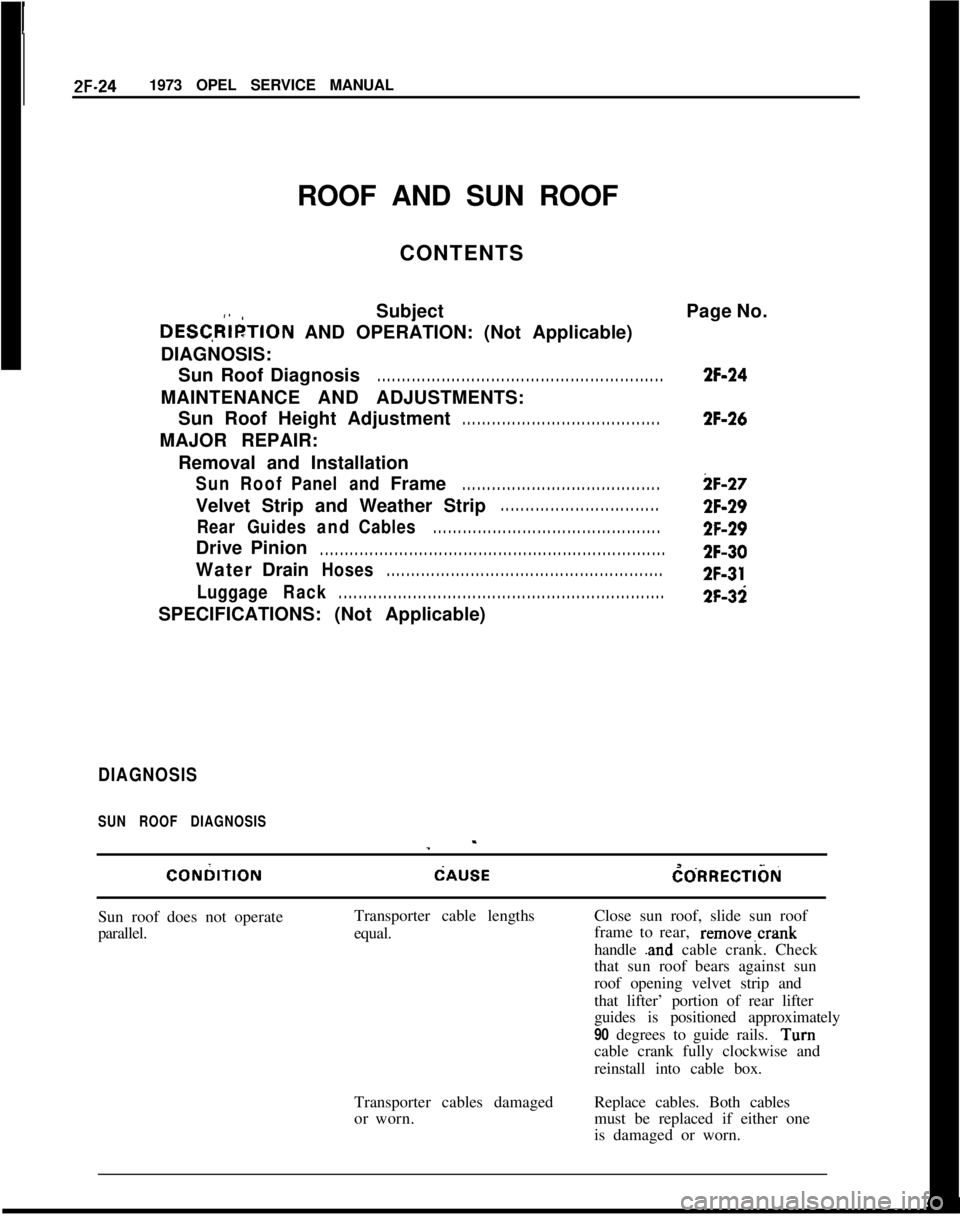
ROOF AND SUN ROOF
CONTENTS
,.,Subject
DESC,RIF?TION AND OPERATION: (Not Applicable)
DIAGNOSIS: Sun Roof Diagnosis
. . . . . . . . . . . . . . . . . . . . . . . . . . . . . . . . . . . . \
. . . . . . . . . . . . . . . . . . . . . .
MAINTENANCE AND ADJUSTMENTS:Sun Roof Height Adjustment
. . . . . . . . . . . . . . . . . . . . . . . . . . . . . . . . . . . . \
. . . .
MAJOR REPAIR:
Removal and Installation
Sun Roof Panel andFrame. . . . . . . . . . . . . . . . . . . . . . . . . . . . . . . . . . . . \
. . . .
Velvet Strip and Weather Strip. . . . . . . . . . . . . . . . . . . . . . . . . . . . . . . .
RearGuides andCables. . . . . . . . . . . . . . . . . . . . . . . . . . . . . . . . . . . . \
. . . . . . . . . .
Drive Pinion. . . . . . . . . . . . . . . . . . . . . . . . . . . . . . . . . . . . \
. . . . . . . . . . . . . . . . . . . . . . . . . . . . . . . . . .
Water DrainHoses. . . . . . . . . . . . . . . . . . . . . . . . . . . . . . . . . . . . \
. . . . . . . . . . . . . . . . . . . .
Luggage Rack. . . . . . . . . . . . . . . . . . . . . . . . . . . . . . . . . . . . \
. . . . . . . . . . . . . . . . . . . . . . . . . . . . . .
SPECIFICATIONS: (Not Applicable) Page No.
2F-24
2F-26
iF-27
2F-29
2F-29
2F-30
2F-31
2F-3i
DIAGNOSIS
SUN ROOF DIAGNOSIS
_ -
CONhTlONPAUSEI~C~RRECTI~X~
Sun roof does not operate
Transporter cable lengths
parallel. equal.Close sun roof, slide sun roof
frame to rear, remove.crank
handle
and cable crank. Check
that sun roof bears against sun
roof opening velvet strip and
that lifter’ portion of rear lifter
guides is positioned approximately
90 degrees to guide rails.
Turn
cable crank fully clockwise and
reinstall into cable box.
Transporter cables damaged
or worn. Replace cables. Both cables
must be replaced if either one
is damaged or worn.