crank OPEL 1900 1973 Owner's Manual
[x] Cancel search | Manufacturer: OPEL, Model Year: 1973, Model line: 1900, Model: OPEL 1900 1973Pages: 625, PDF Size: 17.22 MB
Page 150 of 625
ROOF AND SUN ROOF2F-27
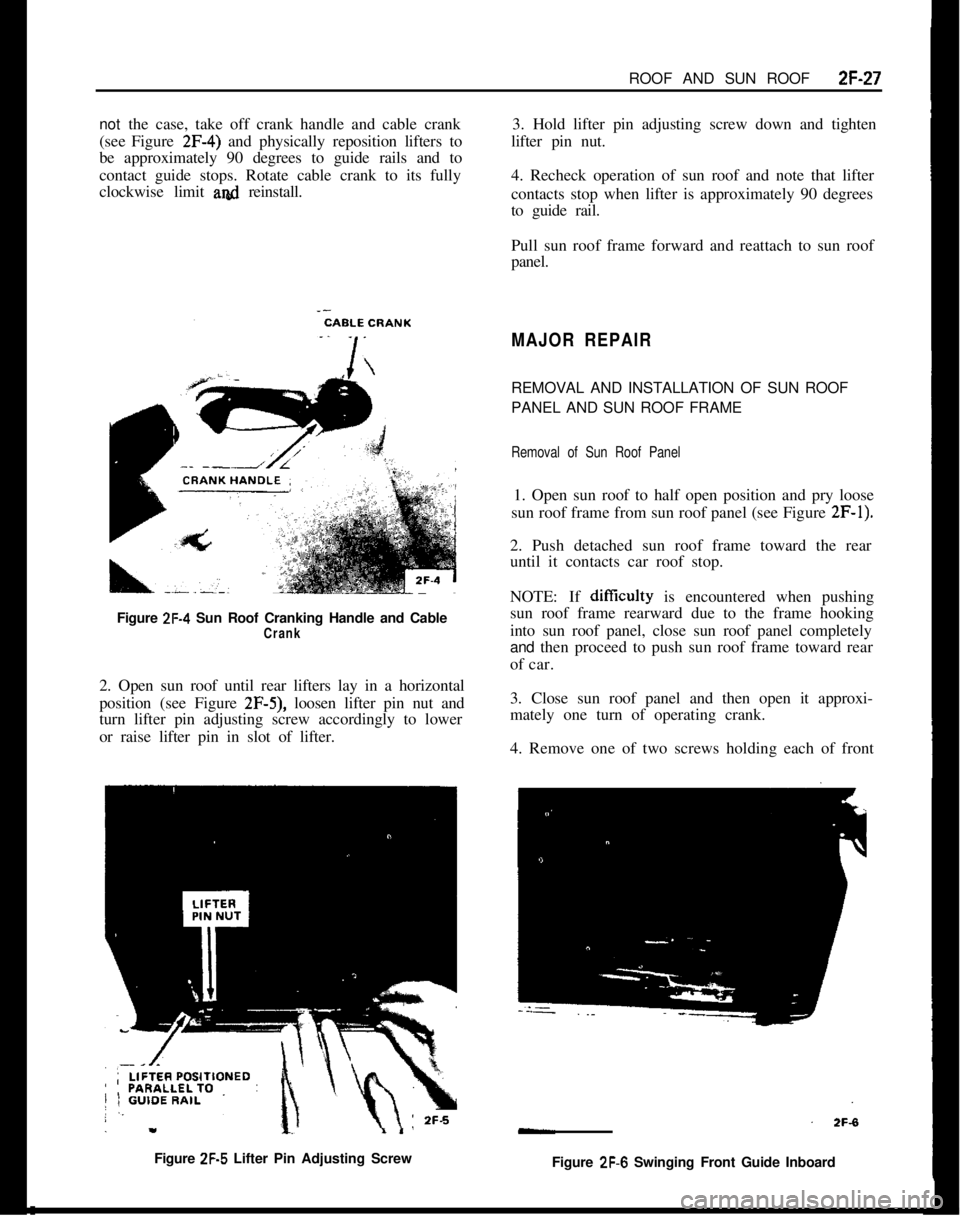
not the case, take off crank handle and cable crank
(see Figure 2F-4) and physically reposition lifters to
be approximately 90 degrees to guide rails and to
contact guide stops. Rotate cable crank to its fully
clockwise limit alad reinstall.
Figure 2F-4 Sun Roof Cranking Handle and CableCrank2. Open sun roof until rear lifters lay in a horizontal
position (see Figure
2F-5), loosen lifter pin nut and
turn lifter pin adjusting screw accordingly to lower
or raise lifter pin in slot of lifter.3. Hold lifter pin adjusting screw down and tighten
lifter pin nut.
4. Recheck operation of sun roof and note that lifter
contacts stop when lifter is approximately 90 degrees
to guide rail.
Pull sun roof frame forward and reattach to sun roof
panel.
MAJOR REPAIRREMOVAL AND INSTALLATION OF SUN ROOF
PANEL AND SUN ROOF FRAME
Removal of Sun Roof Panel1. Open sun roof to half open position and pry loose
sun roof frame from sun roof panel (see Figure
2F-1).2. Push detached sun roof frame toward the rear
until it contacts car roof stop.
NOTE: If difficulty is encountered when pushing
sun roof frame rearward due to the frame hooking
into sun roof panel, close sun roof panel completely
and then proceed to push sun roof frame toward rear
of car.
3. Close sun roof panel and then open it approxi-
mately one turn of operating crank.
4. Remove one of two screws holding each of front
Figure
2F-5 Lifter Pin Adjusting Screw
Figure ZF-6 Swinging Front Guide Inboard
Page 151 of 625
2F-281973 OPEL SERVICE MANUAL
guides to height adjustment rings, loosen second
screw (see Figure 2F-6), and swing guides away from
guide rail.
NOTE: When swinging front guides inboard, be
careful not to change position of height adjustment
rings. It is suggested that the position of the height
adjustment rings be marked with a pencil prior to
loosening of front guide attaching screws.
5. Retighten remaining screw holding front guide in
position to prevent height adjustment rings from
turning.
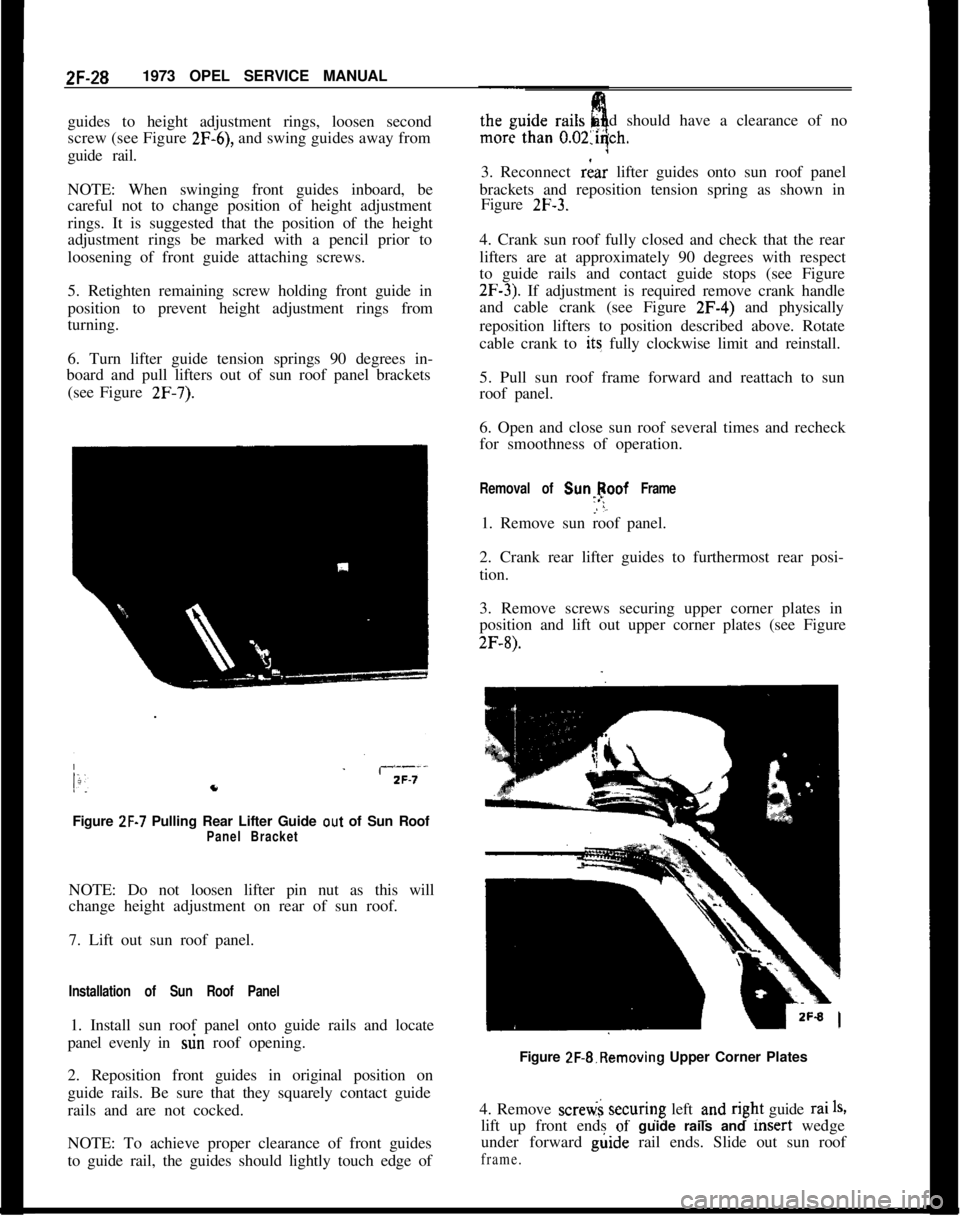
6. Turn lifter guide tension springs 90 degrees in-
board and pull lifters out of sun roof panel brackets
(see Figure
2F-7).Figure
ZF-7 Pulling Rear Lifter Guide out of Sun RoofPanel BracketNOTE: Do not loosen lifter pin nut as this will
change height adjustment on rear of sun roof.
7. Lift out sun roof panel.
Installation of Sun Roof Panel1. Install sun roof panel onto guide rails and locate
panel evenly in stin roof opening.
2. Reposition front guides in original position on
guide rails. Be sure that they squarely contact guide
rails and are not cocked.
NOTE: To achieve proper clearance of front guides
to guide rail, the guides should lightly touch edge ofdshould have a clearance of no
3. Reconnect
riar lifter guides onto sun roof panel
brackets and reposition tension spring as shown in
Figure
2F-3.4. Crank sun roof fully closed and check that the rear
lifters are at approximately 90 degrees with respect
to guide rails and contact guide stops (see Figure
2F-3). If adjustment is required remove crank handle
and cable crank (see Figure 2F-4) and physically
reposition lifters to position described above. Rotate
cable crank to its fully clockwise limit and reinstall.
5. Pull sun roof frame forward and reattach to sun
roof panel.
6. Open and close sun roof several times and recheck
for smoothness of operation.
Removal of Sunlpoof Frame1. Remove sun roof panel.
2. Crank rear lifter guides to furthermost rear posi-
tion.
3. Remove screws securing upper corner plates in
position and lift out upper corner plates (see Figure
2F-8).Figure 2F-&Removing Upper Corner Plates
4. Remove scretii securing left und
r@t guide rai1%lift up front ends
of- guide rails and msert wedge
under forward g&de rail ends. Slide out sun roof
frame.
Page 152 of 625

ROOF AND SUN ROOF2F-29Installation of Sun Roof Frame1. Slide sun roof frame into lower slot of guide rails,
position fully rearward and reattach guide rails to
roof.NOTE: Be sure guide rail retainers at rear of guide
rails are positioned with their dowels in bores of roof
frame.2. Install upper corner plates and secure in place..
3. Install sun roof panel.
REMOVAL AND INSTALLATION OF VELVET STRIP
ON SUN ROOF OPENING, AND VELVET STRIP AND
WEATHERSTRIP ON REAR OF SUN ROOF PANEL
Removal of Velvet Strip on Sun Roof Opening1. Fully open sun roof.
;2. Carefully pull off velvet strip using solvent to dis-
solve cement. Clean area thoroughly before installing
new velvet strip.
Installation of Velvet Strip On Sun Roof Opening1. Cut away for a distance of 1.5 inch the velvet
material on velvet strip that will be on the outside
when strip is cemented in positioAlso cut off to
this dimension the plastic cord i
not cut away velvet material on
1strip which is to be cemented
2. Using
nitrile vinyl trim adhesive (3M Vinyl Trim
Adhesive, Permalastic Viny1 Trim Adhesive or
equivalent) apply sparingly to both sun roof opening
and side of velvet strip to be cemented.
3. Immediately install new velvet strip and position
so that upper edge of velvet strip is flush with car
roof.4. Clean off excess cement being careful not to con-
tact velvet strip.
Removal of Velvet Strip and Wea’therstrip on Rear
of Sun Roof Panel1. Remove sun roof panel.
2. Carefully detach weatherstrip and velvet strip
from sun roof panel using solvent as required todisdolve cement. Thoroughly clean area before in-
stalling new velvet strip and weatherstrip.
Installing Velvet Strip and Weatherstrip On Rear
of Sun Roof Panel1. Using
nitrile vinyl trim adhesive (3M Vinyl Trim
Adhesive Permalastic Viny1 Trim Adhesive or
equivalent) apply sparingly to vertical and horizontal
contact areas at rear of sun roof panel (see Figure
2F-9) and also to side of velvet strip which will touch sun
roof panel.
REAR OF SUN ROOF PANEL
ICAR ROOF
VELVET STRIP
II
,/ WETRSTRIP 1APPLY CEMENT TO HORIZONTAL AND
VERTICAL SURFACES,TO BOTH SIDES
OF VELVET STRIP AND TO SIDE AND
BOTTOM OF WEATHERSTRIP2F-9
Figure
ZF-9 Installing Velvet Strip and Weatherstrip
on Rear of Sun Roof Panel
2. Immediately install new velvet strip and position
so that top edge of velvet strip is flush with sun roof
panel.
3. Apply cement to outboard edge of velvet strip and
to top and bottom contact surfaces of weatherstrip,
and install weatherstrip in position.
4. Clean off excess cement being careful not to con-
tact velvet strip.
5. Install sun roof panel.
REMOVAL AND INSTALLATION OF REAR GUIDES
AND CABLE
Removal of Rear Guides and Cable
1. Remove sun roof panel.
2. Crank rear lifter guides fully rearward and then
remove crank handle and cable crank.
Page 153 of 625
2F-301973 OPEL SERVICE MANUAL
3. Unscrew and remove upper and lower corner
plates (see Figure 2F-8).4. Unscrew and remove left and right upper cable
shields ans pull cable ends out of cable box.
5. Pull cable and rear lifter guides out of leftand
right guide rails.
Installation of Rear Guides and Cable1. Check both cables for wear or damage. If eigher
cable is defective, replace both cables.
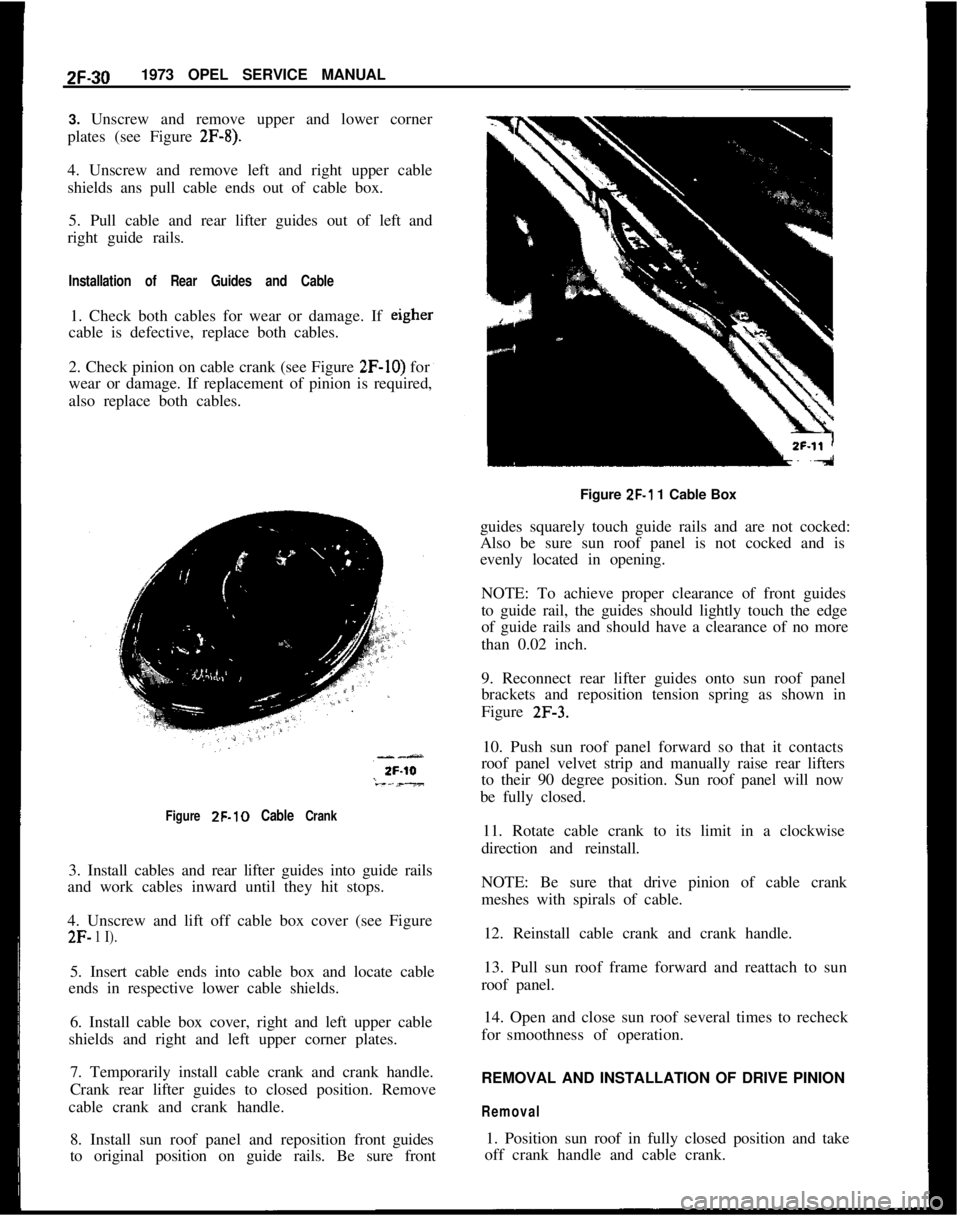
2. Check pinion on cable crank (see Figure
2F-IO) for
wear or damage. If replacement of pinion is required,
also replace both cables.
Figure ZF-10 Cable Crank3. Install cables and rear lifter guides into guide rails
and work cables inward until they hit stops.
4. Unscrew and lift off cable box cover (see Figure
2F- 1 I).5. Insert cable ends into cable box and locate cable
ends in respective lower cable shields.
6. Install cable box cover, right and left upper cable
shields and right and left upper corner plates.
7. Temporarily install cable crank and crank handle.
Crank rear lifter guides to closed position. Remove
cable crank and crank handle.
8. Install sun roof panel and reposition frontguides
to original position on guide rails. Be sure frontFigure
ZF-1 1 Cable Box
guides squarely touch guide rails and are not cocked:
Also be sure sun roof panel is not cocked and is
evenly located in opening.
NOTE: To achieve proper clearance of front guides
to guide rail, the guides should lightly touch the edge
of guide rails and should have a clearance of no more
than 0.02 inch.
9. Reconnect rear lifter guides onto sun roof panel
brackets and reposition tension spring as shown in
Figure
2F-3.10. Push sun roof panel forward so that it contacts
roof panel velvet strip and manually raise rear lifters
to their 90 degree position. Sun roof panel will now
be fully closed.
11. Rotate cable crank to its limit in a clockwise
direction and reinstall.
NOTE: Be sure that drive pinion of cable crank
meshes with spirals of cable.
12. Reinstall cable crank and crank handle.
13. Pull sun roof frame forward and reattach to sun
roof panel.
14. Open and close sun roof several times to recheck
forsmoothness of operation.
REMOVAL AND INSTALLATION OF DRIVE PINION
Removal1. Position sun roof in fully closed position and take
off crank handle and cable crank.
Page 154 of 625

2. Press off snap ring holding drive pinion in place
and remove drive pinion (see Figure 2F-10).
Installation1. Install drive pinion reverse of removal.
NOTE: If drive pinion is to be replaced, also replace
both cables to insure smooth operation of sun roof.
2. Rotate cable crank to its limit in a clockwise direc-
tion and install reverse of removal procedure.ROOF AND SUN ROOF2F-31
REMOVAL AND INSTALLATION OF FRONT AND
REAR WATER DRAINAGE HOSES
Removal of Front Water Drainage Hose
1, Remove sun visor from side of car which will have
drainage pipe taken out.
2. Partially detach pinchweld finishing strip from
door opening involved.
II2F-12L
Figure 2F-12 Sun Roof (Exploded View)
Page 293 of 625
6A- 21973 OPEL SERVICE MANUAL
ENGINE
CONTENTS
Subject
DESCRIPTION AND OPERATION:
EngineConstruction..........................................................
LubricationSystem............................................................
DIAGNOSIS:
Excessive Oil Consumption............................................NoisyValvesandLifters..................................................
MAINTENANCE AND ADJUSTMENTS:
Valve
LifterAdjustment..................................................
MAJOR REPAIR:
Engine Removal and Installation..................................
Engine
OilPanRemoval
andInstallation..................
Manifold, Cylinder Head, Valve Train and
Lifters................................................................................
Connecting Rod Bearings................................................
Crankshaft Bearings and Seals....................................
Piston, Rings and Connecting Rods............................
TimingChainCoverandTimingChain......................
Camshaft..............................................................................
Oil Pump Cover and Gears............................................
SPECIFICATIONS:
BoltTorque.Specifications
..............................................General Specifications......................................................
Engine Dimension and Fits............................................Page No.
6A- 2
6A- 4
6A- 6
6A- 6
6A- 7
6A- 86A-106A-126A-156A-166A-196A-236A-256A-266A-276A-286A-29
DESCRIPTION AND OPERATION
ENGINE CONSTRUCTION
Engine UsageThe 1.9 liter engine is standard equipment on all 1973
Opel
1900, Manta and GT models. This engine has
a compression ratio of
7.6:1 and operates on“regular” low lead grade fuel.
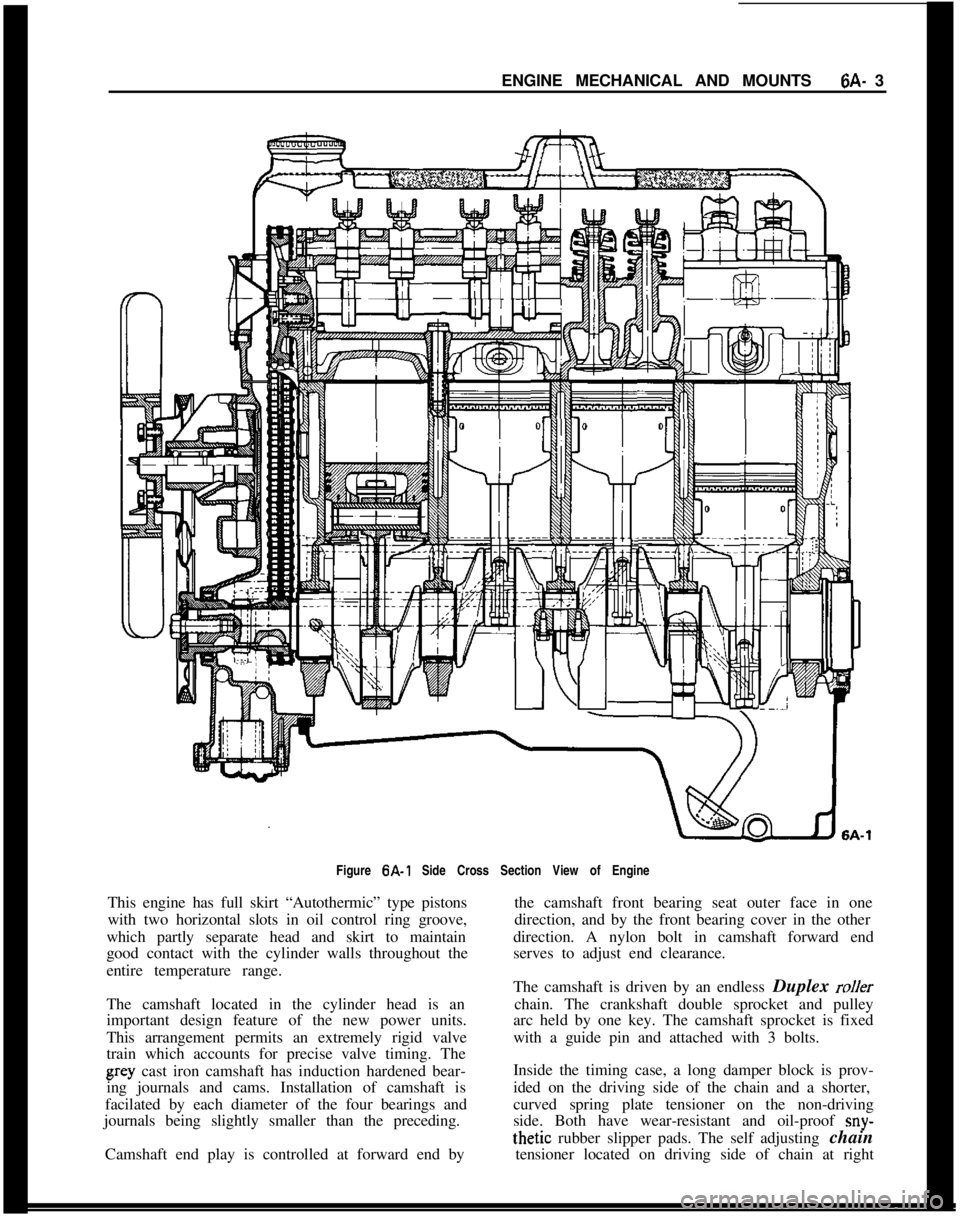
Engine ConstructionThe
cyfinderhead is made of high-grade chromium
grey cast iron. The valve guides are cast intergal with
the head. The overhead camshaft is supported in four
bearings in the cylinder head.Location of the
vzllve seats in combustion chamber
is above the center of cylinder bore. The spark plug
is positioned in the center and near the highest point
of combustion chamber. This arrangement provides
for short flame travel, uniform combustion and good
cold start prop&ties. Exhaust valves have seat in-serts of highly heat and water resisting material. The
head surface is alumetized and so are the seats of the
inlet v&es Alumetizing makes the valve heads
non- scaling and promotes long life. All engines have“rota-caps”.
The forged, five main bearing crankshaft has large-
diameter main and connecting rod bearing journals
with considerable overlap for vibration-free operat-
ion. T&metal bearing shells are used for main and
connecting rod bearings. The crankshaft end play is
controlled by the rear main bearing.
Page 294 of 625
ENGINE MECHANICAL AND MOUNTS6A- 3
Figure 6A-1 Side Cross Section View of Engine
This engine has full skirt “Autothermic” type pistons
with two horizontal slots in oil control ring groove,
which partly separate head and skirt to maintain
good contact with the cylinder walls throughout the
entire temperature range.
The camshaft located in the cylinder head is an
important design feature of the new power units.
This arrangement permits an extremely rigid valve
train which accounts for precise valve timing. Thegray cast iron camshaft has induction hardened bear-
ing journals and cams. Installation of camshaft is
facilated by each diameter of the four bearings and
journals being slightly smaller than the preceding.
Camshaft end play is controlled at forward end bythe camshaft front bearing seat outer face in one
direction, and by the front bearing cover in the other
direction. A nylon bolt in camshaft forward end
serves to adjust end clearance.
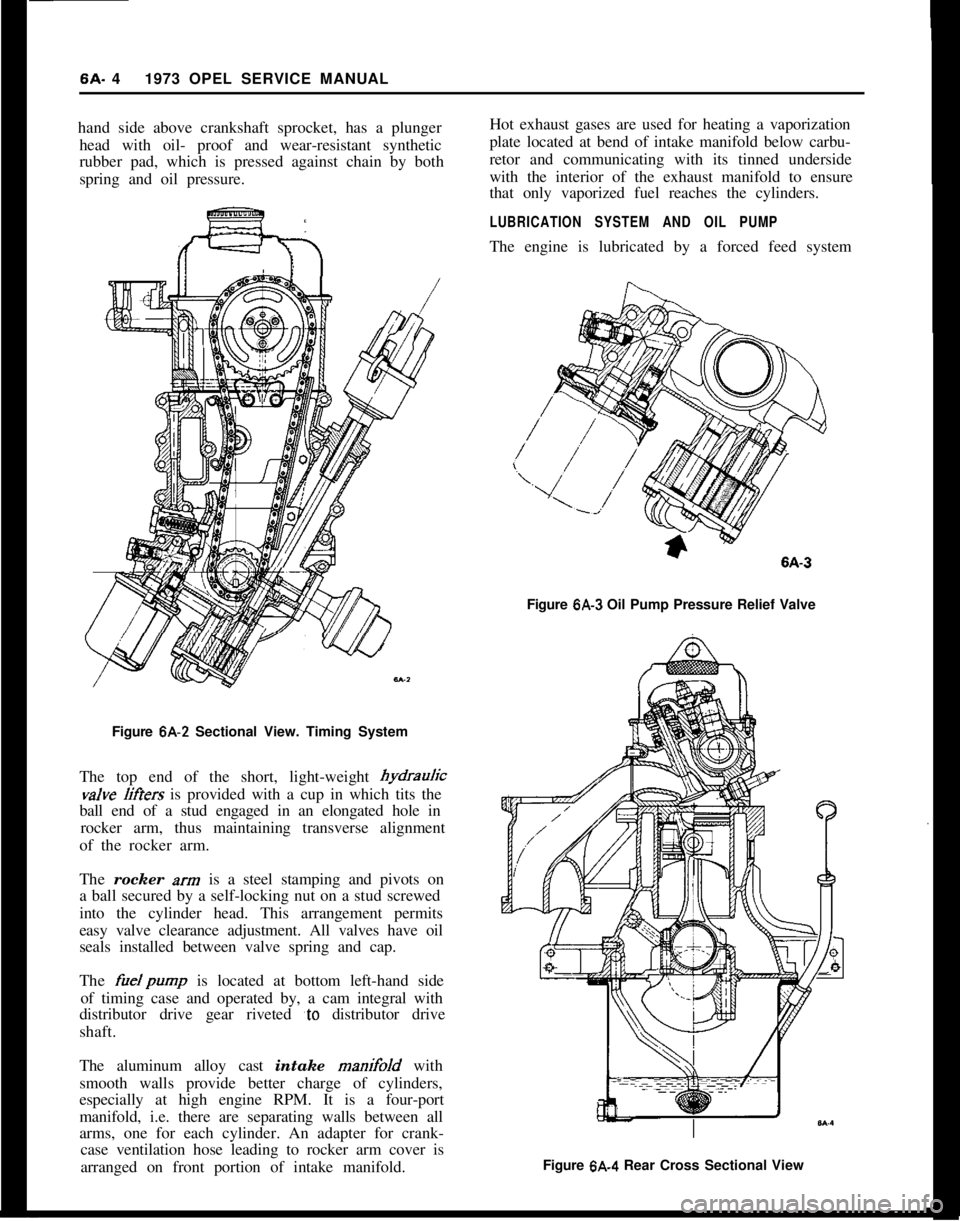
The camshaft is driven by an endless Duplex
rollerchain. The crankshaft double sprocket and pulley
arc held by one key. The camshaft sprocket is fixed
with a guide pin and attached with 3 bolts.
Inside the timing case, a long damper block is prov-
ided on the driving side of the chain and a shorter,
curved spring plate tensioner on the non-driving
side. Both have wear-resistant and oil-proof
sny-thetic rubber slipper pads. The self adjusting chain
tensioner located on driving side of chain at right
Page 295 of 625
6A. 41973 OPEL SERVICE MANUAL
hand side above crankshaft sprocket, has a plunger
head with oil- proof and wear-resistant synthetic
rubber pad, which is pressed against chain by both
spring and oil pressure.
Figure 6A-2 Sectional View. Timing System
The top end of the short, light-weight hydrauricvalve
liffers is provided with a cup in which tits the
ball end of a stud engaged in an elongated hole in
rocker arm, thus maintaining transverse alignment
of the rocker arm.
The rocker
xrn is a steel stamping and pivots on
a ball secured by a self-locking nut on a stud screwed
into the cylinder head. This arrangement permits
easy valve clearance adjustment. All valves have oil
seals installed between valve spring and cap.
The
fuelpump is located at bottom left-hand side
of timing case and operated by, a cam integral with
distributor drive gear riveted
‘to distributor drive
shaft.
The aluminum alloy cast intake manifold with
smooth walls provide better charge of cylinders,
especially at high engine RPM. It is a four-port
manifold, i.e. there are separating walls between all
arms, one for each cylinder. An adapter for crank-
case ventilation hose leading to rocker arm cover is
arranged on front portion of intake manifold.Hot exhaust gases are used for heating a vaporization
plate located at bend of intake manifold below carbu-
retor and communicating with its tinned underside
with the interior of the exhaust manifold to ensure
that only vaporized fuel reaches the cylinders.
LUBRICATION SYSTEM AND OIL PUMPThe engine is lubricated by a forced feed system
Figure
6A-3 Oil Pump Pressure Relief Valve
Figure 6A.4 Rear Cross Sectional View
Page 296 of 625
ENGINE MECHANICAL AND MOUNTS6A- 5
incorporating a gear-type pump driven by the dis-
tributor shaft. The pump body forms part of the
timing case. A passage cast in cylinder block and a
suction pipe connect the pump to the screen cover
assembly in the sump of the oil pan.
The oil pump pressure relief valve is located in the
engine oil pump cover. See Figure 6A-3. The pres-
sure relief valve serves to feed surplus oil back into
the suction passage should the required oil pressure
be exceeded. The old oil pressure relief valve which
is located above the oil filter is inoperative. A heavier
spring has been installed to keep the valve seated at
all times.
The oil filter is of the full flow type. With it in paral-
lel is a by-pass system controlled by a valve in the
timing chain cover above the oil filter which ensures
oil circulation directly to lubrication points if ele-
ment becomes clogged by dirt or oil is too thick to
pass through. Only when oil flow through element is
unrestricted the by-pass valve will close and filtered
oil is fed to the engine.
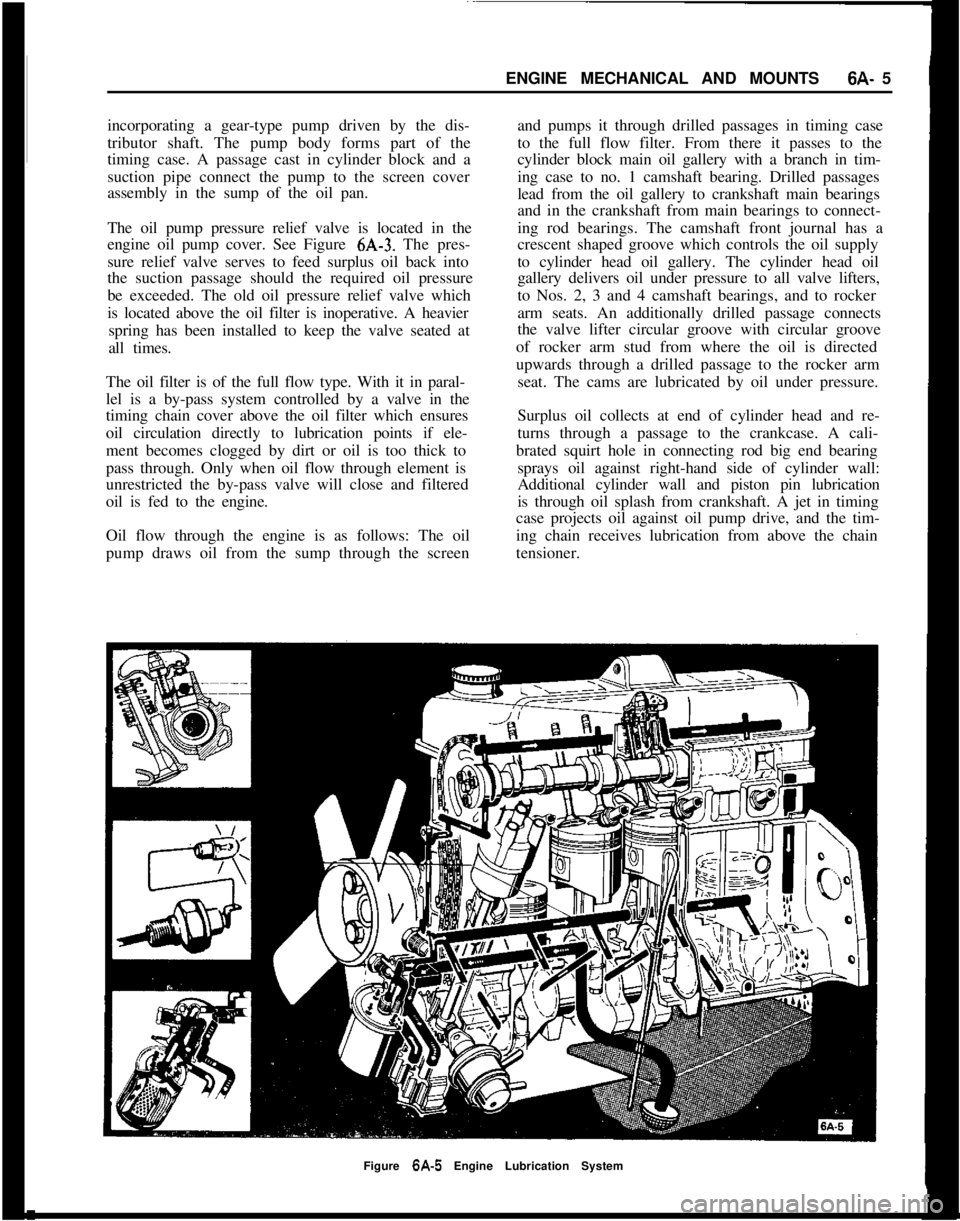
Oil flow through the engine is as follows: The oil
pump draws oil from the sump through the screenand pumps it through drilled passages in timing case
to the full flow filter. From there it passes to the
cylinder block main oil gallery with a branch in tim-
ing case to no. 1 camshaft bearing. Drilled passages
lead from the oil gallery to crankshaft main bearings
and in the crankshaft from main bearings to connect-
ing rod bearings. The camshaft front journal has a
crescent shaped groove which controls the oil supply
to cylinder head oil gallery. The cylinder head oil
gallery delivers oil under pressure to all valve lifters,
to Nos. 2, 3 and 4 camshaft bearings, and to rocker
arm seats. An additionally drilled passage connects
the valve lifter circular groove with circular groove
of rocker arm stud from where the oil is directed
upwards through a drilled passage to the rocker arm
seat. The cams are lubricated by oil under pressure.
Surplus oil collects at end of cylinder head and re-
turns through a passage to the crankcase. A cali-
brated squirt hole in connecting rod big end bearing
sprays oil against right-hand side of cylinder wall:
Additional cylinder wall and piston pin lubrication
is through oil splash from crankshaft. A jet in timing
case projects oil against oil pump drive, and the tim-
ing chain receives lubrication from above the chain
tensioner.
Figure 6A-5 Engine Lubrication System
Page 297 of 625
6A. 61973 OPEL SERVICE MANUALDIAGNOSIS
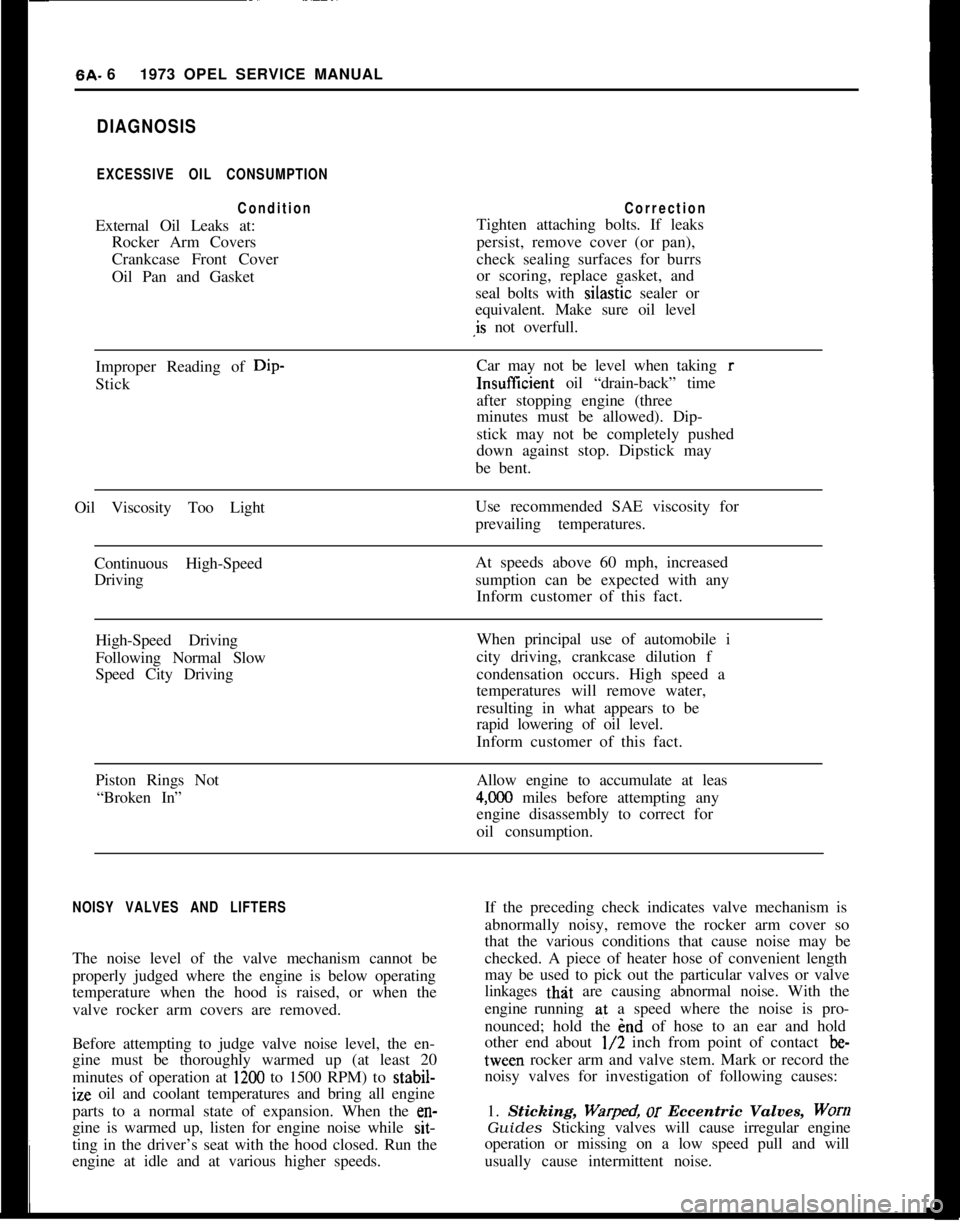
EXCESSIVE OIL CONSUMPTION
ConditionCorrectionExternal Oil Leaks at:Tighten attaching bolts. If leaks
Rocker Arm Coverspersist, remove cover (or pan),
Crankcase Front Covercheck sealing surfaces for burrs
Oil Pan and Gasketor scoring, replace gasket, and
seal bolts with silastic sealer or
equivalent. Make sure oil level
,is not overfull.
Improper Reading of Dip-Car may not be level when taking r
StickInsuffIcient oil “drain-back” time
after stopping engine (three
minutes must be allowed). Dip-
stick may not be completely pushed
down against stop. Dipstick may
be bent.
Oil Viscosity Too LightUse recommended SAE viscosity for
prevailing temperatures.
Continuous High-SpeedAt speeds above 60 mph, increased
Drivingsumption can be expected with any
Inform customer of this fact.
High-Speed DrivingWhen principal use of automobile i
Following Normal Slowcity driving, crankcase dilution f
Speed City Drivingcondensation occurs. High speed a
temperatures will remove water,
resulting in what appears to be
rapid lowering of oil level.
Inform customer of this fact.
Piston Rings NotAllow engine to accumulate at leas
“Broken In”
4,OCO miles before attempting any
engine disassembly to correct for
oil consumption.
NOISY VALVES AND LIFTERSIf the preceding check indicates valve mechanism is
abnormally noisy, remove the rocker arm cover so
that the various conditions that cause noise may be
The noise level of the valve mechanism cannot bechecked. A piece of heater hose of convenient length
properly judged where the engine is below operatingmay be used to pick out the particular valves or valve
temperature when the hood is raised, or when thelinkages
thit are causing abnormal noise. With the
valve rocker arm covers are removed.engine running at a speed where the noise is pro-
nounced; hold the end of hose to an ear and hold
Before attempting to judge valve noise level, the en-other end about
l/2 inch from point of contact be-
gine must be thoroughly warmed up (at least 20tween rocker arm and valve stem. Mark or record the
minutes of operation at
1200 to 1500 RPM) to stabil-noisy valves for investigation of following causes:ize oil and coolant temperatures and bring all engine
parts to a normal state of expansion. When the
en-1. Sticking, Warped, or Eccentric Valves, Worngine is warmed up, listen for engine noise while
sit-Guides Sticking valves will cause irregular engine
ting in the driver’s seat with the hood closed. Run theoperation or missing on a low speed pull and will
engine at idle and at various higher speeds.usually cause intermittent noise.