wheel OPEL ASTRA SALOON 2014 Service Manual
[x] Cancel search | Manufacturer: OPEL, Model Year: 2014, Model line: ASTRA SALOON, Model: OPEL ASTRA SALOON 2014Pages: 245, PDF Size: 7.12 MB
Page 175 of 245
Vehicle care173
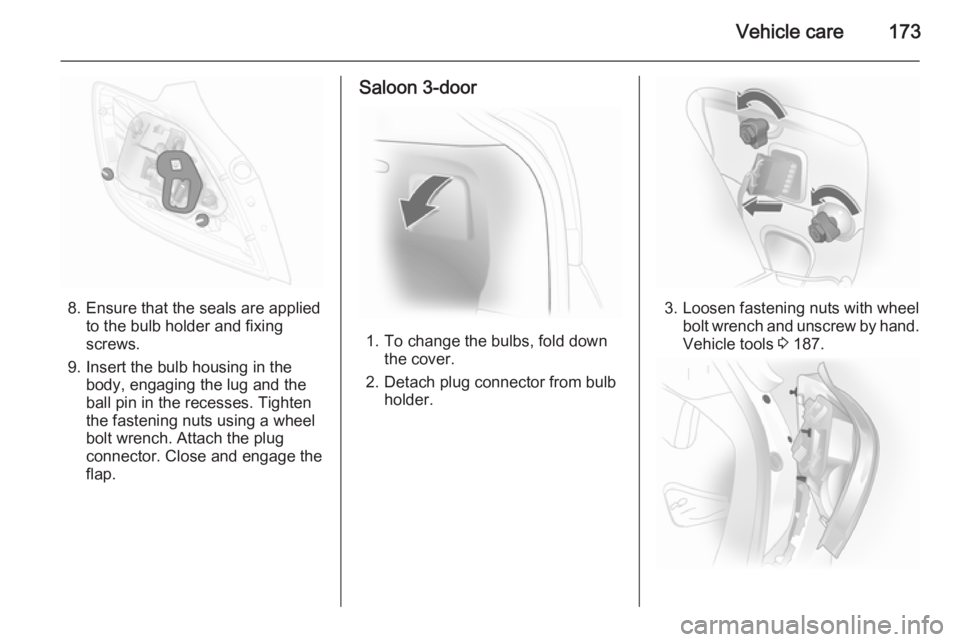
8. Ensure that the seals are appliedto the bulb holder and fixingscrews.
9. Insert the bulb housing in the body, engaging the lug and the
ball pin in the recesses. Tighten
the fastening nuts using a wheel
bolt wrench. Attach the plug
connector. Close and engage the
flap.
Saloon 3-door
1. To change the bulbs, fold down the cover.
2. Detach plug connector from bulb holder.
3. Loosen fastening nuts with wheel bolt wrench and unscrew by hand.
Vehicle tools 3 187.
Page 176 of 245
174Vehicle care
4. Detach bulb housing towards therear.
5. Remove seal from the fasteningbolt. Press the locking tabs on the
outside of the bulb holder outward and remove the bulb holder.
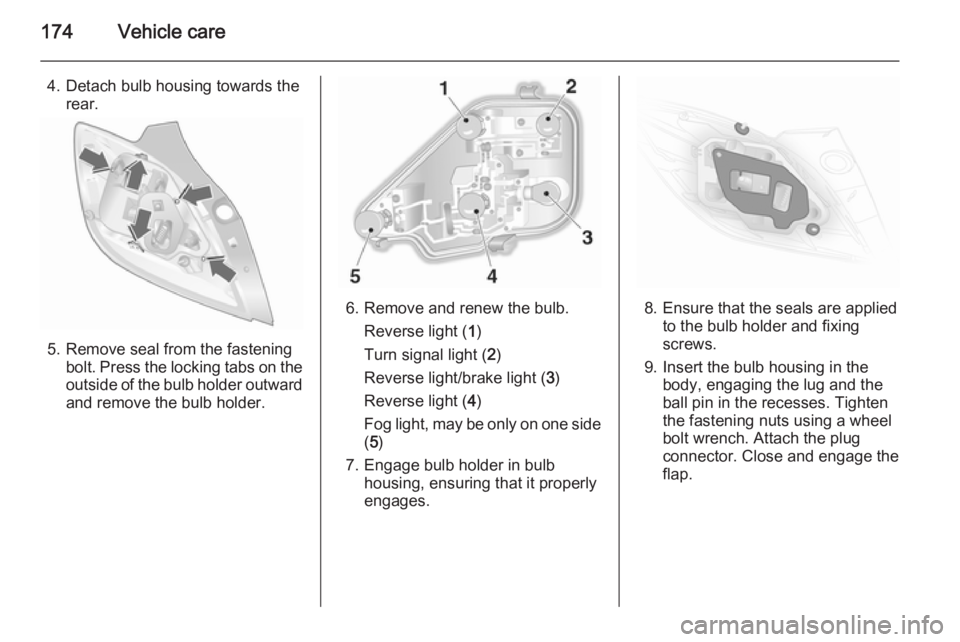
6. Remove and renew the bulb.
Reverse light ( 1)
Turn signal light ( 2)
Reverse light/brake light ( 3)
Reverse light ( 4)
Fog light, may be only on one side ( 5 )
7. Engage bulb holder in bulb housing, ensuring that it properly
engages.8. Ensure that the seals are applied to the bulb holder and fixing
screws.
9. Insert the bulb housing in the body, engaging the lug and the
ball pin in the recesses. Tighten
the fastening nuts using a wheel
bolt wrench. Attach the plug
connector. Close and engage the
flap.
Page 189 of 245
Vehicle care187
No.Circuit29Cigarette lighter, front power
outlet30Rear power outlet31–32–33Open&Start system34Sun roof, TwinTop35Rear power outlet36Socket for towing equipment37–38Central locking system, terminal
3039Left seat heating40Right seat heating41–42–No.Circuit43–44–Vehicle tools
Tools
Vehicles with tyre repair set
The tool kit and tyre repair set are in
a storage compartment below the
floor cover in the load compartment.
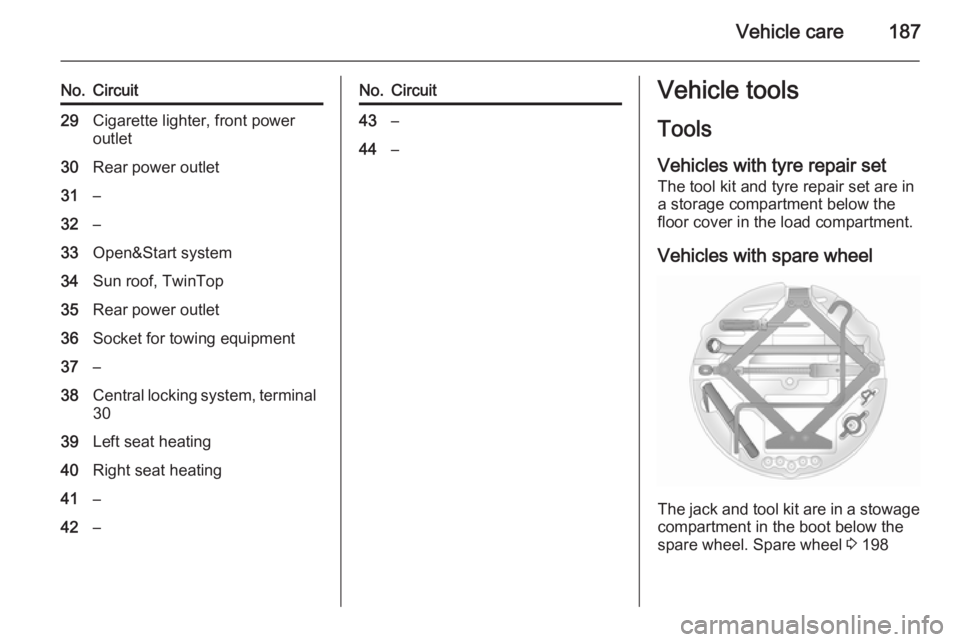
Vehicles with spare wheel
The jack and tool kit are in a stowage
compartment in the boot below the
spare wheel. Spare wheel 3 198
Page 190 of 245
188Vehicle care
TwinTop
The tools for emergency operation of
the convertible hardtop are stowed in
the glove compartment.Wheels and tyres
Tyre condition, wheel condition
Drive over edges slowly and at right
angles if possible. Driving over sharp
edges can cause tyre and wheel
damage. Do not trap tyres on the kerb when parking.
Regularly check the wheels for
damage. Seek the assistance of a
workshop in the event of damage or
unusual wear.
Tyres
Tyres of size 225/45 R 17 are only
permitted if the vehicle is equipped
with electronic stability program.Astra OPC "Nürburgring
Edition" with tyres 225/40 ZR 18
This model is factory-fitted with high-
performance sports tyres, size
225/40 ZR 18. These tyres are
approved for use on public roads but
have typical racing characteristics
and a correspondingly shallow tread.
The tyres provide sportily oriented
and experienced drivers with better
performance at faster speeds on dry
road surfaces but can cause the
vehicle to break away without
warning if this limit is exceeded. Avoid adopting a risky driving style because
of this improved performance. In wet conditions adapt your driving style
and speed to the shallow tread.
Winter tyres Winter tyres improve driving safety at
temperatures below 7 °C and should
therefore be fitted on all wheels.
Page 191 of 245
Vehicle care189
Tyres of size 185/65 R 15,
195/60 R 15, 195/65 R 15 and
205/55 R 16 can be used as winter
tyres.
Tyres of size 205/50 R17 must only
be used as winter tyres.
Tyres of size 215/45 R 17,
225/45 R 17, 225/40 R 18 1)
,
225/40 ZR18 and 235/35 R 19 must not be used as winter tyres.
Saloon, Station wagon, Van: tyres of
size 215/45 R 17 are only approved
as winter tyres if the vehicle was equipped with 18-inch wheels in the
factory.
Winter tyres may only be used on the Astra OPC on special alloy wheels
approved by Opel.
Run-flat winter tyres may only be
used on factory approved alloy
wheels.
In accordance with country-specific
regulations, affix the speed sticker in
the driver's field of view.Run-flat tyres
Run-flat tyres have reinforced, self-
supporting sidewalls, which ensure
that the tyres always have a certain
amount of driveability, even when
there is no pressure.
Run-flat tyres are only permitted on
vehicles with electronic stability
program and tyre pressure monitoring system or deflation detection system.Caution
Check tyre pressures regularly
even if run-flat tyres are fitted.
Depending on tyre manufacturer, run-
flat tyres can be identified from a
marking on the tyre wall. E.g.
ROF=RunonFlat for Goodyear orSSR=Self Supporting Runflat Tyre
for Continental.
Use of run-flat tyres is only permitted
in combination with factory approved
alloy wheels.
Do not use a tyre repair kit.
The ECO tyre pressure must not be
used.
Run-flat tyres must not be combined
with standard tyres.
If converting to standard tyres, note
that the vehicle is not equipped with a spare wheel or tyre repair kit.
Driving with a damaged tyre
A loss in tyre pressure is indicated by
the tyre pressure monitoring system
or the deflation detection system.
If a tyre has no pressure, continued
driving is possible
■ at a speed of max. 80 km/h
■ up to a distance of 80 km9 Warning
The vehicle will be more difficult to
steer and handle. Braking
distance will be longer.
Adapt driving style and speed to the changed conditions.
1) Astra OPC: Permitted as winter tyres without tyre chains.
Page 192 of 245
190Vehicle careTyre designationsE.g. 195/65 R 15 91 H195=Tyre width, mm65=Cross-section ratio (tyre
height to tyre width), %R=Belt type: RadialRF=Type: RunFlat15=Wheel diameter, inches91=Load index e.g. 91 is
equivalent to 618 kgH=Speed code letter
Speed code letter:
Q=up to 160 km/hS=up to 180 km/hT=up to 190 km/hH=up to 210 km/hV=up to 240 km/hW=up to 270 km/h
Tyre pressure
Check the pressure of cold tyres at
least every 14 days and before any
long journey. Do not forget the spare
wheel. This also applies to vehicles
with tyre pressure monitoring.
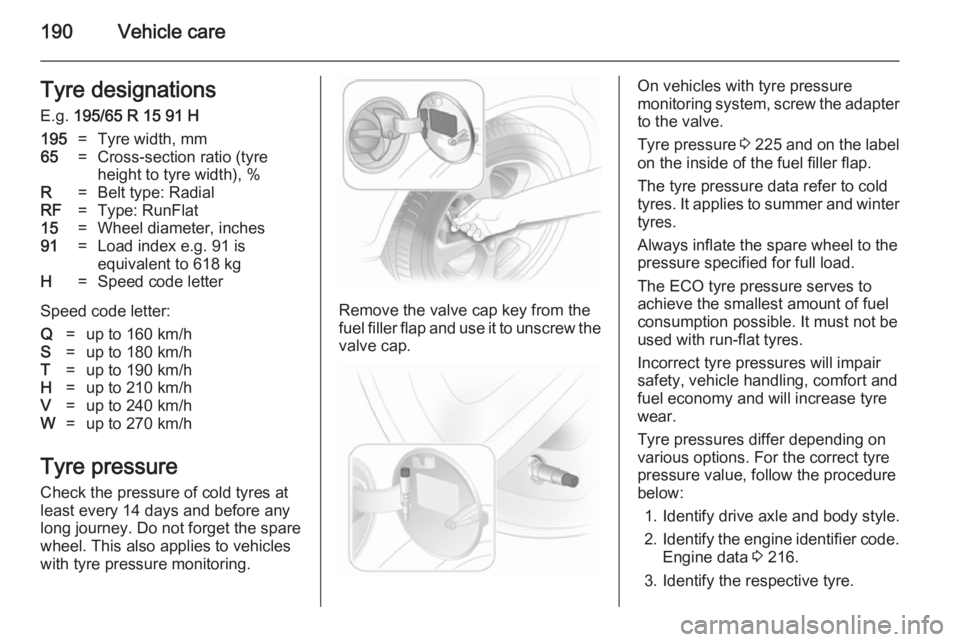
Remove the valve cap key from the
fuel filler flap and use it to unscrew the
valve cap.
On vehicles with tyre pressure
monitoring system, screw the adapter
to the valve.
Tyre pressure 3 225 and on the label
on the inside of the fuel filler flap.
The tyre pressure data refer to cold
tyres. It applies to summer and winter tyres.
Always inflate the spare wheel to the
pressure specified for full load.
The ECO tyre pressure serves to
achieve the smallest amount of fuel
consumption possible. It must not be used with run-flat tyres.
Incorrect tyre pressures will impair
safety, vehicle handling, comfort and
fuel economy and will increase tyre
wear.
Tyre pressures differ depending on
various options. For the correct tyre
pressure value, follow the procedure
below:
1. Identify drive axle and body style.
2. Identify the engine identifier code.
Engine data 3 216.
3. Identify the respective tyre.
Page 193 of 245
Vehicle care191
The tyre pressure tables show all
possible tyre combinations 3 225.
For the tyres approved for your
vehicle, refer to the EEC Certificate of Conformity provided with your vehicle
or other national registration
documents.
The driver is responsible for correct
adjustment of tyre pressure.9 Warning
If the pressure is too low, this can
result in considerable tyre warm-
up and internal damage, leading to tread separation and even to tyre
blow-out at high speeds.
Tyre pressure monitoring
system
The tyre pressure monitoring system
continually checks the pressure of all
four wheels when vehicle speed
exceeds a certain limit.
All wheels must be equipped with
pressure sensors and the tyres must
have the prescribed pressure.
Otherwise, the tyre pressure will be monitored by the deflation detection
system 3 191.
Note
In countries where the tyre pressure
monitoring system is legally
required, the use of wheels without
pressure sensors will invalidate the
vehicle type approval.
The current tyre pressures can be
shown in the Info-Display 3 116.
Vehicle messages, tyre pressure
3 111.
Control indicator w 3 99.
If a complete set of wheels without
sensors is mounted (e.g. four winter
tyres), no error message will be
displayed. The tyre pressure
monitoring system is not operational.
Retrofitting of sensors is possible.
The use of commercially available
liquid tyre repair kits can impair the
function of the system. Factory-
approved systems can be used.
External high-power radio equipment
could disrupt the tyre pressure
monitoring system.System initialisation
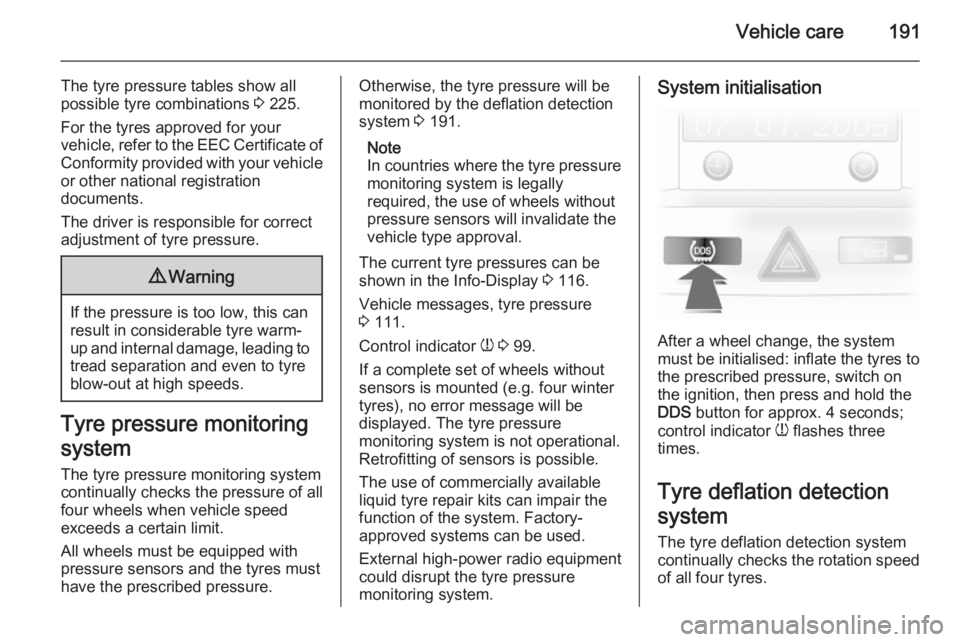
After a wheel change, the system
must be initialised: inflate the tyres to
the prescribed pressure, switch on
the ignition, then press and hold the
DDS button for approx. 4 seconds;
control indicator w flashes three
times.
Tyre deflation detection
system
The tyre deflation detection system
continually checks the rotation speed
of all four tyres.
Page 194 of 245
192Vehicle care
If a tyre loses pressure the control
indicator w illuminates red. Stop
immediately and check tyre pressure.
Control indicator w 3 99.
System initialisation
After tyre pressure correction or
wheel change, the system must be
initialised: Switch on the ignition,
press and hold the DDS button for
approx. 4 seconds, control indicator
w flashes three times.
Tread depth
Check tread depth at regular
intervals.
Tyres should be replaced for safety
reasons at a tread depth of 2-3 mm
(4 mm for winter tyres).
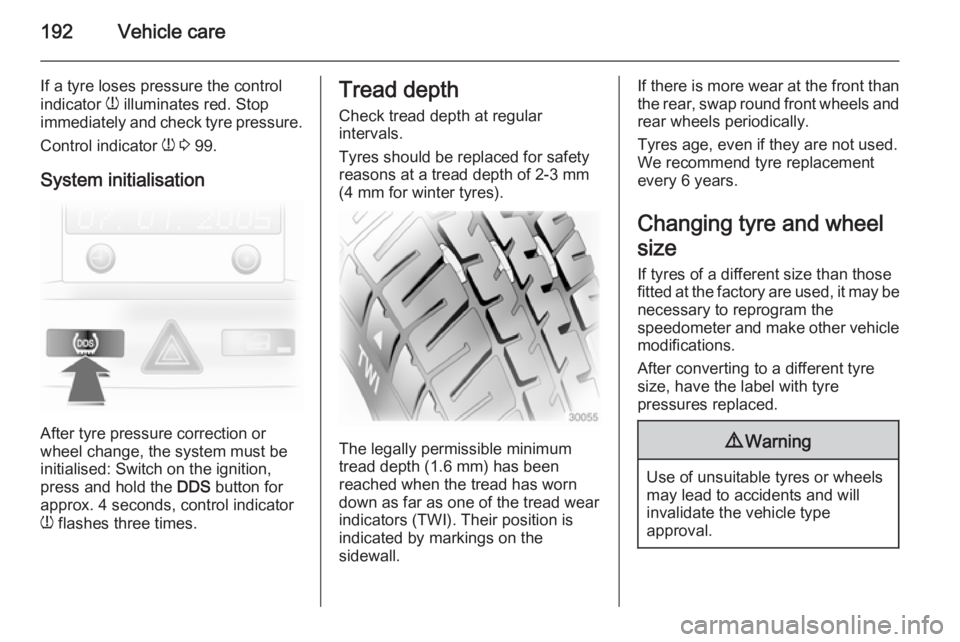
The legally permissible minimum
tread depth (1.6 mm) has been
reached when the tread has worn
down as far as one of the tread wear
indicators (TWI). Their position is
indicated by markings on the
sidewall.
If there is more wear at the front than
the rear, swap round front wheels and rear wheels periodically.
Tyres age, even if they are not used.
We recommend tyre replacement
every 6 years.
Changing tyre and wheel
size If tyres of a different size than those
fitted at the factory are used, it may be necessary to reprogram the
speedometer and make other vehicle
modifications.
After converting to a different tyre
size, have the label with tyre
pressures replaced.9 Warning
Use of unsuitable tyres or wheels
may lead to accidents and will
invalidate the vehicle type
approval.
Page 195 of 245
Vehicle care193Wheel coversWheel covers and tyres that are
factory approved for the respective
vehicle and comply with all of the
relevant wheel and tyre combination
requirements must be used.
If the wheel covers and tyres used are
not factory approved, the tyres must
not have a rim protection ridge.
Wheel covers must not impair brake
cooling.
Remove the wheel covers if tyre
chains are to be installed.9 Warning
Use of unsuitable tyres or wheel
covers could lead to sudden
pressure loss and thereby
accidents.
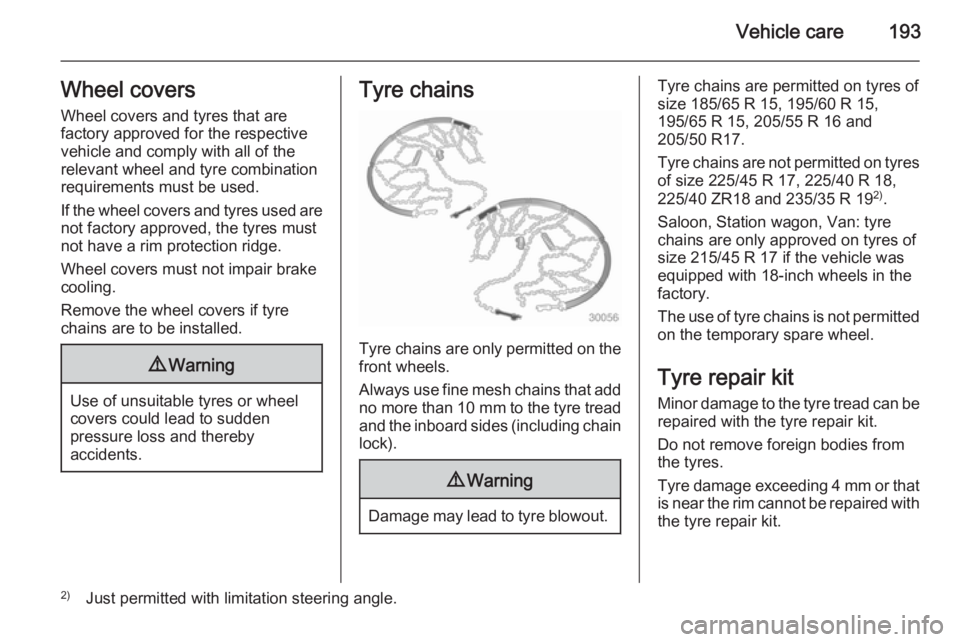
Tyre chains
Tyre chains are only permitted on the
front wheels.
Always use fine mesh chains that add no more than 10 mm to the tyre tread
and the inboard sides (including chain lock).
9 Warning
Damage may lead to tyre blowout.
Tyre chains are permitted on tyres of
size 185/65 R 15, 195/60 R 15,
195/65 R 15, 205/55 R 16 and
205/50 R17.
Tyre chains are not permitted on tyres of size 225/45 R 17, 225/40 R 18,
225/40 ZR18 and 235/35 R 19 2)
.
Saloon, Station wagon, Van: tyre chains are only approved on tyres of
size 215/45 R 17 if the vehicle was
equipped with 18-inch wheels in the
factory.
The use of tyre chains is not permitted on the temporary spare wheel.
Tyre repair kit Minor damage to the tyre tread can be
repaired with the tyre repair kit.
Do not remove foreign bodies from
the tyres.
Tyre damage exceeding 4 mm or that
is near the rim cannot be repaired with the tyre repair kit.2) Just permitted with limitation steering angle.
Page 198 of 245
196Vehicle care
Drain excess tyre pressure with
the button over the pressure indicator.
Do not run the compressor longer than 10 minutes.
14. Detach the tyre repair kit. Screw the filler hose to the free
connection on the sealant bottle.
This prevents sealant leakage.
Stow the tyre repair kit in the load
compartment.
15. Remove any excess sealant using a cloth.
16. Take the label indicating maximum permitted speed from
the sealant bottle and affix in the
driver's field of view.
17. Continue driving immediately so that sealant is evenly distributed
in the tyre. After driving approx.
10 km (but no more than
10 minutes), stop and check tyre
pressure. Screw compressor air
hose directly onto tyre valve and
compressor when doing this.
If tyre pressure is more than
1.3 bar , set it to the correct value.Repeat the procedure until there
is no more loss of pressure.
If the tyre pressure has fallen
below 1.3 bar, the vehicle must
not be used. Seek the assistance
of a workshop.
18. Stow away tyre repair kit in load compartment.
Note
The driving characteristics of the
repaired tyre is severely affected,
therefore have this tyre replaced.
If unusual noise is heard or the
compressor becomes hot, turn
compressor off for at least 30
minutes.
The built-in safety valve opens at a
pressure of 7 bar.
Note the expiry date of the kit. After
this date its sealing capability is no
longer guaranteed. Pay attention to
storage information on sealant
bottle.
Replace the used sealant bottle. Dispose of the bottle as prescribed
by applicable laws.The compressor and sealant can be used from approx. -30 °C.
The adapters supplied can be used
to pump up other items e.g.
footballs, air mattresses, inflatable
dinghies etc. They are located on the underside of the compressor. To
remove, screw on compressor air
hose and withdraw adapter.
Wheel changing Some vehicles are equipped with a
tyre repair kit instead of a spare wheel 3 193.
Make the following preparations and
observe the following information:
■ Park the vehicle on a level, firm and
non-skid surface. The front wheels
must be in the straight-ahead
position.
■ Apply the parking brake and engage first gear, reverse gear or
P .
■ Remove the spare wheel 3 198.
■ On the Astra TwinTop, the roof must be closed before the vehicle
is raised.