wheel OPEL ASTRA SALOON 2014 Workshop Manual
[x] Cancel search | Manufacturer: OPEL, Model Year: 2014, Model line: ASTRA SALOON, Model: OPEL ASTRA SALOON 2014Pages: 245, PDF Size: 7.12 MB
Page 199 of 245
Vehicle care197
■Never change more than one wheel
at once.
■ Use the jack only to change wheels
in case of puncture, not for
seasonal winter or summer tyre
change.
■ If the ground on which the vehicle is standing is soft, a solid board
(max. 1 cm thick) should be placed
under the jack.
■ No people or animals may be in the
vehicle when it is jacked-up.
■ Never crawl under a jacked-up vehicle.
■ Do not start the vehicle when it is raised on the jack.
■ Before screwing in the wheel bolts,
clean them and lightly coat the
taper of each wheel bolt with
commercially available grease.
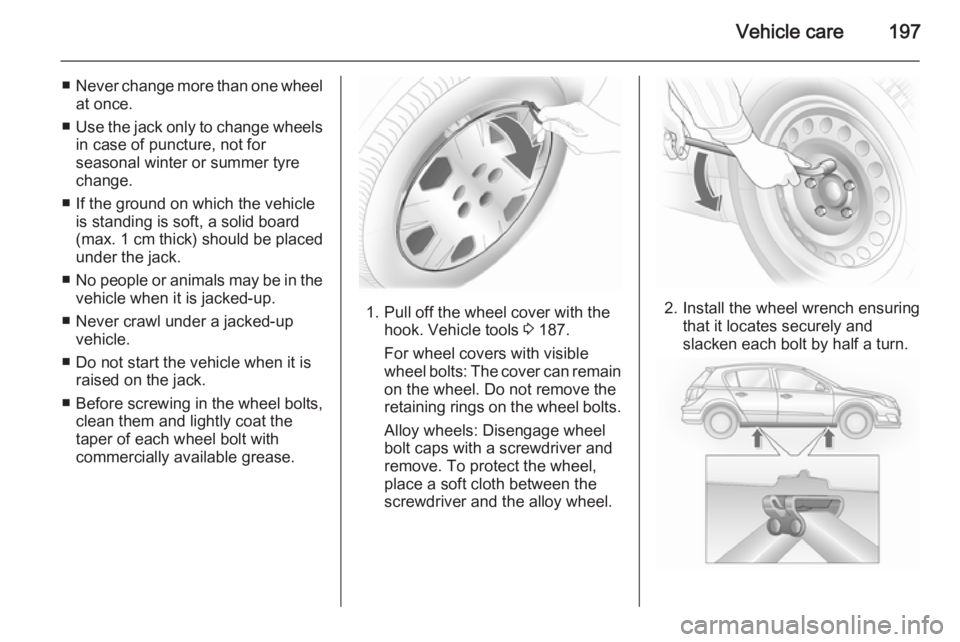
1. Pull off the wheel cover with the hook. Vehicle tools 3 187.
For wheel covers with visible
wheel bolts: The cover can remain
on the wheel. Do not remove the
retaining rings on the wheel bolts.
Alloy wheels: Disengage wheel
bolt caps with a screwdriver and
remove. To protect the wheel,
place a soft cloth between the
screwdriver and the alloy wheel.2. Install the wheel wrench ensuring that it locates securely and
slacken each bolt by half a turn.
Page 200 of 245
198Vehicle care
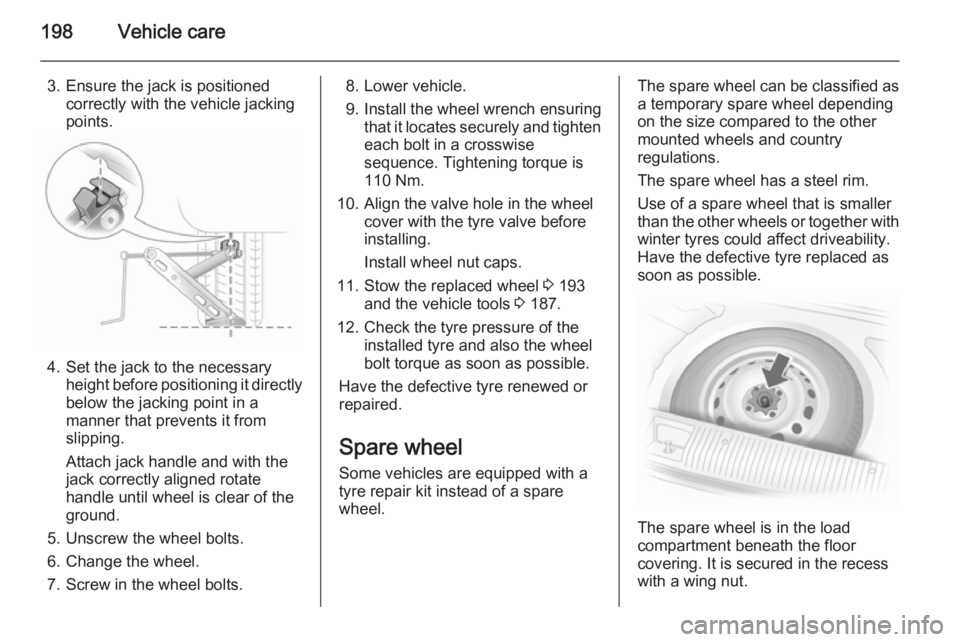
3. Ensure the jack is positionedcorrectly with the vehicle jacking
points.
4. Set the jack to the necessary height before positioning it directly
below the jacking point in a
manner that prevents it from
slipping.
Attach jack handle and with the
jack correctly aligned rotate
handle until wheel is clear of the
ground.
5. Unscrew the wheel bolts.
6. Change the wheel.
7. Screw in the wheel bolts.
8. Lower vehicle.
9. Install the wheel wrench ensuring that it locates securely and tighten
each bolt in a crosswise
sequence. Tightening torque is
110 Nm.
10. Align the valve hole in the wheel cover with the tyre valve before
installing.
Install wheel nut caps.
11. Stow the replaced wheel 3 193
and the vehicle tools 3 187.
12. Check the tyre pressure of the installed tyre and also the wheelbolt torque as soon as possible.
Have the defective tyre renewed or repaired.
Spare wheel
Some vehicles are equipped with a
tyre repair kit instead of a spare
wheel.The spare wheel can be classified as
a temporary spare wheel depending
on the size compared to the other
mounted wheels and country
regulations.
The spare wheel has a steel rim.
Use of a spare wheel that is smaller
than the other wheels or together with winter tyres could affect driveability.
Have the defective tyre replaced as
soon as possible.
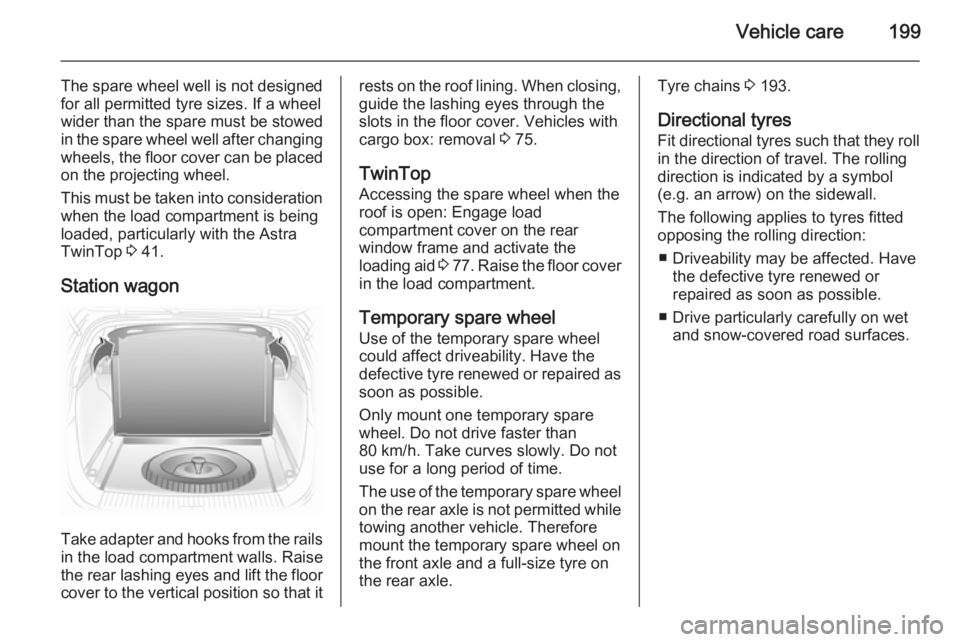
The spare wheel is in the load
compartment beneath the floor
covering. It is secured in the recess
with a wing nut.
Page 201 of 245
Vehicle care199
The spare wheel well is not designedfor all permitted tyre sizes. If a wheel
wider than the spare must be stowed
in the spare wheel well after changing
wheels, the floor cover can be placed on the projecting wheel.
This must be taken into consideration
when the load compartment is being
loaded, particularly with the Astra
TwinTop 3 41.
Station wagon
Take adapter and hooks from the rails
in the load compartment walls. Raise
the rear lashing eyes and lift the floor cover to the vertical position so that it
rests on the roof lining. When closing,
guide the lashing eyes through the
slots in the floor cover. Vehicles with
cargo box: removal 3 75.
TwinTop
Accessing the spare wheel when the roof is open: Engage load
compartment cover on the rear
window frame and activate the
loading aid 3 77 . Raise the floor cover
in the load compartment.
Temporary spare wheel
Use of the temporary spare wheel
could affect driveability. Have the
defective tyre renewed or repaired as soon as possible.
Only mount one temporary spare
wheel. Do not drive faster than
80 km/h. Take curves slowly. Do not
use for a long period of time.
The use of the temporary spare wheel
on the rear axle is not permitted while
towing another vehicle. Therefore
mount the temporary spare wheel on
the front axle and a full-size tyre on
the rear axle.Tyre chains 3 193.
Directional tyres Fit directional tyres such that they rollin the direction of travel. The rolling
direction is indicated by a symbol
(e.g. an arrow) on the sidewall.
The following applies to tyres fitted
opposing the rolling direction:
■ Driveability may be affected. Have the defective tyre renewed or
repaired as soon as possible.
■ Drive particularly carefully on wet and snow-covered road surfaces.
Page 204 of 245
202Vehicle care
Screw in the towing eye as far as it will
go until it stops in a horizontal
position.
Attach a tow rope – or better still a tow
rod – to the towing eye.
The towing eye must only be used for towing and not recovering the vehicle.
Switch on ignition to release steering
wheel lock and to permit operation of
brake lights, horn and windscreen
wiper.
Open&Start system 3 22.
Transmission in neutral.
Caution
Drive slowly. Do not drive jerkily.
Excessive tractive force can
damage the vehicle.
When the engine is not running,
considerably more force is needed to
brake and steer.
To prevent the entry of exhaust gases from the towing vehicle, switch on the
air recirculation and close the
windows.
Vehicles with automatic transmission
must be towed facing forwards, not faster than 80 km/h nor further than
100 km. In all other cases and when
the transmission is defective, the front axle must be raised off the ground.
Seek the assistance of a workshop.
Manual transmission automated
3 142.
After towing, unscrew the towing eye
and refit the cover.
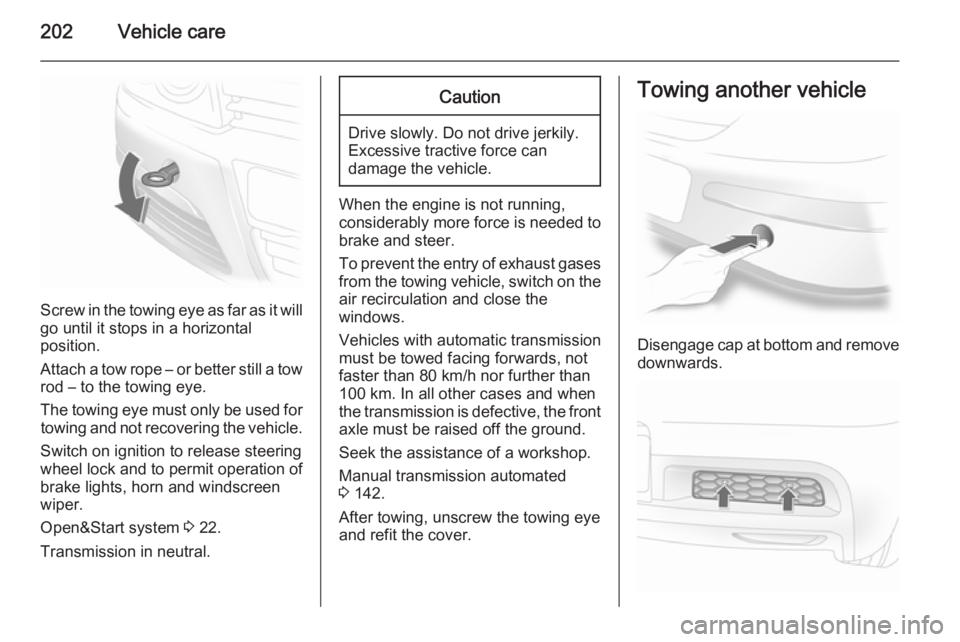
Towing another vehicle
Disengage cap at bottom and remove
downwards.
Page 206 of 245
204Vehicle care
If using a car wash, comply with the
car wash manufacturer's instructions. The windscreen wipers and rear
window wiper must be switched off.
Remove antenna and external
accessories such as roof racks etc.
If you wash your vehicle by hand,
make sure that the insides of the
wheel housings are also thoroughly
rinsed out.
Clean edges and folds on opened
doors and the bonnet as well as the
areas they cover.Caution
Always use a cleaning agent with
a pH value of 4 to 9.
Do not use cleaning agents on hot surfaces.
Do not clean the engine compartmentwith a steam-jet or high-pressure jet
cleaner.
Thoroughly rinse and leather-off the vehicle. Rinse leather frequently. Use
separate leathers for painted and
glass surfaces: remnants of wax on
the windows will impair vision.
Do not use hard objects to remove
spots of tar. Use tar removal spray on
painted surfaces.
Exterior lights
Headlight and other light covers are
made of plastic. Do not use any
abrasive or caustic agents, do not use an ice scraper, and do not clean them
dry.
Polishing and waxing Wax the vehicle regularly (at the
latest when water no longer beads).
Otherwise, the paintwork will dry out.
Polishing is necessary only if the paint
has become dull or if solid deposits
have become attached to it.
Paintwork polish with silicone forms a
protective film, making waxing
unnecessary.
Plastic body parts must not be treated with wax or polishing agents.Windows and windscreen wiper
blades
Use a soft lint-free cloth or chamois
leather together with window cleaner and insect remover.
When cleaning the rear window from
inside, always wipe in parallel to the
heating element to prevent damage.
For mechanical removal of ice, use a
sharp-edged ice scraper. Press the
scraper firmly against the glass so
that no dirt can get under it and
scratch the glass.
Clean smearing wiper blades with a
soft cloth and window cleaner.
Sun roof Never clean with solvents or abrasive
agents, fuels, aggressive media
(e.g. paint cleaner, acetone-
containing solutions etc.), acidic or
highly alkaline media or abrasive
pads. Do not apply wax or polishing
agents to the middle part of the sun
roof.
Page 207 of 245
Vehicle care205
Wheels and tyresDo not use high-pressure jet
cleaners.
Clean rims with a pH-neutral wheel
cleaner.
Rims are painted and can be treated
with the same agents as the body.
Paintwork damageRectify minor paintwork damage witha touch-up pen before rust forms.
Have more extensive damage or rust
areas repaired by a workshop.
Underbody Some areas of the vehicle underbody
have a PVC undercoating while other critical areas have a durable
protective wax coating.
After the underbody is washed, check
the underbody and have it waxed if
necessary.
Bitumen/rubber materials could
damage the PVC coating. Have
underbody work carried out by a
workshop.Before and after winter, wash the
underbody and have the protective
wax coating checked.
Engine compartment
Areas of the engine compartment that
are painted in the same colour as the vehicle must be looked after like any
other painted surface.
It is advisable to wash the engine
compartment before and after winter
and preserve it with wax. Protect the
alternator and brake fluid reservoir
with plastic sheets before washing
the engine.
When washing the engine with a
steam-jet cleaner, do not direct the
steam jet towards components of the
antilock brake system, air
conditioning system or the belt drive
and its components.
After an engine wash, have all engine
room components preserved
thoroughly by a workshop using
protective wax.
Do not use high-pressure jet
cleaners.TwinTop
Clean all seals with a damp soft lint- free cloth. Allow to dry completely. Treat all seals, e.g. on the roof and
windscreen frame, with the special
maintenance kit (available from your
Opel Service Partner) from time to
time. Good contact between the fine
rubber lips and the sealing surfaces
prevents leaks and reduces clamping
forces.
Intermediate roof position for cleaning
3 41.
Do not use high-pressure jet
cleaners.
Towing equipment
Do not clean the coupling ball bar with
a steam-jet or high-pressure jet
cleaner.
Interior care Interior and upholsteryOnly clean the vehicle interior,
including the instrument panel fascia
and panelling, with a dry cloth or
interior cleaner.
Page 225 of 245
![OPEL ASTRA SALOON 2014 Workshop Manual Technical data223
Heavy accessoriesAccessoriesSun roofTowing equipmentSplit rear seat backrestHeadlamp washer systemWeight [kg]23 (not on Saloon 4-door)
17 (Saloon 4-door)21 (not on TwinTop)
26 (TwinT](/img/37/58218/w960_58218-224.png "OPEL ASTRA SALOON 2014 Workshop Manual Technical data223
Heavy accessoriesAccessoriesSun roofTowing equipmentSplit rear seat backrestHeadlamp washer systemWeight [kg]23 (not on Saloon 4-door)
17 (Saloon 4-door)21 (not on TwinTop)
26 (TwinT")
Technical data223
Heavy accessoriesAccessoriesSun roofTowing equipmentSplit rear seat backrestHeadlamp washer systemWeight [kg]23 (not on Saloon 4-door)
17 (Saloon 4-door)21 (not on TwinTop)
26 (TwinTop)20 (Station wagon)
9 (Saloon 3-door / 5-door)2 (Saloon 4-door / 5-door)Vehicle dimensionsSaloon 5-doorSaloon 3-doorSaloon 4-doorStation wagonVanTwinTopLength [mm]424942904587451545154476Width without exterior mirrors [mm]175317531753175317531759Width with two exterior mirrors [mm]203220322033203220322021Height (without antenna) [mm]146014351458150015001411Length of load compartment floor [mm]81981990510851825805Load compartment width [mm]944944102710881103734Height of load compartment opening [mm]614555–766775–Wheelbase [mm]261426142703270327032614Turning circle diameter [m]11.2011.2011.5011.5011.5011.20
Page 229 of 245
[kPa/bar] (psi)[kPa/bar] (psi)[kPa/bar] (psi)[kPa/bar] (psi)[kPa/b](/img/37/58218/w960_58218-228.png "OPEL ASTRA SALOON 2014 Workshop Manual Technical data227
Comfort with up to 3 peopleECO with up to 3 peopleWith full loadEngineTyresfrontrearfrontrearfrontrear[kPa/bar](psi)[kPa/bar] (psi)[kPa/bar] (psi)[kPa/bar] (psi)[kPa/bar] (psi)[kPa/b")
Technical data227
Comfort with up to 3 peopleECO with up to 3 peopleWith full loadEngineTyresfrontrearfrontrearfrontrear[kPa/bar](psi)[kPa/bar] (psi)[kPa/bar] (psi)[kPa/bar] (psi)[kPa/bar] (psi)[kPa/bar] (psi)A17DTR205/55 R 16,230/2.3 (33)210/2.1 (30)270/2.7 (39)250/2.5 (36)250/2.5 (36)290/2.9 (42)225/45 R 17215/45 R 17,250/2.5 (36)230/2.3 (33)––260/2.6 (38)300/3.0 (43)225/40 R 18allTemporary spare
wheel420/4.2 (61)420/4.2 (61)––420/4.2 (61)420/4.2 (61)
Saloon 4-door
Comfort with up to 3 peopleECO with up to 3 peopleWith full loadEngineTyresfrontrearfrontrearfrontrear[kPa/bar](psi)[kPa/bar] (psi)[kPa/bar] (psi)[kPa/bar] (psi)[kPa/bar] (psi)[kPa/bar] (psi)A16XER,
A18XER195/65 R 15,220/2.2 (32)220/2.2 (32)––230/2.3 (33)280/2.8 (41)205/55 R 16215/45 R 17240/2.4 (35)240/2.4 (35)––250/2.5 (36)320/3.2 (46)allTemporary spare
wheel420/4.2 (61)420/4.2 (61)––420/4.2 (61)420/4.2 (61)
Page 231 of 245
[kPa/bar] (psi)[kPa/bar] (psi)[kPa/bar] (psi)[kPa/bar] (psi)[kPa/b](/img/37/58218/w960_58218-230.png "OPEL ASTRA SALOON 2014 Workshop Manual Technical data229
Comfort with up to 3 peopleECO with up to 3 peopleWith full loadEngineTyresfrontrearfrontrearfrontrear[kPa/bar](psi)[kPa/bar] (psi)[kPa/bar] (psi)[kPa/bar] (psi)[kPa/bar] (psi)[kPa/b")
Technical data229
Comfort with up to 3 peopleECO with up to 3 peopleWith full loadEngineTyresfrontrearfrontrearfrontrear[kPa/bar](psi)[kPa/bar] (psi)[kPa/bar] (psi)[kPa/bar] (psi)[kPa/bar] (psi)[kPa/bar] (psi)A17DTJ195/65 R 15,230/2.3 (33)210/2.1 (30)270/2.7 (39)250/2.5 (36)250/2.5 (36)290/2.9 (42)205/55 R 16,225/45 R 17215/45 R 17,250/2.5 (36)230/2.3 (33)––260/2.6 (38)300/3.0 (43)225/40 R 18A17DTR205/55 R 16,230/2.3 (33)210/2.1 (30)270/2.7 (39)250/2.5 (36)250/2.5 (36)290/2.9 (42)225/45 R 17215/45 R 17,250/2.5 (36)230/2.3 (33)––260/2.6 (38)300/3.0 (43)225/40 R 18allTemporary spare
wheel420/4.2 (61)420/4.2 (61)––420/4.2 (61)420/4.2 (61)
Page 232 of 245
[kPa/bar] (psi)[kPa/bar] (psi)[kPa/bar] (psi)[kPa/bar] (psi)[kP](/img/37/58218/w960_58218-231.png "OPEL ASTRA SALOON 2014 Workshop Manual 230Technical data
VanComfort with up to 3 peopleECO with up to 3 peopleWith full loadEngineTyresfrontrearfrontrearfrontrear[kPa/bar](psi)[kPa/bar] (psi)[kPa/bar] (psi)[kPa/bar] (psi)[kPa/bar] (psi)[kP")
230Technical data
VanComfort with up to 3 peopleECO with up to 3 peopleWith full loadEngineTyresfrontrearfrontrearfrontrear[kPa/bar](psi)[kPa/bar] (psi)[kPa/bar] (psi)[kPa/bar] (psi)[kPa/bar] (psi)[kPa/bar] (psi)A17DTJ,
A17DTR195/65 R 15,230/2.3 (33)210/2.1 (30)270/2.7 (39)250/2.5 (36)250/2.5 (36)290/2.9 (42)205/55 R 16allTemporary spare
wheel420/4.2 (61)420/4.2 (61)––420/4.2 (61)420/4.2 (61)
TwinTop
Comfort with up to 3 peopleECO with up to 3 peopleWith full loadEngineTyresfrontrearfrontrearfrontrear[kPa/bar](psi)[kPa/bar] (psi)[kPa/bar] (psi)[kPa/bar] (psi)[kPa/bar] (psi)[kPa/bar] (psi)A16XER225/40 R 18230/2.3 (33)210/2.1 (30)––240/2.4 (35)280/2.8 (41)205/55 R 16,210/2.1 (30)210/2.1 (30)250/2.5 (36)250/2.5 (36)220/2.2 (32)260/2.6 (38)225/45 R 17