check engine OPEL CALIBRA 1988 Service Owners Manual
[x] Cancel search | Manufacturer: OPEL, Model Year: 1988, Model line: CALIBRA, Model: OPEL CALIBRA 1988Pages: 525, PDF Size: 58.26 MB
Page 222 of 525
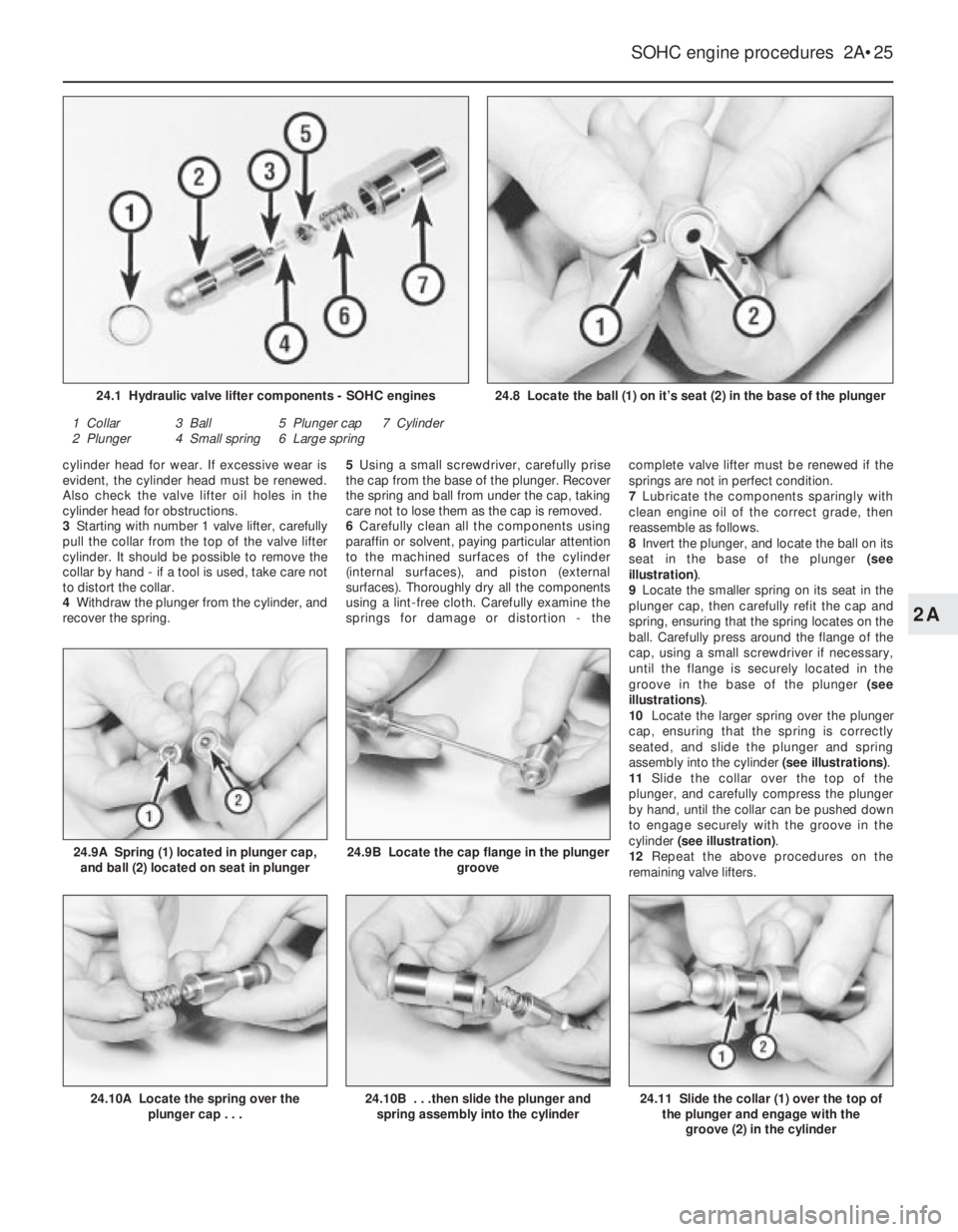
cylinder head for wear. If excessive wear is
evident, the cylinder head must be renewed.
Also check the valve lifter oil holes in the
cylinder head for obstructions.
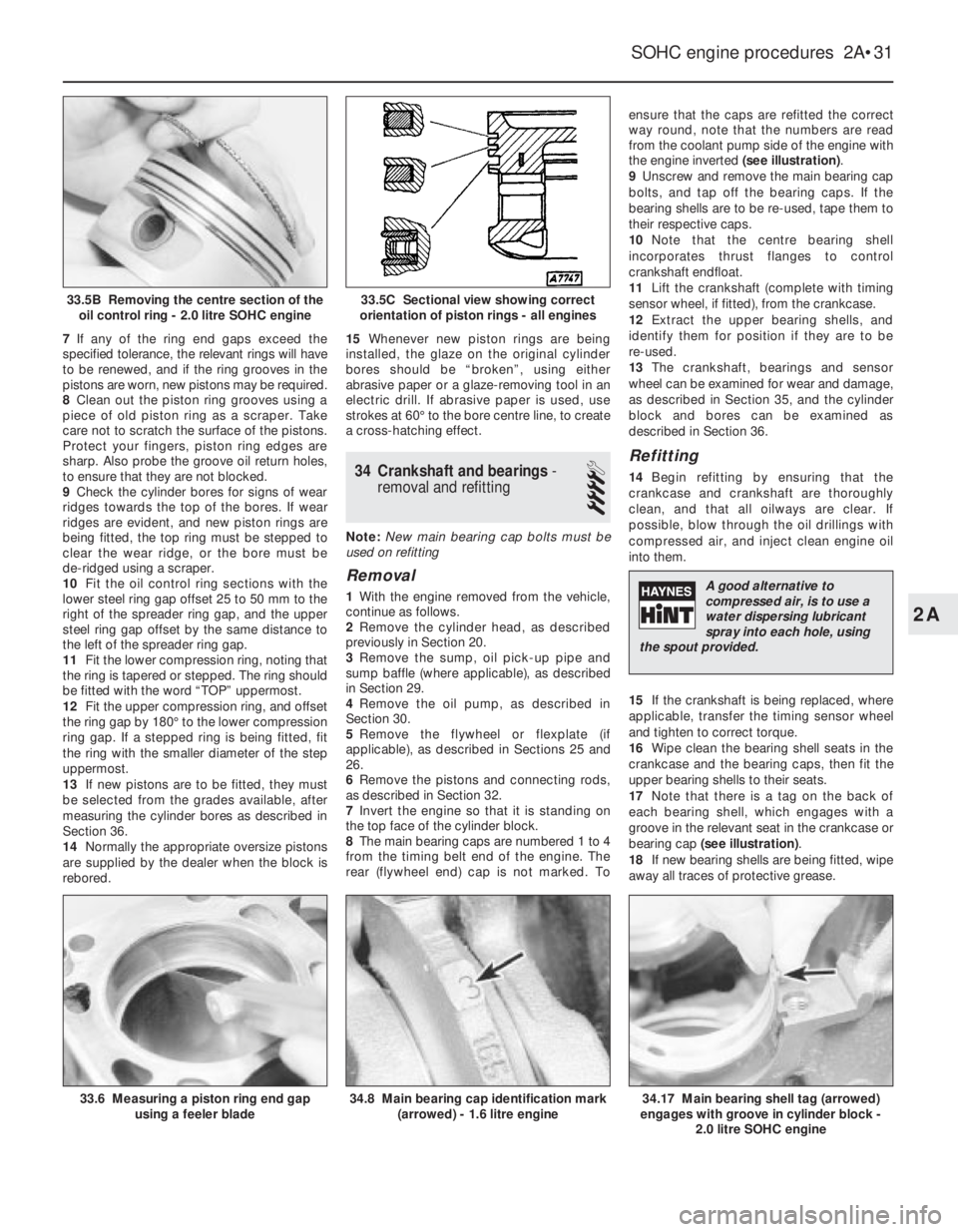
3Starting with number 1 valve lifter, carefully
pull the collar from the top of the valve lifter
cylinder. It should be possible to remove the
collar by hand -if a tool is used, take care not
to distort the collar.
4Withdraw the plunger from the cylinder, and
recover the spring.5Using a small screwdriver, carefully prise
the cap from the base of the plunger. Recover
the spring and ball from under the cap, taking
care not to lose them as the cap is removed.
6Carefully clean all the components using
paraffin or solvent, paying particular attention
to the machined surfaces of the cylinder
(internal surfaces), and piston (external
surfaces). Thoroughly dry all the components
using a lint-free cloth. Carefully examine the
springs for damage or distortion -thecomplete valve lifter must be renewed if the
springs are not in perfect condition.
7Lubricate the components sparingly with
clean engine oil of the correct grade, then
reassemble as follows.
8Invert the plunger, and locate the ball on its
seat in the base of the plunger (see
illustration).
9Locate the smaller spring on its seat in the
plunger cap, then carefully refit the cap and
spring, ensuring that the spring locates on the
ball. Carefully press around the flange of the
cap, using a small screwdriver if necessary,
until the flange is securely located in the
groove in the base of the plunger (see
illustrations).
10Locate the larger spring over the plunger
cap, ensuring that the spring is correctly
seated, and slide the plunger and spring
assembly into the cylinder (see illustrations).
11Slide the collar over the top of the
plunger, and carefully compress the plunger
by hand, until the collar can be pushed down
to engage securely with the groove in the
cylinder (see illustration).
12Repeat the above procedures on the
remaining valve lifters.
SOHC engine procedures 2A•25
24.11 Slide the collar (1) over the top of
the plunger and engage with the
groove (2) in the cylinder24.10B . . .then slide the plunger and
spring assembly into the cylinder
24.9B Locate the cap flange in the plunger
groove24.9A Spring (1) located in plunger cap,
and ball (2) located on seat in plunger
24.10A Locate the spring over the
plunger cap . . .
24.8 Locate the ball (1) on it’s seat (2) in the base of the plunger24.1 Hydraulic valve lifter components - SOHC engines
1 Collar
2 Plunger3 Ball
4 Small spring5 Plunger cap
6 Large spring7 Cylinder
2A
Page 223 of 525
25Flywheel -removal, inspection
and refitting
4
Note: New flywheel securing bolts must he
used on refitting. Certain models are fitted
with a ‘Pot type’ flywheel. Although, it has a
deeply recessed surface for the clutch disc,
the operations below are the same.
Removal
1If not already done, remove the clutch,
(Chapter 6), and the starter motor, (Chapter 5).
2If the engine is in the vehicle, remove the
clutch release bearing and its guide sleeve, as
described in Chapter 6.
3Although the flywheel bolt holes are offset
so that the flywheel can only be fitted in one
position, it will make refitting easier if
alignment marks are made between the
flywheel and the end of the crankshaft.
4Prevent the flywheel from turning by
jamming the ring gear teeth using a large
screwdriver or similar tool. Access is most
easily obtained through the starter motor
aperture if the engine is in the vehicle.
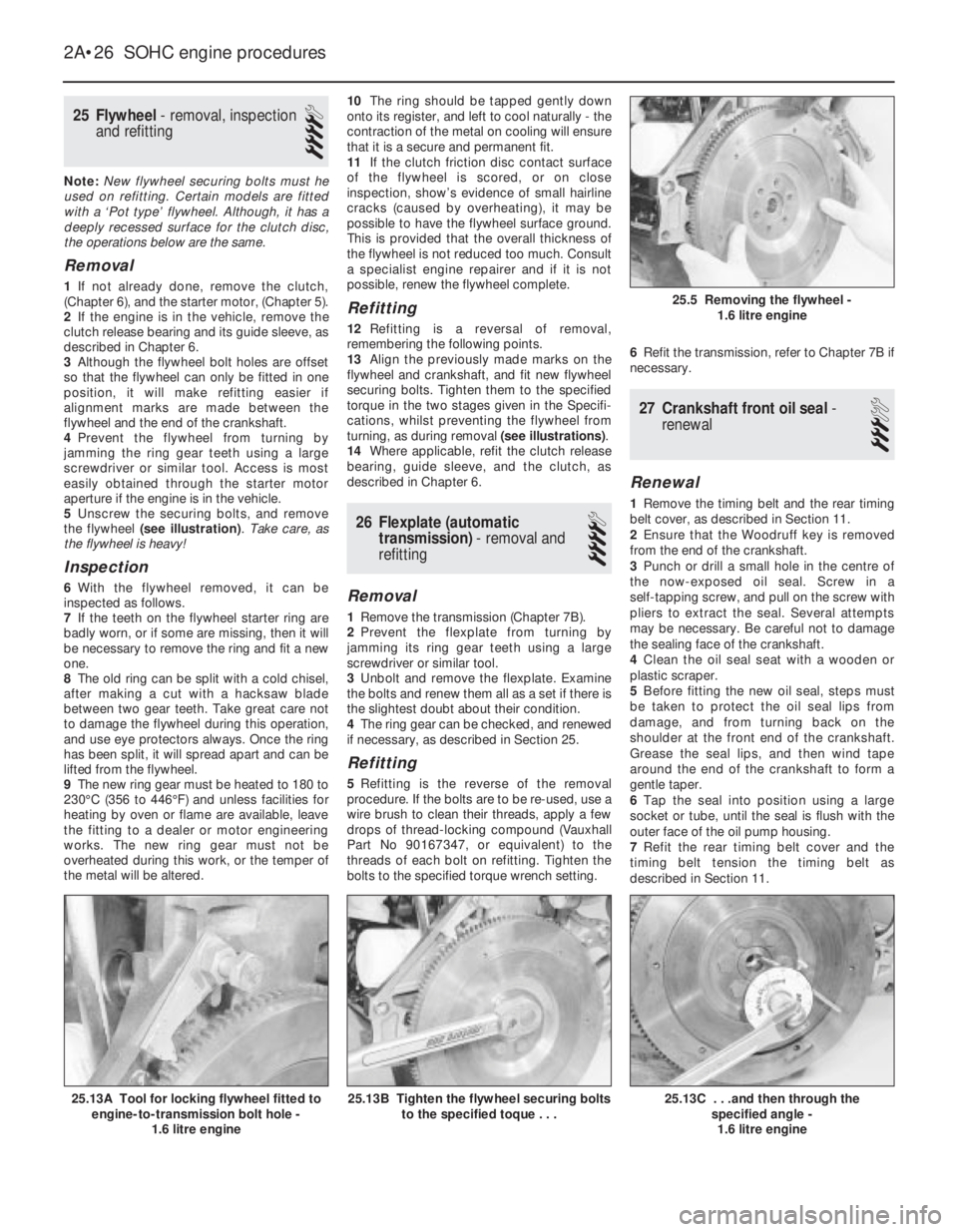
5Unscrew the securing bolts, and remove
the flywheel (see illustration). Take care, as
the flywheel is heavy!
Inspection
6With the flywheel removed, it can be
inspected as follows.
7If the teeth on the flywheel starter ring are
badly worn, or if some are missing, then it will
be necessary to remove the ring and fit a new
one.
8The old ring can be split with a cold chisel,
after making a cut with a hacksaw blade
between two gear teeth. Take great care not
to damage the flywheel during this operation,
and use eye protectors always. Once the ring
has been split, it will spread apart and can be
lifted from the flywheel.
9The new ring gear must be heated to 180 to
230°C (356 to 446°F) and unless facilities for
heating by oven or flame are available, leave
the fitting to a dealer or motor engineering
works. The new ring gear must not be
overheated during this work, or the temper of
the metal will be altered.10The ring should be tapped gently down
onto its register, and left to cool naturally -the
contraction of the metal on cooling will ensure
that it is a secure and permanent fit.
11If the clutch friction disc contact surface
of the flywheel is scored, or on close
inspection, show’s evidence of small hairline
cracks (caused by overheating), it may be
possible to have the flywheel surface ground.
This is provided that the overall thickness of
the flywheel is not reduced too much. Consult
a specialist engine repairer and if it is not
possible, renew the flywheel complete.
Refitting
12Refitting is a reversal of removal,
remembering the following points.
13Align the previously made marks on the
flywheel and crankshaft, and fit new flywheel
securing bolts. Tighten them to the specified
torque in the two stages given in the Specifi-
cations, whilst preventing the flywheel from
turning, as during removal (see illustrations).
14Where applicable, refit the clutch release
bearing, guide sleeve, and the clutch, as
described in Chapter 6.
26Flexplate (automatic
transmission) -removal and
refitting
4
Removal
1Remove the transmission (Chapter 7B).
2Prevent the flexplate from turning by
jamming its ring gear teeth using a large
screwdriver or similar tool.
3Unbolt and remove the flexplate. Examine
the bolts and renew them all as a set if there is
the slightest doubt about their condition.
4The ring gear can be checked, and renewed
if necessary, as described in Section 25.
Refitting
5Refitting is the reverse of the removal
procedure. If the bolts are to be re-used, use a
wire brush to clean their threads, apply a few
drops of thread-locking compound (Vauxhall
Part No 90167347, or equivalent) to the
threads of each bolt on refitting. Tighten the
bolts to the specified torque wrench setting.6Refit the transmission, refer to Chapter 7B if
necessary.
27Crankshaft front oil seal -
renewal
3
Renewal
1Remove the timing belt and the rear timing
belt cover, as described in Section 11.
2Ensure that the Woodruff key is removed
from the end of the crankshaft.
3Punch or drill a small hole in the centre of
the now-exposed oil seal. Screw in a
self-tapping screw, and pull on the screw with
pliers to extract the seal. Several attempts
may be necessary. Be careful not to damage
the sealing face of the crankshaft.
4Clean the oil seal seat with a wooden or
plastic scraper.
5Before fitting the new oil seal, steps must
be taken to protect the oil seal lips from
damage, and from turning back on the
shoulder at the front end of the crankshaft.
Grease the seal lips, and then wind tape
around the end of the crankshaft to form a
gentle taper.
6Tap the seal into position using a large
socket or tube, until the seal is flush with the
outer face of the oil pump housing.
7Refit the rear timing belt cover and the
timing belt tension the timing belt as
described in Section 11.
2A•26SOHC engine procedures
25.13C . . .and then through the
specified angle -
1.6 litre engine25.13B Tighten the flywheel securing bolts
to the specified toque . . .25.13A Tool for locking flywheel fitted to
engine-to-transmission bolt hole -
1.6 litre engine
25.5 Removing the flywheel -
1.6 litre engine
Page 226 of 525
Inspection
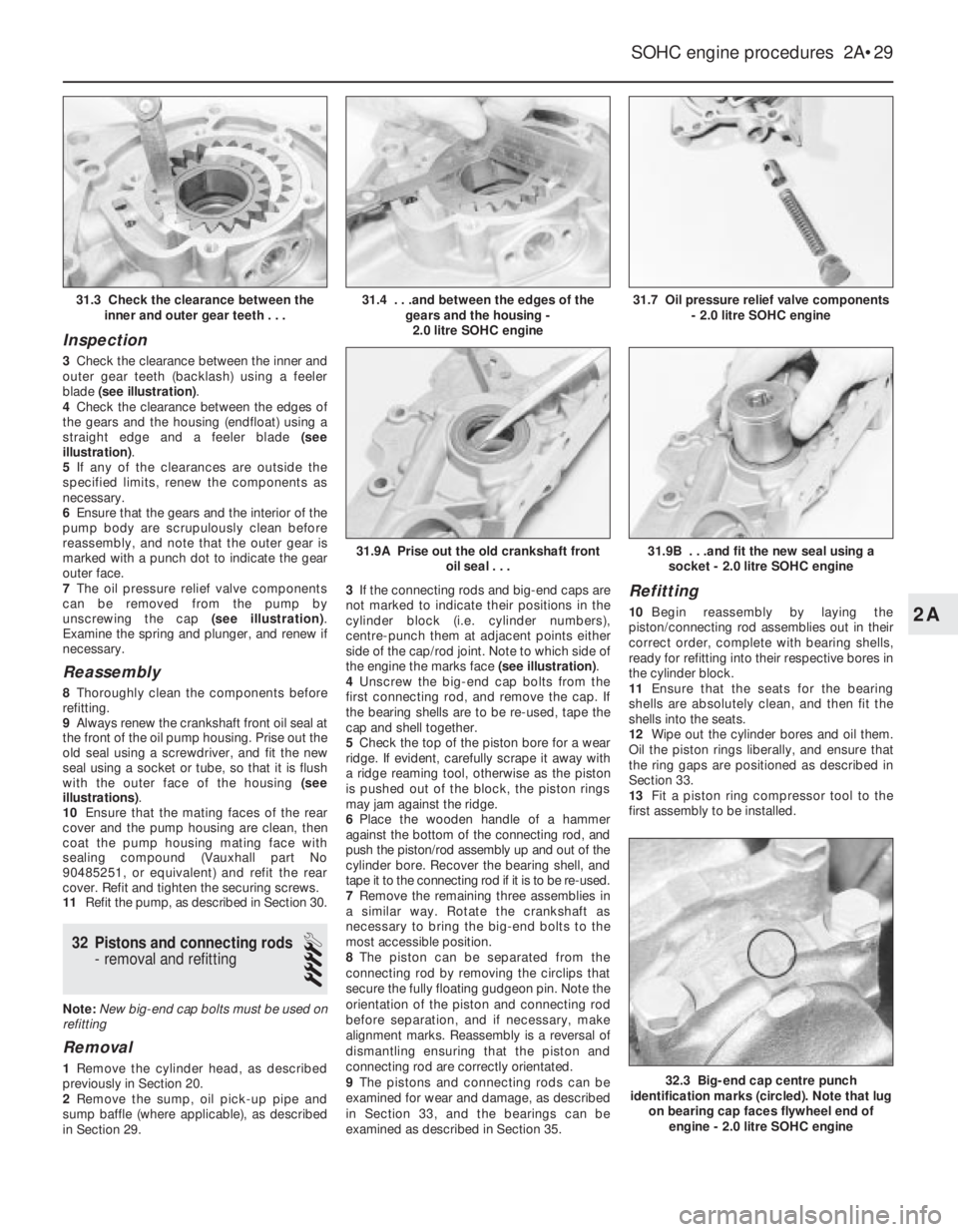
3Check the clearance between the inner and
outer gear teeth (backlash) using a feeler
blade (see illustration).
4Check the clearance between the edges of
the gears and the housing (endfloat) using a
straight edge and a feeler blade (see
illustration).
5If any of the clearances are outside the
specified limits, renew the components as
necessary.
6Ensure that the gears and the interior of the
pump body are scrupulously clean before
reassembly, and note that the outer gear is
marked with a punch dot to indicate the gear
outer face.
7The oil pressure relief valve components
can be removed from the pump by
unscrewing the cap (see illustration).
Examine the spring and plunger, and renew if
necessary.
Reassembly
8Thoroughly clean the components before
refitting.
9Always renew the crankshaft front oil seal at
the front of the oil pump housing. Prise out the
old seal using a screwdriver, and fit the new
seal using a socket or tube, so that it is flush
with the outer face of the housing (see
illustrations).
10Ensure that the mating faces of the rear
cover and the pump housing are clean, then
coat the pump housing mating face with
sealing compound (Vauxhall part No
90485251, or equivalent) and refit the rear
cover. Refit and tighten the securing screws.
11Refit the pump, as described in Section 30.
32Pistons and connecting rods
- removal and refitting
4
Note: New big-end cap bolts must be used on
refitting
Removal
1Remove the cylinder head, as described
previously in Section 20.
2Remove the sump, oil pick-up pipe and
sump baffle (where applicable), as described
in Section 29.3If the connecting rods and big-end caps are
not marked to indicate their positions in the
cylinder block (i.e. cylinder numbers),
centre-punch them at adjacent points either
side of the cap/rod joint. Note to which side of
the engine the marks face (see illustration).
4Unscrew the big-end cap bolts from the
first connecting rod, and remove the cap. If
the bearing shells are to be re-used, tape the
cap and shell together.
5Check the top of the piston bore for a wear
ridge. If evident, carefully scrape it away with
a ridge reaming tool, otherwise as the piston
is pushed out of the block, the piston rings
may jam against the ridge.
6Place the wooden handle of a hammer
against the bottom of the connecting rod, and
push the piston/rod assembly up and out of the
cylinder bore. Recover the bearing shell, and
tape it to the connecting rod if it is to be re-used.
7Remove the remaining three assemblies in
a similar way. Rotate the crankshaft as
necessary to bring the big-end bolts to the
most accessible position.
8The piston can be separated from the
connecting rod by removing the circlips that
secure the fully floating gudgeon pin. Note the
orientation of the piston and connecting rod
before separation, and if necessary, make
alignment marks. Reassembly is a reversal of
dismantling ensuring that the piston and
connecting rod are correctly orientated.
9The pistons and connecting rods can be
examined for wear and damage, as described
in Section 33, and the bearings can be
examined as described in Section 35.
Refitting
10Begin reassembly by laying the
piston/connecting rod assemblies out in their
correct order, complete with bearing shells,
ready for refitting into their respective bores in
the cylinder block.
11Ensure that the seats for the bearing
shells are absolutely clean, and then fit the
shells into the seats.
12Wipe out the cylinder bores and oil them.
Oil the piston rings liberally, and ensure that
the ring gaps are positioned as described in
Section 33.
13Fit a piston ring compressor tool to the
first assembly to be installed.
SOHC engine procedures 2A•29
31.7 Oil pressure relief valve components
- 2.0 litre SOHC engine
32.3 Big-end cap centre punch
identification marks (circled). Note that lug
on bearing cap faces flywheel end of
engine - 2.0 litre SOHC engine
31.9B . . .and fit the new seal using a
socket - 2.0 litre SOHC engine31.9A Prise out the old crankshaft front
oil seal . . .
31.4 . . .and between the edges of the
gears and the housing -
2.0 litre SOHC engine31.3 Check the clearance between the
inner and outer gear teeth . . .
2A
Page 227 of 525
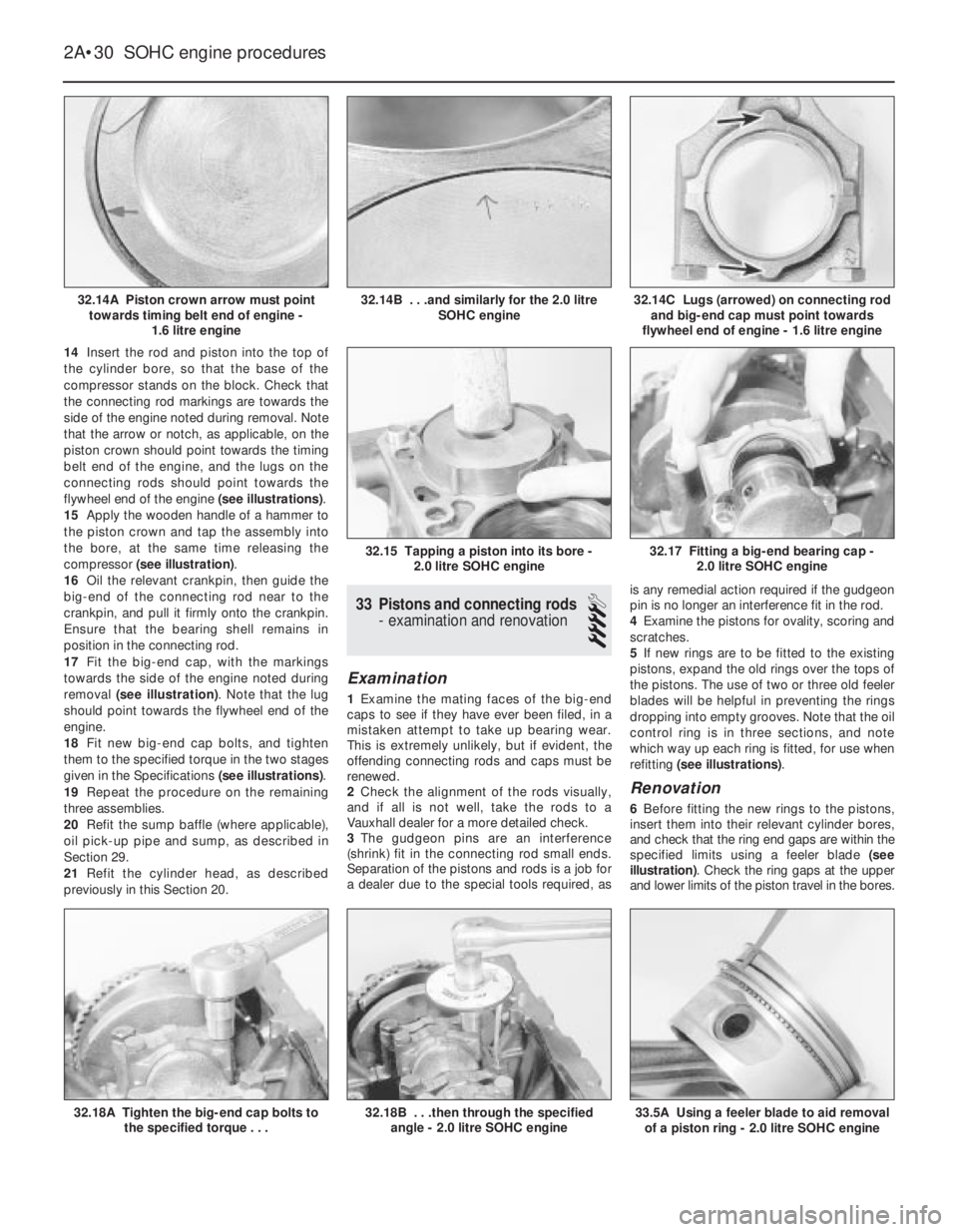
14Insert the rod and piston into the top of
the cylinder bore, so that the base of the
compressor stands on the block. Check that
the connecting rod markings are towards the
side of the engine noted during removal. Note
that the arrow or notch, as applicable, on the
piston crown should point towards the timing
belt end of the engine, and the lugs on the
connecting rods should point towards the
flywheel end of the engine (see illustrations).
15Apply the wooden handle of a hammer to
the piston crown and tap the assembly into
the bore, at the same time releasing the
compressor (see illustration).
16Oil the relevant crankpin, then guide the
big-end of the connecting rod near to the
crankpin, and pull it firmly onto the crankpin.
Ensure that the bearing shell remains in
position in the connecting rod.
17Fit the big-end cap, with the markings
towards the side of the engine noted during
removal (see illustration). Note that the lug
should point towards the flywheel end of the
engine.
18Fit new big-end cap bolts, and tighten
them to the specified torque in the two stages
given in the Specifications (see illustrations).
19Repeat the procedure on the remaining
three assemblies.
20Refit the sump baffle (where applicable),
oil pick-up pipe and sump, as described in
Section 29.
21Refit the cylinder head, as described
previously in this Section 20.
33Pistons and connecting rods
-examination and renovation
4
Examination
1Examine the mating faces of the big-end
caps to see if they have ever been filed, in a
mistaken attempt to take up bearing wear.
This is extremely unlikely, but if evident, the
offending connecting rods and caps must be
renewed.
2Check the alignment of the rods visually,
and if all is not well, take the rods to a
Vauxhall dealer for a more detailed check.
3The gudgeon pins are an interference
(shrink) fit in the connecting rod small ends.
Separation of the pistons and rods is a job for
a dealer due to the special tools required, asis any remedial action required if the gudgeon
pin is no longer an interference fit in the rod.
4Examine the pistons for ovality, scoring and
scratches.
5If new rings are to be fitted to the existing
pistons, expand the old rings over the tops of
the pistons. The use of two or three old feeler
blades will be helpful in preventing the rings
dropping into empty grooves. Note that the oil
control ring is in three sections, and note
which way up each ring is fitted, for use when
refitting (see illustrations).
Renovation
6Before fitting the new rings to the pistons,
insert them into their relevant cylinder bores,
and check that the ring end gaps are within the
specified limits using a feeler blade (see
illustration). Check the ring gaps at the upper
and lower limits of the piston travel in the bores.
2A•30SOHC engine procedures
32.14A Piston crown arrow must point
towards timing belt end of engine -
1.6 litre engine32.14C Lugs (arrowed) on connecting rod
and big-end cap must point towards
flywheel end of engine - 1.6 litre engine
33.5A Using a feeler blade to aid removal
of a piston ring - 2.0 litre SOHC engine32.18B . . .then through the specified
angle - 2.0 litre SOHC engine32.18A Tighten the big-end cap bolts to
the specified torque . . .
32.17 Fitting a big-end bearing cap -
2.0 litre SOHC engine32.15 Tapping a piston into its bore -
2.0 litre SOHC engine
32.14B . . .and similarly for the 2.0 litre
SOHC engine
Page 228 of 525
7If any of the ring end gaps exceed the
specified tolerance, the relevant rings will have
to be renewed, and if the ring grooves in the
pistons are worn, new pistons may be required.
8Clean out the piston ring grooves using a
piece of old piston ring as a scraper. Take
care not to scratch the surface of the pistons.
Protect your fingers, piston ring edges are
sharp. Also probe the groove oil return holes,
to ensure that they are not blocked.
9Check the cylinder bores for signs of wear
ridges towards the top of the bores. If wear
ridges are evident, and new piston rings are
being fitted, the top ring must be stepped to
clear the wear ridge, or the bore must be
de-ridged using a scraper.
10Fit the oil control ring sections with the
lower steel ring gap offset 25 to 50 mm to the
right of the spreader ring gap, and the upper
steel ring gap offset by the same distance to
the left of the spreader ring gap.
11Fit the lower compression ring, noting that
the ring is tapered or stepped. The ring should
be fitted with the word “TOP” uppermost.
12Fit the upper compression ring, and offset
the ring gap by 180°to the lower compression
ring gap. If a stepped ring is being fitted, fit
the ring with the smaller diameter of the step
uppermost.
13If new pistons are to be fitted, they must
be selected from the grades available, after
measuring the cylinder bores as described in
Section 36.
14Normally the appropriate oversize pistons
are supplied by the dealer when the block is
rebored.15Whenever new piston rings are being
installed, the glaze on the original cylinder
bores should be “broken”, using either
abrasive paper or a glaze-removing tool in an
electric drill. If abrasive paper is used, use
strokes at 60°to the bore centre line, to create
a cross-hatching effect.
34Crankshaft and bearings -
removal and refitting
4
Note: New main bearing cap bolts must be
used on refitting
Removal
1With the engine removed from the vehicle,
continue as follows.
2Remove the cylinder head, as described
previously in Section 20.
3Remove the sump, oil pick-up pipe and
sump baffle (where applicable), as described
in Section 29.
4Remove the oil pump, as described in
Section 30.
5Remove the flywheel or flexplate (if
applicable), as described in Sections 25 and
26.
6Remove the pistons and connecting rods,
as described in Section 32.
7Invert the engine so that it is standing on
the top face of the cylinder block.
8The main bearing caps are numbered 1 to 4
from the timing belt end of the engine. The
rear (flywheel end) cap is not marked. Toensure that the caps are refitted the correct
way round, note that the numbers are read
from the coolant pump side of the engine with
the engine inverted (see illustration).
9Unscrew and remove the main bearing cap
bolts, and tap off the bearing caps. If the
bearing shells are to be re-used, tape them to
their respective caps.
10Note that the centre bearing shell
incorporates thrust flanges to control
crankshaft endfloat.
11Lift the crankshaft (complete with timing
sensor wheel, if fitted), from the crankcase.
12Extract the upper bearing shells, and
identify them for position if they are to be
re-used.
13The crankshaft, bearings and sensor
wheel can be examined for wear and damage,
as described in Section 35, and the cylinder
block and bores can be examined as
described in Section 36.
Refitting
14Begin refitting by ensuring that the
crankcase and crankshaft are thoroughly
clean, and that all oilways are clear. If
possible, blow through the oil drillings with
compressed air, and inject clean engine oil
into them.
15If the crankshaft is being replaced, where
applicable, transfer the timing sensor wheel
and tighten to correct torque.
16Wipe clean the bearing shell seats in the
crankcase and the bearing caps, then fit the
upper bearing shells to their seats.
17Note that there is a tag on the back of
each bearing shell, which engages with a
groove in the relevant seat in the crankcase or
bearing cap (see illustration).
18If new bearing shells are being fitted, wipe
away all traces of protective grease.
SOHC engine procedures 2A•31
33.6 Measuring a piston ring end gap
using a feeler blade34.8 Main bearing cap identification mark
(arrowed) - 1.6 litre engine34.17 Main bearing shell tag (arrowed)
engages with groove in cylinder block -
2.0 litre SOHC engine
33.5C Sectional view showing correct
orientation of piston rings - all engines33.5B Removing the centre section of the
oil control ring - 2.0 litre SOHC engine
2A
A good alternative to
compressed air, is to use a
water dispersing lubricant
spray into each hole, using
the spout provided.
Page 229 of 525
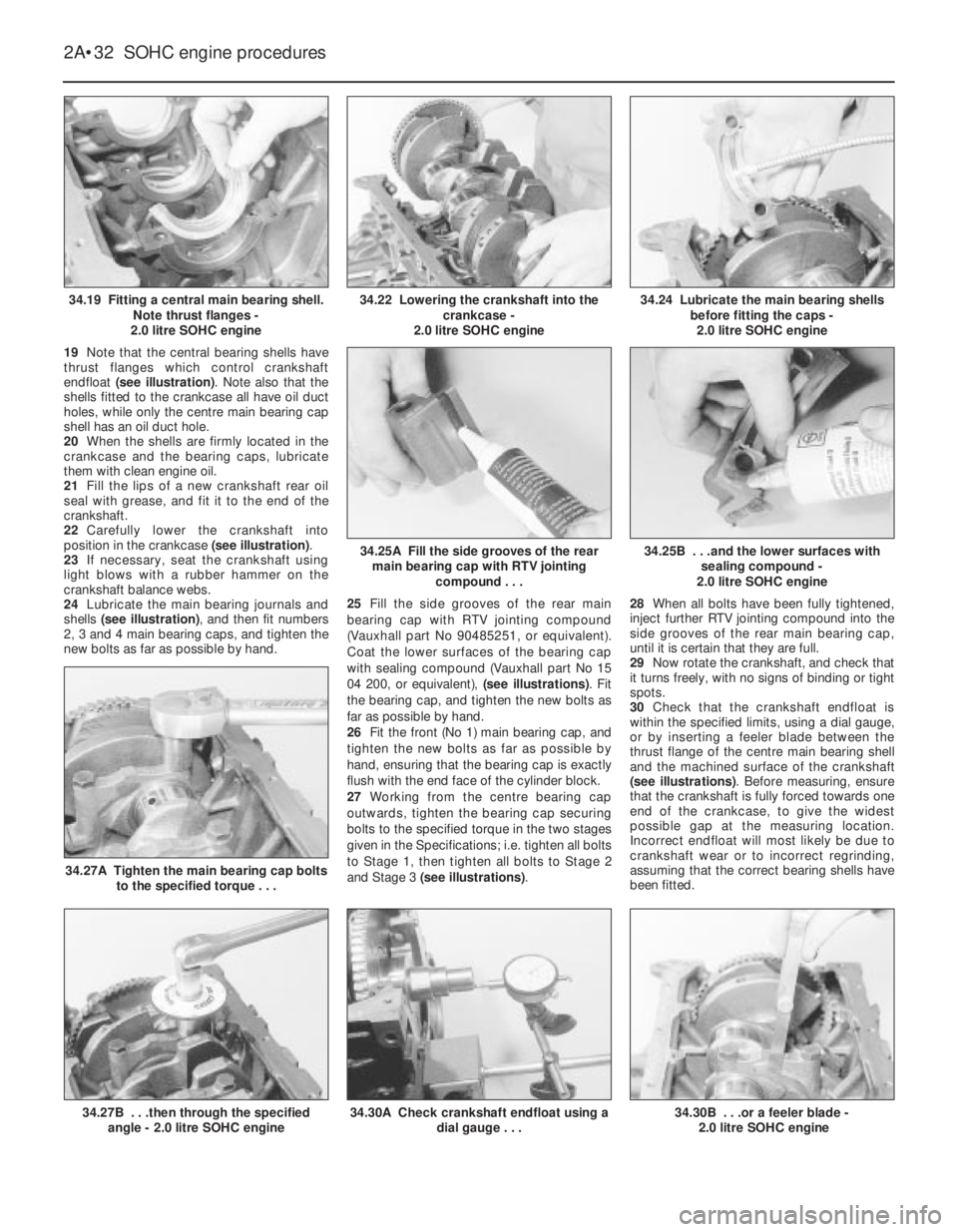
19Note that the central bearing shells have
thrust flanges which control crankshaft
endfloat (see illustration). Note also that the
shells fitted to the crankcase all have oil duct
holes, while only the centre main bearing cap
shell has an oil duct hole.
20When the shells are firmly located in the
crankcase and the bearing caps, lubricate
them with clean engine oil.
21Fill the lips of a new crankshaft rear oil
seal with grease, and fit it to the end of the
crankshaft.
22Carefully lower the crankshaft into
position in the crankcase (see illustration).
23If necessary, seat the crankshaft using
light blows with a rubber hammer on the
crankshaft balance webs.
24Lubricate the main bearing journals and
shells (see illustration), and then fit numbers
2, 3 and 4 main bearing caps, and tighten the
new bolts as far as possible by hand.25Fill the side grooves of the rear main
bearing cap with RTV jointing compound
(Vauxhall part No 90485251, or equivalent).
Coat the lower surfaces of the bearing cap
with sealing compound (Vauxhall part No 15
04 200, or equivalent), (see illustrations). Fit
the bearing cap, and tighten the new bolts as
far as possible by hand.
26Fit the front (No 1) main bearing cap, and
tighten the new bolts as far as possible by
hand, ensuring that the bearing cap is exactly
flush with the end face of the cylinder block.
27Working from the centre bearing cap
outwards, tighten the bearing cap securing
bolts to the specified torque in the two stages
given in the Specifications; i.e. tighten all bolts
to Stage 1, then tighten all bolts to Stage 2
and Stage 3 (see illustrations).28When all bolts have been fully tightened,
inject further RTV jointing compound into the
side grooves of the rear main bearing cap,
until it is certain that they are full.
29Now rotate the crankshaft, and check that
it turns freely, with no signs of binding or tight
spots.
30Check that the crankshaft endfloat is
within the specified limits, using a dial gauge,
or by inserting a feeler blade between the
thrust flange of the centre main bearing shell
and the machined surface of the crankshaft
(see illustrations). Before measuring, ensure
that the crankshaft is fully forced towards one
end of the crankcase, to give the widest
possible gap at the measuring location.
Incorrect endfloat will most likely be due to
crankshaft wear or to incorrect regrinding,
assuming that the correct bearing shells have
been fitted.
2A•32SOHC engine procedures
34.19 Fitting a central main bearing shell.
Note thrust flanges -
2.0 litre SOHC engine34.24 Lubricate the main bearing shells
before fitting the caps -
2.0 litre SOHC engine
34.30B . . .or a feeler blade -
2.0 litre SOHC engine
34.27A Tighten the main bearing cap bolts
to the specified torque . . .
34.27B . . .then through the specified
angle - 2.0 litre SOHC engine34.30A Check crankshaft endfloat using a
dial gauge . . .
34.25B . . .and the lower surfaces with
sealing compound -
2.0 litre SOHC engine34.25A Fill the side grooves of the rear
main bearing cap with RTV jointing
compound . . .
34.22 Lowering the crankshaft into the
crankcase -
2.0 litre SOHC engine
Page 230 of 525
31Refit the previously removed
components, referring to the relevant
Sections of this Chapter.
35Crankshaft and bearings -
examination
4
Examination
1Examine the crankpin and main journal
surfaces for signs of scoring or scratches, and
check the ovality and taper of the crankpins
and main journals. If the bearing surface
dimensions do not fall within the tolerance
ranges given in the Specifications at the
beginning of this Chapter, the crankpins
and/or main journals will have to be reground.
2Big-end and crankpin wear is accompanied
by distinct metallic knocking, particularly
noticeable when the engine is pulling from low
revs, and some loss of oil pressure.
3Main bearing and main journal wear is
accompanied by severe engine vibration rumble
- getting progressively worse as engine rev’s
increase - and again by loss of oil pressure.
4If the crankshaft requires regrinding, take it
to an engine reconditioning specialist, who
will machine it for you and supply the correct
undersize bearing shells.
5Inspect the big-end and main bearing shells
for signs of general wear, scoring, pitting and
scratches. The bearings should be matt grey
in colour. With leadindium bearings, should a
trace of copper colour be noticed, the
bearings are badly worn, as the lead bearing
material has worn away to expose the indium
underlay. Renew the bearings if they are in
this condition, or if there are any signs of
scoring or pitting. You are strongly advised
to renew the bearings - regardless of their
condition at time of major overhaul.
Refitting used bearings is a false economy.
6The undersizes available are designed to
correspond with crankshaft regrind sizes. Thebearings are in fact, slightly more than the
stated undersize, as running clearances have
been allowed for during their manufacture.
7Main and big-end bearing shells can be
identified as to size by the marking on the
back of the shell. Standard size shell bearings
are marked STD or .00, undersize shells are
marked with the undersize such as 0.020 u/s.
This marking method applies only to
replacement bearing shells, and not to those
used during production.
8An accurate method of determining bearing
wear is by using a Plastigage. The crankshaft
is located in the main bearings (and, if
necessary, the big-end bearings), and the
Plastigage filament is located across the
journal. Vauxhall recommend that the
crankshaft journal and bearing shells are
lightly lubricated, to prevent the Plastigage
from tearing as the bearing cap is removed.
The bearing cap should be fitted, and the
bolts tightened to the specified torque. The
cap is then removed, and the width of the
filament is checked against a scale that shows
the bearing running clearance. The clearance
should be compared with that given in the
Specifications.
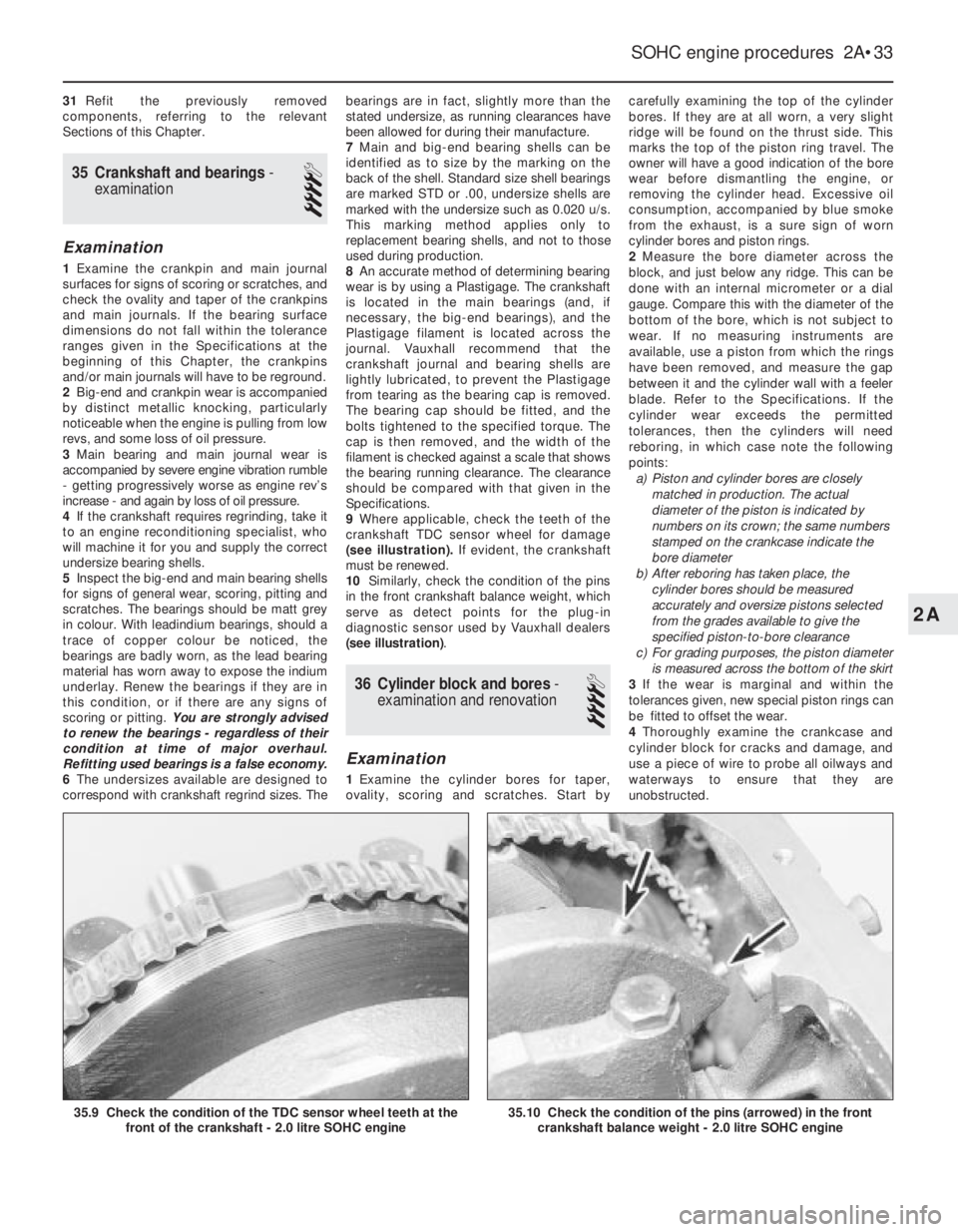
9Where applicable, check the teeth of the
crankshaft TDC sensor wheel for damage
(see illustration). If evident, the crankshaft
must be renewed.
10Similarly, check the condition of the pins
in the front crankshaft balance weight, which
serve as detect points for the plug-in
diagnostic sensor used by Vauxhall dealers
(see illustration).
36Cylinder block and bores -
examination and renovation
4
Examination
1Examine the cylinder bores for taper,
ovality, scoring and scratches. Start bycarefully examining the top of the cylinder
bores. If they are at all worn, a very slight
ridge will be found on the thrust side. This
marks the top of the piston ring travel. The
owner will have a good indication of the bore
wear before dismantling the engine, or
removing the cylinder head. Excessive oil
consumption, accompanied by blue smoke
from the exhaust, is a sure sign of worn
cylinder bores and piston rings.
2Measure the bore diameter across the
block, and just below any ridge. This can be
done with an internal micrometer or a dial
gauge. Compare this with the diameter of the
bottom of the bore, which is not subject to
wear. If no measuring instruments are
available, use a piston from which the rings
have been removed, and measure the gap
between it and the cylinder wall with a feeler
blade. Refer to the Specifications. If the
cylinder wear exceeds the permitted
tolerances, then the cylinders will need
reboring, in which case note the following
points:
a)Piston and cylinder bores are closely
matched in production. The actual
diameter of the piston is indicated by
numbers on its crown; the same numbers
stamped on the crankcase indicate the
bore diameter
b)After reboring has taken place, the
cylinder bores should be measured
accurately and oversize pistons selected
from the grades available to give the
specified piston-to-bore clearance
c)For grading purposes, the piston diameter
is measured across the bottom of the skirt
3If the wear is marginal and within the
tolerances given, new special piston rings can
be fitted to offset the wear.
4Thoroughly examine the crankcase and
cylinder block for cracks and damage, and
use a piece of wire to probe all oilways and
waterways to ensure that they are
unobstructed.
SOHC engine procedures 2A•33
35.10 Check the condition of the pins (arrowed) in the front
crankshaft balance weight - 2.0 litre SOHC engine35.9 Check the condition of the TDC sensor wheel teeth at the
front of the crankshaft - 2.0 litre SOHC engine
2A
Page 231 of 525
5Note that the rubber plug located next to
the bellhousing flange on the cylinder block
covers the aperture for the installation of a
diagnostic TDC sensor. The sensor, when
connected to a monitoring unit, indicates TDC
from the position of the pins set into the
crankshaft balance weight.
37Examination and renovation
-general
4
General
1With the engine completely stripped, clean all
components and examine them for wear. Each
component should be checked, and where
necessary renewed or renovated, as described
in the relevant Sections of this Chapter.
2Renew main and big-end bearing shells as
a matter of course, unless it is known that
they have had little wear, and are in perfect
condition.
3If in doubt whether to renew a component
that is still just serviceable, consider the time
and effort that will be incurred should the
component fail at an early date after rebuild.
Obviously, the age and expected life of the
vehicle must influence the standards applied.4Gaskets, oil seals and O-rings must all be
renewed as a matter of routine. Flywheel,
cylinder head, and main and big-end bearing
cap bolts must be renewed, because of the
high stress to which they are subjected.
5Renew the engine core plugs while they are
easily accessible, if they show signs of
leakage. Knock out the old plugs with a
hammer and chisel or punch. Clean the plug
seats, smear the new plugs with sealing
compound, and tap them squarely into
position.
38Initial start-up after major
overhaul or repair
2
1Make a final check to ensure that
everything has been reconnected to the
engine, and that no rags or tools have been
left in the engine compartment.
2Check that oil and coolant levels are
correct.
3Start the engine. This may take a little longer
than usual, as fuel is pumped to the engine.
4Check that the oil pressure warning lamp
goes out when the engine starts. This may
take a few seconds as the new oil filter fills
with oil.5Run the engine at a fast tickover, and check
for leaks of oil, fuel and coolant. If a new
camshaft has been fitted, pay careful
attention to the running-in procedure given in
Section 18, paragraphs 17 and 18. Where
applicable, check the power steering and/or
automatic transmission fluid cooler unions for
leakage. Some smoke and odd smells may be
experienced, as assembly lubricants and
sealers burn off the various components.
6Bring the engine to normal operating
temperature. Check the ignition timing, idle
speed and the mixture (where applicable), as
described in Chapter 4A or 4B.
7Allow the engine to cool, then recheck the
oil and coolant levels. Top-up if necessary
8If new bearings, pistons, etc., have been
fitted, the engine should be run-in at reduced
speeds and loads for the first 500 miles (800
km) or so. It is beneficial to change the engine
oil and filter after this mileage.
2A•34SOHC engine procedures
Page 233 of 525
1General description
Engine cooling is achieved by a
conventional pump-assisted system, in which
the coolant is pressurised. The system
consists of a radiator, a coolant pump driven
by the engine timing belt, an electric cooling
fan, a thermostat, an expansion tank, and
connecting hoses. Hoses also carry coolant to
and from the heater matrix, which provides
heat for the ventilation and heating system.
The system works in the following way.
Cold coolant from one side of the radiator,
which is mounted at the front of the engine
compartment, passes to the coolant pump,
which forces the coolant through the coolant
passages in the cylinder block and cylinder
head. The coolant absorbs heat from the
engine, and then returns to the radiator
through the heater matrix. As the coolant
flows across the radiator it is cooled, and the
cycle is repeated.
Air flows through the radiator, to cool the
coolant as a result of the vehicle’s forward
motion. However, if the coolant temperature
exceeds a given figure, a
temperature-sensitive switch in the radiator
switches on the electric fan, to increase the
airflow through the radiator. The fan only
operates when necessary, with a consequent
reduction in noise and energy consumption.
To reduce the time taken for the engine to
warm up when starting from cold, the
thermostat, located in the cylinder head
outlet, prevents coolant flowing to the radiator
until the temperature has risen sufficiently.
Instead, the outflow from the cylinder head
bypasses the radiator, and is redirected
around the engine. When the temperature
reaches a given figure, the thermostat opens,
to allow coolant to flow to the radiator. The
thermostat is operated by the expansion of a
temperature sensitive wax capsule.
An expansion tank is incorporated in the
system, to allow for coolant expansion. The
system is topped up through a filler cap on
the expansion tank.
Note that later models may be fitted with
self-tensioning spring clamps to secure the
cooling system (including heater) hoses.
These clamps can be released by squeezing
together their free ends using a large pair of
self-grip pliers or similar so that the clamp can
be moved up the hose, clear of the union.
Check that the clamp is securely seated, and
check for leaks on reassembly.
2Cooling system -draining
2
1With the vehicle parked on level ground,
remove the expansion tank filler cap. If the
engine is warm, cover the filler cap with a
thick cloth, and unscrew the cap slowly, to
gradually relieve the system pressure. Take
care to avoid scalding by steam or coolant
escaping from the pressurised system.
2On DOHC models, remove the engine
undershield, with reference to Chapter 11.
3Position a container beneath the radiator
bottom hose connection, then slacken the
hose clip and ease the hose from the radiator
stub. If the hose joint has not been disturbed
for some time, it will be necessary to
manipulate the hose to break the joint. Allow
the coolant to drain into the container.
4As no cylinder block drain plug is fitted, and
the radiator bottom hose may be situated
halfway up the radiator, the system cannot be
drained completely. Care should therefore be
taken when refilling the system to maintain
antifreeze strength.
5If the coolant has been drained for a reason
other than renewal, then provided it is clean
and less than two years old, it can be re-used.
6If the coolant has been drained for renewal,
and is badly contaminated, the coolant
system should be flushed as described in
Section 4. As the system cannot be drained
completely, it is advisable to flush the system
whenever the coolant is renewed, to minimise
the impurities remaining in the system.
3Cooling system -flushing
2
1If coolant renewal has been neglected, or if
the antifreeze mixture has become diluted,
then in time the cooling system will gradually
lose efficiency, as the coolant passages
become restricted due to rust, scale deposits
and other sediment. To restore coolant
system efficiency, it is necessary to flush the
system clean.
2The radiator should be flushed
independently of the engine, to avoid
unnecessary contamination.
3To flush the radiator, disconnect the top
hose at the radiator, then insert a garden hose
into the radiator top inlet. Direct a flow of
clean water through the radiator, and continue
flushing until clean water emerges from the
radiator bottom outlet (the bottom hose
should have been disconnected to drain the
system). If after a reasonable period, the water
still does not run clear, the radiator can be
flushed with a good proprietary cleaning
agent. It is important that the manufacturer’s
instructions are followed carefully. If the
contamination is particularly bad, insert the
hose in the radiator bottom outlet, and flush
the radiator in reverse.
4To flush the engine, continue as follows.
1.4 and 1.6 litre models (except
C16 NZ2)
5Remove the thermostat as described in
Section 9, then temporarily refit the
thermostat cover.
6With the radiator top and bottom hoses
disconnected from the radiator, insert a
garden hose into the radiator bottom hose.
Direct a flow of clean water through the
engine, and continue flushing until clean water
emerges from the radiator top hose.
7On completion of flushing, refit the
thermostat, and reconnect the hoses.
C16 NZ2, 1.8 and 2.0 litre
models
8Remove the thermostat and cover
assembly, as described in Section 9.
9With the radiator bottom hose
disconnected from the radiator, insert a
garden hose into the radiator bottom hose.
Direct a flow of clean water through the
engine, and continue flushing until clean water
emerges from the thermostat housing. It is
advisable to place a sheet of plastic under the
thermostat housing to deflect water away
from the engine and surrounding components
during the flushing process.
10On completion of flushing, refit the
thermostat and cover assembly, reconnect
the hoses and remove the sheet of plastic.
4Cooling system -filling
2
1Before attempting to fill the cooling system,
make sure that all hoses and clips are in good
condition, and that the clips are tight. Note
that an antifreeze mixture must be used all
year round, to prevent corrosion of the alloy
engine components -refer to Section 5.
2On 1.4 and 1.6 litre models (except C16
NZ2), disconnect the wire and unscrew the
coolant temperature sender from the inlet
manifold.
3Remove the expansion tank cap, and fill the
system by slowly pouring the coolant into the
expansion tank to prevent air locks from
forming.
4If the coolant is being renewed, begin by
pouring in a couple of pints of water, followed
by the correct quantity of antifreeze (see
Section 5), then top-up with more water.
5On 1.4 and 1.6 litre models (except C16
NZ2), refit the coolant temperature sender
when coolant free of air bubbles emerges
from the orifice in the inlet manifold.
6Top-up the coolant level to the “COLD” (or
“KALT”) mark on the expansion tank, then refit
the expansion tank cap.
7Start the engine and run it until it reaches
normal operating temperature, then stop the
engine and allow it to cool.
8Check for leaks, particularly around
disturbed components. Check the coolant
3•2Cooling, heating and ventilation systems
When renewing any hoses,
use a little soapy water as a
lubricant, or soften the hose
in hot water. Do not use oil or
grease, as this may attack the rubber.
Page 234 of 525
level in the expansion tank, and top-up if
necessary. Note that the system must be cold
before an accurate level is indicated in the
expansion tank. If the expansion tank cap is
removed while the engine is still warm, cover
the cap with a thick cloth and unscrew the
cap slowly, to gradually relieve the system
pressure. Take care to avoid scalding by
steam or coolant escaping from the
pressurised system.
9On DOHC models, refit the engine
undershield on completion.
5Coolant mixture -general
1It is important to use an antifreeze mixture
in the cooling system all year round, to
prevent corrosion of the alloy engine
components. The coolant mixture should be
made up from clean, preferably soft, tap
water, and a good quality antifreeze
containing corrosion inhibitor. Ensure that the
antifreeze is ethylene glycol based, as the
cheaper methanol based types evaporate
over a period of time.
2The proportions of water and antifreeze
used will depend on the degree of protection
required. A coolant mixture containing 25%
antifreeze should be regarded as the
minimum strength required to maintain good
anti-corrosion properties. Details of the
degree of protection provided against freezing
will be supplied with the antifreeze by the
manufacturers. For absolute protection, use a
50% antifreeze mixture.
3The coolant mixture should be renewed
every two years, as the corrosion inhibitors
will deteriorate with time.
4Before filling the system with fresh coolant,
drain and flush the system, as described in
Sections 2 and 3, and check that all hoses are
secure and that the clips are tight. Antifreeze
has a searching action, and will leak morerapidly than plain water.
5Refill the system as described in Section 4.
All future topping-up should be carried out
using a coolant mixture of the same
proportions as that used to initially fill the
system.
6Do not use antifreeze in the windscreen
wash system, as it will attack the vehicle
paintwork. Note that antifreeze is poisonous,
and must be handled with due care.
6Radiator (manual
transmission) -removal and
refitting
3
Removal
1The radiator can be removed complete with
the coolant fan and shroud if there is no need
to disturb the fan. If desired, the fan and its
shroud can be removed from the radiator,
with reference to Section 12.
2Drain the cooling system, as described in
Section 2.
3Disconnect the radiator top hose and the
expansion tank at the radiator.
4Disconnect the battery negative lead, then
disconnect the wiring from the cooling fan
switch, located at the bottom right-hand side
of the radiator.5Disconnect the cooling fan wiring
connector, noting its location for use when
refitting.
6Compress and remove the two radiator
securing clips, located at the top corners of
the radiator (see illustration).
7Pull the top of the radiator back towards the
engine to free it from the top mountings, then
lift the radiator to disengage the lower
securing lugs. Move the radiator clear of the
vehicle, taking care not to damage the cooling
fins (see illustrations).
Refitting
8The radiator can be inspected and cleaned
as described in Section 8.
9Refitting is a reversal of removal, bearing in
mind the following points.
10Ensure that the radiator rubber mountings
are in good condition and renew if necessary,
and ensure that the lower securing lugs
engage correctly as the radiator is refitted.
11Refill the cooling system, (Section 4).
7Radiator (automatic
transmission) -removal and
refitting
3
Removal
1On models with automatic transmission,
the radiator left-hand side tank incorporates a
heat exchanger to cool the transmission fluid.
It is connected to the transmission by a pair of
flexible hoses, with a metal pipe at each end.
2When removing the radiator, either clamp
the transmission fluid cooler flexible hoses, or
slacken their clamps, work them off their
unions and swiftly plug or cap each hose end
and union to minimise the loss of fluid and to
prevent the entry of dirt.
Refitting
3On refitting, reverse the removal procedure
and do not forget to check the transmission
fluid level, topping-up as necessary to replace
the lost fluid, as described in Chapter 7B.
Cooling, heating and ventilation systems 3•3
6.7B Withdrawing the radiator -
2.0 litre SOHC model6.7A Radiator freed from top right-hand mounting -
1.6 litre model
6.6 Compressing a radiator securing clip -
2.0 litre SOHC model
3