brake OPEL COMBO 2010 User Guide
[x] Cancel search | Manufacturer: OPEL, Model Year: 2010, Model line: COMBO, Model: OPEL COMBO 2010Pages: 212, PDF Size: 2.49 MB
Page 106 of 212
100 Driving and operationDriving and operation
Manual transmission
automated
3
The Easytronic transmission permits
manual (manual mode) or automatic gear
shifting (automatic mode), both with
automatic clutch control.
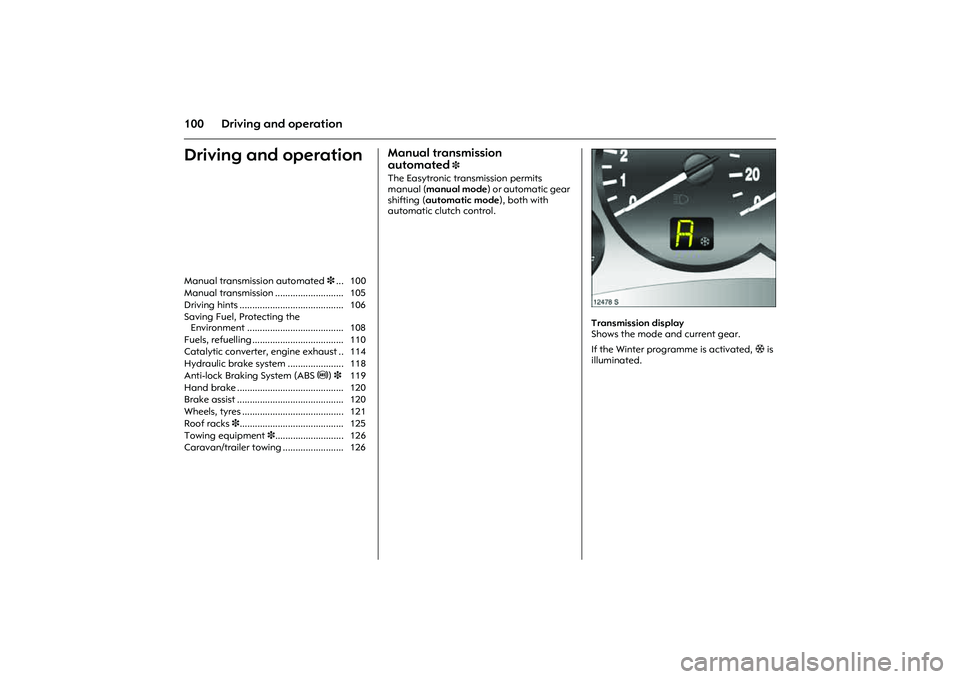
Picture no: 12478s.tif
Transmission display
Shows the mode and current gear.
If the Winter programme is activated, T is
illuminated. Manual transmission automated3... 100
Manual transmission ........................... 105
Driving hints ......................................... 106
Saving Fuel, Protecting the
Environment ...................................... 108
Fuels, refuelling .................................... 110
Catalytic converter, engine exhaust .. 114
Hydraulic brake system ...................... 118
Anti-lock Braking System (ABSu)3 119
Hand brake .......................................... 120
Brake assist .......................................... 120
Wheels, tyres ........................................ 121
Roof racks 3......................................... 125
Towing equipment 3........................... 126
Caravan/trailer towing ........................ 126
Page 107 of 212
101
Driving and operation
Starting the engine
Briefly operate foot brake when starting
the engine. The engine can now be started
in position N and with the foot brake
operated. N appears in the gear display. If
the foot brake is not operated, "N" flashes
in the gear display and the engine cannot
be started.
If no brake lights are operational, the
engine will not start.
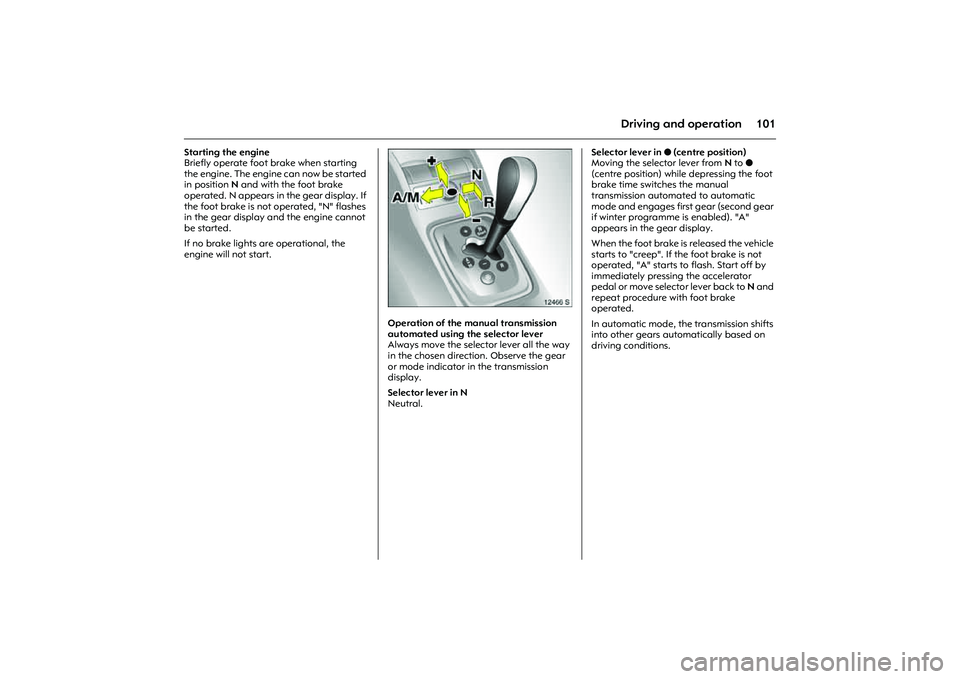
Picture no: 12466s.tif
Operation of the manual transmission
automated using the selector lever
Always move the selector lever all the way
in the chosen direction. Observe the gear
or mode indicator in the transmission
display.
Selector lever in N
Neutral. Selector lever in o (centre position)
Moving the selector lever from N to o
(centre position) while depressing the foot
brake time switches the manual
transmission automated to automatic
mode and engages first gear (second gear
if winter programme is enabled). "A"
appears in the gear display.
When the foot brake is released the vehicle
starts to "creep". If the foot brake is not
operated, "A" starts to flash. Start off by
immediately pressing the accelerator
pedal or move selector lever back to N and
repeat procedure with foot brake
operated.
In automatic mode, the transmission shifts
into other gears automatically based on
driving conditions.
Page 108 of 212
102 Driving and operation
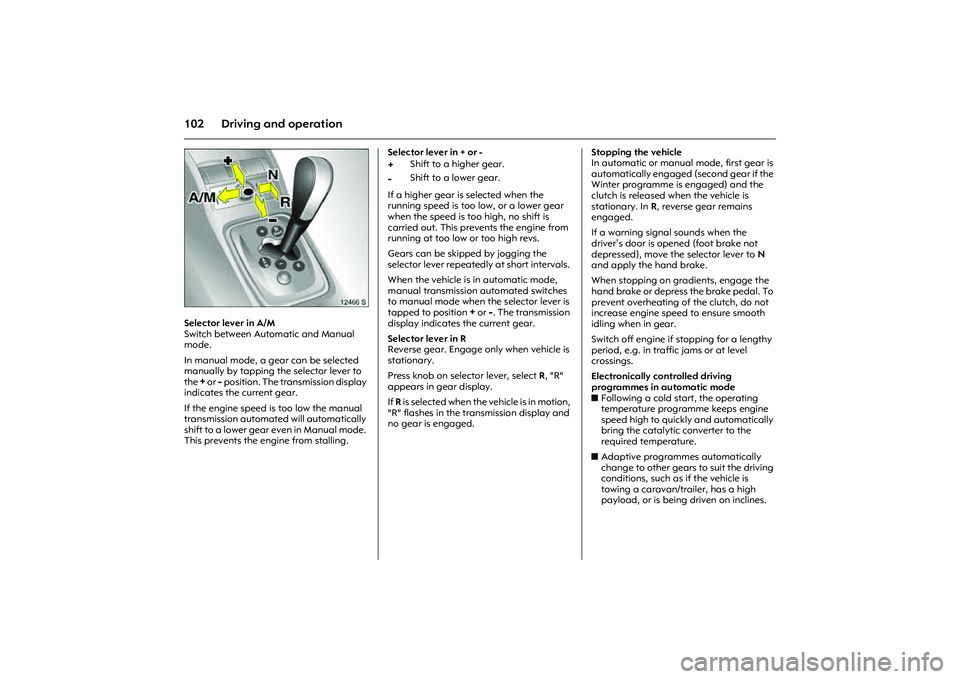
Picture no: 12466s.tif
Selector lever in A/M
Switch between Automatic and Manual
mode.
In manual mode, a gear can be selected
manually by tapping the selector lever to
the
+ or
- position. The transmission display
indicates the current gear.
If the engine speed is too low the manual
transmission automated will automatically
shift to a lower gear even in Manual mode.
This prevents the engine from stalling. Selector lever in + or -
If a higher gear is selected when the
running speed is too low, or a lower gear
when the speed is too high, no shift is
carried out. This prevents the engine from
running at too low or too high revs.
Gears can be skipped by jogging the
selector lever repeatedly at short intervals.
When the vehicle is in automatic mode,
manual transmission automated switches
to manual mode when the selector lever is
tapped to position
+ or
-. The transmission
display indicates the current gear.
Selector lever in R
Reverse gear. Engage only when vehicle is
stationary.
Press knob on selector lever, select R, "R"
appears in gear display.
If R is selected when the vehicle is in motion,
"R" flashes in the transmission display and
no gear is engaged. Stopping the vehicle
In automatic or manual mode, first gear is
automatically engaged (second gear if the
Winter programme is engaged) and the
clutch is released when the vehicle is
stationary. In R, reverse gear remains
engaged.
If a warning signal sounds when the
driver’s door is opened (foot brake not
depressed), move the selector lever to N
and apply the hand brake.
When stopping on gradients, engage the
hand brake or depress the brake pedal. To
prevent overheating of the clutch, do not
increase engine speed to ensure smooth
idling when in gear.
Switch off engine if stopping for a lengthy
period, e.g. in traffic jams or at level
crossings.
Electronically controlled driving
programmes in automatic mode
zFollowing a cold start, the operating
temperature programme keeps engine
speed high to quickly and automatically
bring the catalytic converter to the
required temperature.
zAdaptive programmes automatically
change to other gears to suit the driving
conditions, such as if the vehicle is
towing a caravan/trailer, has a high
payload, or is being driven on inclines.
+
Shift to a higher gear.
-
Shift to a lower gear.
Page 110 of 212
104 Driving and operation
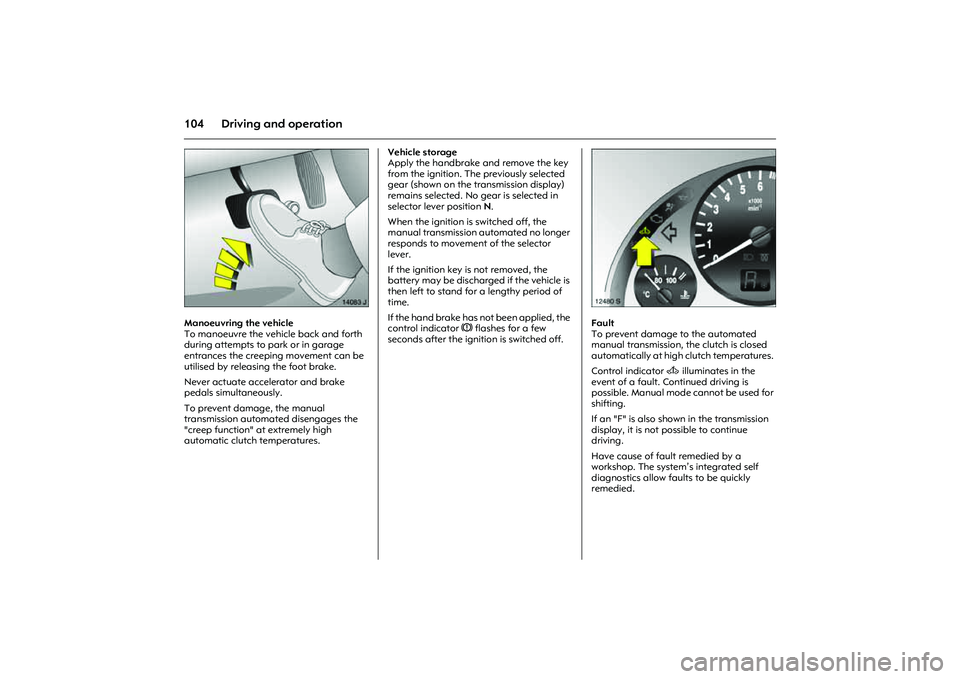
Picture no: 14083j.tif
Manoeuvring the vehicle
To manoeuvre the vehicle back and forth
during attempts to park or in garage
entrances the creeping movement can be
utilised by releasing the foot brake.
Never actuate accelerator and brake
pedals simultaneously.
To prevent damage, the manual
transmission automated disengages the
"creep function" at extremely high
automatic clutch temperatures. Vehicle storage
Apply the handbrake and remove the key
from the ignition. The previously selected
gear (shown on the transmission display)
remains selected. No gear is selected in
selector lever position N.
When the ignition is switched off, the
manual transmission automated no longer
responds to movement of the selector
lever.
If the ignition key is not removed, the
battery may be discharged if the vehicle is
then left to stand for a lengthy period of
time.
If the hand brake has not been applied, the
control indicator R flashes for a few
seconds after the ignition is switched off.
Picture no: 12480s.tif
Fault
To prevent damage to the automated
manual transmission, the clutch is closed
automatically at high clutch temperatures.
Control indicator A illuminates in the
event of a fault. Continued driving is
possible. Manual mode cannot be used for
shifting.
If an "F" is also shown in the transmission
display, it is not possible to continue
driving.
Have cause of fault remedied by a
workshop. The system’s integrated self
diagnostics allow faults to be quickly
remedied.
Page 111 of 212
105
Driving and operation
Picture no: 13739s.tif
Interruption of power supply
The clutch is not disengaged if there is an
interruption of the power supply when a
gear is engaged. The vehicle cannot move.
If the battery is discharged, start the
vehicle using jump leads 3129.
If the cause is not a flat battery, contact a
workshop for assistance. If the vehicle has
to be moved out of flowing traffic,
disengage clutch as follows:
1. Apply hand brake and switch off
ignition.
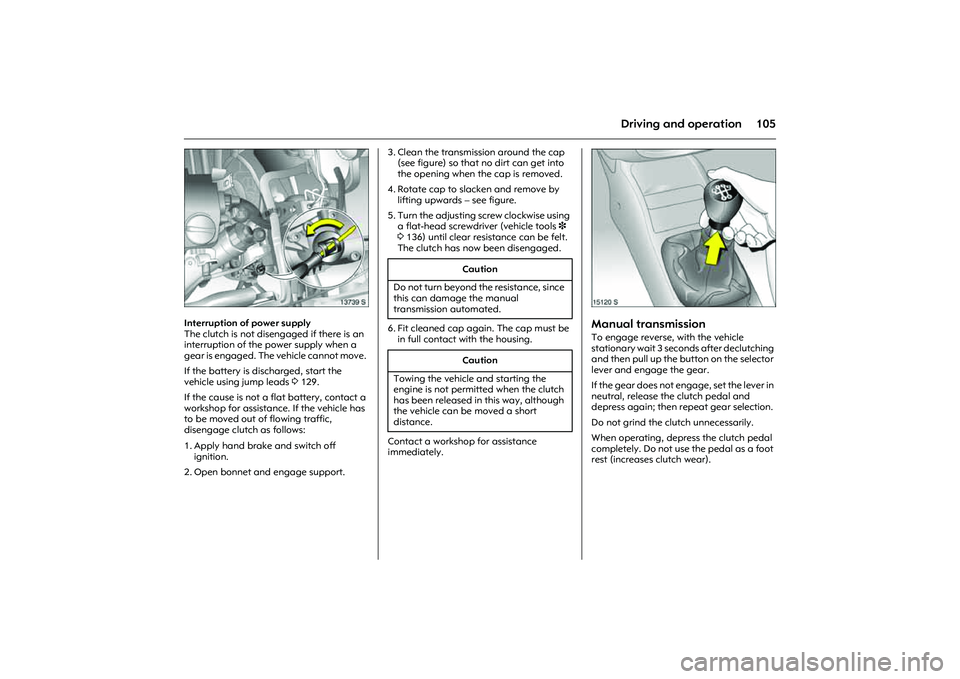
2. Open bonnet and engage support.3. Clean the transmission around the cap
(see figure) so that no dirt can get into
the opening when the cap is removed.
4. Rotate cap to slacken and remove by
lifting upwards – see figure.
5. Turn the adjusting screw clockwise using
a flat-head screwdriver (vehicle tools 3
3136) until clear resistance can be felt.
The clutch has now been disengaged.
6. Fit cleaned cap again. The cap must be
in full contact with the housing.
Contact a workshop for assistance
immediately.
Picture no: 15120s.tif
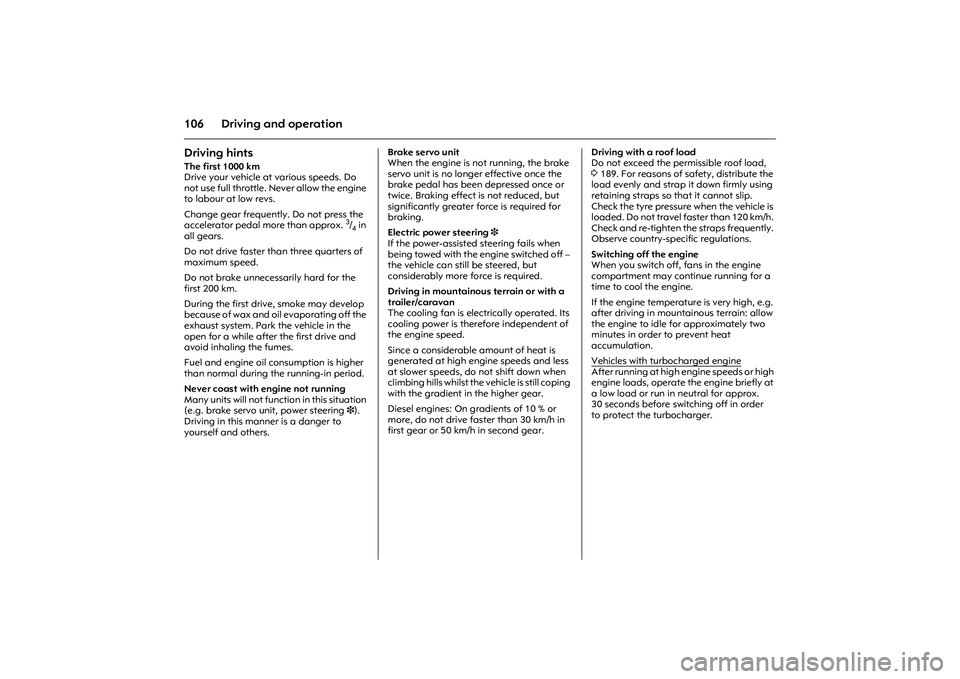
Manual transmissionTo engage reverse, with the vehicle
stationary wait 3 seconds after declutching
and then pull up the button on the selector
lever and engage the gear.
If the gear does not engage, set the lever in
neutral, release the clutch pedal and
depress again; then repeat gear selection.
Do not grind the clutch unnecessarily.
When operating, depress the clutch pedal
completely. Do not use the pedal as a foot
rest (increases clutch wear).
Caution
Do not turn beyond the resistance, since
this can damage the manual
transmission automated.
Caution
Towing the vehicle and starting the
engine is not permitted when the clutch
has been released in this way, although
the vehicle can be moved a short
distance.
Page 112 of 212
106 Driving and operationDriving hints The first 1000 km
Drive your vehicle at various speeds. Do
not use full throttle. Never allow the engine
to labour at low revs.
Change gear frequently. Do not press the
accelerator pedal more than approx.
3/4 in
all gears.
Do not drive faster than three quarters of
maximum speed.
Do not brake unnecessarily hard for the
first 200 km.
During the first drive, smoke may develop
because of wax and oil evaporating off the
exhaust system. Park the vehicle in the
open for a while after the first drive and
avoid inhaling the fumes.
Fuel and engine oil consumption is higher
than normal during the running-in period.
Never coast with engine not running
Many units will not function in this situation
(e.g. brake servo unit, power steering3).
Driving in this manner is a danger to
yourself and others. Brake servo unit
When the engine is not running, the brake
servo unit is no longer effective once the
brake pedal has been depressed once or
twice. Braking effect is not reduced, but
significantly greater force is required for
braking.
Electric power steering 3
If the power-assisted steering fails when
being towed with the engine switched off –
the vehicle can still be steered, but
considerably more force is required.
Driving in mountainous terrain or with a
trailer/caravan
The cooling fan is electrically operated. Its
cooling power is therefore independent of
the engine speed.
Since a considerable amount of heat is
generated at high engine speeds and less
at slower speeds, do not shift down when
climbing hills whilst the vehicle is still coping
with the gradient in the higher gear.
Diesel engines: On gradients of 10 % or
more, do not drive faster than 30 km/h in
first gear or 50 km/h in second gear. Driving with a roof load
Do not exceed the permissible roof load,
3189. For reasons of safety, distribute the
load evenly and strap it down firmly using
retaining straps so that it cannot slip.
Check the tyre pressure when the vehicle is
loaded. Do not travel faster than 120 km/h.
Check and re-tighten the straps frequently.
Observe country-specific regulations.
Switching off the engine
When you switch off, fans in the engine
compartment may continue running for a
time to cool the engine.
If the engine temperature is very high, e.g.
after driving in mountainous terrain: allow
the engine to idle for approximately two
minutes in order to prevent heat
accumulation.
Vehicles with turbocharged engine
After running at high engine speeds or high
engine loads, operate the engine briefly at
a low load or run in neutral for approx.
30 seconds before switching off in order
to protect the turbocharger.
Page 114 of 212
108 Driving and operationSaving Fuel, Protecting the
Environment Trend-setting technology
Environmentally friendly and mainly
recyclable materials were used when your
vehicle was being developed and
manufactured. The production methods
used to make your vehicle are also
environmentally-compatible.
Recycling of production wastes keeps the
circulation of material closed. Reduction of
energy and water requirements also helps
to conserve natural resources.
A highly advanced design means that your
vehicle can be easily disassembled at the
end of its working life, and the individual
materials separated for subsequent re-use.
Materials such as asbestos and cadmium
are not used. The refrigerant in the air
conditioning system 3 is CFC-free.
New painting techniques employ water as
a solvent. End-of-life vehicle recovery
Information on end-of-life vehicle recovery
centres and the recycling of end-of-life
vehicles is available at www.opel.com.
Energy and environment-conscious
driving
zHigh noise levels and exhaust emissions
are often a result of driving without due
attention to saving energy and
protecting the environment.
zYou should therefore drive with energy in
mind: "more kilometres – less fuel".
Reduce the noise level and exhaust
emissions by adopting an environment-
conscious driving style. This is extremely
worthwhile and improves the quality of
life.
Fuel consumption depends to a great
extent on your own personal driving
style. The following hints are intended to
help you consume fuel at a rate that is as
close as possible to the specified levels
3186.
Check your vehicle’s fuel consumption
every time you refuel. This facilitates
early detection of any irregularities
causing increased fuel consumption. Warming up
zFull throttle and warming up at idle
speed increase wear, fuel consumption,
exhaust emission, the amount of
pollutant in the exhaust and the amount
of noise.
zDrive off immediately after starting.
Warm up the engine by running it at
moderate engine speeds.
Uniform speed
zHectic driving significantly increases fuel
consumption, the exhaust emissions, the
proportion of pollutant in the exhaust
gas and the noise level.
zDo not accelerate and brake
unnecessarily. Drive at uniform speed,
watching the road.
Avoid frequent starting off and stopping
e.g. at traffic lights, in short distance
traffic and in queues of traffic by means
of clever planning. Select roads with
good traffic flow.
Idling
zThe engine also consumes fuel when
idling.
zIf you have to wait for more than one
minute, it is worthwhile switching off the
engine. Five minutes of idling
corresponds to approximately one
kilometre of driving.
Page 124 of 212
118 Driving and operationMaintenance
Have all maintenance work carried out at
the specified intervals. We recommend
that you entrust this work to your Opel
Partner, who has proper equipment and
trained personnel available. Electronic
testing systems permit rapid diagnosis and
remedy of faults. This way you can be
certain that all components of the vehicle’s
electrical, injection and ignition systems
operate correctly, that your vehicle has a
low level of pollutant emission and that the
catalytic converter system will have a long
service life.
You are thereby making an important
contribution towards keeping the air clean
and compliance with emissions legislation.
Checking and adjustment of the fuel-
injection and ignition systems is part of the
scope of inspection. For this reason you
should have all maintenance work carried
out at the intervals specified in your Service
and Warranty Booklet.
Picture no: 11629s.tif
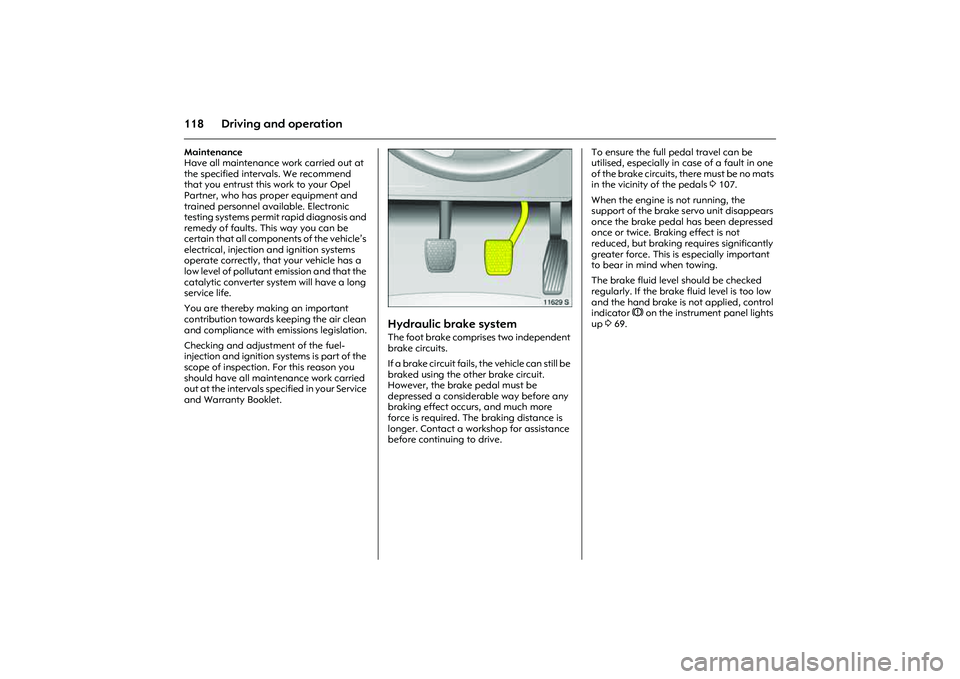
Hydraulic brake system The foot brake comprises two independent
brake circuits.
If a brake circuit fails, the vehicle can still be
braked using the other brake circuit.
However, the brake pedal must be
depressed a considerable way before any
braking effect occurs, and much more
force is required. The braking distance is
longer. Contact a workshop for assistance
before continuing to drive. To ensure the full pedal travel can be
utilised, especially in case of a fault in one
of the brake circuits, there must be no mats
in the vicinity of the pedals 3107.
When the engine is not running, the
support of the brake servo unit disappears
once the brake pedal has been depressed
once or twice. Braking effect is not
reduced, but braking requires significantly
greater force. This is especially important
to bear in mind when towing.
The brake fluid level should be checked
regularly. If the brake fluid level is too low
and the hand brake is not applied, control
indicator R on the instrument panel lights
up 369.
Page 125 of 212
119
Driving and operation
Picture no: 12482s.tif
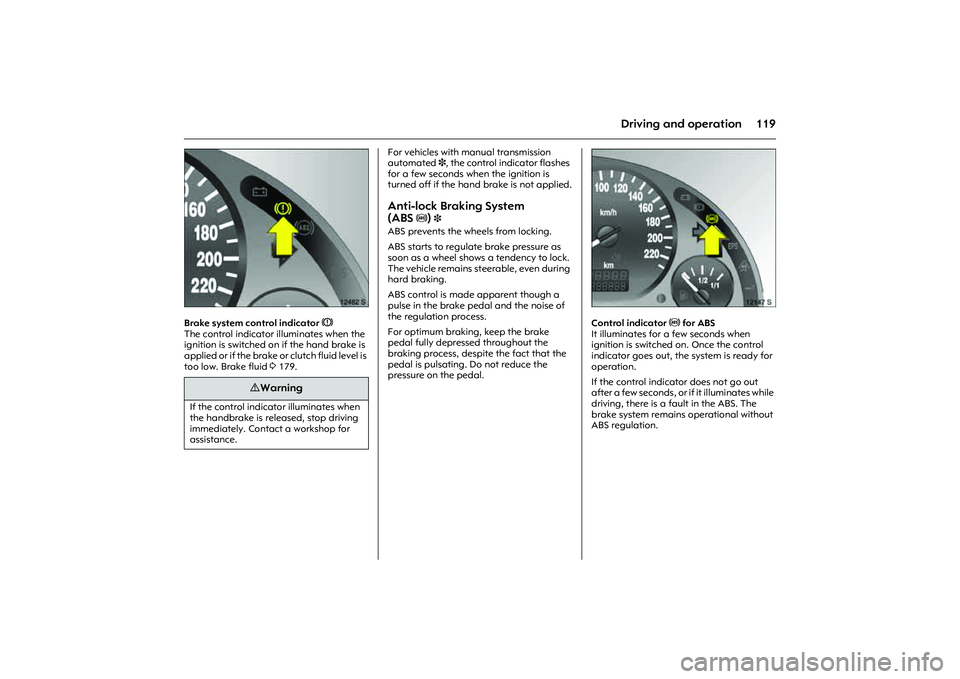
Brake system control indicator R
The control indicator illuminates when the
ignition is switched on if the hand brake is
applied or if the brake or clutch fluid level is
too low. Brake fluid 3179. For vehicles with manual transmission
automated 3, the control indicator flashes
for a few seconds when the ignition is
turned off if the hand brake is not applied.
Anti-lock Braking System
(ABS
u)3
ABS prevents the wheels from locking.
ABS starts to regulate brake pressure as
soon as a wheel shows a tendency to lock.
The vehicle remains steerable, even during
hard braking.
ABS control is made apparent though a
pulse in the brake pedal and the noise of
the regulation process.
For optimum braking, keep the brake
pedal fully depressed throughout the
braking process, despite the fact that the
pedal is pulsating. Do not reduce the
pressure on the pedal.
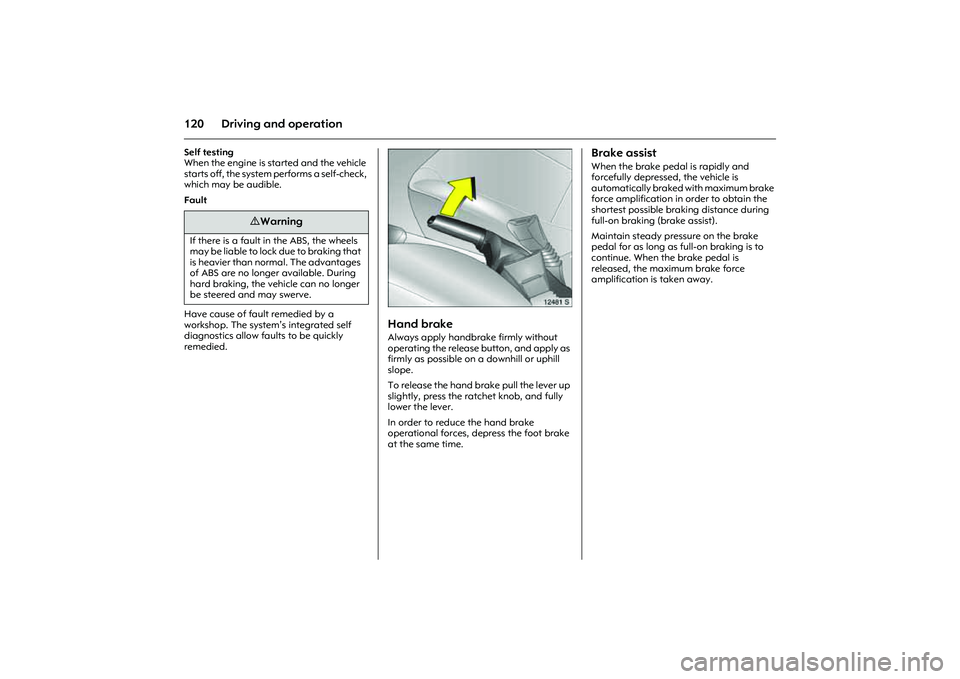
Picture no: 12147s.tif
Control indicator u for ABS
It illuminates for a few seconds when
ignition is switched on. Once the control
indicator goes out, the system is ready for
operation.
If the control indicator does not go out
after a few seconds, or if it illuminates while
driving, there is a fault in the ABS. The
brake system remains operational without
ABS regulation.
9 Warning
If the control indicator illuminates when
the handbrake is released, stop driving
immediately. Contact a workshop for
assistance.
Page 126 of 212
120 Driving and operationSelf testing
When the engine is started and the vehicle
starts off, the system performs a self-check,
which may be audible.
Fault
Have cause of fault remedied by a
workshop. The system’s integrated self
diagnostics allow faults to be quickly
remedied.
Picture no: 12481s.tif
Hand brake Always apply handbrake firmly without
operating the release button, and apply as
firmly as possible on a downhill or uphill
slope.
To release the hand brake pull the lever up
slightly, press the ratchet knob, and fully
lower the lever.
In order to reduce the hand brake
operational forces, depress the foot brake
at the same time.
Brake assist When the brake pedal is rapidly and
forcefully depressed, the vehicle is
automatically braked with maximum brake
force amplification in order to obtain the
shortest possible braking distance during
full-on braking (brake assist).
Maintain steady pressure on the brake
pedal for as long as full-on braking is to
continue. When the brake pedal is
released, the maximum brake force
amplification is taken away.
9 Warning
If there is a fault in the ABS, the wheels
may be liable to lock due to braking that
is heavier than normal. The advantages
of ABS are no longer available. During
hard braking, the vehicle can no longer
be steered and may swerve.