towing OPEL COMBO 2010 User Guide
[x] Cancel search | Manufacturer: OPEL, Model Year: 2010, Model line: COMBO, Model: OPEL COMBO 2010Pages: 212, PDF Size: 2.49 MB
Page 134 of 212
128 Self-help, vehicle careSelf-help, vehicle care
Diesel fuel system, bleeding If the tank is allowed to run dry, the diesel
fuel system must be bled. Turn over the
ignition three times for 15 seconds at a
time. Then start the engine for a maximum
of 40 seconds
1). Repeat this process after
no less than 5 seconds. If the engine fails to
start, seek the assistance of a workshop.
Picture no: 16121s.tif
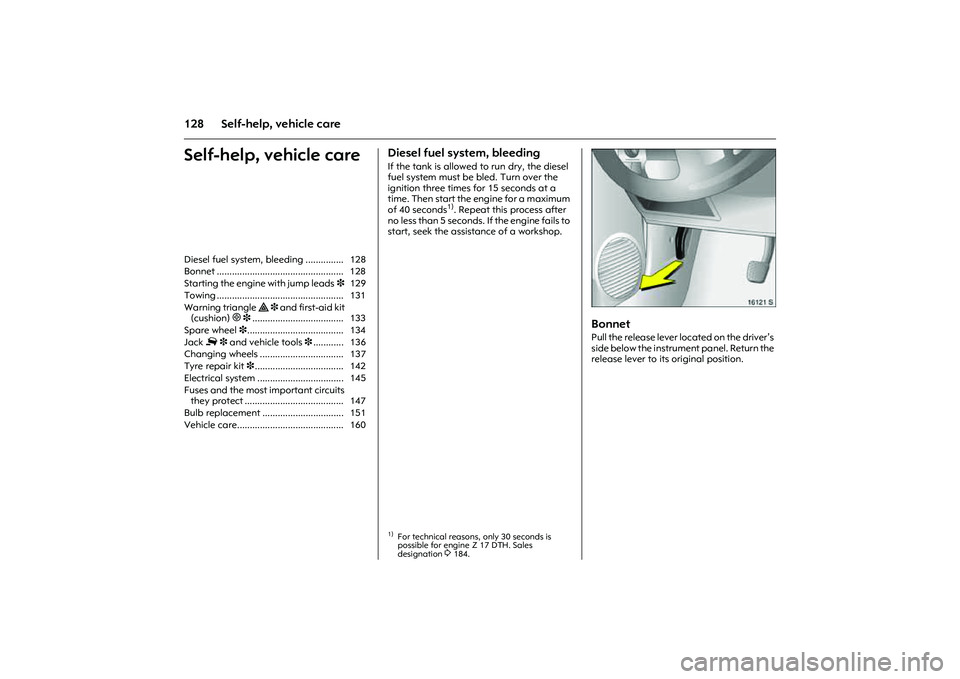
Bonnet Pull the release lever located on the driver’s
side below the instrument panel. Return the
release lever to its original position. Diesel fuel system, bleeding ............... 128
Bonnet .................................................. 128
Starting the engine with jump leads3 129
Towing .................................................. 131
Warning triangle ¨ 3 and first-aid kit
(cushion) + 3.................................... 133
Spare wheel 3...................................... 134
Jack £ 3 and vehicle tools3............ 136
Changing wheels ................................. 137
Tyre repair kit 3................................... 142
Electrical system .................................. 145
Fuses and the most important circuits
they protect ....................................... 147
Bulb replacement ................................ 151
Vehicle care.......................................... 160
1)For technical reasons, only 30 seconds is
possible for engine Z 17 DTH. Sales
designation
3184.
Page 135 of 212
129
Self-help, vehicle care
Picture no: 18097s.tif
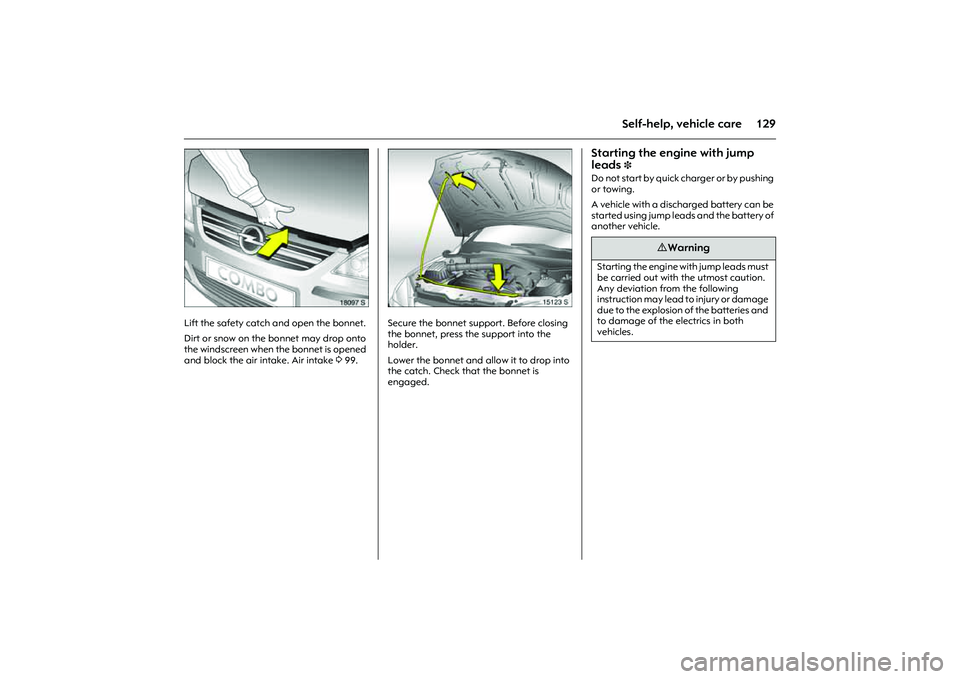
Lift the safety catch and open the bonnet.
Dirt or snow on the bonnet may drop onto
the windscreen when the bonnet is opened
and block the air intake. Air intake 399.
Picture no: 15123s.tif
Secure the bonnet support. Before closing
the bonnet, press the support into the
holder.
Lower the bonnet and allow it to drop into
the catch. Check that the bonnet is
engaged.
Starting the engine with jump
leads
3
Do not start by quick charger or by pushing
or towing.
A vehicle with a discharged battery can be
started using jump leads and the battery of
another vehicle.
9 Warning
Starting the engine with jump leads must
be carried out with the utmost caution.
Any deviation from the following
instruction may lead to injury or damage
due to the explosion of the batteries and
to damage of the electrics in both
vehicles.
Page 137 of 212
131
Self-help, vehicle care
Route the leads so that they cannot catch
on rotating parts in the engine
compartment.
To start the engine:
1. Start the engine of the vehicle providing
the jump start.
2. After 5 minutes, start the other engine.
Start attempts should be made at
intervals of 1 minute not last longer than
15 seconds.
3. Allow both engines to idle for approx.
3 minutes with the leads connected.
4. Switch on electric loads (e.g. light,
heated rear window) of the vehicle
receiving the jump start.
5. Reverse above sequence exactly when
removing leads.
Picture no: 18108s.tif
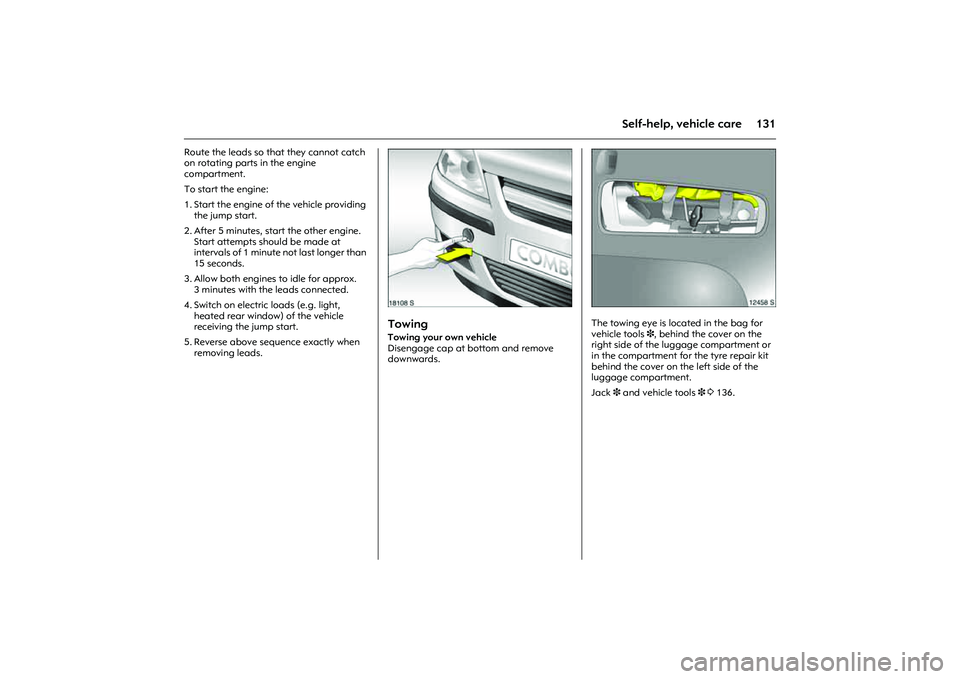
Towing Towing your own vehicle
Disengage cap at bottom and remove
downwards.
Picture no: 12458s.tif
The towing eye is located in the bag for
vehicle tools 3, behind the cover on the
right side of the luggage compartment or
in the compartment for the tyre repair kit
behind the cover on the left side of the
luggage compartment.
Jack 3 and vehicle tools 3 3136.
Page 138 of 212
132 Self-help, vehicle care
Picture no: 18109s.tif
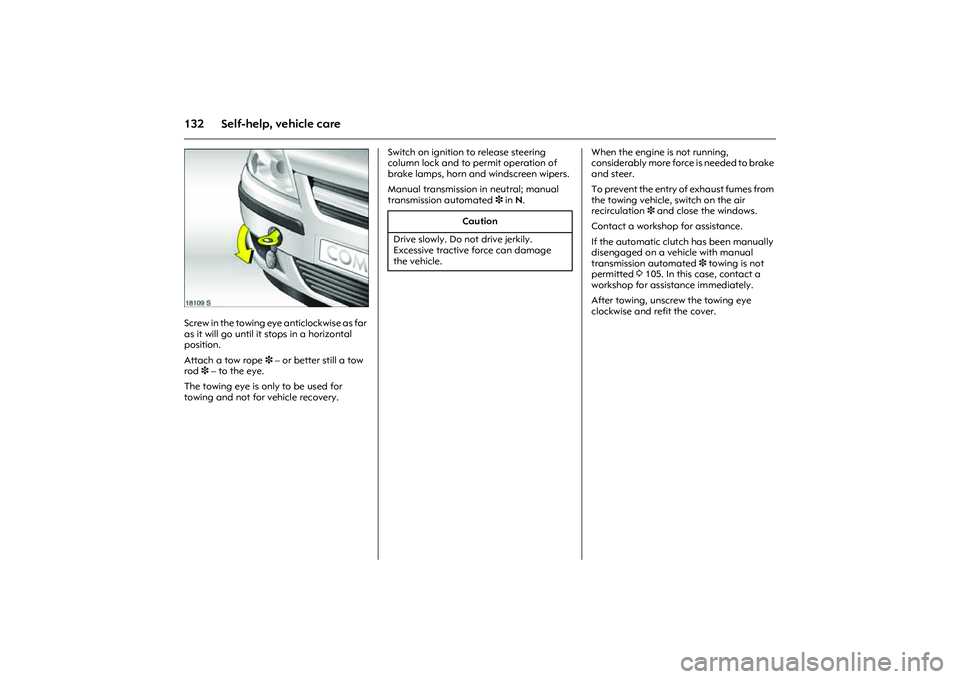
Screw in the towing eye anticlockwise as far
as it will go until it stops in a horizontal
position.
Attach a tow rope 3 – or better still a tow
rod3 – to the eye.
The towing eye is only to be used for
towing and not for vehicle recovery. Switch on ignition to release steering
column lock and to permit operation of
brake lamps, horn and windscreen wipers.
Manual transmission in neutral; manual
transmission automated 3 in N. When the engine is not running,
considerably more force is needed to brake
and steer.
To prevent the entry of exhaust fumes from
the towing vehicle, switch on the air
recirculation 3 and close the windows.
Contact a workshop for assistance.
If the automatic clutch has been manually
disengaged on a vehicle with manual
transmission automated 3 towing is not
permitted 3105. In this case, contact a
workshop for assistance immediately.
After towing, unscrew the towing eye
clockwise and refit the cover.
Caution
Drive slowly. Do not drive jerkily.
Excessive tractive force can damage
the vehicle.
Page 139 of 212
133
Self-help, vehicle care
Picture no: 18110s.tif
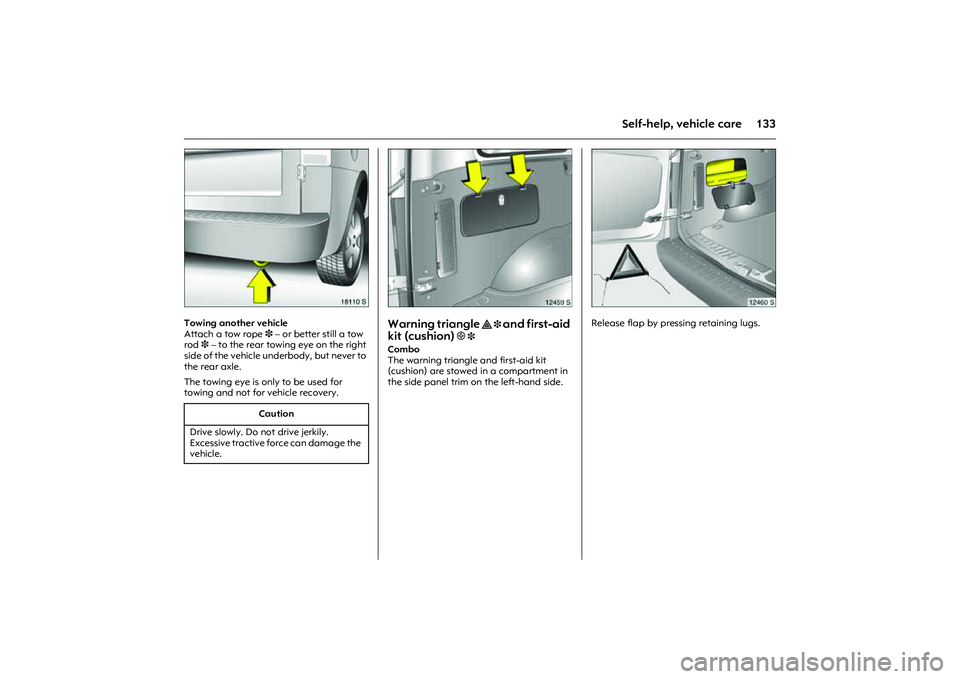
Towing another vehicle
Attach a tow rope 3 – or better still a tow
rod3 – to the rear towing eye on the right
side of the vehicle underbody, but never to
the rear axle.
The towing eye is only to be used for
towing and not for vehicle recovery.
Picture no: 12459s.tif
Warning triangle
¨ 3
and first-aid
kit (cushion)
+ 3
Combo
The warning triangle and first-aid kit
(cushion) are stowed in a compartment in
the side panel trim on the left-hand side.
Picture no: 12460s.tif
Release flap by pressing retaining lugs.
Caution
Drive slowly. Do not drive jerkily.
Excessive tractive force can damage the
vehicle.
Page 153 of 212
147
Self-help, vehicle care
Picture no: 15543s.tif
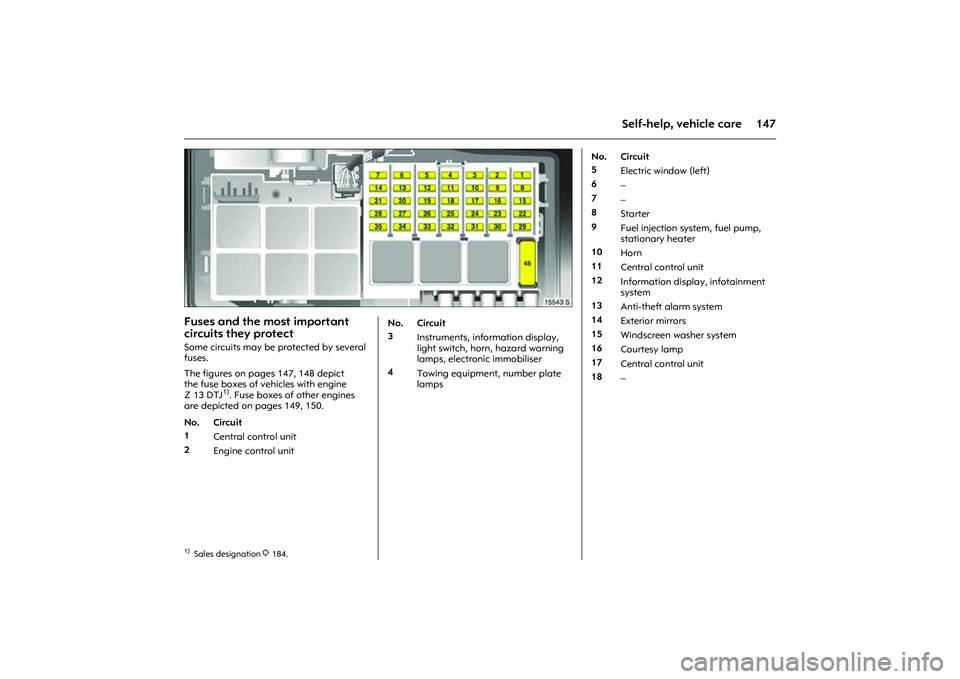
Fuses and the most important
circuits they protectSome circuits may be protected by several
fuses.
The figures on pages 147, 148 depict
the fuse boxes of vehicles with engine
Z13DTJ
1). Fuse boxes of other engines
are depicted on pages 149, 150.
Picture no:
1)Sales designation
3184.
No. Circuit
1
Central control unit
2
Engine control unit
No. Circuit
3
Instruments, information display,
light switch, horn, hazard warning
lamps, electronic immobiliser
4
Towing equipment, number plate
lampsNo. Circuit
5
Electric window (left)
6
–
7
–
8
Starter
9
Fuel injection system, fuel pump,
stationary heater
10
Horn
11
Central control unit
12
Information display, infotainment
system
13
Anti-theft alarm system
14
Exterior mirrors
15
Windscreen washer system
16
Courtesy lamp
17
Central control unit
18
–
Page 169 of 212
163
Self-help, vehicle care
Underbody
Some areas of the vehicle underbody have
a PVC undercoating while other critical
areas have a durable protective wax
coating.
After the underbody is washed, check the
underbody and have more protective wax
applied if necessary.
Bitumen/rubber materials could damage
the PVC coating. Have underbody work
carried out by a workshop.
Before and after winter, wash the
underbody and have the protective wax
coating checked. Natural gas system3
When cleaning the engine or underbody
with a steam jet or high pressure jet
cleaner, do not aim the jet at components
of the natural gas system. In particular, the
natural gas tanks and the pressure valves
at the vehicle underbody and bulkhead in
the engine compartment must be
protected from the pressurised spray.
In addition, these components must not be
treated with chemical cleaners or waxes.
Have natural gas system components
cleaned by a workshop that is authorised
to maintain natural gas vehicles.
Towing equipment
Do not clean the coupling ball bar with a
steam-jet or high-pressure jet cleaner.
Page 177 of 212
171
Opel Service, maintenance
Additional service workAdditional work ⊕
Additional work is work which is not
required for every service but can be
carried out along with a regular service.
Time allowances for such work are not
included within the scope of a regular
service and must be accounted for
separately. However, it is more cost
effective to carry out this work as part of a
planned service than to have it done
separately.
Extreme operating conditions o
Operating conditions are considered
extreme when one or more of the following
occur frequently:
zCold starts,
zStop-and-go,
zCaravan/trailer towing,
zDriving on inclines and/or in high
altitudes,
zPoor road conditions,
zSand and dust,
zExtreme temperature fluctuations.
Police vehicles, taxis and driving school
vehicles are also classified as operating
under extreme conditions.When operating conditions are extreme, it
may be necessary to have certain service
work carried out more frequently than the
planned service intervals.
We recommend obtaining technical advice
for the service requirements of your vehicle
based on the special conditions of use.
Recommended fluids and
lubricants Only use products which have been tested
and approved. Damage caused by using
non-approved operating materials is not
covered by the warranty.
9 Warning
Fuels are dangerous and require
appropriate care when handling. If
swallowed, immediately call a doctor.
Do not inhale fumes and avoid contact
with the skin. Keep out of the reach of
children. Fuels must not be allowed to
contaminate wastewater, groundwater
or soils. Dispose of empty containers
properly. Always keep in mind that fuels
are hazardous to health.
Page 188 of 212
182 Technical dataTechnical data
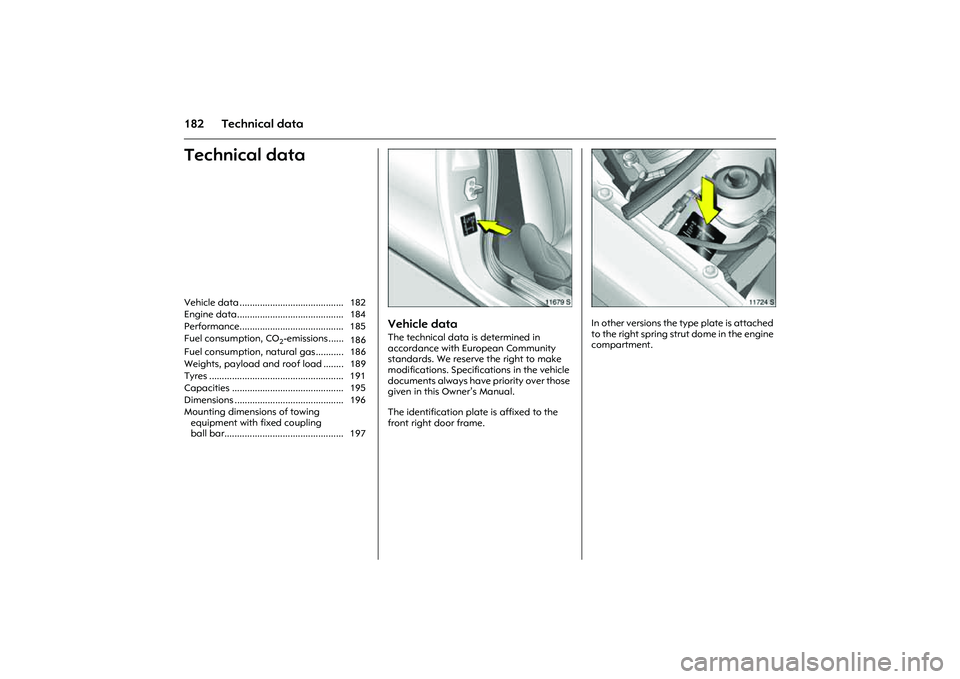
Picture no: 11679s.tif
Vehicle data The technical data is determined in
accordance with European Community
standards. We reserve the right to make
modifications. Specifications in the vehicle
documents always have priority over those
given in this Owner’s Manual.
The identification plate is affixed to the
front right door frame.
Picture no: 11724s.tif
In other versions the type plate is attached
to the right spring strut dome in the engine
compartment. Vehicle data ......................................... 182
Engine data.......................................... 184
Performance......................................... 185
Fuel consumption, CO
2-emissions ......
186
Fuel consumption, natural gas........... 186
Weights, payload and roof load ........ 189
Tyres ..................................................... 191
Capacities ............................................ 195
Dimensions ........................................... 196
Mounting dimensions of towing
equipment with fixed coupling
ball bar............................................... 197
Page 195 of 212
189
Technical data
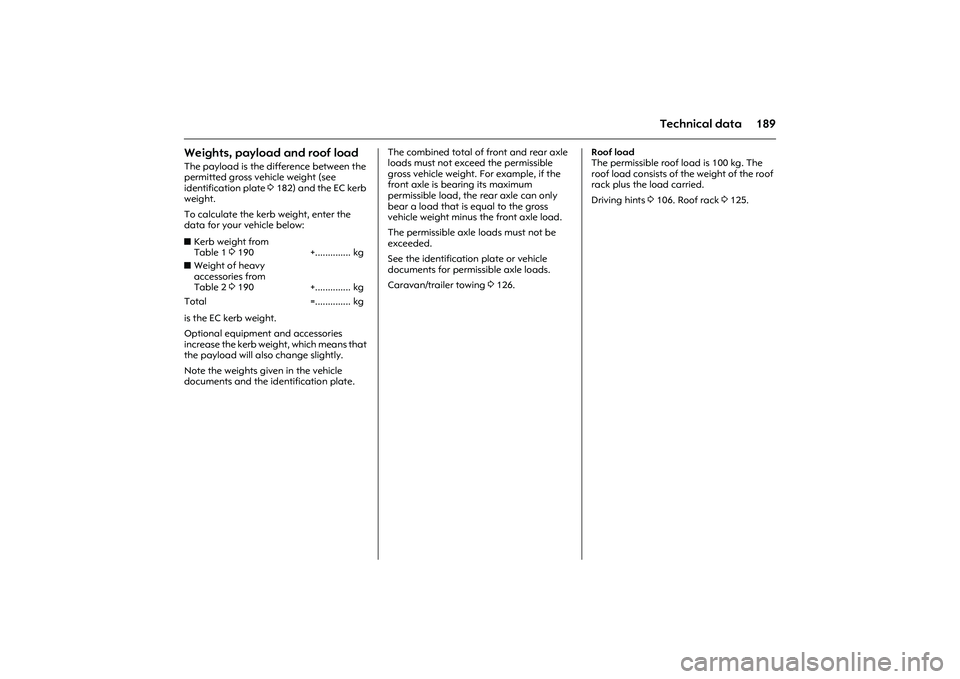
Weights, payload and roof load The payload is the difference between the
permitted gross vehicle weight (see
identification plate 3182) and the EC kerb
weight.
To calculate the kerb weight, enter the
data for your vehicle below:
is the EC kerb weight.
Optional equipment and accessories
increase the kerb weight, which means that
the payload will also change slightly.
Note the weights given in the vehicle
documents and the identification plate. The combined total of front and rear axle
loads must not exceed the permissible
gross vehicle weight. For example, if the
front axle is bearing its maximum
permissible load, the rear axle can only
bear a load that is equal to the gross
vehicle weight minus the front axle load.
The permissible axle loads must not be
exceeded.
See the identification plate or vehicle
documents for permissible axle loads.
Caravan/trailer towing 3126. Roof load
The permissible roof load is 100 kg. The
roof load consists of the weight of the roof
rack plus the load carried.
Driving hints 3106. Roof rack 3125.
zKerb weight from
Table 1 3190 +.............. kg
zWeight of heavy
accessories from
Table 2 3190 +.............. kg
Total =.............. kg