transmission oil OPEL COMBO 2010 Owners Manual
[x] Cancel search | Manufacturer: OPEL, Model Year: 2010, Model line: COMBO, Model: OPEL COMBO 2010Pages: 212, PDF Size: 2.49 MB
Page 18 of 212
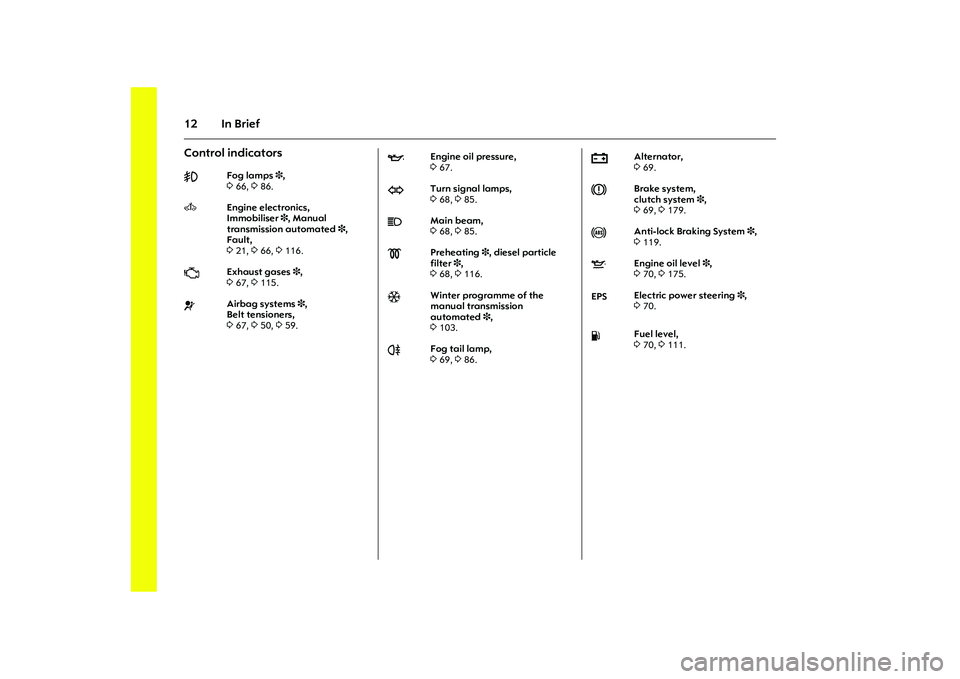
12 In BriefControl indicators >
Fog lamps 3,
366, 386.
A
Engine electronics,
Immobiliser3, Manual
transmission automated 3,
Fault,
321, 366, 3116.
Z
Exhaust gases 3,
367, 3115.
v
Airbag systems 3,
Belt tensioners,
367, 350, 359.
I
Engine oil pressure,
367.
O
Turn signal lamps,
368, 385.
C
Main beam,
368, 385.
!
Preheating 3, diesel particle
filter 3,
368, 3116.
T
Winter programme of the
manual transmission
automated 3,
3103.
r
Fog tail lamp,
369, 386.
p
Alternator,
369.
R
Brake system,
clutch system 3,
369, 3179.
u
Anti-lock Braking System 3,
3119.
S
Engine oil level 3,
370, 3175.
EPSElectric power steering 3,
370.
Y
Fuel level,
370, 3111.
Page 21 of 212
15
In Brief
Picture no: 15120s.tif
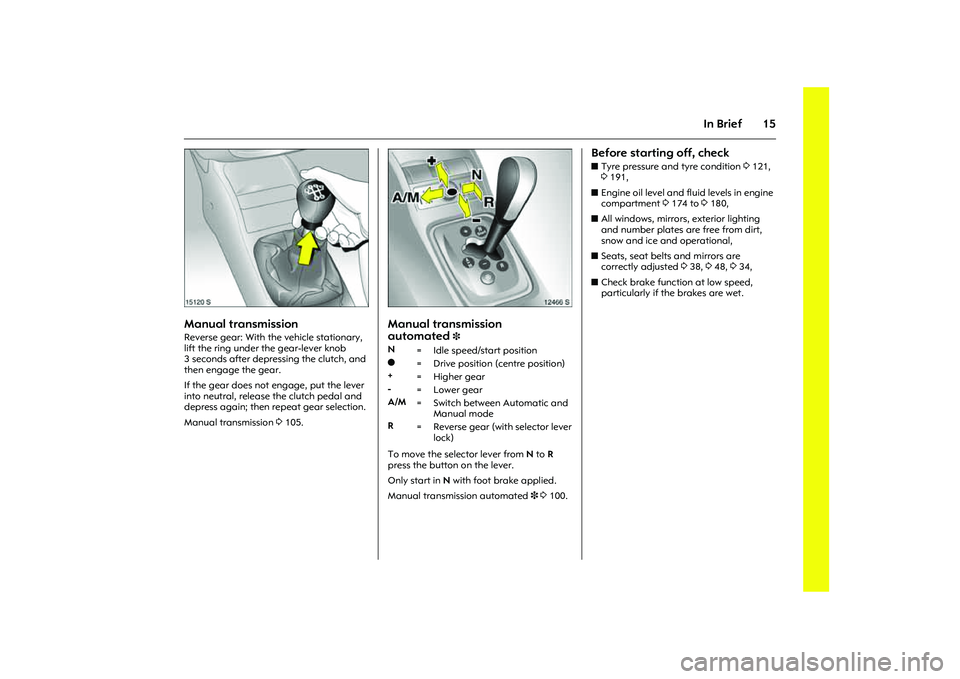
Manual transmission Reverse gear: With the vehicle stationary,
lift the ring under the gear-lever knob
3 seconds after depressing the clutch, and
then engage the gear.
If the gear does not engage, put the lever
into neutral, release the clutch pedal and
depress again; then repeat gear selection.
Manual transmission 3105.
Picture no: 12466s.tif
Manual transmission
automated
3
To move the selector lever from N to R
press the button on the lever.
Only start in N with foot brake applied.
Manual transmission automated 3 3100.
Before starting off, check zTyre pressure and tyre condition 3121,
3191,
zEngine oil level and fluid levels in engine
compartment 3174 to 3180,
zAll windows, mirrors, exterior lighting
and number plates are free from dirt,
snow and ice and operational,
zSeats, seat belts and mirrors are
correctly adjusted 338, 348, 334,
zCheck brake function at low speed,
particularly if the brakes are wet.
N
= Idle speed/start position
o
= Drive position (centre position)
+
=Higher gear
-
= Lower gear
A/M
= Switch between Automatic and
Manual mode
R
= Reverse gear (with selector lever
lock)
Page 73 of 212
67
Instruments
Picture no: 18529s.tif
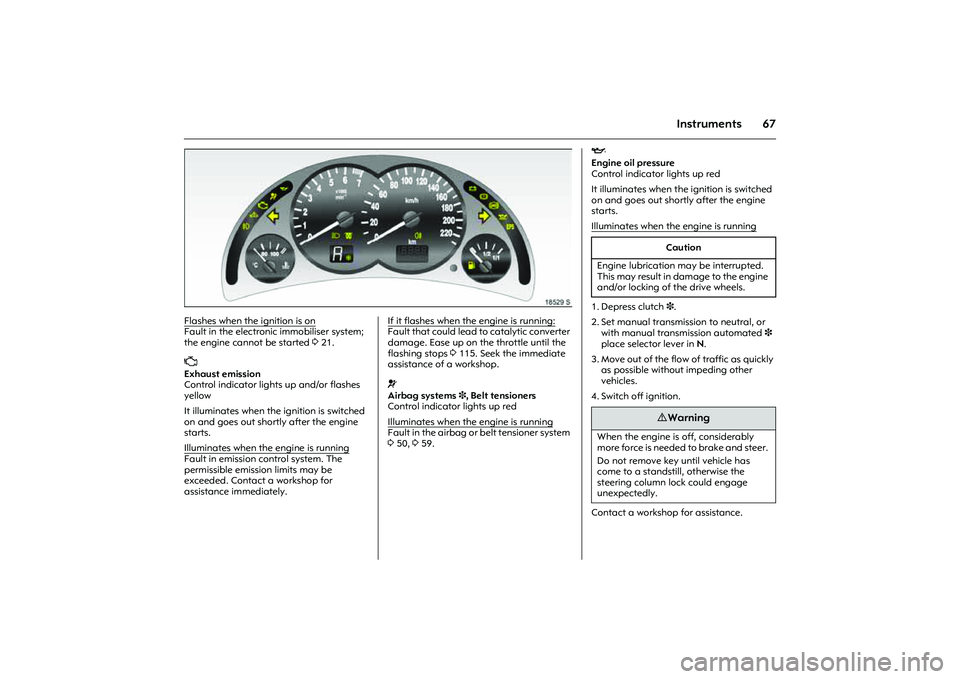
Flashes when the ignition is onFault in the electronic immobiliser system;
the engine cannot be started 321.Z
Exhaust emission
Control indicator lights up and/or flashes
yellow
It illuminates when the ignition is switched
on and goes out shortly after the engine
starts.
Illuminates when the engine is running
Fault in emission control system. The
permissible emission limits may be
exceeded. Contact a workshop for
assistance immediately.
Picture no:
If it flashes when the engine is running:Fault that could lead to catalytic converter
damage. Ease up on the throttle until the
flashing stops 3115. Seek the immediate
assistance of a workshop. v
Airbag systems 3, Belt tensioners
Control indicator lights up red
Illuminates when the engine is runningFault in the airbag or belt tensioner system
350, 359.
I
Engine oil pressure
Control indicator lights up red
It illuminates when the ignition is switched
on and goes out shortly after the engine
starts.
Illuminates when the engine is running
1. Depress clutch 3.
2. Set manual transmission to neutral, or
with manual transmission automated 3
place selector lever in N.
3. Move out of the flow of traffic as quickly
as possible without impeding other
vehicles.
4. Switch off ignition.
Contact a workshop for assistance. Caution
Engine lubrication may be interrupted.
This may result in damage to the engine
and/or locking of the drive wheels.
9 Warning
When the engine is off, considerably
more force is needed to brake and steer.
Do not remove key until vehicle has
come to a standstill, otherwise the
steering column lock could engage
unexpectedly.
Page 116 of 212
110 Driving and operationFuels, refuellingFuel consumption
Fuel consumption is determined under
specific driving conditions 3186.
Special equipment increases the weight of
the vehicle. As a result, they can increase
fuel consumption and reduce the specified
maximum speed.
There is increased friction between engine
and transmission parts during the first
1000 kilometres. This increases fuel
consumption. Fuel for petrol engines
Only use unleaded fuel that complies with
DIN EN 228.
Fuels with ethanol content greater than 5 %
may only be used if the vehicle has been
specifically developed and approved for
these fuels.
Use fuel with the recommended octane
rating (value in bold 3184). Use of fuel
with too low an octane rating can reduce
engine power and torque and slightly
increases fuel consumption. Fuel for diesel engines
Only use diesel fuel that complies with
DIN EN 590. The fuel must have low
sulphur content (max. 50 ppm).
Do not use marine diesel oils, heating oils
or entirely or partially plant-based diesel
fuels, such as rape seed oil or bio diesel,
Aquazole and similar diesel-water
emulsions. Diesel fuels must not be diluted
with fuels for petrol engines.
The flow and filterability of diesel fuel are
temperature-dependent. When
temperatures are low, refuel with diesel fuel
with guaranteed winter properties.
Fuel for natural gas operation
Use natural gas with a methane content of
approx. 78-99 %. L-gas (low) has approx.
78-87 % and H-gas (high) has approx.
87-99 %. Biogas with the same methane
content can also be used if it has been
chemically prepared and desulphurised.
Liquid gas or LPG must not be used. Caution
Use of fuel with too low an octane rating
could lead to uncontrolled combustion
and engine damage.
Page 172 of 212
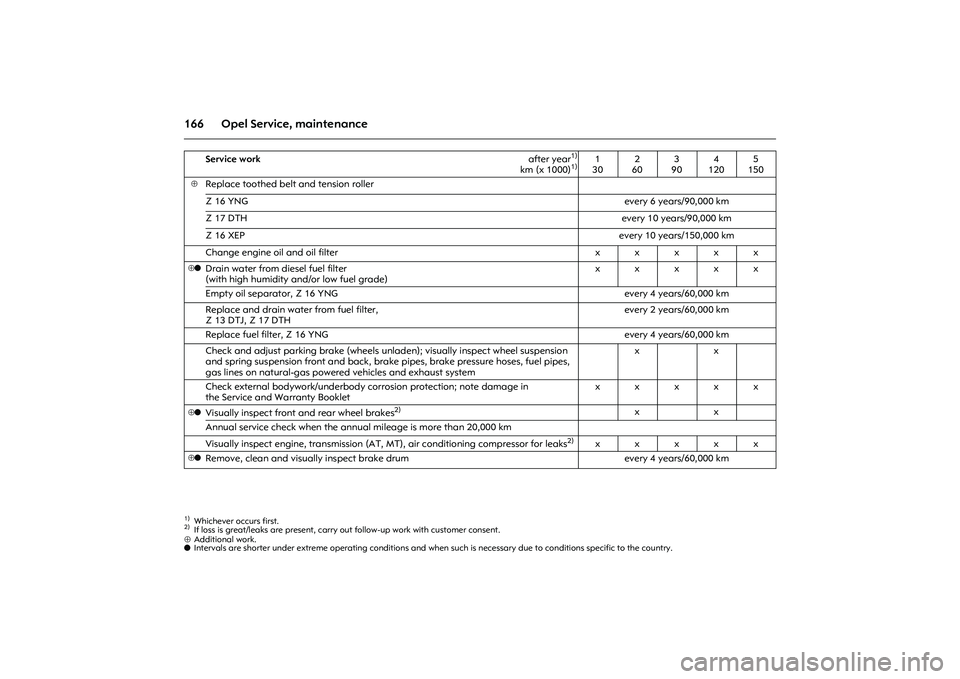
166 Opel Service, maintenance⊕Additional work.
o Intervals are shorter under extreme operating conditions and when such is necessary due to conditions specific to the country.
Service work after year
1)
km (x 1000)
1)
1)Whichever occurs first.
1
302
603
904
1205
150
⊕
Replace toothed belt and tension roller
Z 16 YNGevery 6 years/90,000 km
Z 17 DTHevery 10 years/90,000 km
Z 16 XEPevery 10 years/150,000 km
Change engine oil and oil filter x x x x x
⊕o
Drain water from diesel fuel filter
(with high humidity and/or low fuel grade)xxxxx
Empty oil separator, Z 16 YNG every 4 years/60,000 km
Replace and drain water from fuel filter,
Z 13 DTJ, Z 17 DTHevery 2 years/60,000 km
Replace fuel filter, Z 16 YNG every 4 years/60,000 km
Check and adjust parking brake (wheels unladen); visually inspect wheel suspension
and spring suspension front and back, brake pipes, brake pressure hoses, fuel pipes,
gas lines on natural-gas powered vehicles and exhaust systemxx
Check external bodywork/underbody corrosion protection; note damage in
the Service and Warranty Bookletxxxxx
⊕o
Visually inspect front and rear wheel brakes
2)
2)If loss is great/leaks are present, carry out follow-up work with customer consent.
xx
Annual service check when the annual mileage is more than 20,000 km
Visually inspect engine, transmission (AT, MT), air conditioning compressor for leaks
2)
xxxxx
⊕o
Remove, clean and visually inspect brake drum every 4 years/60,000 km
Page 173 of 212
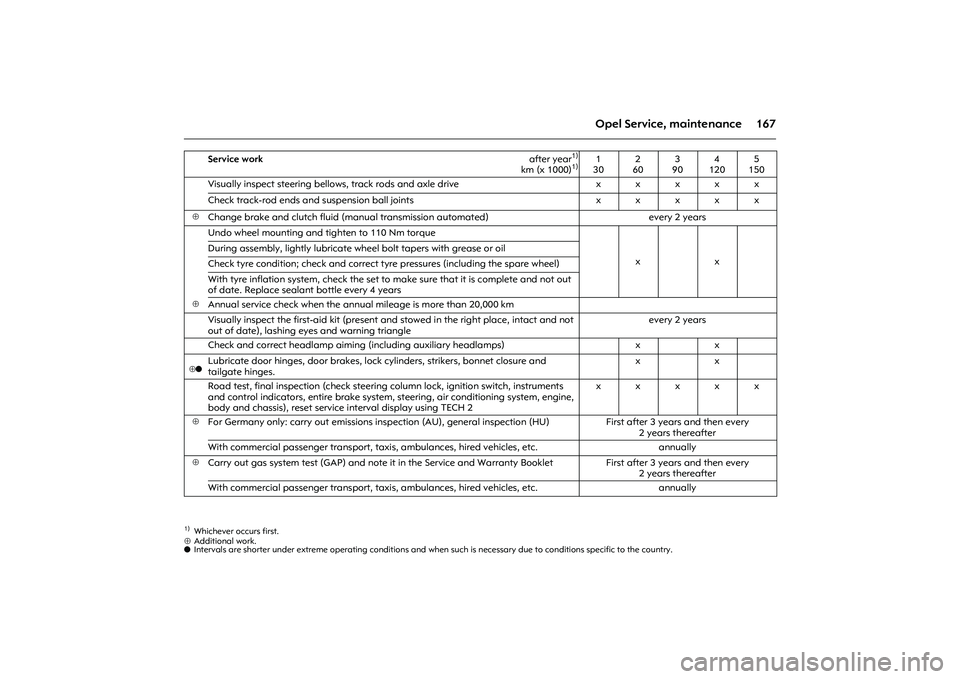
167 Opel Service, maintenance
⊕Additional work.
o Intervals are shorter under extreme operating conditions and when such is necessary due to conditions specific to the country.
Service work after year
1)
km (x 1000)
1)
1)Whichever occurs first.
1
302
603
904
1205
150
Visually inspect steering bellows, track rods and axle drive xxxxx
Check track-rod ends and suspension ball joints xxxxx
⊕
Change brake and clutch fluid (manual transmission automated) every 2 years
Undo wheel mounting and tighten to 110 Nm torque
xx During assembly, lightly lubricate wheel bolt tapers with grease or oil
Check tyre condition; check and correct tyre pressures (including the spare wheel)
With tyre inflation system, check the set to make sure that it is complete and not out
of date. Replace sealant bottle every 4 years
⊕
Annual service check when the annual mileage is more than 20,000 km
Visually inspect the first-aid kit (present and stowed in the right place, intact and not
out of date), lashing eyes and warning triangleevery 2 years
Check and correct headlamp aiming (including auxiliary headlamps) x x
⊕o
Lubricate door hinges, door brakes, lock cylinders, strikers, bonnet closure and
tailgate hinges.xx
Road test, final inspection (check steering column lock, ignition switch, instruments
and control indicators, entire brake system, steering, air conditioning system, engine,
body and chassis), reset service interval display using TECH 2xxxxx
⊕
For Germany only: carry out emissions inspection (AU), general inspection (HU) First after 3 years and then every
2 years thereafter
With commercial passenger transport, taxis, ambulances, hired vehicles, etc. annually
⊕
Carry out gas system test (GAP) and note it in the Service and Warranty Booklet First after 3 years and then every
2 years thereafter
With commercial passenger transport, taxis, ambulances, hired vehicles, etc. annually
Page 175 of 212
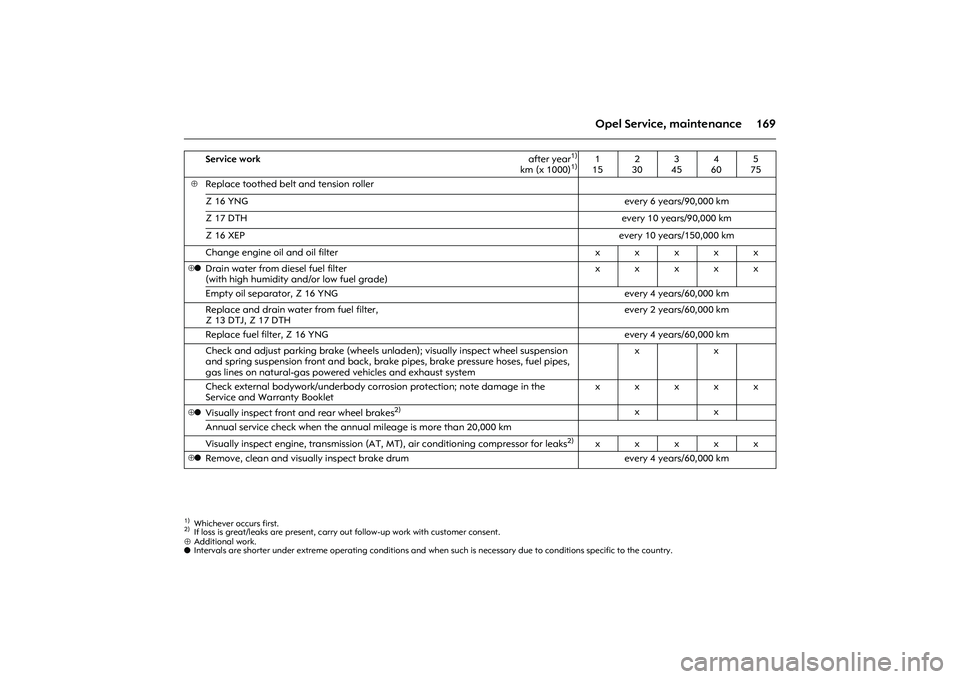
169 Opel Service, maintenance
⊕Additional work.
o Intervals are shorter under extreme operating conditions and when such is necessary due to conditions specific to the country.
Service work after year
1)
km (x 1000)
1)
1)Whichever occurs first.
1
152
303
454
605
75
⊕
Replace toothed belt and tension roller
Z 16 YNGevery 6 years/90,000 km
Z 17 DTHevery 10 years/90,000 km
Z 16 XEPevery 10 years/150,000 km
Change engine oil and oil filter x x x x x
⊕o
Drain water from diesel fuel filter
(with high humidity and/or low fuel grade)xxxxx
Empty oil separator, Z 16 YNG every 4 years/60,000 km
Replace and drain water from fuel filter,
Z 13 DTJ, Z 17 DTHevery 2 years/60,000 km
Replace fuel filter, Z 16 YNG every 4 years/60,000 km
Check and adjust parking brake (wheels unladen); visually inspect wheel suspension
and spring suspension front and back, brake pipes, brake pressure hoses, fuel pipes,
gas lines on natural-gas powered vehicles and exhaust systemxx
Check external bodywork/underbody corrosion protection; note damage in the
Service and Warranty Bookletxxxxx
⊕o
Visually inspect front and rear wheel brakes
2)
2)If loss is great/leaks are present, carry out follow-up work with customer consent.
xx
Annual service check when the annual mileage is more than 20,000 km
Visually inspect engine, transmission (AT, MT), air conditioning compressor for leaks
2)
xxxxx
⊕o
Remove, clean and visually inspect brake drum every 4 years/60,000 km
Page 176 of 212
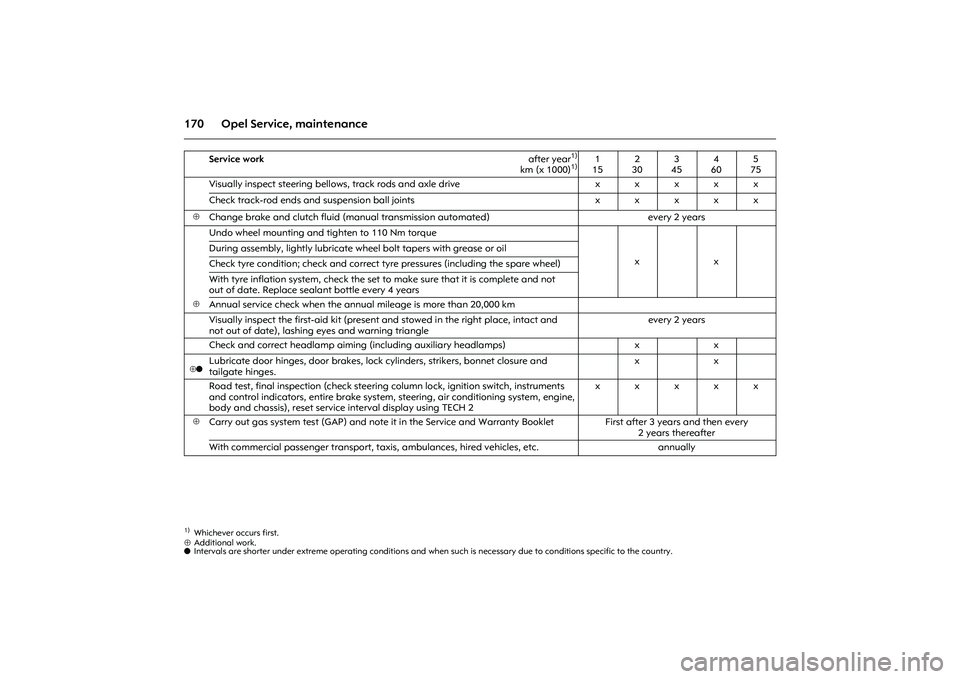
170 Opel Service, maintenance⊕Additional work.
o Intervals are shorter under extreme operating conditions and when such is necessary due to conditions specific to the country.
Service work after year
1)
km (x 1000)
1)
1)Whichever occurs first.
1
152
303
454
605
75
Visually inspect steering bellows, track rods and axle drive x x x x x
Check track-rod ends and suspension ball joints x x x x x
⊕
Change brake and clutch fluid (manual transmission automated) every 2 years
Undo wheel mounting and tighten to 110 Nm torque
xx During assembly, lightly lubricate wheel bolt tapers with grease or oil
Check tyre condition; check and correct tyre pressures (including the spare wheel)
With tyre inflation system, check the set to make sure that it is complete and not
out of date. Replace sealant bottle every 4 years
⊕
Annual service check when the annual mileage is more than 20,000 km
Visually inspect the first-aid kit (present and stowed in the right place, intact and
not out of date), lashing eyes and warning triangleevery 2 years
Check and correct headlamp aiming (including auxiliary headlamps) x x
⊕o
Lubricate door hinges, door brakes, lock cylinders, strikers, bonnet closure and
tailgate hinges.xx
Road test, final inspection (check steering column lock, ignition switch, instruments
and control indicators, entire brake system, steering, air conditioning system, engine,
body and chassis), reset service interval display using TECH 2xxxxx
⊕
Carry out gas system test (GAP) and note it in the Service and Warranty Booklet First after 3 years and then every
2 years thereafter
With commercial passenger transport, taxis, ambulances, hired vehicles, etc. annually
Page 187 of 212
181
Opel Service, maintenance
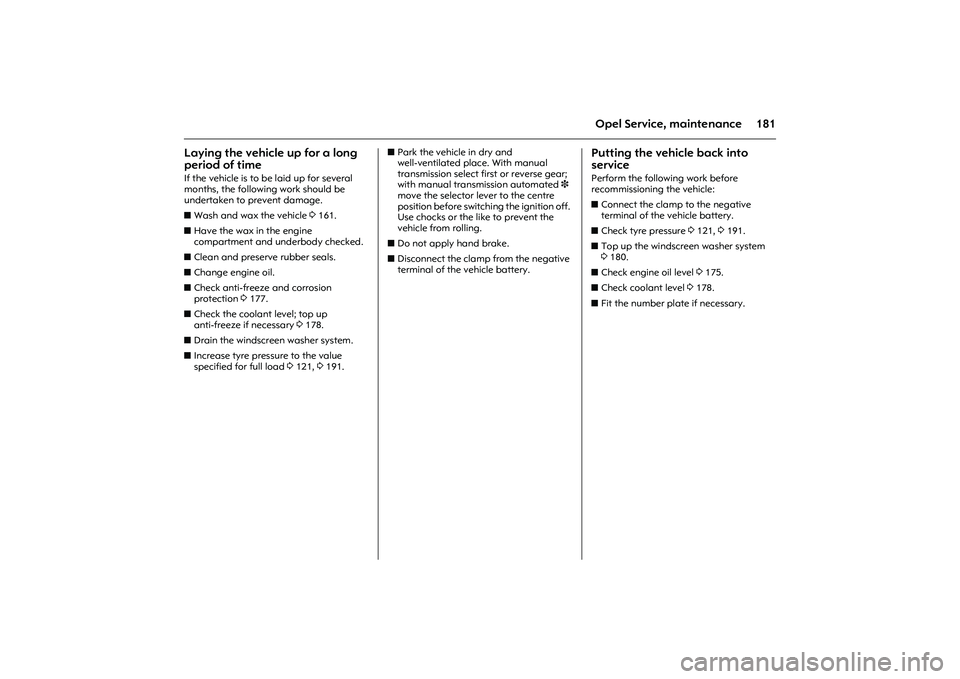
Laying the vehicle up for a long
period of time If the vehicle is to be laid up for several
months, the following work should be
undertaken to prevent damage.
zWash and wax the vehicle 3161.
zHave the wax in the engine
compartment and underbody checked.
zClean and preserve rubber seals.
zChange engine oil.
zCheck anti-freeze and corrosion
protection 3177.
zCheck the coolant level; top up
anti-freeze if necessary 3178.
zDrain the windscreen washer system.
zIncrease tyre pressure to the value
specified for full load 3121, 3191. zPark the vehicle in dry and
well-ventilated place. With manual
transmission select first or reverse gear;
with manual transmission automated 3
move the selector lever to the centre
position before switching the ignition off.
Use chocks or the like to prevent the
vehicle from rolling.
zDo not apply hand brake.
zDisconnect the clamp from the negative
terminal of the vehicle battery.
Putting the vehicle back into
servicePerform the following work before
recommissioning the vehicle:
zConnect the clamp to the negative
terminal of the vehicle battery.
zCheck tyre pressure 3121, 3191.
zTop up the windscreen washer system
3180.
zCheck engine oil level 3175.
zCheck coolant level 3178.
zFit the number plate if necessary.
Page 207 of 212
201
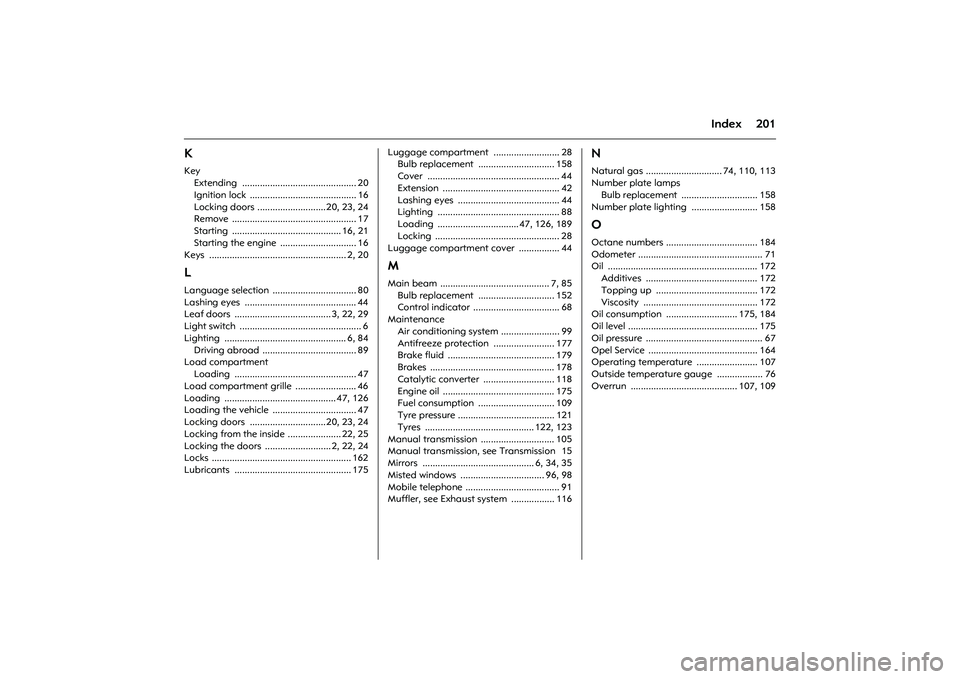
Index
KKey
Extending ............................................. 20
Ignition lock .......................................... 16
Locking doors ...........................20, 23, 24
Remove ................................................. 17
Starting ........................................... 16, 21
Starting the engine .............................. 16
Keys ...................................................... 2, 20LLanguage selection ................................. 80
Lashing eyes ............................................ 44
Leaf doors ...................................... 3, 22, 29
Light switch ................................................ 6
Lighting ................................................ 6, 84
Driving abroad ..................................... 89
Load compartment
Loading ................................................ 47
Load compartment grille ........................ 46
Loading ............................................ 47, 126
Loading the vehicle ................................. 47
Locking doors ..............................20, 23, 24
Locking from the inside ..................... 22, 25
Locking the doors .......................... 2, 22, 24
Locks ....................................................... 162
Lubricants .............................................. 175Luggage compartment .......................... 28
Bulb replacement .............................. 158
Cover .................................................... 44
Extension .............................................. 42
Lashing eyes ........................................ 44
Lighting ................................................ 88
Loading ................................ 47, 126, 189
Locking ................................................. 28
Luggage compartment cover ................ 44
MMain beam ........................................... 7, 85
Bulb replacement .............................. 152
Control indicator .................................. 68
Maintenance
Air conditioning system ....................... 99
Antifreeze protection ........................ 177
Brake fluid .......................................... 179
Brakes ................................................. 178
Catalytic converter ............................ 118
Engine oil ............................................ 175
Fuel consumption .............................. 109
Tyre pressure ...................................... 121
Tyres ........................................... 122, 123
Manual transmission ............................. 105
Manual transmission, see Transmission 15
Mirrors ............................................ 6, 34, 35
Misted windows ................................. 96, 98
Mobile telephone ..................................... 91
Muffler, see Exhaust system ................. 116
NNatural gas .............................. 74, 110, 113
Number plate lamps
Bulb replacement .............................. 158
Number plate lighting .......................... 158OOctane numbers .................................... 184
Odometer ................................................. 71
Oil ........................................................... 172
Additives ............................................ 172
Topping up ........................................ 172
Viscosity ............................................. 172
Oil consumption ............................ 175, 184
Oil level ................................................... 175
Oil pressure .............................................. 67
Opel Service ........................................... 164
Operating temperature ........................ 107
Outside temperature gauge .................. 76
Overrun .......................................... 107, 109