handbrake OPEL COMBO 2010 Owners Manual
[x] Cancel search | Manufacturer: OPEL, Model Year: 2010, Model line: COMBO, Model: OPEL COMBO 2010Pages: 212, PDF Size: 2.49 MB
Page 23 of 212
17
In Brief
Parking the vehicle zAlways apply handbrake firmly without
operating the release button, and apply
as firmly as possible on a downhill or
uphill slope.
zSwitch off the engine and ignition by
turning the ignition key to 0 and
removing it. Turn the steering wheel until
you can feel its lock engage (anti-theft
protection).
On vehicles with manual transmission
automated3, control indicator R
flashes for a few seconds after the
ignition is switched off if the hand brake
has not been applied.
zIf the vehicle is parked on a level surface
or an uphill slope, with a manual
gearbox select first gear or with manual
transmission automated 3 move the
selector lever to the centre position
before switching off the ignition. Also
turn the front wheels away from the kerb
if the vehicle is on an uphill slope.
If the vehicle is on a downhill slope, with
manual gearbox or manual transmission
automated 3 select reverse gear before
switching off the ignition. Also turn the
front wheels towards the kerb. zLock the vehicle with the key in the lock
or the p button on the remote control.
Activate the anti-theft locking system 3
and anti-theft alarm system 3 by
pressing the p button twice.
Advice when parkingzDo not park vehicle on easily ignitable
surfaces as the hot exhaust system
temperatures could cause the surface to
ignite.
zClose windows.
zThe engine cooling fans may run after
the engine has been switched off, 3174.
Locking doors 322, Remote control 3 323,
Central locking system 3 324, Anti-theft
alarm system 3 331, Vehicle
decommissioning 3181.
Interesting functions
Page 53 of 212
47
Seats, Interior
Picture no: 18103s.tif
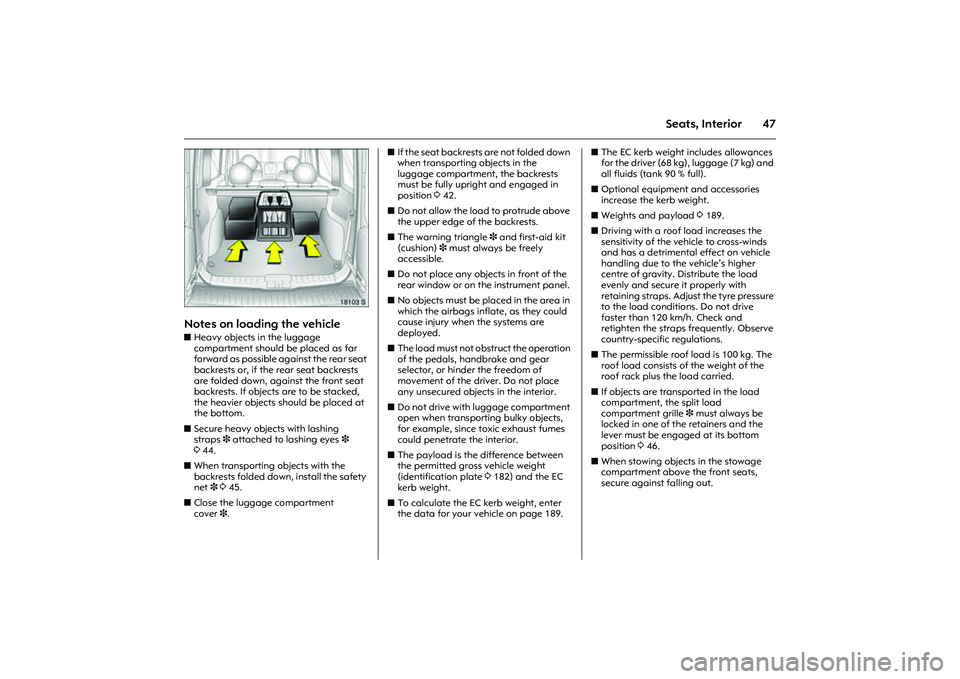
Notes on loading the vehicle zHeavy objects in the luggage
compartment should be placed as far
forward as possible against the rear seat
backrests or, if the rear seat backrests
are folded down, against the front seat
backrests. If objects are to be stacked,
the heavier objects should be placed at
the bottom.
zSecure heavy objects with lashing
straps3 attached to lashing eyes 3
344.
zWhen transporting objects with the
backrests folded down, install the safety
net 3 345.
zClose the luggage compartment
cover3. zIf the seat backrests are not folded down
when transporting objects in the
luggage compartment, the backrests
must be fully upright and engaged in
position 342.
zDo not allow the load to protrude above
the upper edge of the backrests.
zThe warning triangle 3 and first-aid kit
(cushion) 3 must always be freely
accessible.
zDo not place any objects in front of the
rear window or on the instrument panel.
zNo objects must be placed in the area in
which the airbags inflate, as they could
cause injury when the systems are
deployed.
zThe load must not obstruct the operation
of the pedals, handbrake and gear
selector, or hinder the freedom of
movement of the driver. Do not place
any unsecured objects in the interior.
zDo not drive with luggage compartment
open when transporting bulky objects,
for example, since toxic exhaust fumes
could penetrate the interior.
zThe payload is the difference between
the permitted gross vehicle weight
(identification plate 3182) and the EC
kerb weight.
zTo calculate the EC kerb weight, enter
the data for your vehicle on page 189. zThe EC kerb weight includes allowances
for the driver (68 kg), luggage (7 kg) and
all fluids (tank 90 % full).
zOptional equipment and accessories
increase the kerb weight.
zWeights and payload 3189.
zDriving with a roof load increases the
sensitivity of the vehicle to cross-winds
and has a detrimental effect on vehicle
handling due to the vehicle’s higher
centre of gravity. Distribute the load
evenly and secure it properly with
retaining straps. Adjust the tyre pressure
to the load conditions. Do not drive
faster than 120 km/h. Check and
retighten the straps frequently. Observe
country-specific regulations.
zThe permissible roof load is 100 kg. The
roof load consists of the weight of the
roof rack plus the load carried.
zIf objects are transported in the load
compartment, the split load
compartment grille
3 must always be
locked in one of the retainers and the
lever must be engaged at its bottom
position 346.
zWhen stowing objects in the stowage
compartment above the front seats,
secure against falling out.
Page 110 of 212
104 Driving and operation
Picture no: 14083j.tif
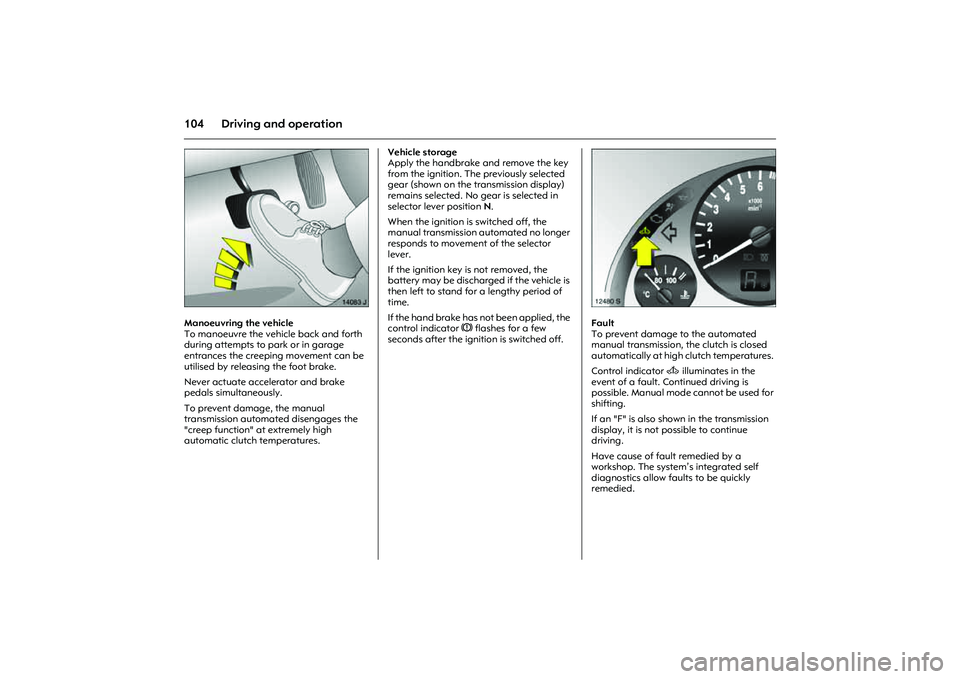
Manoeuvring the vehicle
To manoeuvre the vehicle back and forth
during attempts to park or in garage
entrances the creeping movement can be
utilised by releasing the foot brake.
Never actuate accelerator and brake
pedals simultaneously.
To prevent damage, the manual
transmission automated disengages the
"creep function" at extremely high
automatic clutch temperatures. Vehicle storage
Apply the handbrake and remove the key
from the ignition. The previously selected
gear (shown on the transmission display)
remains selected. No gear is selected in
selector lever position N.
When the ignition is switched off, the
manual transmission automated no longer
responds to movement of the selector
lever.
If the ignition key is not removed, the
battery may be discharged if the vehicle is
then left to stand for a lengthy period of
time.
If the hand brake has not been applied, the
control indicator R flashes for a few
seconds after the ignition is switched off.
Picture no: 12480s.tif
Fault
To prevent damage to the automated
manual transmission, the clutch is closed
automatically at high clutch temperatures.
Control indicator A illuminates in the
event of a fault. Continued driving is
possible. Manual mode cannot be used for
shifting.
If an "F" is also shown in the transmission
display, it is not possible to continue
driving.
Have cause of fault remedied by a
workshop. The system’s integrated self
diagnostics allow faults to be quickly
remedied.
Page 125 of 212
119
Driving and operation
Picture no: 12482s.tif
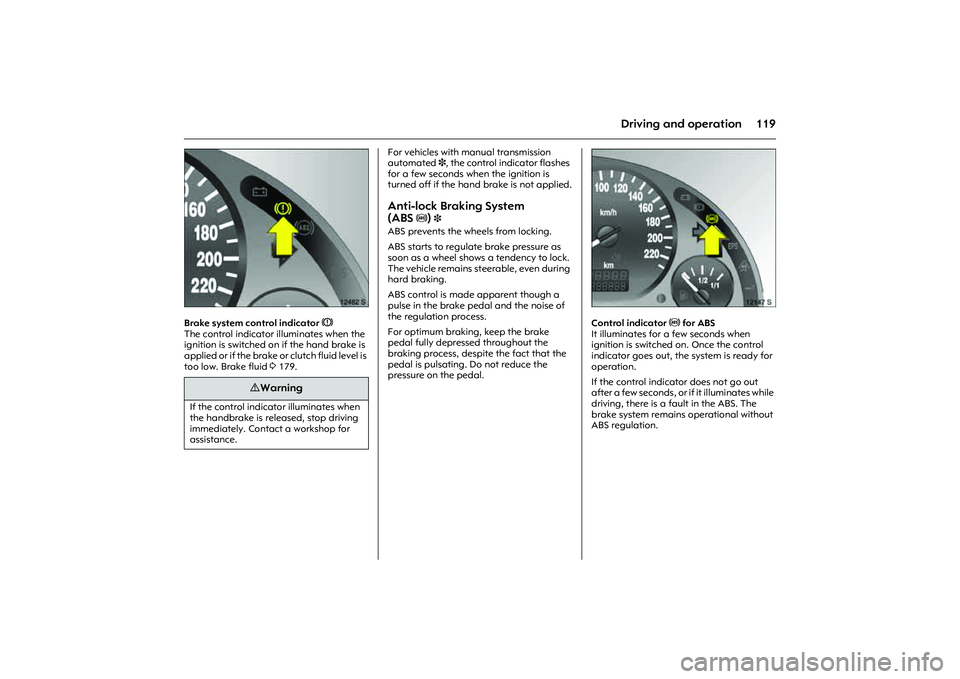
Brake system control indicator R
The control indicator illuminates when the
ignition is switched on if the hand brake is
applied or if the brake or clutch fluid level is
too low. Brake fluid 3179. For vehicles with manual transmission
automated 3, the control indicator flashes
for a few seconds when the ignition is
turned off if the hand brake is not applied.
Anti-lock Braking System
(ABS
u)3
ABS prevents the wheels from locking.
ABS starts to regulate brake pressure as
soon as a wheel shows a tendency to lock.
The vehicle remains steerable, even during
hard braking.
ABS control is made apparent though a
pulse in the brake pedal and the noise of
the regulation process.
For optimum braking, keep the brake
pedal fully depressed throughout the
braking process, despite the fact that the
pedal is pulsating. Do not reduce the
pressure on the pedal.
Picture no: 12147s.tif
Control indicator u for ABS
It illuminates for a few seconds when
ignition is switched on. Once the control
indicator goes out, the system is ready for
operation.
If the control indicator does not go out
after a few seconds, or if it illuminates while
driving, there is a fault in the ABS. The
brake system remains operational without
ABS regulation.
9 Warning
If the control indicator illuminates when
the handbrake is released, stop driving
immediately. Contact a workshop for
assistance.
Page 126 of 212
120 Driving and operationSelf testing
When the engine is started and the vehicle
starts off, the system performs a self-check,
which may be audible.
Fault
Have cause of fault remedied by a
workshop. The system’s integrated self
diagnostics allow faults to be quickly
remedied.
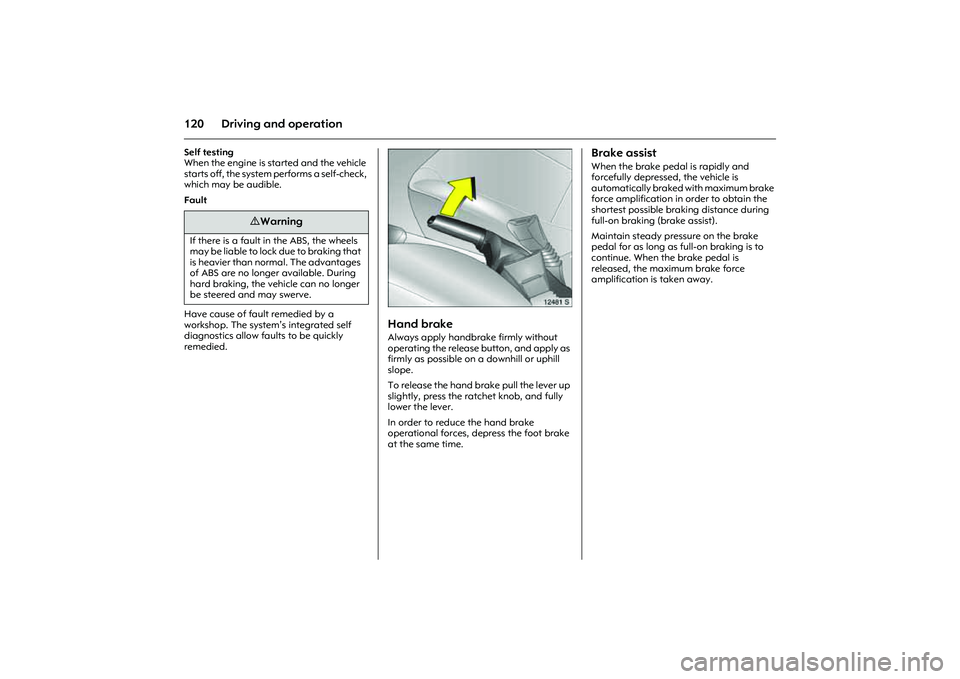
Picture no: 12481s.tif
Hand brake Always apply handbrake firmly without
operating the release button, and apply as
firmly as possible on a downhill or uphill
slope.
To release the hand brake pull the lever up
slightly, press the ratchet knob, and fully
lower the lever.
In order to reduce the hand brake
operational forces, depress the foot brake
at the same time.
Brake assist When the brake pedal is rapidly and
forcefully depressed, the vehicle is
automatically braked with maximum brake
force amplification in order to obtain the
shortest possible braking distance during
full-on braking (brake assist).
Maintain steady pressure on the brake
pedal for as long as full-on braking is to
continue. When the brake pedal is
released, the maximum brake force
amplification is taken away.
9 Warning
If there is a fault in the ABS, the wheels
may be liable to lock due to braking that
is heavier than normal. The advantages
of ABS are no longer available. During
hard braking, the vehicle can no longer
be steered and may swerve.