brake OPEL FRONTERA 1998 Workshop Manual
[x] Cancel search | Manufacturer: OPEL, Model Year: 1998, Model line: FRONTERA, Model: OPEL FRONTERA 1998Pages: 6000, PDF Size: 97 MB
Page 2312 of 6000
TRANSMISSION CONTROL SYSTEM (4L30–E)7A1–67
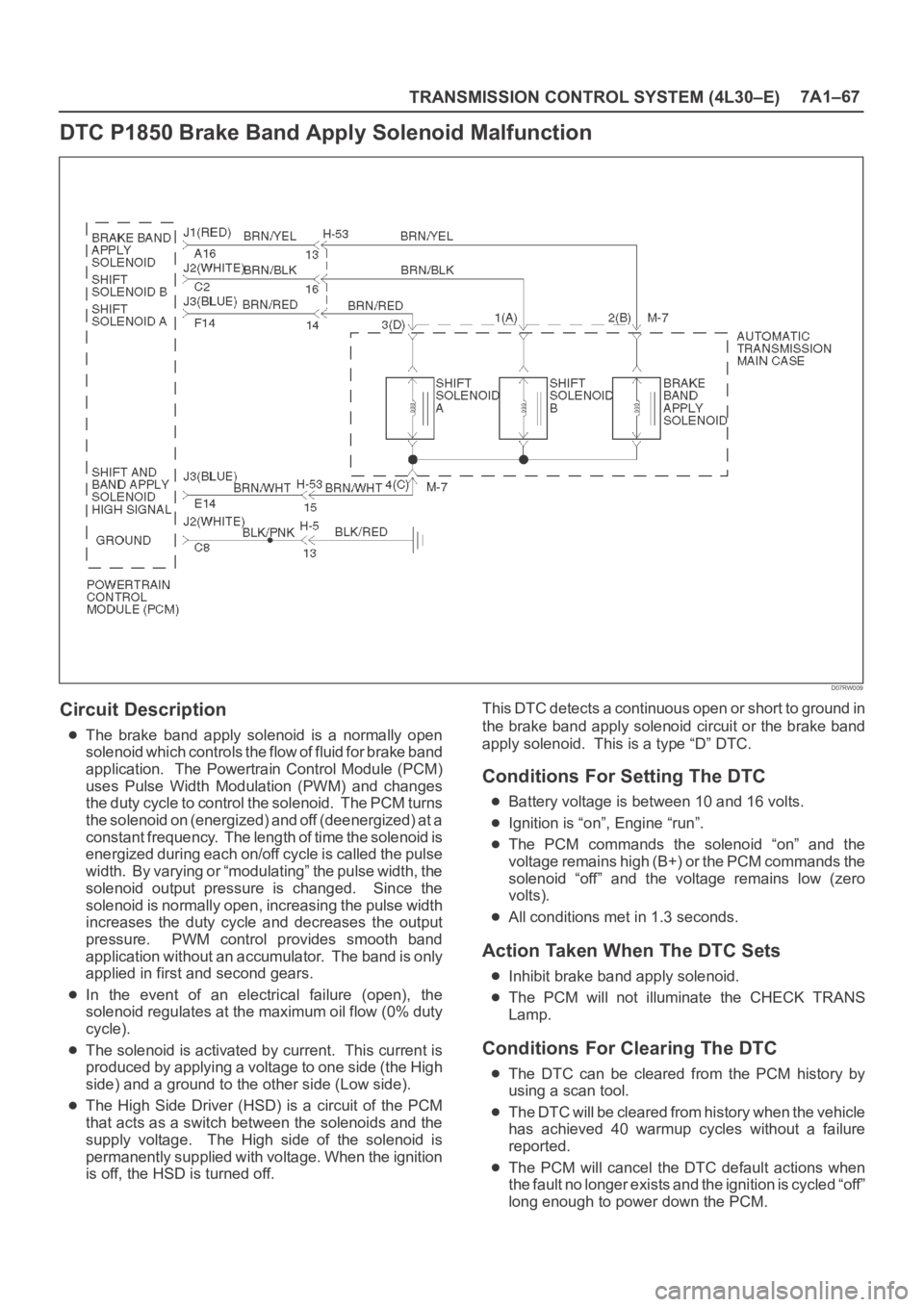
DTC P1850 Brake Band Apply Solenoid Malfunction
D07RW009
Circuit Description
The brake band apply solenoid is a normally open
solenoid which controls the flow of fluid for brake band
application. The Powertrain Control Module (PCM)
uses Pulse Width Modulation (PWM) and changes
the duty cycle to control the solenoid. The PCM turns
the solenoid on (energized) and off (deenergized) at a
constant frequency. The length of time the solenoid is
energized during each on/off cycle is called the pulse
width. By varying or “modulating” the pulse width, the
solenoid output pressure is changed. Since the
solenoid is normally open, increasing the pulse width
increases the duty cycle and decreases the output
pressure. PWM control provides smooth band
application without an accumulator. The band is only
applied in first and second gears.
In the event of an electrical failure (open), the
solenoid regulates at the maximum oil flow (0% duty
cycle).
The solenoid is activated by current. This current is
produced by applying a voltage to one side (the High
side) and a ground to the other side (Low side).
The High Side Driver (HSD) is a circuit of the PCM
that acts as a switch between the solenoids and the
supply voltage. The High side of the solenoid is
permanently supplied with voltage. When the ignition
is off, the HSD is turned off.This DTC detects a continuous open or short to ground in
the brake band apply solenoid circuit or the brake band
apply solenoid. This is a type “D” DTC.
Conditions For Setting The DTC
Battery voltage is between 10 and 16 volts.
Ignition is “on”, Engine “run”.
The PCM commands the solenoid “on” and the
voltage remains high (B+) or the PCM commands the
solenoid “off” and the voltage remains low (zero
volts).
All conditions met in 1.3 seconds.
Action Taken When The DTC Sets
Inhibit brake band apply solenoid.
The PCM will not illuminate the CHECK TRANS
Lamp.
Conditions For Clearing The DTC
The DTC can be cleared from the PCM history by
using a scan tool.
The DTC will be cleared from history when the vehicle
has achieved 40 warmup cycles without a failure
reported.
The PCM will cancel the DTC default actions when
the fault no longer exists and the ignition is cycled “off”
long enough to power down the PCM.
Page 2313 of 6000
7A1–68
TRANSMISSION CONTROL SYSTEM (4L30–E)
Diagnostic Aids
Inspect the wiring for poor electrical connection at the
PCM and at the transmission 16–way connector.
Look for possible bent, backed out, deformed or
damaged terminals. Check for weak terminal tension
as well. Also check for a chafed wire that could short
to bare metal or other wiring. Inspect for a broken wire
inside the insulation.
When diagnosing for a possible intermittent short or
open condition, move the wiring harness while
observing test equipment for a change.
Test Description
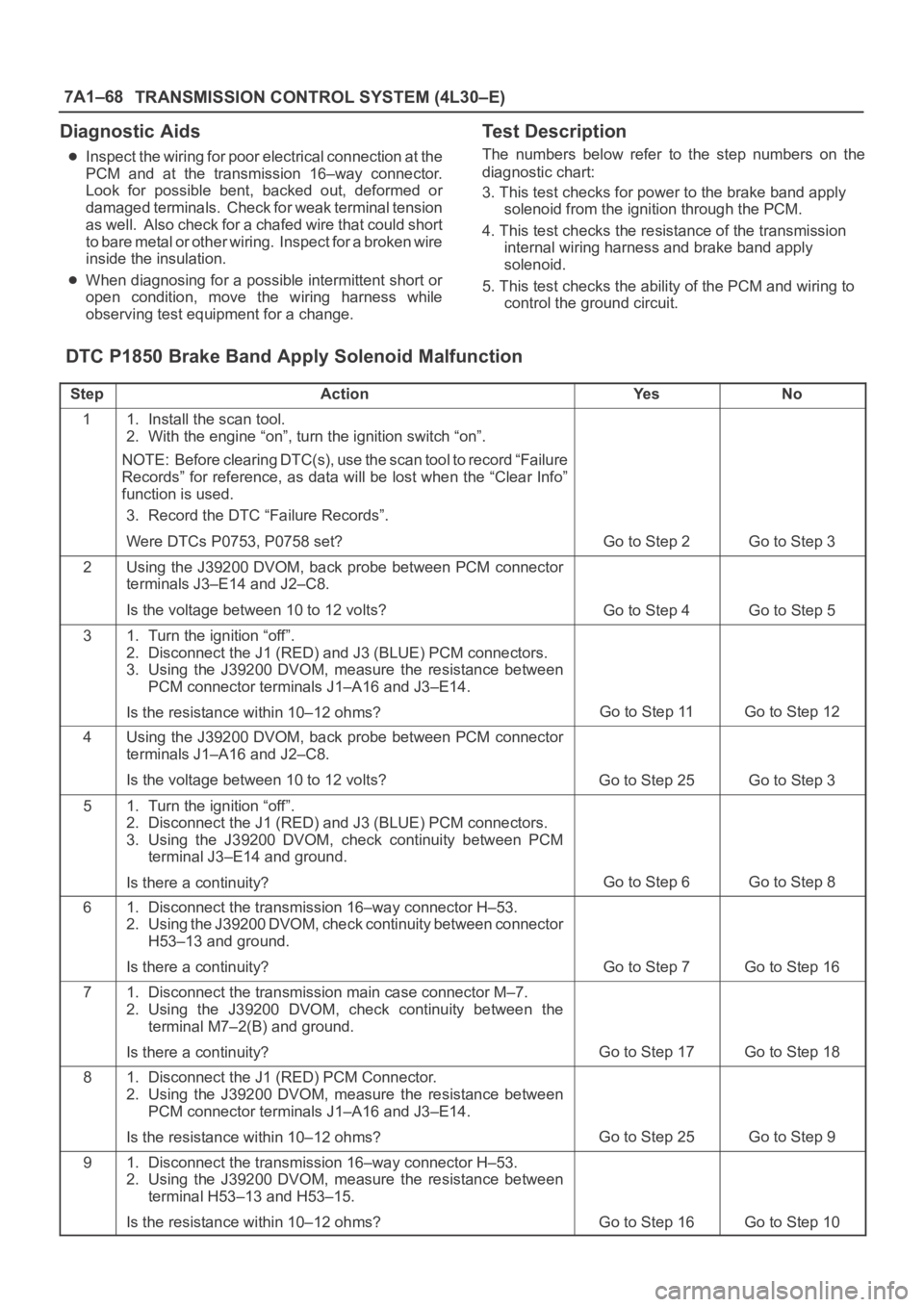
The numbers below refer to the step numbers on the
diagnostic chart:
3. This test checks for power to the brake band apply
solenoid from the ignition through the PCM.
4. This test checks the resistance of the transmission
internal wiring harness and brake band apply
solenoid.
5. This test checks the ability of the PCM and wiring to
control the ground circuit.
DTC P1850 Brake Band Apply Solenoid Malfunction
StepActionYe sNo
11. Install the scan tool.
2. With the engine “on”, turn the ignition switch “on”.
NOTE: Before clearing DTC(s), use the scan tool to record “Failure
Records” for reference, as data will be lost when the “Clear Info”
function is used.
3. Record the DTC “Failure Records”.
Were DTCs P0753, P0758 set?
Go to Step 2Go to Step 3
2Using the J39200 DVOM, back probe between PCM connector
terminals J3–E14 and J2–C8.
Is the voltage between 10 to 12 volts?
Go to Step 4Go to Step 5
31. Turn the ignition “off”.
2. Disconnect the J1 (RED) and J3 (BLUE) PCM connectors.
3. Using the J39200 DVOM, measure the resistance between
PCM connector terminals J1–A16 and J3–E14.
Is the resistance within 10–12 ohms?
Go to Step 11Go to Step 12
4Using the J39200 DVOM, back probe between PCM connector
terminals J1–A16 and J2–C8.
Is the voltage between 10 to 12 volts?
Go to Step 25Go to Step 3
51. Turn the ignition “off”.
2. Disconnect the J1 (RED) and J3 (BLUE) PCM connectors.
3. Using the J39200 DVOM, check continuity between PCM
terminal J3–E14 and ground.
Is there a continuity?
Go to Step 6Go to Step 8
61. Disconnect the transmission 16–way connector H–53.
2. Using the J39200 DVOM, check continuity between connector
H53–13 and ground.
Is there a continuity?
Go to Step 7Go to Step 16
71. Disconnect the transmission main case connector M–7.
2. Using the J39200 DVOM, check continuity between the
terminal M7–2(B) and ground.
Is there a continuity?
Go to Step 17Go to Step 18
81. Disconnect the J1 (RED) PCM Connector.
2. Using the J39200 DVOM, measure the resistance between
PCM connector terminals J1–A16 and J3–E14.
Is the resistance within 10–12 ohms?
Go to Step 25Go to Step 9
91. Disconnect the transmission 16–way connector H–53.
2. Using the J39200 DVOM, measure the resistance between
terminal H53–13 and H53–15.
Is the resistance within 10–12 ohms?
Go to Step 16Go to Step 10
Page 2314 of 6000

TRANSMISSION CONTROL SYSTEM (4L30–E)7A1–69
DTC P1850 Brake Band Apply Solenoid Malfunction (Cont’d)
StepNo Ye s Action
101. Disconnect the transmission main case connector M–7.
2. Using the J39200 DVOM, measure the resistance between
terminals M7–2(B) and M7–4(C).
Is the resistance within 10–12 ohms?
Go to Step 19Go to Step 20
11Using the J39200 DVOM, check continuity between PCM
terminal J1–A16 and ground.
Is there a continuity?
Go to Step 13Go to Step 25
121. Disconnect the transmission 16–way connector H–53.
2. Using the J39200 DVOM, measure the resistance between
terminal H53–13 and H53–15.
Is the resistance within 10–12 ohms?
Go to Step 23Go to Step 14
131. Disconnect the transmission 16–way connector H–53.
2. Using the J39200 DVOM, check continuity between terminal
H53–13 and ground.
Is there a continuity?
Go to Step 15Go to Step 21
141. Disconnect the transmission main case connector M–7.
2. Using the J39200 DVOM, measure the resistance between
terminals M7–2(B) and M7–4(C).
Is the resistance within 10–12 ohms?
Go to Step 24Go to Step 20
151. Disconnect the transmission main case connector M–7.
2. Using the J39200 DVOM, check continuity between the
terminal M7–2(B) and ground.
Is there a continuity?
Go to Step 17Go to Step 22
16The wiring harness between PCM terminal J3–E14 and
transmission 16–way connector terminal H53–15 is open.
Was a problem found and corrected?
Go to Step 26—
17The brake band apply solenoid is faulty, or the internal wiring
harness from the brake band apply solenoid is shorted to ground.
Was a problem found and corrected?
Go to Step 26—
18The wiring harness between the transmission 16–way connector
terminal H53–15 and the transmission main case connector
terminal M7–4(C) is shorted to ground.
Was a problem found and corrected?
Go to Step 26—
19The wiring harness between the transmission 16–way connector
terminal H53–15 and the transmission main case connector
terminal M7–4(C) is open.
Was a problem found and corrected?
Go to Step 26—
20The brake band apply solenoid is faulty, or the internal wiring
harness from the brake band apply solenoid is open.
Was a problem found and corrected?
Go to Step 26—
21The wiring harness between the PCM connector terminal J1–A16
and transmission 16–way connector terminal H53–13 is shorted
to ground.
Was a problem found and corrected?
Go to Step 26—
22The wiring harness between the transmission 16–way connector
terminal H53–13 and the transmission main case connector
terminal M7–2(B) is shorted to ground.
Was a problem found and corrected?
Go to Step 26—
Page 2315 of 6000

7A1–70
TRANSMISSION CONTROL SYSTEM (4L30–E)
DTC P1850 Brake Band Apply Solenoid Malfunction (Cont’d)
StepNo Ye s Action
23The wiring harness between the PCM connector terminal J1–A16
and the 16–way connector terminal H53–13 is open.
Was a problem found and corrected?
Go to Step 26—
24The wiring harness between the transmission 16–way connector
terminal H53–13 and the transmission main case connector
terminal M7–2(B) is open.
Was a problem found and corrected?
Go to Step 26—
25Check every connection at the PCM.
If OK, replace the PCM. Refer to Powertrain Control Module
(PCM) in Automatic Transmission (4L30–E) section.
Is the replacement complete?
Go to Step 26—
261. After the repair is complete, use the scan tool to select “DTC”,
then “Clear Info” function and ensure the following conditions
are met:
The brake band apply solenoid is commanded “on” and the
volts drop to zero.
The brake band apply solenoid is commanded “off” and the
volts increase to B+.
2. Review the scan tool “DTC Info”.
Has the last test failed or is the current DTC displayed?
Begin diagnosis
again
Go to Step 1
Repair verified
Exit DTC table
Page 2317 of 6000
7A1–72
TRANSMISSION CONTROL SYSTEM (4L30–E)
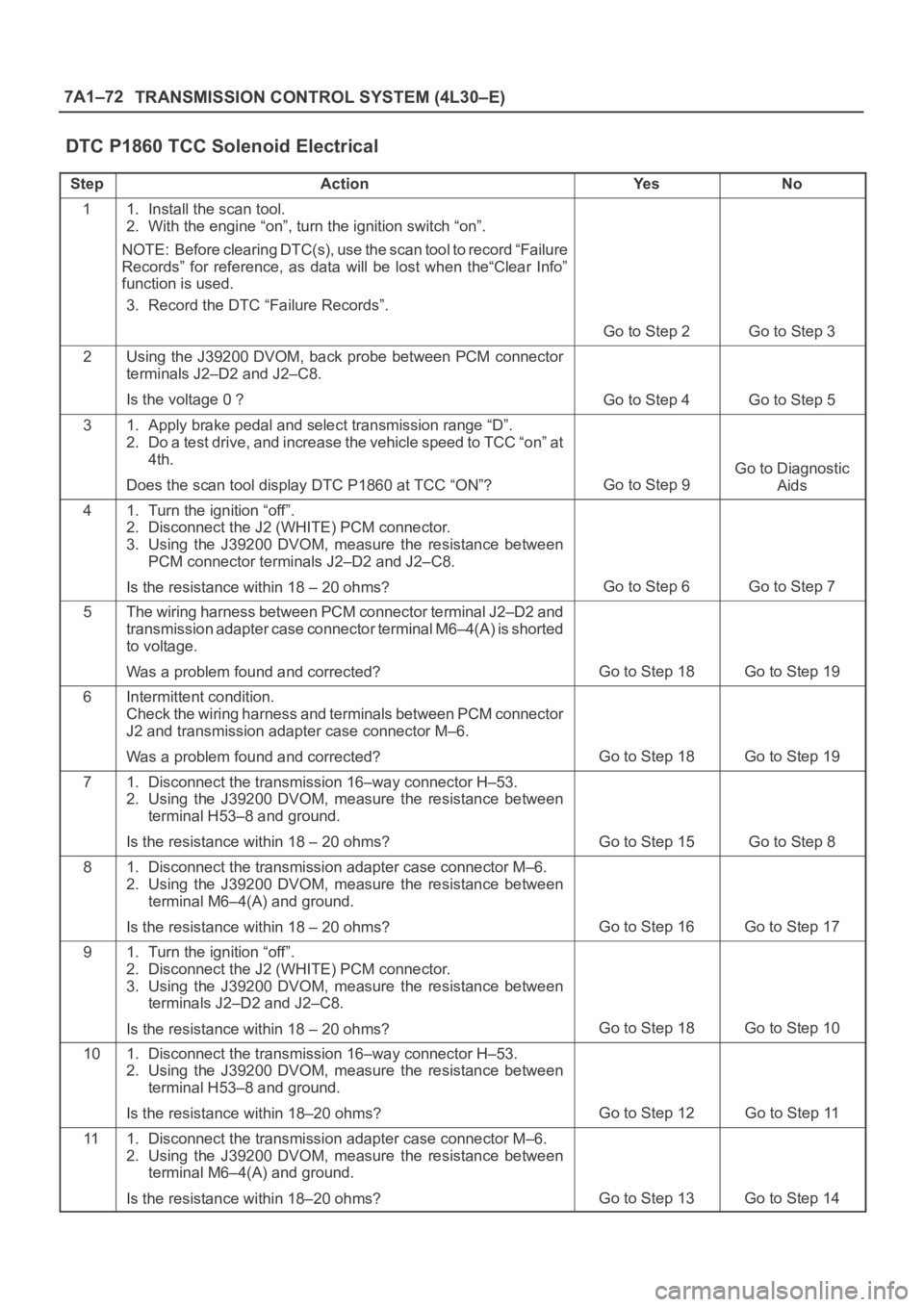
DTC P1860 TCC Solenoid Electrical
StepActionYe sNo
11. Install the scan tool.
2. With the engine “on”, turn the ignition switch “on”.
NOTE: Before clearing DTC(s), use the scan tool to record “Failure
Records” for reference, as data will be lost when the“Clear Info”
function is used.
3. Record the DTC “Failure Records”.
Go to Step 2Go to Step 3
2Using the J39200 DVOM, back probe between PCM connector
terminals J2–D2 and J2–C8.
Is the voltage 0 ?
Go to Step 4Go to Step 5
31. Apply brake pedal and select transmission range “D”.
2. Do a test drive, and increase the vehicle speed to TCC “on” at
4th.
Does the scan tool display DTC P1860 at TCC “ON”?
Go to Step 9
Go to Diagnostic
Aids
41. Turn the ignition “off”.
2. Disconnect the J2 (WHITE) PCM connector.
3. Using the J39200 DVOM, measure the resistance between
PCM connector terminals J2–D2 and J2–C8.
Is the resistance within 18 – 20 ohms?
Go to Step 6Go to Step 7
5The wiring harness between PCM connector terminal J2–D2 and
transmission adapter case connector terminal M6–4(A) is shorted
to voltage.
Was a problem found and corrected?
Go to Step 18Go to Step 19
6Intermittent condition.
Check the wiring harness and terminals between PCM connector
J2 and transmission adapter case connector M–6.
Was a problem found and corrected?
Go to Step 18Go to Step 19
71. Disconnect the transmission 16–way connector H–53.
2. Using the J39200 DVOM, measure the resistance between
terminal H53–8 and ground.
Is the resistance within 18 – 20 ohms?
Go to Step 15Go to Step 8
81. Disconnect the transmission adapter case connector M–6.
2. Using the J39200 DVOM, measure the resistance between
terminal M6–4(A) and ground.
Is the resistance within 18 – 20 ohms?
Go to Step 16Go to Step 17
91. Turn the ignition “off”.
2. Disconnect the J2 (WHITE) PCM connector.
3. Using the J39200 DVOM, measure the resistance between
terminals J2–D2 and J2–C8.
Is the resistance within 18 – 20 ohms?
Go to Step 18Go to Step 10
101. Disconnect the transmission 16–way connector H–53.
2. Using the J39200 DVOM, measure the resistance between
terminal H53–8 and ground.
Is the resistance within 18–20 ohms?
Go to Step 12Go to Step 11
111. Disconnect the transmission adapter case connector M–6.
2. Using the J39200 DVOM, measure the resistance between
terminal M6–4(A) and ground.
Is the resistance within 18–20 ohms?
Go to Step 13Go to Step 14
Page 2529 of 6000
7C–20CLUTCH
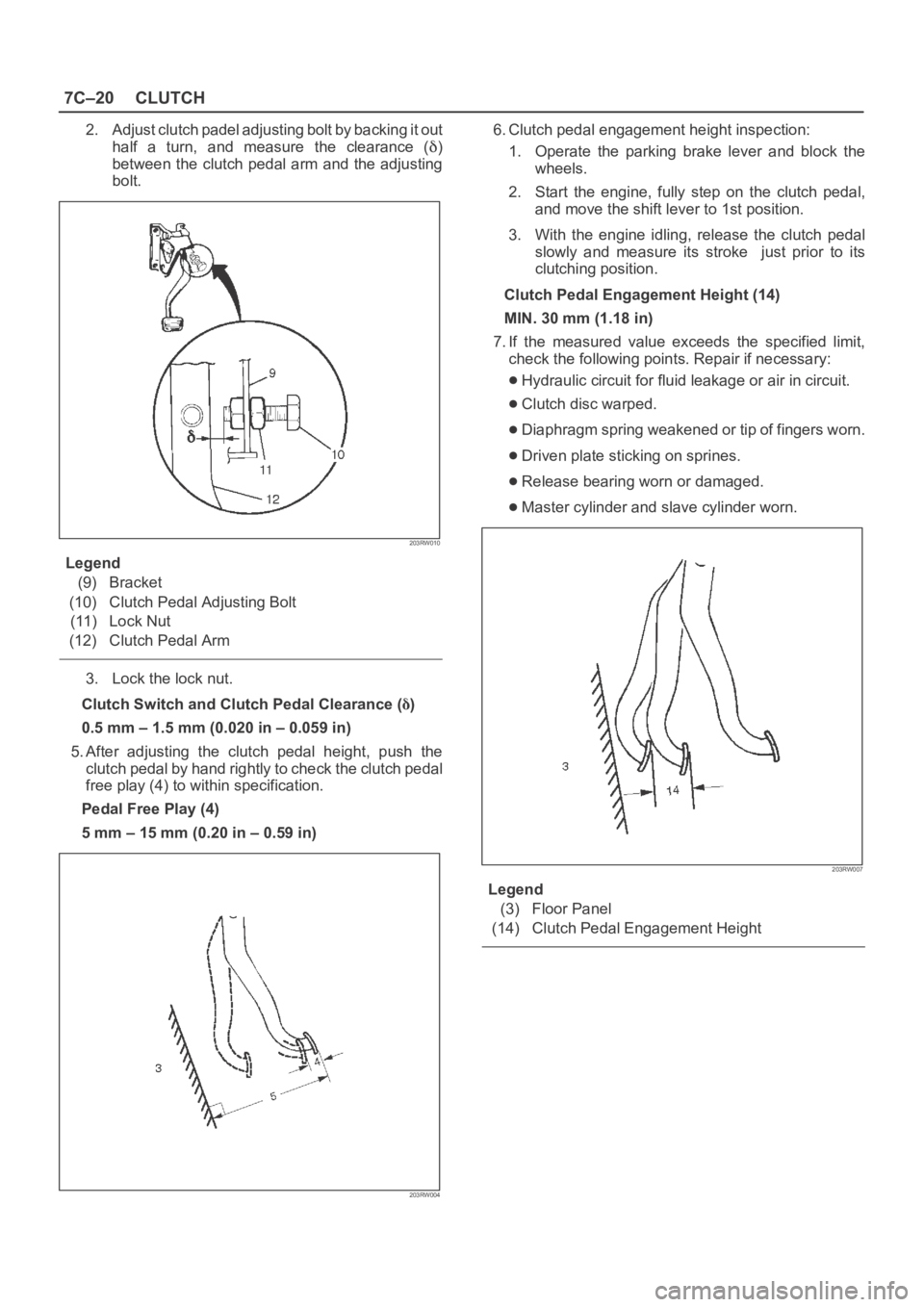
2. Adjust clutch padel adjusting bolt by backing it out
half a turn, and measure the clearance (
)
between the clutch pedal arm and the adjusting
bolt.
203RW010
Legend
(9) Bracket
(10) Clutch Pedal Adjusting Bolt
(11) Lock Nut
(12) Clutch Pedal Arm
3. Lock the lock nut.
Clutch Switch and Clutch Pedal Clearance (
)
0.5 mm – 1.5 mm (0.020 in – 0.059 in)
5. After adjusting the clutch pedal height, push the
clutch pedal by hand rightly to check the clutch pedal
free play (4) to within specification.
Pedal Free Play (4)
5 mm – 15 mm (0.20 in – 0.59 in)
203RW004
6. Clutch pedal engagement height inspection:
1. Operate the parking brake lever and block the
wheels.
2. Start the engine, fully step on the clutch pedal,
and move the shift lever to 1st position.
3. With the engine idling, release the clutch pedal
slowly and measure its stroke just prior to its
clutching position.
Clutch Pedal Engagement Height (14)
MIN. 30 mm (1.18 in)
7. If the measured value exceeds the specified limit,
check the following points. Repair if necessary:
Hydraulic circuit for fluid leakage or air in circuit.
Clutch disc warped.
Diaphragm spring weakened or tip of fingers worn.
Driven plate sticking on sprines.
Release bearing worn or damaged.
Master cylinder and slave cylinder worn.
203RW007
Legend
(3) Floor Panel
(14) Clutch Pedal Engagement Height
Page 2541 of 6000
8A–2LIGHTING SYSTEM
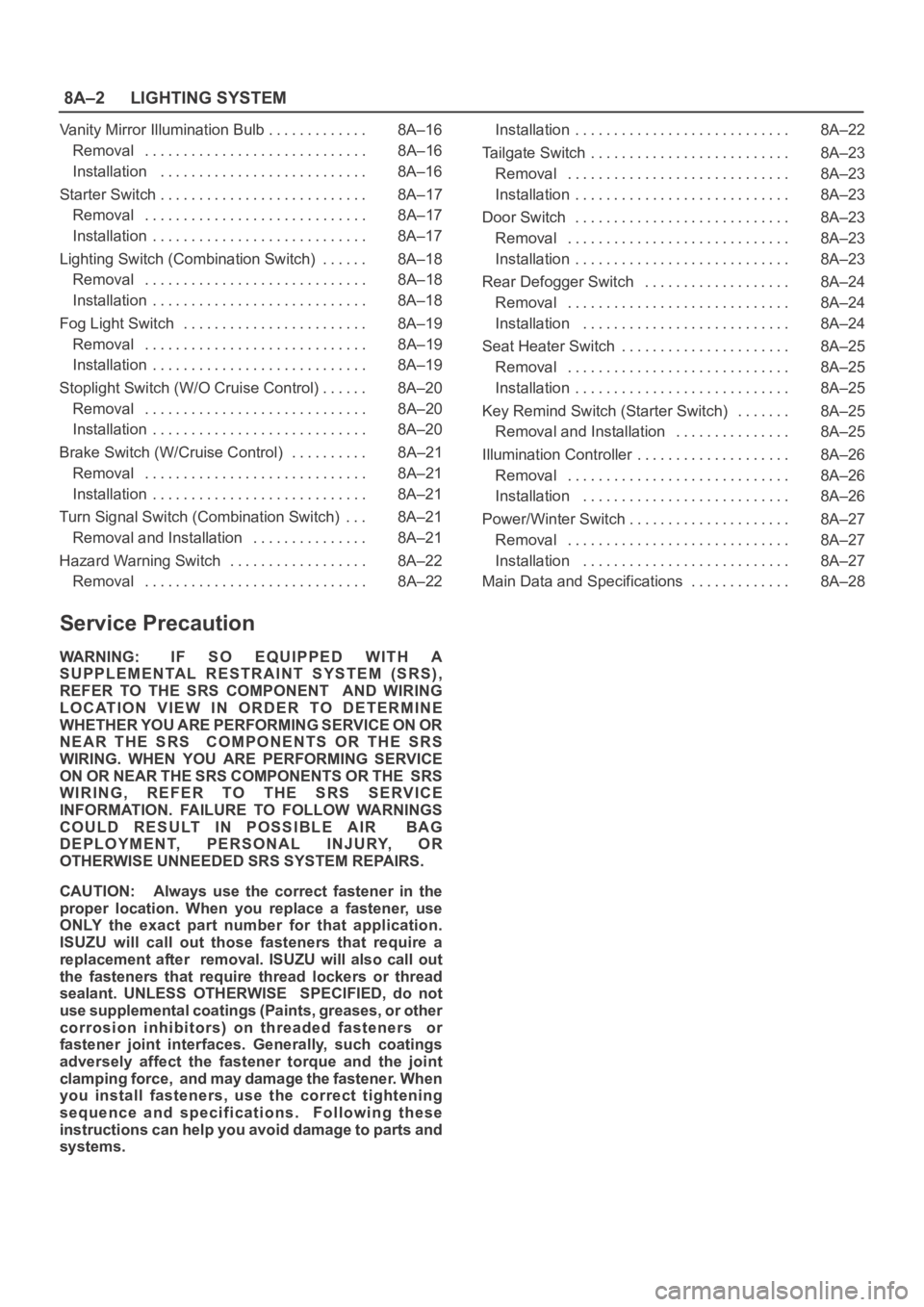
Vanity Mirror Illumination Bulb 8A–16. . . . . . . . . . . . .
Removal 8A–16. . . . . . . . . . . . . . . . . . . . . . . . . . . . .
Installation 8A–16. . . . . . . . . . . . . . . . . . . . . . . . . . .
Starter Switch 8A–17. . . . . . . . . . . . . . . . . . . . . . . . . . .
Removal 8A–17. . . . . . . . . . . . . . . . . . . . . . . . . . . . .
Installation 8A–17. . . . . . . . . . . . . . . . . . . . . . . . . . . .
Lighting Switch (Combination Switch) 8A–18. . . . . .
Removal 8A–18. . . . . . . . . . . . . . . . . . . . . . . . . . . . .
Installation 8A–18. . . . . . . . . . . . . . . . . . . . . . . . . . . .
Fog Light Switch 8A–19. . . . . . . . . . . . . . . . . . . . . . . .
Removal 8A–19. . . . . . . . . . . . . . . . . . . . . . . . . . . . .
Installation 8A–19. . . . . . . . . . . . . . . . . . . . . . . . . . . .
Stoplight Switch (W/O Cruise Control) 8A–20. . . . . .
Removal 8A–20. . . . . . . . . . . . . . . . . . . . . . . . . . . . .
Installation 8A–20. . . . . . . . . . . . . . . . . . . . . . . . . . . .
Brake Switch (W/Cruise Control) 8A–21. . . . . . . . . .
Removal 8A–21. . . . . . . . . . . . . . . . . . . . . . . . . . . . .
Installation 8A–21. . . . . . . . . . . . . . . . . . . . . . . . . . . .
Turn Signal Switch (Combination Switch) 8A–21. . .
Removal and Installation 8A–21. . . . . . . . . . . . . . .
Hazard Warning Switch 8A–22. . . . . . . . . . . . . . . . . .
Removal 8A–22. . . . . . . . . . . . . . . . . . . . . . . . . . . . . Installation 8A–22. . . . . . . . . . . . . . . . . . . . . . . . . . . .
Tailgate Switch 8A–23. . . . . . . . . . . . . . . . . . . . . . . . . .
Removal 8A–23. . . . . . . . . . . . . . . . . . . . . . . . . . . . .
Installation 8A–23. . . . . . . . . . . . . . . . . . . . . . . . . . . .
Door Switch 8A–23. . . . . . . . . . . . . . . . . . . . . . . . . . . .
Removal 8A–23. . . . . . . . . . . . . . . . . . . . . . . . . . . . .
Installation 8A–23. . . . . . . . . . . . . . . . . . . . . . . . . . . .
Rear Defogger Switch 8A–24. . . . . . . . . . . . . . . . . . .
Removal 8A–24. . . . . . . . . . . . . . . . . . . . . . . . . . . . .
Installation 8A–24. . . . . . . . . . . . . . . . . . . . . . . . . . .
Seat Heater Switch 8A–25. . . . . . . . . . . . . . . . . . . . . .
Removal 8A–25. . . . . . . . . . . . . . . . . . . . . . . . . . . . .
Installation 8A–25. . . . . . . . . . . . . . . . . . . . . . . . . . . .
Key Remind Switch (Starter Switch) 8A–25. . . . . . .
Removal and Installation 8A–25. . . . . . . . . . . . . . .
Illumination Controller 8A–26. . . . . . . . . . . . . . . . . . . .
Removal 8A–26. . . . . . . . . . . . . . . . . . . . . . . . . . . . .
Installation 8A–26. . . . . . . . . . . . . . . . . . . . . . . . . . .
Power/Winter Switch 8A–27. . . . . . . . . . . . . . . . . . . . .
Removal 8A–27. . . . . . . . . . . . . . . . . . . . . . . . . . . . .
Installation 8A–27. . . . . . . . . . . . . . . . . . . . . . . . . . .
Main Data and Specifications 8A–28. . . . . . . . . . . . .
Service Precaution
WARNING: IF SO EQUIPPED WITH A
SUPPLEMENTAL RESTRAINT SYSTEM (SRS),
REFER TO THE SRS COMPONENT AND WIRING
LOCATION VIEW IN ORDER TO DETERMINE
WHETHER YOU ARE PERFORMING SERVICE ON OR
NEAR THE SRS COMPONENTS OR THE SRS
WIRING. WHEN YOU ARE PERFORMING SERVICE
ON OR NEAR THE SRS COMPONENTS OR THE SRS
WIRING, REFER TO THE SRS SERVICE
INFORMATION. FAILURE TO FOLLOW WARNINGS
COULD RESULT IN POSSIBLE AIR BAG
DEPLOYMENT, PERSONAL INJURY, OR
OTHERWISE UNNEEDED SRS SYSTEM REPAIRS.
CAUTION: Always use the correct fastener in the
proper location. When you replace a fastener, use
ONLY the exact part number for that application.
ISUZU will call out those fasteners that require a
replacement after removal. ISUZU will also call out
the fasteners that require thread lockers or thread
sealant. UNLESS OTHERWISE SPECIFIED, do not
use supplemental coatings (Paints, greases, or other
corrosion inhibitors) on threaded fasteners or
fastener joint interfaces. Generally, such coatings
adversely affect the fastener torque and the joint
clamping force, and may damage the fastener. When
you install fasteners, use the correct tightening
sequence and specifications. Following these
instructions can help you avoid damage to parts and
systems.
Page 2559 of 6000

8A–20LIGHTING SYSTEM
Stoplight Switch (W/O Cruise Control)
Removal
1. Disconnect the battery ground cable.
2. Disconnect the connector(3), loosen the lock nut(1)
and then remove the stoplight switch(2) by turning it.
310RS007
Installation
To install, follow the removal steps in the reverse order,
noting the following points.
1. Check to see if the brake pedal has been returned by
the return spring to the specified position.
2. Turn the stoplight switch(1) clockwise until the tip of
the threaded portion of the switch contacts the pedal
arm(2).
3. Turn the switch counterclockwise until the space
between the tip of the threaded portion and the pedal
arm is 0.5 to 1.0 mm (0.02 – 0.04 in.).
310RS006
Page 2560 of 6000

LIGHTING SYSTEM8A–21
Brake Switch (W/Cruise Control)
Removal
1. Disconnect the battery ground cable.
2. Disconnect the connector(1), loosen the lock nut(3)
and then remove the brake switch(2) by turning it.
310RW010
Installation
To install, follow the removal steps in the reverse order,
noting the following points.
1. Check to see if the brake pedal has been returned by
the return spring to the specified position.
2. Turn the switch clockwise until the tip of the threaded
portion of the brake switch contacts the pedal arm.
3. Turn the switch counterclockwise until the space
between the tip of the threaded portion and the pedal
arm is 0.5 to 1.0 mm (0.02 – 0.04 in.).
310RS003
Turn Signal Switch (Combination Switch)
Removal and Installation
Refer to the removal and installation steps of the Lighting
Switch (Combination Switch) in this section.
Page 2568 of 6000
LIGHTING SYSTEM8A–29
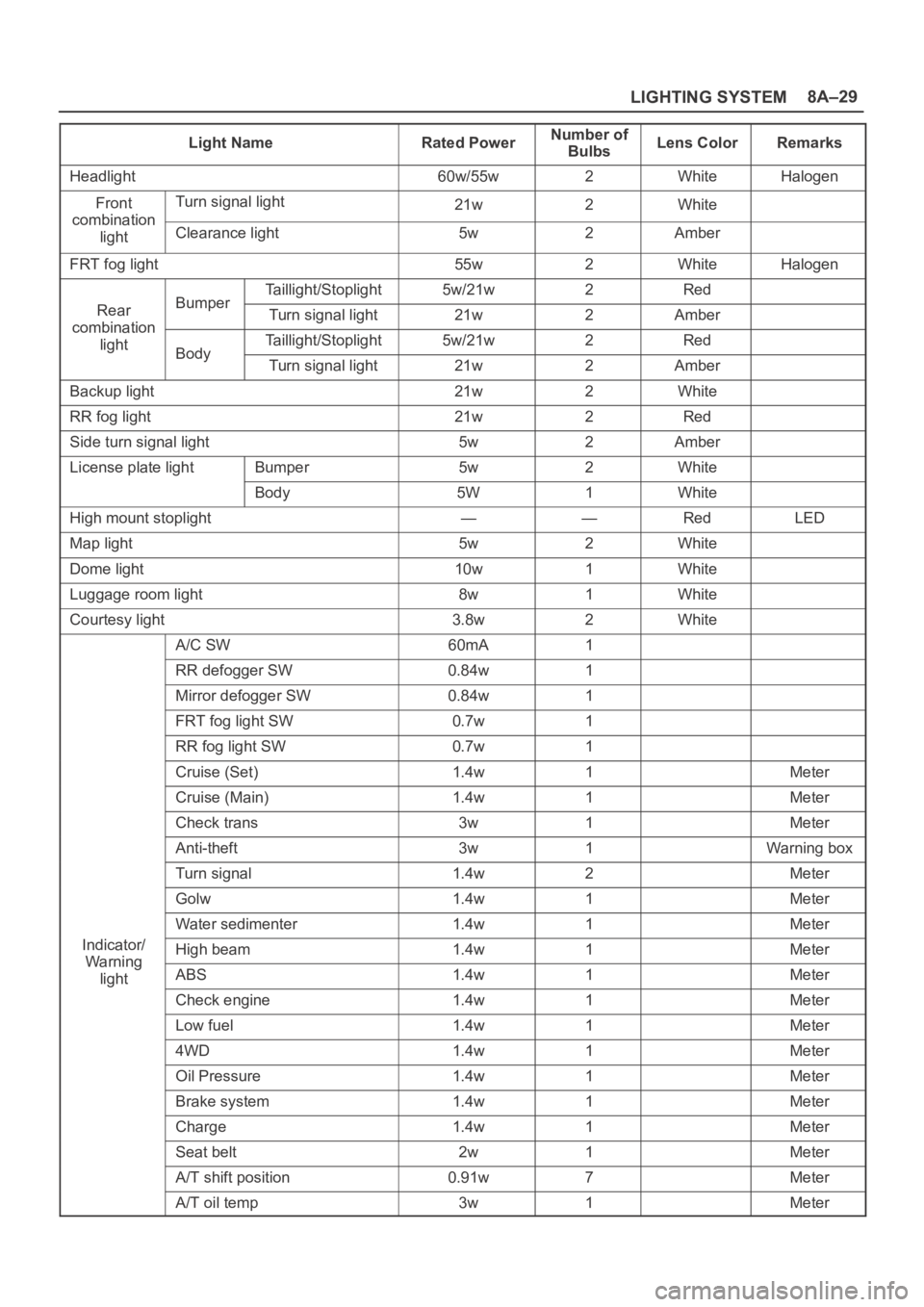
Light NameRated PowerNumber of
BulbsLens ColorRemarks
Headlight60w/55w2WhiteHalogen
FrontTurn signal light21w2Whitecombination
lightClearance light5w2Amber
FRT fog light55w2WhiteHalogen
Taillight/Stoplight5w/21w2Red
RearBumperTurn signal light21w2Ambercombination
lightTaillight/Stoplight5w/21w2RedBodyTurn signal light21w2Amber
Backup light21w2White
RR fog light21w2Red
Side turn signal light5w2Amber
License plate lightBumper5w2White
Body5W1White
High mount stoplight——RedLED
Map light5w2White
Dome light10w1White
Luggage room light8w1White
Courtesy light3.8w2White
A/C SW60mA1
RR defogger SW0.84w1
Mirror defogger SW0.84w1
FRT fog light SW0.7w1
RR fog light SW0.7w1
Cruise (Set)1.4w1Meter
Cruise (Main)1.4w1Meter
Check trans3w1Meter
Anti-theft3w1Warning box
Turn signal1.4w2Meter
Golw1.4w1Meter
Water sedimenter1.4w1Meter
Indicator/High beam1.4w1MeterWa rnin g
lightABS1.4w1Meter
Check engine1.4w1Meter
Low fuel1.4w1Meter
4WD1.4w1Meter
Oil Pressure1.4w1Meter
Brake system1.4w1Meter
Charge1.4w1Meter
Seat belt2w1Meter
A/T shift position0.91w7Meter
A/T oil temp3w1Meter