oil level OPEL GT-R 1973 User Guide
[x] Cancel search | Manufacturer: OPEL, Model Year: 1973, Model line: GT-R, Model: OPEL GT-R 1973Pages: 625, PDF Size: 17.22 MB
Page 358 of 625
2. If inspection of contact points indicates excessive
burning, pitting or wear, check condenser and re-
place if necessary.
3. Inspect all connections and wires in the primary
ignition circuit. Correct any abnormal conditions
found.Carburetor1. Clean fuel strainer in fuel pump. To prevent fuel
leakage in pump, disconnect “IN” line from pump
and raise end above fuel level. The in-line fuel filter
should be replaced every 12,000 miles or every 12
months.
2. Check for freedom of choke valve operation and
clean shaft if necessary, with suitable solvent.
3. Inspect throttle cable or linkage bracket and re-
turn spring for wear. With helper depressing acceler-
ator pedal to floor, check for wide open throttle.
Adjust accelerator pedal height so wide open throttle
is obtained when pedal is within
l/2 inch from floor.
Lubricate linkage pivot points with engine oil.
Air CleanerCheck paper element every 6,000 miles and replace
every
24,ooO miles. If a vehicle is operated in dusty
territory, check condition of air cleaner element
more frequently and replace if necessary.
Fan Belt1. Inspect belt for wear, cracks or frayed points.
Replace and/or adjust as necessary. Specified ten-
sion for belt using Gauge J-23600 is 45 lbs.
Cooling System1. Inspect the radiator, water pump, cylinder head
areas and all radiator and heater hose connections
for evidence of engine coolant leaks.
2. Inspect all hoses for deterioration from gas and oil
contact. Correct as required.
Inspection should be made with engine operating at
normal temperature, cooling system completely
filled, temperature control lever fully open and nor-
mal pressure in the system. Normal pressure should
be 13.2 to 15.2 psi.
Engine Lubrication SystemInspect engine for evidence of oil leakage. Correctany abnormal condition with sealastic or new seals
and gaskets.
Battery
1. Inspect battery, battery mount and cables and
check electrolyte level. Proper level should be just
above the cell plates.
CAUTION:Do not over fill.
2. Determine the serviceability of the battery by ap-
plying the 421 Battery Test.
Positive Crankcase VentilationClean crankcase ventilator metered orifice in the in-
take manifold fitting every 6,000 miles. Also all hoses
and fittings should be inspected, cleaned and re-
placed, if necessary.
To clean, remove rubber hose from metered orifice
and apply air pressure to orifice to remove any for-
eign particles that may be trapped.
Valve Lifter AdjustmentRefer to Engine Mechanical and Mounts section for
valve lifter adjustment procedure.
Engine Tune-Up Instrument ChecksThe following instrument checks and adjustments
serve as a final check on engine condition. These
checks may discover some new problems that may
not have been obvious before. The engine is also
given its final adjustments that will assure maximum
performance, reliability, and proper emission con-
trol.
Refer to Electrical Group for checking procedures of
the following:
Cranking Voltage Check
Ignition Timing
Distributor Advance
Ignition Output
Secondary Resistance
Current Output and Voltage Setting
Idle Speed and Mixture AdjustmentsRefer to carburetor section.
Page 442 of 625
DIAGNOSIS
SEQUENCE
1. Check and correct oil level. Refer to Specifications
for checking and refill procedures.
2. Check and correct vacuum line and fittings.
3. Check and correct manual linkage.
4. Road test car using all selective ranges, noting
when discrepancies in operation occur.
5. If engine performances indicates an engine tuneup
is required, this should be performed before road
testing is completed or transmission correction at-
tempted. Poor engine performance can result in
rough shifting or other malfunctions.
CHECKING PROCEDURESBefore diagnosis of any transmission complaint is
attempted, there must be an understanding of oil
checking procedure and what appearance the oil
should have. Many times a transmission malfunction
can be traced to low oil level, improper reading of
dipstick, or oil appearances; therefore, a careful anal-
ysis of the condition of oil and the level may elimi-
nate needless repairs.
When checking oil level in the Opel Three Speed
Automatic Transmission, the procedure outlined in
Specifications should be followed to obtain the most
accurate reading.
Also when the dipstick is removed, it should be noted
whether the oil is devoid of air bubbles or not. Oil
with air bubbles gives an indication of an air leak in
the suction lines, which can cause erractic operation
and slippage. Water in the oil imparts a milky, pink
cast to the oil and can cause spewing.
EXTERNAL OIL LEAKS
Determining source of oil leakBefore attempting to correct an oil leak, the actual
source of the leak must be determined. In many
cases, the source of the leak can be deceiving due to
“wind flow” around the engine and transmission.
The suspected area should be wiped clear of all oil
before inspecting for the source of the leak. Red dyeAUTOMATIC TRANSMISSION 7C- 81
is used in the transmission oil at the assembly plant
and will indicate if the oil leak is from the transmis-
sion.The use of a “Black Light” to locate the point at
which the oil is leaking is helpful. Comparing the oil
from the leak to that on the engine or transmission
dipstick, when viewed by Black Light, will determine
the source of the leak-engine or transmission.
Oil leaks around the engine and transmission are
generally carried toward the rear of the car by air
stream. For example, a transmission oil filler tube to
case leak will sometimes appear as a leak at the rear
of the transmission. In determining the source of a
leak, proceed as follows:
1. Degrease underside of transmission.
2. Road test to get unit at operating temperature.
3. Inspect for leak with engine running.
4. With engine off, check for oil leaks due to the
raised oil level caused by drain back.
Case Porosity RepairOpel Three-Speed Automatic Transmission external
oil leaks caused by case porosity can be successfully
repaired with the transmission in the car by using the
following recommended procedures:
1. Road test and bring the transmission to operating
temperature, approximately 180 degrees F.
2. Raise car on a hoist or jack stand, engine running,
and locate source of oil leak. Check for oil leaks in
low, drive, and reverse.
3. Shut engine off and thoroughly clean area to be
repaired with a suitable cleaning solvent and a
brush- air dry. A clean, dry soldering acid brush can
be used to clean the area and also to apply the epoxy
cement.
4. Using instructions of the manufacturer, mix a suf-
ficient amount of epoxy, BUICK Group 0.423, Part
No. 1360016, or equivalent, to make the repair. Ob-
serve cautions of manufacturer in handling.
5. While the transmission case is still HOT, apply the
epoxy to the area to be repaired. Make certain the
area to be repaired is fully covered.
6. Allow cement to cure for 3 hours before starting
engine.
7. Road test and check for leaks.
Page 443 of 625
7C- 821973 OPEL SERVICE MANUALAUTOMATIC TRANSMISSION TROUBLE
DIAGNOSIS CHART
Condition
CEllE.e
Concerns Transmission Oil1. Low oil level.a) Oil coming out of oil tiller tube.
b) External oil leak.
c) Failed vacuum modulator.
2. Oil coming out of oil filler
tube.a) Oil level too high.
b) Coolant in transmission oil.
c) External vent clogged with mud.
d) Leak in oil pump suction circuit.
3. External oil leaks in the area
of the torque converter housing.a) Leaking torque converter.
b) Converter housing seal.
c) Sealing washers under converter
housing to case bolts.
d) Sealing washers under converter
housing to pump bolts.
e) Converter housing to case seal.
fj Loose attaching bolts on front of
transmission.
4. External oil leaks in the area
of transmission case and extension.a) Shifter shaft seal.
b) Extension seal.
c) Oil pan gasket.
d) Extension to case gasket.
e) Vacuum modulator gasket.
f) Drain plug gasket.
g) Cooler line fittings.
h) Oil tiller tube seal ring.
i) Detent cable seal ring.
j) Line pressure gauge connection.
5. Low oil pressure.a) Low oil level.
b) Clogged suction screen.
c) Leak in oil pump suction circuit.
d) Leak in oil pressure circuit.
e) Priming valve stuck.
t) Pressure regulator valve malfunction.
g) Sealing ball in valve body dropped out.
6. High oil pressure.a) Modulator vacuum line leaky orinteruupted.
b) Failed vacuum modulator.
c) Leak in any part of engine or
accessory vacuum system.
d) Pressure regulator valve malfunction.
7. Excessrive smoke coming from
exhaust.a) Failed vacuum modulator.
b) Oil from vent valve or leak on hot
exhaust pipe.
Page 444 of 625

AUTOMATIC TRANSMISSION 7C- 83
ConditionCause
Starting
1. No starting in any driverange.a) Low oil level.
b) Clogged suction screen.
c) Manual valve linkage or inner trans-
mission selector lever disconnected.
d) Input shaft broken.e) Pressure regulator valve stuck in open
position. -0 Failed oil pump.
2. No starting in any drive range
for a time. Driving possible only
after repeatedly moving selector
lever to and fro.Manual valve position does not coincide
with valve body channels:
a) Selector lever shaft retaining
pin dropped out.
b) Connecting rod to manual valve
shifting.
c) Selector lever shaft nut loose.
3. No starting after shifting
lever from “P” to “D”, “S”, or “L”
(inadequate engine acceleration).a) Parking
paw1 does not disengage.
4. Sudden starting only after
increase of engine RPM.a) Band servo piston jamming.
b) Low oil level.
c) Oil pump defective.
d) Oil screen missing.
e) Sealing ball in valve body dropped out
5. Heavy jerking when starting.a) Low oil pressure.
b) Wrong modulator valve.
c) Pressure regulator valve stuck.
d) Sealing ball in valve body dropped out.
6. No starting in “D” or “S”
range, but in “L” and “R” range.a) Input sprag installed backwards.
b) Input sprag failure.
7. No starting in “D” or “S” and
“L” (proper driving in “R”; see
also point 9).a) Band worn, does not grip.
b) Band servo piston jamming.
c) Excessive leak in band servo.
d) Parking
paw1 does not disengage.
Page 495 of 625
7C-1341973 OPEL SERVICE MANUAL
Figure 7C-232
Torque Converter4. Rotate converter to check for free movement.
1. Place transmission on portable jack
2. Slide torque converter over stator shaft and input
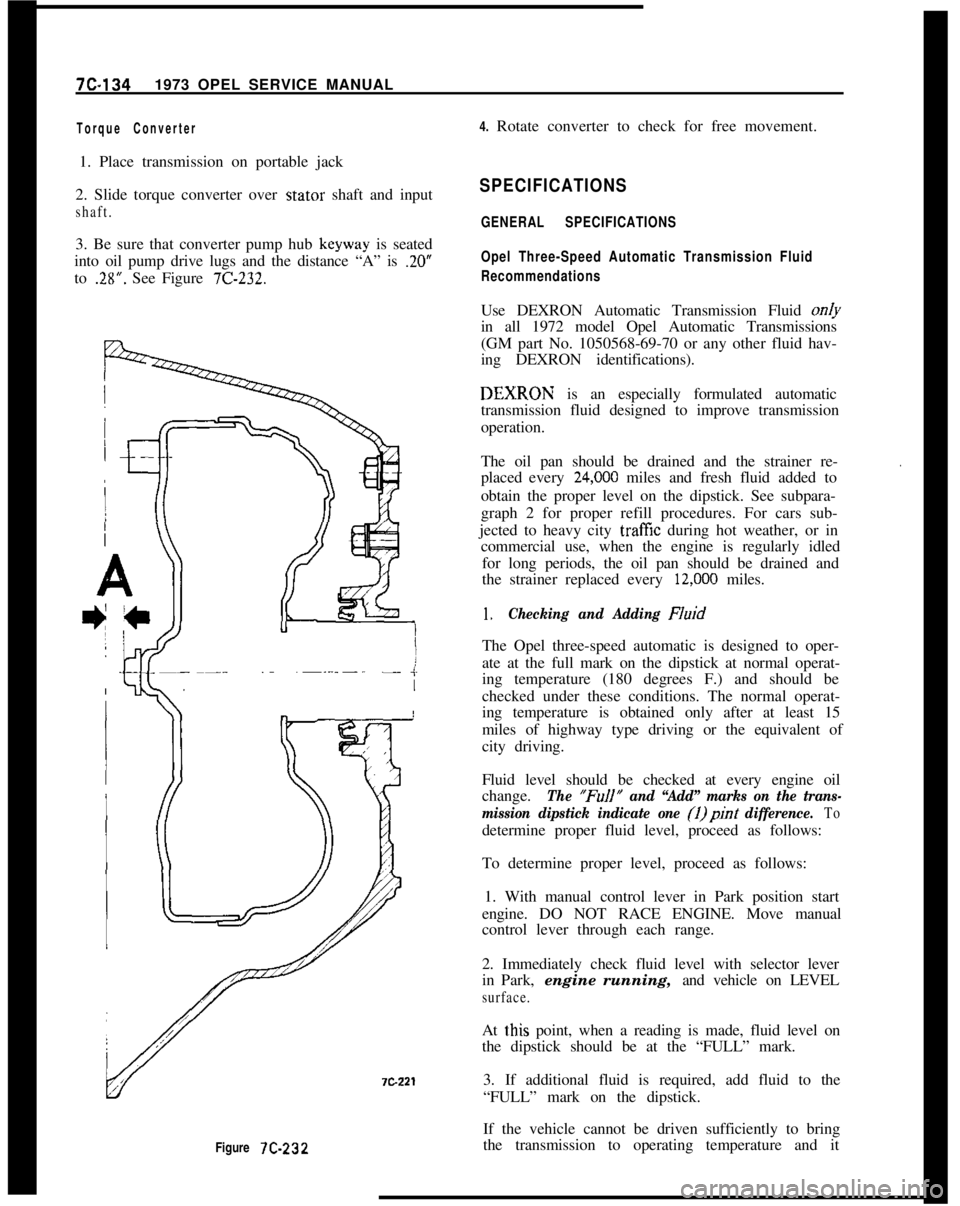
shaft.3. Be sure that converter pump hub keyway is seated
into oil pump drive lugs and the distance “A” is
.20”to
.28”. See Figure 7C-232.
SPECIFICATIONS
GENERAL SPECIFICATIONS
Opel Three-Speed Automatic Transmission Fluid
RecommendationsUse DEXRON Automatic Transmission Fluid on/y
in all 1972 model Opel Automatic Transmissions
(GM part No. 1050568-69-70 or any other fluid hav-
ing DEXRON identifications).DEXIRON is an especially formulated automatic
transmission fluid designed to improve transmission
operation.
The oil pan should be drained and the strainer re-
placed every
24,ooO miles and fresh fluid added to
obtain the proper level on the dipstick. See subpara-
graph 2 for proper refill procedures. For cars sub-
jected to heavy city
traff%z during hot weather, or in
commercial use, when the engine is regularly idled
for long periods, the oil pan should be drained and
the strainer replaced every
12,ooO miles.
.
1.Checking and Adding FluidThe Opel three-speed automatic is designed to oper-
ate at the full mark on the dipstick at normal operat-
ing temperature (180 degrees F.) and should be
checked under these conditions. The normal operat-
ing temperature is obtained only after at least 15
miles of highway type driving or the equivalent of
city driving.
Fluid level should be checked at every engine oil
change.
The “FuIl” and “Add” marks on the trans-
mission dipstick indicate one (1)pint
difference. Todetermine proper fluid level, proceed as follows:
To determine proper level, proceed as follows:
1. With manual control lever in Park position start
engine. DO NOT RACE ENGINE. Move manual
control lever through each range.
2. Immediately check fluid level with selector lever
in Park, engine running, and vehicle on LEVEL
surface.At
t,his point, when a reading is made, fluid level on
the dipstick should be at the “FULL” mark.
3. If additional fluid is required, add fluid to the
“FULL” mark on the dipstick.
If the vehicle cannot be driven sufficiently to bring
the transmission to operating temperature and it
Page 496 of 625
AUTOMATIC TRANSMISSION 7C-135
becomes necessary to check the fluid level, the trans-
mission may be checked at room temperature (70
degrees F.) as follows:
1. With manual control lever in Park position start
engine. DO NOT RACE ENGINE. Move manual
control lever through each range.
2. lmmediately check fluid level with selector lever
in Park, engine running, and vehicle on LEVEL sur-
face.At this point, when a reading is made, fluid level on
the dipstick should be I/4” below the “ADD” mark.
3. If additional fluid is required add fluid to bring
level to
l/4” below the “ADD” mark on the dip-
stick.If transmission fluid level is correctly established at
70 degrees F. it will appear at the “FULL” mark on
the dipstick when the transmission reaches normal
operating temperature (180 degrees F.) The fluid
level is set
l/4” below the “ADD” mark on the
dipstick to allow for expansion of the fluid which
occurs as transmission temperatures rise to normal
operating temperature of 180 degrees F.
Do not overfill, as foaming and loss of fluid through
the vent pipe might occur as fluid heats up. If fluid
is too low especially when cold, complete loss
of’drive may result which can cause transmission fail-
ure.
2.Draining oilpan and rep/a&g strainer assembly.
(a) Raise car on hoist or p/ace OnJxk stands, and
provide container to collect draining fluid.
(b) Remove oil pan and gasket. Discard gasket.
(c) Drain fluid from oil pan. Clean pan with solvent
and dry thoroughly with clean compressed air.
(d) Remove strainer assembly, strainer gasket and
discard.
(e) Install new oil strainer gasket. Install new strainer
assembly.
(f) Install new gasket on oil pan and install pan.
Tighten attaching bolts to 7-10 lb. ft.
(g) Lower car and add approximately three (3) pints
of transmission fluid through filler tube.
(h) With manual control lever in Park position, start
engine. DO NOT RACE ENGINE. Move manual
control lever through each range.
(i) Immediately check fluid level with selector leverin Park, engine running, and vehicle on LEVEL
sur-
face.(i) Add additional fluid to bring level to
l/4” below
the “ADD” mark on the dipstick. Do not overfill.
3.Adding Fluid to Fill Dry Transmission and Con-
verter Assembly
The fluid capacity of the Opel Three Speed Auto-
matic transmission and converter assembly is ap-
proximately IO-l/2 pints, but correct level is
determined by the mark on the dipstick rather than
by amount added. In cases of transmission overhaul,
when a complete fill is required, including a new
converter proceed as follows:
(a) Add approximately 10-l/2 pints of transmission
fluid through tiller tube.
The converter should be replaced on any major fail-
ure, such as a clutch or gearset, and an excessive
amount of foreign material is indicated in the pan. If
installation of a new converter is not required add
approximately five (5) pints of transmission fluid.
(b) With manual control lever in Park position start
engine and run at 1000 RPM. DO NOT RACE EN-
GINE. Move manual control lever through each
range.
(c) Immediately check fluid level with selector lever
in Park, engine running, and vehicle on LEVEL
sur-
face.(d) Add additional fluid to bring level to
l/4” below
the “ADD” mark on the dipstick. Do not overfill.
Opel Three Speed Automatic Transmission Towing
Instructions
If an Opel equipped with an automatic transmission
must be towed, the following precautions must be
observed:
The car may be towed safely on its rear wheels with
the shift lever in neutral position at speeds of 35 miles
per hour or less under most conditions.
However, the drive shaft must be disconnected or the
car towed on its front wheels if:
a. Tow speeds in excess of 35 mph are necessary.
b. Car must be towed for extended distances (over 50
miles).
c. Transmission is not operating properly.
If car is towed on its front wheels, the steering wheel
Page 527 of 625

98.18 1973 OPEL SERVICE MANUAL
DESCRIPTION AND OPERATION
FUNDAMENTAL PRINCIPLES OF REFRIGERATION
We all know what air conditioning does for us, but
very few understand how or why it works. An air
conditioner is functionally very similar to a refrigera-
tor, so let’s take a look at refrigeration. A refrigerator
is a simple mechanism which, surprisingly enough,
works quite a bit like a tea-kettle boiling on a stove.
That may sound far-fetched, but there is more
similarity between the two than most of us would
suspect. In fact, a modern refrigerator can make ice-
cubes and keep food cool and fresh only because a
liquid called the refrigerant boils inside the freezer.
Of codrse everyone knows a boiling tea-kettle is
“hot” and a refrigerator is “cold”. However, this is
where most of us are apt to get confused. We usually
think of “cold” as a definite, positive condition. Ac-
tually though, there is no such thing as “cold”. The
only way we can define it is in a rather negative sort
of way by saying “cold” is simply the lack of heat
just as darkness is the lack of light. We can:t make
things cold directly. All we can do is remove some
of the heat they contain and they will become cold
as a result. And that is the main job of any ice-box
or refrigerator. Both are simply devices for removing
heat.
All substances contain some heat. Theoretically, the
lowest temperature that any substance could obtain
is 459 degrees Fahrenheit below Zero. This may be
called “Cold”, and anything warmer than this con-
tains heat. Since man has never succeeded in getting
all the heat out of an object, we must think about the
transfer of heat from one object to another when
talking about controlling temperatures.
Figure
96-1 Transfer of Heat
Transfer of HeatThe only thing that will attract heat is a colder ob-ject.
:Like water, which always flows down-hill, heat
always flows down a temperature scale
- from a
warm level down to a colder one. When we hold our
hands out toward the fireplace, heat flows from the
hot fire out to our cold hands (Fig.
9B-1). When we
make a snowball, heat always flows from our warm
hands to the colder snow. In an ice-box, the ice al-
ways is colder than the stored food, so heat naturally
is drawn out of the warm food by the colder ice.
Measurement of HeatEveryone thinks he knows how heat is measured.
Thermometers are used in most: homes. Whenever
we speak of temperature from now on, we will mean
Fahrenheit. They can tell how hot a substance is, but
they can’t tell us everything about heat.
Figure
98-2 Applied Temperature Alone is Not the
Sole Measurement of Heat
When we put a tea-kettle on a stove, we expect it to
get hotter and hotter until it finally boils. All during
the process, we can tell exactly how hot the water is
by means of a thermometer (Fig.
9B-2). However,
our thermometer will show us that the flame is just
as hot when we first put the tea-kettle on the stove
as it is when the water finally boils. Why doesn’t the
water boil immediately then? Also, why does it take
longer to boil a quart of water than a cupful? Obvi-
ously temperature isn’t the only measurement of
heat.
Even though heat is intangible, it can be measured by
quantity as well as intensity. It is recognized that
thermometers indicate only the intensity of heat. The
unit for measuring quantity of heat is specified as
that amount necessary to make 1 pound of water 1
degree warmer (Fig.
9B-3). We call this quantity of
heat a British Thermal Unit. Often it is abbreviated
to Btu.
Perhaps we can get a better idea of these two charac-
Page 530 of 625

REFRIGERANT COMPONENTS ALL MODELSSE- 21
about heat instead of refrigeration. But in doing so,
we have learned how a simple ice-box works. It’s
because the magic of latent heat of fusion gives ice
the ability to soak up quantities of heat without get-
ting any warmer.
Therefore, since it stays cold, it can continue to draw
heat away from stored foods and make them cooler.
The latent heat of vaporization can be an even better
“magnet” because it will soak up even more heat.
Whenever we think of anything boiling, we instinc-
tively think of it being very hot. However, that’s not
true in every case. Just because water
boi1.s at 212
degrees doesn’t mean that all other substances will
boil at the same temperature. Some would have to be
put into a blast furnace to make them bubble and
give off vapor. On the other hand, others will boil
violently while sitting on a block of ice.
And so each substance has its own particular boiling
point temperature. But regardless of whether it is
high or low, they all absorb unusually large quanti-
ties of heat without getting any warmer when they
change from a liquid into a vapor.
Consequently, any liquid that will boil at a tempera-
ture below the freezing point of water, will make ice
cubes and keep vegetables cool in a mechanical re-
frigerator.
Figure
9B-10 Simple R-12 Refrigerator
Refrigerant - 12Refrigerant-12 is used in the air conditioning system
and boils at 21.7 degrees below zero. Maybe that
doesn’t mean very much until we picture a flask of
R-12 sitting at the North Pole boiling away just like
a tea-kettle on a stove. No one would dare pick up
the flask with his bare hands because, even though
boiling, it would be so cold and it would be drawing
heat away from nearby objects so fast that human
flesh would freeze in a very short time. If we were toput a flask of R-12 inside a refrigerator cabinet, it
would boil and draw heat away from everything sur-
rounding it (Fig.
9B-10). So long as any refrigerant
remained in the flask, it would keep on soaking up
heat until the temperature got down to 21.7 degrees
below zero.
Now we can begin to see the similarity between a
boiling tea-kettle and a refrigerator. Ordinarily we
think of the flame pushing heat into the tea-kettle.
Yet, it is just as logical to turn our thinking around
and picture the tea-kettle pulling heat out of the
flame. Both the tea-kettle and the flask of refrigerant
do the same thing they draw in heat to boil
although they do so at different temperature levels.
There also is another similarity between the ice-box
and the mechanical refrigerator. In the ice-box, wa-
ter from melting ice literally carried heat out of the
cabinet. In our simple refrigerator, rising vapors do
the same job.Rdsing
Our R-l 2Water is so cheap that we could afford to throw it
away. But R-12, or any other refrigerant, is too ex-
pensive just to let float away into the atmosphere. If
there was some way to remove the heat from the
vapor and change it back into a liquid, it could be
returned to the flask and used over again (Fig. 9B-
11).There is a way, and that is where we find the biggest
difference between the old ice-box and the modern
refrigerator. We used to put in new ice to replace that
lost by melting. Now we use the same refrigerantover and over again.
Figure 9B-1 1 Re-Using Refrigerant
Page 531 of 625
9B-22 1973 OPEL SERVICE MANUAL
We can change a vapor back into a liquid by chilling
it, or do the same thing with pressure. When we
condense a vapor we will find that the heat removed
just exactly equals the amount of heat that was neces-
sary to make the substance vaporize in the first place.
At last the lost is found! The latent heat of vaporiza-
tion the heat that apparently disappeared when
a liquid boiled into a vapor again reappears on
the scene when that same vapor reverts back into a
liquid. It is just like putting air into a balloon to
expand it and then letting the same amount of air out
again to return the balloon to its original condition.
We know that any substance will condense at the
same temperature at which it boiled. This tempera-
ture point is a clear-cut division like a fence. On one
side, a substance is a liquid. Immediately on the
other side it is a vapor. Whichever way a substance
would go, from hot to cold or cold to hot, it will
change its character the moment it crosses over thefence.But pressure moves the fence! Water will boil at 212
degrees under normal conditions. Naturally, we ex-
pect steam to condense at the same temperature. But
whenever we put pressure on steam, it doesn’t! It will
condense at some temperature higher than 212 de-
grees. The greater the pressure, the higher the boiling
point and the temperature at which a vapor will
condense. This is the reason why pressure cookers
cook food faster, since the pressure on the water
permits it to boil out at a higher temperature. We
know that R-12 boils at 21.7 degrees below zero. A
thermometer will show us that the rising vapors,
even though they have soaked up lots of heat, are
only slightly warmer. But the vapors must be made
warmer than the room air if we expect heat to flow
out of them. Also, the condensing point temperature
must be above that of room air or else the vapors
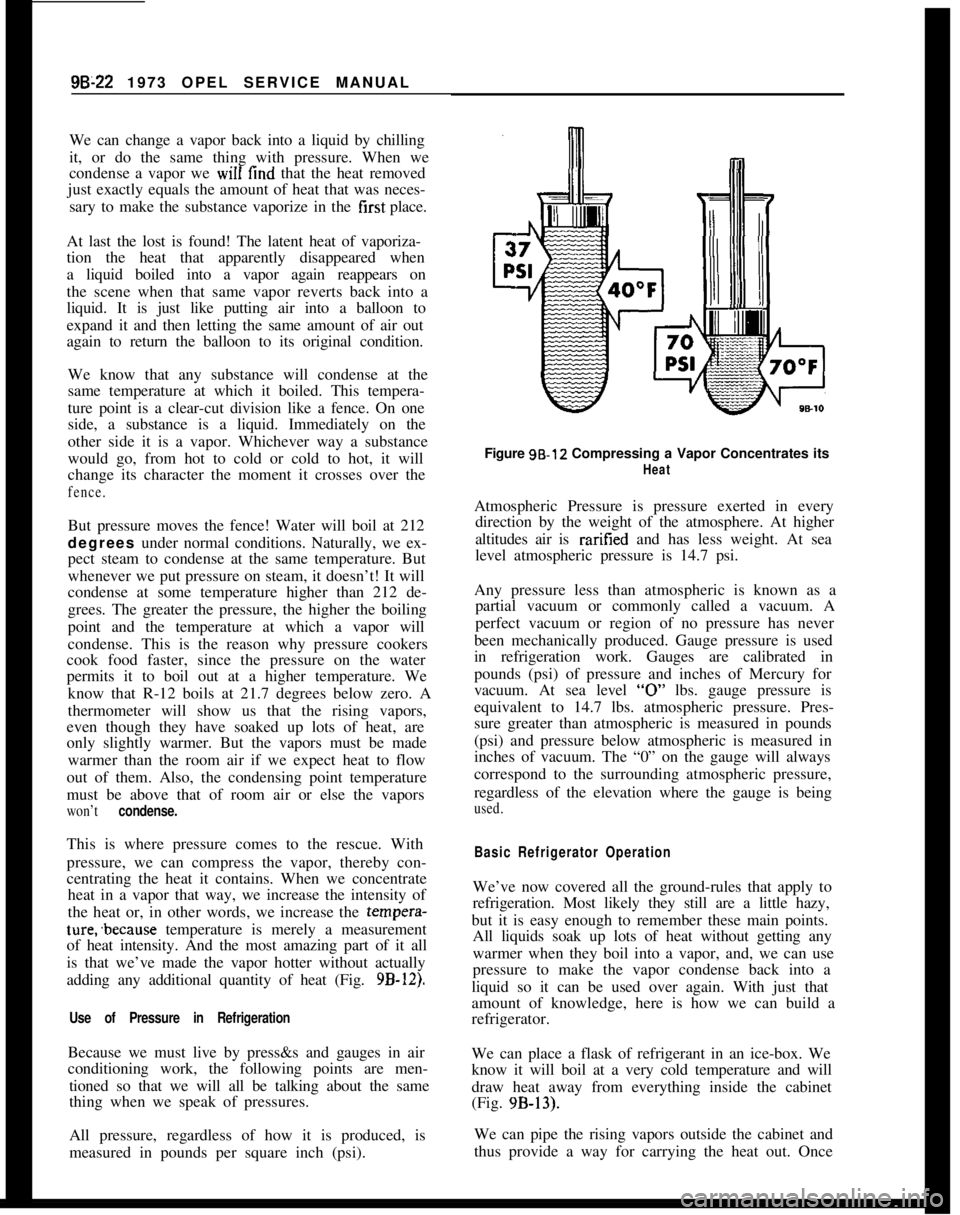
won’t condense.This is where pressure comes to the rescue. With
pressure, we can compress the vapor, thereby con-
centrating the heat it contains. When we concentrate
heat in a vapor that way, we increase the intensity of
the heat or, in other words, we increase the tempera-ture;because temperature is merely a measurement
of heat intensity. And the most amazing part of it all
is that we’ve made the vapor hotter without actually
adding any additional quantity of heat (Fig.
9B-12).
Use of Pressure in RefrigerationBecause we must live by press&s and gauges in air
conditioning work, the following points are men-
tioned so that we will all be talking about the same
thing when we speak of pressures.
All pressure, regardless of how it is produced, is
measured in pounds per square inch (psi).Figure 98.12 Compressing a Vapor Concentrates its
HeatAtmospheric Pressure is pressure exerted in every
direction by the weight of the atmosphere. At higher
altitudes air is raritied and has less weight. At sea
level atmospheric pressure is 14.7 psi.
Any pressure less than atmospheric is known as a
partial vacuum or commonly called a vacuum. A
perfect vacuum or region of no pressure has never
been mechanically produced. Gauge pressure is used
in refrigeration work. Gauges are calibrated in
pounds (psi) of pressure and inches of Mercury for
vacuum. At sea level
“0” lbs. gauge pressure is
equivalent to 14.7 lbs. atmospheric pressure. Pres-
sure greater than atmospheric is measured in pounds
(psi) and pressure below atmospheric is measured in
inches of vacuum. The “0” on the gauge will always
correspond to the surrounding atmospheric pressure,
regardless of the elevation where the gauge is being
used.
Basic Refrigerator OperationWe’ve now covered all the ground-rules that apply to
refrigeration. Most likely they still are a little hazy,
but it is easy enough to remember these main points.
All liquids soak up lots of heat without getting any
warmer when they boil into a vapor, and, we can use
pressure to make the vapor condense back into a
liquid so it can be used over again. With just that
amount of knowledge, here is how we can build a
refrigerator.
We can place a flask of refrigerant in an ice-box. We
know it will boil at a very cold temperature and will
draw heat away from everything inside the cabinet
(Fig. 9B-13).
We can pipe the rising vapors outside the cabinet and
thus provide a way for carrying the heat out. Once
Page 533 of 625
9B-24 1973 OPEL SERVICE MANUAL
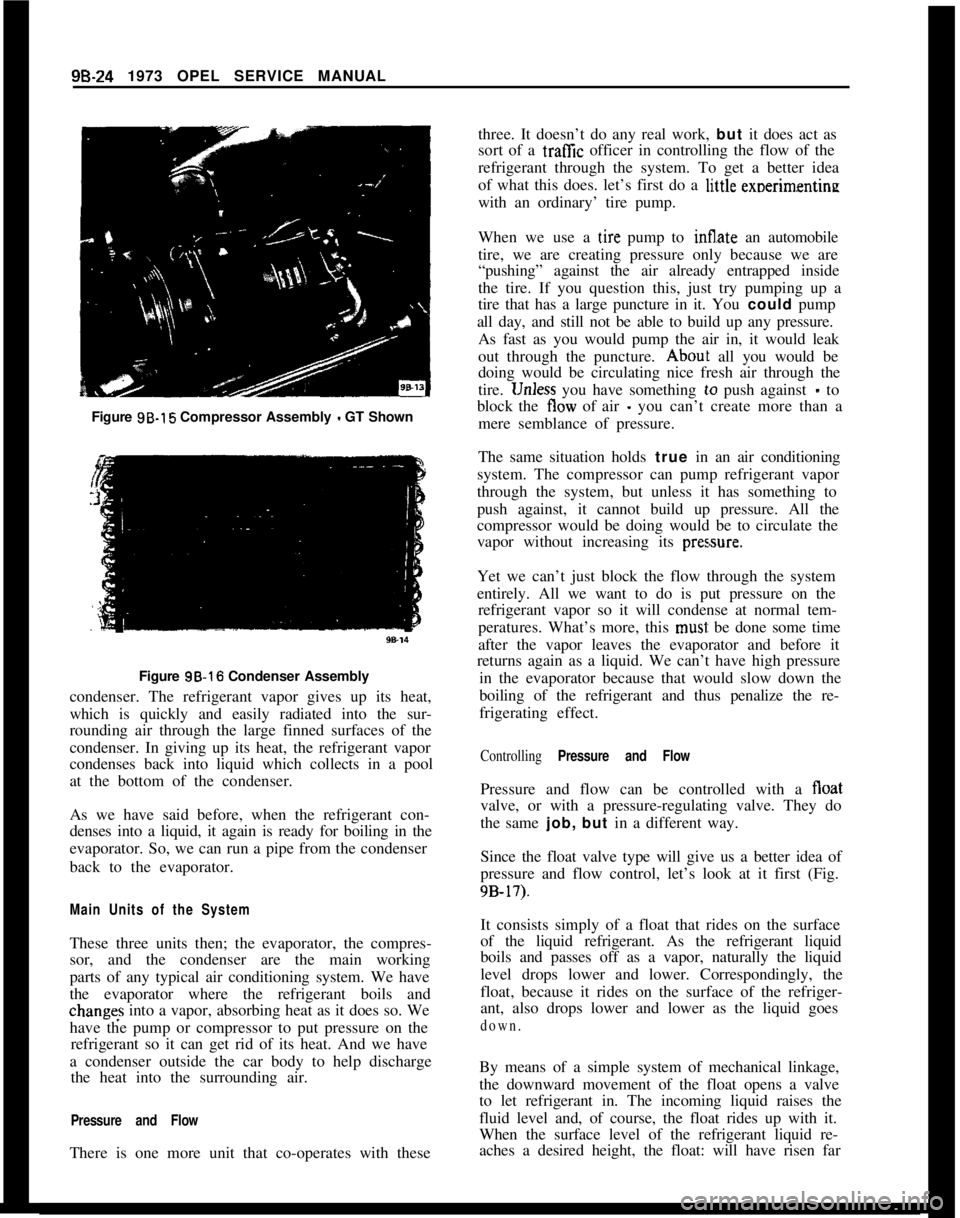
Figure 9B-15 Compressor Assembly - GT Shown
Figure 3B-16 Condenser Assembly
condenser. The refrigerant vapor gives up its heat,
which is quickly and easily radiated into the sur-
rounding air through the large finned surfaces of the
condenser. In giving up its heat, the refrigerant vapor
condenses back into liquid which collects in a pool
at the bottom of the condenser.
As we have said before, when the refrigerant con-
denses into a liquid, it again is ready for boiling in the
evaporator. So, we can run a pipe from the condenser
back to the evaporator.
Main Units of the SystemThese three units then; the evaporator, the compres-
sor, and the condenser are the main working
parts of any typical air conditioning system. We have
the evaporator where the refrigerant boils andchanges into a vapor, absorbing heat as it does so. We
have the pump or compressor to put pressure on the
refrigerant so it can get rid of its heat. And we have
a condenser outside the car body to help discharge
the heat into the surrounding air.
Pressure and FlowThere is one more unit that co-operates with thesethree. It doesn’t do any real work, but it does act as
sort of a traffic officer in controlling the flow of the
refrigerant through the system. To get a better idea
of what this does. let’s first do a li,ttle exoerimentine
with an ordinary’ tire pump.
When we use a
t,ire pump to Sate an automobile
tire, we are creating pressure only because we are
“pushing” against the air already entrapped inside
the tire. If you question this, just try pumping up a
tire that has a large puncture in it. You could pump
all day, and still not be able to build up any pressure.
As fast as you would pump the air in, it would leak
out through the puncture.
Abou~t all you would be
doing would be circulating nice fresh air through the
tire.
1Jnless you have something lo push against - to
block the tlow of air
- you can’t create more than a
mere semblance of pressure.
The same situation holds true in an air conditioning
system. The compressor can pump refrigerant vapor
through the system, but unless it has something to
push against, it cannot build up pressure. All the
compressor would be doing would be to circulate the
vapor without increasing its
pres,sure.Yet we can’t just block the flow through the system
entirely. All we want to do is put pressure on the
refrigerant vapor so it will condense at normal tem-
peratures. What’s more, this
musi: be done some time
after the vapor leaves the evaporator and before it
returns again as a liquid. We can’t have high pressure
in the evaporator because that would slow down the
boiling of the refrigerant and thus penalize the re-
frigerating effect.
Controlling Pressure and FlowPressure and flow can be controlled with a float
valve, or with a pressure-regulating valve. They do
the same job, but in a different way.
Since the float valve type will give us a better idea of
pressure and flow control, let’s look at it first (Fig.
9B-17).It consists simply of a float that rides on the surface
of the liquid refrigerant. As the refrigerant liquid
boils and passes off as a vapor, naturally the liquid
level drops lower and lower. Correspondingly, the
float, because it rides on the surface of the refriger-
ant, also drops lower and lower as the liquid goes
down.By means of a simple system of mechanical linkage,
the downward movement of the float opens a valve
to let refrigerant in. The incoming liquid raises the
fluid level and, of course, the float rides up with it.
When the surface level of the refrigerant liquid re-
aches a desired height, the float: will have risen far