warning light OPEL KARL 2015 Owner's Manual
[x] Cancel search | Manufacturer: OPEL, Model Year: 2015, Model line: KARL, Model: OPEL KARL 2015Pages: 217, PDF Size: 4.16 MB
Page 142 of 217
OPEL Karl Owner Manual (GMK-Localizing-EU RHD-9231168) - 2016 - crc -
5/7/15
Driving and Operating 141
Manual Gearbox
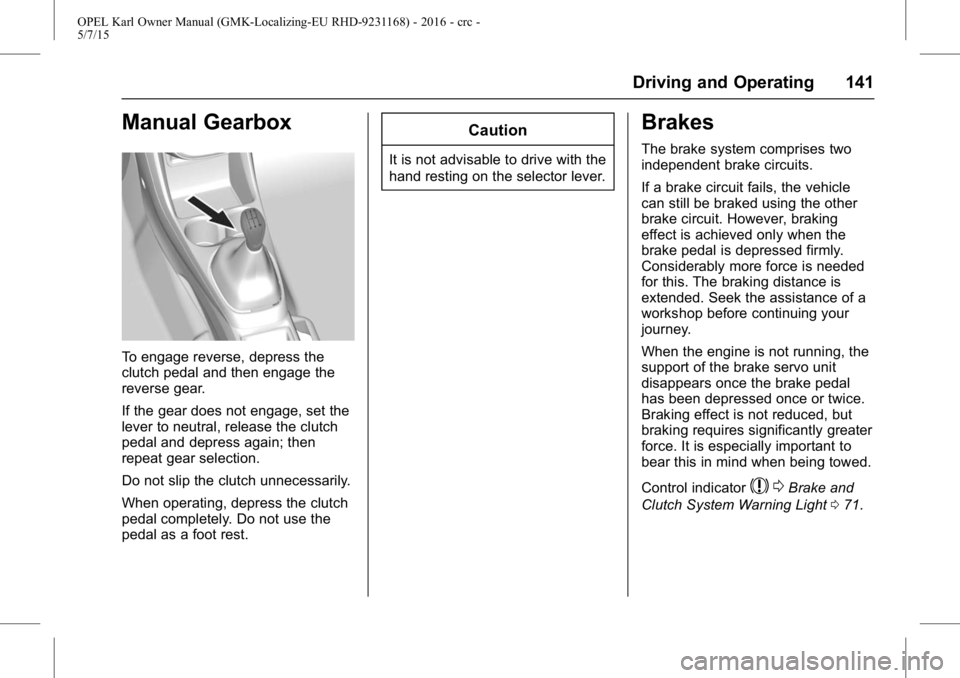
To engage reverse, depress the
clutch pedal and then engage the
reverse gear.
If the gear does not engage, set the
lever to neutral, release the clutch
pedal and depress again; then
repeat gear selection.
Do not slip the clutch unnecessarily.
When operating, depress the clutch
pedal completely. Do not use the
pedal as a foot rest.
Caution
It is not advisable to drive with the
hand resting on the selector lever.
Brakes
The brake system comprises two
independent brake circuits.
If a brake circuit fails, the vehicle
can still be braked using the other
brake circuit. However, braking
effect is achieved only when the
brake pedal is depressed firmly.
Considerably more force is needed
for this. The braking distance is
extended. Seek the assistance of a
workshop before continuing your
journey.
When the engine is not running, the
support of the brake servo unit
disappears once the brake pedal
has been depressed once or twice.
Braking effect is not reduced, but
braking requires significantly greater
force. It is especially important to
bear this in mind when being towed.
Control indicator
$0Brake and
Clutch System Warning Light 071.
Page 143 of 217
OPEL Karl Owner Manual (GMK-Localizing-EU RHD-9231168) - 2016 - crc -
5/7/15
142 Driving and Operating
Antilock Brake
System (ABS)
Anti-lock brake system (ABS)
prevents the wheels from locking.
ABS starts to regulate brake
pressure as soon as a wheel shows
a tendency to lock. The vehicle
remains steerable, even during hard
braking.
ABS control is made apparent
through a pulse in the brake pedal
and the noise of the regulation
process.
For optimum braking, keep the
brake pedal fully depressed
throughout the braking process,
despite the fact that the pedal is
pulsating. Do not reduce the
pressure on the pedal.
After starting off, the system
performs a self-test which may be
audible.
Control indicator
!0Antilock
Brake System (ABS) Warning
Light 071.
Adaptive brake light
During full braking, all three brake
lights flash for the duration of ABS
control.
Fault
{Warning
If there is a fault in the ABS, the
wheels may be liable to lock due
to braking that is heavier than
normal. The advantages of ABS
are no longer available. During
hard braking, the vehicle can no
longer be steered and may
swerve.
Have the cause of the fault
remedied by a workshop.
Parking Brake
{Warning
Always apply parking brake firmly
without operating the release
button, and apply as firmly as
possible on a downhill or uphill
slope.
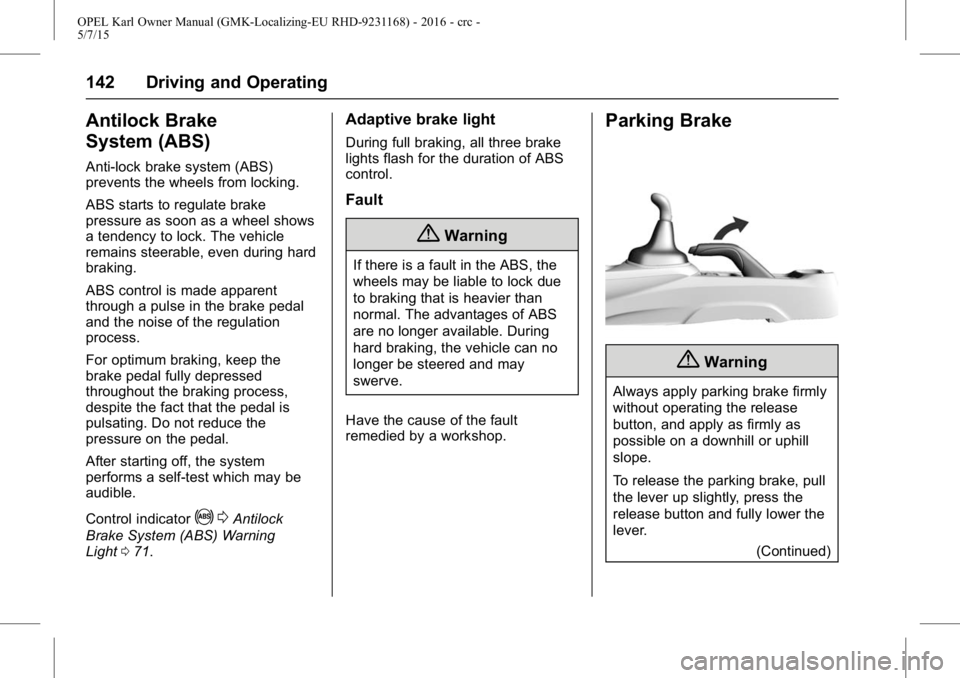
To release the parking brake, pull
the lever up slightly, press the
release button and fully lower the
lever. (Continued)
Page 144 of 217
OPEL Karl Owner Manual (GMK-Localizing-EU RHD-9231168) - 2016 - crc -
5/7/15
Driving and Operating 143
Warning (Continued)
To reduce the operating forces of
the parking brake, depress the
foot brake at the same time.
See Brake and Clutch System
Warning Light 071.
Brake Assist
If the brake pedal is depressed
quickly and forcefully, maximum
brake force is automatically applied
(full braking).
Maintain continuous pressure on the
brake pedal for as long as full
braking is required. Maximum brake
force is automatically reduced when
the brake pedal is released.
Hill Start Assist (HSA)
The system helps prevent
unintended movement when driving
away on inclines.
When releasing the foot brake after
stopping on an incline, the brakes
remain on for a further two seconds. The brakes release automatically as
soon as the vehicle begins to
accelerate.
The hill start assist is not active
during an Autostop.
Ride Control Systems
Traction Control
System (TCS)
The Traction Control system (TC) is
a component of the Electronic
Stability Control system.
TC improves driving stability when
necessary, regardless of the tyre of
road surface or tyre grip, by
preventing the drive wheels from
spinning.
As soon as the drive wheels starts
to spin, engine output is reduced
and the wheel spinning the most is
braked individually. This
considerably improves the driving
stability of the vehicle on slippery
road surfaces.
TC is operational as soon as the
control indicator
Gextinguishes.
When TC is active
Gflashes.
Page 145 of 217
OPEL Karl Owner Manual (GMK-Localizing-EU RHD-9231168) - 2016 - crc -
5/7/15
144 Driving and Operating
{Warning
Do not let this special safety
feature tempt you into taking risks
when driving.
Adapt speed to the road
conditions.
Control indicator
G 0Electronic
Stability Control (ESC) Indicator
Light 072.
Deactivation
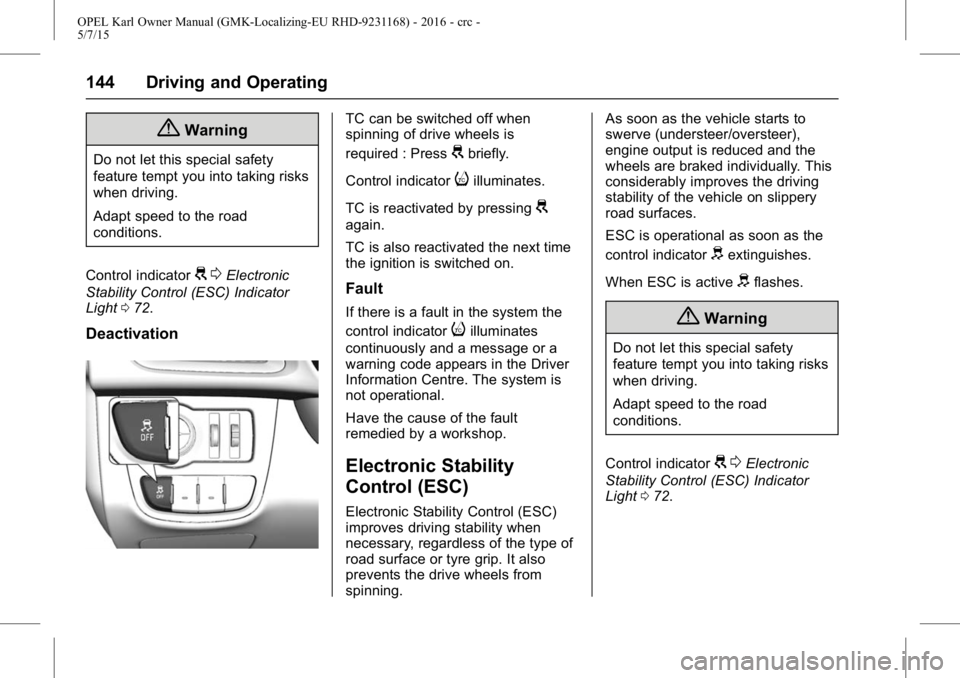
TC can be switched off when
spinning of drive wheels is
required : Press
Gbriefly.
Control indicator
iilluminates.
TC is reactivated by pressing
G
again.
TC is also reactivated the next time
the ignition is switched on.
Fault
If there is a fault in the system the
control indicator
iilluminates
continuously and a message or a
warning code appears in the Driver
Information Centre. The system is
not operational.
Have the cause of the fault
remedied by a workshop.
Electronic Stability
Control (ESC)
Electronic Stability Control (ESC)
improves driving stability when
necessary, regardless of the type of
road surface or tyre grip. It also
prevents the drive wheels from
spinning. As soon as the vehicle starts to
swerve (understeer/oversteer),
engine output is reduced and the
wheels are braked individually. This
considerably improves the driving
stability of the vehicle on slippery
road surfaces.
ESC is operational as soon as the
control indicator
dextinguishes.
When ESC is active
dflashes.
{Warning
Do not let this special safety
feature tempt you into taking risks
when driving.
Adapt speed to the road
conditions.
Control indicator
G 0Electronic
Stability Control (ESC) Indicator
Light 072.
Page 152 of 217
OPEL Karl Owner Manual (GMK-Localizing-EU RHD-9231168) - 2016 - crc -
5/7/15
Driving and Operating 151
.no brake pedal operation
. no active accelerator operation
or speeding-up
. no active steering
If the driver is active, no warning will
be issued.
Activation
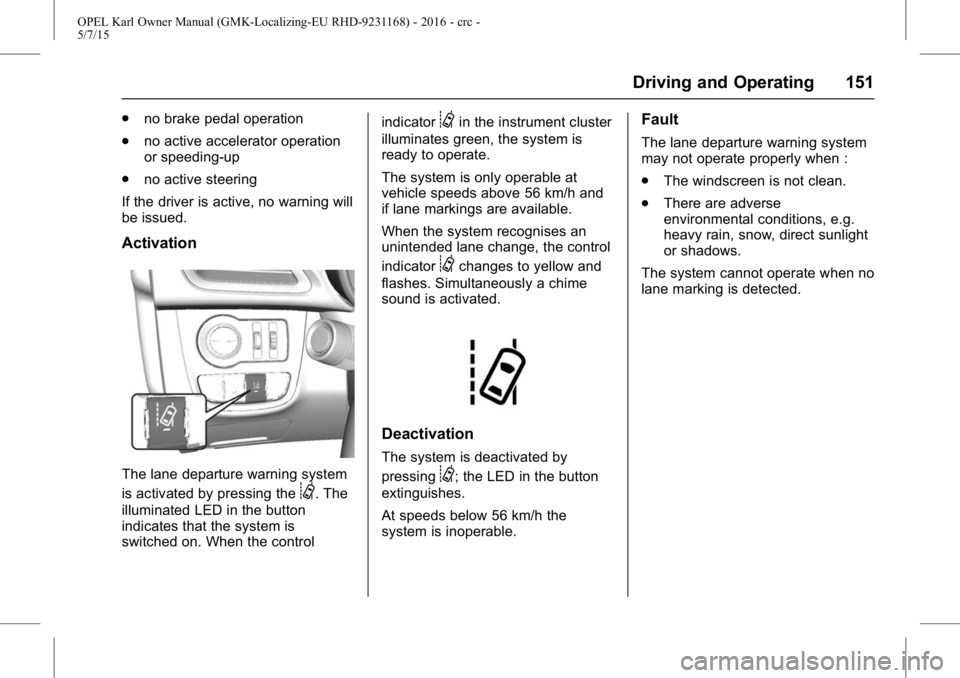
The lane departure warning system
is activated by pressing the
@. The
illuminated LED in the button
indicates that the system is
switched on. When the control indicator
@in the instrument cluster
illuminates green, the system is
ready to operate.
The system is only operable at
vehicle speeds above 56 km/h and
if lane markings are available.
When the system recognises an
unintended lane change, the control
indicator
@changes to yellow and
flashes. Simultaneously a chime
sound is activated.
Deactivation
The system is deactivated by
pressing
@; the LED in the button
extinguishes.
At speeds below 56 km/h the
system is inoperable.
Fault
The lane departure warning system
may not operate properly when :
. The windscreen is not clean.
. There are adverse
environmental conditions, e.g.
heavy rain, snow, direct sunlight
or shadows.
The system cannot operate when no
lane marking is detected.
Page 163 of 217
OPEL Karl Owner Manual (GMK-Localizing-EU RHD-9231168) - 2016 - crc -
5/7/15
162 Vehicle Care
Charging the vehicle battery
{Warning
On vehicles with stop-start
system, ensure that the charging
potential does not exceed
14.6 volts when using a battery
charger. Otherwise the vehicle
battery might be damaged.
Jump starting
0Jump
Starting 0188.
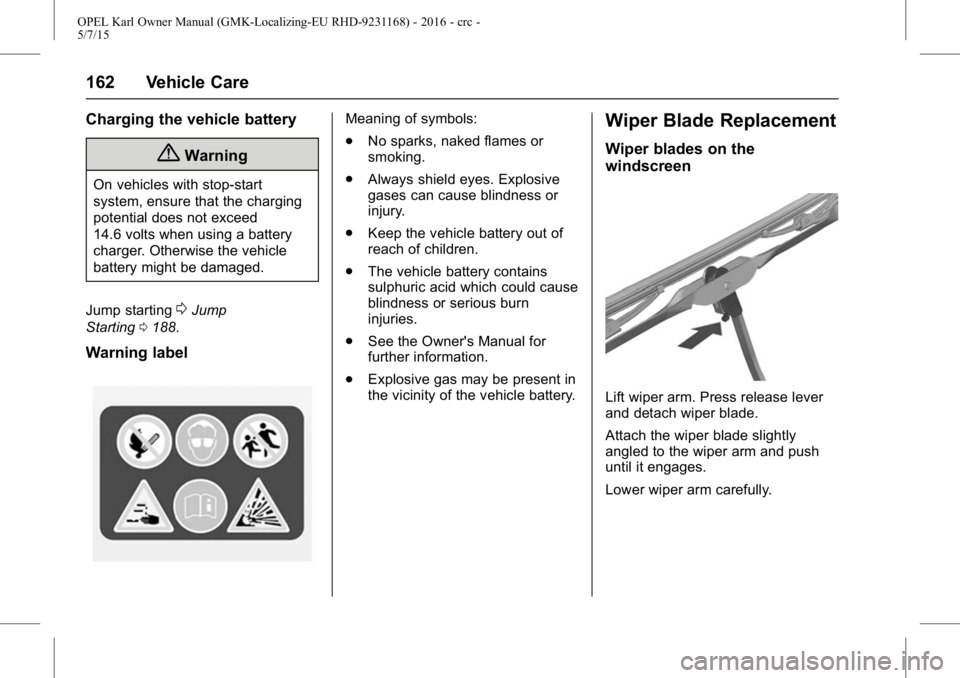
Warning label
Meaning of symbols:
.
No sparks, naked flames or
smoking.
. Always shield eyes. Explosive
gases can cause blindness or
injury.
. Keep the vehicle battery out of
reach of children.
. The vehicle battery contains
sulphuric acid which could cause
blindness or serious burn
injuries.
. See the Owner's Manual for
further information.
. Explosive gas may be present in
the vicinity of the vehicle battery.Wiper Blade Replacement
Wiper blades on the
windscreen
Lift wiper arm. Press release lever
and detach wiper blade.
Attach the wiper blade slightly
angled to the wiper arm and push
until it engages.
Lower wiper arm carefully.
Page 178 of 217
OPEL Karl Owner Manual (GMK-Localizing-EU RHD-9231168) - 2016 - crc -
5/7/15
Vehicle Care 177
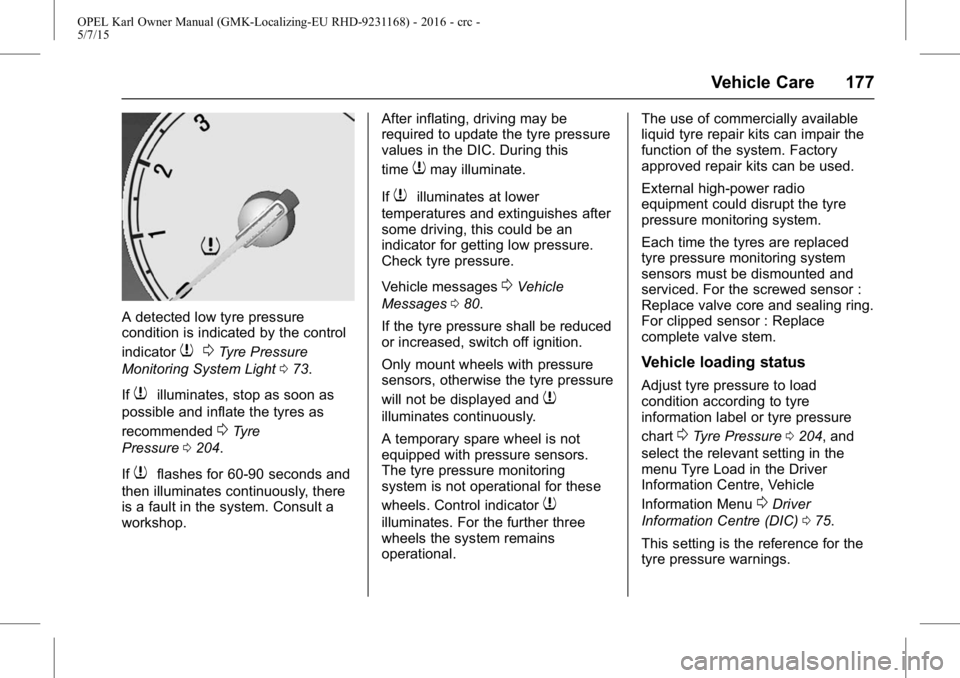
A detected low tyre pressure
condition is indicated by the control
indicator
70Tyre Pressure
Monitoring System Light 073.
If
7illuminates, stop as soon as
possible and inflate the tyres as
recommended
0Tyre
Pressure 0204.
If
7flashes for 60-90 seconds and
then illuminates continuously, there
is a fault in the system. Consult a
workshop. After inflating, driving may be
required to update the tyre pressure
values in the DIC. During this
time
7may illuminate.
If
7illuminates at lower
temperatures and extinguishes after
some driving, this could be an
indicator for getting low pressure.
Check tyre pressure.
Vehicle messages
0Vehicle
Messages 080.
If the tyre pressure shall be reduced
or increased, switch off ignition.
Only mount wheels with pressure
sensors, otherwise the tyre pressure
will not be displayed and
7
illuminates continuously.
A temporary spare wheel is not
equipped with pressure sensors.
The tyre pressure monitoring
system is not operational for these
wheels. Control indicator
7
illuminates. For the further three
wheels the system remains
operational. The use of commercially available
liquid tyre repair kits can impair the
function of the system. Factory
approved repair kits can be used.
External high-power radio
equipment could disrupt the tyre
pressure monitoring system.
Each time the tyres are replaced
tyre pressure monitoring system
sensors must be dismounted and
serviced. For the screwed sensor :
Replace valve core and sealing ring.
For clipped sensor : Replace
complete valve stem.
Vehicle loading status
Adjust tyre pressure to load
condition according to tyre
information label or tyre pressure
chart
0Tyre Pressure
0204, and
select the relevant setting in the
menu Tyre Load in the Driver
Information Centre, Vehicle
Information Menu
0Driver
Information Centre (DIC) 075.
This setting is the reference for the
tyre pressure warnings.
Page 179 of 217
OPEL Karl Owner Manual (GMK-Localizing-EU RHD-9231168) - 2016 - crc -
5/7/15
178 Vehicle Care
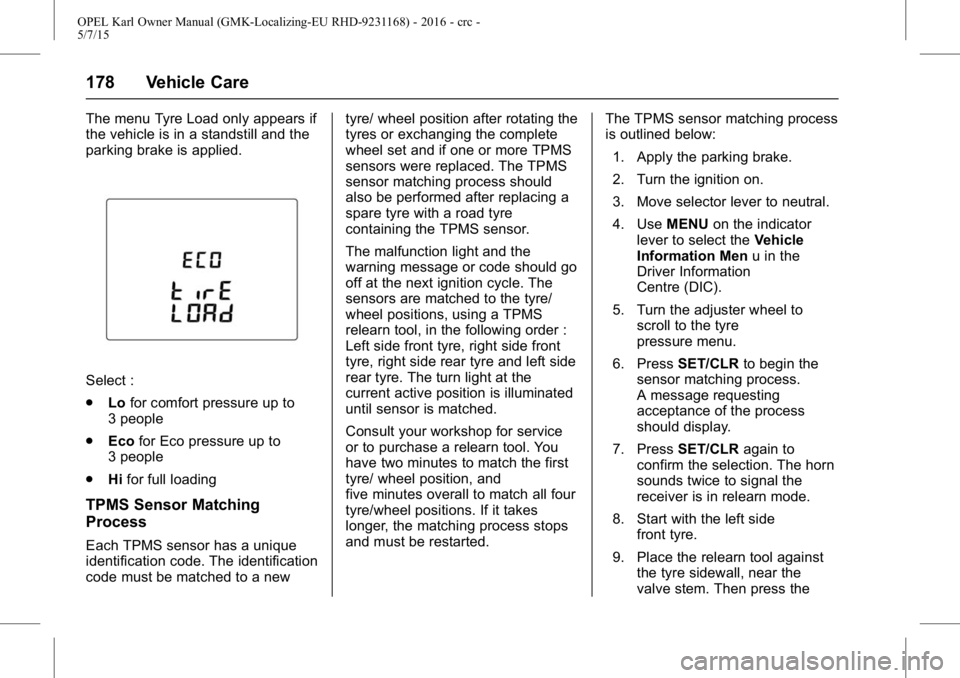
The menu Tyre Load only appears if
the vehicle is in a standstill and the
parking brake is applied.
Select :
.Lofor comfort pressure up to
3 people
. Eco for Eco pressure up to
3 people
. Hifor full loading
TPMS Sensor Matching
Process
Each TPMS sensor has a unique
identification code. The identification
code must be matched to a new tyre/ wheel position after rotating the
tyres or exchanging the complete
wheel set and if one or more TPMS
sensors were replaced. The TPMS
sensor matching process should
also be performed after replacing a
spare tyre with a road tyre
containing the TPMS sensor.
The malfunction light and the
warning message or code should go
off at the next ignition cycle. The
sensors are matched to the tyre/
wheel positions, using a TPMS
relearn tool, in the following order :
Left side front tyre, right side front
tyre, right side rear tyre and left side
rear tyre. The turn light at the
current active position is illuminated
until sensor is matched.
Consult your workshop for service
or to purchase a relearn tool. You
have two minutes to match the first
tyre/ wheel position, and
five minutes overall to match all four
tyre/wheel positions. If it takes
longer, the matching process stops
and must be restarted.
The TPMS sensor matching process
is outlined below:
1. Apply the parking brake.
2. Turn the ignition on.
3. Move selector lever to neutral.
4. Use MENUon the indicator
lever to select the Vehicle
Information Men u in the
Driver Information
Centre (DIC).
5. Turn the adjuster wheel to scroll to the tyre
pressure menu.
6. Press SET/CLR to begin the
sensor matching process.
A message requesting
acceptance of the process
should display.
7. Press SET/CLR again to
confirm the selection. The horn
sounds twice to signal the
receiver is in relearn mode.
8. Start with the left side front tyre.
9. Place the relearn tool against the tyre sidewall, near the
valve stem. Then press the
Page 209 of 217

OPEL Karl Owner Manual (GMK-Localizing-EU RHD-9231168) - 2016 - crc -
5/7/15
208 Index
IndexA
Accessories andModifications . . . . . . . . . . . . . . . . . . 156
Accessory Power . . . . . . . . . . . . . . . 137
Adjustable Air Vents . . . . . . . . . . . . 131
Adjustments Seat, Initial Drive . . . . . . . . . . . . . . . 33
Air Conditioning . . . . . . . . . . . . . . . . 126
Air Conditioning Regular Operation . . . . . . . . . . . . . . . . . . . . . 132
Air Filter, Passenger Compartment . . . . . . . . . . . . . . . . . 132
Air Intake . . . . . . . . . . . . . . . . . . . . . . . 132
Airbags Curtain . . . . . . . . . . . . . . . . . . . . . . . . . 43
Front . . . . . . . . . . . . . . . . . . . . . . . . . . . 42
Light On-Off . . . . . . . . . . . . . . . . . . . . 70
On-Off Light . . . . . . . . . . . . . . . . . . . . 70
On-Off Switch . . . . . . . . . . . . . . . . . . 43
Safety Belt Tensioner Light . . . . . 70
Side . . . . . . . . . . . . . . . . . . . . . . . . . . . . 42
System Check . . . . . . . . . . . . . . . . . . 38
Alarm System Anti-theft . . . . . . . . . . . . . . . . . . . . . . . . 26
AM-FM Radio . . . . . . . . . . . . . . . . . . . 102
Anti-theft Alarm System . . . . . . . . . . . . . . . . . . 26
Antilock Brake System (ABS) . . . 142 Antilock Brake System
(ABS) (cont'd)
Warning Light . . . . . . . . . . . . . . . . . . . 71
Appearance Care
Exterior . . . . . . . . . . . . . . . . . . . . . . . 191
Interior . . . . . . . . . . . . . . . . . . . . . . . . 192
Audio System Theft-Deterrent Feature . . . . . . . . . 92
Auto Stop Mode . . . . . . . . . . . . . . . . . 74
Automatic
Engine Start/Stop Feature . . . . 137
Auxiliary Devices . . . . . . . . . . . . . . . . . . . . . . . 108
B
Battery . . . . . . . . . . . . . . . . . . . . . . . . . 160
Jump Starting . . . . . . . . . . . . . . . . . 188
Power Protection . . . . . . . . . . . . . . . 91
Blade Replacement, Wiper . . . . . 162
Bluetooth
Overview . . . . . . . . . . . . . . . . . . . . . .116
Bonnet . . . . . . . . . . . . . . . . . . . . . . . . . 157
Bonnet Ajar Light . . . . . . . . . . . . . . . . 74
Brakes . . . . . . . . . . . . . . . . . . . . . 141, 160 Antilock . . . . . . . . . . . . . . . . . . . . . . . 142
Assist . . . . . . . . . . . . . . . . . . . . . . . . . 143
Brake and Clutch SystemWarning Light . . . . . . . . . . . . . . . . . 71
Fluid . . . . . . . . . . . . . . . . . . . . . . . . . . 160
Page 210 of 217

OPEL Karl Owner Manual (GMK-Localizing-EU RHD-9231168) - 2016 - crc -
5/7/15
Index 209
Brakes (cont'd)Parking . . . . . . . . . . . . . . . . . . . . . . . 142
Bulb Replacement Centre High-Mounted
Brake lamp (CHMBL) . . . . . . . 167
Fog Lamps . . . . . . . . . . . . . . . . . . . 165
Front Indicator Lamps . . . . . . . . 165
Headlamps . . . . . . . . . . . . . . . . . . . 163
Headlamps and Parking Lamps . . . . . . . . . . . . . . . . . . . . . . 163
Instrument Panel Illumination . . . . . . . . . . . . . . . . . . 168
Interior Lamps . . . . . . . . . . . . . . . . 168
Number Plate Lamps . . . . . . . . . 168
Position Lamps . . . . . . . . . . . . . . . . . 88
Side Indicator Lamps . . . . . . . . . 167
Taillights . . . . . . . . . . . . . . . . . . . . . . 165
Buzzers, Warning . . . . . . . . . . . . . . . . 81
C
Capacities and
Specifications . . . . . . . . . . . . . . . . . 204
Car Pass . . . . . . . . . . . . . . . . . . . . . . . . 21
Carbon Monoxide Engine Exhaust . . . . . . . . . . . . . . . 140
Fuel Consumption CO2Emissions . . . . . . . . . . . . . . . . . . . 154
Catalytic Converter . . . . . . . . . . . . . 140
Caution, Danger, and Warning . . . . 4 Central Locking System . . . . . . . . . 22
Centre Console Lighting . . . . . . . . . 90
Centre High-Mounted Brake
lamp (CHMBL) . . . . . . . . . . . . . . . . 167
Chains, Tyre . . . . . . . . . . . . . . . . . . . . 180
Charging System Light . . . . . . . . . . 70
Check Malfunction Indicator EngineLight . . . . . . . . . . . . . . . . . . . . . . . . . . 70
Child Restraint Installation Locations . . . . . . . . . . . . . . . . . . . . . . 46
Child Restraint Systems Top Tether . . . . . . . . . . . . . . . . . . . . . . 51
Child Restraints Installation Locations . . . . . . . . . . . 46
ISOFIX . . . . . . . . . . . . . . . . . . . . . . . . . 50
Systems . . . . . . . . . . . . . . . . . . . . . . . . 45
Cleaning Exterior Care . . . . . . . . . . . . . . . . . 191
Interior Care . . . . . . . . . . . . . . . . . . 192
Climate Control System
Electronic . . . . . . . . . . . . . . . . . . . . . 128
Climate Control Systems Heating and Ventilation . . . . . . . 125
Clock . . . . . . . . . . . . . . . . . . . . . . . . . . . . 63
Compact Spare Tyre . . . . . . . . . . . . 186
Compartment . . . . . . . . . . . . . . . . . . . . 53
Load . . . . . . . . . . . . . . . . . . . . . . . . . . . . 53 Compartments
Storage . . . . . . . . . . . . . . . . . . . . . . . . . 52
Conformity Declaration of . . . . . . . . . . . . . . . . . 205
Control Indicators . . . . . . . . . . . . . . . . 65
Control of a Vehicle . . . . . . . . . . . . . 134
Convenience Net . . . . . . . . . . . . . . . . 56
Convex Mirrors . . . . . . . . . . . . . . . . . . 27
Coolant Engine . . . . . . . . . . . . . . . . . . . . . . . . 159
Engine Temperature Gauge . . . . 68
Engine TemperatureWarning Light . . . . . . . . . . . . . . . . . 72
Cornering Lights . . . . . . . . . . . . . . . . . 88
Covers . . . . . . . . . . . . . . . . . . . . . . . . . . 89 Misted Lamps . . . . . . . . . . . . . . . . . . 89
Rear Compartment/Storage
Panel . . . . . . . . . . . . . . . . . . . . . . . . . 56
Wheel . . . . . . . . . . . . . . . . . . . . . . . . 180
Cruise Control . . . . . . . . . . . . . . . . . . 148 Light . . . . . . . . . . . . . . . . . . . . . . . . . . . . 74
Cupholders . . . . . . . . . . . . . . . . . . . . . . 53
Curtain Airbag System . . . . . . . . . . . 43