engine OPEL KARL 2015 Repair Manual
[x] Cancel search | Manufacturer: OPEL, Model Year: 2015, Model line: KARL, Model: OPEL KARL 2015Pages: 217, PDF Size: 4.16 MB
Page 172 of 217
OPEL Karl Owner Manual (GMK-Localizing-EU RHD-9231168) - 2016 - crc -
5/7/15
Vehicle Care 171
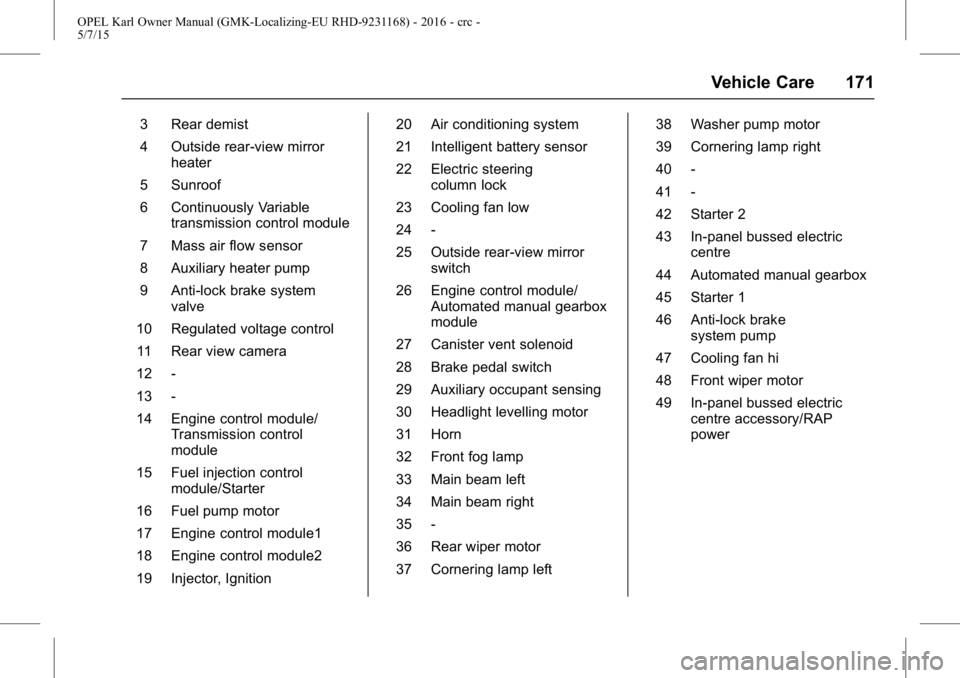
3 Rear demist
4 Outside rear-view mirrorheater
5 Sunroof
6 Continuously Variable transmission control module
7 Mass air flow sensor
8 Auxiliary heater pump
9 Anti-lock brake system valve
10 Regulated voltage control 11 Rear view camera
12 -
13 -
14 Engine control module/ Transmission control
module
15 Fuel injection control module/Starter
16 Fuel pump motor
17 Engine control module1
18 Engine control module2
19 Injector, Ignition 20 Air conditioning system
21 Intelligent battery sensor
22 Electric steering
column lock
23 Cooling fan low
24 -
25 Outside rear-view mirror switch
26 Engine control module/ Automated manual gearbox
module
27 Canister vent solenoid
28 Brake pedal switch
29 Auxiliary occupant sensing
30 Headlight levelling motor
31 Horn
32 Front fog lamp
33 Main beam left
34 Main beam right
35 -
36 Rear wiper motor
37 Cornering lamp left 38 Washer pump motor
39 Cornering lamp right
40 -
41 -
42 Starter 2
43 In-panel bussed electric
centre
44 Automated manual gearbox
45 Starter 1
46 Anti-lock brake system pump
47 Cooling fan hi
48 Front wiper motor
49 In-panel bussed electric centre accessory/RAP
power
Page 176 of 217
OPEL Karl Owner Manual (GMK-Localizing-EU RHD-9231168) - 2016 - crc -
5/7/15
Vehicle Care 175
Directional tyres
Directional tyres must be mounted
so that they rotate in the correct
direction. The proper rotation
direction is indicated by a symbol
(e.g. an arrow) on the sidewall.
Tyre Pressure
Check the pressure of cold tyres at
least every 14 days and before any
long journey. Do not forget the
spare wheel. This also applies to
vehicles with tyre pressure
monitoring system.
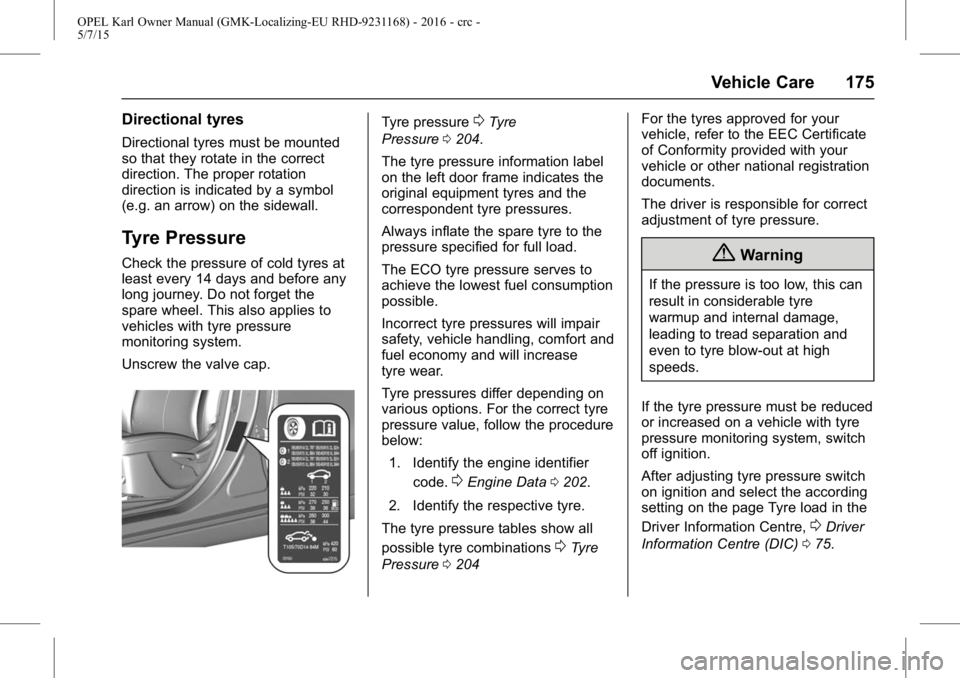
Unscrew the valve cap.
Tyre pressure0Tyre
Pressure 0204.
The tyre pressure information label
on the left door frame indicates the
original equipment tyres and the
correspondent tyre pressures.
Always inflate the spare tyre to the
pressure specified for full load.
The ECO tyre pressure serves to
achieve the lowest fuel consumption
possible.
Incorrect tyre pressures will impair
safety, vehicle handling, comfort and
fuel economy and will increase
tyre wear.
Tyre pressures differ depending on
various options. For the correct tyre
pressure value, follow the procedure
below: 1. Identify the engine identifier code.
0Engine Data 0202.
2. Identify the respective tyre.
The tyre pressure tables show all
possible tyre combinations
0Tyre
Pressure 0204 For the tyres approved for your
vehicle, refer to the EEC Certificate
of Conformity provided with your
vehicle or other national registration
documents.
The driver is responsible for correct
adjustment of tyre pressure.
{Warning
If the pressure is too low, this can
result in considerable tyre
warmup and internal damage,
leading to tread separation and
even to tyre blow-out at high
speeds.
If the tyre pressure must be reduced
or increased on a vehicle with tyre
pressure monitoring system, switch
off ignition.
After adjusting tyre pressure switch
on ignition and select the according
setting on the page Tyre load in the
Driver Information Centre,
0Driver
Information Centre (DIC) 075.
Page 183 of 217
OPEL Karl Owner Manual (GMK-Localizing-EU RHD-9231168) - 2016 - crc -
5/7/15
182 Vehicle Care
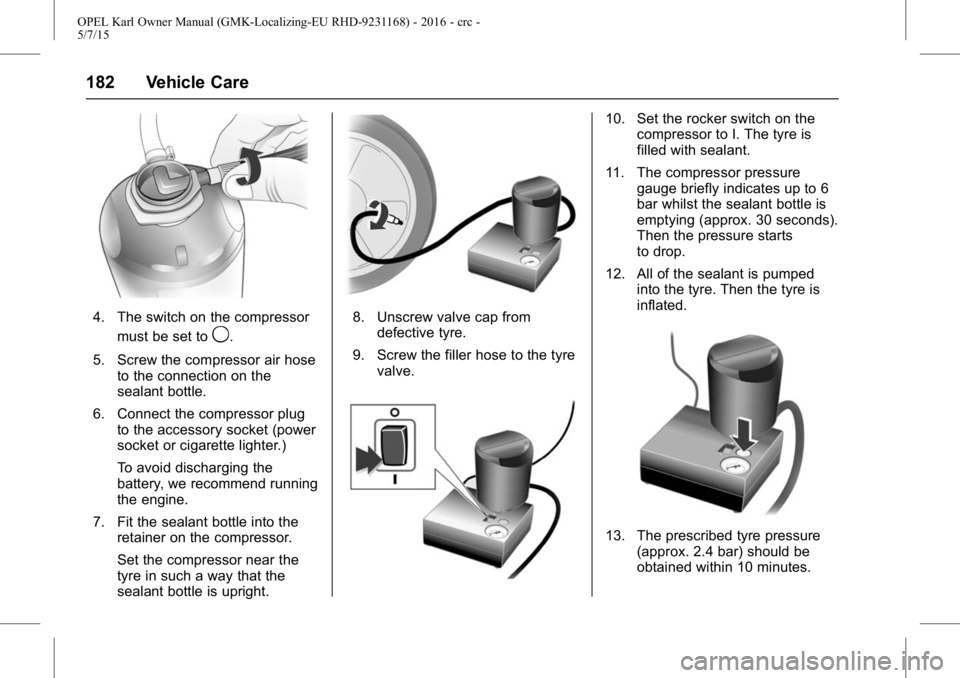
4. The switch on the compressormust be set to
9.
5. Screw the compressor air hose to the connection on the
sealant bottle.
6. Connect the compressor plug to the accessory socket (power
socket or cigarette lighter.)
To avoid discharging the
battery, we recommend running
the engine.
7. Fit the sealant bottle into the retainer on the compressor.
Set the compressor near the
tyre in such a way that the
sealant bottle is upright.
8. Unscrew valve cap from
defective tyre.
9. Screw the filler hose to the tyre valve.
10. Set the rocker switch on the compressor to I. The tyre is
filled with sealant.
11. The compressor pressure gauge briefly indicates up to 6
bar whilst the sealant bottle is
emptying (approx. 30 seconds).
Then the pressure starts
to drop.
12. All of the sealant is pumped into the tyre. Then the tyre is
inflated.
13. The prescribed tyre pressure(approx. 2.4 bar) should be
obtained within 10 minutes.
Page 190 of 217
OPEL Karl Owner Manual (GMK-Localizing-EU RHD-9231168) - 2016 - crc -
5/7/15
Vehicle Care 189
.Apply the parking brake, manual
gearbox in neutral, automatic
transmission in P.
. Open the positive terminal
protection caps of both vehicle
batteries.
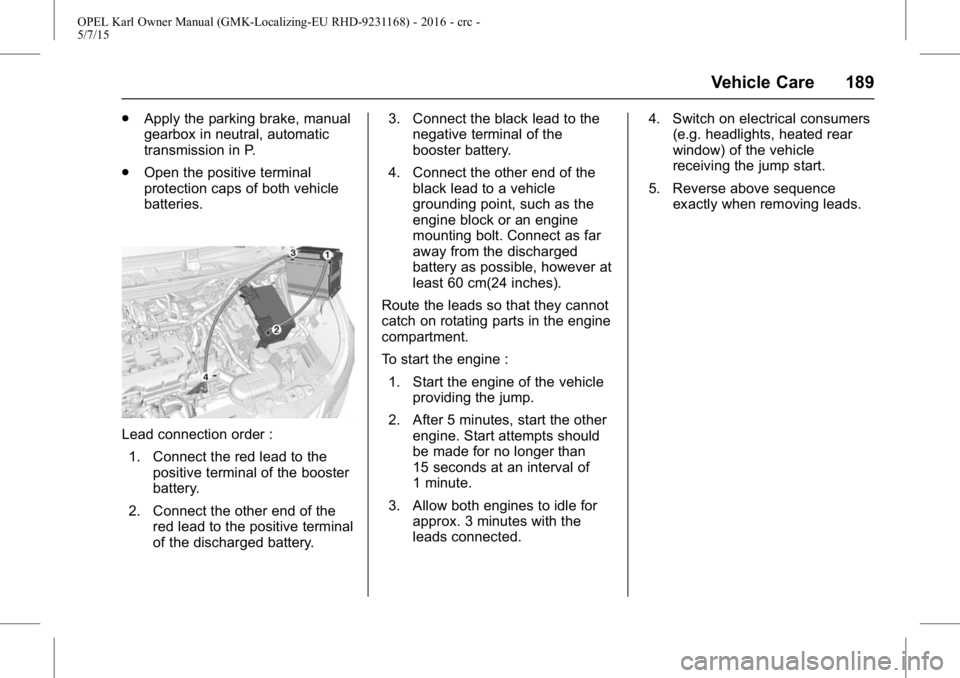
Lead connection order :
1. Connect the red lead to the positive terminal of the booster
battery.
2. Connect the other end of the red lead to the positive terminal
of the discharged battery. 3. Connect the black lead to the
negative terminal of the
booster battery.
4. Connect the other end of the black lead to a vehicle
grounding point, such as the
engine block or an engine
mounting bolt. Connect as far
away from the discharged
battery as possible, however at
least 60 cm(24 inches).
Route the leads so that they cannot
catch on rotating parts in the engine
compartment.
To start the engine : 1. Start the engine of the vehicle providing the jump.
2. After 5 minutes, start the other engine. Start attempts should
be made for no longer than
15 seconds at an interval of
1 minute.
3. Allow both engines to idle for approx. 3 minutes with the
leads connected. 4. Switch on electrical consumers
(e.g. headlights, heated rear
window) of the vehicle
receiving the jump start.
5. Reverse above sequence exactly when removing leads.
Page 191 of 217
OPEL Karl Owner Manual (GMK-Localizing-EU RHD-9231168) - 2016 - crc -
5/7/15
190 Vehicle Care
Towing the Vehicle
If towing service is not available in
an emergency, your vehicle may be
temporarily towed by a rope secured
to the emergency towing eye.
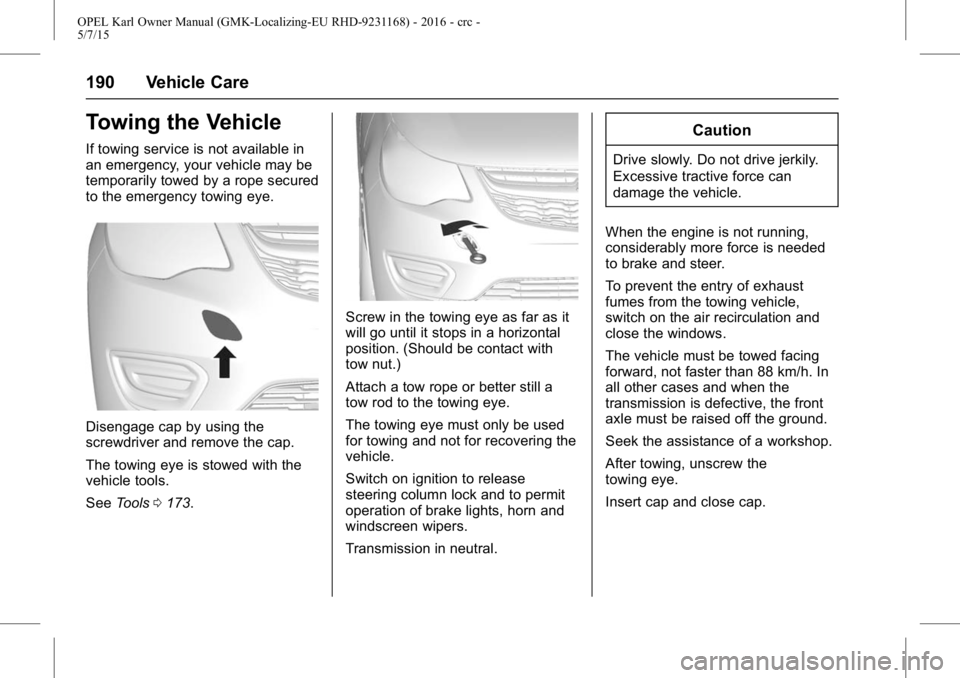
Disengage cap by using the
screwdriver and remove the cap.
The towing eye is stowed with the
vehicle tools.
SeeTools 0173.
Screw in the towing eye as far as it
will go until it stops in a horizontal
position. (Should be contact with
tow nut.)
Attach a tow rope or better still a
tow rod to the towing eye.
The towing eye must only be used
for towing and not for recovering the
vehicle.
Switch on ignition to release
steering column lock and to permit
operation of brake lights, horn and
windscreen wipers.
Transmission in neutral.
Caution
Drive slowly. Do not drive jerkily.
Excessive tractive force can
damage the vehicle.
When the engine is not running,
considerably more force is needed
to brake and steer.
To prevent the entry of exhaust
fumes from the towing vehicle,
switch on the air recirculation and
close the windows.
The vehicle must be towed facing
forward, not faster than 88 km/h. In
all other cases and when the
transmission is defective, the front
axle must be raised off the ground.
Seek the assistance of a workshop.
After towing, unscrew the
towing eye.
Insert cap and close cap.
Page 192 of 217
OPEL Karl Owner Manual (GMK-Localizing-EU RHD-9231168) - 2016 - crc -
5/7/15
Vehicle Care 191
Appearance Care
Exterior Care
Locks
The locks are lubricated at the
factory using a high quality lock
cylinder grease. Use de-icing agent
only when absolutely necessary, as
this has a degreasing effect and
impairs lock function. After using
de-icing agent, have the locks
re-greased by a workshop.
Washing
The paintwork of your vehicle is
exposed to environmental
influences. Wash and wax your
vehicle regularly. When using
automatic vehicle washes, select a
programme that includes waxing.
Bird droppings, dead insects, resin,
pollen and the like should be
cleaned off immediately, as they
contain aggressive constituents
which can cause paint damage.
If using a vehicle wash, comply with
the vehicle wash manufacturer's
instructions. The windscreen wipersand rear window wiper must be
switched off. Lock the vehicle so
that the fuel filler flap cannot be
opened. Remove antenna and
external accessories such as roof
racks etc.
If you wash your vehicle by hand,
make sure that the insides of the
wheel housings are also thoroughly
rinsed out.
Clean edges and folds on opened
doors and the bonnet as well as the
areas they cover.Caution
Always use a cleaning agent with
a pH value of 4 to 9.
Do not use cleaning agents on
hot surfaces.
Have the door hinges of all doors
greased by a workshop.
Do not clean the engine
compartment with a steam-jet or
high-pressure jet cleaner. Thoroughly rinse and leather-off the
vehicle. Rinse leather frequently.
Use separate leathers for painted
and glass surfaces : Remnants of
wax on the windows will impair
vision.
Do not use hard objects to remove
spots of tar. Use tar removal spray
on painted surfaces.
Exterior lights
Headlamp and other lamp covers
are made of plastic.
Do not use any abrasive or caustic
agents, do not use an ice scraper,
and do not clean them dry.
Polishing and waxing
Wax the vehicle regularly (at the
latest when water no longer beads).
Otherwise, the paintwork will
dry out.
Polishing is necessary only if the
paint has become dull or if solid
deposits have become attached
to it.
Paintwork polish with silicone forms
a protective film, making waxing
unnecessary.
Page 196 of 217
OPEL Karl Owner Manual (GMK-Localizing-EU RHD-9231168) - 2016 - crc -
5/7/15
Service and Maintenance 195
Service display0Service
Display 068.
Confirmations
Confirmation of service is recorded
in the Service and Warranty
Booklet. The date and mileage is
completed with the stamp and
signature of the servicing workshop.
Make sure that the Service and
Warranty Booklet is completed
correctly as continuous proof of
service is essential if any warranty
or goodwill claims are to be met,
and is also a benefit when selling
the vehicle.
Service interval with remaining
engine oil life duration
The service interval is based on
several parameters depending on
usage.
The service display lets you know
when to change the engine oil.
Service display
0Service
Display 068.
Recommended
Fluids, Lubricants,
and Parts
Recommended Fluids
and Lubricants
Only use products that meet the
recommended specifications.
Damage resulting from the use of
products not compliant with these
specifications will not be covered by
the warranty.
{Warning
Operating materials are
hazardous and could be
poisonous. Handle with care. Pay
attention to information given on
the containers.
Engine oil
Engine oil is identified by its quality
and its viscosity. Quality is more
important than viscosity when
selecting which engine oil to use.
The oil quality ensures e.g. engine cleanliness, wear protection and oil
ageing control, whereas viscosity
grade gives information on the oil's
thickness over a temperature range.
Dexos is the newest engine oil
quality that provides optimum
protection for petrol and diesel
engines. If it is unavailable, engine
oils of other listed qualities have to
be used. Recommendations for
petrol engines are also valid for
Compressed Natural Gas (CNG),
Liquefied Petroleum Gas (LPG) and
Ethanol (E85) fuelled engines.
Select the appropriate engine oil
based on its quality and on the
minimum ambient temperature
0
Recommended Fluids and
Lubricants
0195.
Topping up engine oil
Engine oils of different
manufacturers and brands can be
mixed as long as they comply with
the required engine oil quality and
viscosity.
Page 197 of 217
OPEL Karl Owner Manual (GMK-Localizing-EU RHD-9231168) - 2016 - crc -
5/7/15
196 Service and Maintenance
Use of engine oil with only ACEA
A1/B1 or only A5/B5 quality is
prohibited, since it can cause
longterm engine damage under
certain operating conditions.
Select the appropriate engine oil
based on its quality and on the
minimum ambient temperature
0
Recommended Fluids and
Lubricants0195.
Additional engine oil additives
The use of additional engine oil
additives could cause damage and
invalidate the warranty.
Engine oil viscosity grades
The SAE viscosity grade gives
information of the thickness of
the oil.
Multi-grade oil is indicated by two
figures, e.g. SAE 5W-30. The first
figure, followed by a W, indicates
the low temperature viscosity and
the second figure the high
temperature viscosity. Select the appropriate viscosity
grade depending on the minimum
ambient temperature
0
Recommended Fluids and
Lubricants
0195.
All of the recommended viscosity
grades are suitable for high ambient
temperatures.
Coolant and antifreeze
Use only organic acid type-long life
coolant (LLC) antifreeze approved
for the vehicle. Consult a workshop.
The system is factory filled with
coolant designed for excellent
corrosion protection and frost
protection down to approx. -36 °C.
In northern countries with very low
temperatures the factory filled
coolant provides frost protection
down to approx. -50 °C. This
concentration should be maintained
all year round. The use of additional
coolant additives intended to give
additional corrosion protection or
seal against minor leaks can cause
function problems. Liability for consequences resulting from the
use of additional coolant additives
will be rejected.
Brake and clutch fluid
Over time, brake fluid absorbs
moisture which will reduce braking
effectiveness. The brake fluid
should therefore be replaced at the
specified interval.
Page 198 of 217
OPEL Karl Owner Manual (GMK-Localizing-EU RHD-9231168) - 2016 - crc -
5/7/15
Service and Maintenance 197
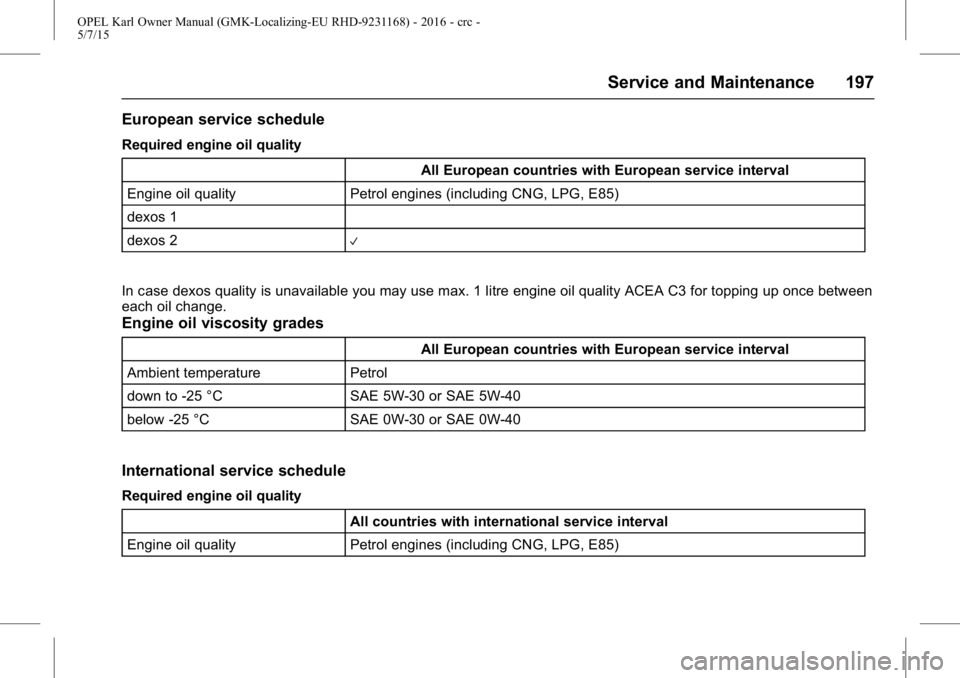
European service schedule
Required engine oil qualityAll European countries with European service interval
Engine oil quality Petrol engines (including CNG, LPG, E85)
dexos 1
dexos 2
V
In case dexos quality is unavailable you may use max. 1 litre engine oil quality ACEA C3 for topping up once between
each oil change.
Engine oil viscosity grades
All European countries with European service interval
Ambient temperature Petrol
down to -25 °C SAE 5W-30 or SAE 5W-40
below -25 °C SAE 0W-30 or SAE 0W-40
International service schedule
Required engine oil quality
All countries with international service interval
Engine oil quality Petrol engines (including CNG, LPG, E85)
Page 199 of 217
OPEL Karl Owner Manual (GMK-Localizing-EU RHD-9231168) - 2016 - crc -
5/7/15
198 Service and Maintenance
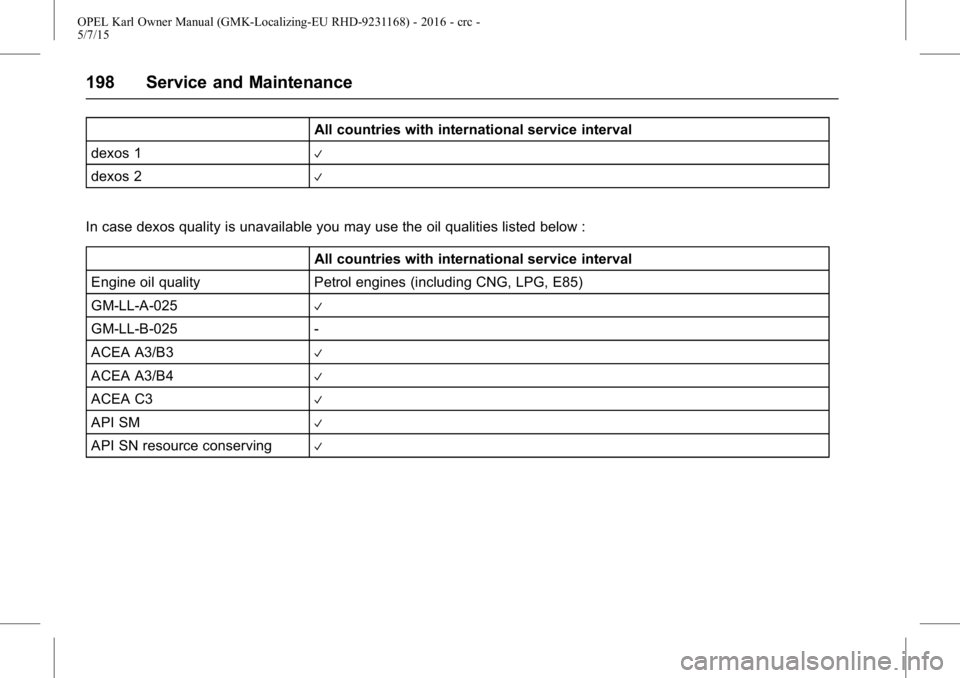
All countries with international service interval
dexos 1
V
dexos 2V
In case dexos quality is unavailable you may use the oil qualities listed below :
All countries with international service interval
Engine oil quality Petrol engines (including CNG, LPG, E85)
GM-LL-A-025
V
GM-LL-B-025 -
ACEA A3/B3
V
ACEA A3/B4V
ACEA C3V
API SMV
API SN resource conservingV