light OPEL MERIVA 2009 Service Manual
[x] Cancel search | Manufacturer: OPEL, Model Year: 2009, Model line: MERIVA, Model: OPEL MERIVA 2009Pages: 248, PDF Size: 4.46 MB
Page 114 of 248
108 LightingTo activate the lead-me-to-the-car light
function, press button q on the remote
control twice with the vehicle locked.
Country-specific version 3: to enable the
lead-me-to-the-car function, press
button q on the remote control once with
the vehicle locked.
The lead-me-to-the-car light function is
deactivated immediately by pressing
button p of the remote control or
switching on the ignition.
Picture no: 14759s.tif
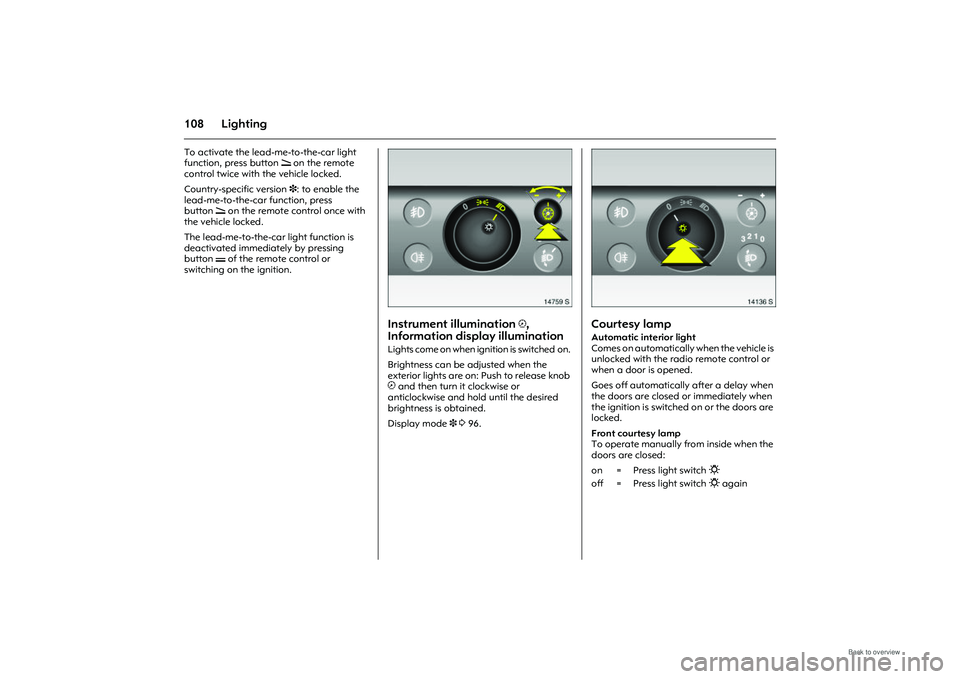
Instrument illumination
k,
Information display illumination
Lights come on when ignition is switched on.
Brightness can be adjusted when the
exterior lights are on: Push to release knob
k and then turn it clockwise or
anticlockwise and hold until the desired
brightness is obtained.
Display mode 3 396.
Picture no: 14136s.tif
Courtesy lamp Automatic interior light
Comes on automatically when the vehicle is
unlocked with the radi o remote control or
when a door is opened.
Goes off automatically after a delay when
the doors are closed or immediately when
the ignition is switched on or the doors are
locked.
Front courtesy lamp
To operate manually from inside when the
doors are closed: on = Press light switch 0
off = Press light switch 0 again
Page 115 of 248
109
Lighting
Picture no: 11607s.tif
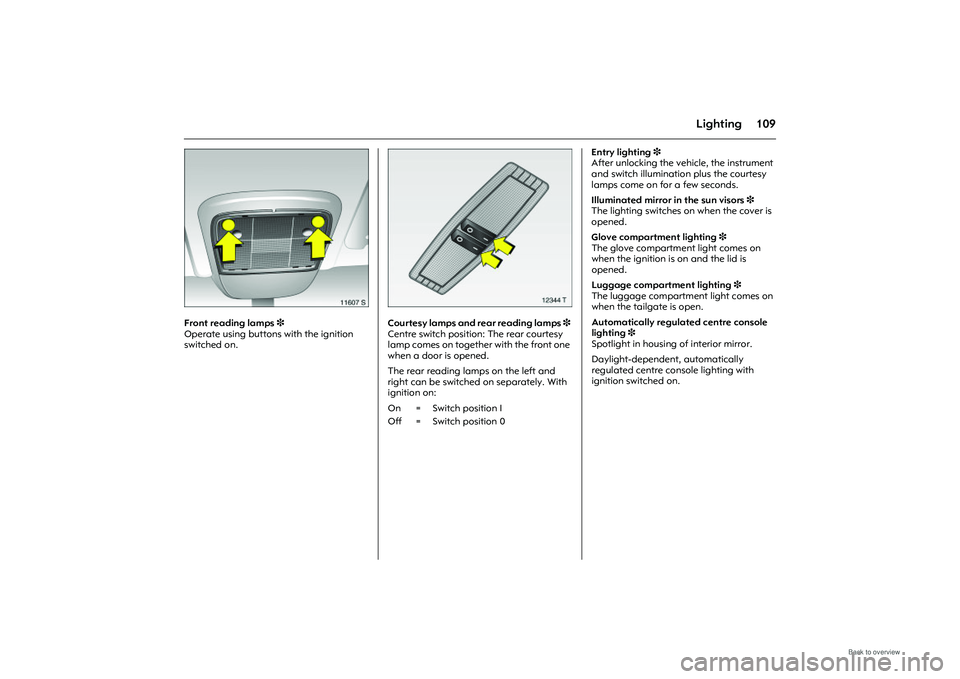
Front reading lamps 3
Operate using buttons with the ignition
switched on.
Picture no: 12344t.tif
Courtesy lamps and rear reading lamps 3
Centre switch position: The rear courtesy
lamp comes on together with the front one
when a door is opened.
The rear reading lamps on the left and
right can be switched on separately. With
ignition on: Entry lighting
3
After unlocking the vehicle, the instrument
and switch illumination plus the courtesy
lamps come on for a few seconds.
Illuminated mirror in the sun visors 3
The lighting switches on when the cover is
opened.
Glove compartment lighting 3
The glove compartment light comes on
when the ignition is on and the lid is
opened.
Luggage compartment lighting 3
The luggage compartment light comes on
when the tailgate is open.
Automatically regulated centre console
lighting 3
Spotlight in housing of interior mirror.
Daylight-dependent, automatically
regulated centre console lighting with
ignition switched on. On = Switch position I
Off = Switch position 0
Page 116 of 248
110 LightingBattery discharge protection
3
Some consumers such as the interior
lighting switch themselves off after
approx. 30 minutes if the ignition is off in
order to protect the battery charge. Misted light covers The inside of the light covers may mist up
briefly in poor, wet and cold weather
conditions, in heavy rain or after washing.
The mist disappears quickly by itself; to
help, switch on the lights. Headlamps when driving abroad The asymmetrical dipped beam increases
the field of vision on the passenger side of
the lane.
In countries where traffic drives on the
opposite side of the road, prevent glare as
follows.
Vehicles with halogen headlamp system
or Xenon headlamp system 3
Have headlights conver ted in a workshop.
Picture no: 14053h.tif
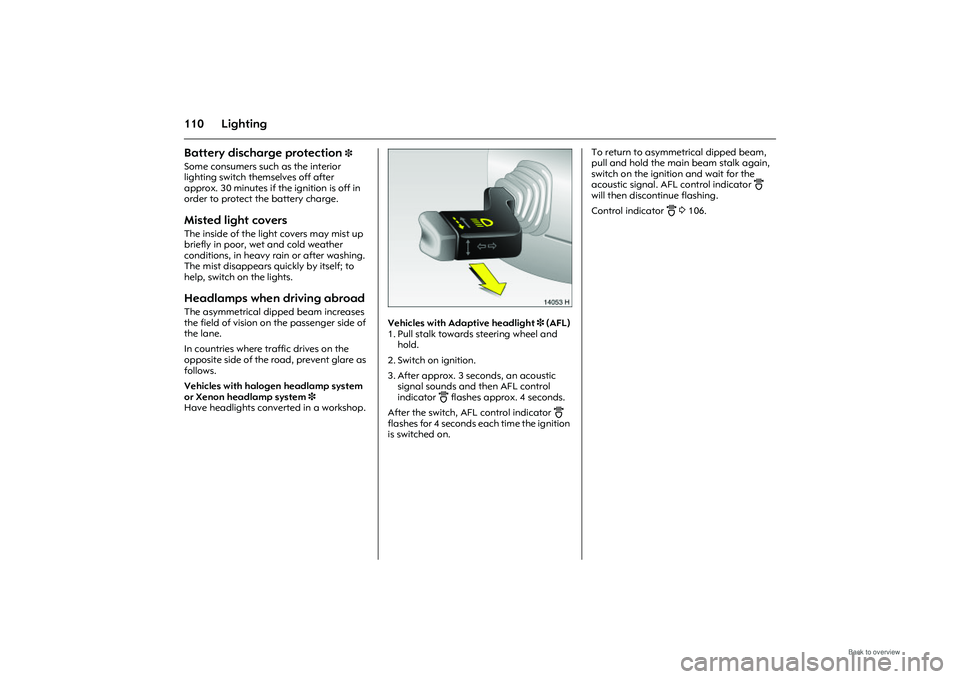
Vehicles with Adaptive headlight 3 (AFL)
1. Pull stalk towards steering wheel and hold.
2. Switch on ignition.
3. After approx. 3 seconds, an acoustic signal sounds and then AFL control
indicator
B flashes approx. 4 seconds.
After the switch, AFL control indicator
B
flashes for 4 seconds each time the ignition
is switched on. To return to asymmetrical dipped beam,
pull and hold the main beam stalk again,
switch on the ignition and wait for the
acoustic signal. AFL control indicator
B
will then discontinue flashing.
Control indicator
B
3 106.
Page 128 of 248
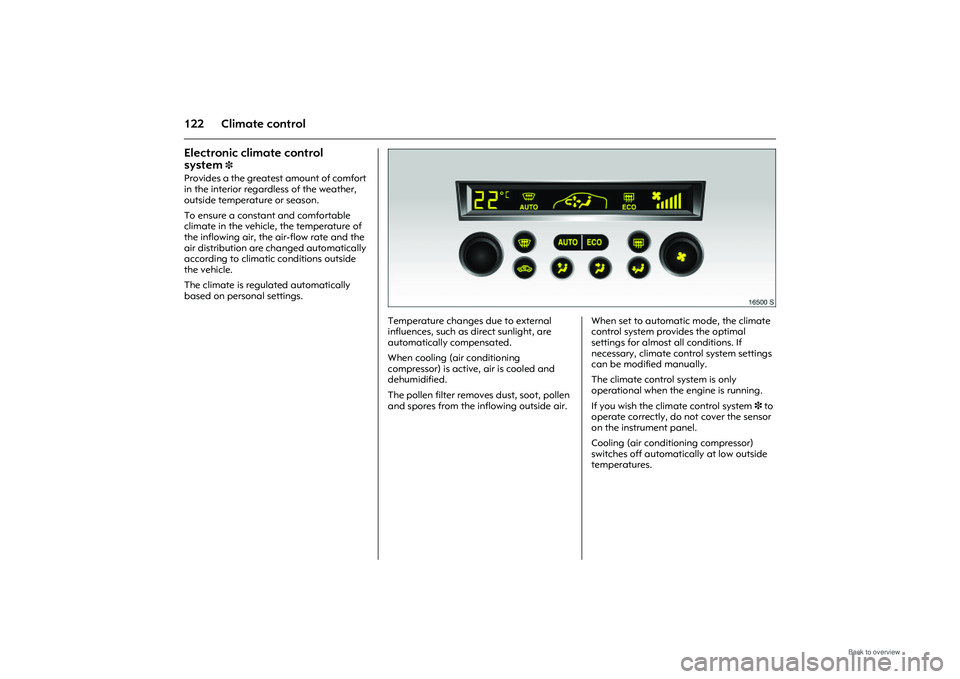
122 Climate controlElectronic climate control
system
3
Provides a the greatest amount of comfort
in the interior regardless of the weather,
outside temperature or season.
To ensure a constant and comfortable
climate in the vehicle, the temperature of
the inflowing air, the air-flow rate and the
air distribution are changed automatically
according to climatic conditions outside
the vehicle.
The climate is regulated automatically
based on personal settings.
Picture no: 16500s.tif
Temperature changes due to external
influences, such as direct sunlight, are
automatically compensated.
When cooling (air conditioning
compressor) is active, air is cooled and
dehumidified.
The pollen filter removes dust, soot, pollen
and spores from the inflowing outside air.
Picture no:
When set to automatic mode, the climate
control system provides the optimal
settings for almost all conditions. If
necessary, climate control system settings
can be modified manually.
The climate control system is only
operational when the engine is running.
If you wish the climate control system 3 to
operate correctly, do not cover the sensor
on the instrument panel.
Cooling (air conditioning compressor)
switches off automatically at low outside
temperatures.
Page 136 of 248
130 Driving and operation
Picture no: 18386s.tif
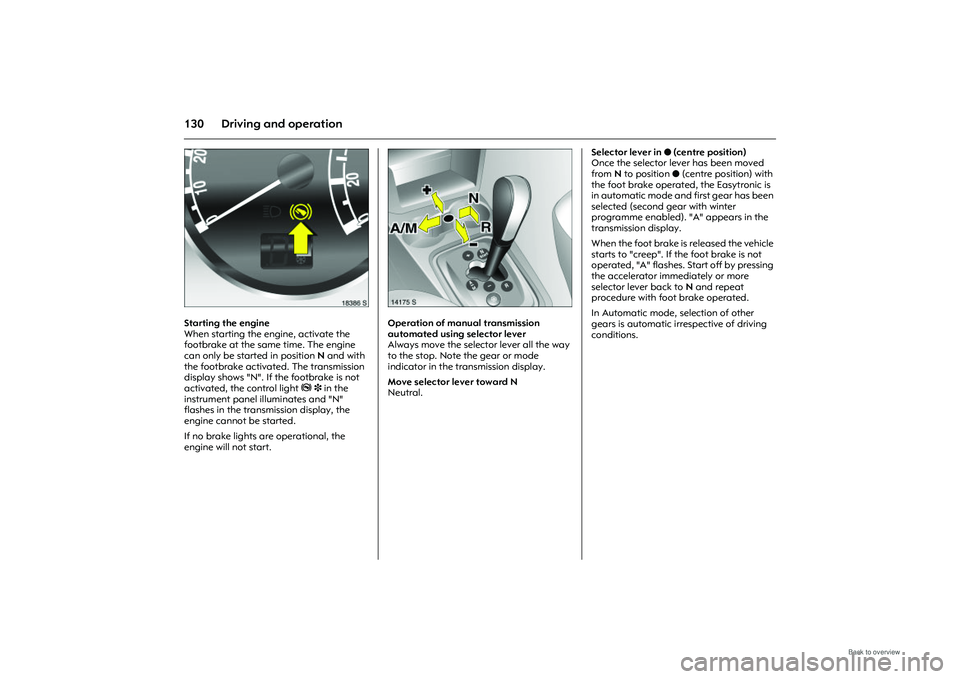
Starting the engine
When starting the engine, activate the
footbrake at the same time. The engine
can only be started in position N and with
the footbrake activated. The transmission
display shows "N". If the footbrake is not
activated, the control light j 3 in the
instrument panel illuminates and "N"
flashes in the transmission display, the
engine cannot be started.
If no brake lights are operational, the
engine will not start.
Picture no: 14175s.tif
Operation of manual transmission
automated using selector lever
Always move the selector lever all the way
to the stop. Note the gear or mode
indicator in the transmission display.
Move selector lever toward N
Neutral. Selector lever in
o (centre position)
Once the selector lever has been moved
from N to position o (centre position) with
the foot brake operated, the Easytronic is
in automatic mode and first gear has been
selected (second gear with winter
programme enabled). "A" appears in the
transmission display.
When the foot brake is released the vehicle
starts to "creep". If the foot brake is not
operated, "A" flashes. Start off by pressing
the accelerator immediately or more
selector lever back to N and repeat
procedure with foot brake operated.
In Automatic mode, selection of other
gears is automatic irrespective of driving
conditions.
Page 139 of 248
133
Driving and operation
Picture no: 14083j.tif
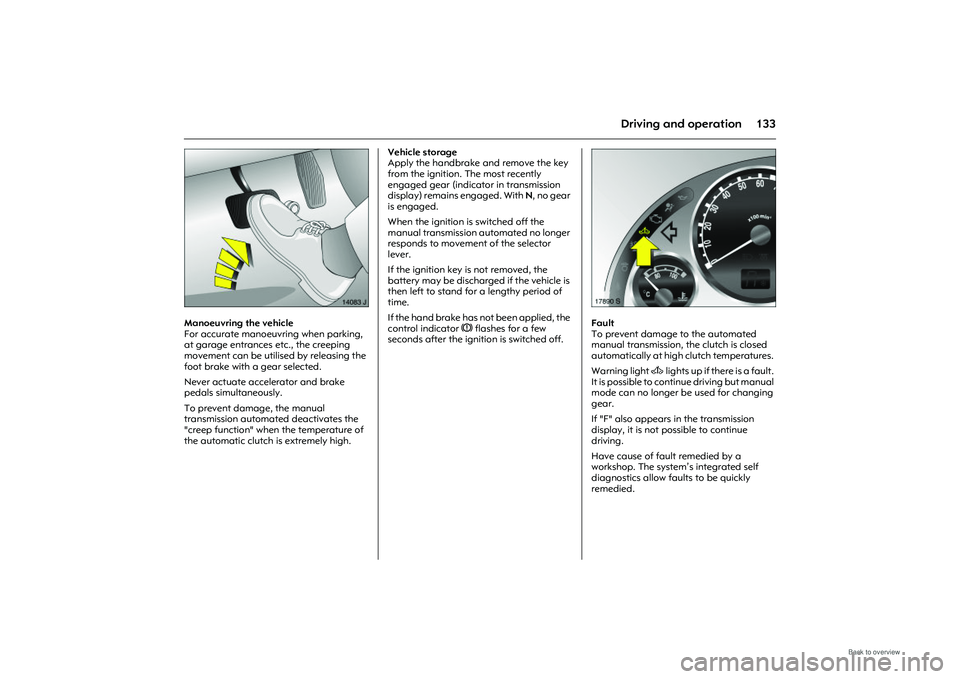
Manoeuvring the vehicle
For accurate manoeuvring when parking,
at garage entrances etc., the creeping
movement can be utilised by releasing the
foot brake with a gear selected.
Never actuate accelerator and brake
pedals simultaneously.
To prevent damage, the manual
transmission automated deactivates the
"creep function" when the temperature of
the automatic clutch is extremely high. Vehicle storage
Apply the handbrake and remove the key
from the ignition. The most recently
engaged gear (indicator in transmission
display) remains engaged. With
N, no gear
is engaged.
When the ignition is switched off the
manual transmission automated no longer
responds to movement of the selector
lever.
If the ignition key is not removed, the
battery may be discharg ed if the vehicle is
then left to stand for a lengthy period of
time.
If the hand brake has not been applied, the
control indicator R flashes for a few
seconds after the ignition is switched off.
Picture no: 17890s.tif
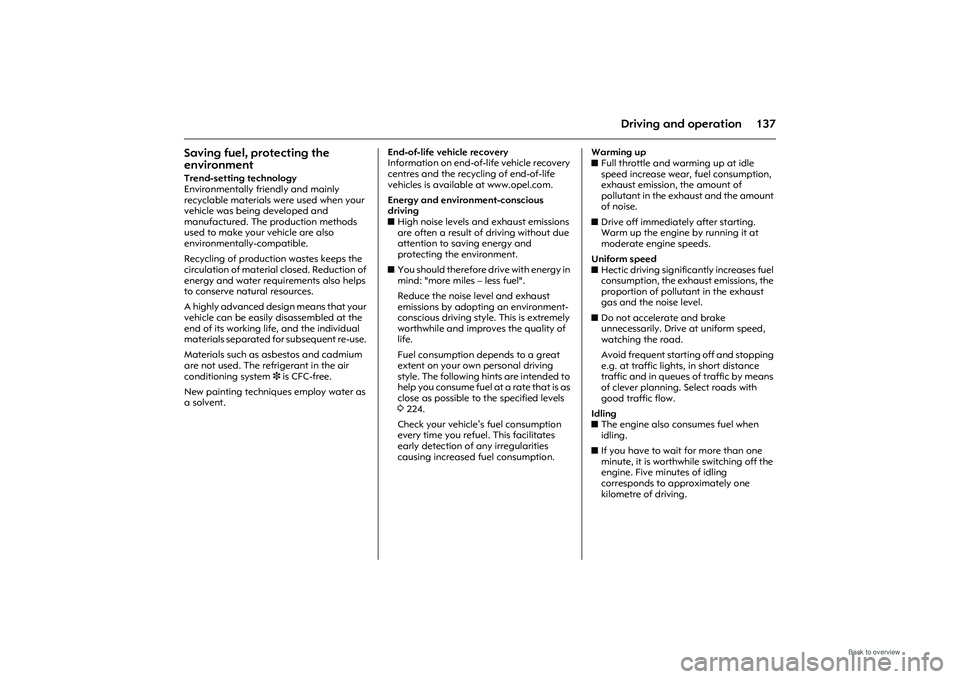
Fault
To prevent damage to the automated
manual transmission, the clutch is closed
automatically at high clutch temperatures.
Warning light A lights up if there is a fault.
It is possible to continue driving but manual
mode can no longer be used for changing
gear.
If "F" also appears in the transmission
display, it is not possible to continue
driving.
Have cause of fault remedied by a
workshop. The system’s integrated self
diagnostics allow faults to be quickly
remedied.
Page 143 of 248
137
Driving and operation
Saving fuel, protecting the
environmentTrend-setting technology
Environmentally friendly and mainly
recyclable materials were used when your
vehicle was being developed and
manufactured. The production methods
used to make your vehicle are also
environmentally-compatible.
Recycling of production wastes keeps the
circulation of material closed. Reduction of
energy and water requirements also helps
to conserve natural resources.
A highly advanced design means that your
vehicle can be easily disassembled at the
end of its working life, and the individual
materials separated for subsequent re-use.
Materials such as asbestos and cadmium
are not used. The refrigerant in the air
conditioning system 3 is CFC-free.
New painting techniques employ water as
a solvent. End-of-life vehicle recovery
Information on end-of-life vehicle recovery
centres and the recycling of end-of-life
vehicles is availabl
e at www.opel.com.
Energy and environment-conscious
driving
z High noise levels and exhaust emissions
are often a result of driving without due
attention to saving energy and
protecting the environment.
z You should therefore drive with energy in
mind: "more miles – less fuel".
Reduce the noise level and exhaust
emissions by adopting an environment-
conscious driving style. This is extremely
worthwhile and improves the quality of
life.
Fuel consumption depends to a great
extent on your own personal driving
style. The following hints are intended to
help you consume fuel at a rate that is as
close as possible to the specified levels
3224.
Check your vehicle’s fuel consumption
every time you refuel. This facilitates
early detection of any irregularities
causing increased fuel consumption. Warming up
z
Full throttle and warming up at idle
speed increase wear, fuel consumption,
exhaust emission, the amount of
pollutant in the exhaust and the amount
of noise.
z Drive off immediately after starting.
Warm up the engine by running it at
moderate engine speeds.
Uniform speed
z Hectic driving significantly increases fuel
consumption, the exhaust emissions, the
proportion of pollutant in the exhaust
gas and the noise level.
z Do not accelerate and brake
unnecessarily. Drive at uniform speed,
watching the road.
Avoid frequent starting off and stopping
e.g. at traffic lights, in short distance
traffic and in queues of traffic by means
of clever planning. Select roads with
good traffic flow.
Idling
z The engine also consumes fuel when
idling.
z If you have to wait for more than one
minute, it is worthwhile switching off the
engine. Five minutes of idling
corresponds to approximately one
kilometre of driving.
Page 144 of 248
138 Driving and operationOverrun
zThe fuel supply is shut off automatically
on overrun, e.g. when descending steep
hills or when braking 3136.
z To enable the overrun cut-off to come
into action and save fuel, do not
accelerate or declutch during overrun.
Correct gear selection
z High revs increase engine wear and fuel
consumption.
z Do not race your engine. Avoid driving at
high engine speeds.
Making use of the tachometer helps to
save fuel. Drive in a low engine speed
range for each gear as much as possible
with uniform engine speeds. Drive as
often as possible in top gear, select the
next higher gear as soon as possible,
and only change down when the engine
is no longer running perfectly smoothly.
High speed
z The higher the speed, the higher the
consumption and the noise level. At top
speed, you consume a great deal of fuel
and produce excessive noise and
exhaust emissions. z
Slightly releasing th e accelerator pedal
results in distinct fu el savings with no
major loss of speed.
Drive at no more than around three
quarters of maximum speed and you will
use up to 50 % less fuel, without losing a
great deal of time.
Tyre pressure
z Inadequate tyre pressure, leading to
higher road resistance, costs money in
two ways: for more fuel and increased
tyre wear.
z Regular checks (every 14 days) pay off.
Electrical loads
z The power consumption of electrical
equipment increases fuel consumption.
z Switch off all auxiliary electrical loads
(e.g. air conditioning 3, heated rear
window) when not needed.
Roof racks, ski-holders
z Due to air resistance, a roof load can
increase fuel consumption by
approx. 1l/100 km.
z Remove them if they are not being used. Repair and maintenance
z
Improper repairs or adjustment and
maintenance work can increase fuel
consumption. Do not carry out work on
the engine yourself.
You may out of ignorance infringe
environmental laws by not disposing of
materials properly.
Appropriate parts might not be recycled.
Contact with some of the materials
involved may pose a health hazard.
z We recommend that repair and
maintenance be entrusted to your Opel
Partner.
Extreme driving conditions
z Going up steep slopes, cornering, driving
on poor roads and winter driving all
increase fuel consumption.
Fuel consumption increases dramatically
in urban traffic and at winter
temperatures, especially on short trips
when the engine operating temperature
is not reached.
z Follow the hints given above to keep
consumption to a minimum under such
conditions.
Page 145 of 248
139
Driving and operation
Fuels, refuellingFuel consumption
The fuel consumption is determined under
specified driving conditions 3224.
Special equipment increases the weight of
the vehicle. As a result, they can increase
fuel consumption and reduce the specified
maximum speed.
For the first few thousand kilometres,
friction between the engine and
transmission components is higher. This
increases fuel consumption. Fuel for petrol engines
Only use unleaded fuel that complies
with DIN EN 228.
Fuels with ethanol content greater than 5 %
may only be used if the vehicle has been
specifically developed and approved for
these fuels.
Use fuel with the recommended octane
rating (value in bold
3220). Use of fuel
with too low an octane rating can reduce
engine power and torque and will slightly
increase fuel consumption. Fuel for diesel engines
Only use diesel fuel that complies
with DIN EN 590. The fuel must have low
sulphur content (maximum 50 ppm).
Do not use marine diesel oils, heating oils
or entirely or partially plant-based diesel
fuels, such as rape seed oil or bio diesel,
Aquazole and similar diesel-water
emulsions. Diesel fuels must not be diluted
with fuels for petrol engines.
The flow and filterability of diesel fuel are
temperature-dependent. When
temperatures are low, re
fuel with diesel fuel
with guaranteed winter properties.
Caution
Use of fuel with too low an octane rating
could lead to uncontrolled combustion
and engine damage.
Page 149 of 248
143
Driving and operation
Picture no: 17891s.tif
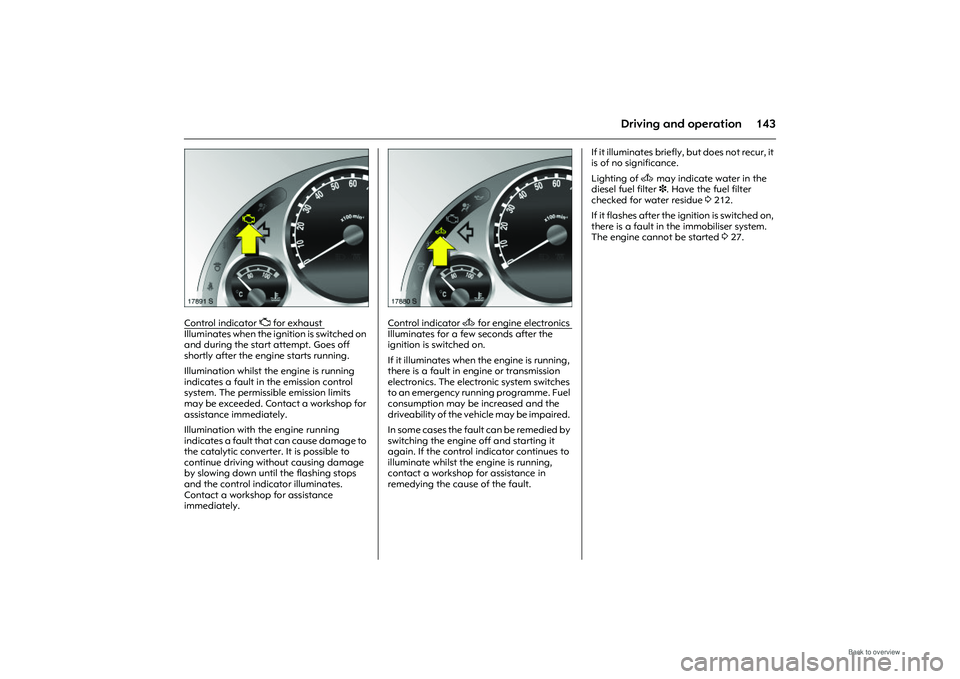
Control indicator
Z for exhaust
Illuminates when the ignition is switched on
and during the start attempt. Goes off
shortly after the engine starts running.
Illumination whilst the engine is running
indicates a fault in the emission control
system. The permissible emission limits
may be exceeded. Contact a workshop for
assistance immediately.
Illumination with the engine running
indicates a fault that can cause damage to
the catalytic converter. It is possible to
continue driving without causing damage
by slowing down until the flashing stops
and the control indicator illuminates.
Contact a workshop for assistance
immediately.
Picture no: 17880s.tif
Control indicator
A
for engine electronics
Illuminates for a few seconds after the
ignition is switched on.
If it illuminates when the engine is running,
there is a fault in engine or transmission
electronics. The electr onic system switches
to an emergency runni ng programme. Fuel
consumption may be increased and the
driveability of the vehicle may be impaired.
In some cases the fault can be remedied by
switching the engine off and starting it
again. If the control indicator continues to
illuminate whilst the en gine is running,
contact a workshop for assistance in
remedying the cause of the fault. If it illuminates briefly, but does not recur, it
is of no significance.
Lighting of
A may indicate water in the
diesel fuel filter 3. Have the fuel filter
checked for water residue 3212.
If it flashes after the ignition is switched on,
there is a fault in the immobiliser system.
The engine cannot be started 327.