light OPEL MERIVA 2009 Repair Manual
[x] Cancel search | Manufacturer: OPEL, Model Year: 2009, Model line: MERIVA, Model: OPEL MERIVA 2009Pages: 248, PDF Size: 4.46 MB
Page 189 of 248
183
Self-help, vehicle care
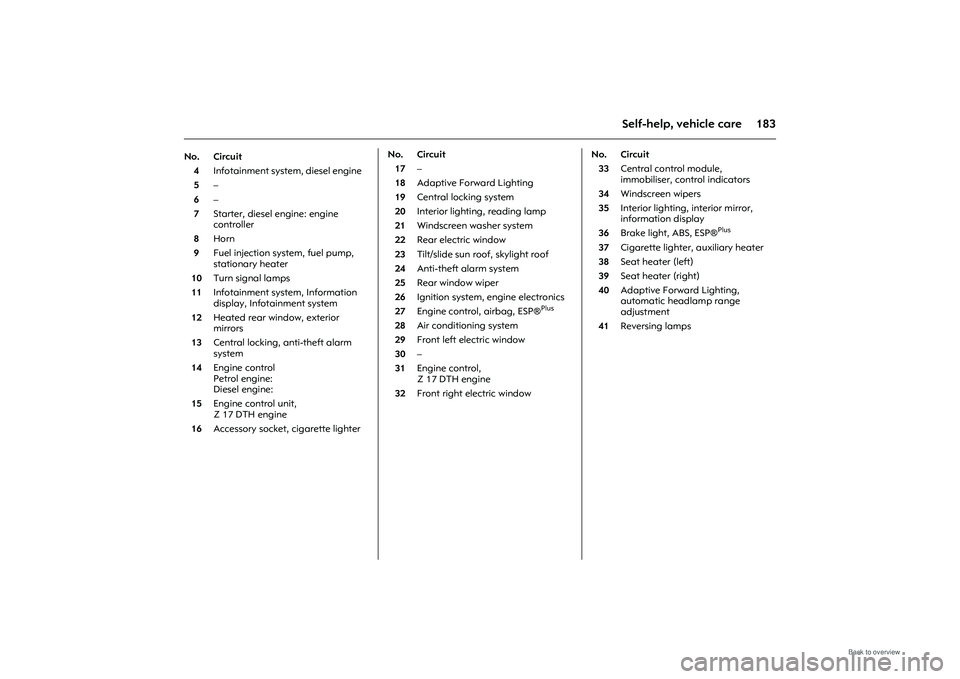
No. Circuit4 Infotainment system, diesel engine
5 –
6 –
7 Starter, diesel engine: engine
controller
8 Horn
9 Fuel injection system, fuel pump,
stationary heater
10 Turn signal lamps
11 Infotainment system, Information
display, Infotainment system
12 Heated rear window, exterior
mirrors
13 Central locking, anti-theft alarm
system
14 Engine control
Petrol engine:
Diesel engine:
15 Engine control unit,
Z 17 DTH engine
16 Accessory socket, cigarette lighter No. Circuit
17 –
18 Adaptive Forward Lighting
19 Central locking system
20 Interior lighting, reading lamp
21 Windscreen washer system
22 Rear electric window
23 Tilt/slide sun roof, skylight roof
24 Anti-theft alarm system
25 Rear window wiper
26 Ignition system, engine electronics
27 Engine control, airbag, ESP®
Plus
28 Air conditioning system
29 Front left electric window
30 –
31 Engine control,
Z 17 DTH engine
32 Front right electric window No. Circuit
33 Central control module,
immobiliser, control indicators
34 Windscreen wipers
35 Interior lighting, interior mirror,
information display
36 Brake light, ABS, ESP®
Plus
37Cigarette lighter, auxiliary heater
38 Seat heater (left)
39 Seat heater (right)
40 Adaptive Forward Lighting,
automatic headlamp range
adjustment
41 Reversing lamps
Page 190 of 248
184 Self-help, vehicle care
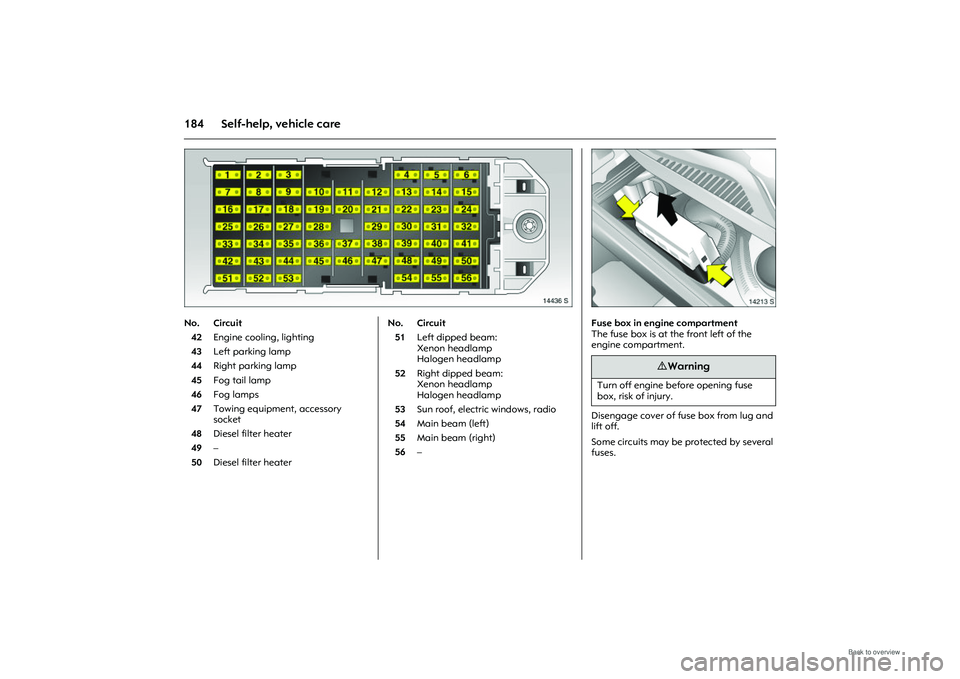
Picture no: 14436s.tif Picture no:
No. Circuit
42 Engine cooling, lighting
43 Left parking lamp
44 Right parking lamp
45 Fog tail lamp
46 Fog lamps
47 Towing equipment, accessory
socket
48 Diesel filter heater
49 –
50 Diesel filter heater
No. Circuit
51 Left dipped beam:
Xenon headlamp
Halogen headlamp
52 Right dipped beam:
Xenon headlamp
Halogen headlamp
53 Sun roof, electric windows, radio
54 Main beam (left)
55 Main beam (right)
56 –
Picture no: 14213s.tif
Fuse box in engine compartment
The fuse box is at the front left of the
engine compartment.
Disengage cover of fuse box from lug and
lift off.
Some circuits may be protected by several
fuses.
9 Warning
Turn off engine before opening fuse
box, risk of injury.
Page 194 of 248
188 Self-help, vehicle careHalogen headlamp system
3,
Adaptive Forward Lighting (AFL)
Halogen headlamp system for dipped and
main beam in comb ination with curve
lighting and cornering light.
Picture no: 14222s.tif
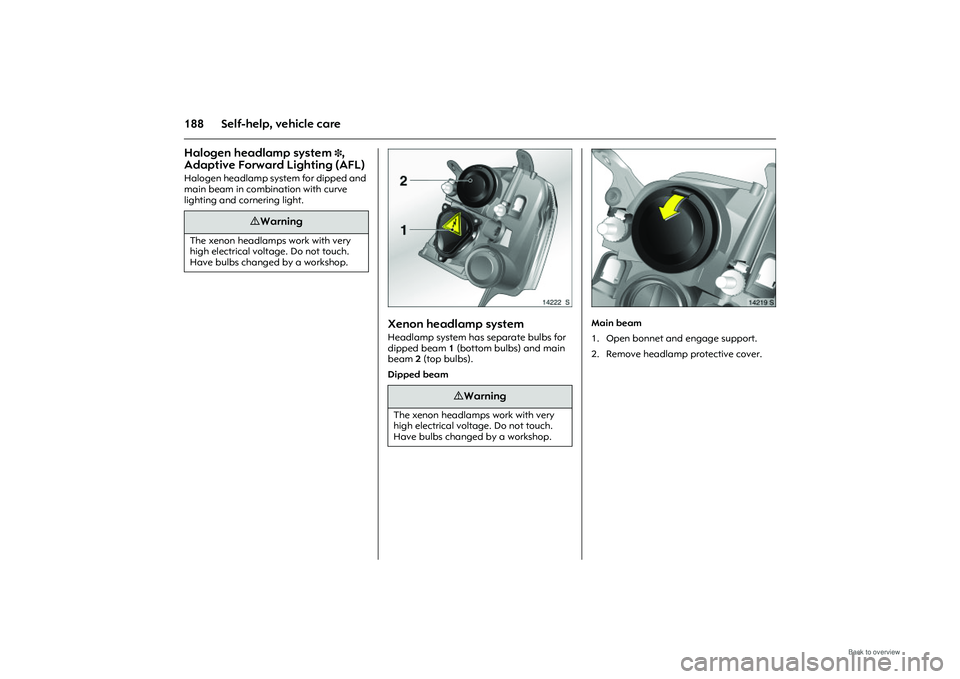
Xenon headlamp systemHeadlamp system has separate bulbs for
dipped beam 1 (bottom bulbs) and main
beam 2 (top bulbs).
Dipped beam
Picture no: 14219s.tif
Main beam
1. Open bonnet and engage support.
2. Remove headlamp protective cover.
9 Warning
The xenon headlamps work with very
high electrical voltage. Do not touch.
Have bulbs changed by a workshop.
9 Warning
The xenon headlamps work with very
high electrical volt age. Do not touch.
Have bulbs changed by a workshop.
Page 198 of 248
192 Self-help, vehicle care
Picture no: 17954S.tif
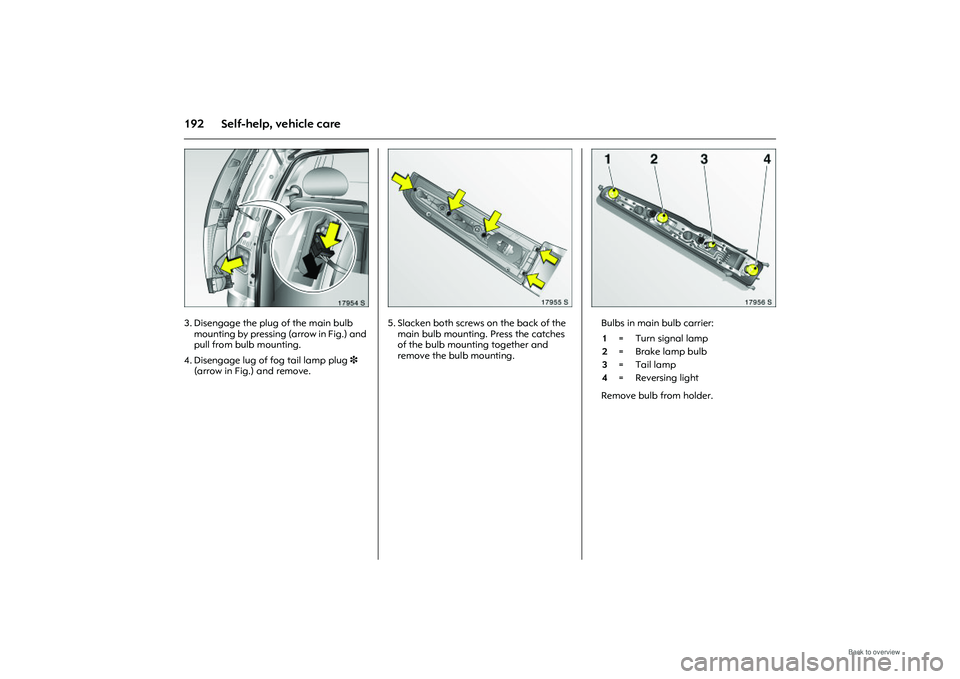
3. Disengage the plug of the main bulb mounting by pressing (arrow in Fig.) and
pull from bulb mounting.
4. Disengage lug of fog tail lamp plug 3
(arrow in Fig.) and remove.
Picture no: 17955S.tif
5. Slacken both screws on the back of the
main bulb mounting. Press the catches
of the bulb mounting together and
remove the bulb mounting.
Picture no: 17956s.tif
Bulbs in main bulb carrier:
Remove bulb from holder. 1 = Turn signal lamp
2 =Brake lamp bulb
3 = Tail lamp
4 = Reversing light
Page 202 of 248
196 Self-help, vehicle care
Picture no: 12928j.tif
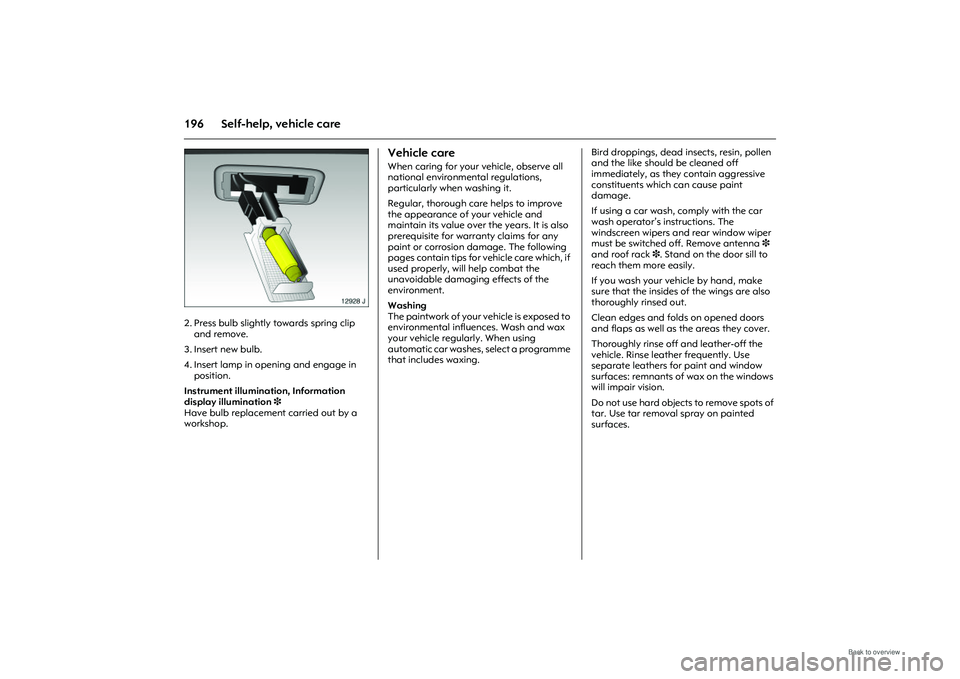
2. Press bulb slightly towards spring clip and remove.
3. Insert new bulb.
4. Insert lamp in op ening and engage in
position.
Instrument illumination, Information
display illumination 3
Have bulb replacement carried out by a
workshop.
Vehicle careWhen caring for your vehicle, observe all
national environmental regulations,
particularly when washing it.
Regular, thorough care helps to improve
the appearance of your vehicle and
maintain its value over the years. It is also
prerequisite for warranty claims for any
paint or corrosion damage. The following
pages contain tips for vehicle care which, if
used properly, will help combat the
unavoidable damaging effects of the
environment.
Washing
The paintwork of your vehicle is exposed to
environmental influences. Wash and wax
your vehicle regularly. When using
automatic car washes, select a programme
that includes waxing. Bird droppings, dead insects, resin, pollen
and the like should be cleaned off
immediately, as they contain aggressive
constituents which can cause paint
damage.
If using a car wash, comply with the car
wash operator’s instructions. The
windscreen wipers and rear window wiper
must be switched off. Remove antenna
3
and roof rack 3 . Stand on the door sill to
reach them more easily.
If you wash your vehicle by hand, make
sure that the insides of the wings are also
thoroughly rinsed out.
Clean edges and folds on opened doors
and flaps as well as the areas they cover.
Thoroughly rinse off and leather-off the
vehicle. Rinse leather frequently. Use
separate leathers for paint and window
surfaces: remnants of wax on the windows
will impair vision.
Do not use hard objects to remove spots of
tar. Use tar removal spray on painted
surfaces.
Page 203 of 248
197
Self-help, vehicle care
Polishing and waxing
Wax the vehicle regularly (by the time the
water no longer beads at the latest).
Otherwise, the paintwork will dry out.
Polishing is necessary only if the paint has
become dull or if solid deposits have
become attached to it.
Paintwork polish with silicone forms a
protective film, making waxing
unnecessary.
Plastic body parts should not be treated
with wax and polish.
Wheels and tyres
Do not use high-pressure jet cleaners.
Clean wheels with a pH-neutral wheel
cleaner.
Wheels are painted and can be treated
with the same agents as the body.
Paintwork damage
Rectify minor paintwork damage with a
touch-up pen before rust forms. Have more
extensive damage or rust areas repaired
by a workshop. Exterior lights
Headlamp and other lamp covers are
made of plastic. Do not use any caustic
agents, do not use an ice scraper, and do
not clean them when dry.
Plastic and rubber parts
Plastic and rubber parts can be cleaned
with the same cleaner as used to clean the
body. Use interior cleaner if necessary. Do
not use any other agent. Avoid solvents
and petrol in particular. Do not use high-
pressure jet cleaners.
Interior and upholstery
Only clean the vehicle interior, including
the instrument panel fascia and panelling,
with a dry cloth or interior cleaner.
The instrument pane
l should only be
cleaned using a soft damp cloth.
Clean fabric upholstery with a vacuum
cleaner and brush. Remove stains with an
upholstery cleaner.
Clean seat belts with lukewarm water or
interior cleaner.
Caution
Close Velcro fasteners as open Velcro
fasteners on clothing could damage
seat upholstery.
Page 206 of 248
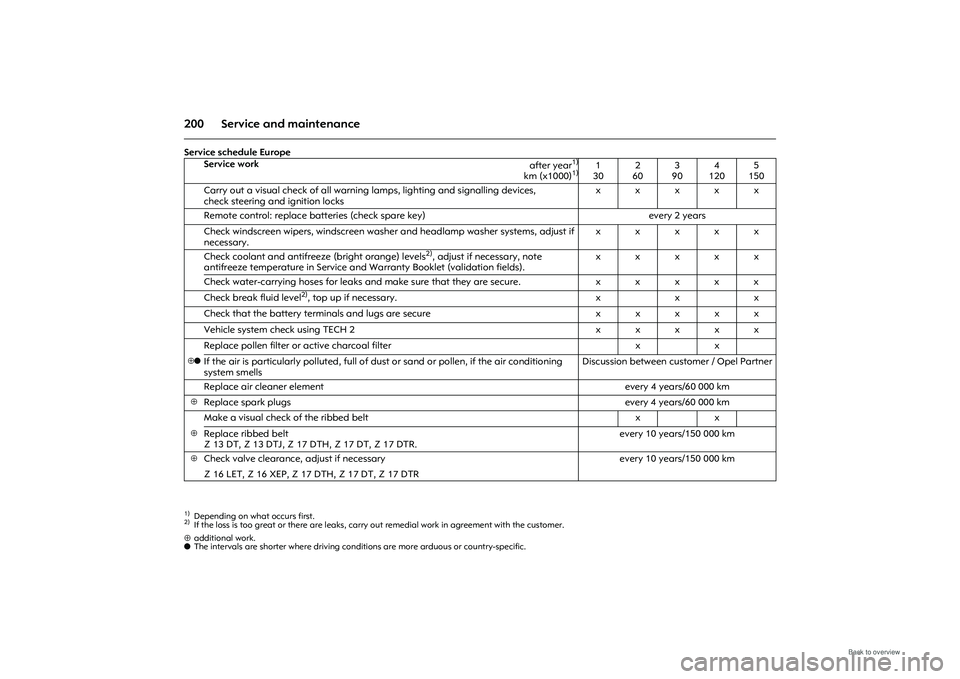
200 Service and maintenanceService schedule Europe⊕additional work.
o The intervals are shorter where driving conditions are more arduous or country-specific.
Service work
after year
1)
km (x1000)
1)
1)Depending on what occurs first.
1
30 2
60 3
90 4
120 5
150
Carry out a visual check of all warning lamps, lighting and signalling devices,
check steering and ignition locks xxxxx
Remote control: replace batteries (check spare key) every 2 years
Check windscreen wipers, windscreen washer and headlamp washer systems, adjust if
necessary. xxxxx
Check coolant and antifreeze (bright orange) levels
2), adjust if necessary, note
antifreeze temperature in Service and Warranty Booklet (validation fields).
2)If the loss is too great or there are leaks, carry out remedial work in agr eement with the customer.
xxxxx
Check water-carrying hoses for leaks and make sure that they are secure. xxxxx
Check break fluid level
2), top up if necessary. xxx
Check that the battery terminals and lugs are secure xxxxx
Vehicle system check using TECH 2 xxxxx
Replace pollen filter or active charcoal filter xx
⊕o
If the air is particularly polluted, full of du st or sand or pollen, if the air conditioning
system smells Discussion between customer / Opel Partner
Replace air cleaner element every 4 years/60 000 km
⊕
Replace spark plugsevery 4 years/60 000 km
Make a visual check of the ribbed belt xx
⊕
Replace ribbed belt
Z 13 DT, Z 13 DTJ, Z 17 DTH, Z 17 DT, Z 17 DTR. every 10 years/150 000 km
⊕
Check valve clearance,
adjust if necessary
Z 16 LET, Z 16 XEP, Z 17 DTH, Z 17 DT, Z 17 DTR every 10 years/150 000 km
Page 209 of 248
203
Service and maintenance
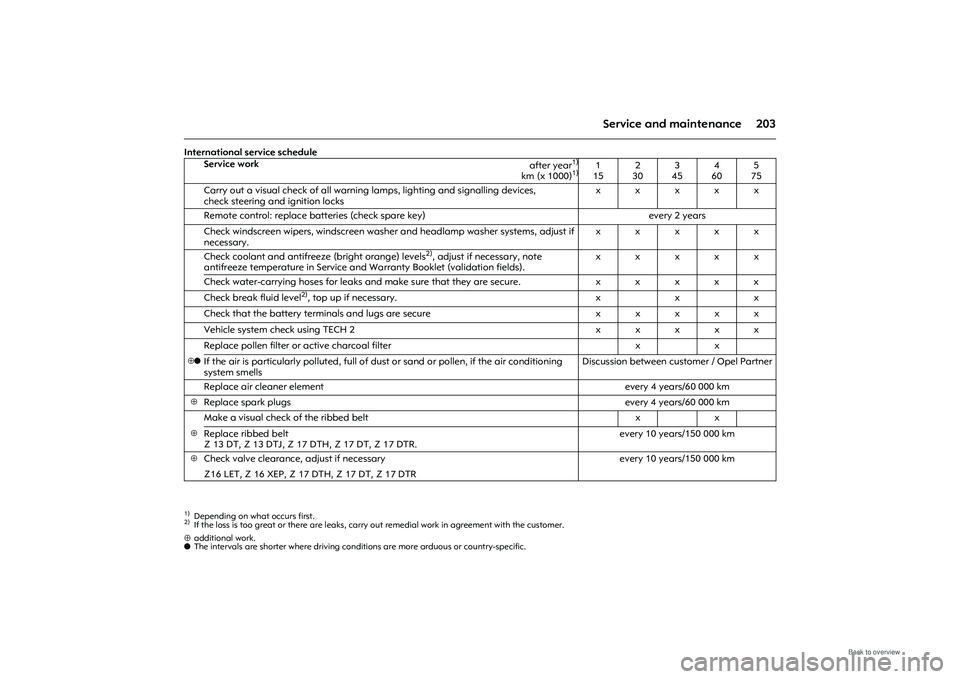
International service schedule⊕ additional work.
o The intervals are shorter where driving conditions are more arduous or country-specific.
Service work
after year
1)
km (x 1000)
1)
1)Depending on what occurs first.
1
15 2
30 3
45 4
60 5
75
Carry out a visual check of all warning lamps, lighting and signalling devices,
check steering and ignition locks xxxxx
Remote control: replace batteries (check spare key) every 2 years
Check windscreen wipers, windscreen washer and headlamp washer systems, adjust if
necessary. xxxxx
Check coolant and antifreeze (bright orange) levels
2), adjust if necessary, note
antifreeze temperature in Service and Warranty Booklet (validation fields).
2)If the loss is too great or there are leaks, carry out remedial work in agr eement with the customer.
xxxxx
Check water-carrying hoses for leaks and make sure that they are secure. xxxxx
Check break fluid level
2), top up if necessary. xxx
Check that the battery terminals and lugs are secure xxxxx
Vehicle system check using TECH 2 xxxxx
Replace pollen filter or active charcoal filter xx
⊕o
If the air is particularly polluted, full of du st or sand or pollen, if the air conditioning
system smells Discussion between customer / Opel Partner
Replace air cleaner element every 4 years/60 000 km
⊕
Replace spark plugsevery 4 years/60 000 km
Make a visual check of the ribbed belt xx
⊕
Replace ribbed belt
Z 13 DT, Z 13 DTJ, Z 17 DTH, Z 17 DT, Z 17 DTR. every 10 years/150 000 km
⊕
Check valve clearance,
adjust if necessary
Z16 LET, Z 16 XEP, Z 17 DTH, Z 17 DT, Z 17 DTR every 10 years/150 000 km
Page 230 of 248
224 Technical DataFuel consumption, CO
2 -emissions
Directive 80/1268/EEC (last changed
by 2004/3/EC) has applied for the
measurement of fuel consumption
since 1996.The directive is oriented to actual driving
practices: Urban driving is rated at approx.
1
/3 and off-road driving with approx.
2/3
(urban and extra-ur ban consumption).
Cold starts and acceleration phases are
also taken into consideration.
The specification of CO
2 emission is also a
constituent of the directive. The figures given must not be taken as a
guarantee for the actual fuel consumption
of a particular vehicle.
All values are based on the EU base model
with standard equipment.
The calculation of fuel consumption as
specified by directive 2004/3/EC takes
account of the vehicle’s kerb weight,
ascertained in accordance with the said
regulation. Optional ex
tras may result in
slightly higher fuel consumption and CO
2
emission levels than those quoted.
Fuel economy, Protec ting the environment
3 137.
Page 232 of 248
226 Technical DataWeights, payload and roof load The payload is the difference between the
permitted gross vehicle weight (see
identification plate 3218) and the EC kerb
weight.
To calculate the kerb weight, enter the
data for your vehicle below:
is the EC kerb weight.
Optional equipmen t and accessories
increase the kerb weight, which means that
the payload will also change slightly.
Note weight ranges in the vehicle
documents and on the rating plate. The combined total of front and rear axle
loads must not exceed the permissible
gross vehicle weight. For example, if the
front axle is bearing its maximum
permissible load, the rear axle can only
bear a load that is equal to the gross
vehicle weight minus
the front axle load.
When the trailer is coupled and the towing
vehicle fully loaded (including all
occupants), the permissible rear axle load
(see identification plate or vehicle
documents) may be exceeded by 25 kg
and the permissible gross vehicle weight by
25 kg. If the permissible rear axle load is
exceeded, a maximum speed of 100 km/h
applies. If national regulations specify a
lower maximum speed for vehicles towing
a trailer, this must be observed.
See the identification plate or vehicle
documents for permissible axle loads. Roof load
The permissible roof load is 100 kg. The
roof load consists of the weight of the roof
rack plus the load carried.
Driving hints
3135. Roof rack 3158.
z Unladen weight from
table 1 3227 +.............. kg
z Weight of heavy
accessories from
table 2 3227. +.............. kg
Total =.............. kg