ECU OPEL MERIVA 2017 Owner's Manual
[x] Cancel search | Manufacturer: OPEL, Model Year: 2017, Model line: MERIVA, Model: OPEL MERIVA 2017Pages: 251, PDF Size: 8.14 MB
Page 150 of 251
![OPEL MERIVA 2017 Owners Manual 148Driving and operatingManual mode
Move selector lever out of position D
towards the left and then forwards or backwards.
<:shift to a higher gear]:shift to a lower gear
If a higher gear is selected](/img/37/58232/w960_58232-149.png "OPEL MERIVA 2017 Owners Manual 148Driving and operatingManual mode
Move selector lever out of position D
towards the left and then forwards or backwards.
<:shift to a higher gear]:shift to a lower gear
If a higher gear is selected")
148Driving and operatingManual mode
Move selector lever out of position D
towards the left and then forwards or backwards.
<:shift to a higher gear]:shift to a lower gear
If a higher gear is selected when
vehicle speed is too low, or a lower
gear when vehicle speed is too high,
the shift is not executed. This can
cause a message in the Driver
Information Centre.
In manual mode, no automatic
shifting to a higher gear takes place
at high engine revolutions.
Electronic driving
programmes
● Following a cold start, the operating temperature
programme increases engine
speed to quickly bring the
catalytic converter to the required
temperature.
● The automatic neutral shift function automatically shifts to
idling when the vehicle is stopped with a forward gear engaged and
the brake pedal is pressed.
● Special programmes automatically adapt the shiftingpoints when driving up inclines or
down hills.
Kickdown If the accelerator pedal is pressed
down completely in automatic mode,
the transmission shifts to a lower gear
depending on engine speed.Fault
In the event of a fault, g illuminates.
Additionally a code number or a
vehicle message is displayed in the
Driver Information Centre. Vehicle
messages 3 106.
The transmission no longer shifts automatically. Continued travel is
possible with manual shifting.
Only the highest gear is available.
Depending on the fault, second gear
may also be available in manual
mode. Shift only when vehicle is at a
standstill.
Have the cause of the fault remedied
by a workshop.
Interruption of power supply
In the event of an interruption of
power supply, the selector lever
cannot be moved out of the P
position. The ignition key cannot be
removed from the ignition switch.
If the vehicle battery is discharged,
start the vehicle using jump leads
3 213.
Page 170 of 251
168Driving and operatingRear axle load
When the trailer is coupled and the
towing vehicle fully loaded, the
permissible rear axle load (see
identification plate or vehicle
documents) may be exceeded by
80 kg (vehicles with LPG system:
110 kg), the gross vehicle weight rating may be exceeded by 70 kg
(vehicles with LPG system: 95 kg). If
the permissible rear axle load is
exceeded, a maximum speed of
100 km/h applies.
Towing equipmentCaution
When operating without a trailer,
remove the coupling ball bar.
Stowage of the detachable
coupling ball bar
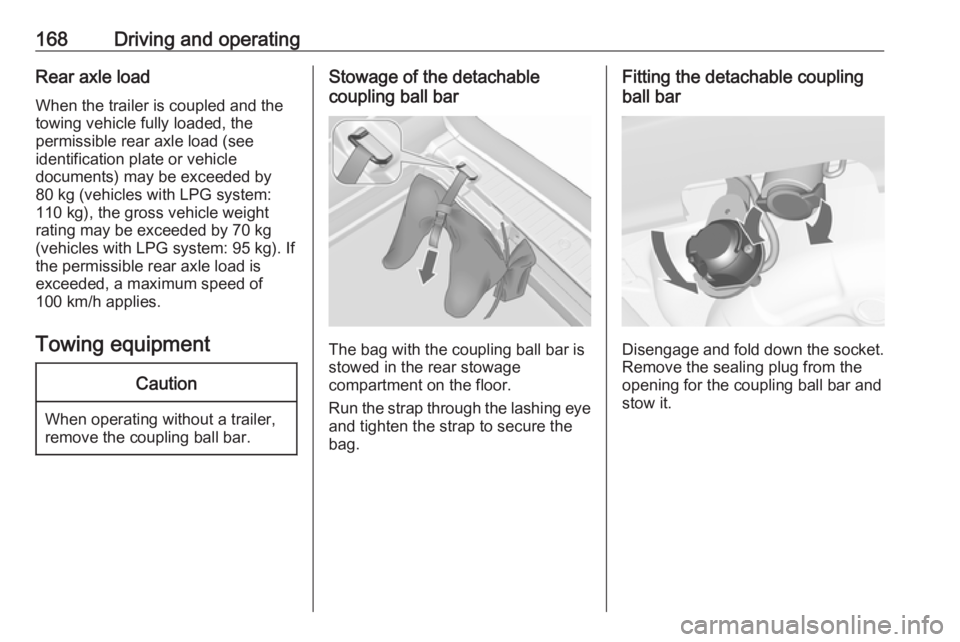
The bag with the coupling ball bar is
stowed in the rear stowage
compartment on the floor.
Run the strap through the lashing eye and tighten the strap to secure the
bag.
Fitting the detachable coupling
ball bar
Disengage and fold down the socket. Remove the sealing plug from the
opening for the coupling ball bar and
stow it.
Page 176 of 251
174Vehicle care
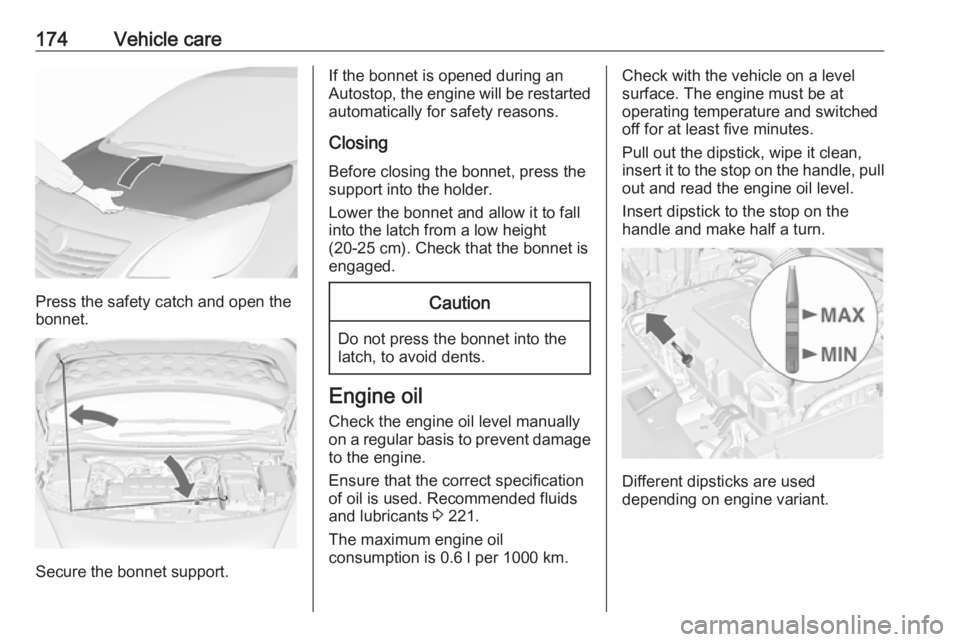
Press the safety catch and open the
bonnet.
Secure the bonnet support.
If the bonnet is opened during an
Autostop, the engine will be restarted automatically for safety reasons.
Closing
Before closing the bonnet, press the
support into the holder.
Lower the bonnet and allow it to fall
into the latch from a low height
(20-25 cm). Check that the bonnet is engaged.Caution
Do not press the bonnet into the
latch, to avoid dents.
Engine oil
Check the engine oil level manually
on a regular basis to prevent damage
to the engine.
Ensure that the correct specification
of oil is used. Recommended fluids
and lubricants 3 221.
The maximum engine oil
consumption is 0.6 l per 1000 km.
Check with the vehicle on a level
surface. The engine must be at
operating temperature and switched
off for at least five minutes.
Pull out the dipstick, wipe it clean,
insert it to the stop on the handle, pull
out and read the engine oil level.
Insert dipstick to the stop on the
handle and make half a turn.
Different dipsticks are used
depending on engine variant.
Page 185 of 251
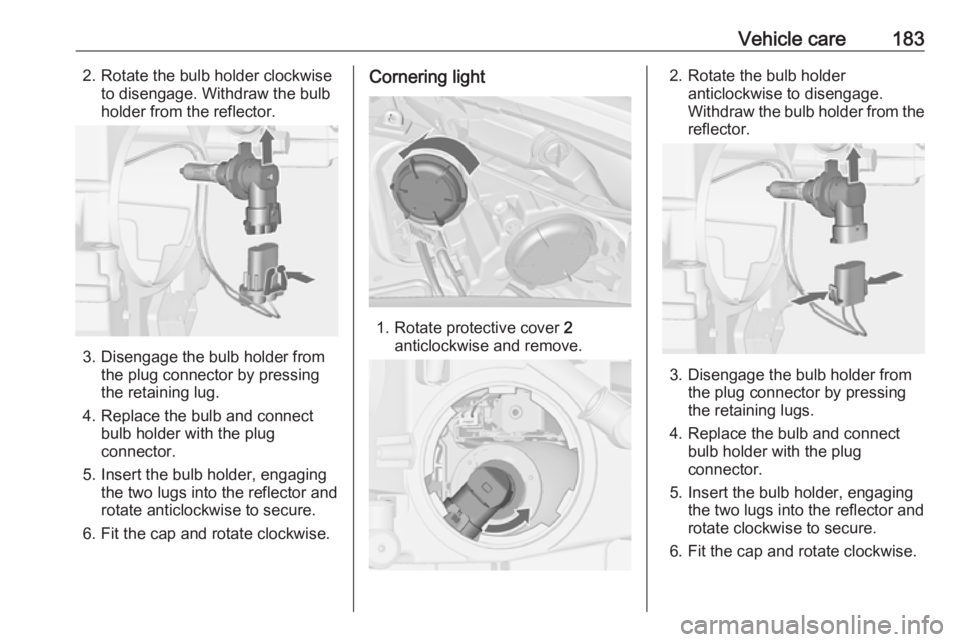
Vehicle care1832. Rotate the bulb holder clockwiseto disengage. Withdraw the bulb
holder from the reflector.
3. Disengage the bulb holder from the plug connector by pressing
the retaining lug.
4. Replace the bulb and connect bulb holder with the plug
connector.
5. Insert the bulb holder, engaging the two lugs into the reflector and
rotate anticlockwise to secure.
6. Fit the cap and rotate clockwise.
Cornering light
1. Rotate protective cover 2
anticlockwise and remove.
2. Rotate the bulb holder anticlockwise to disengage.
Withdraw the bulb holder from the
reflector.
3. Disengage the bulb holder from the plug connector by pressing
the retaining lugs.
4. Replace the bulb and connect bulb holder with the plug
connector.
5. Insert the bulb holder, engaging the two lugs into the reflector and
rotate clockwise to secure.
6. Fit the cap and rotate clockwise.
Page 187 of 251
Vehicle care185
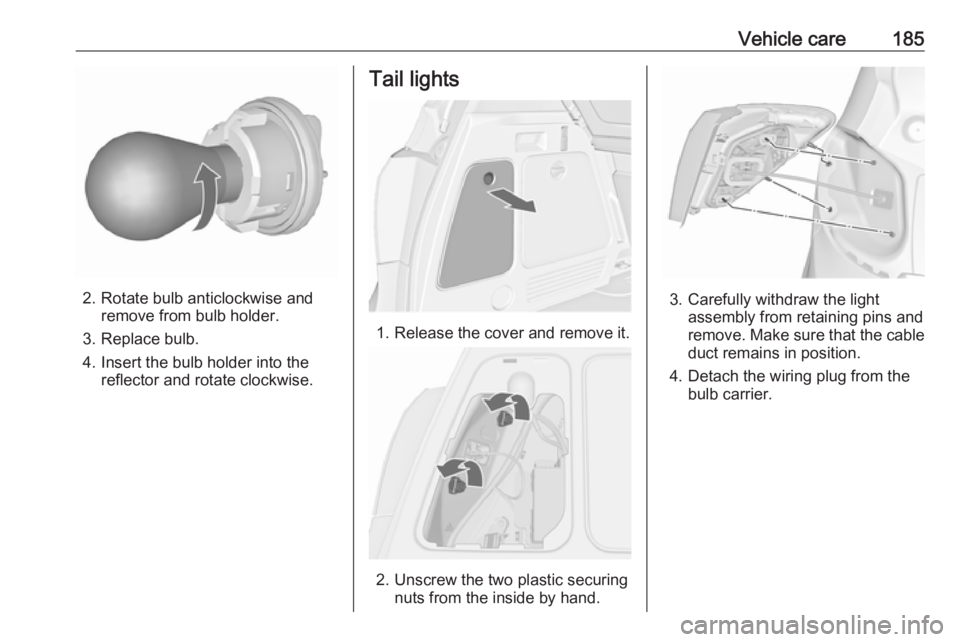
2. Rotate bulb anticlockwise andremove from bulb holder.
3. Replace bulb.
4. Insert the bulb holder into the reflector and rotate clockwise.
Tail lights
1. Release the cover and remove it.
2. Unscrew the two plastic securing nuts from the inside by hand.
3. Carefully withdraw the lightassembly from retaining pins and
remove. Make sure that the cable duct remains in position.
4. Detach the wiring plug from the bulb carrier.
Page 188 of 251
186Vehicle care
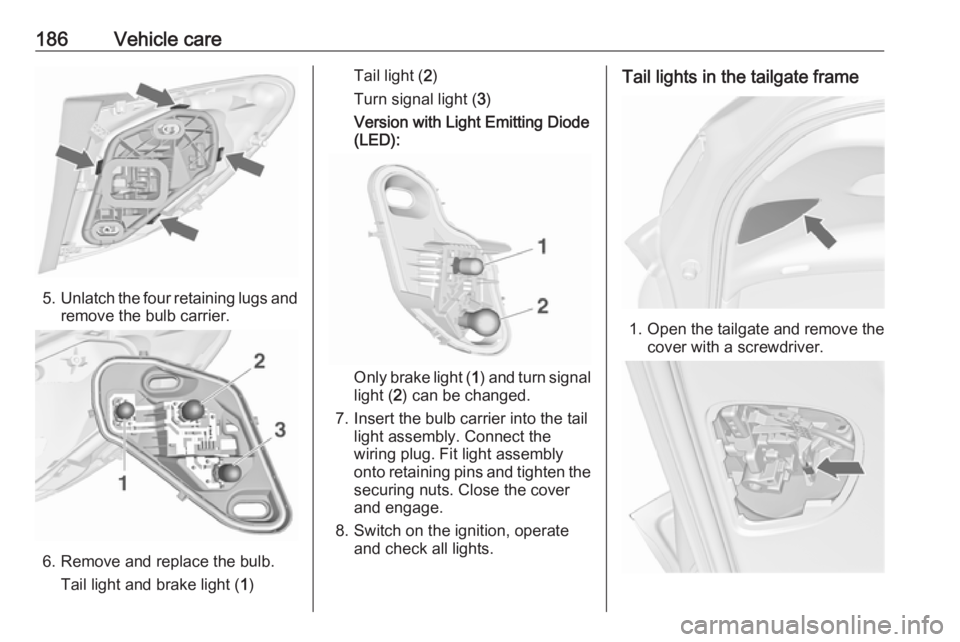
5.Unlatch the four retaining lugs and
remove the bulb carrier.
6. Remove and replace the bulb.
Tail light and brake light ( 1)
Tail light ( 2)
Turn signal light ( 3)
Version with Light Emitting Diode (LED):
Only brake light ( 1) and turn signal
light ( 2) can be changed.
7. Insert the bulb carrier into the tail light assembly. Connect the
wiring plug. Fit light assembly
onto retaining pins and tighten the securing nuts. Close the cover
and engage.
8. Switch on the ignition, operate and check all lights.
Tail lights in the tailgate frame
1. Open the tailgate and remove the
cover with a screwdriver.
Page 210 of 251
208Vehicle careMake the following preparations and
observe the following information:
● Park the vehicle on a level, firm and non-skid surface. The front
wheels must be in the straight- ahead position.
● Apply the parking brake and engage first gear, reverse gear or
P .
● Remove the spare wheel 3 210.
● Never change more than one wheel at once.
● Use the jack only to change wheels in case of puncture, not
for seasonal winter or summer
tyre change.
● The jack is maintenance-free.
● If the ground on which the vehicle
is standing is soft, a solid board
(max. 1 cm thick) should be
placed under the jack.
● Take heavy objects out of the vehicle before jacking up.
● No people or animals may be in the vehicle when it is jacked-up.
● Never crawl under a jacked-up vehicle.●Do not start the vehicle when it is
raised on the jack.
● Before screwing in the wheel bolts, clean them and lightly coat
the taper of each wheel bolt with
commercially available grease.9 Warning
Do not grease the thread of the
wheel bolt.
1. Pull off the wheel cover.
For wheel covers with visible
wheel bolts: The cover can remain
on the wheel. Do not remove the
retaining rings on the wheel bolts.
Alloy wheels: Disengage wheel
bolt caps with a screwdriver and
remove. To protect the wheel,
place a soft cloth between the
screwdriver and the alloy wheel.
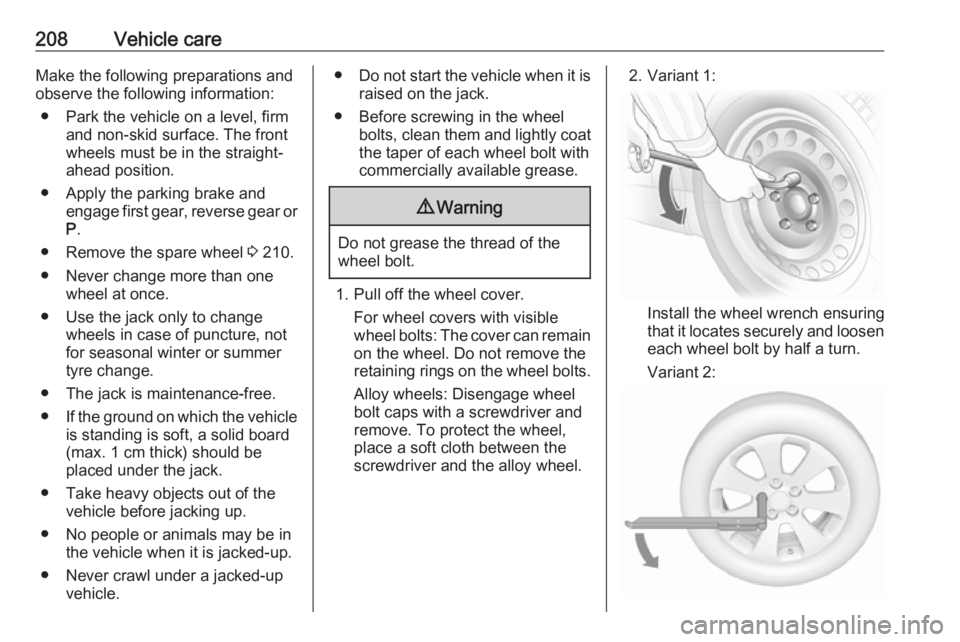
2. Variant 1:
Install the wheel wrench ensuring
that it locates securely and loosen
each wheel bolt by half a turn.
Variant 2:
Page 211 of 251
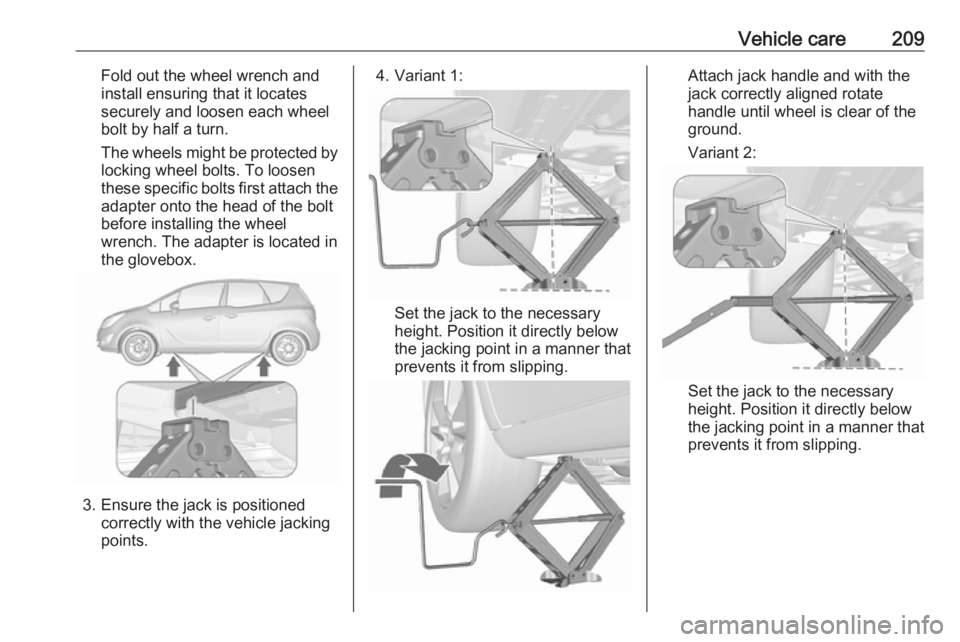
Vehicle care209Fold out the wheel wrench and
install ensuring that it locates
securely and loosen each wheel
bolt by half a turn.
The wheels might be protected by locking wheel bolts. To loosen
these specific bolts first attach the
adapter onto the head of the bolt
before installing the wheel
wrench. The adapter is located in
the glovebox.
3. Ensure the jack is positioned correctly with the vehicle jacking
points.
4. Variant 1:
Set the jack to the necessary
height. Position it directly below
the jacking point in a manner that
prevents it from slipping.
Attach jack handle and with the
jack correctly aligned rotate handle until wheel is clear of theground.
Variant 2:
Set the jack to the necessary
height. Position it directly below
the jacking point in a manner that
prevents it from slipping.
Page 212 of 251
210Vehicle care
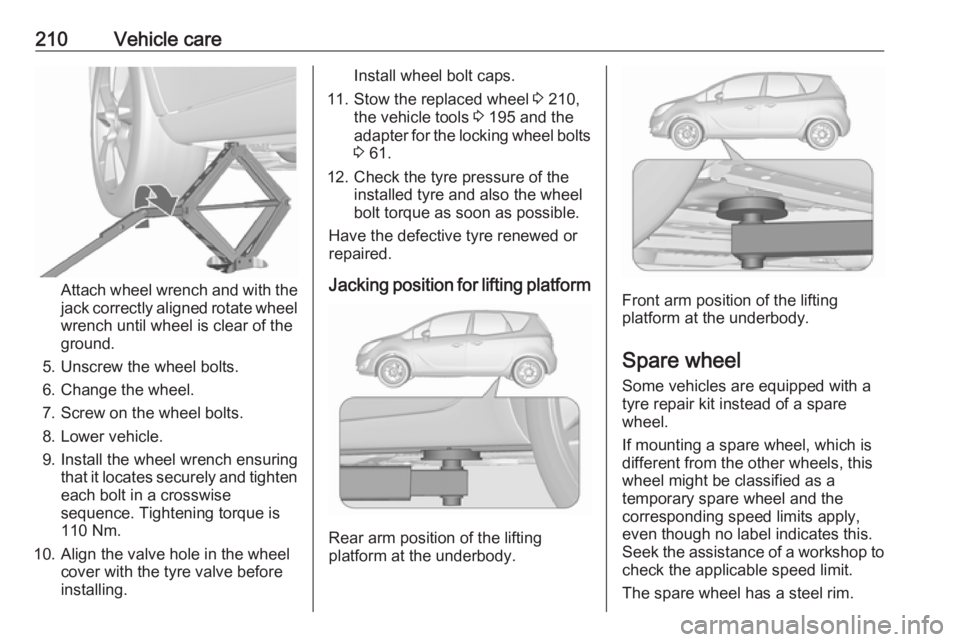
Attach wheel wrench and with the
jack correctly aligned rotate wheel wrench until wheel is clear of the
ground.
5. Unscrew the wheel bolts. 6. Change the wheel.
7. Screw on the wheel bolts.
8. Lower vehicle.
9. Install the wheel wrench ensuring that it locates securely and tighten
each bolt in a crosswise
sequence. Tightening torque is
110 Nm.
10. Align the valve hole in the wheel cover with the tyre valve before
installing.
Install wheel bolt caps.
11. Stow the replaced wheel 3 210,
the vehicle tools 3 195 and the
adapter for the locking wheel bolts 3 61.
12. Check the tyre pressure of the installed tyre and also the wheel
bolt torque as soon as possible.
Have the defective tyre renewed or repaired.
Jacking position for lifting platform
Rear arm position of the lifting
platform at the underbody.
Front arm position of the lifting
platform at the underbody.
Spare wheel Some vehicles are equipped with a
tyre repair kit instead of a spare
wheel.
If mounting a spare wheel, which is
different from the other wheels, this
wheel might be classified as a
temporary spare wheel and the
corresponding speed limits apply,
even though no label indicates this.
Seek the assistance of a workshop to
check the applicable speed limit.
The spare wheel has a steel rim.
Page 213 of 251
Vehicle care211Caution
The use of a spare wheel that issmaller than the other wheels or in combination with winter tyres
could affect driveability. Have the defective tyre replaced as soon as
possible.
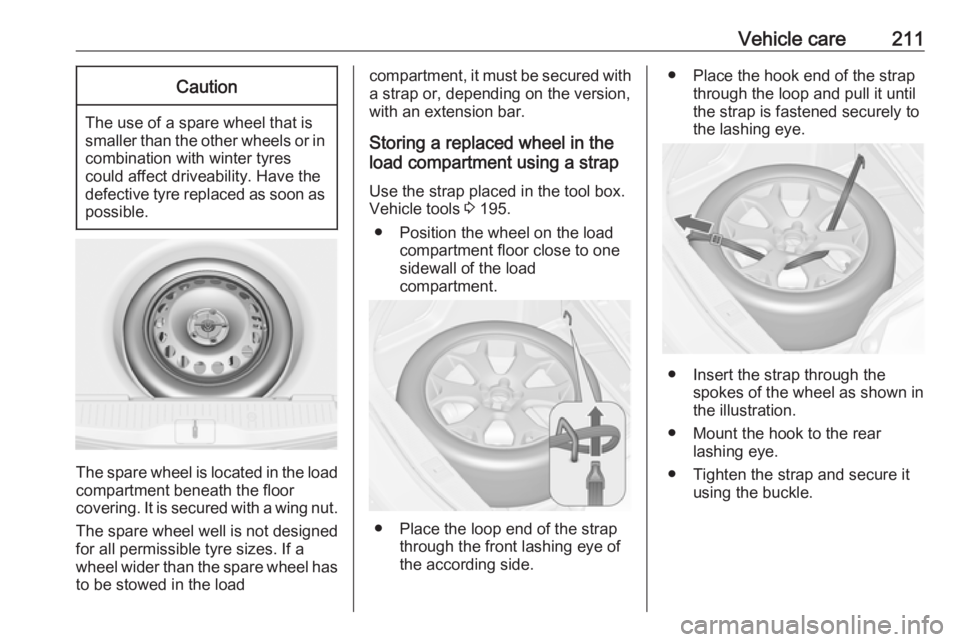
The spare wheel is located in the load
compartment beneath the floor
covering. It is secured with a wing nut.
The spare wheel well is not designed for all permissible tyre sizes. If a
wheel wider than the spare wheel has
to be stowed in the load
compartment, it must be secured with a strap or, depending on the version,
with an extension bar.
Storing a replaced wheel in the
load compartment using a strap
Use the strap placed in the tool box.
Vehicle tools 3 195.
● Position the wheel on the load compartment floor close to one
sidewall of the load
compartment.
● Place the loop end of the strap through the front lashing eye of
the according side.
● Place the hook end of the strap through the loop and pull it until
the strap is fastened securely to
the lashing eye.
● Insert the strap through the spokes of the wheel as shown in
the illustration.
● Mount the hook to the rear lashing eye.
● Tighten the strap and secure it using the buckle.