warning OPEL MOVANO_B 2020 Manual user
[x] Cancel search | Manufacturer: OPEL, Model Year: 2020, Model line: MOVANO_B, Model: OPEL MOVANO_B 2020Pages: 353, PDF Size: 9.4 MB
Page 233 of 353
Driving and operating231Restart of the engine by the stop-start system
If one of the conditions for an
Autostop is not fulfilled anymore or
the vehicle starts to move, the engine
may be restarted automatically by the
stop-start system.
An automatic engine restart may not
be possible if a door or the bonnet is
open.
If an electrical accessory, e.g. a
portable CD player, is connected to
the power outlet, a brief power drop
during restart might be noticeable.
If the Infotainment system is active,
audio sound may briefly be reduced
or interrupted during the restart.
Fault
If the LED illuminates in deactivation
button ) without first being pressed
to deactivate the system, there is a
fault in the stop-start system and it is
deactivated. A corresponding
message also appears in the Driver
Information Centre 3 105.
Seek the assistance of a workshop.Parking9 Warning
● Do not park the vehicle on an
easily ignitable surface. The
high temperature of the
exhaust system could ignite the
surface.
● Always apply parking brake without pressing release
button. Apply as firmly as
possible on a downhill slope or
uphill slope. Depress brake
pedal at the same time to
reduce operating force.
● Switch off the engine.
● If the vehicle is on a level surface or uphill slope, engage
first gear. On an uphill slope,
turn the front wheels away from
the kerb.
If the vehicle is on a downhill
slope, engage reverse gear.
Turn the front wheels towards the kerb.
● Close the windows.
● Turn the ignition key to position
0 and remove it. Turn the
steering wheel until the
steering wheel lock is felt to
engage.
Lock the vehicle 3 24 and activate the
anti-theft locking system 3 35 and
anti-theft alarm system 3 36.
Air suspension
Operates automatically when the
vehicle is driven. The air suspension
system constantly adjusts the ride
height according to the vehicle load.
Caution
To ensure safe operation of the air
suspension system, do not exceed the maximum permissible gross
vehicle weight rating. Refer to
identification plate 3 316 or the
vehicle documents.
Page 236 of 353
234Driving and operatingconditions. Autostop is not available
and fuel consumption may be higher
during this period. The emission of
smells and smoke during this process is normal.
Under certain driving conditions, e.g.
short distances, the system cannot
clean itself automatically.
If cleaning of the filter is required and
if previous driving conditions did not
enable automatic cleaning, it will be
indicated by illumination of control
indicator j 3 99. Seek the
assistance of a workshop
immediately.Caution
If the cleaning process is
interrupted, there is a risk of
provoking severe engine damage.
Cleaning takes place quickest at high engine speeds and loads.
Catalytic converter
The catalytic converter reduces the
amount of harmful substances in the
exhaust gases.
Caution
Fuel grades other than those listed on page 3 262 could damage the
catalytic converter or electronic
components.
Unburnt fuel will overheat and
damage the catalytic converter.
Therefore avoid excessive use of
the starter, running the fuel tank
dry and starting the engine by
pushing or towing.
In the event of misfiring, uneven
engine running, a reduction in engine performance or other unusual
problems, have the cause of the fault
rectified by a workshop as soon as
possible. In an emergency, driving
can be continued for a short period,
keeping vehicle speed and engine
speed low.
If control indicator Z flashes, the
permitted emission limits may be
exceeded. Lift your foot off the
accelerator until Z stops flashing and
is steadily illuminated. Contact a
workshop immediately.
Malfunction indicator light 3 99.
AdBlue
General information The selective catalytic reduction is a
method to substantially reduce the
nitrogen oxides in the exhaust
emission. This is achieved by
injecting a Diesel Exhaust Fluid
(DEF) into the exhaust system.
The designation of this fluid is
AdBlue ®
. It is a non-toxic, non-
flammable, colourless and odourless
fluid which consists of 32% urea and
68% water.9 Warning
Avoid contact of your eyes or skin
with AdBlue.
In case of eye or skin contact,
rinse off with water.
Page 237 of 353
Driving and operating235Caution
Avoid contact of the paintwork withAdBlue.
In case of contact, rinse off with water.
AdBlue freezes at a temperature of
approx. -11 °C. As the vehicle is
equipped with an AdBlue pre-heater,
the emissions reduction at low
temperatures is ensured. The AdBlue
pre-heater works automatically.
Level warnings
The AdBlue consumption is approx.
3.5 l per 1000 km and depends on the
driving behaviour.
AdBlue gauge 3 93.
Level warnings in the Driver
Information Centre
If the AdBlue level falls below a
certain value, a level warning will be
displayed in the Driver Information Centre 3 105.
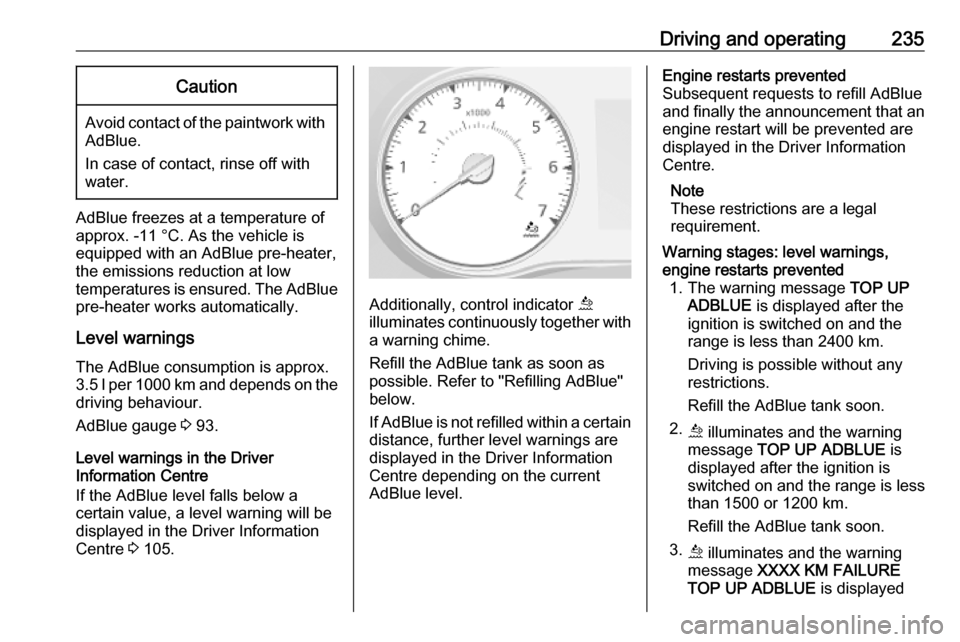
Additionally, control indicator ú
illuminates continuously together with a warning chime.
Refill the AdBlue tank as soon as
possible. Refer to "Refilling AdBlue"
below.
If AdBlue is not refilled within a certain distance, further level warnings are
displayed in the Driver Information
Centre depending on the current
AdBlue level.
Engine restarts prevented
Subsequent requests to refill AdBlue
and finally the announcement that an engine restart will be prevented are
displayed in the Driver Information
Centre.
Note
These restrictions are a legal
requirement.Warning stages: level warnings,
engine restarts prevented 1. The warning message TOP UP
ADBLUE is displayed after the
ignition is switched on and the
range is less than 2400 km.
Driving is possible without any
restrictions.
Refill the AdBlue tank soon.
2. ú illuminates and the warning
message TOP UP ADBLUE is
displayed after the ignition is
switched on and the range is less
than 1500 or 1200 km.
Refill the AdBlue tank soon.
3. ú illuminates and the warning
message XXXX KM FAILURE
TOP UP ADBLUE is displayed
Page 238 of 353

236Driving and operatingafter the ignition is switched on
and the range is less than 1000 or
800 km. The message is repeated
every 100 km. When the range is less than 200 km the message is
repeated every 50 km.
Vehicle speed may be limited to
20 km/h after switching the engine
off and on again until the range is
reduced to 0 km.
Refill the tank completely or with a volume of at least 10 l of AdBlue
(depending on AdBlue
consumption) as soon as
possible.
4. Y illuminates during driving with
warning message 0KM FAILURE
TOP UP ADBLUE :
The engine cannot be restarted
after switching off the ignition.
To allow the engine to be
restarted, refill the tank
completely or with a volume of at
least 10 l of AdBlue (depending on AdBlue consumption) as soon as
possible.
Illumination of control indicator Y may
be accompanied by a warning chime.Warning chimes 3 107.High emission warnings
If the exhaust emission rises above a certain value, warnings similar to therange warnings as described above
will be displayed in the Driver
Information Centre. Control indicator
ú illuminates continuously together
with j 3 99 and a warning chime.
Requests to have the exhaust system checked and finally the
announcement that an engine restart
will be prevented are displayed in the
Driver Information Centre.
Note
These restrictions are a legal
requirement.
Seek the assistance of a workshop as
soon as possible.Warning stages: high emission
warnings 1. ú and j illuminate with
warning message Check Anti-
Pollution System .
Fault in the system that may result in a loss of engine power.Seek the assistance of a
workshop as soon as possible.
2. ú and j illuminate with
warning message xxxKM failure
antipollution .
Indicates that in less than 1000 or 800 km an engine restart will be
prohibited after switching off the
ignition. This warning message
will be repeated every 100 km.
When the range is less than 200
km the message is repeated
every 50 km.
Vehicle speed may be limited to
20 km/h after switching the engine
off and on again until the range is
reduced to 0 km.
Seek the assistance of a
workshop as soon as possible.
3. ú and j illuminate with
warning message 0KM failure
antipollution .
The engine cannot be restarted
after switching off the ignition.
Seek the assistance of a
workshop.
Page 239 of 353
Driving and operating237Illumination of control indicators ú
and j may be accompanied by a
warning chime.
Warning chimes 3 107.
Version without level warnings in the Driver Information Centre
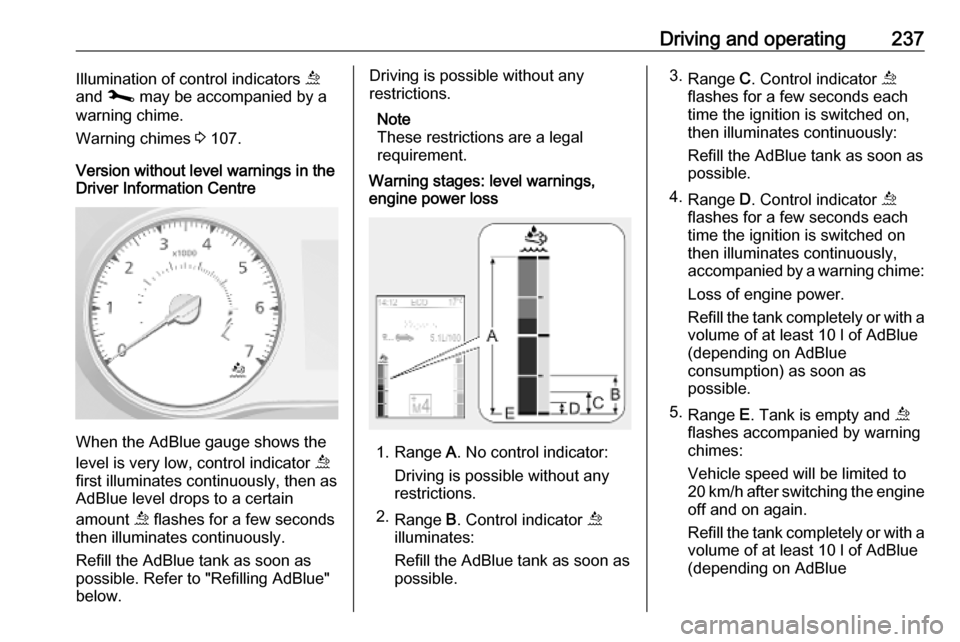
When the AdBlue gauge shows the
level is very low, control indicator ú
first illuminates continuously, then as
AdBlue level drops to a certain
amount ú flashes for a few seconds
then illuminates continuously.
Refill the AdBlue tank as soon as
possible. Refer to "Refilling AdBlue"
below.
Driving is possible without any
restrictions.
Note
These restrictions are a legal
requirement.Warning stages: level warnings,
engine power loss
1. Range A. No control indicator:
Driving is possible without any
restrictions.
2. Range B. Control indicator ú
illuminates:
Refill the AdBlue tank as soon as
possible.
3. Range C. Control indicator ú
flashes for a few seconds each
time the ignition is switched on,
then illuminates continuously:
Refill the AdBlue tank as soon as
possible.
4. Range D. Control indicator ú
flashes for a few seconds each
time the ignition is switched on
then illuminates continuously,
accompanied by a warning chime:
Loss of engine power.
Refill the tank completely or with a
volume of at least 10 l of AdBlue
(depending on AdBlue
consumption) as soon as
possible.
5. Range E. Tank is empty and ú
flashes accompanied by warning
chimes:
Vehicle speed will be limited to
20 km/h after switching the engine
off and on again.
Refill the tank completely or with a
volume of at least 10 l of AdBlue (depending on AdBlue
Page 240 of 353
238Driving and operatingconsumption) as soon as
possible.
High emission warnings If the exhaust emission rises above a
certain value, control indicator ú
illuminates together with j 3 99.
Consult a workshop as soon as
possible.
Note
These restrictions are a legal
requirement.Warning stages: high emission
warnings 1. ú and j illuminate:
Fault in the system. Seek the assistance of a
workshop as soon as possible.
2. ú and j flash when the engine
is started then illuminate
continuously:
Fault in the system resulting in a
loss of engine power.Seek the assistance of a
workshop as soon as possible.
3. ú and j flash:
Fault in the system.
Vehicle speed will be limited to
20 km/h after switching the engine
off and on again.
Seek the assistance of a
workshop as soon as possible.
Illumination of control indicators ú
and j may be accompanied by a
warning chime.
Warning chimes 3 107.
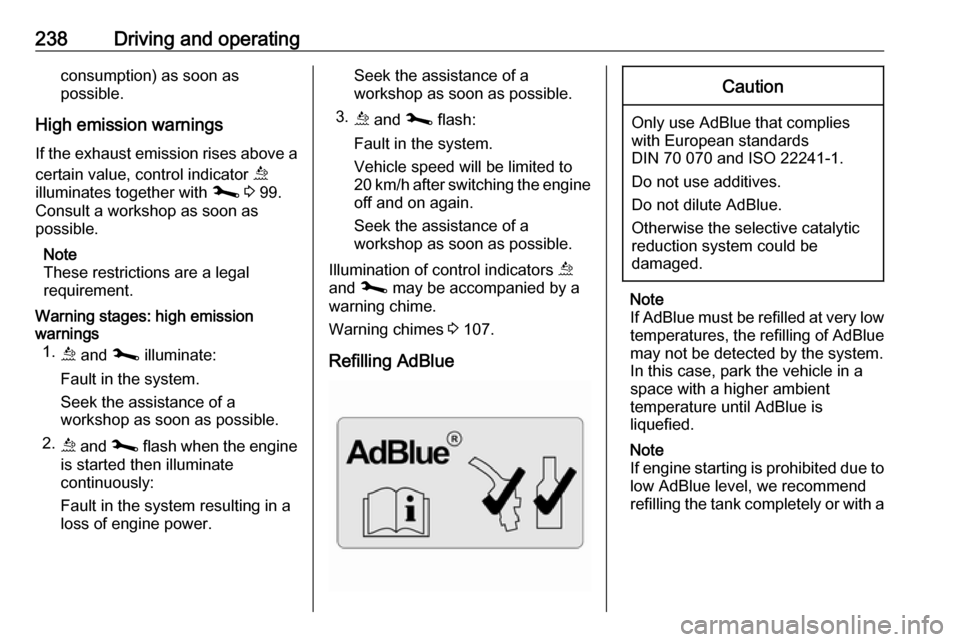
Refilling AdBlueCaution
Only use AdBlue that complies
with European standards
DIN 70 070 and ISO 22241-1.
Do not use additives.
Do not dilute AdBlue.
Otherwise the selective catalytic
reduction system could be
damaged.
Note
If AdBlue must be refilled at very low temperatures, the refilling of AdBlue
may not be detected by the system.
In this case, park the vehicle in a
space with a higher ambient
temperature until AdBlue is
liquefied.
Note
If engine starting is prohibited due to low AdBlue level, we recommend
refilling the tank completely or with a
Page 242 of 353
240Driving and operatingAdditionally, the fumes in the tank
are captured in the canister and do
not emerge.
Note
Since AdBlue has a limited
durability, check the date of expiry
before refilling.
1. Switch off engine and remove key
from ignition switch.
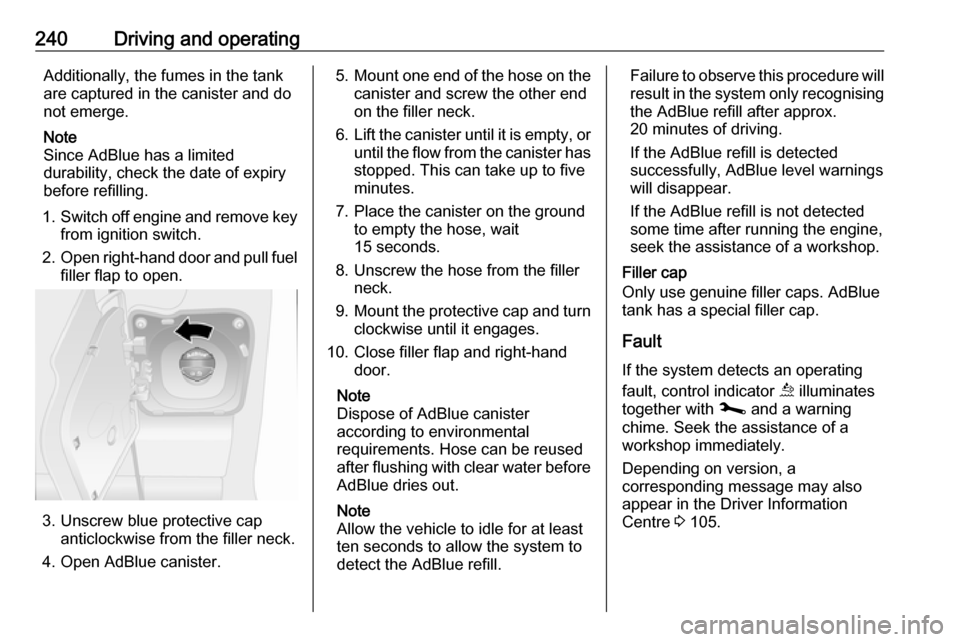
2. Open right-hand door and pull fuel
filler flap to open.
3. Unscrew blue protective cap anticlockwise from the filler neck.
4. Open AdBlue canister.
5. Mount one end of the hose on the
canister and screw the other end
on the filler neck.
6. Lift the canister until it is empty, or
until the flow from the canister has stopped. This can take up to five
minutes.
7. Place the canister on the ground to empty the hose, wait
15 seconds.
8. Unscrew the hose from the filler neck.
9. Mount the protective cap and turn
clockwise until it engages.
10. Close filler flap and right-hand door.
Note
Dispose of AdBlue canister
according to environmental
requirements. Hose can be reused
after flushing with clear water before
AdBlue dries out.
Note
Allow the vehicle to idle for at least
ten seconds to allow the system to
detect the AdBlue refill.Failure to observe this procedure will
result in the system only recognising the AdBlue refill after approx.
20 minutes of driving.
If the AdBlue refill is detected
successfully, AdBlue level warnings
will disappear.
If the AdBlue refill is not detected
some time after running the engine,
seek the assistance of a workshop.
Filler cap
Only use genuine filler caps. AdBlue tank has a special filler cap.
Fault
If the system detects an operating
fault, control indicator ú illuminates
together with j and a warning
chime. Seek the assistance of a
workshop immediately.
Depending on version, a
corresponding message may also
appear in the Driver Information
Centre 3 105.
Page 245 of 353
Driving and operating243warning may sound as a signal to
depress the brake pedal or apply the
parking brake.
Switch off engine if stopping for a lengthy period, e.g. in traffic jams.
When the vehicle is parked and the
driver's door is opened, a warning
chime will sound if neutral is not
selected or the brake pedal has not
been depressed.
Engine braking
Automatic mode
When driving downhill, the manual transmission automated does not shift into higher gears until a fairly
high engine speed has been reached. It shifts down in good time when
braking.
Manual mode
To utilise the engine braking effect, select a lower gear in good time when driving downhill.Rocking the vehicle
Rocking the vehicle is only
permissible if the vehicle is stuck in
sand, mud, snow or a hole. Move the
selector lever between R and D/M (or
between + and -) in a repeat pattern,
while applying light pressure to the
accelerator pedal. Do not race the
engine and avoid sudden
acceleration.
Parking
Apply the parking brake. The most recently engaged gear (see
transmission display) remains
engaged. With N, no gear is engaged.
When the ignition is switched off, the transmission no longer responds to
movement of the selector lever.
If the ignition is not switched off, or the parking brake has not been applied, a
warning chime will sound upon
opening the driver's door.
Manual mode If a higher gear is selected when the
engine speed is too low, or a lower
gear when the speed is too high, theshift is not executed. This prevents
the engine from running at too low or
too high an engine speed.
If engine speed is too low, the
transmission automatically shifts to a
lower gear.
If engine speed is too high, the
transmission only switches to a higher gear via kickdown.
Electronic driving programmes
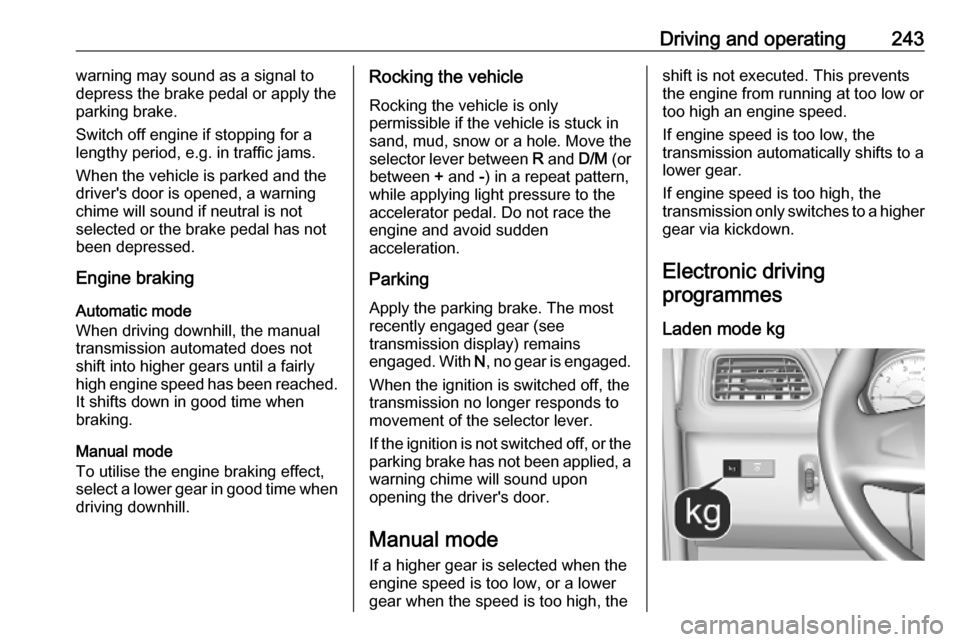
Laden mode kg
Page 247 of 353
Driving and operating245ABS starts to regulate brake pressure
as soon as a wheel shows a tendency to lock. The vehicle remains
steerable, even during hard braking.
ABS control is made apparent
through a pulse in the brake pedal
and the noise of the regulation
process.
For optimum braking, keep the brake
pedal fully depressed throughout the
braking process, despite the fact that
the pedal is pulsating. Do not reduce
the pressure on the pedal.
Control indicator u 3 100.
Fault
If control indicators u and j
illuminate with a message in the
Driver Information Centre, there is a fault in the ABS. The brake system
remains operational but without ABS
regulation.9 Warning
If there is a fault in the ABS, the
wheels may be liable to lock due
to braking that is heavier than
normal. The advantages of ABS are no longer available. During
hard braking, the vehicle can no longer be steered and may
swerve.
If control indicators u, j , R and
C illuminate, the ABS and ESC are
deactivated and a message is shown
in the Driver Information Centre.
Have the cause of the fault remedied
by a workshop.
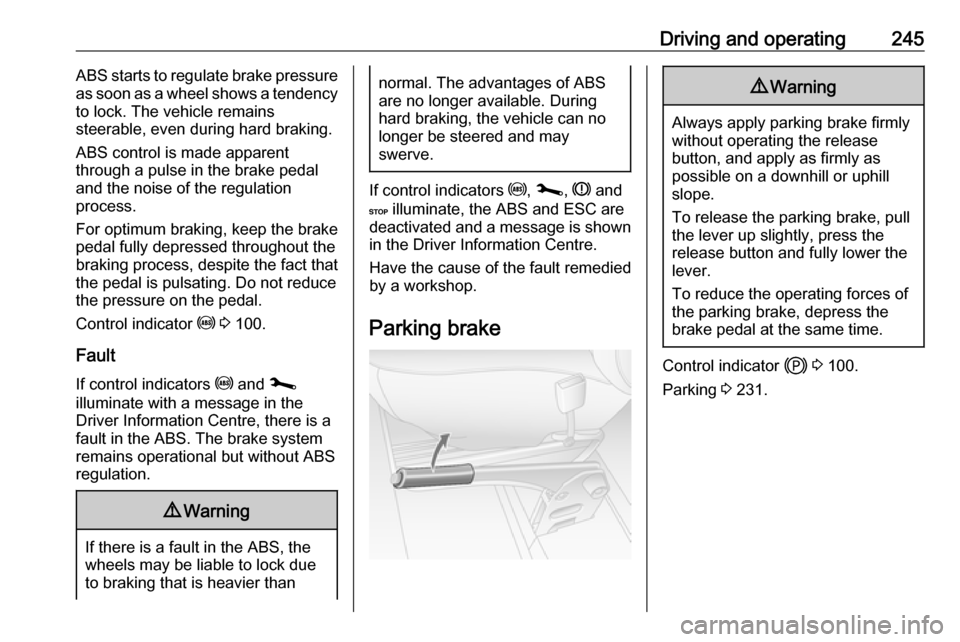
Parking brake
9 Warning
Always apply parking brake firmly
without operating the release
button, and apply as firmly as
possible on a downhill or uphill
slope.
To release the parking brake, pull
the lever up slightly, press the
release button and fully lower the
lever.
To reduce the operating forces of
the parking brake, depress the
brake pedal at the same time.
Control indicator j 3 100.
Parking 3 231.
Page 249 of 353
Driving and operating247Ride control systems
Traction Control system The traction control system is a
component part of the Electronic
Stability Control (ESC) which
improves driving stability when
necessary, regardless of the type of
road surface or tyre grip, by
preventing the drive wheels from
spinning.
As soon as the drive wheels start to
spin, engine output is reduced and
the wheel spinning the most is braked
individually. This considerably
improves the driving stability of the
vehicle on slippery road surfaces.
Traction control system is operational
as soon as the ignition is switched on and control indicator b extinguishes
in the instrument cluster.
When traction control system is active b flashes.9 Warning
Do not let this special safety
feature tempt you into taking risks
when driving.
Adapt speed to the road
conditions.
Control indicator b 3 101.
Trailer stability assist 3 266.
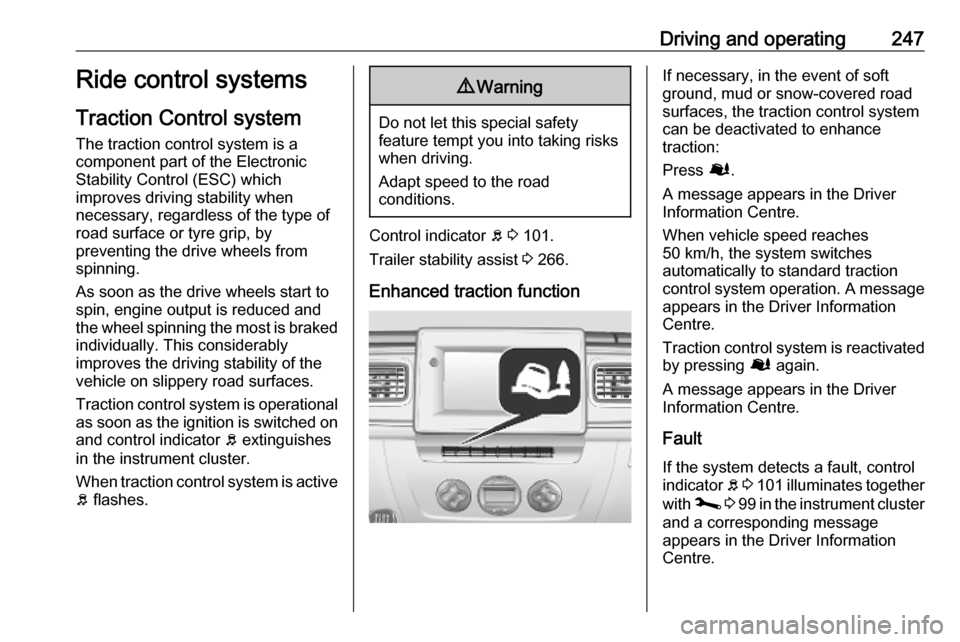
Enhanced traction function
If necessary, in the event of soft
ground, mud or snow-covered road
surfaces, the traction control system
can be deactivated to enhance
traction:
Press Ø.
A message appears in the Driver
Information Centre.
When vehicle speed reaches
50 km/h, the system switches
automatically to standard traction control system operation. A message
appears in the Driver Information
Centre.
Traction control system is reactivated by pressing Ø again.
A message appears in the Driver
Information Centre.
Fault
If the system detects a fault, control
indicator b 3 101 illuminates together
with j 3 99 in the instrument cluster
and a corresponding message
appears in the Driver Information
Centre.