warning OPEL VIVARO 2015 Service Manual
[x] Cancel search | Manufacturer: OPEL, Model Year: 2015, Model line: VIVARO, Model: OPEL VIVARO 2015Pages: 205, PDF Size: 4.47 MB
Page 87 of 205
Instruments and controls85
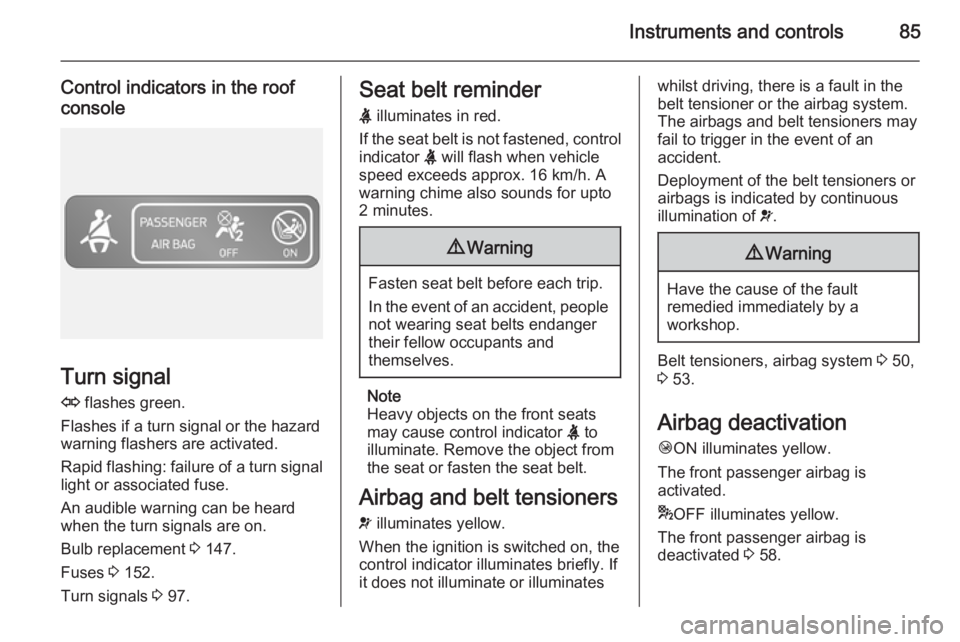
Control indicators in the roof
console
Turn signal
O flashes green.
Flashes if a turn signal or the hazard
warning flashers are activated.
Rapid flashing: failure of a turn signal
light or associated fuse.
An audible warning can be heard
when the turn signals are on.
Bulb replacement 3 147.
Fuses 3 152.
Turn signals 3 97.
Seat belt reminder
X illuminates in red.
If the seat belt is not fastened, control
indicator X will flash when vehicle
speed exceeds approx. 16 km/h. A
warning chime also sounds for upto
2 minutes.9 Warning
Fasten seat belt before each trip.
In the event of an accident, people
not wearing seat belts endanger their fellow occupants and
themselves.
Note
Heavy objects on the front seats
may cause control indicator X to
illuminate. Remove the object from
the seat or fasten the seat belt.
Airbag and belt tensioners
v illuminates yellow.
When the ignition is switched on, the
control indicator illuminates briefly. If it does not illuminate or illuminates
whilst driving, there is a fault in the
belt tensioner or the airbag system.
The airbags and belt tensioners may
fail to trigger in the event of an
accident.
Deployment of the belt tensioners or
airbags is indicated by continuous
illumination of v.9 Warning
Have the cause of the fault
remedied immediately by a
workshop.
Belt tensioners, airbag system 3 50,
3 53.
Airbag deactivation Ó ON illuminates yellow.
The front passenger airbag is
activated.
* OFF illuminates yellow.
The front passenger airbag is
deactivated 3 58.
Page 88 of 205
86Instruments and controls
If both control indicators ÓON and
* OFF are illuminated
simultaneously, there is a system
failure. The status of the system is not discernible, therefore no person is
permitted to occupy the front
passenger seat. Contact a workshop immediately.
If illuminated in conjunction with v or
F , seek the assistance of a workshop.9 Danger
Risk of fatal injury for a child using
a child restraint system together
with activated front passenger
airbag.
Risk of fatal injury for an adult
person with deactivated front
passenger airbag.
Airbag system 3 53, belt tensioners
3 50, airbag deactivation 3 58.
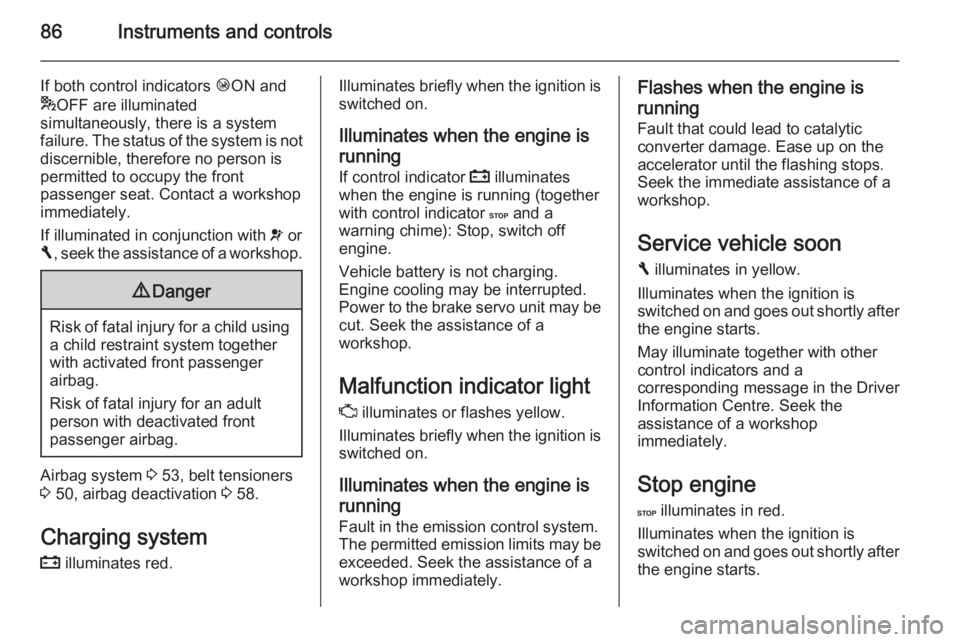
Charging system p illuminates red.
Illuminates briefly when the ignition is
switched on.
Illuminates when the engine is
running
If control indicator p illuminates
when the engine is running (together
with control indicator C and a
warning chime): Stop, switch off
engine.
Vehicle battery is not charging.
Engine cooling may be interrupted.
Power to the brake servo unit may be
cut. Seek the assistance of a
workshop.
Malfunction indicator light Z illuminates or flashes yellow.
Illuminates briefly when the ignition is
switched on.
Illuminates when the engine is running Fault in the emission control system.
The permitted emission limits may be
exceeded. Seek the assistance of a
workshop immediately.Flashes when the engine is
running
Fault that could lead to catalytic
converter damage. Ease up on the
accelerator until the flashing stops.
Seek the immediate assistance of a
workshop.
Service vehicle soon F illuminates in yellow.
Illuminates when the ignition is
switched on and goes out shortly after
the engine starts.
May illuminate together with other
control indicators and a
corresponding message in the Driver
Information Centre. Seek the
assistance of a workshop
immediately.
Stop engine C illuminates in red.
Illuminates when the ignition is
switched on and goes out shortly after
the engine starts.
Page 89 of 205
Instruments and controls87
Illuminates together with other controlindicators (e.g., p, I and R),
accompanied by a warning chime and
a corresponding message in the
Driver Information Centre: stop
engine immediately and seek the
assistance of a workshop.
Brake system
R illuminates red.
Illuminates when the parking brake is
released if the brake fluid level is too
low 3 143.9 Warning
Stop. Do not continue your
journey. Consult a workshop.
Illuminates after the ignition is
switched on if the parking brake is
applied 3 123 and extinguishes
when the parking brake is released.
If R illuminates together with control
indicator C and a warning chime,
there is a fault in the braking system.
A corresponding message also
appears in the Driver Information
Centre 3 90. Seek the assistance of
a workshop immediately.
Brake system 3 122.
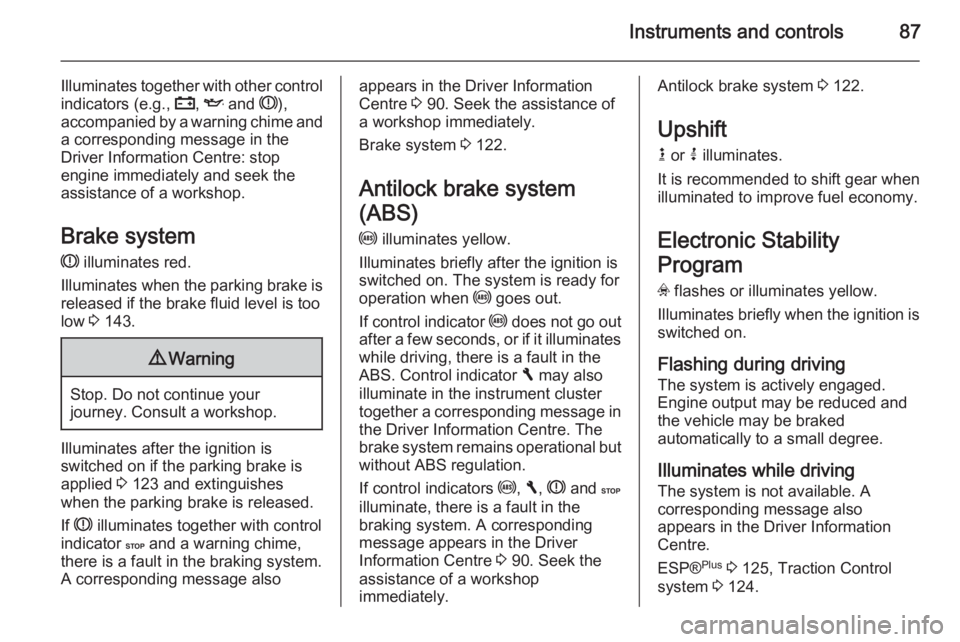
Antilock brake system
(ABS) u illuminates yellow.
Illuminates briefly after the ignition is
switched on. The system is ready for
operation when u goes out.
If control indicator u does not go out
after a few seconds, or if it illuminates while driving, there is a fault in the
ABS. Control indicator F may also
illuminate in the instrument cluster
together a corresponding message in the Driver Information Centre. The
brake system remains operational but without ABS regulation.
If control indicators u, F , R and C
illuminate, there is a fault in the
braking system. A corresponding
message appears in the Driver
Information Centre 3 90. Seek the
assistance of a workshop
immediately.Antilock brake system 3 122.
Upshift
k or j illuminates.
It is recommended to shift gear when
illuminated to improve fuel economy.
Electronic Stability
Program
v flashes or illuminates yellow.
Illuminates briefly when the ignition is
switched on.
Flashing during driving The system is actively engaged.
Engine output may be reduced and
the vehicle may be braked
automatically to a small degree.
Illuminates while driving
The system is not available. A
corresponding message also
appears in the Driver Information
Centre.
ESP® Plus
3 125, Traction Control
system 3 124.
Page 90 of 205
88Instruments and controlsElectronic Stability
Program off
Ø illuminates yellow.
If ESP ®Plus
has been deactivated with
button Ø on the instrument panel,
control indicator Ø illuminates and a
corresponding message appears in
the Driver Information Centre 3 90.
ESP® Plus
3 125, Traction Control
system 3 124.
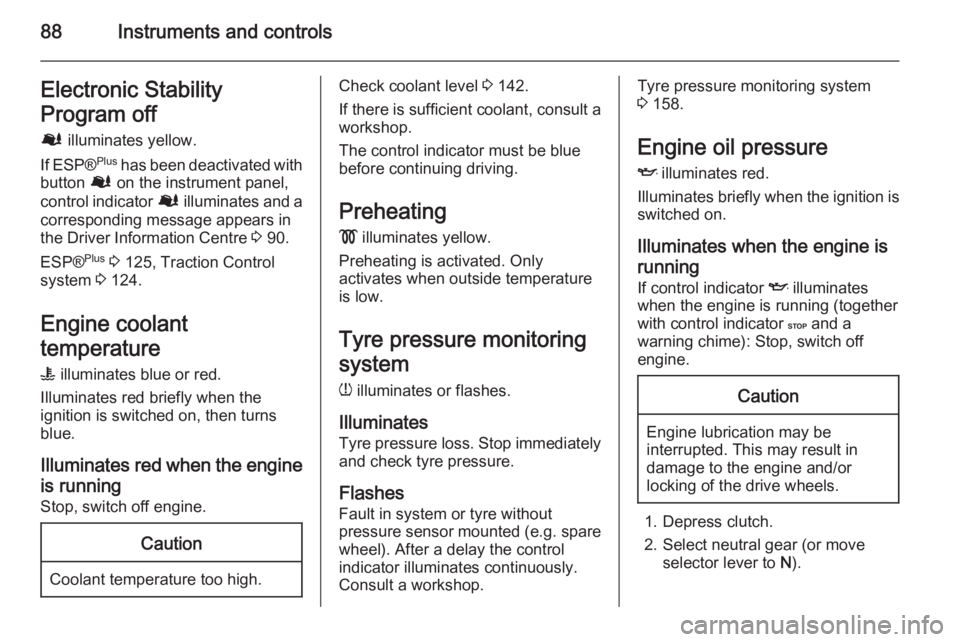
Engine coolant
temperature
W illuminates blue or red.
Illuminates red briefly when the
ignition is switched on, then turns
blue.
Illuminates red when the engine
is running Stop, switch off engine.Caution
Coolant temperature too high.
Check coolant level 3 142.
If there is sufficient coolant, consult a workshop.
The control indicator must be blue
before continuing driving.
Preheating
! illuminates yellow.
Preheating is activated. Only
activates when outside temperature
is low.
Tyre pressure monitoring
system
w illuminates or flashes.
Illuminates Tyre pressure loss. Stop immediately
and check tyre pressure.
Flashes Fault in system or tyre without
pressure sensor mounted ( e.g. spare
wheel). After a delay the control
indicator illuminates continuously.
Consult a workshop.Tyre pressure monitoring system 3 158.
Engine oil pressure
I illuminates red.
Illuminates briefly when the ignition is
switched on.
Illuminates when the engine is running
If control indicator I illuminates
when the engine is running (together
with control indicator C and a
warning chime): Stop, switch off
engine.Caution
Engine lubrication may be
interrupted. This may result in
damage to the engine and/or
locking of the drive wheels.
1. Depress clutch.
2. Select neutral gear (or move selector lever to N).
Page 91 of 205
Instruments and controls89
3. Move out of the flow of traffic asquickly as possible without
impeding other vehicles.
4. Switch off ignition.9 Warning
When the engine is off,
considerably more force is needed
to brake and steer.
Do not remove key until vehicle is stationary, otherwise the steering
wheel lock could engage
unexpectedly.
Check oil level before seeking
assistance of a workshop 3 140.
Fuel economy mode
ECO illuminates green when ECO
mode is engaged to reduce fuel
consumption.
ECO mode, driving economically
3 112.
Low fuel
Y illuminates yellow.
When the ignition is switched on, the control indicator illuminates briefly.
Illuminates when level in fuel tank is
low (range of approx. 50 km); refuel
immediately 3 134.
Catalytic converter 3 120.
Bleeding the diesel fuel system
3 146.
Autostop
D illuminates when engine is in an
Autostop.
Stop-start system 3 117.
Exterior light 9 illuminates green.
Illuminated when the headlights are
on.
8 illuminates green.
Illuminated when the sidelights are
on.
Lighting 3 95.High beam
P illuminates blue.
Illuminated when high beam is on and
during headlight flash 3 96.
Fog light > illuminates green.
Illuminated when the front fog lights
are on 3 98.
Rear fog light r illuminates green.
Illuminated when the rear fog light is
on 3 98.
Cruise control
m , U illuminates green or yellow.
m illuminates green when a certain
speed is stored.
U illuminates green when the system
is on.
Speed limiter
U illuminates yellow.
Page 93 of 205
Instruments and controls91Vehicle messages
Messages are displayed in the Driver
Information Centre and may be
accompanied by illumination of
control indicator F or C in the
instrument cluster.
Information messages Information messages regarding,
e.g. engine starting conditions, stop-
start system, parking brake
application, central locking, steering
wheel lock etc. provide the current
status of certain vehicle functions and
instructions for use.
Fault messages Fault messages regarding, e.g. fuel
filter, airbags, exhaust emissions etc.
are displayed together with control
indicator F. Drive with caution and
seek the assistance of a workshop as
soon as possible.
To remove fault messages from the
display, press button on end of wiper
lever. After a few seconds the
message may disappearautomatically and F remains
illuminated. The fault will then be
stored in the on board system.
Warning messagesWarning messages regarding, e.g.
engine, battery or brake system
failure, are displayed together with
control indicator C and may be
accompanied by a warning chime.
Stop engine immediately and seek
the assistance of a workshop.
Fuel economy messages
Fuel economy messages provide tips to improve fuel efficiency. Journeys
can be saved in the system memory,
enabling you to compare
performances.
Refer to Infotainment system manual
for further information.
Fuel economy rating 3 92.
Warning chimes
A corresponding message may also
appear in the Driver Information
Centre when a warning chime is
sounded.When starting the engine or
whilst driving: ■ If seat belt is not fastened 3 50.
■ During operation of the turn and lane-change signals 3 97.
■ During illumination of certain control indicators.
■ If the parking assist detects an object 3 130.
■ If the vehicle speed briefly exceeds
a set limit 3 126, 3 130.
■ If a door or the bonnet is not properly closed when vehicle
exceeds a certain speed.
■ If there is a fault in the brake system
3 87.
■ If the vehicle battery is not charging
3 86.
■ If engine lubrication is interrupted 3 88.
■ If the electronic key is outside of the
detection range.
Electronic key system 3 23, Power
button 3 114.
Page 99 of 205
![OPEL VIVARO 2015 Service Manual Lighting97
For each headlight:
Using a screwdriver, turn the screw
by a 1
/4 turn towards the
] symbol to
lower the beams or towards the <
symbol to raise the beams.
Ensure the headlight beams are](/img/37/58240/w960_58240-98.png "OPEL VIVARO 2015 Service Manual Lighting97
For each headlight:
Using a screwdriver, turn the screw
by a 1
/4 turn towards the
] symbol to
lower the beams or towards the <
symbol to raise the beams.
Ensure the headlight beams are")
Lighting97
For each headlight:
Using a screwdriver, turn the screw
by a 1
/4 turn towards the
] symbol to
lower the beams or towards the <
symbol to raise the beams.
Ensure the headlight beams are
returned to their original positions
when required.
Daytime running lights
Daytime running lights increase
visibility of the vehicle during daylight.
They are switched on automatically
when the ignition is switched on.
If required, the daytime running lights can be deactivated via the
Infotainment system. For further
information, refer to Infotainment
system manual.
Automatic light control 3 95.Adaptive forward lighting
Cornering light Depending on the steering angle,
vehicle speed and gear selected
when cornering, an additional light
will illuminate the corner of the road
on the respective side.
Hazard warning flashers
Operated with the ¨ button.
In the event of hard braking, the
hazard warning flashers may turn on
automatically. Switch off by pressing
the ¨ button.
Turn and lane-change
signalslever up=right turn signallever down=left turn signal
When the steering wheel is turned
back, the lever automatically returns
to its original position and the turn
signal is deactivated. This will not
happen when making a minor
steering manoeuvre such as lane
changing.
For three flashes, e.g. when changing
lanes, move lever part way to first
stop and then release.
Page 104 of 205
102Climate control
■Open side air vents as required and
direct them towards door windows.
■ For simultaneous warming of the foot well, set air distribution control
to J.
Heated rear window 3 42.
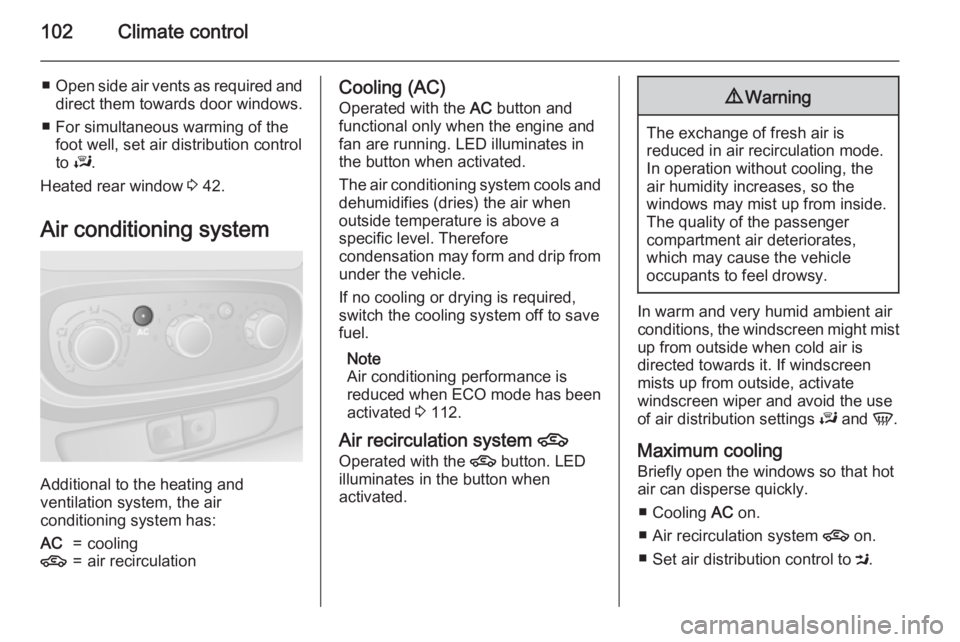
Air conditioning system
Additional to the heating and
ventilation system, the air
conditioning system has:
AC=cooling4=air recirculationCooling (AC)
Operated with the AC button and
functional only when the engine and
fan are running. LED illuminates in
the button when activated.
The air conditioning system cools and
dehumidifies (dries) the air when
outside temperature is above a
specific level. Therefore
condensation may form and drip from under the vehicle.
If no cooling or drying is required,
switch the cooling system off to save
fuel.
Note
Air conditioning performance is
reduced when ECO mode has been
activated 3 112.
Air recirculation system 4
Operated with the 4 button. LED
illuminates in the button when
activated.9 Warning
The exchange of fresh air is
reduced in air recirculation mode.
In operation without cooling, the
air humidity increases, so the
windows may mist up from inside.
The quality of the passenger
compartment air deteriorates,
which may cause the vehicle
occupants to feel drowsy.
In warm and very humid ambient air conditions, the windscreen might mist up from outside when cold air is
directed towards it. If windscreen
mists up from outside, activate
windscreen wiper and avoid the use
of air distribution settings J and V.
Maximum cooling
Briefly open the windows so that hot
air can disperse quickly.
■ Cooling AC on.
■ Air recirculation system 4 on.
■ Set air distribution control to M.
Page 107 of 205
Climate control1059Warning
The exchange of fresh air is
reduced in air recirculation mode.
In operation without cooling the air humidity increases, so the
windows may mist up from inside.
The quality of the passenger
compartment air deteriorates,
which may cause the vehicle
occupants to feel drowsy.
To return to Automatic mode: Press
AUTO button.
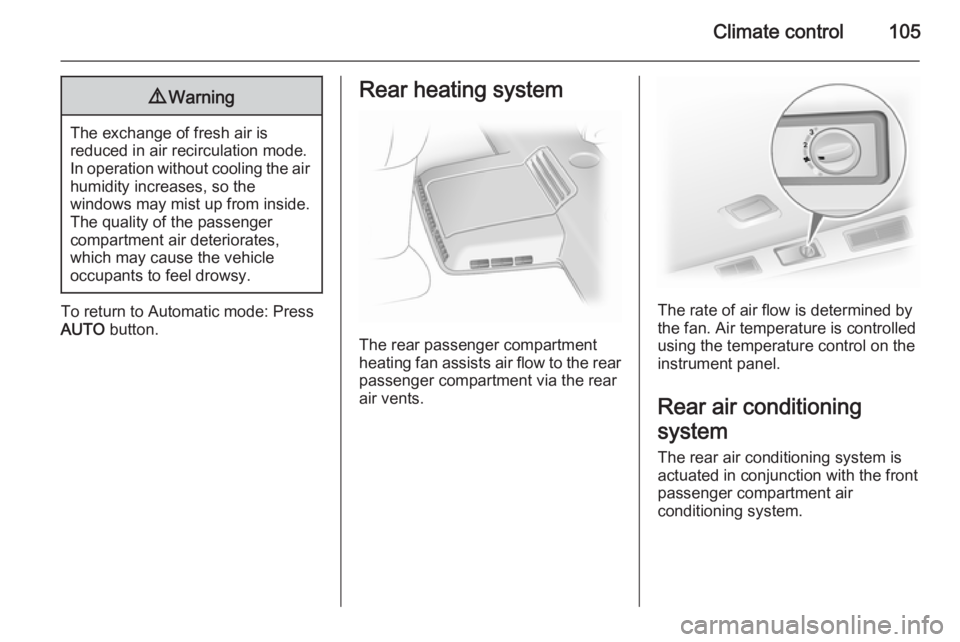
Rear heating system
The rear passenger compartment
heating fan assists air flow to the rear
passenger compartment via the rear
air vents.
The rate of air flow is determined by
the fan. Air temperature is controlled
using the temperature control on the
instrument panel.
Rear air conditioning
system
The rear air conditioning system is
actuated in conjunction with the front
passenger compartment air
conditioning system.
Page 108 of 205
106Climate control
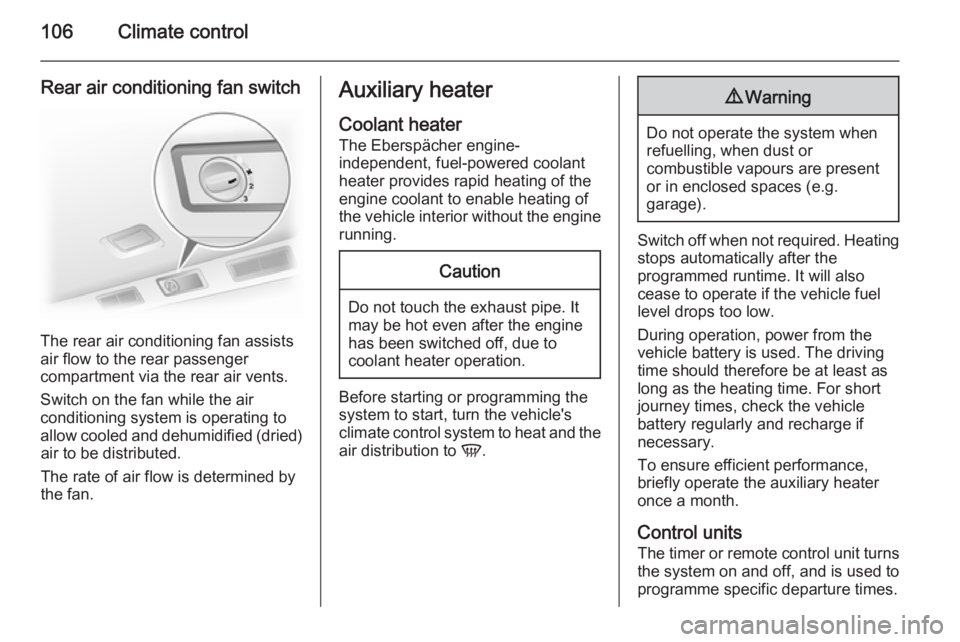
Rear air conditioning fan switch
The rear air conditioning fan assists
air flow to the rear passenger
compartment via the rear air vents.
Switch on the fan while the air
conditioning system is operating to
allow cooled and dehumidified (dried) air to be distributed.
The rate of air flow is determined by
the fan.
Auxiliary heater
Coolant heater The Eberspächer engine-
independent, fuel-powered coolant
heater provides rapid heating of the
engine coolant to enable heating of
the vehicle interior without the engine
running.Caution
Do not touch the exhaust pipe. It
may be hot even after the engine
has been switched off, due to
coolant heater operation.
Before starting or programming the
system to start, turn the vehicle's
climate control system to heat and the
air distribution to V.
9Warning
Do not operate the system when
refuelling, when dust or
combustible vapours are present
or in enclosed spaces (e.g.
garage).
Switch off when not required. Heating stops automatically after the
programmed runtime. It will also
cease to operate if the vehicle fuel
level drops too low.
During operation, power from the
vehicle battery is used. The driving
time should therefore be at least as
long as the heating time. For short
journey times, check the vehicle
battery regularly and recharge if
necessary.
To ensure efficient performance,
briefly operate the auxiliary heater
once a month.
Control units The timer or remote control unit turns
the system on and off, and is used to
programme specific departure times.