engine OPEL ZAFIRA 2009 Workshop Manual
[x] Cancel search | Manufacturer: OPEL, Model Year: 2009, Model line: ZAFIRA, Model: OPEL ZAFIRA 2009Pages: 228, PDF Size: 7.3 MB
Page 150 of 228
150
Driving and operating
If the trailer starts snaking, drive more
slowly, do not attempt to correct the
steering and brake sharply if
necessary.
When driving downhill, drive in the
same gear as if driving uphill and
drive at a similar speed.
Adjust tyre pressure to the value
specified for full load 3 220.
Trailer towing
Trailer loads
The permissible trailer loads are
vehicle and engine-dependent
maximum values which must not be
exceeded. The actual trailer load is
the difference between the actual
gross weight of the trailer and the
actual coupling socket load with the
trailer coupled.
The permissible trailer loads are
specified
in the vehicle documents. In
general, they are valid for gradients
up to max. 12 % The permitted trailer load applies up
to the specified incline and up to an
altitude of 1000 metres above sea
level. Since engine power decreases
as altitude increases because of the
air becoming thinner, therefore
reducing climbing ability, the
permissible gross train weight also
decreases by 10 % for every 1000
metres of additional altitude. The
gross
train weight does not have to be
reduced when driving on roads with
slight inclines (less than 8 %, e. g.
motorways).
The permissible gross train weight
must not be exceeded. This weight is
specified on the identification plate
3 208.
Vertical coupling load
The vertical coupling load is the load
exerted by the trailer on the coupling
ball. It can be varied by changing the
weight distribution when loading the
trailer.
The maximum permissible vertical
coupling load (75 kg) is specified on
the towing equipment identification
plate and in the vehicle documents. Always aim for the maximum load,
especially in the case of heavy
trailers. The vertical coupling load
should never fall below 25 kg.
Rear axle load
When the trailer is coupled and the
towing vehicle fully loaded, the
permissible rear axle load (see
identification plate or vehicle
documents) may be exceeded by 90
kg
and the gross vehicle weight rating
by 75 kg. If the permissible rear axle
load is exceeded, a maximum speed
of 100 km/h applies.
Towing equipment Caution
When operating without a trailer,
remove the coupling ball bar.
Page 153 of 228
Driving and operating
153
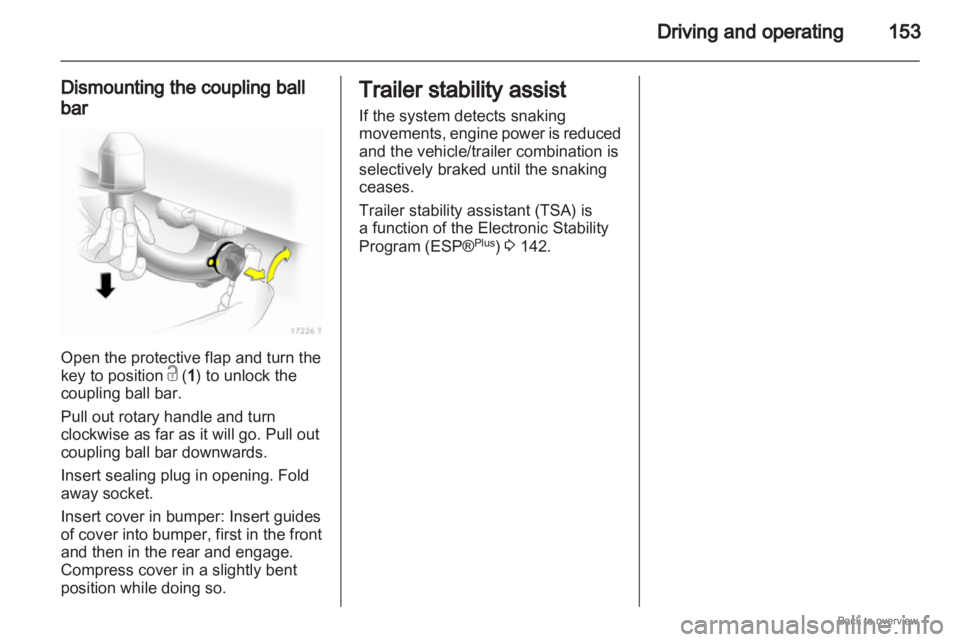
Dismounting the coupling ball
bar Open the protective flap and turn the
key to position c (1
) to unlock the
coupling ball bar.
Pull out rotary handle and turn
clockwise as far as it will go. Pull out
coupling ball bar downwards.
Insert sealing plug in opening. Fold
away socket.
Insert cover in bumper: Insert guides
of cover into bumper, first in the front
and then in the rear and engage.
Compress cover in a slightly bent
position while doing so. Trailer stability assist
If the system detects snaking
movements,
engine power is reduced
and the vehicle/trailer combination is
selectively braked until the snaking
ceases.
Trailer stability assistant (TSA) is
a function of the Electronic Stability
Program (ESP® Plus
) 3 142.
Page 154 of 228
154
Vehicle care
Vehicle care
General Information ...................154
Vehicle checks ........................... 155
Bulb replacement .......................160
Electrical system ........................167
Vehicle tools .............................. 173
Wheels and tyres .......................174
Jump starting ............................. 185
Towing ....................................... 187
Appearance care .......................189 General Information
Accessories and vehicle
modifications
We
recommend to use Genuine Parts
and Accessories and factory
approved parts specific for your
vehicle type. We cannot assess or
guarantee for other products - even if
they have a regulatory or otherwise
granted approval.
Do not make any modifications to the
electrical system, e. g. changes of
electronic control units (chip tuning).
Vehicle storage
Storage for a long period of time
Following must be done if the vehicle
should be stored for several months:
■ Wash and wax the vehicle.
■ Have the wax in the engine compartment and underbody
checked.
■ Clean and preserve rubber seals.
■ Change engine oil. ■ Drain washer fluid reservoir.
■
Check coolant anti-freeze andcorrosion protection.
■ Adjust tyre pressure to the value specified for full load.
■ Park vehicle in dry, well ventilated place. Engage first or reverse gear
or set selector lever to P. Prevent
the vehicle from rolling.
■ Do not apply hand brake.
■ Open bonnet, close all doors and lock the vehicle.
■ Disconnect the clamp from the negative terminal of the vehicle
battery. Beware that all systems are
not functional, e.g. anti-theft alarm
system.
Putting back into operation
Following must be done if the vehicle
is putting back into operation: ■ Connect the clamp to the negative terminal of the vehicle battery.
Activate the electronic of the power
windows.
■ Check tyre pressure.
■ Fill up the washer fluid reservoir.
Page 155 of 228
Vehicle care
155
■ Check the engine oil level.
■ Check the coolant level.
■ Fit the number plate if necessary.
End-of-life vehicle
recovery
Information on end-of-life vehicle
recovery centres and the recycling of
end-of-life vehicles is available on our
website www.opel.com. Only entrust
this work to an authorised recycling
centre. Vehicle checks
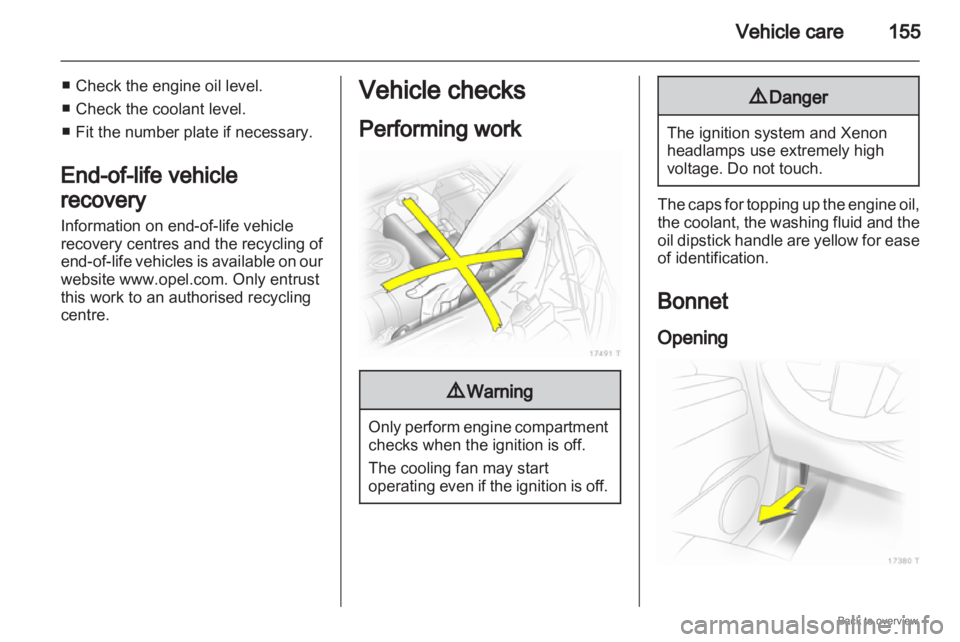
Performing work
9
Warning Only perform engine compartment
checks when the ignition is off.
The cooling fan may start
operating
even if the ignition is off. 9
Danger The ignition system and Xenon
headlamps use extremely high
voltage. Do not touch.
The caps for topping up the engine oil,
the
coolant, the washing fluid and the
oil dipstick handle are yellow for ease
of identification.
Bonnet
Opening
Page 156 of 228
156
Vehicle care
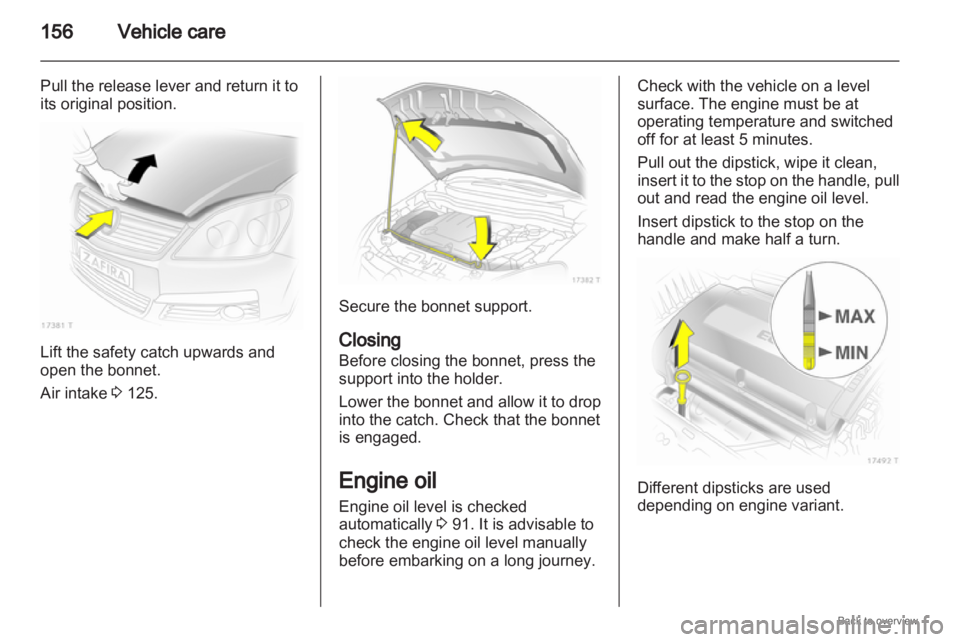
Pull the release lever and return it to
its original position. Lift the safety catch upwards and
open the bonnet.
Air intake 3 125. Secure the bonnet support.
Closing
Before closing the bonnet, press the
support into the holder.
Lower
the bonnet and allow it to drop
into the catch. Check that the bonnet
is engaged.
Engine oil
Engine oil level is checked
automatically 3 91. It is advisable to
check the engine oil level manually
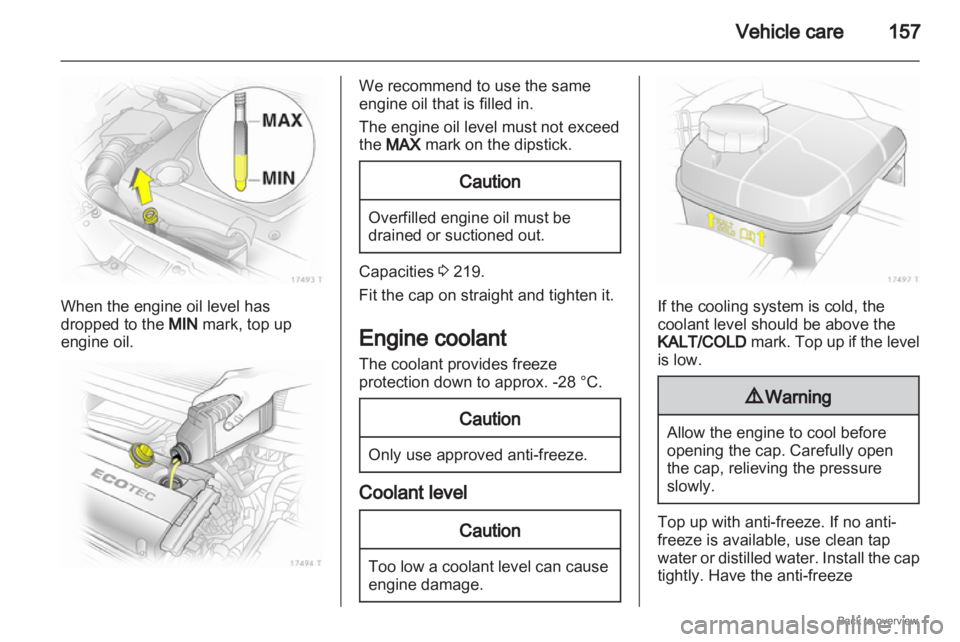
before embarking on a long journey. Check with the vehicle on a level
surface. The engine must be at
operating temperature and switched
off for at least 5 minutes.
Pull out the dipstick, wipe it clean,
insert
it to the stop on the handle, pull
out and read the engine oil level.
Insert dipstick to the stop on the
handle and make half a turn. Different dipsticks are used
depending on engine variant.
Page 157 of 228
Vehicle care
157When the engine oil level has
dropped to the
MIN mark, top up
engine oil. We recommend to use the same
engine oil that is filled in.
The engine oil level must not exceed
the MAX mark on the dipstick.
Caution
Overfilled engine oil must be
drained or suctioned out.
Capacities
3 219.
Fit the cap on straight and tighten it.
Engine coolant
The coolant provides freeze
protection down to approx. -28 °C. Caution
Only use approved anti-freeze.
Coolant level
Caution
Too low a coolant level can cause
engine damage. If the cooling system is cold, the
coolant level should be above the
KALT/COLD
mark. Top up if the level
is low. 9
Warning Allow the engine to cool before
opening the cap. Carefully open
the cap, relieving the pressure
slowly.
Top up with anti-freeze. If no anti-
freeze is available, use clean tap
water
or distilled water. Install the cap
tightly. Have the anti-freeze
Page 159 of 228
Vehicle care
159
Batteries do not belong in household
waste. They must be disposed of at
an appropriate recycling collection
point.
Laying up the vehicle for more than
4 weeks can lead to battery
discharge.
Disconnect the clamp from
the negative terminal of the vehicle
battery.
Ensure the ignition is switched off
before connecting or disconnecting
the vehicle battery.
Diesel fuel system
bleeding
If the tank has been run dry, the diesel
fuel system must be bled. Switch on
the ignition three times for 15 seconds
at a time. Then start the engine for
a maximum of 40 seconds. Repeat
this process after no less than
5 seconds. If the engine fails to start,
seek the assistance of a workshop. Wiper blade replacement
Service setting for front
windscreen wipers
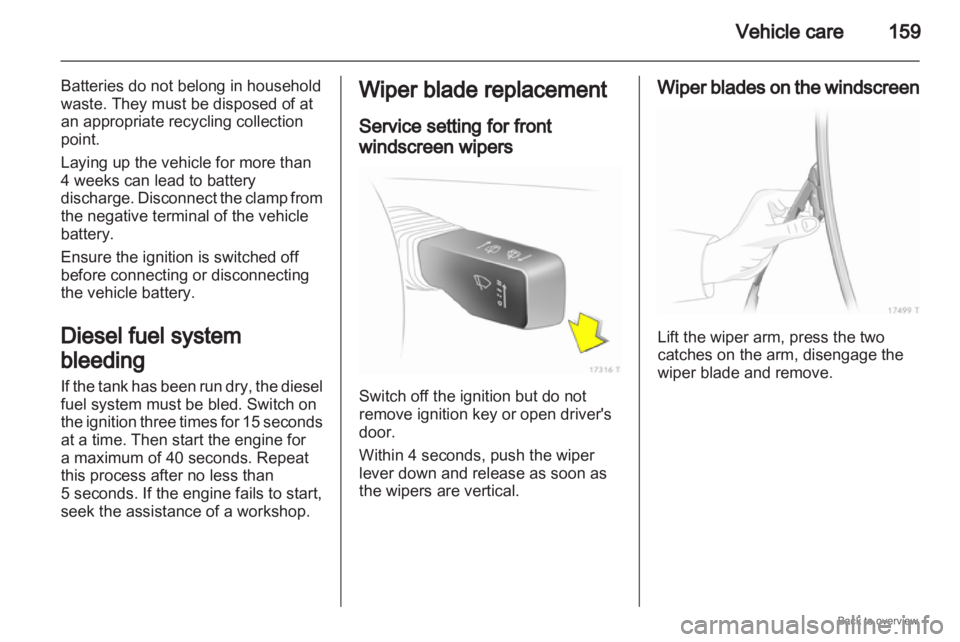
Switch off the ignition but do not
remove ignition key or open driver's
door.
Within 4 seconds, push the wiper
lever down and release as soon as
the wipers are vertical. Wiper blades on the windscreen
Lift the wiper arm, press the two
catches on the arm, disengage the
wiper blade and remove.
Page 160 of 228
160
Vehicle care
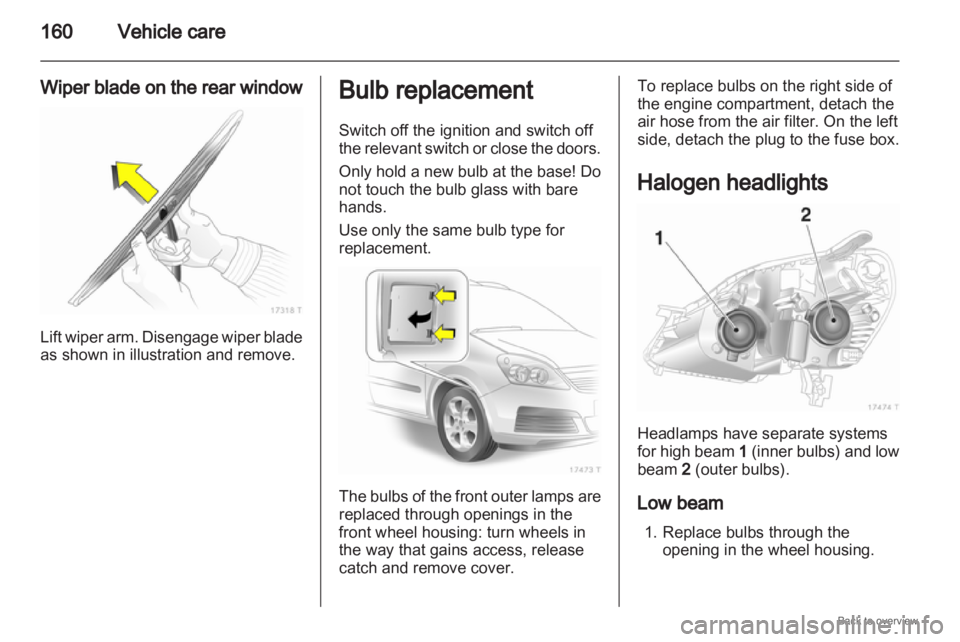
Wiper blade on the rear window Lift wiper arm. Disengage wiper blade
as shown in illustration and remove. Bulb replacement
Switch off the ignition and switch off
the
relevant switch or close the doors.
Only hold a new bulb at the base! Do
not touch the bulb glass with bare
hands.
Use only the same bulb type for
replacement. The bulbs of the front outer lamps are
replaced through openings in the
front wheel housing: turn wheels in
the way that gains access, release
catch and remove cover. To replace bulbs on the right side of
the engine compartment, detach the
air hose from the air filter. On the left
side, detach the plug to the fuse box.
Halogen headlights
Headlamps have separate systems
for
high beam 1 (inner bulbs) and low
beam 2 (outer bulbs).
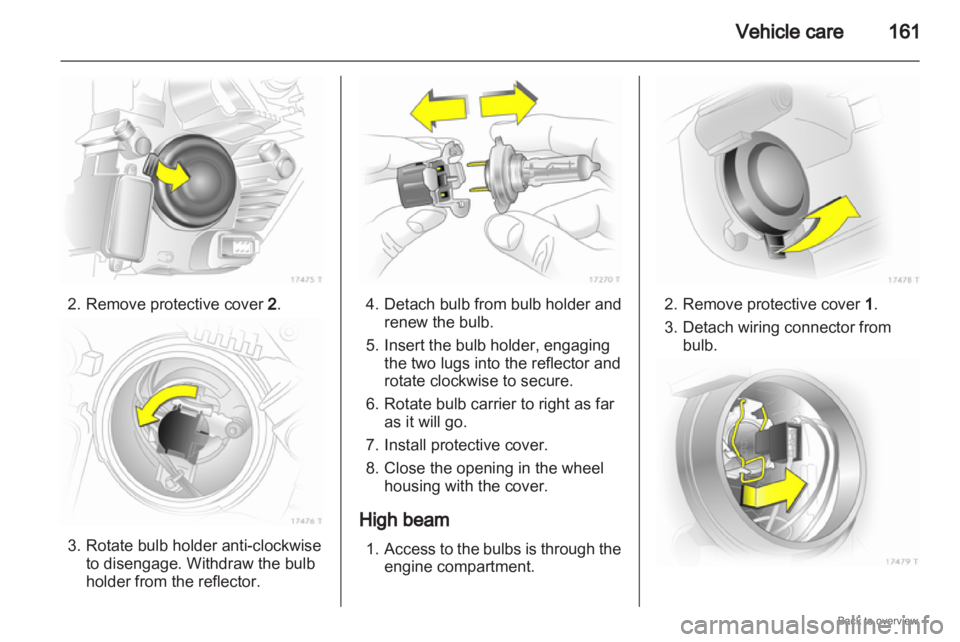
Low beam 1. Replace bulbs through the opening in the wheel housing.
Page 161 of 228
Vehicle care
1612. Remove protective cover
2. 3. Rotate bulb holder anti-clockwise
to disengage. Withdraw the bulb
holder from the reflector. 4. Detach bulb from bulb holder and
renew the bulb.
5.
Insert the bulb holder, engagingthe two lugs into the reflector and
rotate clockwise to secure.
6. Rotate bulb carrier to right as far as it will go.
7. Install protective cover.
8. Close the opening in the wheel housing with the cover.
High beam 1. Access to the bulbs is through the engine compartment. 2. Remove protective cover
1.
3. Detach wiring connector frombulb.
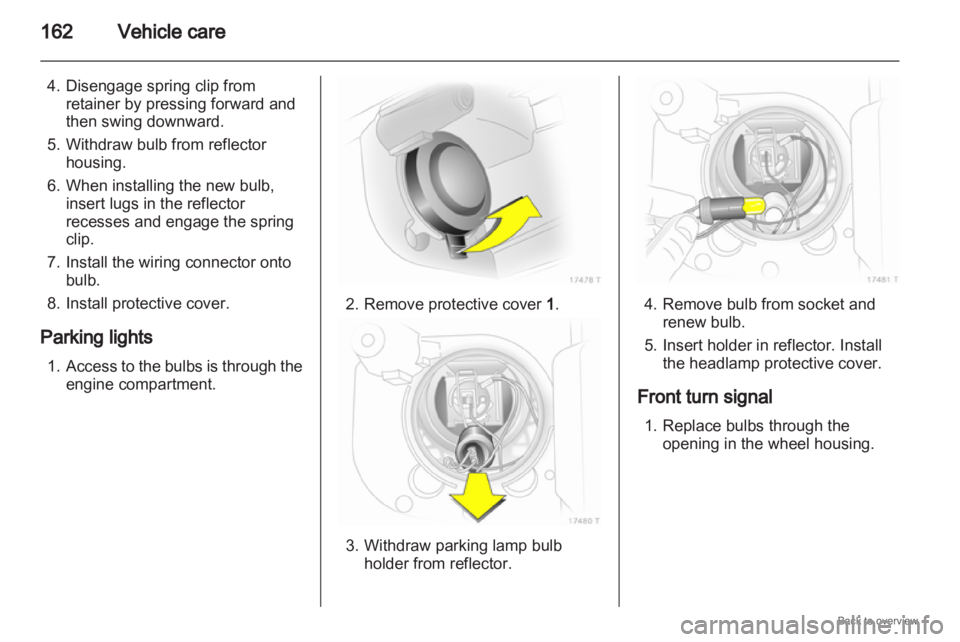
Page 162 of 228
162
Vehicle care
4. Disengage spring clip from retainer by pressing forward and
then swing downward.
5.
Withdraw bulb from reflectorhousing.
6. When installing the new bulb, insert lugs in the reflector
recesses and engage the spring
clip.
7. Install the wiring connector onto bulb.
8. Install protective cover.
Parking lights 1. Access to the bulbs is through the engine compartment. 2. Remove protective cover
1. 3. Withdraw parking lamp bulb
holder from reflector. 4. Remove bulb from socket and
renew bulb.
5.
Insert holder in reflector. Installthe headlamp protective cover.
Front turn signal 1. Replace bulbs through the opening in the wheel housing.