fuel PEUGEOT 108 2015 User Guide
[x] Cancel search | Manufacturer: PEUGEOT, Model Year: 2015, Model line: 108, Model: PEUGEOT 108 2015Pages: 271, PDF Size: 7.42 MB
Page 78 of 271
76
108_en_Chap05_conduite_ed01-2015
F With the parking brake applied, press the brake pedal then select position N .
F
S
tart the engine.
Moving off
if you do not press the brake pedal or
if the gear selector is not in position N ,
engine starting is not possible.
Never leave a child unsupervised inside
the vehicle with the engine running.F
Sel
ect position E using the gear selector.
th
e gearbox then operates in auto-active
mode, without any intervention required by the
driver.
It continuously selects the most suitable gear
for:
- op timised fuel consumption,
-
t
he driving style,
-
t
he profile of the road,
-
t
he load in the vehicle.
to o
btain optimum acceleration, when
overtaking another vehicle for example, press
firmly on the accelerator pedal going beyond
the point of resistance.
Automatic (EASY) mode
It is possible to change mode at any time, by
moving the gear selector from position E to
position M and the other way round.
F
W
ith your foot on the brake pedal, select
position R , E or M.
F
R
elease the parking brake.
F
P
rogressively release the brake pedal.
A
ccelerate away.
Creep function
this function makes manoeuvring the vehicle
at low speed easier (parking, traffic jams…).
After first placing the gear selector in
position
E, M or R , the vehicle moves off as
soon as you take your foot off the brake
pedal , at low speed, with the engine at idle.
th
e creep function may be temporarily
unavailable if the clutch temperature is
too high or the gradient too steep. An
audible signal gives a warning if the
clutch temperature is too high. Never select neutral N when the vehicle
is moving.
Driving
Page 81 of 271
79
108_en_Chap05_conduite_ed01-2015
System which reduces fuel consumption by recommending the most appropriate gear.
gear shift indicator
Operation
example:
- Y ou are in third gear.
-
Y
ou press the accelerator pedal.
-
t
h
e system may suggest that you engage
a higher gear.
Depending on the driving situation and your
vehicle's equipment, the system may advise
you to change gear.
the
gear engagement recommendations must
not be considered compulsory. In fact, the
configuration of the road, the amount of traffic
and safety remain determining factors when
choosing the best gear. t
her
efore, the driver
remains responsible for deciding whether or not
to follow the advice given by the system.
th
is function cannot be deactivated.
th
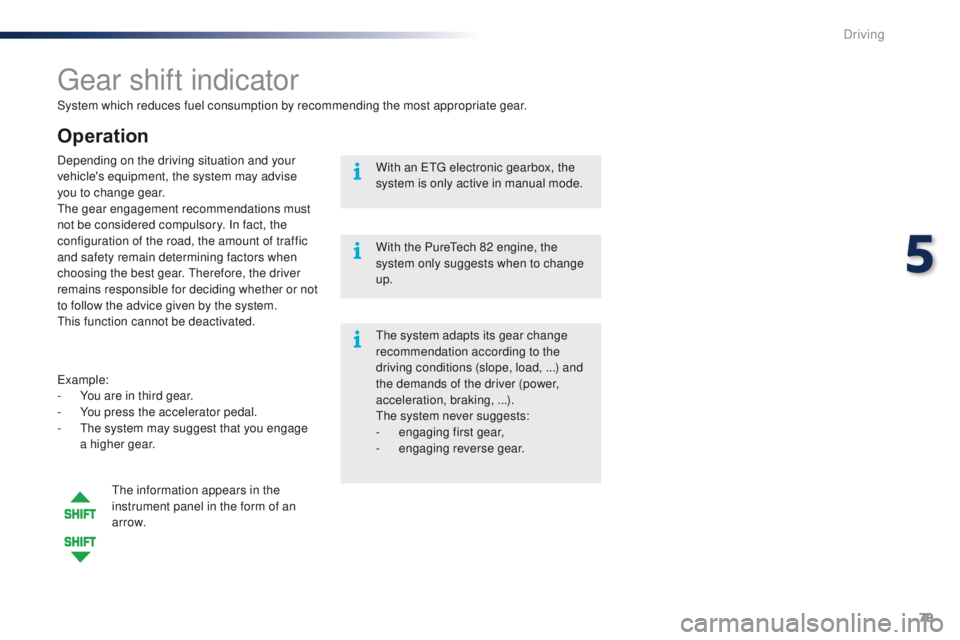
e information appears in the
instrument panel in the form of an
ar row.
th
e system adapts its gear change
recommendation according to the
driving conditions (slope, load, ...) and
the demands of the driver (power,
acceleration, braking,
...).
th
e system never suggests:
-
e
ngaging first gear,
-
enga
ging reverse gear.
With an
etg electronic gearbox, the
system is only active in manual mode.
With the Pure
te
ch 82 engine, the
system only suggests when to change
up.
5
Driving
Page 83 of 271

81
108_en_Chap05_conduite_ed01-2015
Stop & Start (Vti 68 S&S engine)
Operation
Going into engine STOP mode
this indicator lamp comes on in the
instrument panel and the engine
goes into standby automatically:
-
w
hen stationary, in neutral, and you
release the clutch pedal.
Never refuel with the engine in S
tO
P
mode; you must switch off the ignition
with the button. For smoother operation, during
parking manoeuvres S
tO
P mode is
not available for a few seconds after
coming out of reverse gear.
S
tO
P mode does not affect the
vehicle's systems, such as for example,
braking, power steering...
Special cases: STOP mode not
available
StOP mode is not invoked principally when:
- t he driver's door is open,
-
t
he driver's seat belt is not fastened,
-
t
he engine is needed to maintain a
comfortable temperature in the passenger
compartment,
-
d
emisting is active,
-
s
ome special conditions (battery charge,
engine temperature, braking assistance,
vehicle stopped on a steep gradient, high
altitude...) where the engine is needed to
assure control of a system.
th
e Stop & Start
system puts the engine temporarily into standby - S
tO
P mode - during stops in the traffic (red lights, traffic jams, or other...). t
h
e
engine restarts automatically - S
tA
R
t
mode - as soon as you want to move off.
t
h
e restart takes place instantly, quickly and silently.
Per fect for urban use, the Stop & Start system reduces fuel consumption and exhaust emissions as well as the noise level when stationary.
Stop & Start time counters
A partial time counter counts the periods in
StO P mode during a journey.
It is displayed in the trip computer once the
Stop & Start acts.
Press one of the screen management buttons
to return to the previous display.
A global time counter counts the periods in
S
tO
P mode since the last reset.
When it is displayed, press one of the screen
management buttons to reset the counter.
5
Driving
Page 105 of 271
103
108_en_Chap07_securite_ed01-2015
Under-inflation alert
this is given by fixed illumination of
this warning lamp, accompanied by
an audible signal.
F
R
educe speed immediately, avoid
excessive steering movements and sudden
braking.
F
S
top the vehicle as soon as it is safe to do
so.
th
e loss of pressure detected does not
always cause visible bulging of the tyre.
Do not satisfy yourself with just a visual
check.
F
I
f you have a compressor (such as the one
in the temporary puncture repair kit) check
the pressures of the four tyres when cold.
I
f it is not possible to carry out this check
straight away, drive carefully at reduced
speed.
or
F
I
n the event of a puncture, use the
temporary puncture repair kit or the spare
wheel (depending on equipment).
th
e alert is maintained until the system
is reinitialised.
Reinitialisation
Before reinitialising the system, ensure
that the pressures of the four tyres are
correct for the use of the vehicle and in
line with the recommendations on the
tyre pressure label.
th
e under-inflation detection system
does not give a warning if a pressure is
incorrect at the time of reinitialisation.
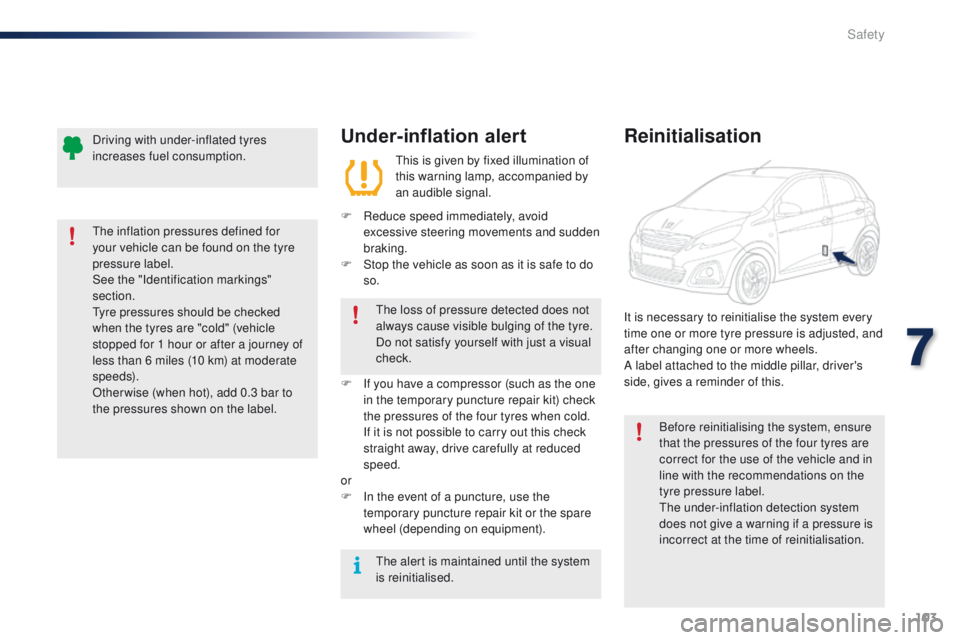
It is necessary to reinitialise the system every
time one or more tyre pressure is adjusted, and
after changing one or more wheels.
A label attached to the middle pillar, driver's
side, gives a reminder of this.
th
e inflation pressures defined for
your vehicle can be found on the tyre
pressure label.
See the "Identification markings"
section.
ty
re pressures should be checked
when the tyres are "cold" (vehicle
stopped for 1 hour or after a journey of
less than 6 miles (10 km) at moderate
speeds).
Other wise (when hot), add 0.3 bar to
the pressures shown on the label. Driving with under-inflated tyres
increases fuel consumption.
7
Safety
Page 138 of 271
136
108_en_Chap09_info-pratiques_ed01-2015
Fuel tank
Low fuel levelRefuelling
When the low fuel level is reached,
this warning lamp comes on and the
last bar flashes, accompanied by an
audible signal.
You have approximately 5 litres remaining.
In certain driving conditions and depending on the
engine, the distance which can be travelled with the
fuel remaining may be less than 30
miles (50 km).
When the frequency of the flashing increases, you
have approximately 3 litres remaining .
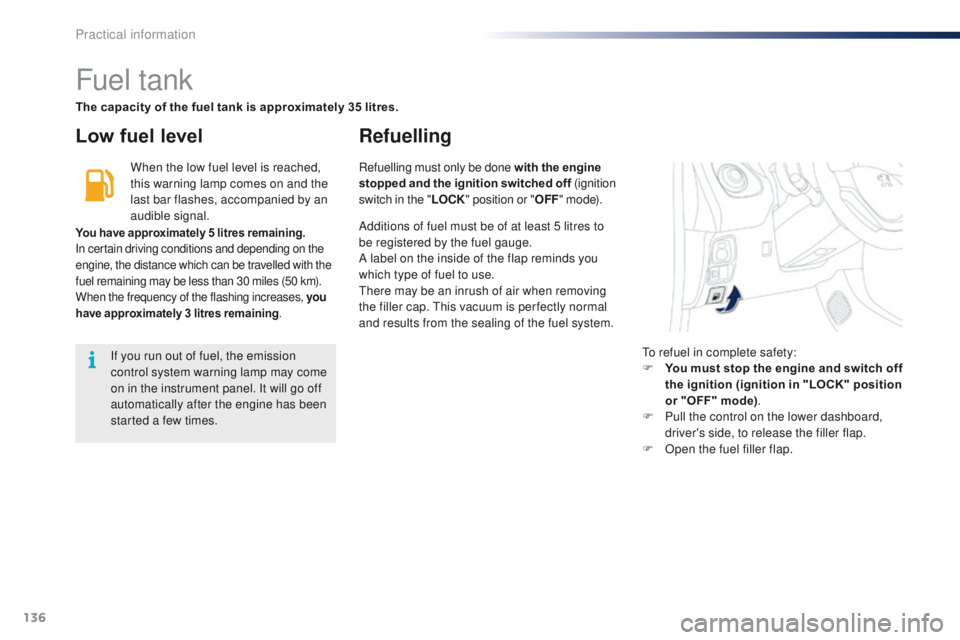
to refuel in complete safety:
F
Y ou must stop the engine and switch off
the ignition (ignition in "LOCK" position
or "OFF" mode) .
F
P
ull the control on the lower dashboard,
driver's side, to release the filler flap.
F
O
pen the fuel filler flap.
If you run out of fuel, the emission
control system warning lamp may come
on in the instrument panel. It will go off
automatically after the engine has been
started a few times. Refuelling must only be done with the engine
stopped and the ignition switched off (ignition
switch in the "
LOCK" position or " OFF" m o d e).
The capacity of the fuel tank is approximately 35 litres.
Additions of fuel must be of at least 5 litres to
be registered by the fuel gauge.
A label on the inside of the flap reminds you
which type of fuel to use.
th
ere may be an inrush of air when removing
the filler cap.
t
h
is vacuum is per fectly normal
and results from the sealing of the fuel system.
Practical information
Page 139 of 271
137
108_en_Chap09_info-pratiques_ed01-2015
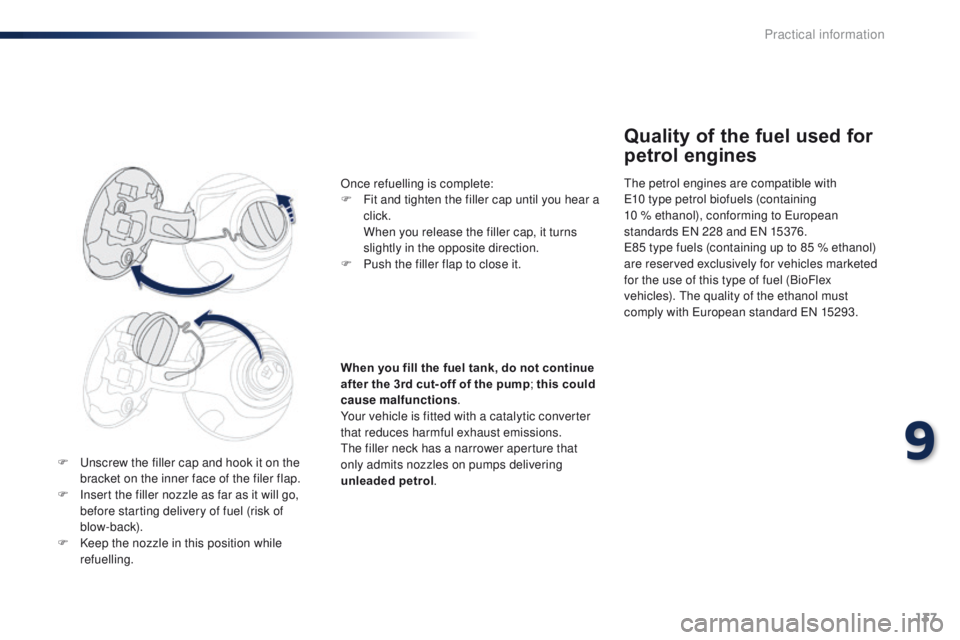
F unscrew the filler cap and hook it on the bracket on the inner face of the filer flap.
F
I
nsert the filler nozzle as far as it will go,
before starting delivery of fuel (risk of
blow- back).
F
K
eep the nozzle in this position while
refuelling.
Quality of the fuel used for
petrol engines
the petrol engines are compatible with e1 0 type petrol biofuels (containing
10
% ethanol), conforming to e
u
ropean
standards
e
N 2
28 and e
N 1
5376.
e8
5 type fuels (containing up to 85 % ethanol)
are reserved exclusively for vehicles marketed
for the use of this type of fuel (BioFlex
vehicles).
t
h
e quality of the ethanol must
comply with
e
u
ropean standard e
N 1
5293.
Once refuelling is complete:
F
F
it and tighten the filler cap until you hear a
click.
W
hen you release the filler cap, it turns
slightly in the opposite direction.
F
P
ush the filler flap to close it.
When you fill the fuel tank, do not continue
after the 3rd cut- off of the pump ; this could
cause malfunctions .
Your vehicle is fitted with a catalytic converter
that reduces harmful exhaust emissions.
th
e filler neck has a narrower aperture that
only admits nozzles on pumps delivering
unleaded petrol .
9
Practical information
Page 158 of 271
156
108_en_Chap09_info-pratiques_ed01-2015
Dashboard fuses
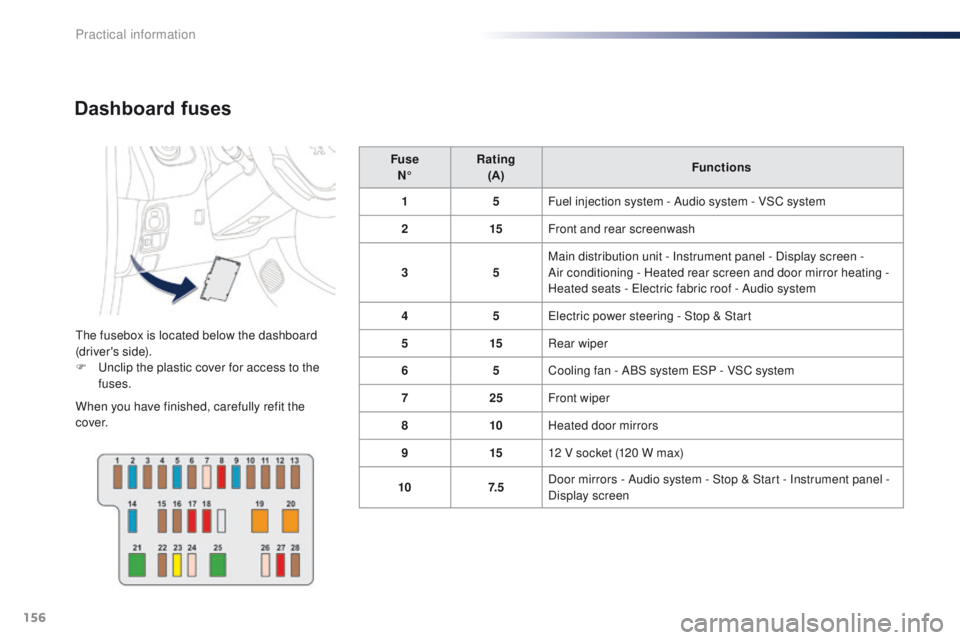
the fusebox is located below the dashboard
(driver's side).
F u
n
clip the plastic cover for access to the
fuses.
When you have finished, carefully refit the
c ove r. Fuse
N° Rating
(A) Functions
1 5Fuel injection system - Audio system - VSC system
2 15Front and rear screenwash
3 5Main distribution unit - Instrument panel - Display screen -
Air conditioning - Heated rear screen and door mirror heating -
Heated seats - e
l
ectric fabric roof - Audio system
4 5
el
ectric power steering - Stop & Start
5 15Rear wiper
6 5Cooling fan - ABS system
e
S
P - VSC system
7 25Front wiper
8 10Heated door mirrors
9 1512 V socket (120 W max)
10 7. 5Door mirrors - Audio system - Stop & Start - Instrument panel -
Display screen
Practical information
Page 159 of 271
157
108_en_Chap09_info-pratiques_ed01-2015
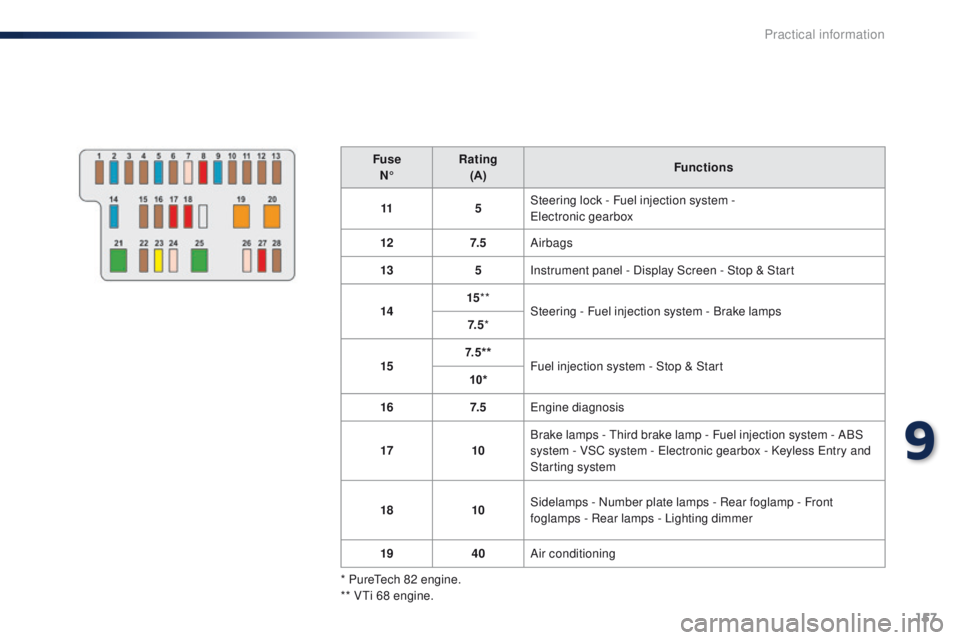
FuseN° Rating
(A) Functions
11 5Steering lock - Fuel injection system -
ele
ctronic gearbox
12 7. 5Airbags
13 5Instrument panel - Display Screen - Stop & Start
14 15
**
Steering - Fuel injection system - Brake lamps
7. 5 *
15 7. 5 * *
Fuel injection system - Stop & Start
10*
16 7. 5
en
gine diagnosis
17 10Brake lamps -
t
h
ird brake lamp - Fuel injection system - ABS
system - VSC system -
e
l
ectronic gearbox - Keyless e
n
try and
Starting system
18 10Sidelamps - Number plate lamps - Rear foglamp - Front
foglamps - Rear lamps - Lighting dimmer
19 40Air conditioning
* Pure
te
ch 82 engine.
** V
ti 6
8 engine.
9
Practical information
Page 160 of 271
158
108_en_Chap09_info-pratiques_ed01-2015
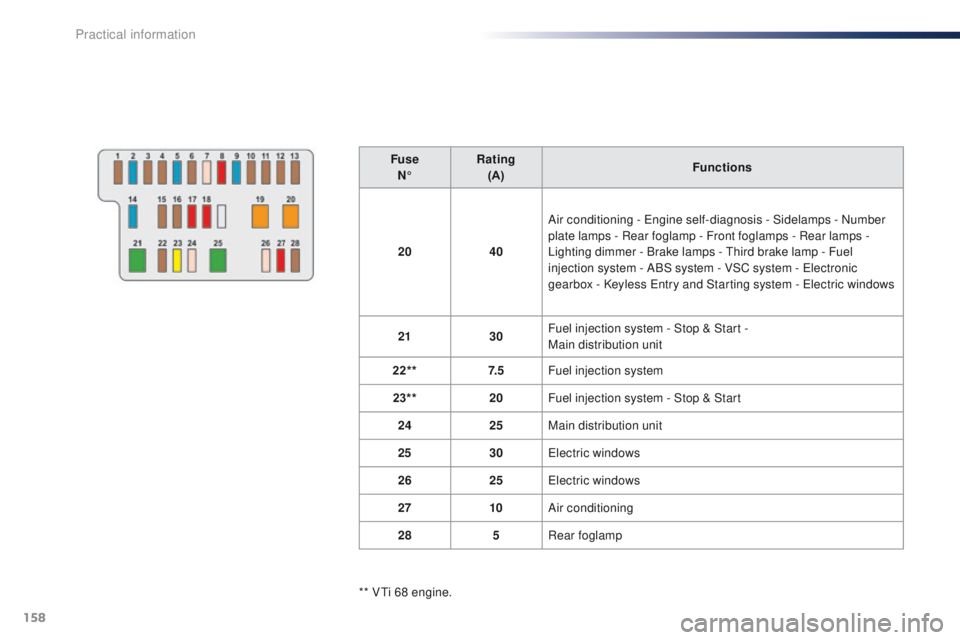
FuseN° Rating
(A) Functions
20 40Air conditioning -
e
n
gine self-diagnosis - Sidelamps - Number
plate lamps - Rear foglamp - Front foglamps - Rear lamps
-
Lighting dimmer - Brake lamps -
t
h
ird brake lamp - Fuel
injection system - ABS system - VSC system -
e
l
ectronic
gearbox - Keyless
e
n
try and Starting system - e
l
ectric windows
21 30Fuel injection system - Stop & Start -
Main distribution unit
22** 7. 5Fuel injection system
23** 20Fuel injection system - Stop & Start
24 25Main distribution unit
25 30
el
ectric windows
26 25
el
ectric windows
27 10Air conditioning
28 5Rear foglamp
** V
ti 6
8 engine.
Practical information
Page 161 of 271
159
108_en_Chap09_info-pratiques_ed01-2015
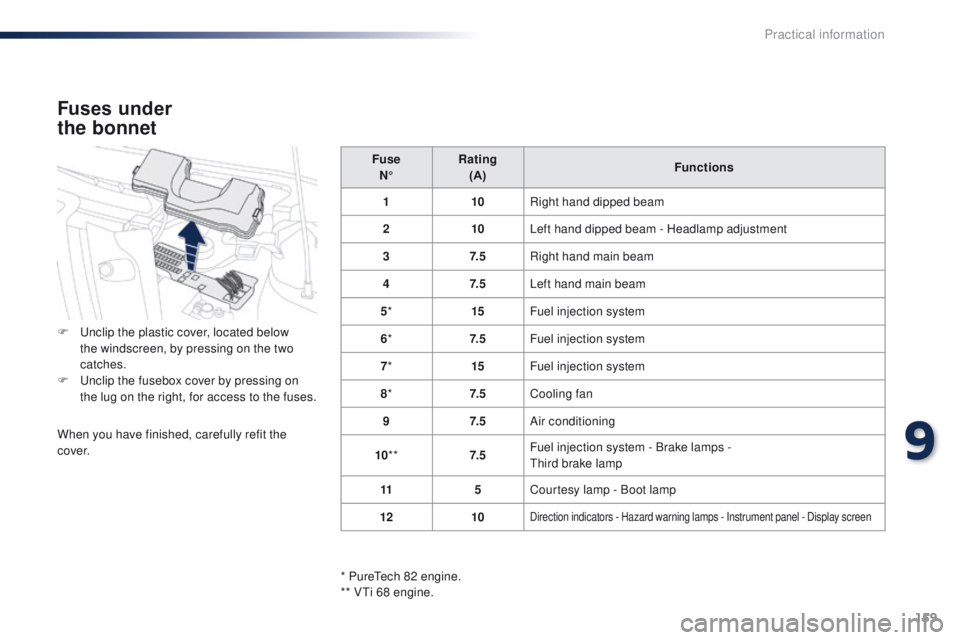
Fuse
N° Rating
(A) Functions
1 10Right hand dipped beam
2 10Left hand dipped beam - Headlamp adjustment
3 7. 5Right hand main beam
4 7. 5Left hand main beam
5 * 15Fuel injection system
6 * 7. 5Fuel injection system
7 * 15Fuel injection system
8 * 7. 5Cooling fan
9 7. 5Air conditioning
10 ** 7. 5Fuel injection system - Brake lamps -
th
ird brake lamp
11 5Courtesy lamp - Boot lamp
12 10
Direction indicators - Hazard warning lamps - Instrument panel - Display screen
Fuses under
the bonnet
F unclip the plastic cover, located below
the windscreen, by pressing on the two
catches.
F
u
n
clip the fusebox cover by pressing on
the lug on the right, for access to the fuses.
When you have finished, carefully refit the
c ove r.
* Pure
te
ch 82 engine.
** V
ti 6
8 engine.
9
Practical information