display PEUGEOT 108 2018 User Guide
[x] Cancel search | Manufacturer: PEUGEOT, Model Year: 2018, Model line: 108, Model: PEUGEOT 108 2018Pages: 180, PDF Size: 7.14 MB
Page 57 of 180
55
Release
F Press the red button on the buckle.
F G uide the seat belt as it reels in.
Seat belt(s) not fastened/
unfastened warning lamp(s)
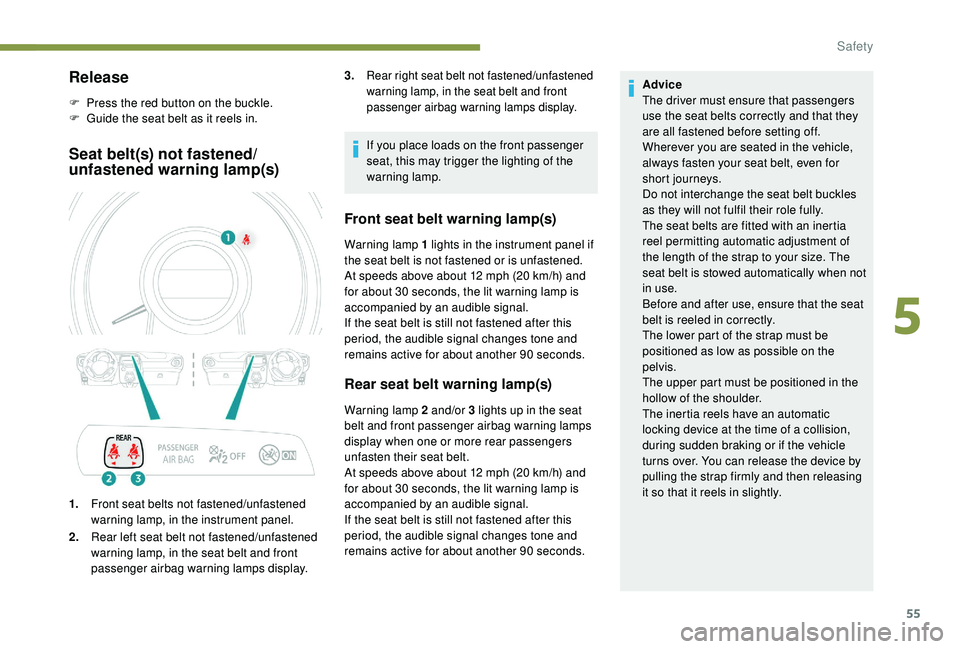
1.Front seat belts not fastened/unfastened
warning lamp, in the instrument panel.
2. Rear left seat belt not fastened/unfastened
warning lamp, in the seat belt and front
passenger airbag warning lamps display. If you place loads on the front passenger
seat, this may trigger the lighting of the
warning lamp.
Front seat belt warning lamp(s)
Warning lamp 1 lights in the instrument panel if
t he seat belt is not fastened or is unfastened.
At speeds above about 12
mph (20 km/h) and
for about 30
seconds, the lit warning lamp is
accompanied by an audible signal.
If the seat belt is still not fastened after this
period, the audible signal changes tone and
remains active for about another 90
seconds.
Rear seat belt warning lamp(s)
Warning lamp 2 and/or 3 lights up in the seat
b elt and front passenger airbag warning lamps
display when one or more rear passengers
unfasten their seat belt.
At speeds above about 12
mph (20 km/h) and
for about 30
seconds, the lit warning lamp is
accompanied by an audible signal.
If the seat belt is still not fastened after this
period, the audible signal changes tone and
remains active for about another 90
seconds.Advice
The driver must ensure that passengers
use the seat belts correctly and that they
are all fastened before setting off.
Wherever you are seated in the vehicle,
always fasten your seat belt, even for
short journeys.
Do not interchange the seat belt buckles
as they will not fulfil their role fully.
The seat belts are fitted with an inertia
reel permitting automatic adjustment of
the length of the strap to your size. The
seat belt is stowed automatically when not
in use.
Before and after use, ensure that the seat
belt is reeled in correctly.
The lower part of the strap must be
positioned as low as possible on the
pelvis.
The upper part must be positioned in the
hollow of the shoulder.
The inertia reels have an automatic
locking device at the time of a
collision,
during sudden braking or if the vehicle
turns over. You can release the device by
pulling the strap firmly and then releasing
it so that it reels in slightly.
3.
Rear right seat belt not fastened/unfastened
warning lamp, in the seat belt and front
passenger airbag warning lamps display.
5
Safety
Page 63 of 180
61
Deactivating the
passenger's front airbag
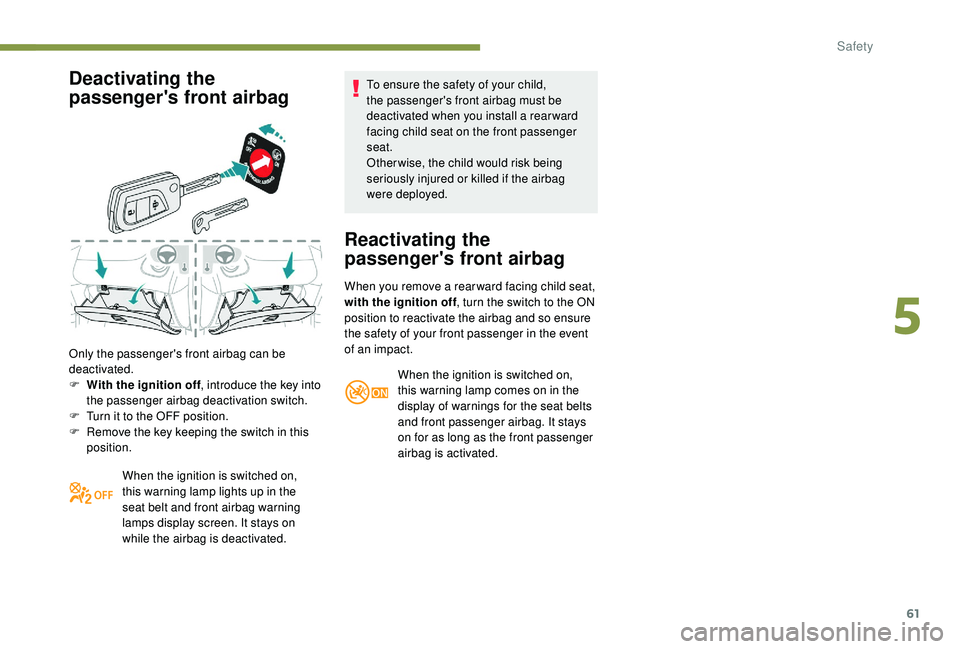
Only the passenger's front airbag can be
deactivated.
F
W
ith the ignition off , introduce the key into
the passenger airbag deactivation switch.
F
T
urn it to the OFF position.
F
R
emove the key keeping the switch in this
position.
When the ignition is switched on,
this warning lamp lights up in the
seat belt and front airbag warning
lamps display screen. It stays on
while the airbag is deactivated. To ensure the safety of your child,
the passenger's front airbag must be
deactivated when you install a
rear ward
facing child seat on the front passenger
seat.
Otherwise, the child would risk being
seriously injured or killed if the airbag
were deployed.
Reactivating the
passenger's front airbag
When you remove a rear ward facing child seat,
w ith the ignition off , turn the switch to the ON
position to reactivate the airbag and so ensure
the safety of your front passenger in the event
of an impact.
When the ignition is switched on,
this warning lamp comes on in the
display of warnings for the seat belts
and front passenger airbag. It stays
on for as long as the front passenger
airbag is activated.
5
Safety
Page 79 of 180
77
M.Manual mode with sequential changing of
the gears: move the selector backwards
and then to the left to select this mode.
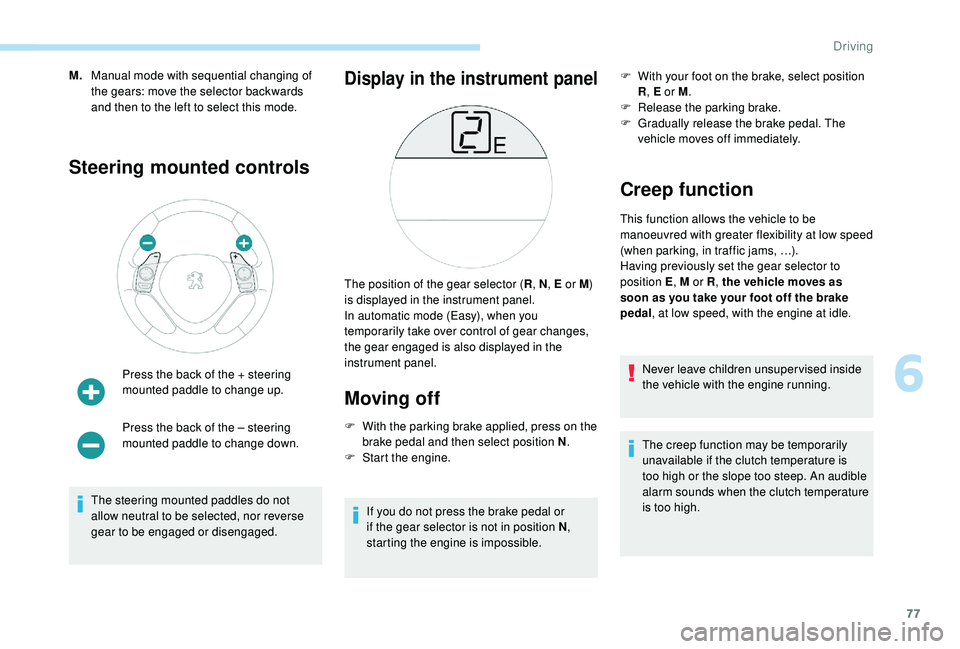
Steering mounted controls
Press the back of the + steering
mounted paddle to change up.
Press the back of the – steering
mounted paddle to change down.
The steering mounted paddles do not
allow neutral to be selected, nor reverse
gear to be engaged or disengaged.
Display in the instrument panel
Moving off
F With the parking brake applied, press on the brake pedal and then select position N .
F
S
tart the engine.
If you do not press the brake pedal or
if the gear selector is not in position N ,
starting the engine is impossible. F
W
ith your foot on the brake, select position
R , E or M .
F
R
elease the parking brake.
F
G
radually release the brake pedal. The
vehicle moves off immediately.
Creep function
This function allows the vehicle to be
manoeuvred with greater flexibility at low speed
(when parking, in traffic jams, …).
Having previously set the gear selector to
position E , M or R, the vehicle moves as
soon as you take your foot off the brake
pedal , at low speed, with the engine at idle.
Never leave children unsuper vised inside
the vehicle with the engine running.
The creep function may be temporarily
unavailable if the clutch temperature is
too high or the slope too steep. An audible
alarm sounds when the clutch temperature
is too high.
The position of the gear selector (
R, N , E or M)
is displayed in the instrument panel.
In automatic mode (Easy), when you
temporarily take over control of gear changes,
the gear engaged is also displayed in the
instrument panel.
6
Driving
Page 80 of 180
78
F Select position E with the gear selector.
The gearbox then operates in auto-adaptive
mode, without any action needed from the
driver.
It continuously selects the gear best adapted to
the following parameters:
-
f
uel consumption optimisation,
-
s
tyle of driving,
-
r
oad conditions,
-
v
ehicle load.
To obtain the best acceleration, for instance
when overtaking another vehicle, press hard on
the accelerator pedal and go through the point
of resistance.
At any time, you can change the mode by
moving the gear selector from position E to
position M and vice versa.
Never select neutral (position N ) when the
vehicle is moving.
Temporary control of gear
changing
You can temporarily take control of gear
changes using the steering mounted control
paddles + and -.
Manual mode
During braking or deceleration, the gearbox
changes down automatically to be in the
correct gear for the vehicle to accelerate again.
Under strong acceleration, the gearbox will not
change up without action by the driver at the
gear selector or the controls under the steering
wheel (unless the engine speed is close to its
maximum speed).Automatic mode (EASY)The gear change requests are acted upon only
if the engine speed allows. If they are rejected,
an audible signal sounds.
The gear engaged is displayed in the
instrument panel.
This function allows you to anticipate certain
situations, such as overtaking another vehicle
or approaching a
bend in the road.
After a
few moments with no action on the
control paddles, the gearbox returns to
automatic operation.
F
M
ove the gear selector to position M .
F
C
hange gears using:
-
t
he gear selector, by moving it:
-
b
ackwards, + to change up a gear,
-
f
or wards, - to change down a gear,
-
o
r the steering mounted control paddles +
or -.
The gear engaged is displayed.
The gear change requests are acted upon only
if the engine speed allows.
It is not necessary to release the accelerator
when changing gear. If a
change is rejected, an
audible signal sounds. You can change mode at any time by moving
the gear selector from position M to position E
and vice versa.
Never select neutral (position N ) when the
vehicle is moving.
Reverse gear
To engage reverse gear, the vehicle must be
stationary with your foot on the brake pedal.
F
Sel
ect position R .
An audible signal indicates that reverse gear
has been engaged.
Stopping the vehicle
The vehicle can be stopped regardless of the
position of the gear selector ( N, E or R ).
However, if the driver's door is opened when
the gear selector is not in position N , an audible
signal will sound.
Driving
Page 83 of 180
81
Operation
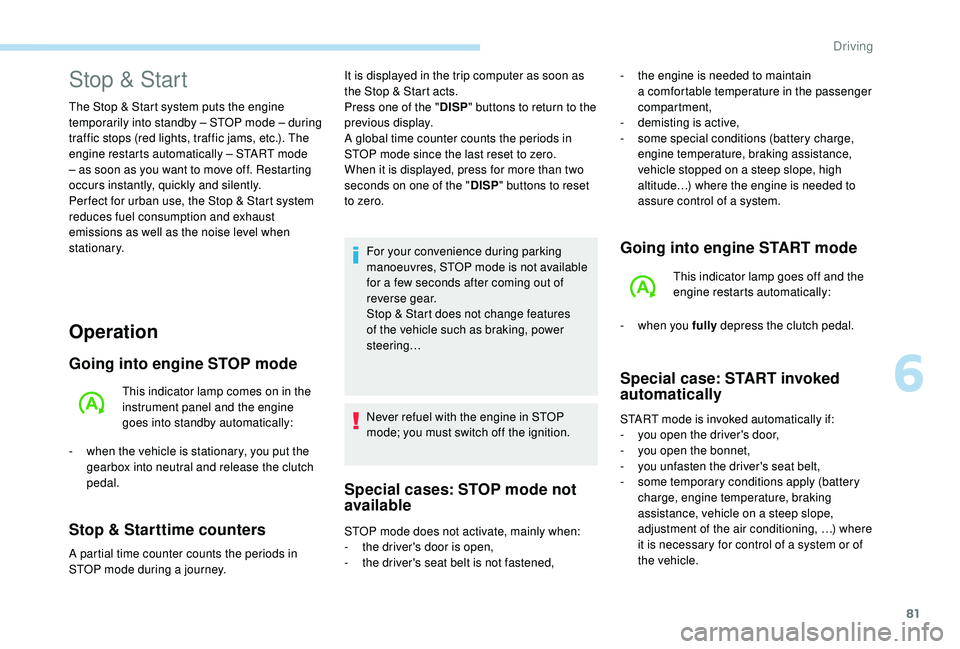
Going into engine STOP mode
This indicator lamp comes on in the
instrument panel and the engine
goes into standby automatically:
-
w
hen the vehicle is stationary, you put the
gearbox into neutral and release the clutch
pedal.
Stop & Starttime counters
A partial time counter counts the periods in
STOP mode during a journey. For your convenience during parking
manoeuvres, STOP mode is not available
for a
few seconds after coming out of
reverse gear.
Stop & Start does not change features
of the vehicle such as braking, power
steering…
Never refuel with the engine in STOP
mode; you must switch off the ignition.
Special cases: STOP mode not
available
Stop & Start
The Stop & Start system puts the engine
temporarily into standby – STOP mode – during
traffic stops (red lights, traffic jams, etc.). The
engine restarts automatically – START mode
– as soon as you want to move off. Restarting
occurs instantly, quickly and silently.
Per fect for urban use, the Stop & Start system
reduces fuel consumption and exhaust
emissions as well as the noise level when
stationary. -
t
he engine is needed to maintain
a comfortable temperature in the passenger
compartment,
-
d
emisting is active,
-
s
ome special conditions (battery charge,
engine temperature, braking assistance,
vehicle stopped on a
steep slope, high
altitude…) where the engine is needed to
assure control of a
system.
Going into engine START mode
This indicator lamp goes off and the
engine restarts automatically:
-
w
hen you fully depress the clutch pedal.
Special case: START invoked
automatically
START mode is invoked automatically if:
- y
ou open the driver's door,
-
y
ou open the bonnet,
-
y
ou unfasten the driver's seat belt,
-
s
ome temporary conditions apply (battery
charge, engine temperature, braking
assistance, vehicle on a
steep slope,
adjustment of the air conditioning, …) where
it is necessary for control of a
system or of
the vehicle.
It is displayed in the trip computer as soon as
the Stop & Start acts.
Press one of the "
DISP" buttons to return to the
previous display.
A global time counter counts the periods in
STOP mode since the last reset to zero.
When it is displayed, press for more than two
seconds on one of the " DISP" buttons to reset
to zero.
STOP mode does not activate, mainly when:
-
t
he driver's door is open,
-
t
he driver's seat belt is not fastened,
6
Driving
Page 84 of 180
82
Operating fault
In the event of a fault with the
s ystem, this warning lamp flashes in
the instrument panel.
Have it checked by a
PEUGEOT dealer or
a
qualified workshop.
Maintenance
Before doing anything under the bonnet,
deactivate the Stop & Start system to
avoid any risk of injury resulting from an
automatic change to START mode.
The Stop & Start system requires a
12 V
battery of specific technology and
specification.
All work on this type of battery must be
carried out only by a
PEUGEOT dealer or
a
qualified workshop.
For more information on the 12
V batter y,
refer to the corresponding section. Driving on flooded roads
Before driving in a
flooded area, it is
strongly recommended that you deactivate
the Stop & Start system.
For more information on Driving advice ,
particularly on flooded roads, refer to the
corresponding section.
Deactivation/Manual
reactivation
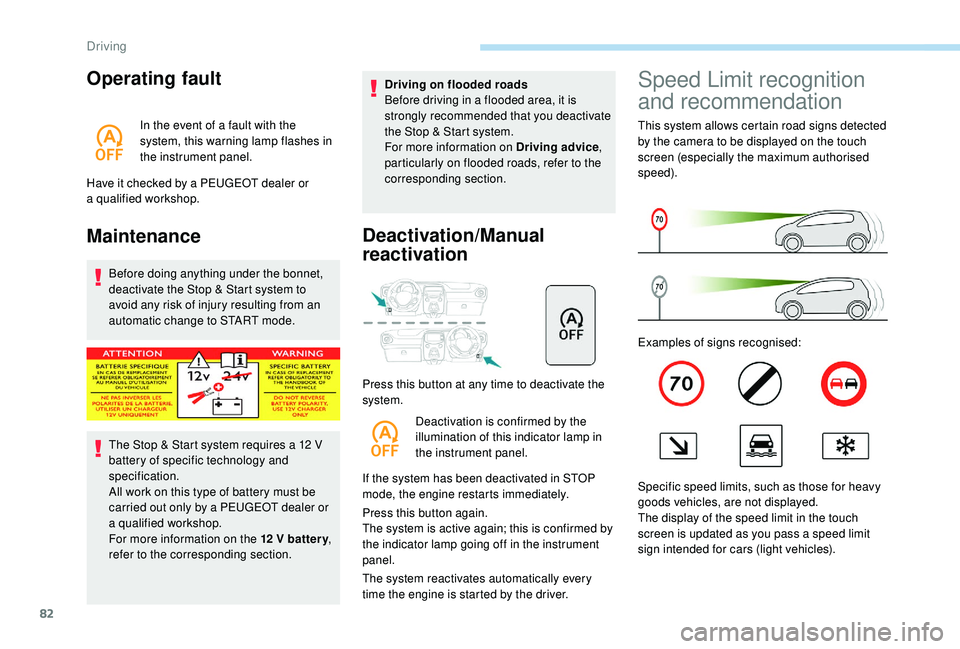
Press this button at any time to deactivate the
system.
Deactivation is confirmed by the
illumination of this indicator lamp in
the instrument panel.
If the system has been deactivated in STOP
mode, the engine restarts immediately.
Press this button again.
The system is active again; this is confirmed by
the indicator lamp going off in the instrument
panel.
The system reactivates automatically every
time the engine is started by the driver.
Speed Limit recognition
and recommendation
This system allows certain road signs detected
by the camera to be displayed on the touch
screen (especially the maximum authorised
speed).
Examples of signs recognised:
Specific speed limits, such as those for heavy
goods vehicles, are not displayed.
The display of the speed limit in the touch
screen is updated as you pass a
speed limit
sign intended for cars (light vehicles).
Driving
Page 85 of 180
83
The units for the speed limits (mph or
km/h) depend on the country you are
driving in.
It should be taken into account so that you
obser ve the speed limit.
For the system to operate correctly when
you change country, the units for speed in
the instrument panel must be those for the
country you are driving in.
The automatic reading of road signs is
a driving assistance system and does not
always display speed limits correctly.
The speed limit signs present on the road
always take priority over the display by the
system.
The system cannot in any circumstances
replace the need for vigilance on the part
of the driver.
The driver must observe the driving
regulations and must adapt the speed of
the vehicle to suit the weather and traffic.
It is possible for the system to not display
the speed limit if it does not detect a
speed
limit sign within a
preset period.
The system is designed to detect signs
that conform to the Vienna Convention on
road signs. To maintain correct operation of the
system: regularly clean the area in front of
the camera.
The internal sur face of the windscreen can
also become misted around the camera.
In humid and cold weather, demist the
windscreen regularly.
Activation/deactivation
F In the touch screen, select
the " Configuration " menu
then " General " and activate
" Configuration of traffic signs
recognition ".
Activation is taken into account after about
1
second.
Set the associated alerts ( no aler t, visual
alerts or visual and sound alerts ):
F
I
n " Speeding alert ", set "Notification
alert " then " Level of notification ".
F
I
n " Overtaking alert ", set "Notification
alert ".
Display
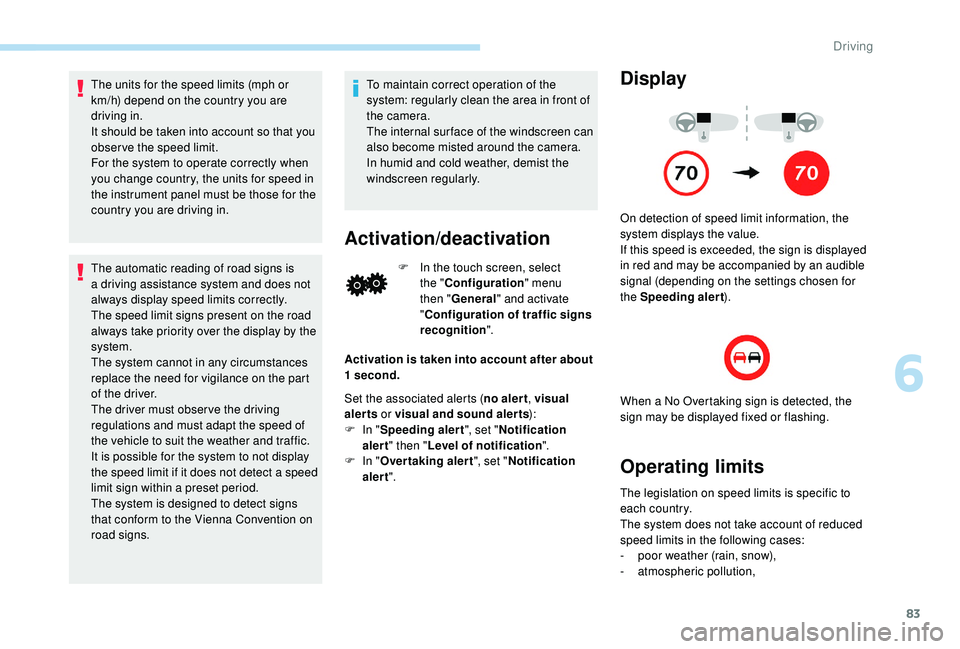
On detection of speed limit information, the
system displays the value.
If this speed is exceeded, the sign is displayed
in red and may be accompanied by an audible
signal (depending on the settings chosen for
the Speeding alert ).
When a
No Overtaking sign is detected, the
sign may be displayed fixed or flashing.
Operating limits
The legislation on speed limits is specific to
each country.
The system does not take account of reduced
speed limits in the following cases:
-
p
oor weather (rain, snow),
-
a
tmospheric pollution,
6
Driving
Page 86 of 180
84
- when towing,
- d riving with a space-saver type spare wheel
or snow chains fitted,
-
p
uncture repair using the temporary repair
kit,
-
y
oung drivers, etc.
The following situations may inter fere with the
operation of the system or prevent it working:
-
p
oor visibility (inadequate street lighting,
falling snow, rain, fog),
-
w
indscreen area located in front of the
camera: dirty, misted, frost-covered, snow-
covered, damaged or covered by a
sticker,
-
f
ault with the camera,
-
h
idden road signs (other vehicles,
vegetation, snow),
-
s
peed limit signs that do not conform to the
standard, are damaged or distorted.
If an app on your smart phone is used
via Mirror Screen, the sign displayed by
the system may be temporarily hidden. It
will be redisplayed as soon as you pass
another sign.Speed limiter
System which prevents the
vehicle from exceeding the speed
programmed by the driver.
The limiter is switched on manually: this
can be done regardless of the vehicle speed.
However, if you are travelling at less than
18
mph (30 km/h), the programmed speed will
be set at 18
mph (30 km/h).
The speed limiter is paused using the control.
The programmed speed can be exceeded
temporarily by pressing the accelerator firmly
beyond the point of resistance.
To return to the programmed speed, simply
release the accelerator pedal until the set limit
speed has been reached again.
The programmed speed is erased when
the ignition is switched off.
The limiter cannot, under any
circumstances, replace respect for speed
limits, nor the vigilance of the driver.
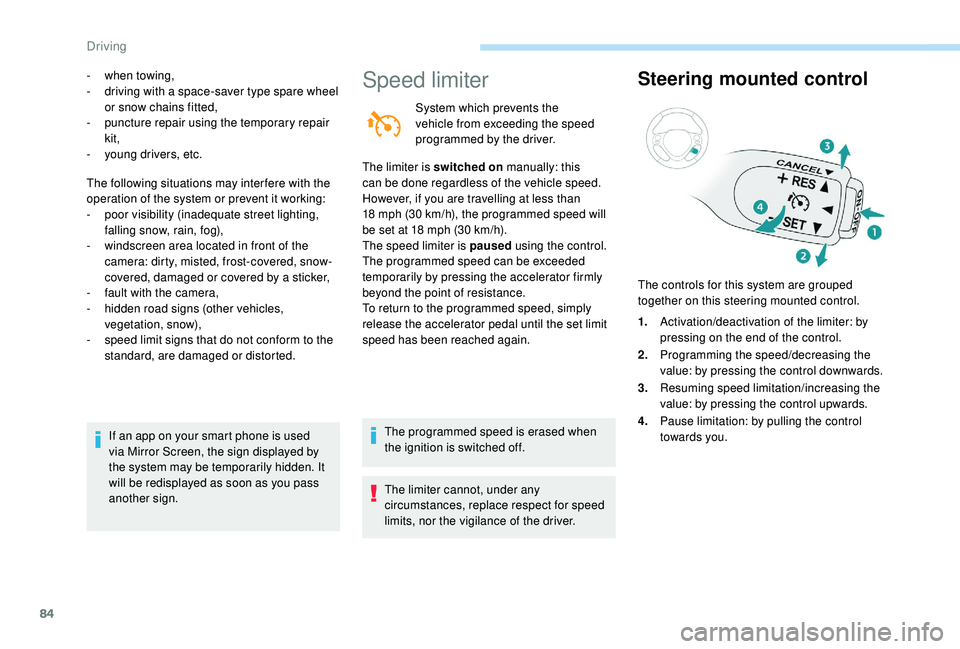
Steering mounted control
The controls for this system are grouped
together on this steering mounted control.
1.Activation/deactivation of the limiter: by
pressing on the end of the control.
2. Programming the speed/decreasing the
value: by pressing the control downwards.
3. Resuming speed limitation/increasing the
value: by pressing the control upwards.
4. Pause limitation: by pulling the control
towards you.
Driving
Page 87 of 180
85
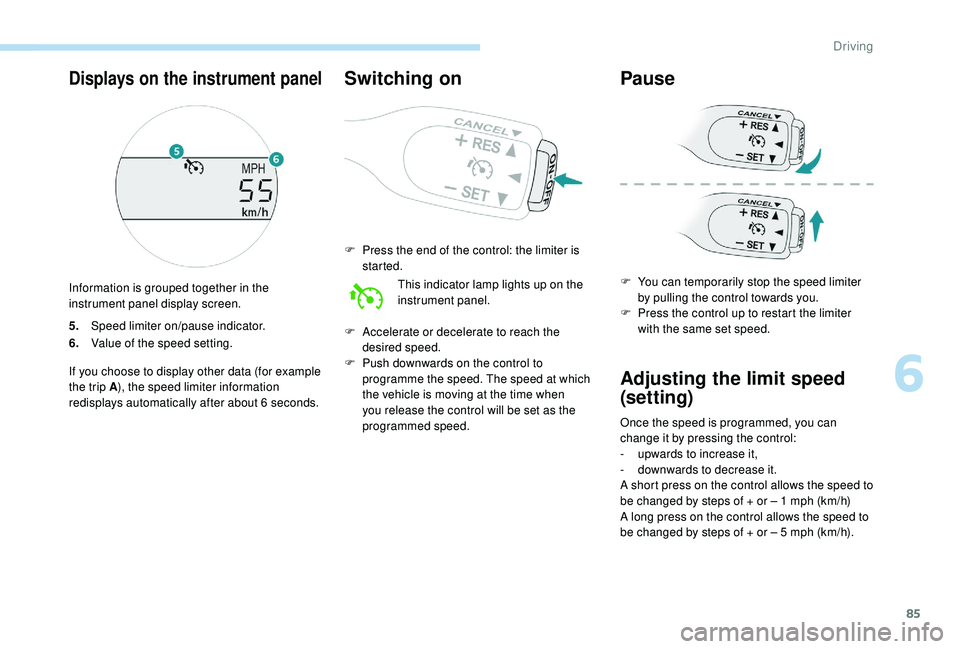
5.Speed limiter on/pause indicator.
6. Value of the speed setting.
If you choose to display other data (for example
the trip A ), the speed limiter information
redisplays automatically after about 6
seconds.
Switching on
F Press the end of the control: the limiter is started.
This indicator lamp lights up on the
instrument panel.
F
A
ccelerate or decelerate to reach the
desired speed.
F
P
ush downwards on the control to
programme the speed. The speed at which
the vehicle is moving at the time when
you release the control will be set as the
programmed speed.
Pause
F You can temporarily stop the speed limiter by pulling the control towards you.
F
P
ress the control up to restart the limiter
with the same set speed.
Adjusting the limit speed
(set ting)
Once the speed is programmed, you can
change it by pressing the control:
-
u
pwards to increase it,
-
d
ownwards to decrease it.
A short press on the control allows the speed to
be changed by steps of + or – 1
mph (km/h)
A long press on the control allows the speed to
be changed by steps of + or – 5
mph (km/h).
Displays on the instrument panel
Information is grouped together in the
instrument panel display screen.
6
Driving
Page 88 of 180
86
Temporarily exceeding the
speed setting
F Press firmly on the accelerator pedal,
going beyond the point of resistance, to
exceed the programmed speed limit.
The speed limiter is deactivated temporarily
and the displayed programmed speed flashes.
An audible signal accompanies the
flashing of the programmed speed when
exceeding the speed is not due to an
action by the driver (steep hill…).
As soon as the vehicle's speed returns to the
programmed value, the limiter operates again:
the display of the programmed speed becomes
steady again.
Switching off
F Press the end of the control: the display of information on the speed limiter disappears.
Operating fault
If this warning lamp comes on in
the instrument panel it signals
a
malfunction of the limiter. Have it checked by a
PEUGEOT dealer or
a
qualified workshop.
The use of mats not approved by
PEUGEOT may inter fere with the
operation of the speed limiter.
To avoid any risk of jamming of the pedals:
-
e
nsure that mats are secured correctly,
-
n
ever place one mat on top of another.
Active City Brake
Active City Brake is a driving assistance
s ystem that aims to avoid a frontal collision or
to reduce the speed of an impact if the driver
does not react or reacts too late (brake applied
too late).
This system has been designed to improve driving
safety.
It remains the driver's responsibility to continuously
monitor the state of the traffic and to assess the
distances and relative speeds of other vehicles.
Active City Brake cannot in any circumstances
replace the need for vigilance on the part of the
driver.
Never look at the laser sensor through
an optical instrument (magnifying glass,
microscope…) at a
distance of less than
10
centimetres: risk of eye injury.
Principle
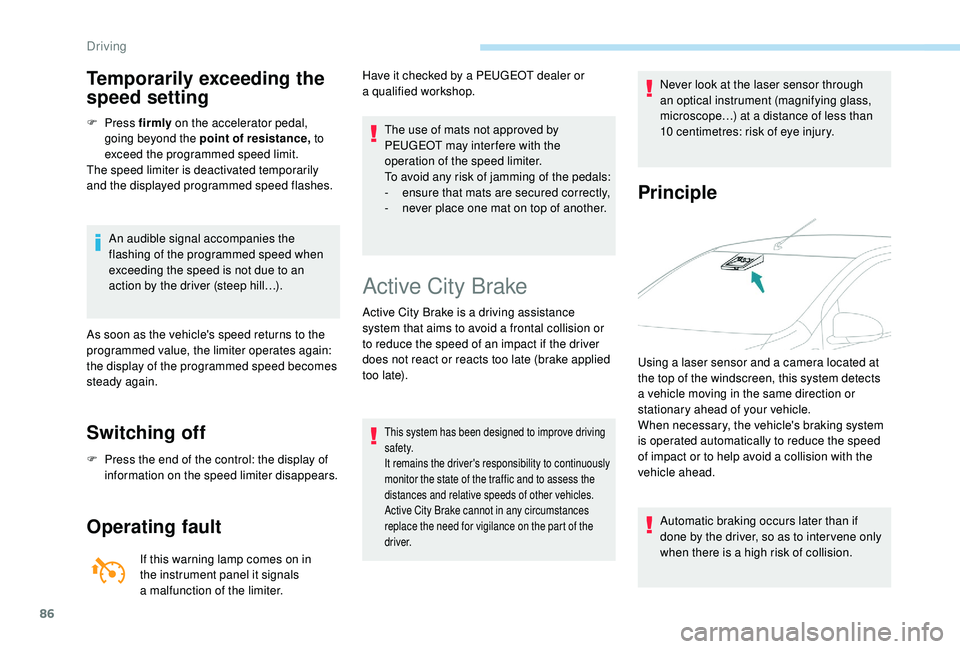
Using a laser sensor and a camera located at
t he top of the windscreen, this system detects
a
vehicle moving in the same direction or
stationary ahead of your vehicle.
When necessary, the vehicle's braking system
is operated automatically to reduce the speed
of impact or to help avoid a
collision with the
vehicle ahead.
Automatic braking occurs later than if
done by the driver, so as to inter vene only
when there is a
high risk of collision.
Driving