ESP PEUGEOT 2008 2015 Owner's Guide
[x] Cancel search | Manufacturer: PEUGEOT, Model Year: 2015, Model line: 2008, Model: PEUGEOT 2008 2015Pages: 340, PDF Size: 8.4 MB
Page 166 of 340
164
2008_en_Chap09_info-pratiques_ed01-2015
AdBlue® additive and SCR system
for BlueHDi Diesel engines
To assure respect for the environment and
conformity with the new Euro 6 emissions
standard, without adversely affecting the
per formance or fuel consumption of Diesel
engines, PEUGEOT has taken the decision to
equip its vehicles with an effective system that
associates SCR (Selective Catalytic Reduction)
with a particle filter (FAP) for the treatment of
exhaust gases.
Presentation of the SCR system
Using an additive called AdBlue® containing
urea, a catalytic converter turns up to 85%
of nitrous oxides (NOx) into nitrogen and
water, which are harmless to health and the
environment. The AdBlue
® additive is held in a special
tank located under the boot at the rear of
the vehicle. It has a capacity of 17 litres: this
provides a driving range of about 12 500 miles
(20 000 km), after which an alert is triggered
warning you when the reserve remaining is
enough for just 1 500 miles (2 400 km).
During each scheduled service of your vehicle
by a PEUGEOT dealer or a qualified workshop,
the AdBlue
® additive tank is refilled in order to
allow normal operation of the SCR system.
If the estimated mileage between two services
is greater than 12 500 miles (20 000 km), we
recommend that you go to a PEUGEOT dealer
or a qualified workshop to have the necessary
top-up carried out. Once the AdBlue
® tank is empty, a
s
ystem required by regulations prevents
starting of the engine.
If the SCR is faulty, the level of
emissions from your vehicle will no
longer meet the Euro 6 standard: you
vehicle becomes polluting.
In the event of a confirmed fault
with the SCR system, you must go
to a PEUGEOT dealer or a qualified
workshop as soon as possible: after
a running distance of 650 miles
(1
100 km), a system will be triggered
automatically to prevent engine starting.
Practical information
Page 192 of 340
190
2008_en_Chap09_info-pratiques_ed01-2015
Changing brake lamp and
direction indicator bulbs
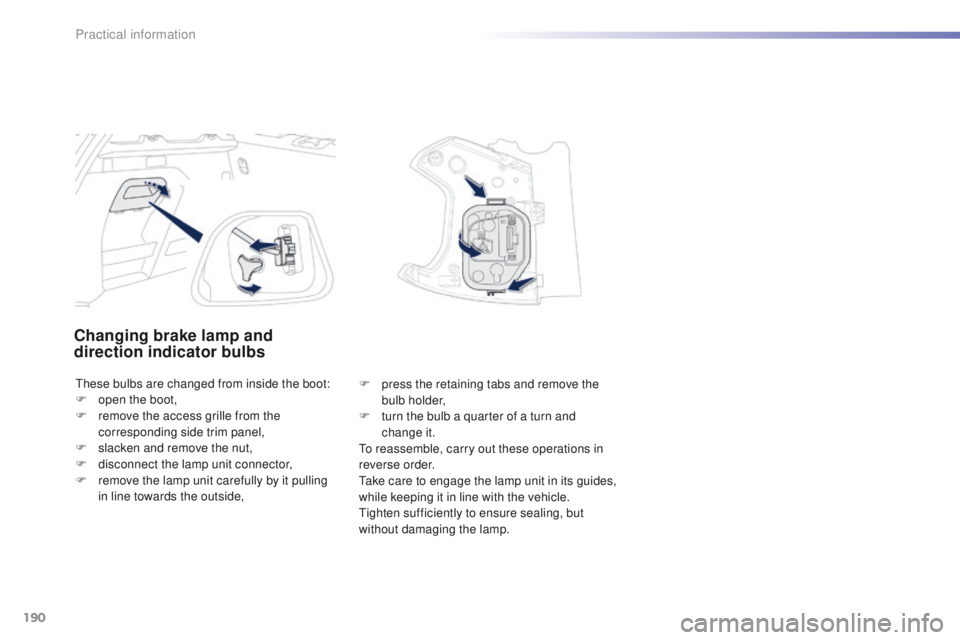
These bulbs are changed from inside the boot:
F o pen the boot,
F
r
emove the access grille from the
corresponding side trim panel,
F
s
lacken and remove the nut,
F
d
isconnect the lamp unit connector,
F
r
emove the lamp unit carefully by it pulling
in line towards the outside, F
p ress the retaining tabs and remove the
bulb holder,
F
t
urn the bulb a quarter of a turn and
change
it.
To reassemble, carry out these operations in
reverse order.
Take care to engage the lamp unit in its guides,
while keeping it in line with the vehicle.
Tighten sufficiently to ensure sealing, but
without damaging the lamp.
Practical information
Page 195 of 340
193
2008_en_Chap09_info-pratiques_ed01-2015
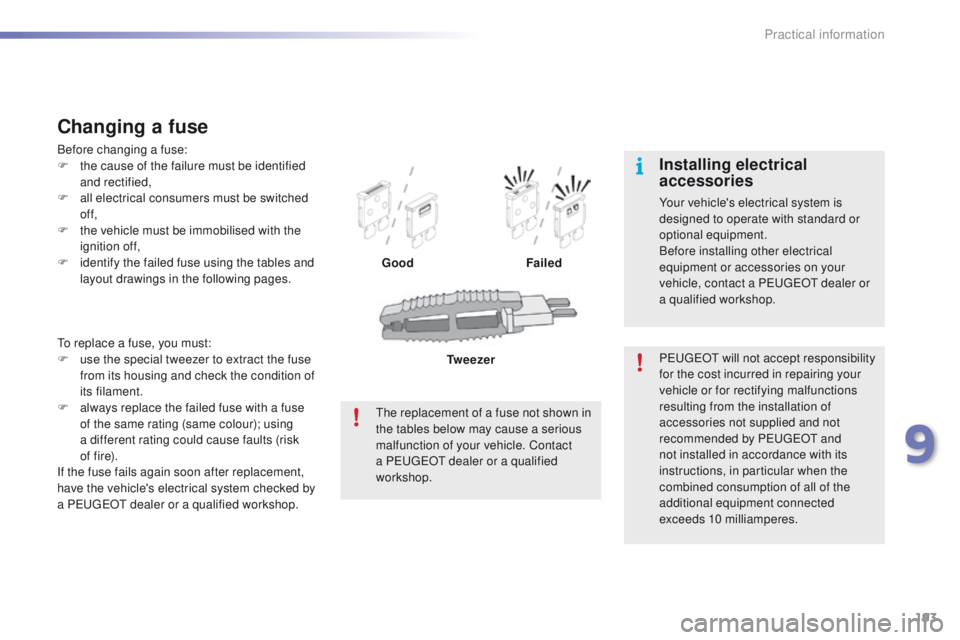
To replace a fuse, you must:
F u se the special tweezer to extract the fuse
from its housing and check the condition of
its filament.
F
a
lways replace the failed fuse with a fuse
of the same rating (same colour); using
a different rating could cause faults (risk
of
f i r e).
If the fuse fails again soon after replacement,
have the vehicle's electrical system checked by
a PEUGEOT dealer or a qualified workshop.
Changing a fuse
Before changing a fuse:
F t he cause of the failure must be identified
and rectified,
F
a
ll electrical consumers must be switched
of f,
F
t
he vehicle must be immobilised with the
ignition off,
F
i
dentify the failed fuse using the tables and
layout drawings in the following pages. Good
Failed
PEUGEOT will not accept responsibility
for the cost incurred in repairing your
vehicle or for rectifying malfunctions
resulting from the installation of
accessories not supplied and not
recommended by PEUGEOT and
not installed in accordance with its
instructions, in particular when the
combined consumption of all of the
additional equipment connected
exceeds 10 milliamperes.Installing electrical
accessories
Your vehicle's electrical system is
designed to operate with standard or
optional equipment.
Before installing other electrical
equipment or accessories on your
vehicle, contact a PEUGEOT dealer or
a qualified workshop.
The replacement of a fuse not shown in
the tables below may cause a serious
malfunction of your vehicle. Contact
a PEUGEOT dealer or a qualified
workshop. Tw e e z e r
9
Practical information
Page 199 of 340
197
2008_en_Chap09_info-pratiques_ed01-2015
Fuse N°Rating Functions
F16 15 AFront foglamps.
F18 10 ARight hand main beam headlamp.
F19 10 ALeft hand main beam headlamp.
F25 30 AHeadlamp wash relay (accessory).
F29 40 AFront wiper motor.
F30 80 APre-heater plugs (Diesel).
Engine compartment
fuses
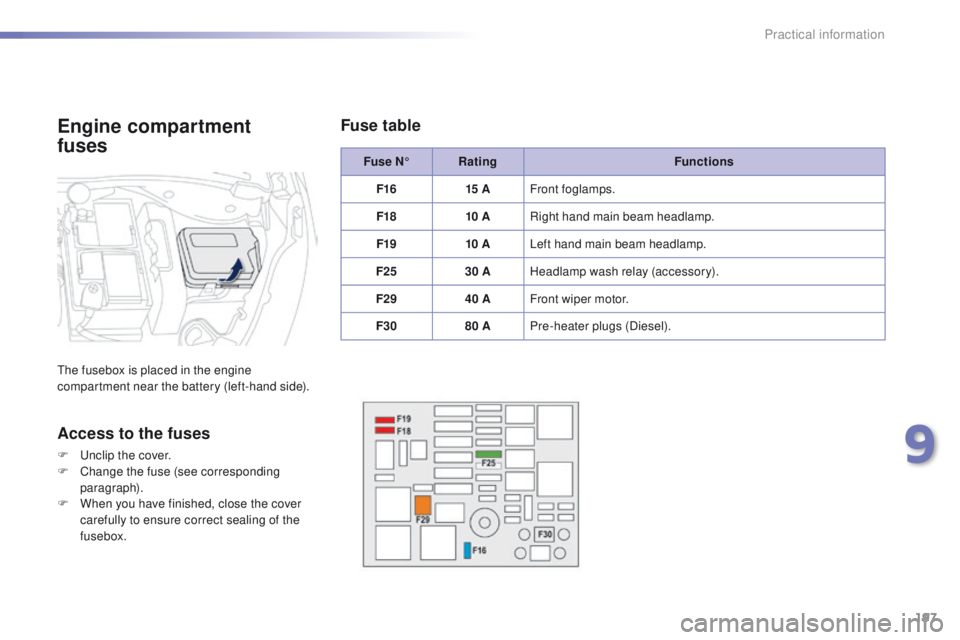
The fusebox is placed in the engine
compartment near the battery (left-hand side).
Access to the fuses
F Unclip the cover.
F
C hange the fuse (see corresponding
paragraph).
F
W
hen you have finished, close the cover
carefully to ensure correct sealing of the
fusebox.
Fuse table
9
Practical information
Page 202 of 340
200
2008_en_Chap09_info-pratiques_ed01-2015
It is advisable to disconnect the battery
if the vehicle is to be left unused for
more than one month.
The batteries contain harmful substances
such as sulphuric acid and lead. They
must be disposed of in accordance
with regulations and must not, in any
circumstances, be discarded with household
waste.
Take used remote control batteries and
vehicle batteries to a special collection point.
Protect your eyes and face before
handling the battery.
All operations on the battery must be
carried out in a well ventilated area and
away from naked flames and sources
of sparks, so as to avoid the risk of
explosion or fire.
Do not try to charge a frozen battery;
the battery must first be thawed out to
avoid the risk of explosion. If the battery
has been frozen, before charging have
it checked by a PEUGEOT dealer or a
qualified workshop who will check that
the internal components have not been
damaged and the casing is not cracked,
which could cause a leak of toxic and
corrosive acid.
Do not reverse the polarity and use only
a 12 V charger.
Do not disconnect the terminals while
the engine is running.
Do not charge the batteries without
disconnecting the terminals first.
Wash your hands afterwards.
Do not push the vehicle to start the
engine if you have an electronic or
automatic gearbox.Before disconnecting the battery
Wait 2 minutes after switching off the ignition
before disconnecting the battery.
Close the windows and the doors before
disconnecting the battery.
Following reconnection of the
battery
Following reconnection of the battery, switch on
the ignition and wait 1 minute before starting to
permit initialisation of the electronic systems.
However, if problems remain following this
operation, contact a PEUGEOT dealer or a
qualified workshop.
Referring to the corresponding section, you
must yourself reinitialise:
-
t
he remote control key,
-
t
he on-board satellite navigation system.
The Stop & Start battery does not have
to be disconnected for charging.
Charging the battery using
a battery charger
F Disconnect the battery from the vehicle.
F
F ollow the instructions for use provided by
the manufacturer of the charger.
F
C
onnect the battery starting with the
negative terminal (-).
F
C
heck that the terminals and connectors
are clean. If they are covered with sulphate
(whitish or greenish deposit), remove them
and clean them.
Practical information
Page 203 of 340
201
2008_en_Chap09_info-pratiques_ed01-2015
System which manages the duration of use of certain functions to retain a sufficient level of charge
in the battery.
After the engine has stopped, you can still use functions such as the audio and telematics
system, windscreen wipers, dipped beam headlamps, courtesy lamps, etc. for a maximum
combined duration of about thirty minutes.
Electrical energy economy mode
Switching to economy mode
Once this time has elapsed, a message
appears in the screen indicating that the
vehicle has switched to economy mode and the
active functions are put on standby.
If a telephone call is being made at this time, it
will be maintained for around 10 minutes with
the Bluetooth hands-free system of your audio
system.
Exiting economy mode
These functions are reactivated automatically
next time the vehicle is driven.
F
T
o restore these functions immediately,
start the engine and let it run for at least
five minutes.
A flat battery prevents the engine from
starting (refer to the corresponding
section).
Load reduction mode
System which manages the use of certain
functions according to the level of charge
remaining in the battery.
When the vehicle is being driven, the load
reduction function temporarily deactivates
certain functions, such as the air conditioning,
the heated rear screen...
The deactivated functions are reactivated
automatically as soon as conditions permit.
9
Practical information
Page 204 of 340
202
2008_en_Chap09_info-pratiques_ed01-2015
Changing a wiper blade
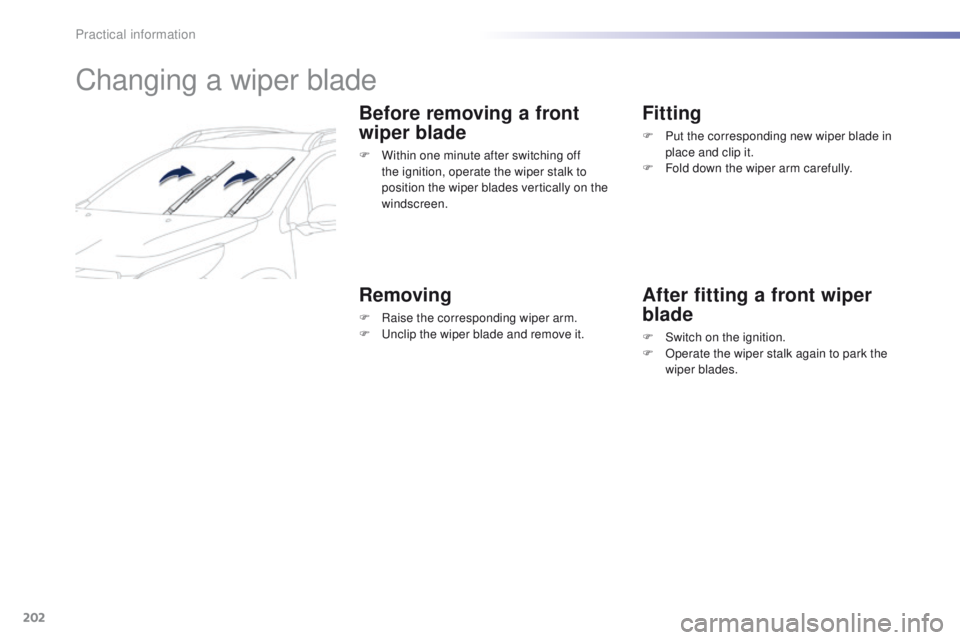
Before removing a front
wiper blade
F Within one minute after switching off the ignition, operate the wiper stalk to
position the wiper blades vertically on the
windscreen.
Removing
F Raise the corresponding wiper arm.
F U nclip the wiper blade and remove it.
Fitting
F Put the corresponding new wiper blade in place and clip it.
F
F
old down the wiper arm carefully.
After fitting a front wiper
blade
F Switch on the ignition.
F O perate the wiper stalk again to park the
wiper blades.
Practical information
Page 216 of 340
214
2008_en_Chap10_verifications_ed01-2015
Checking levels
Oil level
The check is carried out either when the
ignition is switched on using the oil level
indicator in the instrument panel (depending
on version), or using the dipstick.Engine oil change
Refer to the warranty and maintenance record
for details of the interval for this operation.
In order to maintain the reliability of the engine
and emission control system, never use
additives in the engine oil.
Oil specification
The oil must be the correct grade for your
engine and conform to the manufacturer's
recommendations.The brake fluid level should be close
to the "MA X" mark. If it is not, check
the brake pad wear.
Brake fluid level
Changing the fluid
Refer to the warranty and maintenance record
for details of the interval for this operation.
Fluid specification
The brake fluid must conform to the
manufacturer's recommendations.
Take care when working under the bonnet, as certain areas of the engine may be extremely hot (risk of burns) and the cooling fan could start at
any time (even with the ignition off).
Check all of these levels regularly, in line with the warranty and maintenance record. Top them up if necessary, unless other wise indicated.
If a level drops significantly, have the corresponding system checked by a PEUGEOT dealer or a qualified workshop.
It is normal to top up the oil level
between two services (or oil changes).
PEUGEOT recommends that you check
the level, and top up if necessary, every
3 000 miles (5 000 kms).
It will only be correct if the vehicle is on level
ground and the engine has been off for more
than 30 minutes.
Checks
Page 221 of 340
219
2008_en_Chap11_caracteristiques-techniques_ed01-2015
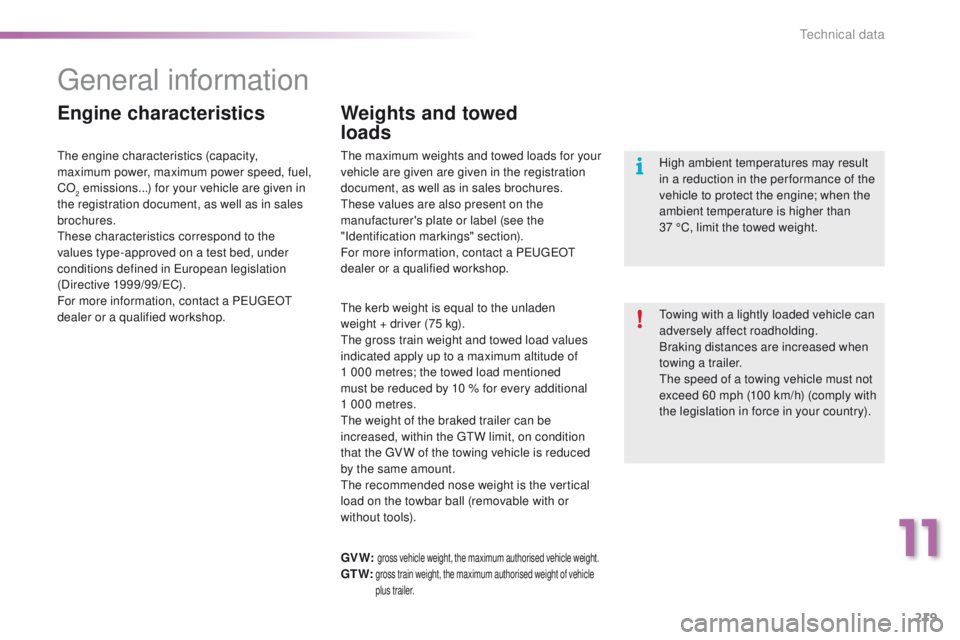
General information
Towing with a lightly loaded vehicle can
adversely affect roadholding.
Braking distances are increased when
towing a trailer.
The speed of a towing vehicle must not
exceed 60 mph (100 km/h) (comply with
the legislation in force in your country). High ambient temperatures may result
in a reduction in the per formance of the
vehicle to protect the engine; when the
ambient temperature is higher than
37 °C, limit the towed weight.
Engine characteristicsWeights and towed
loads
The engine characteristics (capacity,
maximum power, maximum power speed, fuel,
CO
2 emissions...) for your vehicle are given in
t
he registration document, as well as in sales
brochures.
These characteristics correspond to the
values type-approved on a test bed, under
conditions defined in European legislation
(Directive
1999/99/EC).
For more information, contact a PEUGEOT
dealer or a qualified workshop. The maximum weights and towed loads for your
vehicle are given are given in the registration
document, as well as in sales brochures.
These values are also present on the
manufacturer's plate or label (see the
"Identification markings" section).
For more information, contact a PEUGEOT
dealer or a qualified workshop.
The kerb weight is equal to the unladen
weight
+ driver (75 kg).
The gross train weight and towed load values
indicated apply up to a maximum altitude of
1 000 metres; the towed load mentioned
must be reduced by 10 % for every additional
1
000 metres.
The weight of the braked trailer can be
increased, within the GTW limit, on condition
that the GV W of the towing vehicle is reduced
by the same amount.
The recommended nose weight is the vertical
load on the towbar ball (removable with or
without tools).
GV W:
gross vehicle weight, the maximum authorised vehicle weight.GT W: gross train weight, the maximum authorised weight of vehicle plus trailer.
11
Technical data
Page 222 of 340
220
2008_en_Chap11_caracteristiques-techniques_ed01-2015
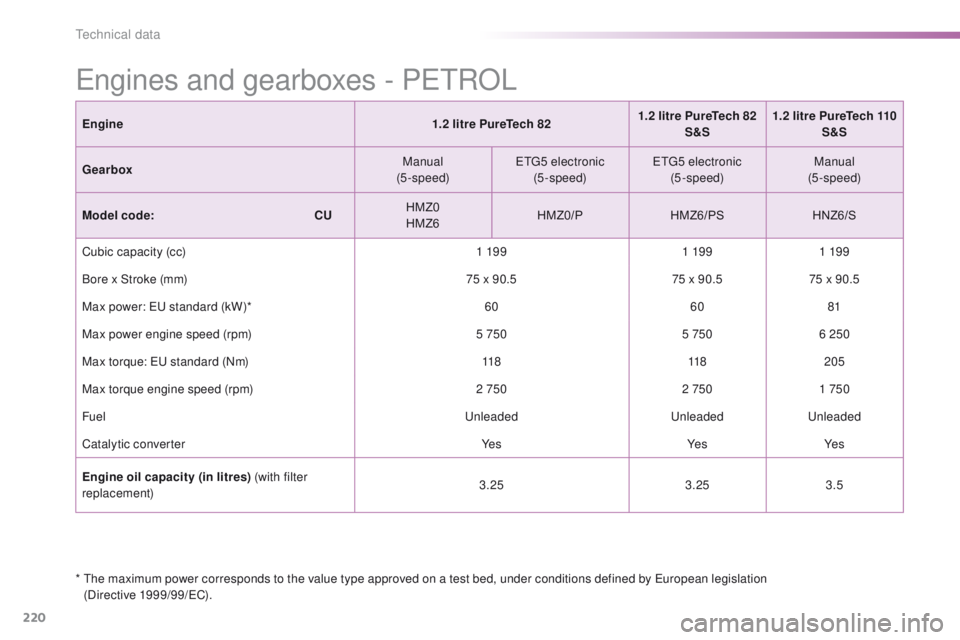
Engines and gearboxes - PETROL
* The maximum power corresponds to the value type approved on a test bed, under conditions defined by European legislation (Directive 1999/99/EC).
Engine
1.2 litre PureTech 821.2 litre PureTech 82
S&S 1.2 litre PureTech 110
S&S
Gearbox Manual
(5-speed) ETG5 electronic
(5-speed) ETG5 electronic
(5-speed) Manual
(5-speed)
Model code:
C
U
HMZ0
HMZ6 HMZ0/P
HMZ6/PS HNZ6/S
Cubic capacity (cc) 1 19 91 19 91 19 9
Bore x Stroke (mm) 75 x 90.575 x 90.575 x 90.5
Max power: EU standard (kW)* 606081
Max power engine speed (rpm) 5 7505 7506 250
Max torque: EU standard (Nm) 118118205
Max torque engine speed (rpm) 2 7502 7501 750
Fuel UnleadedUnleadedUnleaded
Catalytic converter Ye sYe sYe s
Engine oil capacity (in litres) (with filter
replacement) 3.25
3.253.5
Technical data