stop start PEUGEOT 2008 2016 User Guide
[x] Cancel search | Manufacturer: PEUGEOT, Model Year: 2016, Model line: 2008, Model: PEUGEOT 2008 2016Pages: 450, PDF Size: 14.16 MB
Page 49 of 450
47
2008_en_Chap02_ouvertures_ed01-2016
Lost keys
Go to a PEUGEOT dealer with the vehicle's registration document, your personal identification documents and if possible the key code label.
The PEUGEOT dealer will be able to look up the key code and the transponder code required to order a new key.
Remote control
The high frequency remote control is a sensitive system; do not operate it while it is in your pocket as there is a possibility that it may unlock the
vehicle, without you being aware of it.
Do not repeatedly press the buttons of your remote control out of range and out of sight of your vehicle. You run the risk of stopping it from
working and the remote control would have to be reinitialised.
No remote control can operate when the key is in the ignition switch, even when the ignition is switched off, except for reinitialisation.
Anti-theft protection
Do not make any modifications to the electronic engine immobiliser system; this could cause malfunctions.
Locked vehicle
Driving with the doors locked may make access to the passenger compartment by the emergency services more difficult in an emergency.
As a safety precaution, never leave children alone in the vehicle, except for a very short period.
In all cases, it is essential to remove the key from the ignition switch when leaving the vehicle.
Second-hand vehicle
Have the pairing of all of the keys in your possession checked by a PEUGEOT dealer, to ensure that only your keys can be used to open and
start the vehicle.
2
Access
Page 65 of 450
63
2008_en_Chap03_confort_ed01-2016
In order for these systems to be fully effective, follow the operation and maintenance
guidelines below:
F
T
o obtain an even air distribution, take care not to obstruct the exterior air intake grilles
located at the base of the windscreen, the nozzles, the vents and the air outlets, as well
as the air extractor located in the boot.
F
D
o not cover the sunshine sensor, located on the dashboard; this is used for regulation
of the air conditioning system.
F
O
perate the air conditioning system for at least 5 to 10 minutes, once or twice a month
to keep it in per fect working order.
F
E
nsure that the passenger compartment filter is in good condition and have the filter
elements replaced regularly.
W
e recommend the use of a combined passenger compartment filter. Thanks to its
special active additive, it contributes to the purification of the air breathed by the
occupants and the cleanliness of the passenger compartment (reduction of allergic
symptoms, bad odours and greasy deposits).
F
T
o ensure correct operation of the air conditioning system, you are also advised to have
it checked regularly as recommended in the warranty and maintenance record.
F
I
f the system does not produce cold air, switch it off and contact a PEUGEOT dealer or
a qualified workshop.
When towing the maximum load on a steep gradient in high temperatures, switching off the
air conditioning increases the available engine power and so improves the towing ability.
Recommendations for ventilation and air conditioning
If after an extended stop in sunshine,
the interior temperature is very high, first
ventilate the passenger compartment for
a few moments.
Put the air flow control at a setting high
enough to quickly change the air in the
passenger compartment.
The air conditioning system does not
contain chlorine and does not present
any danger to the ozone layer.
The condensation created by the air
conditioning results in a discharge
of water under the vehicle which is
perfectly normal.
Stop & Start
The heating and air conditioning systems only work when the engine is running.
To maintain a comfortable temperature in the passenger compartment, you can temporarily
deactivate the Stop & Start system.
For more information on Stop & Start, refer to the corresponding section.
3
Comfort
Page 72 of 450
70
2008_en_Chap03_confort_ed01-2016
F Switch off the demisting/defrosting of the rear screen and door mirrors
as soon as appropriate, as lower
current consumption results in
reduced fuel consumption.
Front demist - defrost Rear screen
demist
-
defrost
The control button is located on the
air conditioning system control panel.
These markings on the control panel indicate the control positions for rapid demisting or
defrosting of the windscreen and side windows.Manual air conditioning
Switching on
The rear screen demisting/defrosting can only
operate when the engine is running.
F
P
ress this button to demist /defrost the
rear screen and (depending on version)
the door mirrors. The indicator lamp
associated with the button comes on.
With Stop & Start, when demisting has
been activated, the STOP mode is not
available.
Switching off
The demisting/defrosting switches off automatically
to prevent an excessive consumption of current.
F
I
t is possible to stop the demisting/defrosting
operation before it is switched off automatically
by pressing the button again. The indicator
lamp associated with the button goes off.
Dual-zone digital air
conditioning
Auto - Visibility programme
F Press the " visibility" button to
demist or defrost the windscreen
and side windows as quickly as
possible.
Switching on
F Put the air flow, temperature and distribution controls to the dedicated
marked position.
F
P
ress the "A /C " button for air
conditioning; the indicator lamp in
the button comes on.
F
P
ress the "A /C " button again;
the indicator lamp in the button
goes
off.
Switching off
Switching on
The system automatically manages the air
conditioning, air flow and air intake, and
provides optimum distribution towards the
windscreen and side windows.
Switching offF
P
ress the "visibility" button
again or on "AUTO" ; the indicator
lamp in the button goes off and
the indicator lamp in the "AUTO"
button comes on.
The system reverts to the previous settings.
Comfort
Page 81 of 450
79
2008_en_Chap05_conduite_ed01-2016
Driving recommendations
Observe the driving regulations and remain
vigilant whatever the traffic conditions.
Pay close attention to the traffic and keep your
hands on the wheel so that you are ready to
react at any time to any eventuality.
On a long journey, a break every two hours is
strongly recommended.
In difficult weather, drive smoothly, anticipate
the need to brake and increase the distance
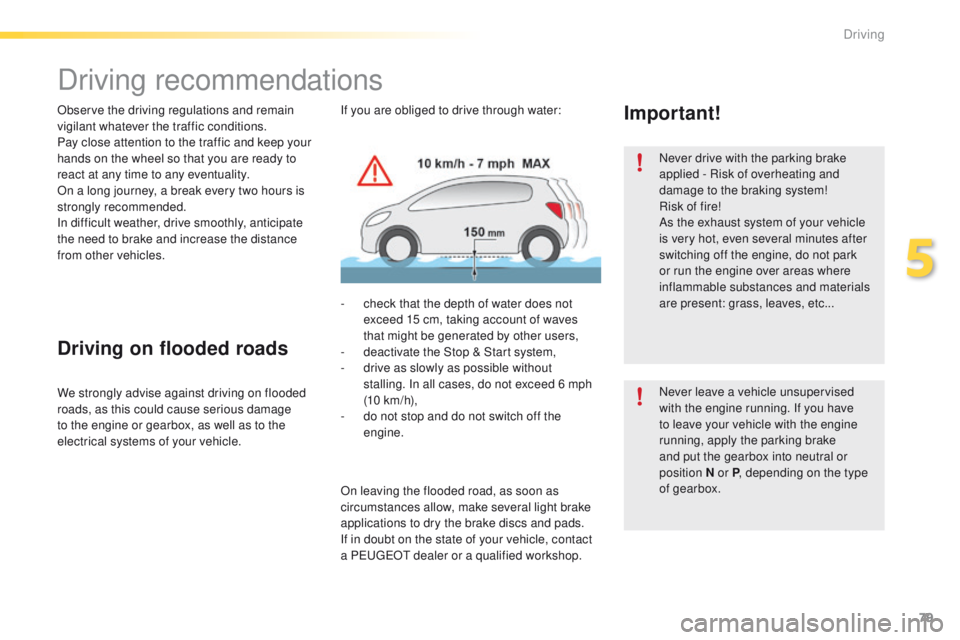
from other vehicles.If you are obliged to drive through water:Important!
Driving on flooded roads
- check that the depth of water does not exceed 15 cm, taking account of waves
that might be generated by other users,
-
d
eactivate the Stop & Start system,
-
d
rive as slowly as possible without
stalling. In all cases, do not exceed 6 mph
(10
km/h),
-
d
o not stop and do not switch off the
engine.
We strongly advise against driving on flooded
roads, as this could cause serious damage
to the engine or gearbox, as well as to the
electrical systems of your vehicle.
On leaving the flooded road, as soon as
circumstances allow, make several light brake
applications to dry the brake discs and pads.
If in doubt on the state of your vehicle, contact
a PEUGEOT dealer or a qualified workshop. Never drive with the parking brake
applied - Risk of overheating and
damage to the braking system!
Risk of fire!
As the exhaust system of your vehicle
is very hot, even several minutes after
switching off the engine, do not park
or run the engine over areas where
inflammable substances and materials
are present: grass, leaves, etc...
Never leave a vehicle unsupervised
with the engine running. If you have
to leave your vehicle with the engine
running, apply the parking brake
and put the gearbox into neutral or
position
N or P, depending on the type
of gearbox.
5
Driving
Page 82 of 450
80
2008_en_Chap05_conduite_ed01-2016
Starting - Switching off the engine
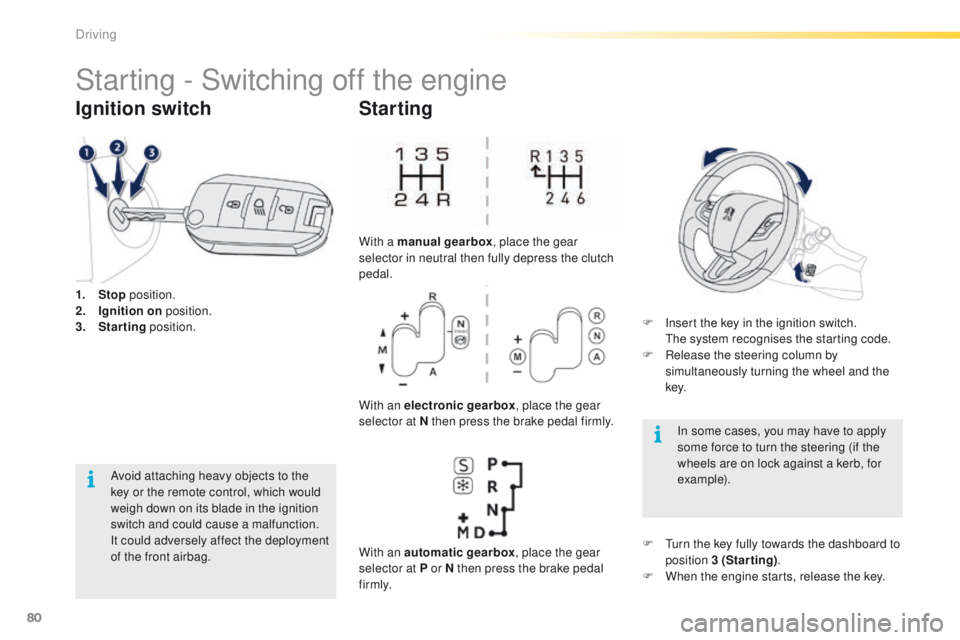
1. Stop position.
2. I gnition on position.
3.
S
tarting position.
Ignition switch
Avoid attaching heavy objects to the
key or the remote control, which would
weigh down on its blade in the ignition
switch and could cause a malfunction.
It could adversely affect the deployment
of the front airbag.
Starting
With a manual gearbox , place the gear
selector in neutral then fully depress the clutch
pedal.
With an electronic gearbox , place the gear
selector at N then press the brake pedal firmly.
With an automatic gearbox , place the gear
selector at P or N then press the brake pedal
f i r m l y. F
I
nsert the key in the ignition switch.
T
he system recognises the starting code.
F
R
elease the steering column by
simultaneously turning the wheel and the
key.
In some cases, you may have to apply
some force to turn the steering (if the
wheels are on lock against a kerb, for
example).
F
T
urn the key fully towards the dashboard to
position 3 (Starting) .
F
W
hen the engine starts, release the key.
Driving
Page 87 of 450
85
2008_en_Chap05_conduite_ed01-2016
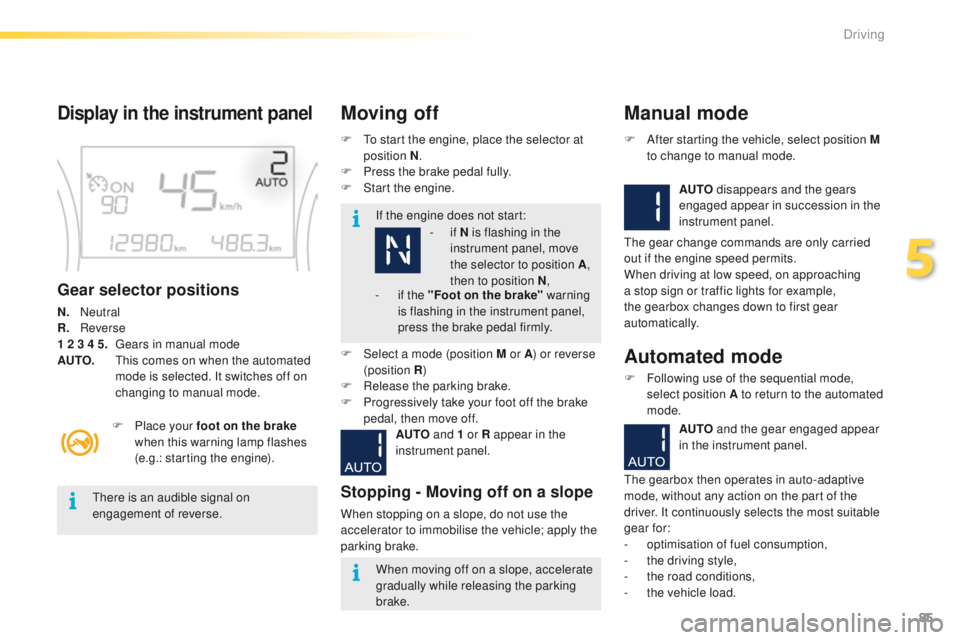
Display in the instrument panel
Gear selector positions
N. Neutral
R . Reverse
1 2 3 4 5.
G
ears in manual mode
AUTO.
T
his comes on when the automated
mode is selected. It switches off on
changing to manual mode. F
T
o start the engine, place the selector at
position N .
F
P
ress the brake pedal fully.
F
S
tart the engine.
Moving off
If the engine does not start:
F
P
lace your foot on the brake
when this warning lamp flashes
(e.g.: starting the engine).
There is an audible signal on
engagement of reverse.
When moving off on a slope, accelerate
gradually while releasing the parking
brake.
F
Sel
ect a mode (position M or A ) or reverse
(position R )
F
R
elease the parking brake.
F
P
rogressively take your foot off the brake
pedal, then move off.
AUTO and 1 or R appear in the
instrument panel.
Stopping - Moving off on a slope
When stopping on a slope, do not use the
accelerator to immobilise the vehicle; apply the
parking brake.
Manual mode
AUTO disappears and the gears
engaged appear in succession in the
instrument panel.
F
A
fter starting the vehicle, select position M
to change to manual mode.
The gear change commands are only carried
out if the engine speed permits.
When driving at low speed, on approaching
a stop sign or traffic lights for example,
the gearbox changes down to first gear
automatically.
Automated mode
F Following use of the sequential mode, select position A to return to the automated
mode.
-
i
f
N is flashing in the
instrument panel, move
the selector to position A ,
then to position N ,
-
i
f the "Foot on the brake" warning
is flashing in the instrument panel,
press the brake pedal firmly.
AUTO and the gear engaged appear
in the instrument panel.
The gearbox then operates in auto-adaptive
mode, without any action on the part of the
driver. It continuously selects the most suitable
gear for:
-
o
ptimisation of fuel consumption,
-
t
he driving style,
-
t
he road conditions,
-
t
he vehicle load.
5
Driving
Page 88 of 450
86
2008_en_Chap05_conduite_ed01-2016
You must press the brake pedal firmly
while starting the engine.
Never select neutral N while the vehicle
is moving.
Only engage reverse gear R when the
vehicle is immobilised, with your foot on
the brake pedal.
In all cases, you must apply the parking
brake to immobilise the vehicle.
For best acceleration, when overtaking
another vehicle for example, press the
accelerator pedal firmly to pass the
point of resistance.
"Auto sequential" mode
In the automated mode, you can resume
control temporarily at any time using the
steering mounted control paddles.
The use of these paddles permits manual
selection of the gears in situations which
require a more rapid change-down than in
the automated mode (arrival at a roundabout,
leaving a car park with a steep gradient,
over taking...).
The gearbox engages the required gear if
the engine speed permits. AUTO
remains
displayed on the instrument panel.
After a few moments, the gearbox resumes
automatic control of the gears.
Stopping the vehicle
Before switching off the engine, you can
change to position N to be in neutral.
In this case, you must apply the parking
brake to immobilise the vehicle.
Reinitialisation
Following disconnection of the battery, the
gearbox must be reinitialised.
F
S
witch on the ignition.
AUTO and - appear in the instrument
panel.
F
Sel
ect position N .
F
P
ress the brake pedal.
F
W
ait approximately 30 seconds until N or a
gear appears in the instrument panel.
F
R
elease the brake pedal.
The gearbox is operational again.
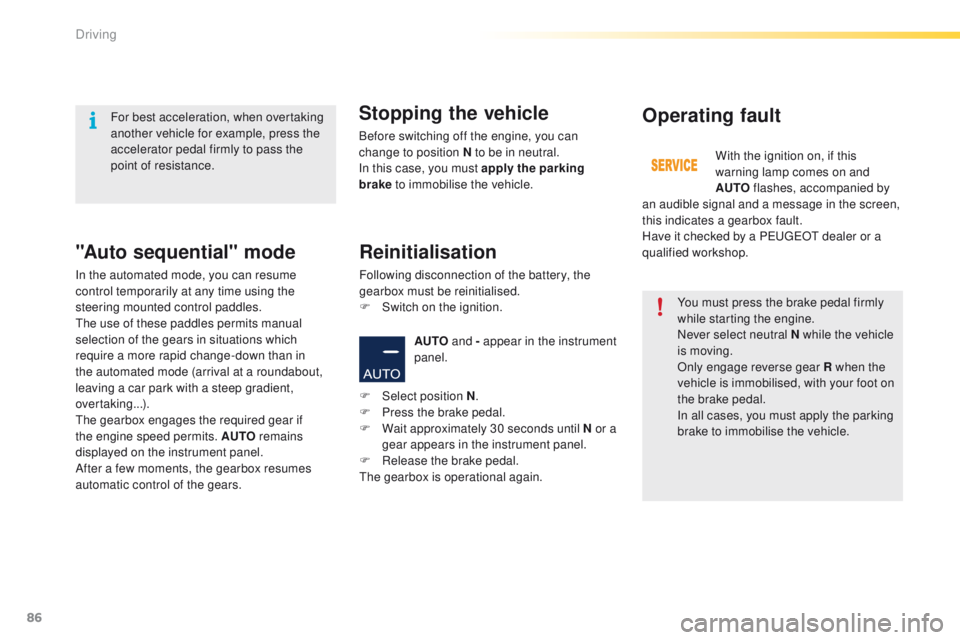
Operating fault
With the ignition on, if this
warning lamp comes on and
AUTO flashes, accompanied by
an audible signal and a message in the screen,
this indicates a gearbox fault.
Have it checked by a PEUGEOT dealer or a
qualified workshop.
Driving
Page 92 of 450
90
2008_en_Chap05_conduite_ed01-2016
Operating fault
When immobilising the vehicle, with
the engine running, you must place the
gear selector at neutral N.
Before carrying out any work in the
engine compartment, check that the
gear selector is at neutral N and that the
parking brake is applied. With the ignition on, the flashing
of this warning lamp and the
flashing of AUTO
, accompanied
by an audible signal and a message in
the instrument panel screen, indicates a
malfunction of the gearbox.
Have it checked by PEUGEOT or a qualified
workshop.
You must press the brake pedal firmly
when starting the engine.
Whatever the circumstances, you must
manually apply the parking brake to
immobilise the vehicle.
Stopping the vehicle
Before switching off the engine, you can
choose to:
-
m
ove to position N to engage neutral,
-
l
eave the gear engaged; in this case, it will
not be possible to move the vehicle.
In both cases, you must apply the parking
brake to immobilise the vehicle.
Driving
Page 102 of 450
100
2008_en_Chap05_conduite_ed01-2016
Stop & Start
Operation
Going into engine STOP mode
The "ECO" warning lamp comes
on in the instrument panel and the
engine goes into standby:
-
for e-HDi Diesel engines :
●
w
ith a manual gearbox , at speeds
below 12 mph (20 km/h), when you place
the gear selector into neutral, and you
release the clutch pedal,
●
w
ith an electronic gearbox , at speeds
below 5 mph (8 km/h), when you press
the brake pedal or place the gear
selector into position N ,
-
for e-VTI and e-THP petrol engines and
BlueHDi Diesel engines, with the vehicle
stationary. Never refuel with the engine in STOP
mode; you must switch off the ignition
with the key. For your comfort, during parking
manoeuvres, STOP mode is not
available for a few seconds after
coming out of reverse gear.
Stop & Start does not affect the
vehicle's systems, such as for example,
braking, power steering...
Special cases: STOP mode not
available
STOP mode is not invoked when:
- t
he driver's door is open,
-
t
he driver's seat belt is not fastened,
-
t
he vehicle has not exceeded 6 mph
(10
km/h) since the last engine start using
t h e key,
-
t
he engine is needed to maintain a
comfortable temperature in the passenger
compartment,
-
d
emisting has been selected,
-
s
ome special conditions (battery charge,
engine temperature, braking assistance,
ambient temperature...) where the engine is
needed to assure control of a system.
A time counter calculates the sum
of the periods in STOP mode
during a journey. It rests itself
to zero every time the ignition is
switched on with the key. The "ECO"
warning lamp flashes for
a few seconds then goes off.
This operation is perfectly normal.
The Stop & Start
system puts the engine temporarily into standby - STOP mode - during stops in the traffic (red lights, traffic jams, or other...). The
engine restarts automatically - START mode - as soon as you want to move off. The restart takes place instantly, quickly and silently.
Per fect for urban use, the Stop & Start system reduces fuel consumption and exhaust emissions as well as the noise level when stationary.
Driving
Page 103 of 450
101
2008_en_Chap05_conduite_ed01-2016
Going into engine START mode
The "ECO" warning lamp goes off
and the engine starts:
-
w
ith a manual gearbox , when you
depress the clutch pedal,
-
w
ith an electronic / automatic gearbox :
●
g
ear selector in position A / D or M ,
when you release the brake pedal,
●
o
r gear lever in position N and the brake
pedal released, when you place the gear
selector into position A / D or M ,
●
o
r when you engage reverse gear.
With a manual gearbox in STOP mode, if you
engage a gear without fully depressing the
clutch pedal, a message is displayed asking
you to fully depress the clutch pedal so that the
engine can restart. For reasons of safety and for your comfort,
START mode is invoked automatically when:
Special cases: START invoked
automatically
- you open the driver's door,
- y
ou unfasten the driver's seat belt,
-
t
he speed of the vehicle exceeds 7 mph
(11
km/h) with an electronic gearbox,
-
s
ome special conditions (battery charge,
engine temperature, braking assistance,
ambient temperature...) where the engine is
needed for control of a system.
If the system has been deactivated
in STOP mode, the engine restarts
immediately.
In certain circumstances, such as the need
to maintain a comfortable temperature in the
passenger compartment, it may be preferable
to deactivate the Stop & Start system.
The system can be deactivated at any time,
once the ignition is on.
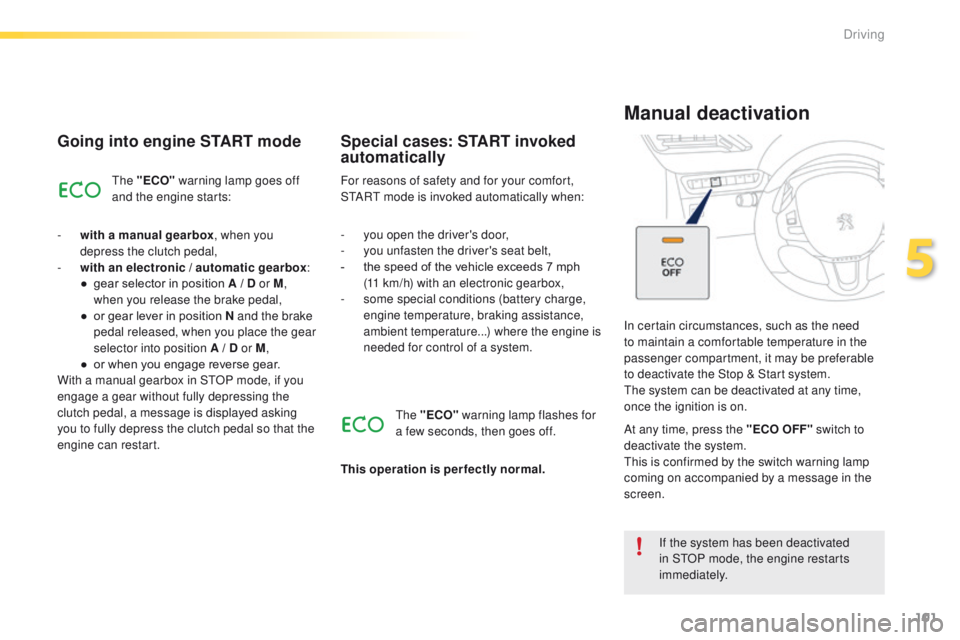
Manual deactivation
The "ECO"
warning lamp flashes for
a few seconds, then goes off.
This operation is perfectly normal. At any time, press the "ECO OFF"
switch to
deactivate the system.
This is confirmed by the switch warning lamp
coming on accompanied by a message in the
screen.
5
Driving