light PEUGEOT 2008 2016 Owner's Guide
[x] Cancel search | Manufacturer: PEUGEOT, Model Year: 2016, Model line: 2008, Model: PEUGEOT 2008 2016Pages: 450, PDF Size: 14.16 MB
Page 125 of 450
123
2008_en_Chap06_visibilite_ed01-2016
The sidelamps and dipped beam headlamps are
switched on automatically, without any action
on the part of the driver, when a low level of
external light is detected or in certain cases of
activation of the windscreen wipers.
As soon as the brightness returns to a sufficient
level or after the windscreen wipers are switched
off, the lamps are switched off automatically.
Automatic illumination of headlamps
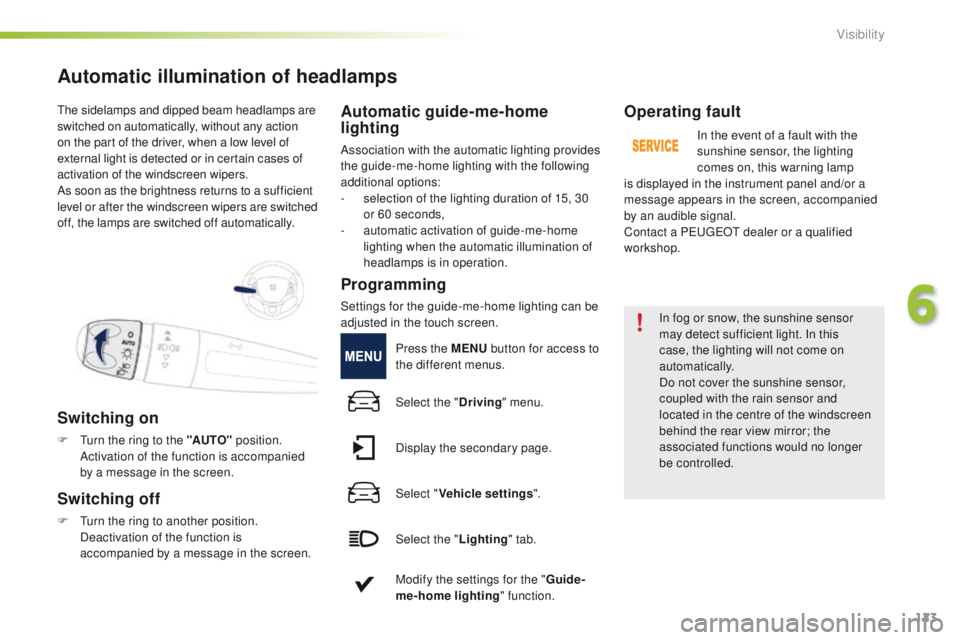
Switching on
F Turn the ring to the "AUTO" position.
Activation of the function is accompanied
by a message in the screen.
Switching off
F Turn the ring to another position. Deactivation of the function is
accompanied by a message in the screen.
Automatic guide-me-home
lighting
Association with the automatic lighting provides
the guide-me-home lighting with the following
additional options:
-
s
election of the lighting duration of 15, 30
or 60 seconds,
-
a
utomatic activation of guide-me-home
lighting when the automatic illumination of
headlamps is in operation.
Operating fault
In the event of a fault with the
sunshine sensor, the lighting
comes on, this warning lamp
is displayed in the instrument panel and/or a
message appears in the screen, accompanied
by an audible signal.
Contact a PEUGEOT dealer or a qualified
workshop.
In fog or snow, the sunshine sensor
may detect sufficient light. In this
case, the lighting will not come on
automatically.
Do not cover the sunshine sensor,
coupled with the rain sensor and
located in the centre of the windscreen
behind the rear view mirror; the
associated functions would no longer
be controlled.
Programming
Settings for the guide-me-home lighting can be
adjusted in the touch screen. Press the MENU button for access to
the different menus.
Select the " Driving" menu.
Display the secondary page.
Select " Vehicle settings ".
Select the " Lighting" tab.
Modify the settings for the " Guide-
me-home lighting " function.
6
Visibility
Page 127 of 450
125
2008_en_Chap06_visibilite_ed01-2016
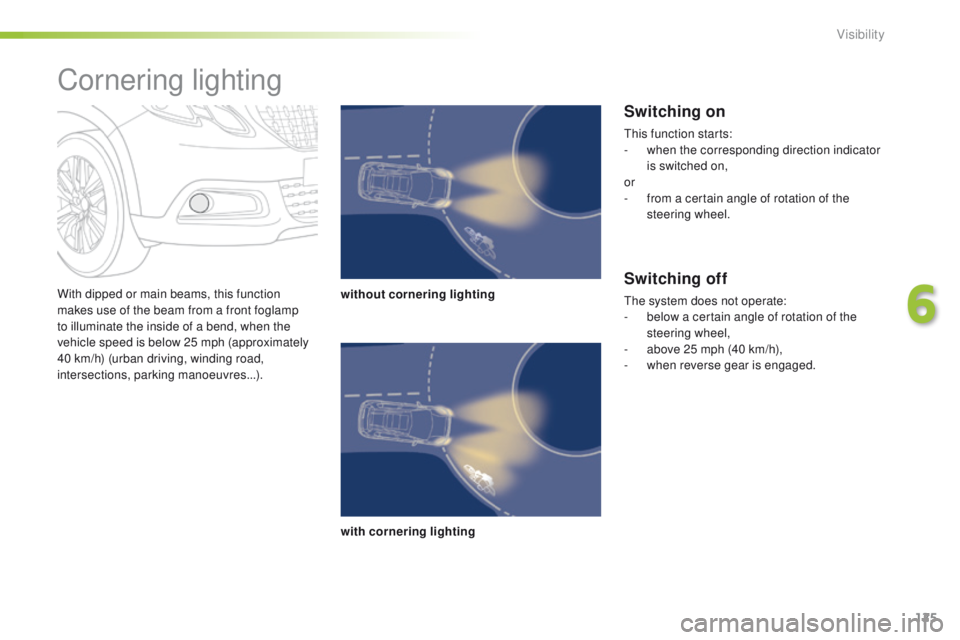
With dipped or main beams, this function
makes use of the beam from a front foglamp
to illuminate the inside of a bend, when the
vehicle speed is below 25 mph (approximately
40 km/h) (urban driving, winding road,
intersections, parking manoeuvres...).
Cornering lighting
with cornering lightingwithout cornering lighting
Switching on
This function starts:
-
w hen the corresponding direction indicator
is switched on,
or
-
f
rom a certain angle of rotation of the
steering wheel.
Switching off
The system does not operate:
- b elow a certain angle of rotation of the
steering wheel,
-
a
bove 25 mph (40 km/h),
-
w
hen reverse gear is engaged.
6
Visibility
Page 132 of 450
130
2008_en_Chap06_visibilite_ed01-2016
Lighting dimmerSystem for the manual adjustment of the brightness of the instrument panel and the touch screen to
suit the ambient light level.
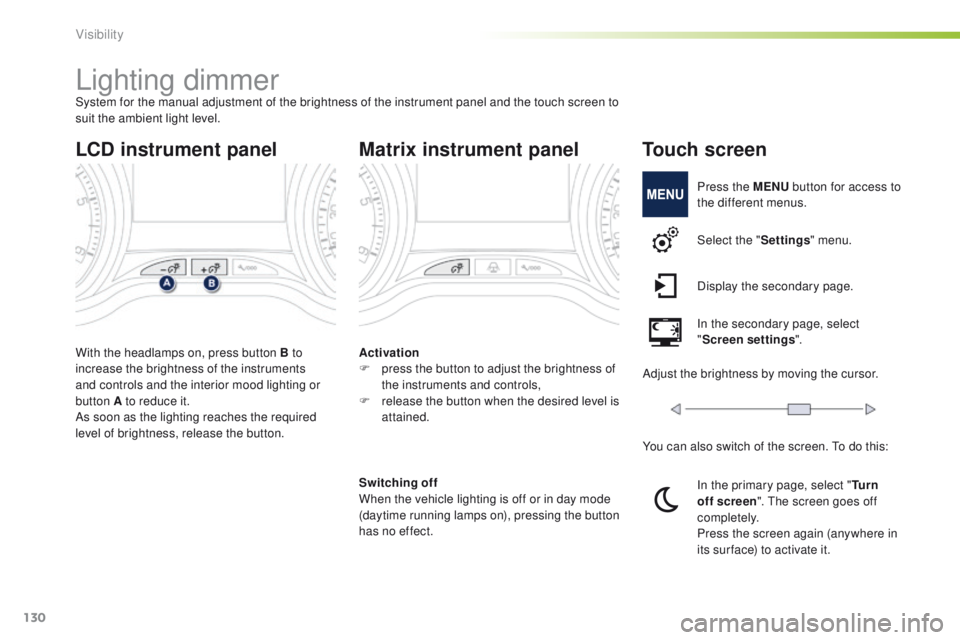
With the headlamps on, press button B to
increase the brightness of the instruments
and controls and the interior mood lighting or
button A to reduce it.
As soon as the lighting reaches the required
level of brightness, release the button.
LCD instrument panel
Activation
F p ress the button to adjust the brightness of
the instruments and controls,
F
r
elease the button when the desired level is
attained.
Matrix instrument panel
Switching off
When the vehicle lighting is off or in day mode
(daytime running lamps on), pressing the button
has no effect.
Touch screen
Press the MENU button for access to
the different menus.
Select the " Settings" menu.
Display the secondary page.
In the secondary page, select
" Screen settings ".
Adjust the brightness by moving the cursor.
You can also switch of the screen. To do this:
In the primary page, select " Tu r n
off screen ". The screen goes off
completely.
Press the screen again (anywhere in
its sur face) to activate it.
Visibility
Page 133 of 450
131
2008_en_Chap06_visibilite_ed01-2016
Courtesy lamps
In this position, the courtesy
lamp comes on gradually:
-
w
hen the vehicle is unlocked,
-
w
hen the key is removed from the ignition,
-
w
hen opening a door,
-
w
hen the remote control locking button is
pressed, in order to locate your vehicle.
It switches off gradually:
-
w
hen the vehicle is locked,
-
w
hen the ignition is switched on,
-
3
0 seconds after the last door is closed. Permanently off.
Permanent lighting.
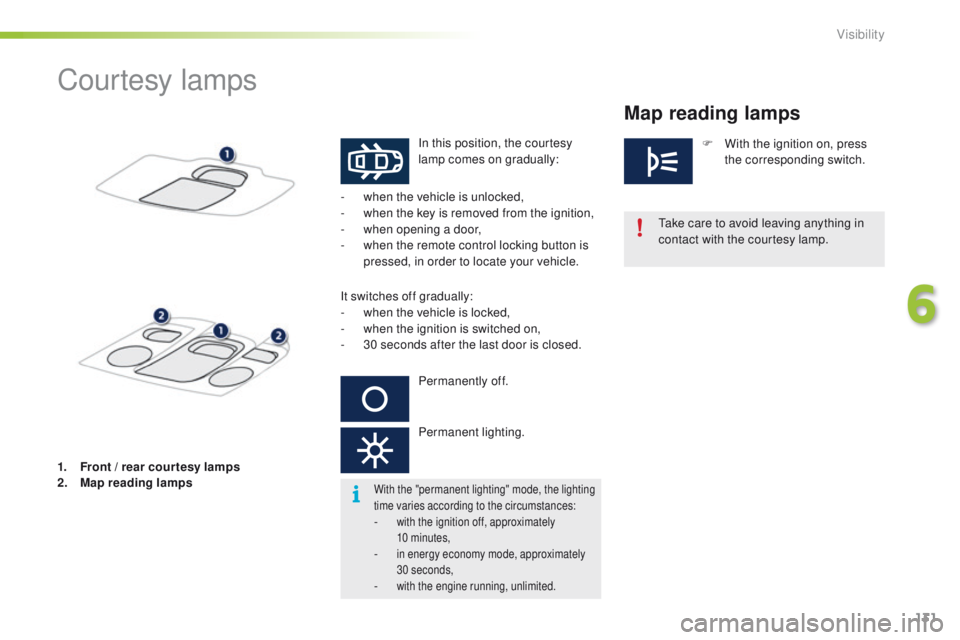
1.
F
ront / rear cour tesy lamps
2.
M
ap reading lamps
With the "permanent lighting" mode, the lighting
time varies according to the circumstances:
- with the ignition off, approximately
10 minutes,
- in energy economy mode, approximately
30 seconds,
- with the engine running, unlimited.
Take care to avoid leaving anything in
contact with the courtesy lamp.
Map reading lamps
F With the ignition on, press the corresponding switch.
6
Visibility
Page 134 of 450
132
2008_en_Chap06_visibilite_ed01-2016
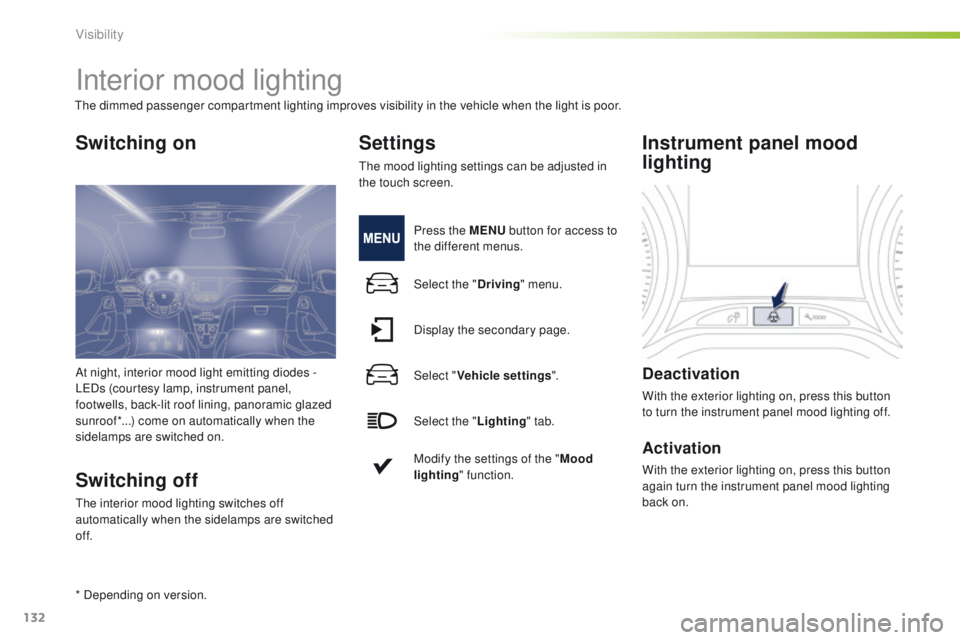
Interior mood lighting
Switching on
Switching off
The interior mood lighting switches off
automatically when the sidelamps are switched
of f.
Settings
The mood lighting settings can be adjusted in
the touch screen.
* Depending on version.
The dimmed passenger compartment lighting improves visibility in the vehicle when the light is poor.
Press the MENU button for access to
the different menus.
Select the " Driving" menu.
Display the secondary page.
Select " Vehicle settings ".
Select the " Lighting" tab.
Modify the settings of the " Mood
lighting " function.
Instrument panel mood
lighting
Deactivation
With the exterior lighting on, press this button
to turn the instrument panel mood lighting off.
Activation
With the exterior lighting on, press this button
again turn the instrument panel mood lighting
back on.
At night, interior mood light emitting diodes
-
LEDs (courtesy lamp, instrument panel,
footwells, back-lit roof lining, panoramic glazed
sunroof*...) come on automatically when the
sidelamps are switched on.
Visibility
Page 135 of 450
133
2008_en_Chap06_visibilite_ed01-2016
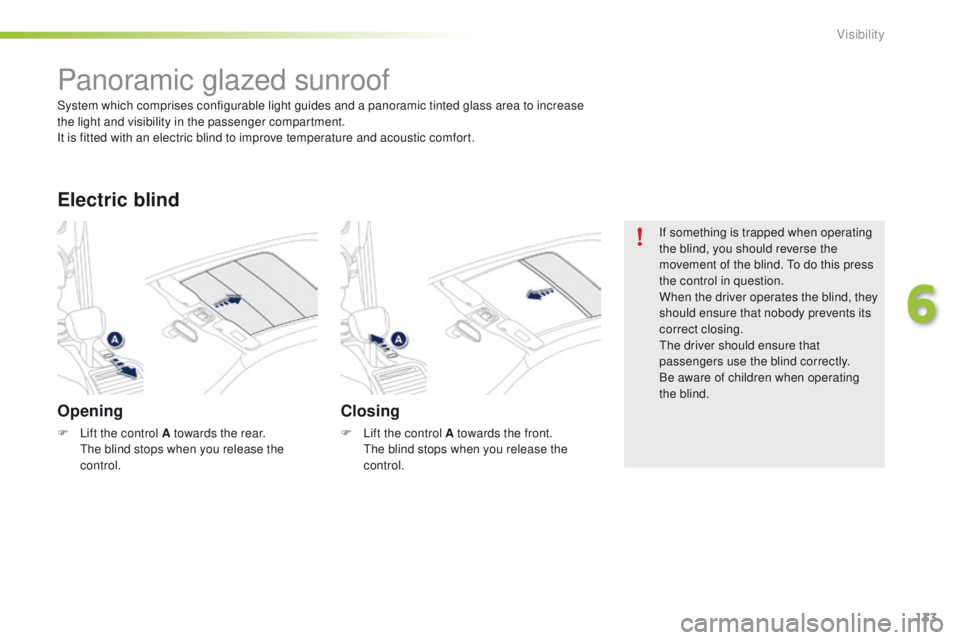
Panoramic glazed sunroof
Opening
F Lift the control A towards the rear. The blind stops when you release the
control.
Electric blind
Closing
F Lift the control A towards the front. T he blind stops when you release the
control. If something is trapped when operating
the blind, you should reverse the
movement of the blind. To do this press
the control in question.
When the driver operates the blind, they
should ensure that nobody prevents its
correct closing.
The driver should ensure that
passengers use the blind correctly.
Be aware of children when operating
the blind.
System which comprises configurable light guides and a panoramic tinted glass area to increase
the light and visibility in the passenger compartment.
It is fitted with an electric blind to improve temperature and acoustic comfort.
6
Visibility
Page 137 of 450
135
2008_en_Chap07_securite_ed01-2016
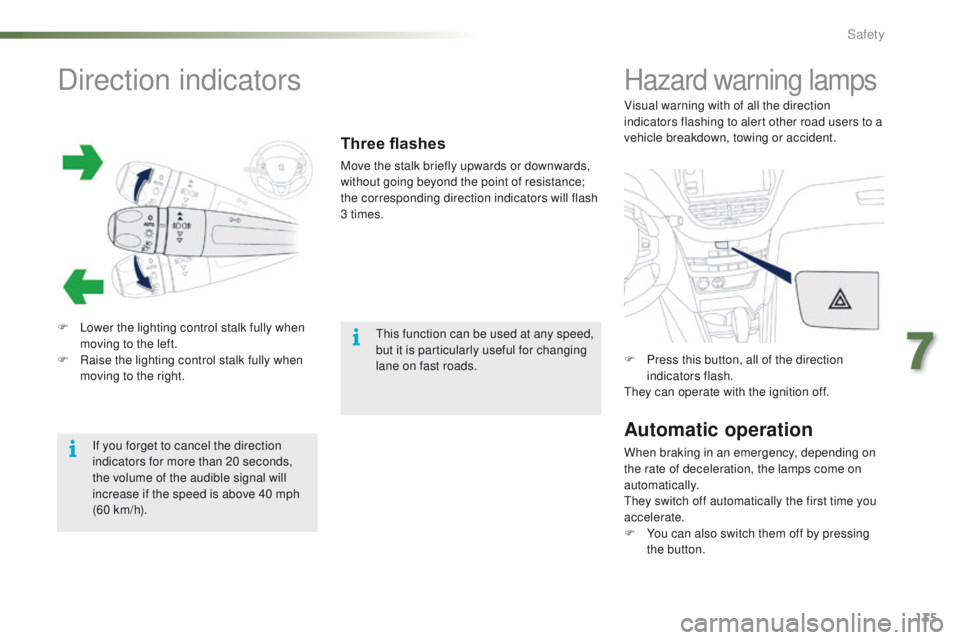
Direction indicators
F Lower the lighting control stalk fully when moving to the left.
F
R
aise the lighting control stalk fully when
moving to the right.
Three flashes
Move the stalk briefly upwards or downwards,
without going beyond the point of resistance;
the corresponding direction indicators will flash
3 times.
If you forget to cancel the direction
indicators for more than 20 seconds,
the volume of the audible signal will
increase if the speed is above 40 mph
(60 km/h).
Hazard warning lamps
F Press this button, all of the direction indicators flash.
They can operate with the ignition off.
This function can be used at any speed,
but it is particularly useful for changing
lane on fast roads. Visual warning with of all the direction
indicators flashing to alert other road users to a
vehicle breakdown, towing or accident.
Automatic operation
When braking in an emergency, depending on
the rate of deceleration, the lamps come on
automatically.
They switch off automatically the first time you
accelerate.
F
Y
ou can also switch them off by pressing
the button.
7
Safety
Page 143 of 450
141
2008_en_Chap07_securite_ed01-2016
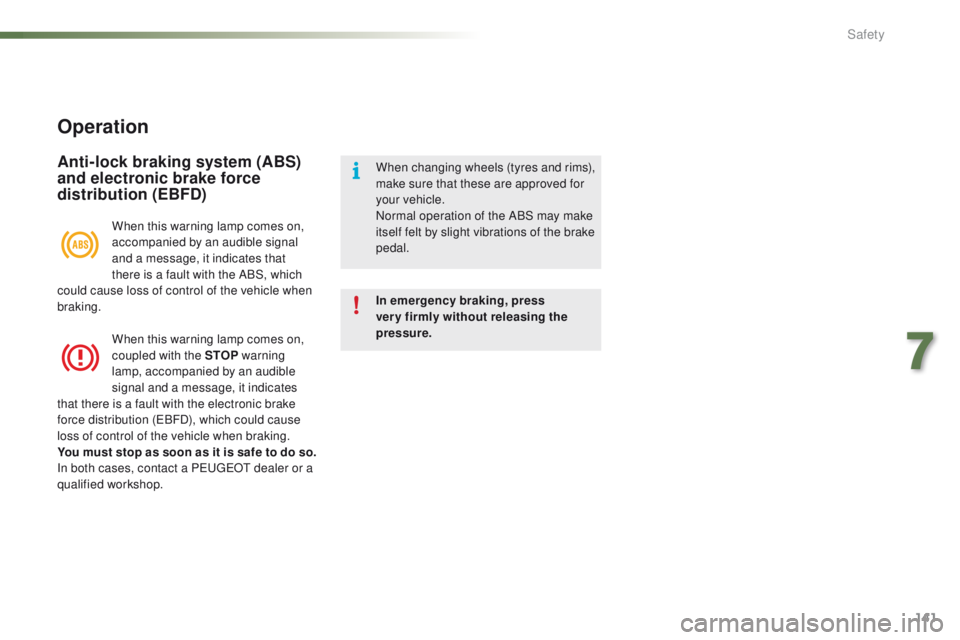
Operation
Anti-lock braking system (ABS)
and electronic brake force
distribution (EBFD)
In emergency braking, press
very firmly without releasing the
pressure. When changing wheels (tyres and rims),
make sure that these are approved for
your vehicle.
Normal operation of the ABS may make
itself felt by slight vibrations of the brake
pedal.
When this warning lamp comes on,
accompanied by an audible signal
and a message, it indicates that
there is a fault with the ABS, which
could cause loss of control of the vehicle when
braking.
When this warning lamp comes on,
coupled with the STOP warning
lamp, accompanied by an audible
signal and a message, it indicates
that there is a fault with the electronic brake
force distribution (EBFD), which could cause
loss of control of the vehicle when braking.
You must stop as soon as it is safe to do so.
In both cases, contact a PEUGEOT dealer or a
qualified workshop.
7
Safety
Page 153 of 450
151
2008_en_Chap07_securite_ed01-2016
Advice
The driver must ensure that passengers use
the seat belts correctly and that they are all
fastened before setting off.
Wherever you are seated in the vehicle,
always fasten your seat belt, even for short
journeys.
Do not interchange the seat belt buckles as
they will not fulfil their role fully.
The seat belts are fitted with an inertia reel
permitting automatic adjustment of the
length of the strap to your size. The seat belt
is stowed automatically when not in use.
Before and after use, ensure that the seat
belt is reeled in correctly.
The lower part of the strap must be
positioned as low as possible on the pelvis.
The upper part must be positioned in the
hollow of the shoulder.
The inertia reels are fitted with an automatic
locking device which comes into operation in
the event of a collision, emergency braking
or if the vehicle rolls over. You can release
the device by pulling the strap firmly and
then releasing it so that it reels in slightly.
Recommendations for children
Use a suitable child seat if the passenger is
less than 12 years old or shorter than one
and a half metres.
Never use the same seat belt to secure more
than one person.
Never allow a child to travel on your lap.
For more information on child seats, refer to
the corresponding section.
In order to be effective, a seat belt must:
-
b
e tightened as close to the body as
possible,
-
b
e pulled in front of you with a smooth
movement, checking that it does not
twist,
-
b
e used to restrain only one person,
-
n
ot bear any trace of cuts or fraying,
-
n
ot be converted or modified to avoid
affecting its performance.
In accordance with current safety
regulations, for all repairs on your vehicle's
seat belts, go to a qualified workshop with
the skills and equipment needed, which a
PEUGEOT dealer is able to provide.
Have your seat belts checked regularly by a
PEUGEOT dealer or a qualified workshop,
particularly if the straps show signs of
damage.
Clean the seat belt straps with soapy
water or a textile cleaning product, sold by
PEUGEOT dealers.
After folding or moving a seat or rear bench
seat, ensure that the seat belt is positioned
and reeled in correctly.
In the event of an impact
Depending on the nature and
seriousness of the impact , the
pretensioning device may be deployed
before and independently of the airbags.
Deployment of the pretensioners is
accompanied by a slight discharge of
harmless smoke and a noise, due to the
activation of the pyrotechnic cartridge
incorporated in the system.
In all cases, the airbag warning lamp comes
on.
Following an impact, have the seat belts
system checked, and if necessary replaced,
by a PEUGEOT dealer or a qualified
workshop.
7
Safety
Page 154 of 450
152
2008_en_Chap07_securite_ed01-2016
Airbags
General information
System designed to contribute towards
improving the safety of the occupants (with
the exception of the rear centre passenger)
in the event of violent collisions. The airbags
supplement the action of the seat belts fitted
with force limiters (all except the centre rear
passenger belt).
If a collision occurs, the electronic detectors
record and analyse the front and side impacts
sustained in the impact detection zones:
-
i
n the case of a serious impact, the airbags
are deployed instantly and contribute
towards better protection of the occupants
of the vehicle (with the exception of the
rear centre passenger); immediately after
the impact, the airbags deflate rapidly so
that they do not hinder visibility or the exit
of the occupants,
-
i
n the case of a minor or rear impact or in
certain roll-over conditions, the airbags
may not be deployed; the seat belt
alone contributes towards ensuring your
protection in these situations.
The airbags do not operate when the
ignition is switched off. Deployment of one or more of the
airbags is accompanied by a slight
emission of smoke and a noise, due
to the activation of the pyrotechnic
cartridge incorporated in the system.
This smoke is not harmful, but sensitive
individuals may experience slight
irritation.
The noise of detonation associated with
the deployment of one or more airbags
may result in a slight loss of hearing for
a short time.
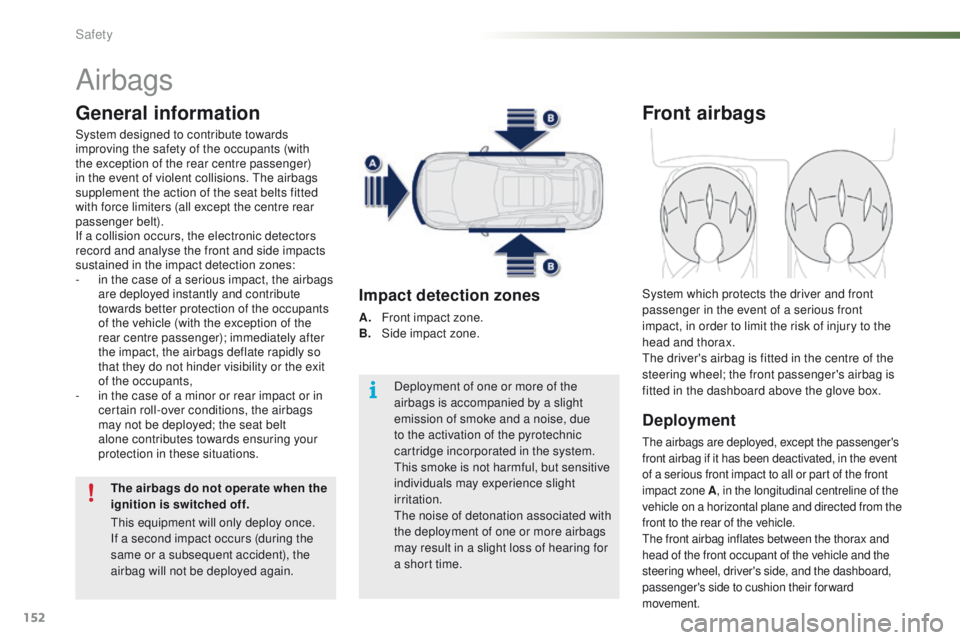
Impact detection zones
A. Front impact zone.
B. S
ide impact zone.
Front airbags
Deployment
The airbags are deployed, except the passenger's
front airbag if it has been deactivated, in the event
of a serious front impact to all or part of the front
impact zone A , in the longitudinal centreline of the
vehicle on a horizontal plane and directed from the
front to the rear of the vehicle.
The front airbag inflates between the thorax and
head of the front occupant of the vehicle and the
steering wheel, driver's side, and the dashboard,
passenger's side to cushion their forward
movement.
System which protects the driver and front
passenger in the event of a serious front
impact, in order to limit the risk of injury to the
head and thorax.
The driver's airbag is fitted in the centre of the
steering wheel; the front passenger's airbag is
fitted in the dashboard above the glove box.
This equipment will only deploy once.
If a second impact occurs (during the
same or a subsequent accident), the
airbag will not be deployed again.
Safety