ESP Peugeot 206 CC 2003 Owner's Guide
[x] Cancel search | Manufacturer: PEUGEOT, Model Year: 2003, Model line: 206 CC, Model: Peugeot 206 CC 2003Pages: 135, PDF Size: 2.11 MB
Page 118 of 135
PRACTICAL INFORMATION
110
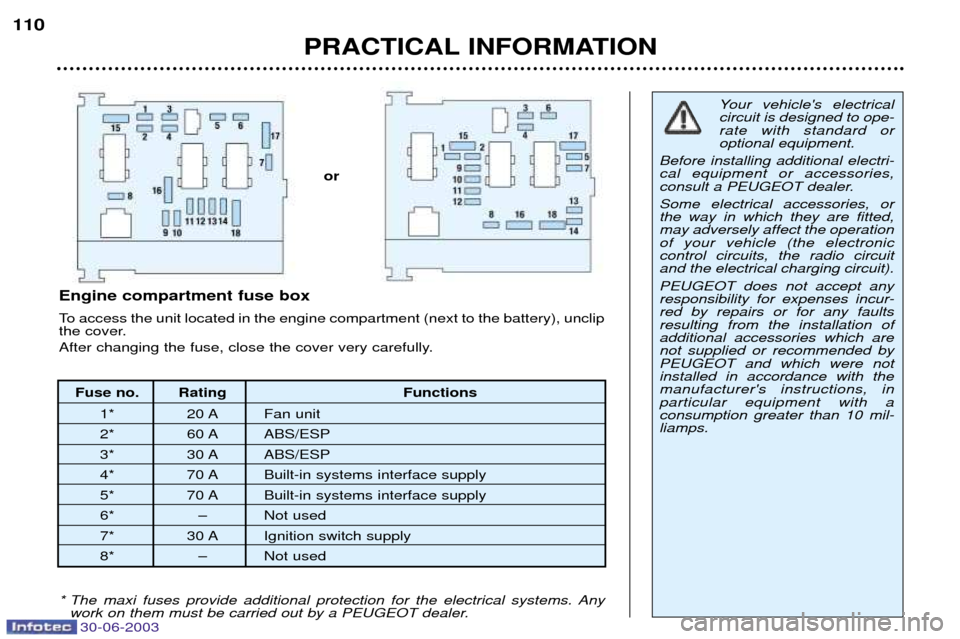
Fuse no. Rating Functions
1* 20 A Fan unit
2* 60 A ABS/ESP
3* 30 A ABS/ESP
4* 70 A Built-in systems interface supply
5* 70 A Built-in systems interface supply
6* Ð Not used
7* 30 A Ignition switch supply
8* Ð Not used
Engine compartment fuse box
To access the unit located in the engine compartment (next to the battery), unclip
the cover.
After changing the fuse, close the cover very carefully.
Your vehicle's electrical circuit is designed to ope-rate with standard oroptional equipment.
Before installing additional electri-cal equipment or accessories,
consult a PEUGEOT dealer. Some electrical accessories, or the way in which they are fitted,may adversely affect the operationof your vehicle (the electroniccontrol circuits, the radio circuitand the electrical charging circuit). PEUGEOT does not accept any responsibility for expenses incur-red by repairs or for any faultsresulting from the installation ofadditional accessories which arenot supplied or recommended byPEUGEOT and which were notinstalled in accordance with themanufacturer's instructions, inparticular equipment with aconsumption greater than 10 mil-liamps.
* The maxi fuses provide additional protection for the electrical systems. Any work on them must be carried out by a PEUGEOT dealer.
or
30-06-2003
Page 119 of 135
30-06-2003
PRACTICAL INFORMATION111
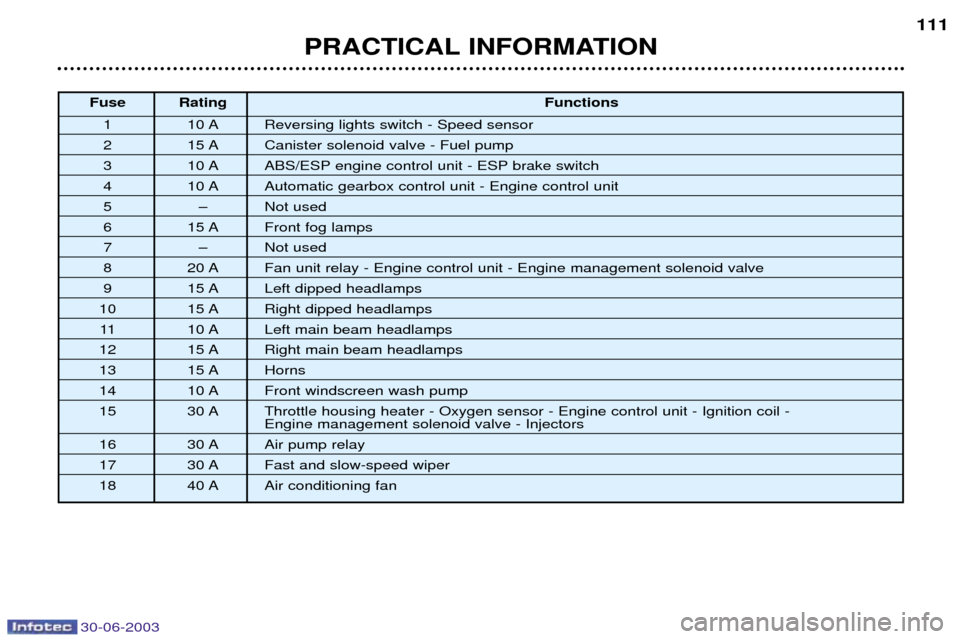
Fuse Rating
Functions
1 10 A Reversing lights switch - Speed sensor
2 15 A Canister solenoid valve - Fuel pump
3 10 A ABS/ESP engine control unit - ESP brake switch
4 10 A Automatic gearbox control unit - Engine control unit
5 Ð Not used
6 15 A Front fog lamps
7 Ð Not used
8 20 A Fan unit relay - Engine control unit - Engine management solenoid valve
9 15 A Left dipped headlamps
10 15 A Right dipped headlamps
11 10 A Left main beam headlamps
12 15 A Right main beam headlamps
13 15 A Horns
14 10 A Front windscreen wash pump
15 30 A Throttle housing heater - Oxygen sensor - Engine control unit - Ignition coil -
Engine management solenoid valve - Injectors
16 30 A Air pump relay
17 30 A Fast and slow-speed wiper
18 40 A Air conditioning fan
Page 124 of 135
30-06-2003
PRACTICAL INFORMATION
116
BODYWORK MAINTENANCE
To preserve the paintwork and the plastic trim on your vehicle, we rec-ommend that you wash them regu-
larly.
- by hand: there are no specific pre-
cautions to take;
- using an automatic car wash: repeated use of poorly maintained automatic car washes can lead tothe appearance of microscopicscratches which give the paint-work a matt appearance (espe-cially visible on dark colours);
- using a high pressure washer: always follow the recommenda-tions on the equipment (pressureand spraying distance). If there are damaged areas on the vehicle (painted bumpers orheadlamps), it is not recommend-ed to direct the high pressure jet
onto them. Wash these areas byhand. Also avoid the entry of water into the locks.
For all questions relating to themaintenance of your vehicle, con-tact an approved dealer who canadvise you on quality productsselected by our departments. Clean off bird droppings,resinous deposits, tarstains and grease marks assoon as possible; (these all
contain substances which cancause serious damage to thepaintwork).
- Do not use a dry or abrasive cloth, or detergent or solventproducts to clean the doublelens, complex surface head-lamps as they are fitted withpolycarbonate glass covered in aprotective finish.
- Do not use petrol, oil or cloth stain removers to clean thebodywork and plastic parts ofyour vehicle.
- To prevent the development of bodywork corrosion as a result ofaccidental damage (stone chips,scratches etc.), have them
repaired swiftly.