engine PEUGEOT 207 2009 Owner's Manual
[x] Cancel search | Manufacturer: PEUGEOT, Model Year: 2009, Model line: 207, Model: PEUGEOT 207 2009Pages: 279, PDF Size: 19.5 MB
Page 90 of 279
ACCESS
84
Quality of the fuel used for petrol
engines
The petrol engines are perfectly com-
patible with E10 type petrol biofuels
(containing 10 % ethanol), conforming
to European standards EN 228 and
EN 15376.
E85 type fuels (containing up to 85 %
ethanol) are reserved exclusively for ve-
hicles marketed for the use of this type
of fuel (BioFlex vehicles). The quality of
the ethanol must comply with European
standard EN 15376.
For Brazil only, special vehicles are
marketed to run on fuels containing up
to 100 % ethanol (type E100). Quality of the fuel used for Diesel
engines
The Diesel engines are perfectly com-
patible with biofuels which conform to
current and future European standards
(diesel fuel which complies with stand-
ard EN 590 mixed with a biofuel which
complies with standard EN 14214)
available at the pumps (containing up
to 7 % Fatty Acid Methyl Ester).
The B30 biofuel can be used in cer-
tain Diesel engines; however, this use
is subject to strict application of the
special servicing conditions. Consult a
PEUGEOT dealer.
The use of any other type of (bio)fuel
(vegetable or animal oils, pure or dilut-
ed, domestic fuel...) is strictly prohibited
(risk of damage to the engine and fuel
circuit).
Page 116 of 279
!
SAFETY
108
The ESP/ASR systems offer ex-
ceptional safety in normal driving,
but this should not encourage the
driver to take extra risks or drive at
high speed.
The correct functioning of these
systems depends on observation
of the manufacturer's recommen-
dations regarding the wheels (tyres
and rims), the braking components,
the electronic components and the
PEUGEOT assembly and opera-
tion procedures.
After an impact, have these systems
checked by a PEUGEOT dealer.
Deactivation
In exceptional conditions (starting a
vehicle which is bogged down, stuck
in snow, on soft ground, ...), it may be
advisable to disarm the ASR and ESP
systems, so that the wheels can move
freely and regain grip.
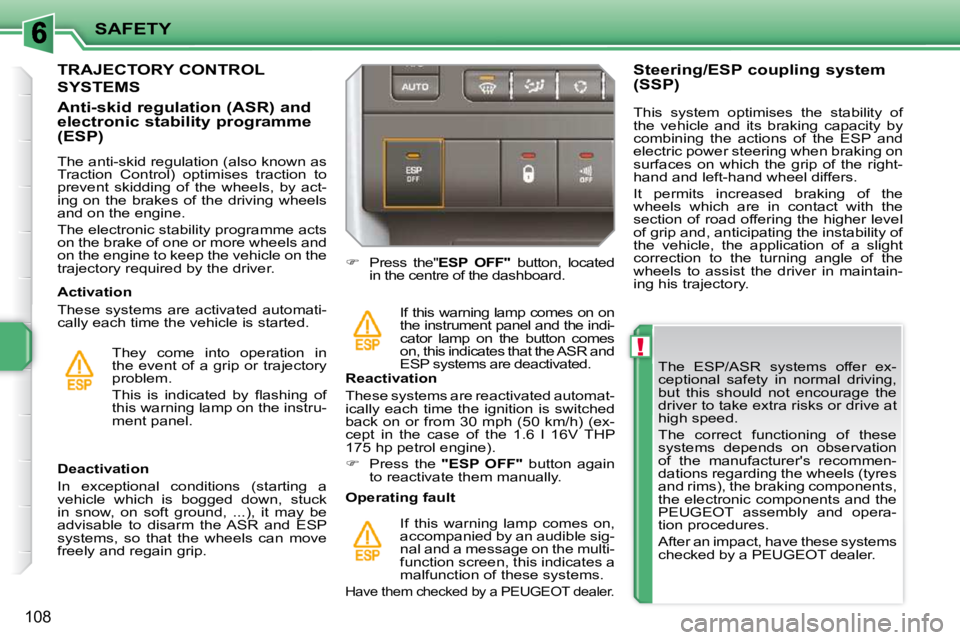
Press the" ESP OFF" button, located
in the centre of the dashboard.
If this warning lamp comes on on
the instrument panel and the indi-
cator lamp on the button comes
on, this indicates that the ASR and
ESP systems are deactivated.
Reactivation
These systems are reactivated automat-
ically each time the ignition is switched
back on or from 30 mph (50 km/h) (ex-
cept in the case of the 1.6 l 16V THP
175 hp petrol engine).
Press the "ESP OFF" button again
to reactivate them manually.
Operating fault
If this warning lamp comes on,
accompanied by an audible sig-
nal and a message on the multi-
function screen, this indicates a
malfunction of these systems.
Have them checked by a PEUGEOT dealer.
TRAJECTORY CONTROL
SYSTEMS
Activation
These systems are activated automati-
cally each time the vehicle is started.
Anti-skid regulation (ASR) and
electronic stability programme
(ESP)
They come into operation in
the event of a grip or trajectory
problem.
This is indicated by fl ashing of
this warning lamp on the instru-
ment panel. Steering/ESP coupling system
(SSP)
The anti-skid regulation (also known as
Traction Control) optimises traction to
prevent skidding of the wheels, by act-
ing on the brakes of the driving wheels
and on the engine.
The electronic stability programme acts
on the brake of one or more wheels and
on the engine to keep the vehicle on the
trajectory required by the driver. This system optimises the stability of
the vehicle and its braking capacity by
combining the actions of the ESP and
electric power steering when braking on
surfaces on which the grip of the right-
hand and left-hand wheel differs.
It permits increased braking of the
wheels which are in contact with the
section of road offering the higher level
of grip and, anticipating the instability of
the vehicle, the application of a slight
correction to the turning angle of the
wheels to assist the driver in maintain-
ing his trajectory.
Page 118 of 279
SAFETY
110
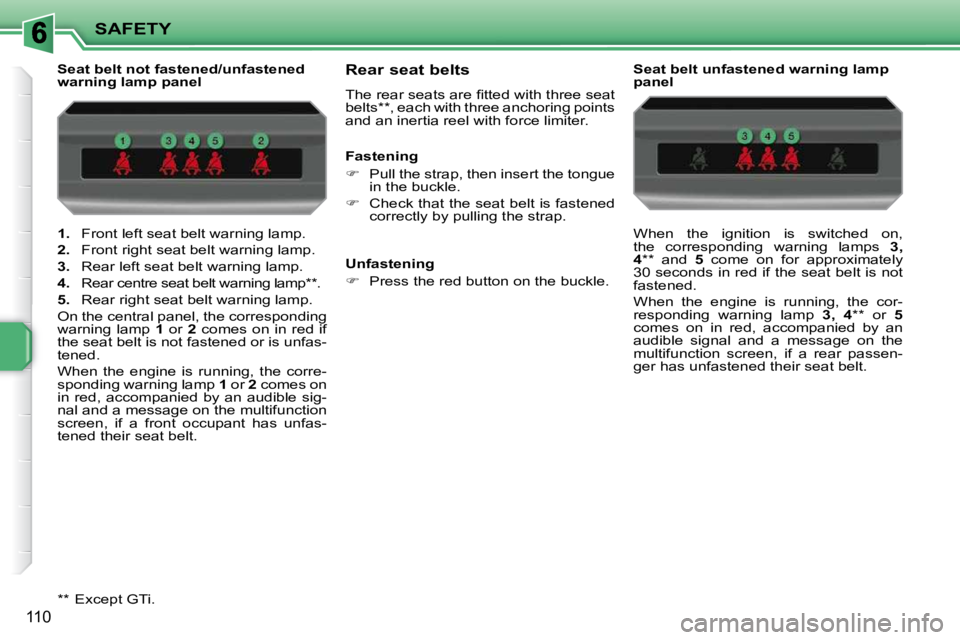
1. Front left seat belt warning lamp.
2. Front right seat belt warning lamp.
3. Rear left seat belt warning lamp.
4. Rear centre seat belt warning lamp ** .
5. Rear right seat belt warning lamp.
On the central panel, the corresponding
warning lamp 1 or 2 comes on in red if
the seat belt is not fastened or is unfas-
tened.
When the engine is running, the corre-
sponding warning lamp 1 or 2 comes on
in red, accompanied by an audible sig-
nal and a message on the multifunction
screen, if a front occupant has unfas-
tened their seat belt.
Seat belt not fastened/unfastened
warning lamp panel
Rear seat belts
The rear seats are fi tted with three seat
belts ** , each with three anchoring points
and an inertia reel with force limiter. Seat belt unfastened warning lamp
panel
When the ignition is switched on,
the corresponding warning lamps
3,
4 ** and 5 come on for approximately
30 seconds in red if the seat belt is not
fastened.
When the engine is running, the cor-
responding warning lamp 3, 4 ** or 5
comes on in red, accompanied by an
audible signal and a message on the
multifunction screen, if a rear passen-
ger has unfastened their seat belt.
Fastening
Pull the strap, then insert the tongue
in the buckle.
Check that the seat belt is fastened
correctly by pulling the strap.
Unfastening
Press the red button on the buckle.
** Except GTi.
Page 125 of 279
i
117
* According to engine.
GEAR CHANGE INDICATOR *
System which reduces fuel consump-
tion by advising the driver to change up
a gear on vehicles fi tted with a manual
gearbox.
Operation
The system acts solely in the context of
economical driving.
Depending on the driving situation and
your vehicle's equipment, the system
may advise you to skip one or more
gears. You can follow this instruction with-
out engaging the intermediate gears.
The gear engagement recommenda-
tions must not be considered compulsory.
In fact, the confi guration of the road, the
amount of traffi c and safety remain deter-
mining factors when choosing the best
gear. Therefore, the driver remains re-
sponsible for deciding whether or not to
follow the advice given by the system.
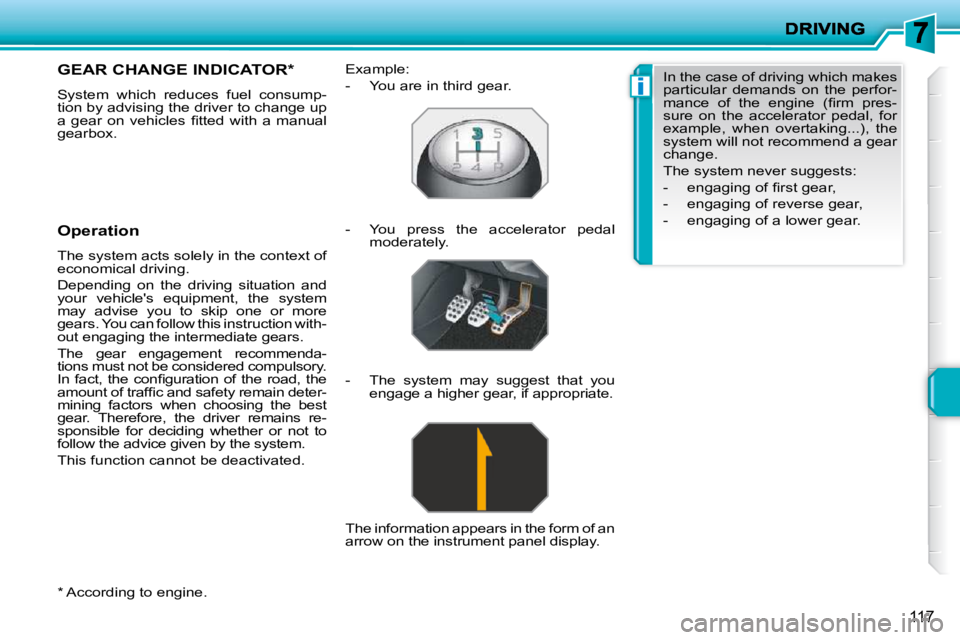
This function cannot be deactivated. Example:
- You are in third gear.
The information appears in the form of an
arrow on the instrument panel display. In the case of driving which makes
particular demands on the perfor-
mance of the engine (fi rm pres-
sure on the accelerator pedal, for
example, when overtaking...), the
system will not recommend a gear
change.
The system never suggests:
- engaging of fi rst gear,
- engaging of reverse gear,
- engaging of a lower gear.
- You press the accelerator pedal
moderately.
- The system may suggest that you engage a higher gear, if appropriate.
Page 126 of 279
i
118
"2 TRONIC" GEARBOX
(SALOON)
Five-speed electronically controlled
gearbox which offers a choice between
the comfort of automatic operation or
the pleasure of manual gear changing.
Three driving modes are offered:
- the automated mode for automatic
control of the gears by the gearbox,
- the sequential mode for manual
changing of the gears by the driver,
- the auto sequential mode for over-
taking, for example, remaining in
the automated mode while using the
functions of the sequential mode.
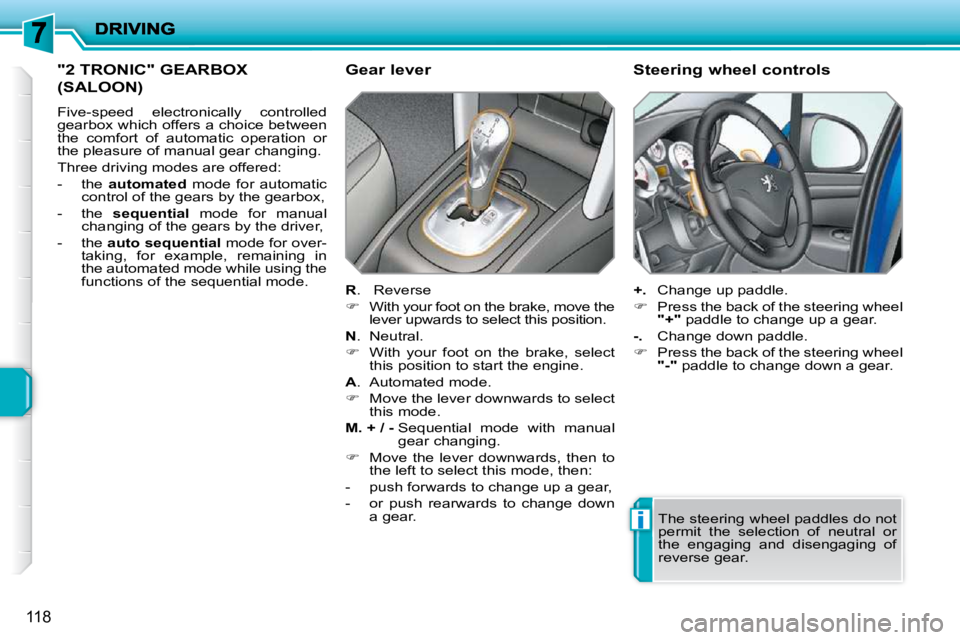
R . Reverse
With your foot on the brake, move the
lever upwards to select this position.
N . Neutral.
With your foot on the brake, select
this position to start the engine.
A . Automated mode.
Move the lever downwards to select
this mode.
M
.
+ / - Sequential mode with manual
gear changing.
Move the lever downwards, then to
the left to select this mode, then:
- push forwards to change up a gear,
- or push rearwards to change down a gear.
Gear lever
+
. Change up paddle.
Press the back of the steering wheel
"+" paddle to change up a gear.
-
. Change down paddle.
Press the back of the steering wheel
"-" paddle to change down a gear.
Steering wheel controls
The steering wheel paddles do not
permit the selection of neutral or
the engaging and disengaging of
reverse gear.
Page 127 of 279
i
i
i
119
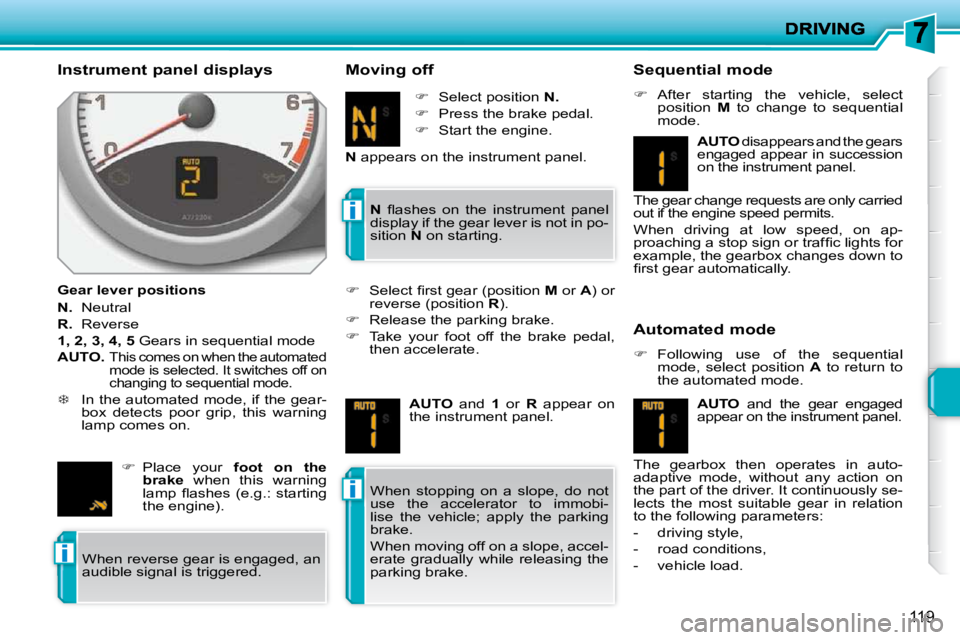
Instrument panel displays
Gear lever positions
N
. Neutral
R
. Reverse
1, 2, 3, 4, 5 Gears in sequential mode
AUTO.
This comes on when the automated
mode is selected. It switches off on
changing to sequential mode.
In the automated mode, if the gear-
box detects poor grip, this warning
lamp comes on. Moving off Sequential mode
After starting the vehicle, select
position M to change to sequential
mode.
Automated mode
Following use of the sequential
mode, select position A to return to
the automated mode.
When stopping on a slope, do not
use the accelerator to immobi-
lise the vehicle; apply the parking
brake.
When moving off on a slope, accel-
erate gradually while releasing the
parking brake.
Place your foot on the
brake when this warning
lamp fl ashes (e.g.: starting
the engine).
Select position N
.
Press the brake pedal.
Start the engine.
N appears on the instrument panel.
N fl ashes on the instrument panel
display if the gear lever is not in po-
sition N on starting.
Select fi rst gear (position M or A ) or
reverse (position R ).
Release the parking brake.
Take your foot off the brake pedal,
then accelerate.
AUTO and 1 or R appear on
the instrument panel.
AUTO disappears and the gears
engaged appear in succession
on the instrument panel.
The gear change requests are only carried
out if the engine speed permits.
When driving at low speed, on ap-
proaching a stop sign or traffi c lights for
example, the gearbox changes down to
fi rst gear automatically.
AUTO and the gear engaged
appear on the instrument panel.
The gearbox then operates in auto-
adaptive mode, without any action on
the part of the driver. It continuously se-
lects the most suitable gear in relation
to the following parameters:
- driving style,
- road conditions,
- vehicle load.
When reverse gear is engaged, an
audible signal is triggered.
Page 128 of 279
!
i
120
"Auto sequential" mode
In the automated mode, you can resume
control temporarily at any time using the
steering wheel controls.
The use of these controls permits man-
ual selection of the gears in situations
which require a more rapid change-down
than in the automated mode (arrival at
a roundabout, leaving a car park with a
steep gradient, overtaking...).
The gearbox engages the required gear if
the engine speed permits. AUTO remains
displayed on the instrument panel.
After a few minutes, the gearbox re-
sumes automatic control of the gears. "Snow" automated mode
In the automated mode, if the vehi-
cle detects poor grip, the gearbox will
change automatically to the "snow" au-
tomated mode.
Stopping the vehicle
Before switching off the engine, you can
change to position
N to be in neutral.
In this case, it is imperative that you ap-
ply the parking brake to immobilise the
vehicle.
Reinitialisation
Following disconnection of the battery,
the gearbox must be reinitialised.
Switch on the ignition. Operating fault
With the ignition on, if this warn-
ing lamp comes on and AUTO
fl ashes, accompanied by an au-
dible signal and a message on
the multifunction screen, this indicates
a gearbox malfunction.
Have it checked by a PEUGEOT dealer.
You must press the brake pedal
while starting the engine.
Never select neutral N while the
vehicle is moving.
Only engage reverse gear R when
the vehicle is immobilised, with
your foot on the brake pedal.
In all cases, it is imperative that you
apply the parking brake to immobi-
lise the vehicle.
If you press the accelerator pedal
beyond the point of resistance, the
gearbox selects the gear below to
permit sharper acceleration.
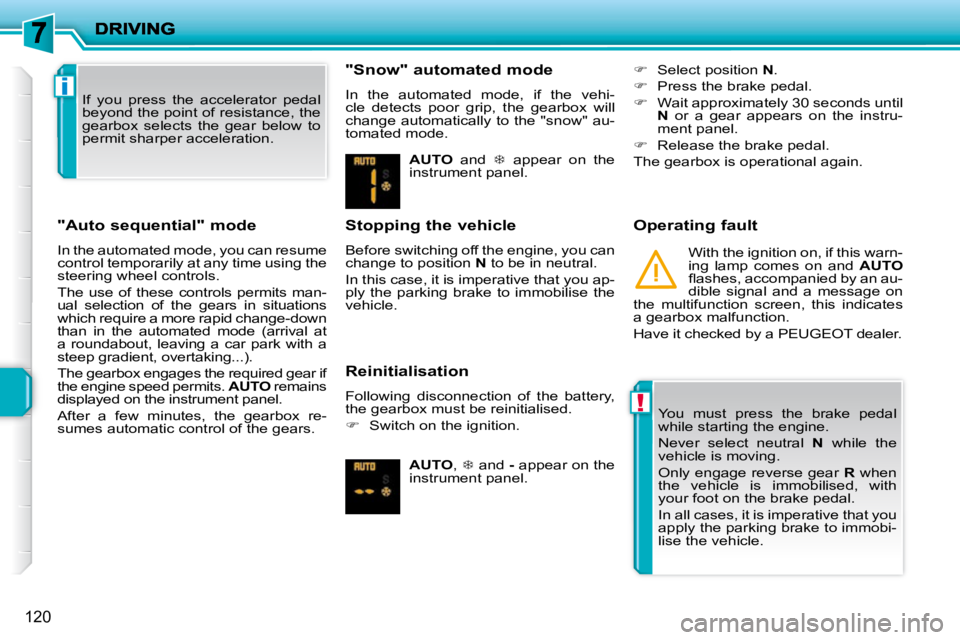
AUTO and appear on the
instrument panel.
AUTO , and - appear on the
instrument panel.
Select position N .
Press the brake pedal.
Wait approximately 30 seconds until
N or a gear appears on the instru-
ment panel.
Release the brake pedal.
The gearbox is operational again.
Page 129 of 279
121
4-SPEED AUTOMATIC
GEARBOX
Four-speed automatic gearbox which
offers a choice between the comfort of
fully automatic operation, enhanced by
sport and snow programmes, or manual
gear changing.
Therefore, four driving modes are of-
fered:
- automatic operation for electronic
management of the gears by the
gearbox,
- sport programme for a more dynamic
style of driving,
- snow programme to improve driving
when traction is poor,
- manual operation for sequential
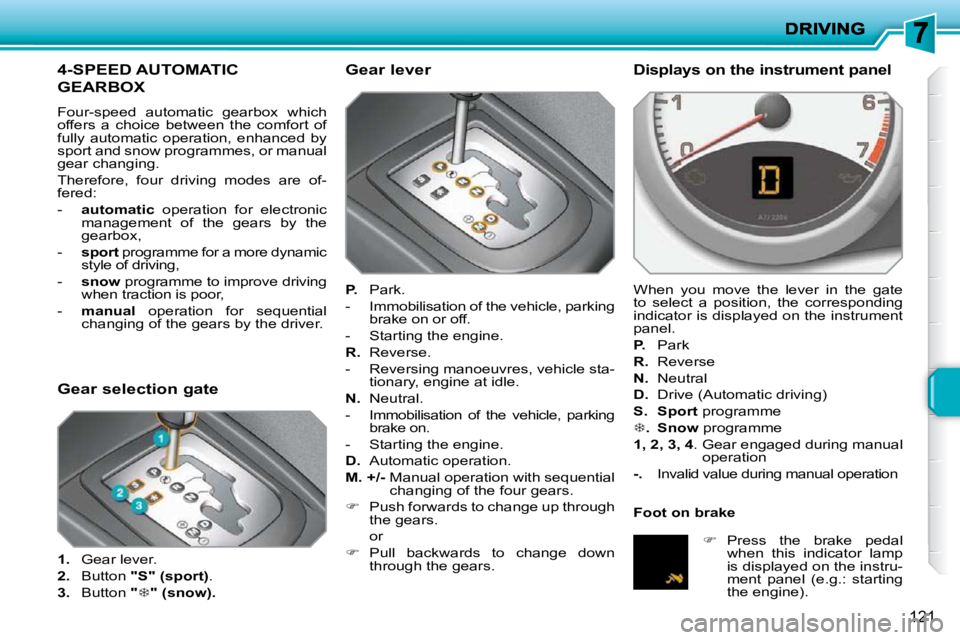
changing of the gears by the driver. Gear lever
P. Park.
- Immobilisation of the vehicle, parking brake on or off.
- Starting the engine.
R. Reverse.
- Reversing manoeuvres, vehicle sta- tionary, engine at idle.
N. Neutral.
- Immobilisation of the vehicle, parking brake on.
- Starting the engine.
D. Automatic operation.
M. +/- Manual operation with sequential
changing of the four gears.
Push forwards to change up through
the gears.
or
Pull backwards to change down
through the gears.
Displays on the instrument panel
When you move the lever in the gate
to select a position, the corresponding
indicator is displayed on the instrument
panel.
P. Park
R. Reverse
N. Neutral
D. Drive (Automatic driving)
S.
Sport programme
. Snow programme
1, 2, 3, 4 . Gear engaged during manual
operation
-. Invalid value during manual operation
Gear selection gate
1. Gear lever.
2. Button "S" (sport) .
3. Button "
" (snow). Foot on brake
Press the brake pedal
when this indicator lamp
is displayed on the instru-
ment panel (e.g.: starting
the engine).
Page 130 of 279
!
!
i
122
Moving off
Apply the parking brake.
Select position P or N .
Start the engine.
If this procedure is not followed, an au-
dible signal is heard, accompanied by a
message on the multifunction screen.
With the engine running, press the
brake pedal.
Release the parking brake.
Select position R , D or M. ,
Gradually release the brake pedal.
The vehicle moves off immediately.
If position N is engaged inadvert-
ently while driving, allow the engine
to return to idle then engage posi-
tion D to accelerate. The gearbox then operates in auto-
adaptive mode, without any intervention
on the part of the driver. It continuously
selects the most suitable gear accord-
ing to the style of driving, the profi le of
the road and the load in the vehicle.
For maximum acceleration without
touching the lever, press the accelera-
tor pedal down fully (kick down). The
gearbox changes down automatically
or maintains the gear selected until the
maximum engine speed is reached.
On braking, the gearbox changes down
automatically to provide effi cient engine
braking.
If you release the accelerator sharply,
the gearbox will not change to a higher
gear for safety reasons.
Automatic operation
Select position D for automatic
changing of the four gears.
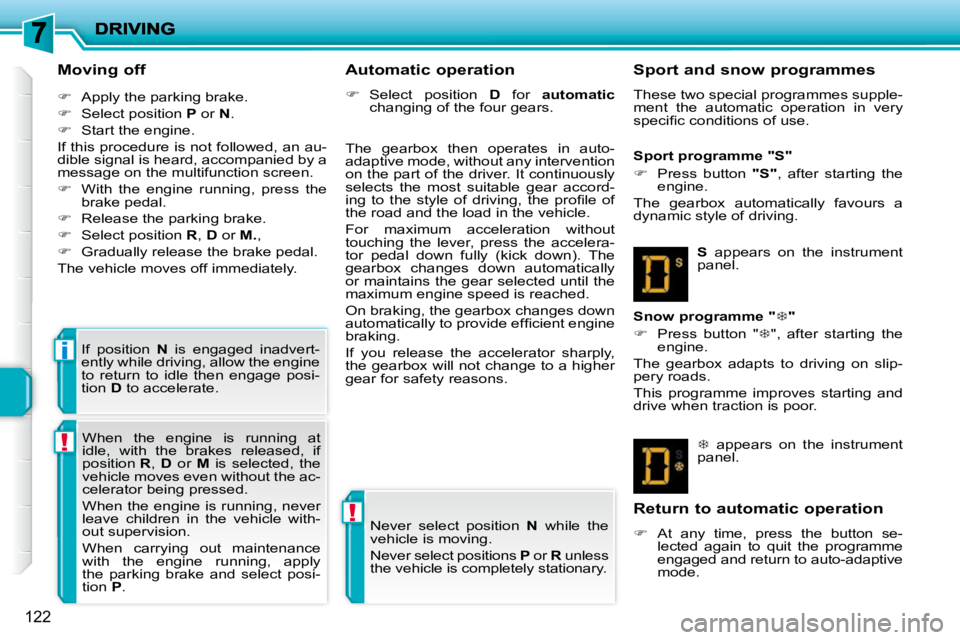
appears on the instrument
panel.
Snow programme "
"
Press button " ", after starting the
engine.
The gearbox adapts to driving on slip-
pery roads.
This programme improves starting and
drive when traction is poor.
S appears on the instrument
panel.
Sport programme "S"
Press button "S" , after starting the
engine.
The gearbox automatically favours a
dynamic style of driving.
Never select position N while the
vehicle is moving.
Never select positions P or R unless
the vehicle is completely stationary.
When the engine is running at
idle, with the brakes released, if
position
R , D or M is selected, the
vehicle moves even without the ac-
celerator being pressed.
When the engine is running, never
leave children in the vehicle with-
out supervision.
When carrying out maintenance
with the engine running, apply
the parking brake and select posi-
tion P . Sport and snow programmes
These two special programmes supple-
ment the automatic operation in very
specifi c conditions of use.
Return to automatic operation
At any time, press the button se-
lected again to quit the programme
engaged and return to auto-adaptive
mode.
Page 131 of 279
!i
123
Stopping the vehicle
Before switching off the engine, you
can engage position P or N to place the
gearbox in neutral.
In both cases, apply the parking brake
to immobilise the vehicle. Operating fault
When the ignition is on, the light-
ing of this warning lamp, accom-
panied by an audible signal and
a message on the multifunction
screen, indicates a gearbox mal-
function.
In this case, the gearbox switches to
back-up mode and is locked in 3rd gear.
You may feel a substantial knock when
changing from P to R and from N to R .
This will not cause any damage to the
gearbox.
Do not exceed 60 mph (100 km/h), local
speed restrictions permitting.
Contact a PEUGEOT dealer as soon as
possible.
There is a risk of damage to the
gearbox:
- if you press the accelerator and brake pedals at the same time,
- if you force the movement of the gear lever from the P posi-
tion to another position when
the battery is fl at.
Manual operation
Select position M for sequential
changing of the four gears.
Push the lever towards the + sign to
change up a gear.
Pull the lever towards the - sign to
change down a gear.
D disappears and the gears
engaged appear in succes-
sion on the instrument panel.
In the event of the engine la-
bouring or over-revving, the
gear selected fl ashes for a few sec-
onds, then the actual gear engaged is
displayed.
It is possible to change from position D
(automatic) to position M (manual) at
any time.
When the vehicle is stationary or mov-
ing very slowly, the gearbox selects
gear M1 automatically.
The sport and snow programmes do not
operate in manual mode. If the lever is not in position
P ,
when the driver's door is opened
or approximately 45 seconds after
the ignition is switched off, a mes-
sage appears in the multifunction
screen.
Return the lever to position P ;
the message disappears.
It is only possible to change from one
gear to another if the vehicle speed and
engine speed permit; otherwise, the
gearbox will operate temporarily in au-
tomatic mode.
Invalid value during manual
operation
This symbol is displayed if a
gear is not engaged correctly
(selector between two posi-
tions).