warning PEUGEOT 207 2011 Service Manual
[x] Cancel search | Manufacturer: PEUGEOT, Model Year: 2011, Model line: 207, Model: PEUGEOT 207 2011Pages: 248, PDF Size: 8.61 MB
Page 132 of 248
8
i
CHECKS
130
CHECKS
Unless otherwise indicated, check these
components in accordance with the
Warranty and Maintenance Record and in
relation to your engine.
Otherwise, have them checked by a
PEUGEOT dealer or a qualifi ed workshop.
Battery
The battery does not require
any maintenance.
However, check that the ter-
minals are clean and correctly
tightened, particularly in sum-
mer and winter.
When carrying out work on the battery,
refer to the "Practical information" sec-
tion for details of the precautions to be
taken before disconnecting the battery
and following its reconnection.
Air filter and passenger compartment filter
Refer to the Warranty and
Maintenance Record for de-
tails of the replacement inter-
vals for these components.
Depending on the environ-
ment (dusty atmosphere...) and the use
of the vehicle (city driving...), replace
them twice as often if necessary
.
A clogged passenger compartment fi lter
may have an adverse effect on the per-
formance of the air conditioning system
and generate undesirable odours.
Particle emission filter (Diesel)
Illumination of the service warning lamp togeth-
er with a related message indicates the start of
saturation of the particle emissions fi lter.
As soon as the driving conditions permit, re-
generate the fi lter by driving at a speed of at
least 35 mph (60 km/h) until the service warn-
ing lamp goes off.
Maintenance of the particle emission fi lter
must be carried out by a PEUGEOT dealer or
a qualifi ed workshop.
Oil filter
Replace the oil fi lter each time
the engine oil is changed.
Refer to the Warranty and
Maintenance Record for de-
tails of the replacement inter-
val for this component. Following prolonged operation of
the vehicle at very low speed or at
idle, you may, exceptionally, notice
the emission of water vapour at
the exhaust on acceleration. This
does not have any adverse effect
on the performance of the vehicle
or on the environment.
Page 152 of 248
9PRACTICAL INFORMATION
150
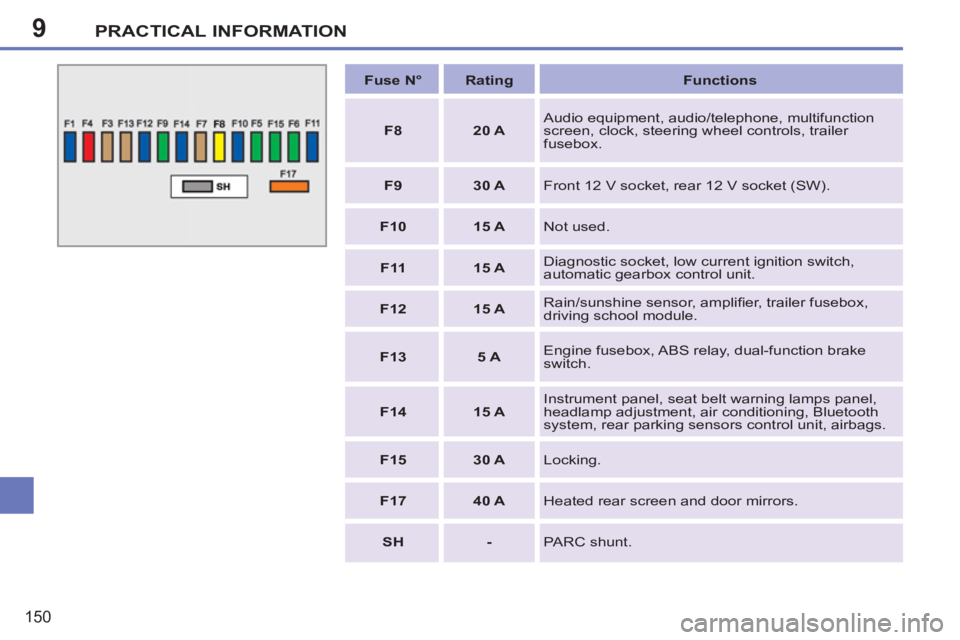
Fuse N°
Rating
Functions
F8
20 A
Audio equipment, audio/telephone, multifunction
screen, clock, steering wheel controls, trailer
fusebox.
F9
30 A
Front 12 V socket, rear 12 V socket (SW).
F10
15 A
Not used.
F11
15 A
Diagnostic socket, low current ignition switch,
automatic gearbox control unit.
F12
15 A
Rain/sunshine sensor, amplifi er, trailer fusebox,
driving school module.
F13
5 A
Engine fusebox, ABS relay, dual-function brake
switch.
F14
15 A
Instrument panel, seat belt warning lamps panel,
headlamp adjustment, air conditioning, Bluetooth
system, rear parking sensors control unit, airbags.
F15
30 A
Locking.
F17
40 A
Heated rear screen and door mirrors.
SH
-
PARC shunt.
Page 158 of 248
9
i
i
PRACTICAL INFORMATION
156
TOWING THE VEHICLE
Procedure for having your vehicle towed
or for towing another vehicle using a re-
movable towing eye.
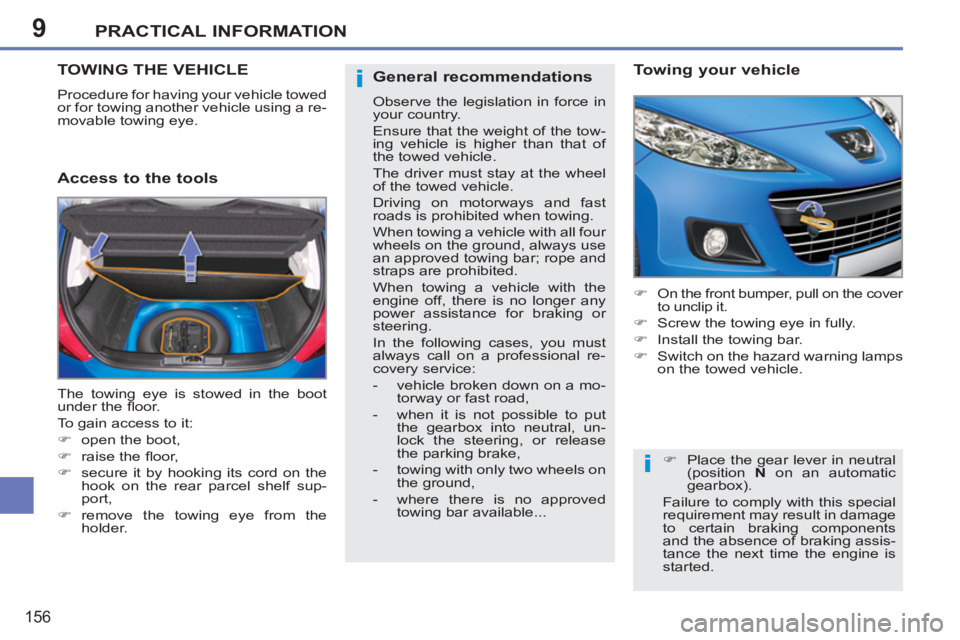
Access to the tools
Towing your vehicle
)
On the front bumper, pull on the cover
to unclip it.
)
Screw the towing eye in fully.
)
Install the towing bar.
)
Switch on the hazard warning lamps
on the towed vehicle.
The towing eye is stowed in the boot
under the fl oor.
To gain access to it:
)
open the boot,
)
raise the fl oor,
)
secure it by hooking its cord on the
hook on the rear parcel shelf sup-
port,
)
remove the towing eye from the
holder.
)
Place the gear lever in neutral
(position N
on an automatic
gearbox).
Failure to comply with this special
requirement may result in damage
to certain braking components
and the absence of braking assis-
tance the next time the engine is
started.
General recommendations
Observe the legislation in force in
your country.
Ensure that the weight of the tow-
ing vehicle is higher than that of
the towed vehicle.
The driver must stay at the wheel
of the towed vehicle.
Driving on motorways and fast
roads is prohibited when towing.
When towing a vehicle with all four
wheels on the ground, always use
an approved towing bar; rope and
straps are prohibited.
When towing a vehicle with the
engine off, there is no longer any
power assistance for braking or
steering.
In the following cases, you must
always call on a professional re-
covery service:
- vehicle broken down on a mo-
torway or fast road,
- when it is not possible to put
the gearbox into neutral, un-
lock the steering, or release
the parking brake,
- towing with only two wheels on
the ground,
- where there is no approved
towing bar available...
Page 159 of 248
9
ii
PRACTICAL INFORMATION
157
)
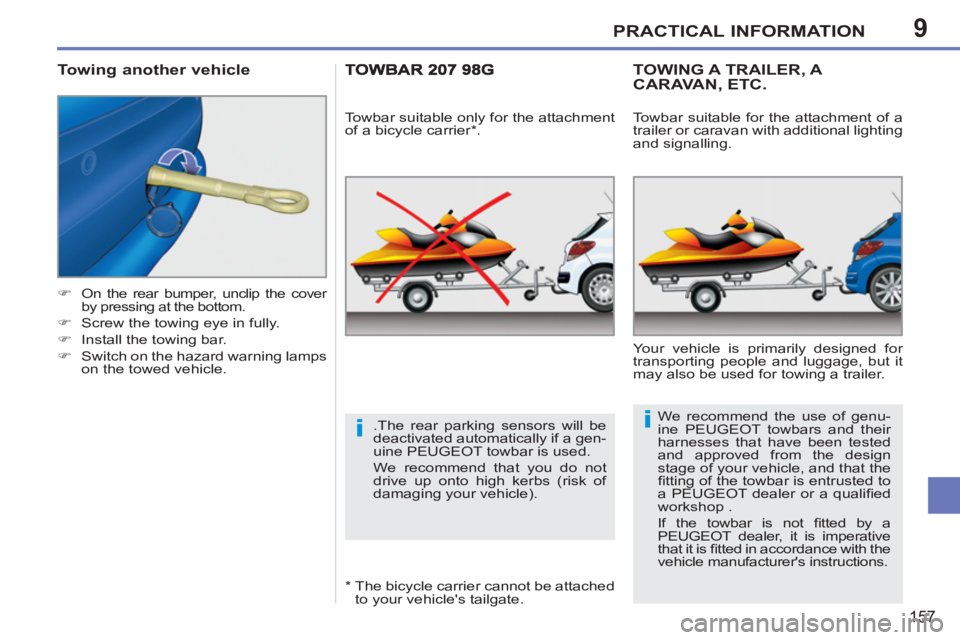
On the rear bumper, unclip the cover
by pressing at the bottom.
)
Screw the towing eye in fully.
)
Install the towing bar.
)
Switch on the hazard warning lamps
on the towed vehicle.
Towing another vehicle
*
The bicycle carrier cannot be attached
to your vehicle's tailgate.
Towbar suitable only for the attachment
of a bicycle carrier *
.
TOWING A TRAILER, A
CARAVAN, ETC.
Your vehicle is primarily designed for
transporting people and luggage, but it
may also be used for towing a trailer.
Towbar suitable for the attachment of a
trailer or caravan with additional lighting
and signalling.
We recommend the use of genu-
ine PEUGEOT towbars and their
harnesses that have been tested
and approved from the design
stage of your vehicle, and that the
fi tting of the towbar is entrusted to
a PEUGEOT dealer or a qualifi ed
workshop .
If the towbar is not fi tted by a
PEUGEOT dealer, it is imperative
that it is fi tted in accordance with the
vehicle manufacturer's instructions. . The rear parking sensors will be
deactivated automatically if a gen-
uine PEUGEOT towbar is used.
We recommend that you do not
drive up onto high kerbs (risk of
damaging your vehicle).
Page 160 of 248
9
i
PRACTICAL INFORMATION
158
Driving advice
Distribution of loads
)
Distribute the load in the trailer so
that the heaviest items are as close
as possible to the axle and the nose
weight approaches the maximum
permitted without exceeding it.
Air density decreases with altitude, thus
reducing engine performance. Above
1 000 metres, the maximum towed load
must be reduced by 10 % for every
1 000 metres of altitude.
Refer to the "Technical Data" section for
details of the weights and towed loads
which apply to your vehicle.
Side wind
)
Take into account the increased
sensitivity to side wind.
Cooling
Towing a trailer on a slope increases
the temperature of the coolant.
As the fan is electrically controlled, its
cooling capacity is not dependent on
the engine speed.
)
To lower the engine speed, reduce
your speed. Driving with a trailer places greater de-
mands on the towing vehicle and the
driver must take particular care. The maximum towed load on a long in-
cline depends on the gradient and the
ambient temperature.
In all cases, keep a check on the coolant
temperature.
Braking
Towing a trailer increases the braking
distance.
Tyres
)
Check the tyre pressures of the towing
vehicle and of the trailer, observing the
recommended pressures.
Lighting
)
Check the electrical lighting and sig-
nalling on the trailer.
The rear parking sensors will be
deactivated automatically if a gen-
uine PEUGEOT towbar is used.
)
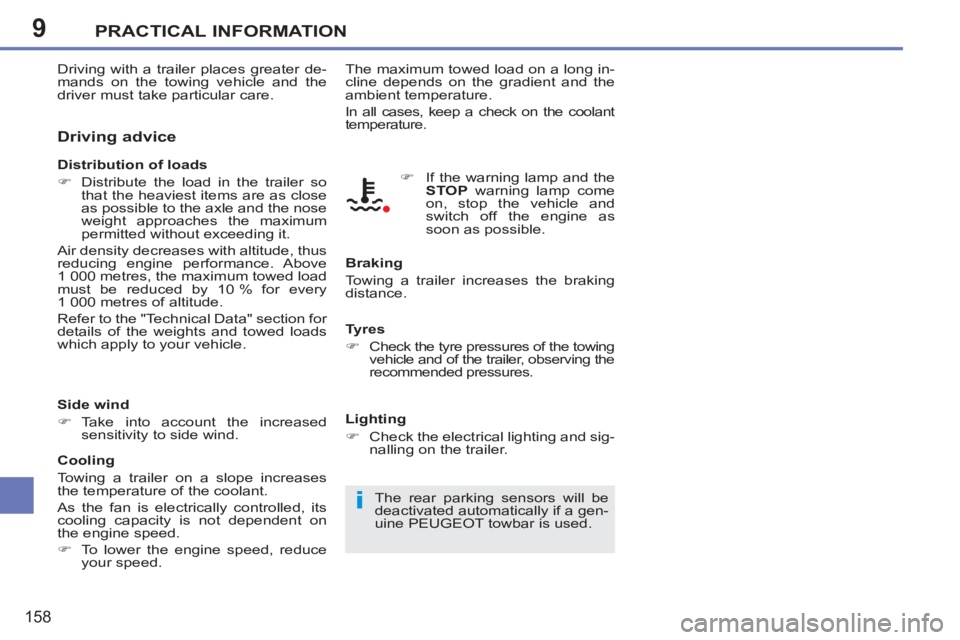
If the warning lamp and the
STOP
warning lamp come
on, stop the vehicle and
switch off the engine as
soon as possible.
Page 162 of 248
9PRACTICAL INFORMATION
160
ACCESSORIES
A wide range of accessories and
genuine parts is available from the
PEUGEOT dealer network.
These accessories and parts have been
tested and approved for reliability and
safety.
They are all adapted to your vehicle and
benefi t from PEUGEOT's recommenda-
tion and warranty.
Conversion kits
You can obtain an "Enterprise" kit to
convert a trade vehicle to a private car
and vice-versa.
"Transport solutions":
boot liner, luggage net, cigarette lighter,
roof bars, bicycle carrier on roof bars,
ski carrier, roof box...
Tow bar, which mst be fi tted by PEUGEOT
dealer or a qualifi ed workshop.
"Comfort":
door defl ectors, side blinds and rear
blind, coat hanger fi xed to head restraint,
front centre armrest, under shelf storage,
front and rear parking sensors...
"Styling":
aluminium gear lever knob, spoiler, styl-
ing strips, alloy wheels, trims, chromed
mirror shells, body kit...
*
To avoid any risk of jamming of the
pedals:
- ensure that the mat is positioned
and secured correctly,
- never fi t one mat on top of another.
"Security":
anti-theft alarm, window engraving,
wheel security bolts, child seats and
booster cushions, breathalyzer, fi rst aid
kit, warning triangle, high visibility jack-
et, stolen vehicle tracking system, tem-
porary puncture repair kit, snow chains,
non-slip covers, front foglamps kit...
"Protection":
mats * , seat covers compatible with lat-
eral airbags, aluminium or PVC door
aperture fi nishers...
Page 163 of 248
9
!
i
i
PRACTICAL INFORMATION
161
Installation of radio
communication transmitters
Before installing any after-market ra-
dio communication transmitter, you
can contact a PEUGEOT dealer for
the specifi cation of transmitters which
can be fi tted (frequency, maximum
power, aerial position, specifi c instal-
lation requirements), in line with the
Vehicle Electromagnetic Compatibility
Directive (2004/104/EC)
.
Depending on the legislation in
force in the country, it may be
compulsory to have a high vis-
ibility safety vest, warning triangle
and spare bulbs and fuses avail-
able in the vehicle.
The fi tting of electrical equipment
or accessories which are not rec-
ommended by PEUGEOT may
result in a failure of your vehicle's
electronic system and excessive
electrical consumption.
Please note this precaution. You
are advised to contact a PEUGEOT
representative to be shown the
range of recommended equipment
and accessories.
"Multimedia":
audio systems, satellite navigation
systems, hands-free kit, CD changer,
speakers, DVD player, connection kit
for MP3 or CD player, USB Box...
You can also obtain products for cleaning
and maintenance (exterior and interior),
topping up (screenwash...), and refi lls
(cartridge for the temporary puncture re-
pair kit...) by visiting a PEUGEOT dealer.
Page 166 of 248
10
164
TECHNICAL DATA
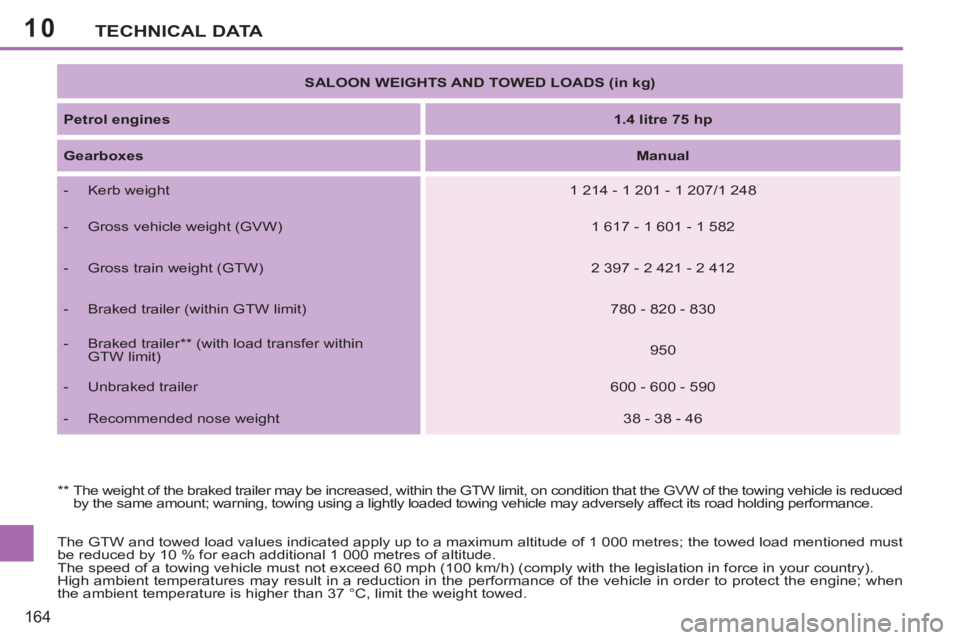
The GTW and towed load values indicated apply up to a maximum altitude of 1 000 metres; the towed load mentioned must
be reduced by 10 % for each additional 1 000 metres of altitude.
The speed of a towing vehicle must not exceed 60 mph (100 km/h) (comply with the legislation in force in your country).
High ambient temperatures may result in a reduction in the performance of the vehicle in order to protect the engine; when
the ambient temperature is higher than 37 °C, limit the weight towed.
SALOON WEIGHTS AND TOWED LOADS (in kg)
Petrol engines
1.4 litre 75 hp
Gearboxes
Manual
- Kerb weight
1 214 - 1 201 - 1 207/1 248
- Gross vehicle weight (GVW)
1 617 - 1 601 - 1 582
- Gross train weight (GTW)
2 397 - 2 421 - 2 412
- Braked trailer (within GTW limit)
780 - 820 - 830
- Braked trailer ** (with load transfer within
GTW limit)
950
- Unbraked trailer
600 - 600 - 590
- Recommended nose weight
38 - 38 - 46
** The weight of the braked trailer may be increased, within the GTW limit, on condition that the GVW of the towing vehicle is reduced
by the same amount; warning, towing using a lightly loaded towing vehicle may adversely affect its road holding performance.
Page 167 of 248
10TECHNICAL DATA
165
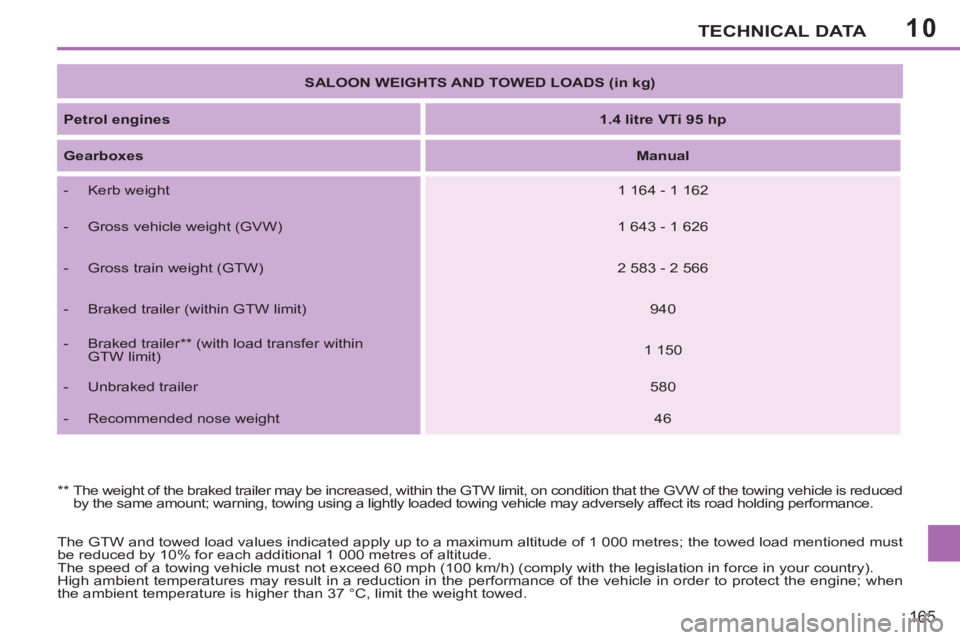
The GTW and towed load values indicated apply up to a maximum altitude of 1 000 metres; the towed load mentioned must
be reduced by 10% for each additional 1 000 metres of altitude.
The speed of a towing vehicle must not exceed 60 mph (100 km/h) (comply with the legislation in force in your country).
High ambient temperatures may result in a reduction in the performance of the vehicle in order to protect the engine; when
the ambient temperature is higher than 37 °C, limit the weight towed.
** The weight of the braked trailer may be increased, within the GTW limit, on condition that the GVW of the towing vehicle is reduced
by the same amount; warning, towing using a lightly loaded towing vehicle may adversely affect its road holding performance.
SALOON WEIGHTS AND TOWED LOADS (in kg)
Petrol engines
1.4 litre VTi 95 hp
Gearboxes
Manual
- Kerb weight
1 164 - 1 162
- Gross vehicle weight (GVW)
1 643 - 1 626
- Gross train weight (GTW)
2 583 - 2 566
- Braked trailer (within GTW limit)
940
- Braked trailer ** (with load transfer within
GTW limit)
1 150
- Unbraked trailer
580
- Recommended nose weight
46
Page 168 of 248
10
166
TECHNICAL DATA
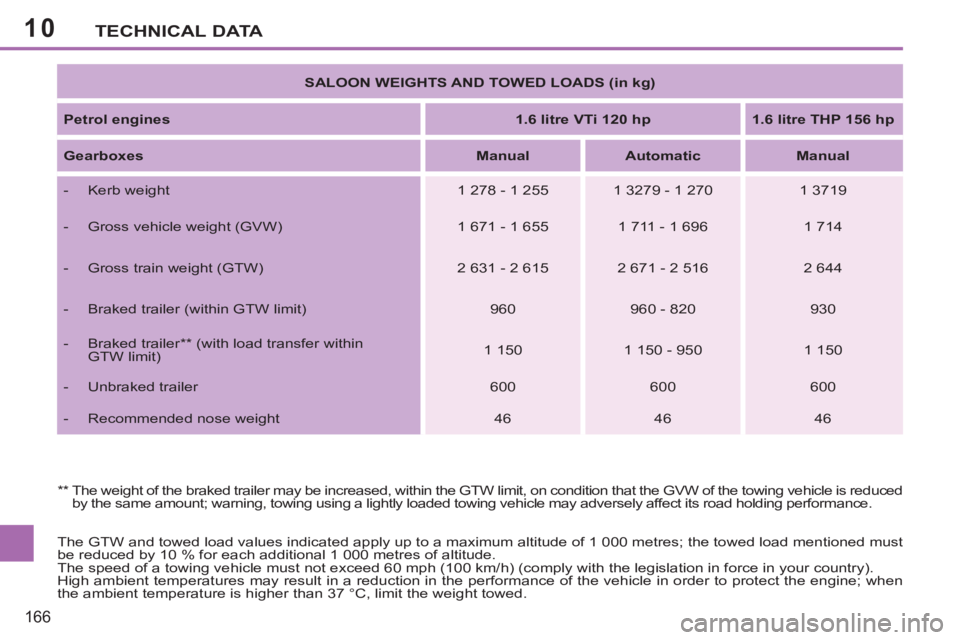
SALOON WEIGHTS AND TOWED LOADS (in kg)
Petrol engines
1.6 litre VTi 120 hp
1.6 litre THP 156 hp
Gearboxes
Manual
Automatic
Manual
- Kerb weight
1 278 - 1 255
1 3279 - 1 270
1 3719
- Gross vehicle weight (GVW)
1 671 - 1 655
1 711 - 1 696
1 714
- Gross train weight (GTW) 2 631 - 2 615
2 671 - 2 516
2 644
- Braked trailer (within GTW limit) 960
960 - 820
930
- Braked trailer ** (with load transfer within
GTW limit)
1 150
1 150 - 950
1 150
- Unbraked trailer
600
600
600
- Recommended nose weight
46
46
46
The GTW and towed load values indicated apply up to a maximum altitude of 1 000 metres; the towed load mentioned must
be reduced by 10 % for each additional 1 000 metres of altitude.
The speed of a towing vehicle must not exceed 60 mph (100 km/h) (comply with the legislation in force in your country).
High ambient temperatures may result in a reduction in the performance of the vehicle in order to protect the engine; when
the ambient temperature is higher than 37 °C, limit the weight towed.
** The weight of the braked trailer may be increased, within the GTW limit, on condition that the GVW of the towing vehicle is red
uced
by the same amount; warning, towing using a lightly loaded towing vehicle may adversely affect its road holding performance.