parking Peugeot 207 CC 2012 User Guide
[x] Cancel search | Manufacturer: PEUGEOT, Model Year: 2012, Model line: 207 CC, Model: Peugeot 207 CC 2012Pages: 224, PDF Size: 7.1 MB
Page 111 of 224
7
!i
DRIVING
109
Stopping the vehicle
Before switching off the engine, you
can engage position P
or N
to place the
gearbox in neutral.
In both cases, apply the parking brake
to immobilise the vehicle.
Operating fault
There is a risk of damage to the
gearbox:
- if you press the accelerator and
brake pedals at the same time,
- if you force the movement of
the gear lever from the P
posi-
tion to another position when
the battery is fl at.
To reduce fuel consumption when
at a prolonged standstill with the
engine running (traffi c jam...), put
the gear lever in the N
position and
apply the parking brake.
Manual operation
)
Select position M
for sequential
changing of the four gears.
)
Push the lever towards the +
sign to
change up a gear.
)
Pull the lever towards the -
sign to
change down a gear.
D
disappears and the gears
engaged appear in succes-
sion on the instrument panel.
If the engine speed is too low
or too high, the gear selected
fl ashes for a few seconds, then the ac-
tual gear engaged is displayed.
It is possible to change from position D
(automatic) to position M
(manual) at
any time.
When the vehicle is stationary or mov-
ing very slowly, the gearbox selects
gear M1
automatically.
The sport and snow programmes do not
operate in manual mode. If the lever is not in position P
,
when the driver's door is opened
or approximately 45 seconds after
the ignition is switched off, a mes-
sage appears in the multifunction
screen.
)
Return the lever to position P
;
the message disappears.
It is only possible to change from one
gear to another if the vehicle speed and
engine speed permit; otherwise, the
gearbox will operate temporarily in au-
tomatic mode.
Invalid value during manual
operation
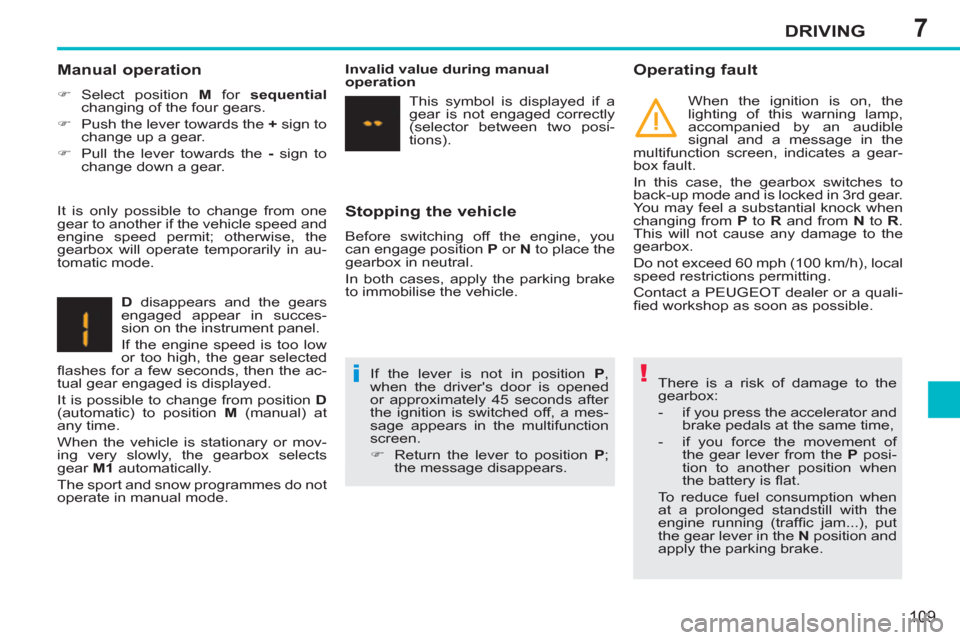
This symbol is displayed if a
gear is not engaged correctly
(selector between two posi-
tions).
When the ignition is on, the
lighting of this warning lamp,
accompanied by an audible
signal and a message in the
multifunction screen, indicates a gear-
box fault.
In this case, the gearbox switches to
back-up mode and is locked in 3rd gear.
You may feel a substantial knock when
changing from P
to R
and from N
to R
.
This will not cause any damage to the
gearbox.
Do not exceed 60 mph (100 km/h), local
speed restrictions permitting.
Contact a PEUGEOT dealer or a quali-
fi ed workshop as soon as possible.
Page 116 of 224
7
i
i
DRIVING
11 4
VISUAL AND AUDIBLE
PARKING SENSORS
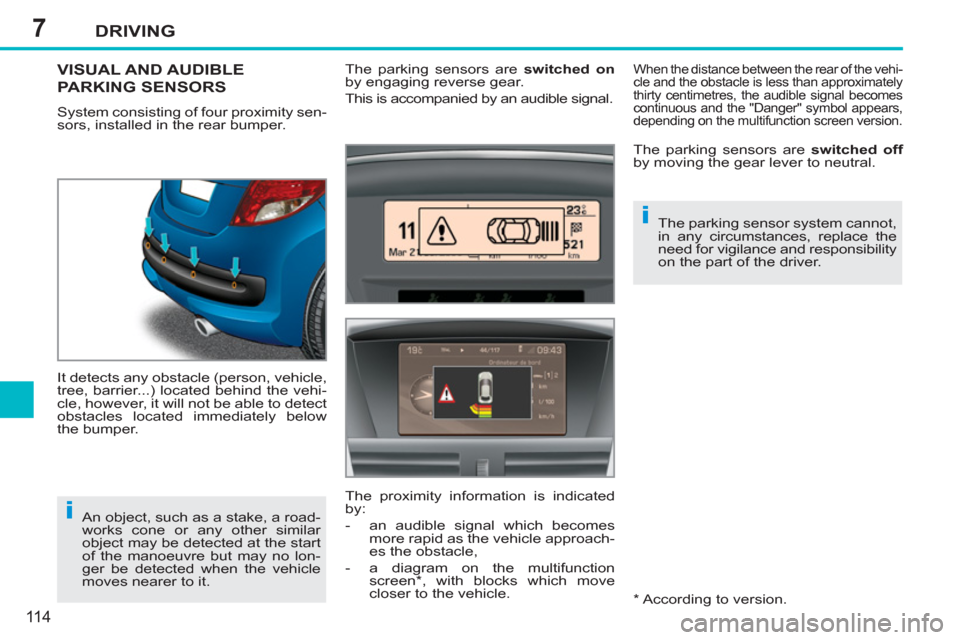
System consisting of four proximity sen-
sors, installed in the rear bumper.
It detects any obstacle (person, vehicle,
tree, barrier...) located behind the vehi-
cle, however, it will not be able to detect
obstacles located immediately below
the bumper. The parking sensors are switched on
by engaging reverse gear.
This is accompanied by an audible signal.
*
According to version. An object, such as a stake, a road-
works cone or any other similar
object may be detected at the start
of the manoeuvre but may no lon-
ger be detected when the vehicle
moves nearer to it.
When the distance between the rear of the vehi-
cle and the obstacle is less than approximately
thirty centimetres, the audible signal becomes
continuous and the "Danger" symbol appears,
depending on the multifunction screen version.
The parking sensor system cannot,
in any circumstances, replace the
need for vigilance and responsibility
on the part of the driver. The parking sensors are switched off
by moving the gear lever to neutral.
The proximity information is indicated
by:
- an audible signal which becomes
more rapid as the vehicle approach-
es the obstacle,
- a diagram on the multifunction
screen * , with blocks which move
closer to the vehicle.
Page 117 of 224
7
ii
i
DRIVING
115
Deactivation/Activation of the rear
parking sensors
Operating fault
In bad weather or in winter, ensure
that the sensors are not covered
with mud, ice or snow. When re-
verse gear is engaged, an audible
signal (long beep) indicates that
the sensors may be dirty.
When the vehicle is moving at a
speed below 6 mph (10 km/h), cer-
tain sound sources (motorcycle,
lorry, pneumatic drill, etc.) may trig-
ger the audible signals of the park-
ing sensor system.
In the event of a malfunction of
the system, when reverse gear is
engaged this warning lamp is dis-
played in the instrument panel and/
or a message appears in the screen, accom-
panied by an audible signal (short beep).
Contact a PEUGEOT dealer or a quali-
fi ed workshop.
The status of the function is stored
when the ignition is switched off.
For more information on access to
the parking sensors menu, refer to
the section covering the confi gura-
tion of vehicle systems.
The function will be deactivated au-
tomatically if a trailer is being towed
or a bicycle carrier is fi tted (vehicle
fi tted with a towbar or bicycle car-
rier recommended by PEUGEOT).
The function is deactivated
or activated via the vehicle
confi guration menu.
Page 124 of 224
8
!
CHECKS
122
Only use products recommended
by PEUGEOT or products of equiv-
alent quality and specifi cations.
In order to optimise the operation
of units as important as the braking
system, PEUGEOT selects and of-
fers very specifi c products.
To avoid damaging the electrical
units, the use of a high pressure
washer in the engine compartment
is strictly prohibited
.
Automatic gearbox
The gearbox does not re-
quire any maintenance (no oil
change).
Refer to the servicing booklet
for details of the checking in-
tervals for this component.
Brake disc and drum wear
For any information relating
to checking of the brake disc
and/or drum wear, contact a
PEUGEOT dealer or a quali-
fi ed workshop.
Manual gearbox
The gearbox does not re-
quire any maintenance (no oil
change).
Refer to the servicing booklet
for details of the level checking
intervals for this component.
Brake pads
Brake wear depends on the
style of driving, particularly in
the case of vehicles used in
town, over short distances. It
may be necessary to have the
condition of the brakes checked, even
between vehicle services.
Unless there is a leak on the circuit, a
drop in the brake fl uid level indicates
that the brake pads are worn.
Parking brake
If the parking brake travel is
too long or if you notice a loss
of effectiveness of this sys-
tem, the parking brake must
be adjusted, even between
two services.
This system must be checked by a PEUGEOT
dealer or a qualifi ed workshop.
Page 132 of 224
9
i
PRACTICAL INFORMATION
130
Parking the vehicle
Immobilise the vehicle where it
does not block traffi c: if possible,
park the vehicle on level, stable
and non-slippery ground.
Apply the parking brake, switch off
the ignition and engage fi rst gear *
to lock the wheels.
If necessary, place a chock under
the wheel diagonally opposite the
wheel to be changed.
It is imperative that you ensure that
the occupants get out of the vehicle
and wait in a safe location.
Never go underneath a vehicle
raised using a jack; use an axle
stand.
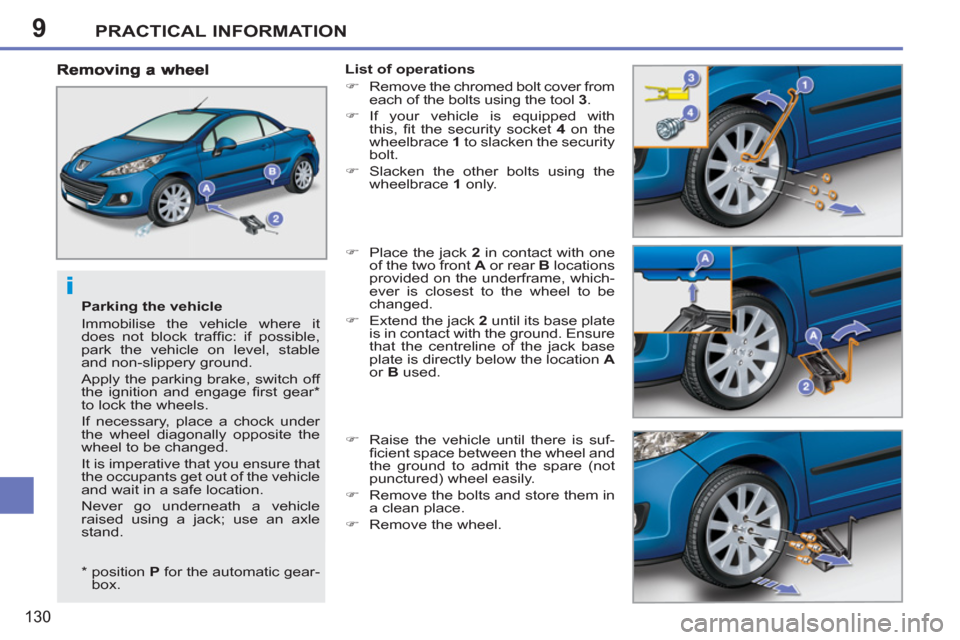
List of operations
)
Remove the chromed bolt cover from
each of the bolts using the tool 3
.
)
If your vehicle is equipped with
this, fi t the security socket 4
on the
wheelbrace 1
to slacken the security
bolt.
)
Slacken the other bolts using the
wheelbrace 1
only.
)
Place the jack 2
in contact with one
of the two front A
or rear B
locations
provided on the underframe, which-
ever is closest to the wheel to be
changed.
)
Extend the jack 2
until its base plate
is in contact with the ground. Ensure
that the centreline of the jack base
plate is directly below the location A
or B
used.
)
Raise the vehicle until there is suf-
fi cient space between the wheel and
the ground to admit the spare (not
punctured) wheel easily.
)
Remove the bolts and store them in
a clean place.
)
Remove the wheel.
* position P
for the automatic gear-
box.
Page 140 of 224
9PRACTICAL INFORMATION
138
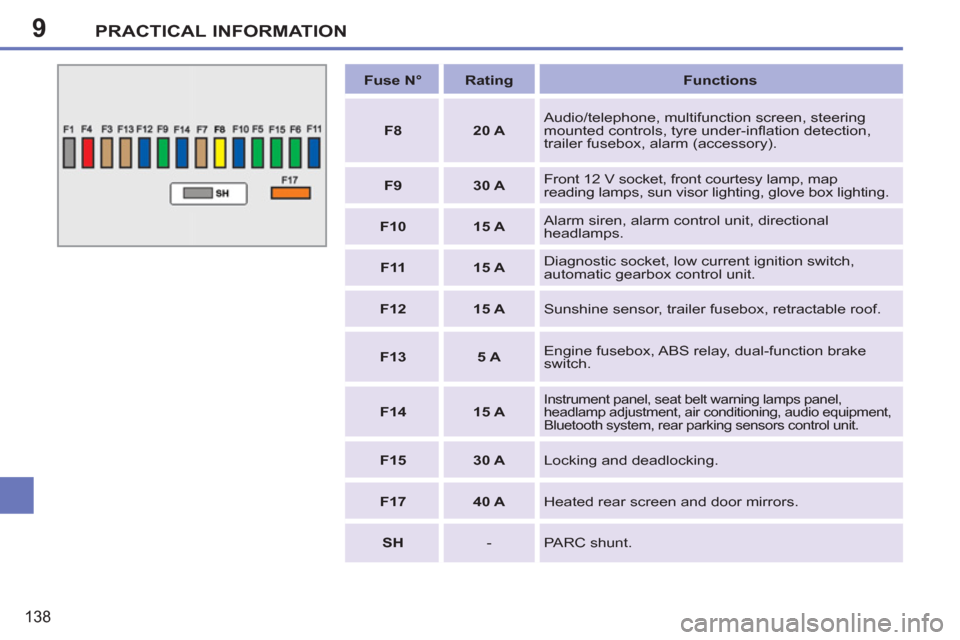
Fuse N°
Rating
Functions
F8
20 A
Audio/telephone, multifunction screen, steering
mounted controls, tyre under-infl ation detection,
trailer fusebox, alarm (accessory).
F9
30 A
Front 12 V socket, front courtesy lamp, map
reading lamps, sun visor lighting, glove box lighting.
F10
15 A
Alarm siren, alarm control unit, directional
headlamps.
F11
15 A
Diagnostic socket, low current ignition switch,
automatic gearbox control unit.
F12
15 A
Sunshine sensor, trailer fusebox, retractable roof.
F13
5 A
Engine fusebox, ABS relay, dual-function brake
switch.
F14
15 A
Instrument panel, seat belt warning lamps panel,
headlamp adjustment, air conditioning, audio equipment,
Bluetooth system, rear parking sensors control unit.
F15
30 A
Locking and deadlocking.
F17
40 A
Heated rear screen and door mirrors.
SH
- PARC shunt.
Page 147 of 224
9
!
i
PRACTICAL INFORMATION
145
General recommendations
Observe the legislation in force in
your country.
Ensure that the weight of the tow-
ing vehicle is higher than that of the
towed vehicle.
The driver must stay at the wheel
of the towed vehicle.
Driving on motorways and fast
roads is prohibited when towing.
When towing a vehicle with all four
wheels on the ground, always use
an approved towing bar; rope and
straps are prohibited.
When towing a vehicle with the
engine off, there is no longer any
power assistance for braking or
steering.
In the following cases, you must al-
ways call on a professional recovery
service:
- vehicle broken down on a mo-
torway or fast road,
- when it is not possible to put the
gearbox into neutral, unlock the
steering, or release the parking
brake,
- towing with only two wheels on
the ground,
- where there is no approved
towing bar available...
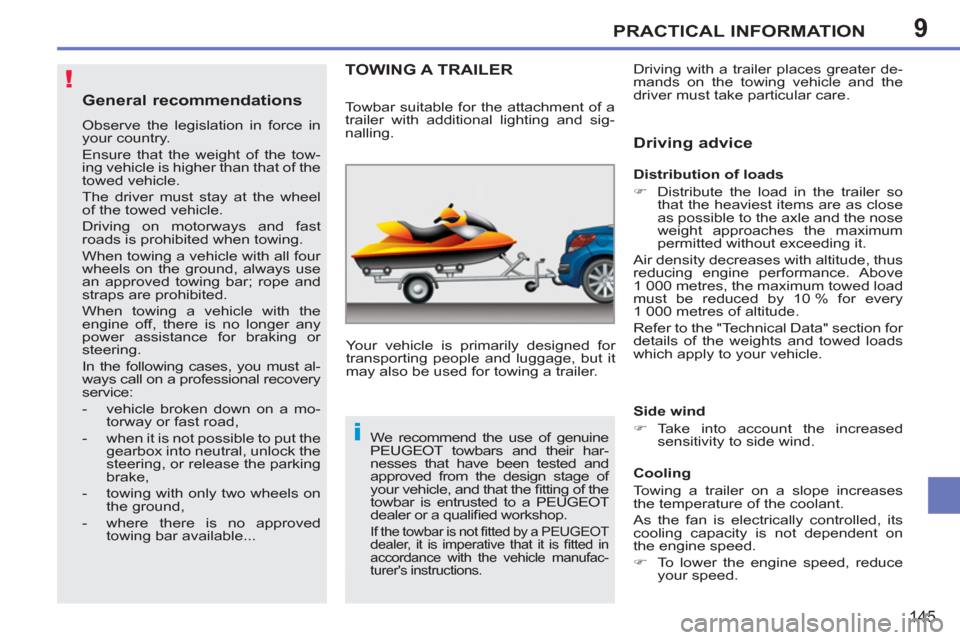
TOWING A TRAILER
Your vehicle is primarily designed for
transporting people and luggage, but it
may also be used for towing a trailer. Driving with a trailer places greater de-
mands on the towing vehicle and the
driver must take particular care.
Distribution of loads
)
Distribute the load in the trailer so
that the heaviest items are as close
as possible to the axle and the nose
weight approaches the maximum
permitted without exceeding it.
Air density decreases with altitude, thus
reducing engine performance. Above
1 000 metres, the maximum towed load
must be reduced by 10 % for every
1 000 metres of altitude.
Refer to the "Technical Data" section for
details of the weights and towed loads
which apply to your vehicle.
Side wind
)
Take into account the increased
sensitivity to side wind.
Towbar suitable for the attachment of a
trailer with additional lighting and sig-
nalling.
We recommend the use of genuine
PEUGEOT towbars and their har-
nesses that have been tested and
approved from the design stage of
your vehicle, and that the fi tting of the
towbar is entrusted to a PEUGEOT
dealer or a qualifi ed workshop.
If the towbar is not fi tted by a PEUGEOT
dealer, it is imperative that it is fi tted in
accordance with the vehicle manufac-
turer's instructions.
Driving advice
Cooling
Towing a trailer on a slope increases
the temperature of the coolant.
As the fan is electrically controlled, its
cooling capacity is not dependent on
the engine speed.
)
To lower the engine speed, reduce
your speed.
Page 148 of 224
9
i
!
PRACTICAL INFORMATION
146
The maximum towed load on a long in-
cline depends on the gradient and the
ambient temperature.
)
If the warning lamp and the
STOP
warning lamp come
on, stop the vehicle and
switch off the engine as
soon as possible.
Braking
Towing a trailer increases the braking
distance.
To avoid overheating of the brakes on a
long mountain type of descent, the use
of engine braking is recommended.
Tyres
)
Check the tyre pressures of the towing
vehicle and of the trailer, observing the
recommended pressures.
The rear parking sensors will be de-
activated automatically if a genuine
PEUGEOT towbar is used.
In all cases, keep a check on the cool-
ant temperature.
Lighting
)
Check the electrical lighting and
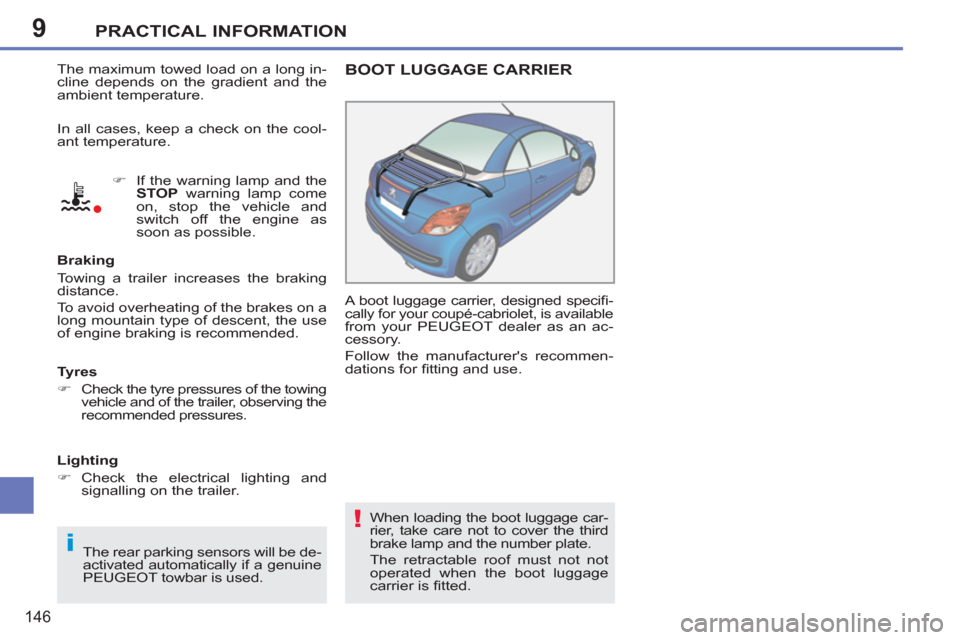
signalling on the trailer. BOOT LUGGAGE CARRIER
A boot luggage carrier, designed specifi -
cally for your coupé-cabriolet, is available
from your PEUGEOT dealer as an ac-
cessory.
Follow the manufacturer's recommen-
dations for fi tting and use.
When loading the boot luggage car-
rier, take care not to cover the third
brake lamp and the number plate.
The retractable roof must not not
operated when the boot luggage
carrier is fi tted.
Page 149 of 224
9
i
!
i
PRACTICAL INFORMATION
147
ACCESSORIES
A wide range of accessories and genu-
ine parts is available from the PEUGEOT
dealer network.
These accessories and parts have been
tested and approved for reliability and
safety.
They are all adapted to your vehicle and
benefi t from PEUGEOT's recommenda-
tion and warranty.
Depending on the legislation in
force in the country, it may be com-
pulsory to have a high visibility
safety vest, warning triangle and
spare bulbs and fuses available in
the vehicle.
The fi tting of electrical equipment or
accessories which are not recom-
mended by PEUGEOT may result
in a failure of your vehicle's elec-
tronic system and excessive electri-
cal consumption.
Please note this precaution. You
are advised to contact a PEUGEOT
representative to be shown the range
of recommended equipment and
accessories.
"Comfort":
door defl ectors, side blinds and rear
blind, coat hanger fi xed to head re-
straint, front centre armrest, under shelf
storage, front and rear parking sen-
sors...
Installation of radio
communication transmitters
Before installing any after-market
radio communication transmitter,
you can contact a PEUGEOT deal-
er for the specifi cation of transmit-
ters which can be fi tted (frequency,
maximum power, aerial position,
specifi c installation requirements),
in line with the Vehicle Electro-
magnetic Compatibility Directive
(2004/104/EC).
"Transport solutions":
boot liner, luggage net, cigarette lighter,
roof bars, bicycle carrier on roof bars,
ski carrier, roof box...
Tow bar, which mst be fi tted by PEUGEOT
dealer or a qualifi ed workshop.
"Styling":
aluminium gear lever knob, spoiler, styling
strips, alloy wheels, trims, chromed mirror
shells, body kit...
*
To avoid any risk of jamming of the
pedals:
- ensure that the mat is positioned
and secured correctly,
- never fi t one mat on top of another.
"Security":
anti-theft alarm, window engraving,
wheel security bolts, child seats and
booster cushions, breathalyzer, fi rst aid
kit, warning triangle, high visibility jacket,
stolen vehicle tracking system, tempo-
rary puncture repair kit, snow chains,
non-slip covers, front foglamps kit...
"Protection":
mats * , seat covers compatible with lateral
airbags, aluminium or PVC door aperture
fi nishers...
"Multimedia":
audio systems, satellite navigation
systems, hands-free kit, CD changer,
speakers, DVD player, connection kit
for MP3 or CD player, USB Box...
You can also obtain products for cleaning
and maintenance (exterior and interior),
topping up (screenwash...),and refi lls
(cartridge for the temporary puncture re-
pair kit...) by visiting a PEUGEOT dealer.
Page 213 of 224
211
VISUAL SEARCH
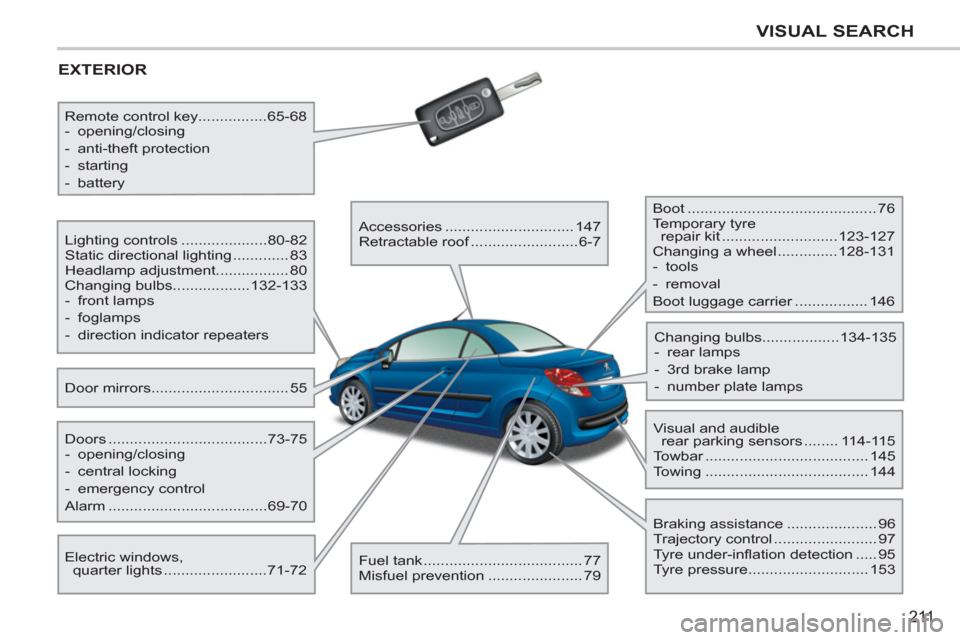
EXTERIOR
Door mirrors ................................ 55 Lighting controls ....................80-82
Static directional lighting ............. 83
Headlamp adjustment................. 80
Changing bulbs..................132-133
- front lamps
- foglamps
- direction indicator repeaters
Electric windows,
quarter lights ........................71-72 Doors .....................................73-75
- opening/closing
- central locking
- emergency control
Alarm .....................................69-70 Remote control key................65-68
- opening/closing
- anti-theft protection
- starting
- battery
Accessories .............................. 147
Retractable roof .........................6-7
Fuel tank ..................................... 77
Misfuel prevention ...................... 79 Boot ............................................ 76
Temporary tyre
repair kit ...........................123-127
Changing a wheel ..............128-131
- tools
- removal
Boot luggage carrier ................. 146
Visual and audible
rear parking sensors ........ 114-115
Towbar ...................................... 145
Towing ...................................... 144 Changing bulbs..................134-135
- rear lamps
- 3rd brake lamp
- number plate lamps
Braking assistance ..................... 96
Trajectory control ........................ 97
Tyre under-in
fl ation detection ..... 95
Tyre pressure............................ 153