tow Peugeot 207 CC 2014 User Guide
[x] Cancel search | Manufacturer: PEUGEOT, Model Year: 2014, Model line: 207 CC, Model: Peugeot 207 CC 2014Pages: 232, PDF Size: 11.11 MB
Page 98 of 232
5
i
CHILD SAFETY
96
207CC_EN_CHAP05_SECURITE ENFANTS_ED01-2014
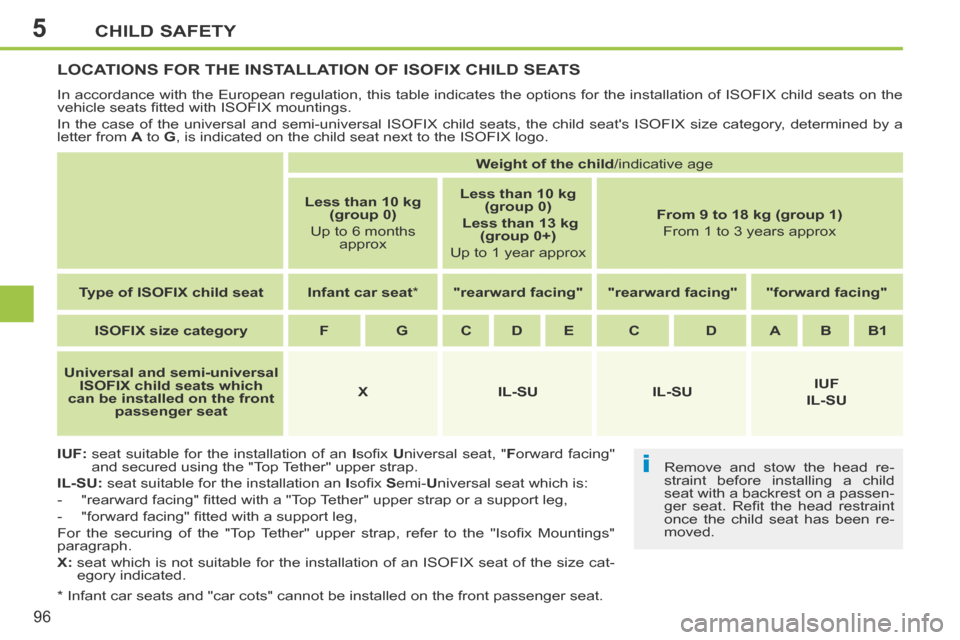
LOCATIONS FOR THE INSTALLATION OF ISOFIX CHILD SEATS
In accordance with the European regulation, this table indicates the opt\
ions for the installation of ISOFIX child seats on the
vehicle seats fi tted with ISOFIX mountings.
In the case of the universal and semi-universal ISOFIX child seats, the \
child seat's ISOFIX size category, determined by a
letter from A to G , is indicated on the child seat next to the ISOFIX logo.
IUF: seat suitable for the installation of an I sofi x U niversal seat, " F orward facing"
and secured using the "Top Tether" upper strap.
IL-SU: seat suitable for the installation an I sofi x S emi- U niversal seat which is:
- "rearward facing" fi tted with a "Top Tether" upper strap or a support leg,
- "forward facing" fi tted with a support leg,
For the securing of the "Top Tether" upper strap, refer to the "Isofi x Mountings"
paragraph.
X: seat which is not suitable for the installation of an ISOFIX seat of the size cat- egory indicated.
Weight of the child/ indicative age
Less than 10 kg (group 0)
Up to 6 months approx Less than 10 kg
(group 0)
Less than 13 kg
(group 0+)
Up to 1 year approx From 9 to 18 kg (group 1)
From 1 to 3 years approx
Type of ISOFIX child seat Infant car seat * " rearward facing" " rearward facing" "forward facing"
ISOFIX size category F G C D E C D A B B1
Universal and semi-universal ISOFIX child seats which
can be installed on the front passenger seat X
IL-SU IL-SU IUF
IL-SU
* Infant car seats and "car cots" cannot be installed on the front passeng\
er seat. Remove and stow the head re-
straint before installing a child
seat with a backrest on a passen-
ger seat. Refi t the head restraint
once the child seat has been re-
moved.
Page 100 of 232
6
i
SAFETY
98
207CC_EN_CHAP06_SECURITE_ED01-2014
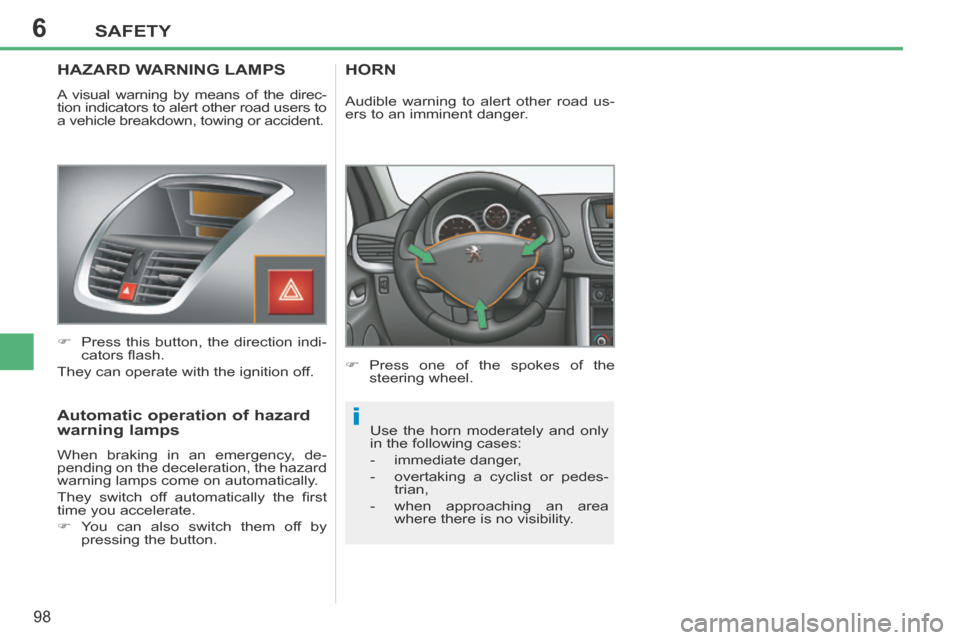
HAZARD WARNING LAMPS
A visual warning by means of the direc-
tion indicators to alert other road users to
a vehicle breakdown, towing or accident.
Press this button, the direction indi-cators fl ash.
They can operate with the ignition off.
Automatic operation of hazard
warning lamps
When braking in an emergency, de-
pending on the deceleration, the hazard
warning lamps come on automatically.
They switch off automatically the fi rst
time you accelerate.
You can also switch them off by pressing the button.
HORN
Press one of the spokes of the steering wheel.
Use the horn moderately and only
in the following cases:
- immediate danger,
- overtaking a cyclist or pedes- trian,
- when approaching an area where there is no visibility.
Audible warning to alert other road us-
ers to an imminent danger.
Page 106 of 232
6
i
SAFETY
104
207CC_EN_CHAP06_SECURITE_ED01-2014
The driver must ensure that passen-
gers use the seat belts correctly and
that they are all restrained securely
before setting off.
Wherever you are seated in the ve-
hicle, always fasten your seat belt,
even for short journeys.
Do not interchange the seat belt
buckles as they will not fulfi l their
role fully.
The seat belts are fi tted with an in-
ertia reel permitting automatic ad-
justment of the length of the strap
to your size. The seat belt is stowed
automatically when not in use.
Before and after use, ensure that
the seat belt is reeled in correctly.
The lower part of the strap must be
positioned as low as possible on
the pelvis.
The upper part must be positioned
in the hollow of the shoulder.
The inertia reels are fi tted with an
automatic locking device which
comes into operation in the event
of a collision, emergency braking
or if the vehicle rolls over. You can
release the device by pulling fi rmly
on the strap and releasing it so that
it reels in slightly. In order to be effective, a seat belt must:
- be tightened as close to the body as
possible,
- be pulled in front of you with a smooth movement, checking that it
does not twist,
- be used to restrain only one person,
- not bear any trace of cuts or fraying,
- not be converted or modifi ed to avoid affecting its performance.
In accordance with current safety regula-
tions, for all repairs on your vehicle, go to
a qualifi ed workshop with the skills and
equipment needed, which a PEUGEOT
dealer is able to provide.
Have your seat belts checked regu-
larly by a PEUGEOT dealer or a quali-
fi ed workshop, particularly if the straps
show signs of damage.
Clean the seat belt straps with soapy
water or a textile cleaning product, sold
by PEUGEOT dealers.
After folding or moving a seat or rear
bench seat, ensure that the seat belt is
positioned and reeled in correctly. Recommendations for children
Use a suitable child seat if the passen-
ger is less than 12 years old or shorter
than one and a half metres.
Never use the same seat belt to se-
cure more than one person.
Never allow a child to travel on your lap.
In the event of an impact
Depending on the nature and se-
riousness of the impact , the pre-
tensioning device may be deployed
before and independently of the air-
bags. Deployment of the pretensioners
is accompanied by a slight discharge
of harmless smoke and a noise, due
to the activation of the pyrotechnic car-
tridge incorporated in the system.
In all cases, the airbag warning lamp
comes on.
Following an impact, have the seat
belts system checked, and if neces-
sary replaced, by a PEUGEOT dealer
or a qualifi ed workshop.
Page 107 of 232
6
!
i
SAFETY
105
207CC_EN_CHAP06_SECURITE_ED01-2014
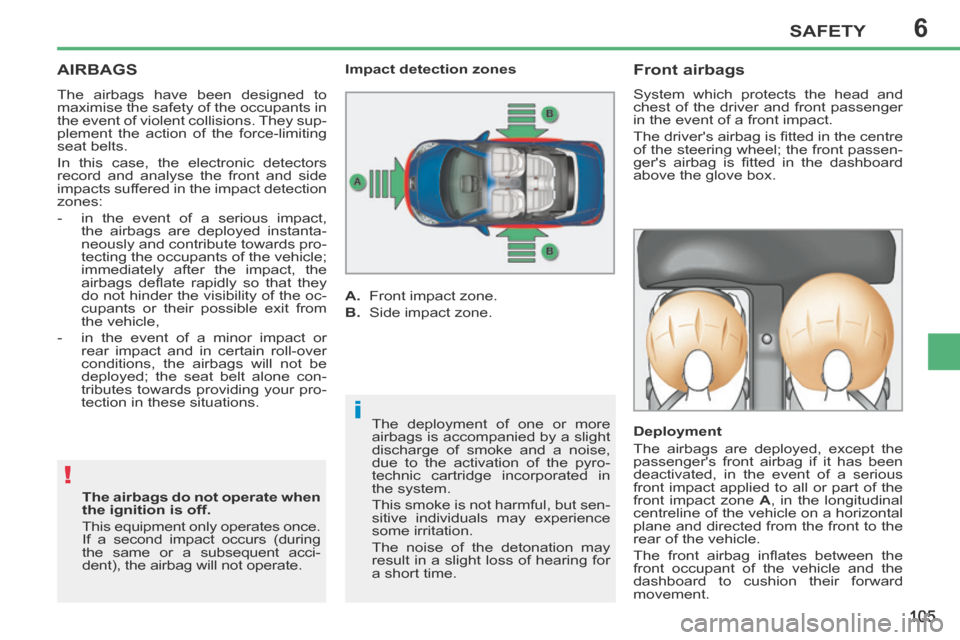
AIRBAGS
The airbags have been designed to
maximise the safety of the occupants in
the event of violent collisions. They sup-
plement the action of the force-limiting
seat belts.
In this case, the electronic detectors
record and analyse the front and side
impacts suffered in the impact detection
zones:
- in the event of a serious impact, the airbags are deployed instanta-
neously and contribute towards pro-
tecting the occupants of the vehicle;
immediately after the impact, the
airbags defl ate rapidly so that they
do not hinder the visibility of the oc-
cupants or their possible exit from
the vehicle,
- in the event of a minor impact or rear impact and in certain roll-over
conditions, the airbags will not be
deployed; the seat belt alone con-
tributes towards providing your pro-
tection in these situations.
The airbags do not operate when
the ignition is off.
This equipment only operates once.
If a second impact occurs (during
the same or a subsequent acci-
dent), the airbag will not operate. Impact detection zones
A. Front impact zone.
B. Side impact zone.
Front airbags
Deployment
The airbags are deployed, except the
passenger's front airbag if it has been
deactivated, in the event of a serious
front impact applied to all or part of the
front impact zone
A , in the longitudinal
centreline of the vehicle on a horizontal
plane and directed from the front to the
rear of the vehicle.
The front airbag infl ates between the
front occupant of the vehicle and the
dashboard to cushion their forward
movement.
The deployment of one or more
airbags is accompanied by a slight
discharge of smoke and a noise,
due to the activation of the pyro-
technic cartridge incorporated in
the system.
This smoke is not harmful, but sen-
sitive individuals may experience
some irritation.
The noise of the detonation may
result in a slight loss of hearing for
a short time. System which protects the head and
chest of the driver and front passenger
in the event of a front impact.
The driver's airbag is fi tted in the centre
of the steering wheel; the front passen-
ger's airbag is fi tted in the dashboard
above the glove box.
Page 109 of 232
6
!
SAFETY
107
207CC_EN_CHAP06_SECURITE_ED01-2014
* According to country.
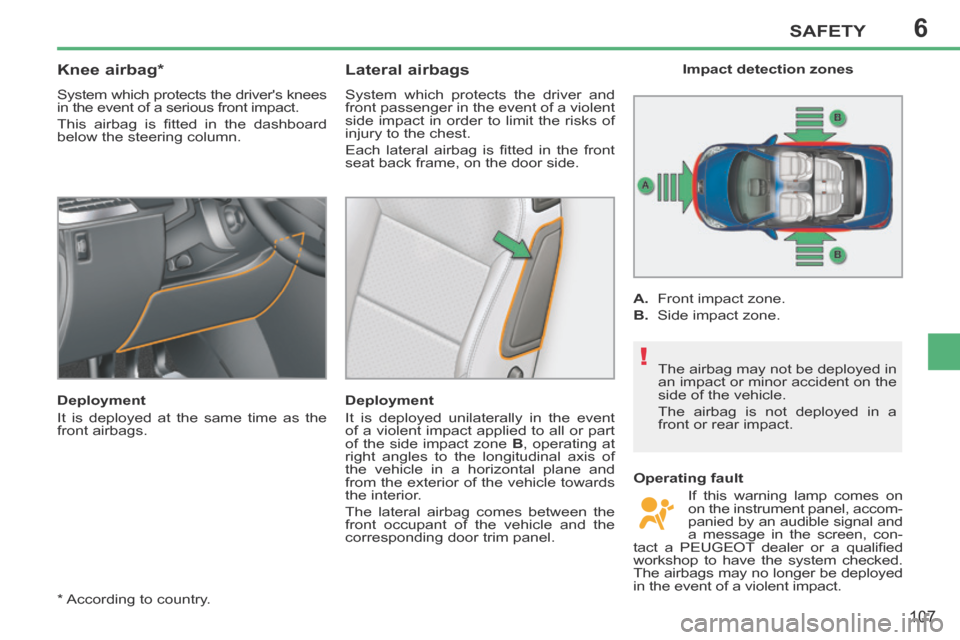
Knee airbag *
System which protects the driver's knees
in the event of a serious front impact.
This airbag is fi tted in the dashboard
below the steering column.
Deployment
It is deployed at the same time as the
front airbags.
Lateral airbags
System which protects the driver and
front passenger in the event of a violent
side impact in order to limit the risks of
injury to the chest.
Each lateral airbag is fi tted in the front
seat back frame, on the door side.
Deployment
It is deployed unilaterally in the event
of a violent impact applied to all or part
of the side impact zone B , operating at
right angles to the longitudinal axis of
the vehicle in a horizontal plane and
from the exterior of the vehicle towards
the interior.
The lateral airbag comes between the
front occupant of the vehicle and the
corresponding door trim panel. Impact detection zones
A. Front impact zone.
B. Side impact zone. The airbag may not be deployed in
an impact or minor accident on the
side of the vehicle.
The airbag is not deployed in a
front or rear impact.
Operating fault If this warning lamp comes on
on the instrument panel, accom-
panied by an audible signal and
a message in the screen, con-
tact a PEUGEOT dealer or a qualifi ed
workshop to have the system checked.
The airbags may no longer be deployed
in the event of a violent impact.
Page 115 of 232
7
!i
i
DRIVING
11 3
207CC_EN_CHAP07_CONDUITE_ED01-2014
Stopping the vehicle
Before switching off the engine, you
can engage position P or N to place the
gearbox in neutral.
In both cases, apply the parking brake
to immobilise the vehicle.
Operating fault
There is a risk of damage to the
gearbox:
- if you press the accelerator and brake pedals at the same time,
- if you force the movement of the gear lever from the P posi-
tion to another position when
the battery is fl at.
To reduce fuel consumption when
at a prolonged standstill with the
engine running (traffi c jam...), put
the gear lever in the N position and
apply the parking brake.
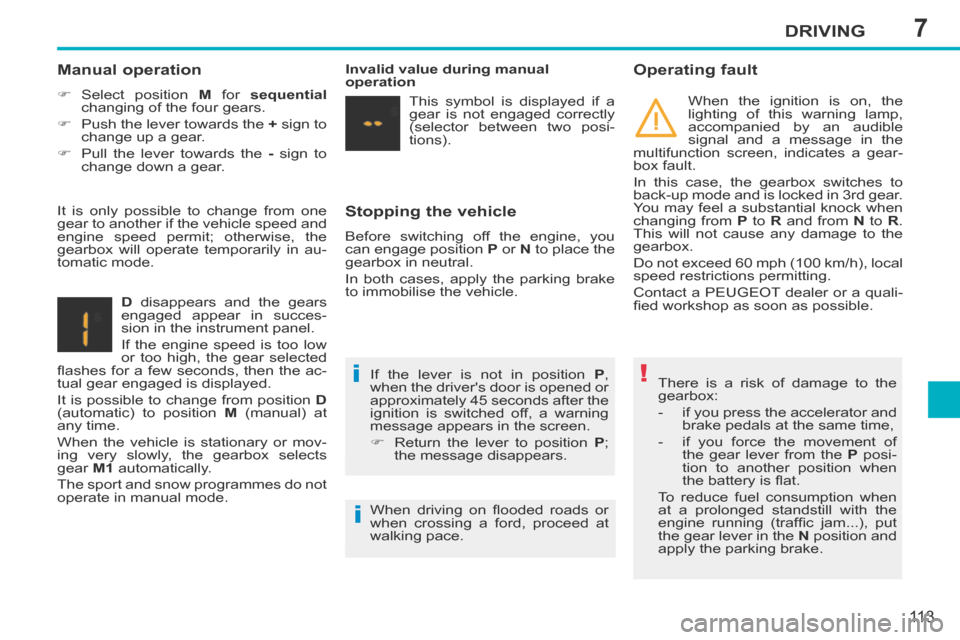
Manual operation
Select position M for sequential
changing of the four gears.
Push the lever towards the + sign to
change up a gear.
Pull the lever towards the - sign to
change down a gear.
D disappears and the gears
engaged appear in succes-
sion in the instrument panel.
If the engine speed is too low
or too high, the gear selected
fl ashes for a few seconds, then the ac-
tual gear engaged is displayed.
It is possible to change from position D
(automatic) to position M (manual) at
any time.
When the vehicle is stationary or mov-
ing very slowly, the gearbox selects
gear M1 automatically.
The sport and snow programmes do not
operate in manual mode. If the lever is not in position
P ,
when the driver's door is opened or
approximately 45 seconds after the
ignition is switched off, a warning
message appears in the screen.
Return the lever to position P ;
the message disappears.
It is only possible to change from one
gear to another if the vehicle speed and
engine speed permit; otherwise, the
gearbox will operate temporarily in au-
tomatic mode.
Invalid value during manual
operation
This symbol is displayed if a
gear is not engaged correctly
(selector between two posi-
tions). When the ignition is on, the
lighting of this warning lamp,
accompanied by an audible
signal and a message in the
multifunction screen, indicates a gear-
box fault.
In this case, the gearbox switches to
back-up mode and is locked in 3rd gear.
You may feel a substantial knock when
changing from P to R and from N to R .
This will not cause any damage to the
gearbox.
Do not exceed 60 mph (100 km/h), local
speed restrictions permitting.
Contact a PEUGEOT dealer or a quali-
fi ed workshop as soon as possible.
When driving on fl ooded roads or
when crossing a ford, proceed at
walking pace.
Page 121 of 232
7
ii
i
DRIVING
11 9
207CC_EN_CHAP07_CONDUITE_ED01-2014
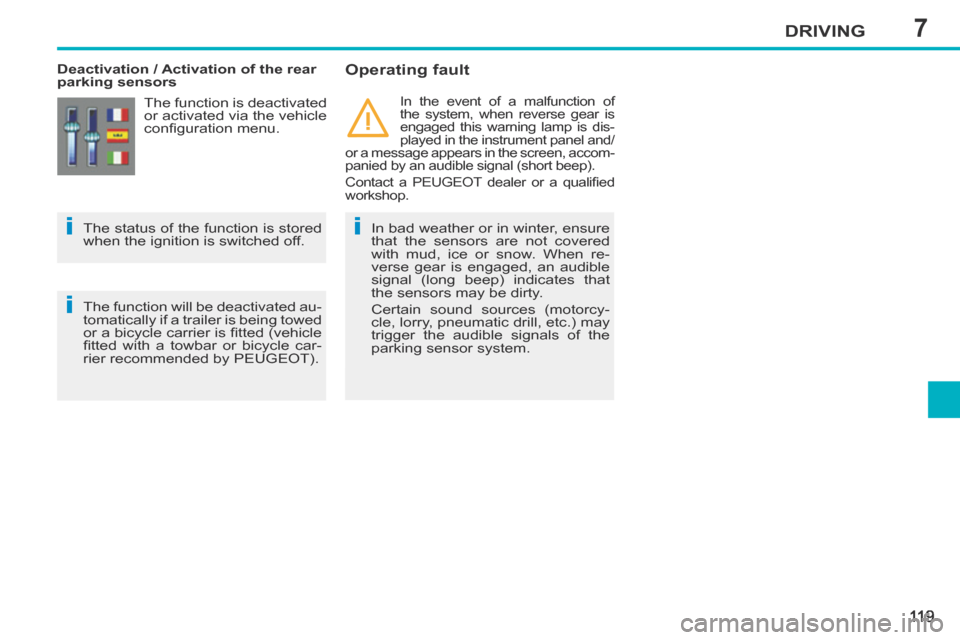
Deactivation / Activation of the rear
parking sensors Operating fault
In bad weather or in winter, ensure
that the sensors are not covered
with mud, ice or snow. When re-
verse gear is engaged, an audible
signal (long beep) indicates that
the sensors may be dirty.
Certain sound sources (motorcy-
cle, lorry, pneumatic drill, etc.) may
trigger the audible signals of the
parking sensor system.
In the event of a malfunction of
the system, when reverse gear is
engaged this warning lamp is dis-
played in the instrument panel and/
or a message appears in the screen, accom-
panied by an audible signal (short beep).
Contact a PEUGEOT dealer or a qualifi ed
workshop.
The status of the function is stored
when the ignition is switched off.
The function will be deactivated au-
tomatically if a trailer is being towed
or a bicycle carrier is fi tted (vehicle
fi tted with a towbar or bicycle car-
rier recommended by PEUGEOT). The function is deactivated
or activated via the vehicle
confi guration menu.
Page 129 of 232
8
!
CHECKS
127
207CC_EN_CHAP08_VERIFICATIONS_ED01-2014
Only use products recommended by
PEUGEOT or products of equivalent
quality and specifi cations.
In order to optimise the operation
of units as important as the braking
system, PEUGEOT selects and of-
fers very specifi c products.
To avoid damaging the electrical
units, the use of a high pressure
washer in the engine compartment
is strictly prohibited .
After washing the vehicle, or in hu-
mid or wintry conditions, ice can
form on the brake discs and pads
with a resulting loss of effi ciency of
the brakes. Make a few light brake
applications to defrost and dry the
brakes.
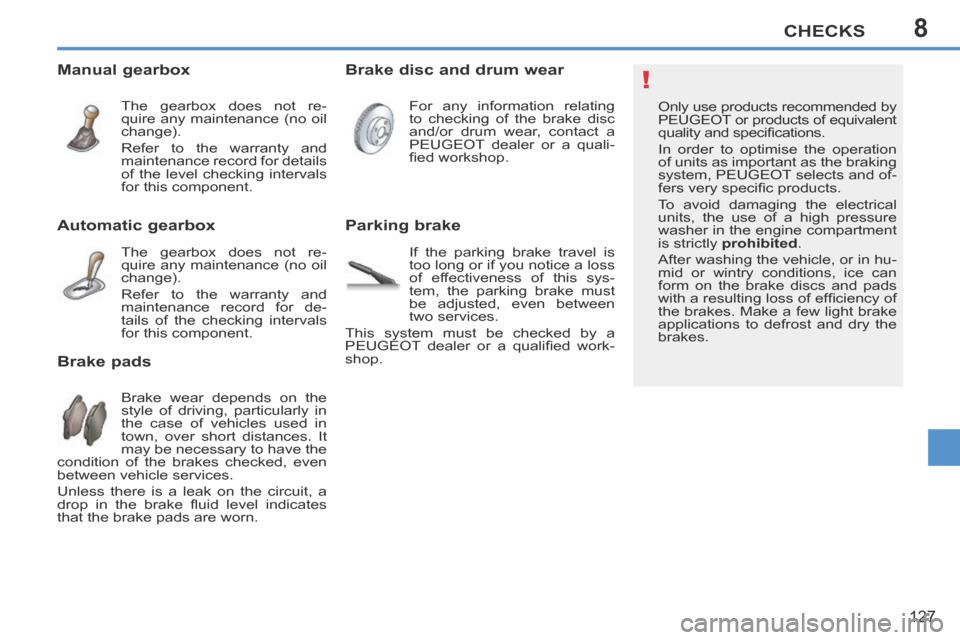
Automatic gearbox
The gearbox does not re-
quire any maintenance (no oil
change).
Refer to the warranty and
maintenance record for de-
tails of the checking intervals
for this component.
Brake disc and drum wear
For any information relating
to checking of the brake disc
and/or drum wear, contact a
PEUGEOT dealer or a quali-
fi ed workshop.
Manual gearbox
The gearbox does not re-
quire any maintenance (no oil
change).
Refer to the warranty and
maintenance record for details
of the level checking intervals
for this component.
Brake pads
Brake wear depends on the
style of driving, particularly in
the case of vehicles used in
town, over short distances. It
may be necessary to have the
condition of the brakes checked, even
between vehicle services.
Unless there is a leak on the circuit, a
drop in the brake fl uid level indicates
that the brake pads are worn.
Parking brake
If the parking brake travel is
too long or if you notice a loss
of effectiveness of this sys-
tem, the parking brake must
be adjusted, even between
two services.
This system must be checked by a
PEUGEOT dealer or a qualifi ed work-
shop.
Page 133 of 232
9
!
PRACTICAL INFORMATION
131
207CC_EN_CHAP09_INFO PRATIQUES_ED01-2014
As soon as possible, go to a
PEUGEOT dealer or a qualifi ed
workshop.
You must inform the technician
that you have used this kit. Af-
ter inspection, the technician will
advise you on whether the tyre
can be repaired or if it must be
replaced.
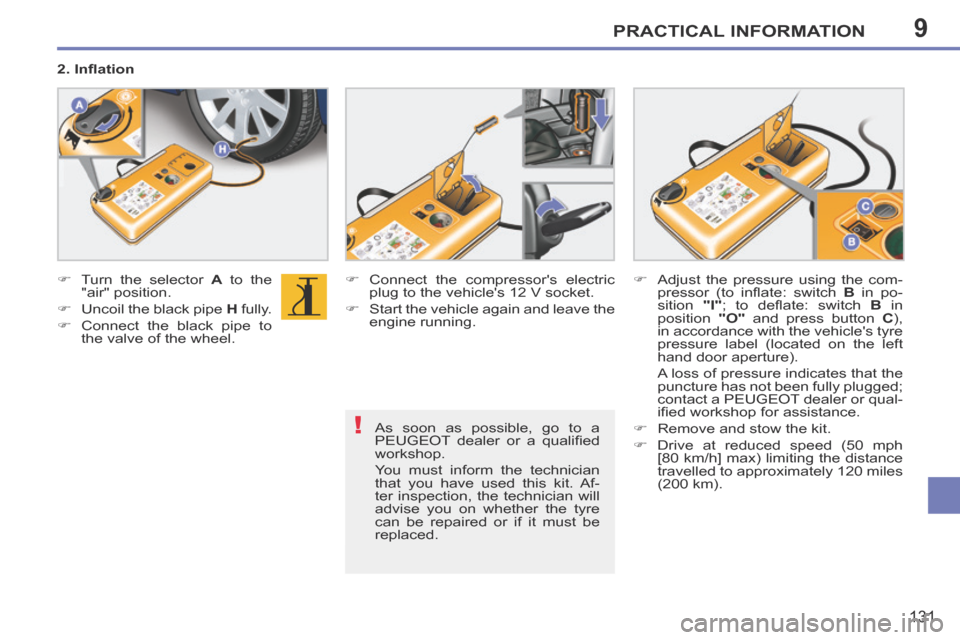
2. Infl ation
Turn the selector
A to the
"air" position.
Uncoil the black pipe H fully.
Connect the black pipe to the valve of the wheel. Connect the compressor's electric
plug to the vehicle's 12 V socket.
Start the vehicle again and leave the engine running. Adjust the pressure using the com-
pressor (to infl ate: switch B in po-
sition "I" ; to defl ate: switch B in
position "O" and press button C ),
in accordance with the vehicle's tyre
pressure label (located on the left
hand door aperture).
A loss of pressure indicates that the puncture has not been fully plugged;
contact a PEUGEOT dealer or qual-
ifi ed workshop for assistance.
Remove and stow the kit.
Drive at reduced speed (50 mph [80 km/h] max) limiting the distance
travelled to approximately 120 miles
(200 km).
Page 134 of 232
9
!
PRACTICAL INFORMATION
132
207CC_EN_CHAP09_INFO PRATIQUES_ED01-2014
Beware of discharges of fl uid.
The expiry date of the fl uid is indi-
cated on the cartridge.
The sealant cartridge is designed
for single use; even if only partly
used, it must be replaced.
After use, do not discard the car-
tridge into the environment, take
it to an authorised waste disposal
site or a PEUGEOT dealer.
Do not forget to obtain a new
sealant cartridge, available from
PEUGEOT dealers or from a qual-
ifi ed workshop.
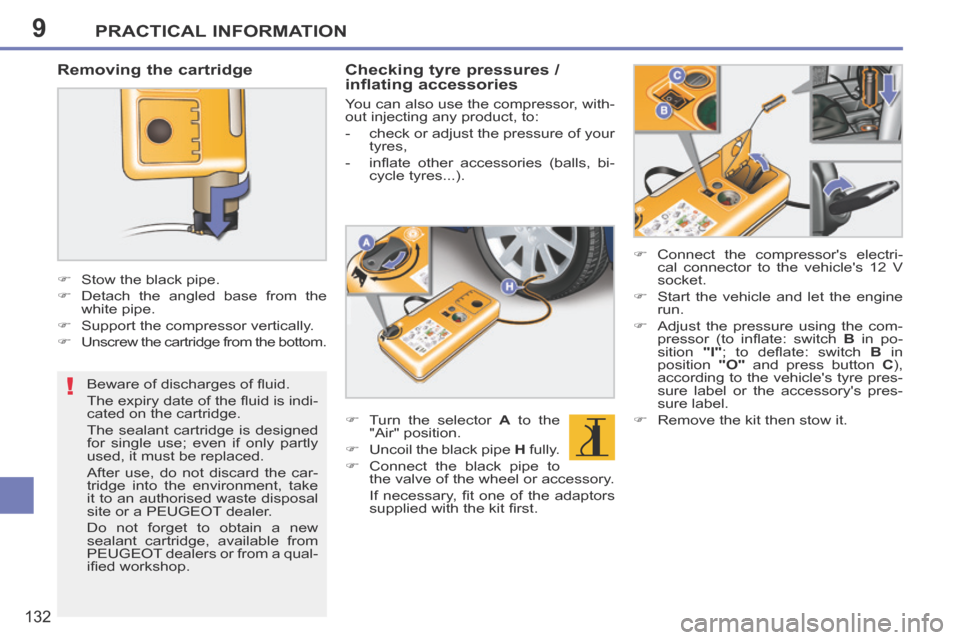
Removing the cartridge
Stow the black pipe.
Detach the angled base from the white pipe.
Support the compressor vertically.
Unscrew the cartridge from the bottom.
Checking tyre pressures / inflating accessories
You can also use the compressor, with-
out injecting any product, to:
- check or adjust the pressure of your tyres,
- infl ate other accessories (balls, bi- cycle tyres...).
Turn the selector A to the
"Air" position.
Uncoil the black pipe H fully.
Connect the black pipe to the valve of the wheel or accessory.
If necessary, fi t one of the adaptors supplied with the kit fi rst. Connect the compressor's electri-
cal connector to the vehicle's 12 V
socket.
Start the vehicle and let the engine run.
Adjust the pressure using the com- pressor (to infl ate: switch B in po-
sition "I" ; to defl ate: switch B in
position "O" and press button C ),
according to the vehicle's tyre pres-
sure label or the accessory's pres-
sure label.
Remove the kit then stow it.