ESP Peugeot 207 CC 2014 Owner's Guide
[x] Cancel search | Manufacturer: PEUGEOT, Model Year: 2014, Model line: 207 CC, Model: Peugeot 207 CC 2014Pages: 232, PDF Size: 11.11 MB
Page 109 of 232
6
!
SAFETY
107
207CC_EN_CHAP06_SECURITE_ED01-2014
* According to country.
Knee airbag *
System which protects the driver's knees
in the event of a serious front impact.
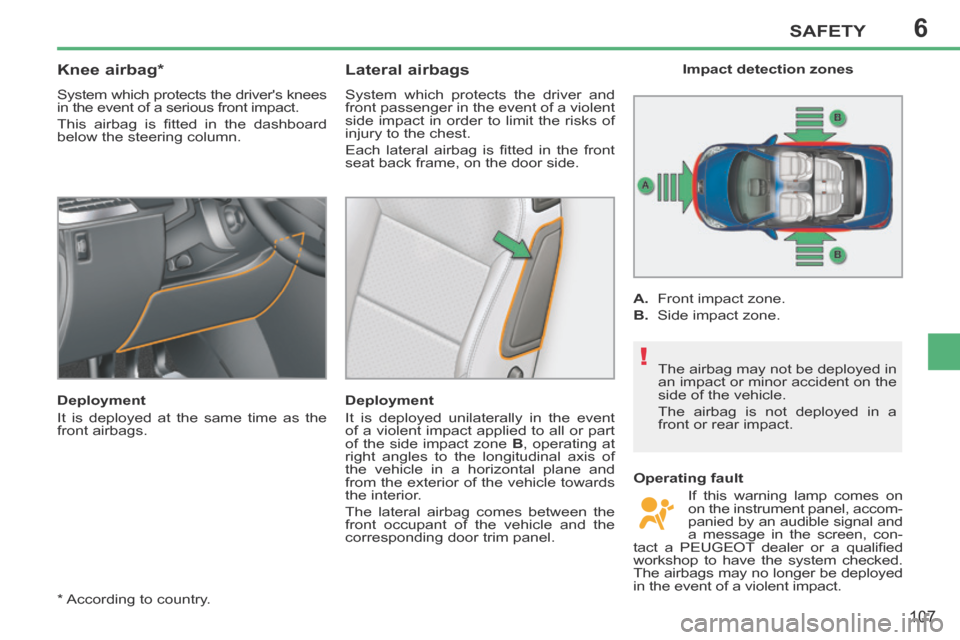
This airbag is fi tted in the dashboard
below the steering column.
Deployment
It is deployed at the same time as the
front airbags.
Lateral airbags
System which protects the driver and
front passenger in the event of a violent
side impact in order to limit the risks of
injury to the chest.
Each lateral airbag is fi tted in the front
seat back frame, on the door side.
Deployment
It is deployed unilaterally in the event
of a violent impact applied to all or part
of the side impact zone B , operating at
right angles to the longitudinal axis of
the vehicle in a horizontal plane and
from the exterior of the vehicle towards
the interior.
The lateral airbag comes between the
front occupant of the vehicle and the
corresponding door trim panel. Impact detection zones
A. Front impact zone.
B. Side impact zone. The airbag may not be deployed in
an impact or minor accident on the
side of the vehicle.
The airbag is not deployed in a
front or rear impact.
Operating fault If this warning lamp comes on
on the instrument panel, accom-
panied by an audible signal and
a message in the screen, con-
tact a PEUGEOT dealer or a qualifi ed
workshop to have the system checked.
The airbags may no longer be deployed
in the event of a violent impact.
Page 112 of 232
7
!
DRIVING
11 0
207CC_EN_CHAP07_CONDUITE_ED01-2014
* According to engine.
GEAR SHIFT INDICATOR *
System which reduces fuel consumption
by advising the driver to change up on
vehicles fi tted with a manual gearbox.
Operation
The system intervenes only when driv-
ing economically.
Depending on the driving situation and
your vehicle's equipment, the system
may advise you to skip one or more
gears. You can follow this instruction
without engaging the intermediate
gears.
The gear recommended should not
be considered compulsory. In fact, the
confi guration of the road, the amount
of traffi c and safety remain determining
factors when choosing the best gear.
Therefore, the driver remains responsi-
ble for deciding whether or not to follow
the advice given by the system.
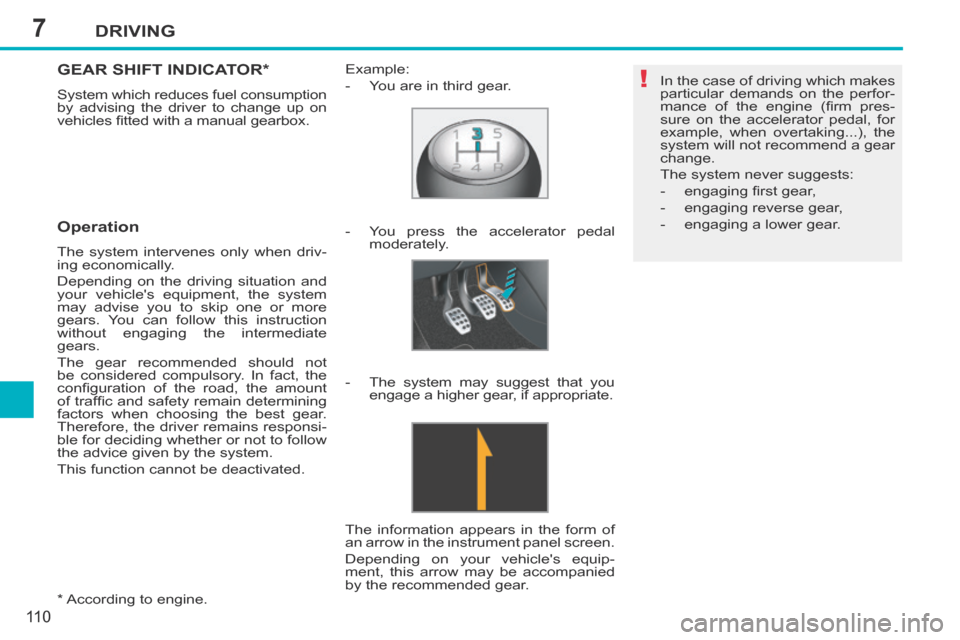
This function cannot be deactivated. Example:
- You are in third gear.
- You press the accelerator pedal
moderately.
- The system may suggest that you engage a higher gear, if appropriate.
The information appears in the form of
an arrow in the instrument panel screen.
Depending on your vehicle's equip-
ment, this arrow may be accompanied
by the recommended gear. In the case of driving which makes
particular demands on the perfor-
mance of the engine (fi rm pres-
sure on the accelerator pedal, for
example, when overtaking...), the
system will not recommend a gear
change.
The system never suggests:
- engaging fi rst gear,
- engaging reverse gear,
- engaging a lower gear.
Page 113 of 232
7DRIVING
111
207CC_EN_CHAP07_CONDUITE_ED01-2014
AUTOMATIC GEARBOX
Four-speed automatic gearbox which
offers a choice between the comfort of
fully automatic operation, enhanced by
sport and snow programmes, or manual
gear changing.
There are therefore four driving modes:
- automatic operation for electronic management of the gears by the
gearbox,
- sport programme for a more dy- namic style of driving,
- snow programme to improve driv- ing when traction is poor,
- sequential operation for manual changing of the gears by the driver.
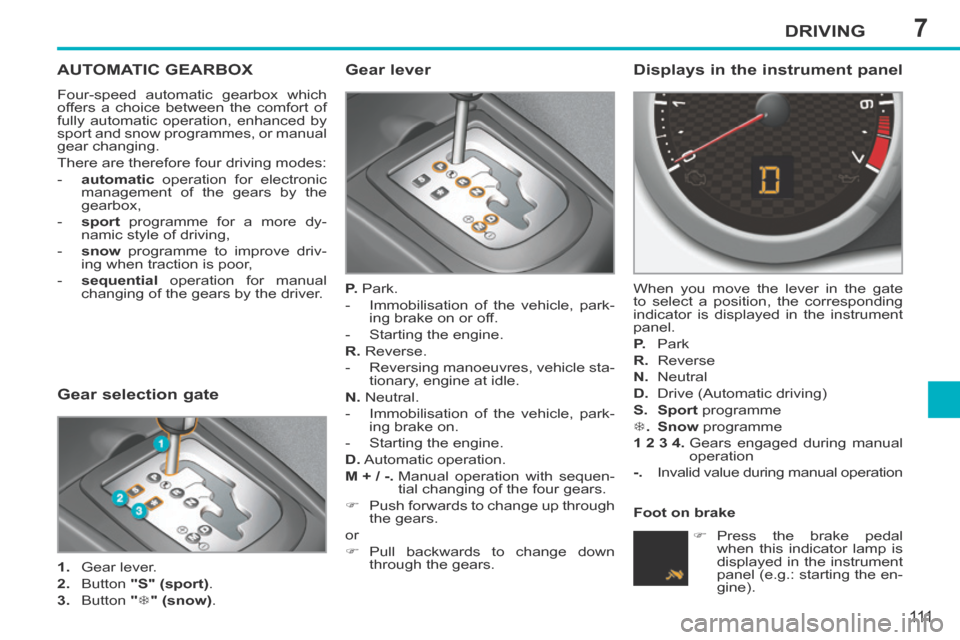
Gear lever
P. Park.
- Immobilisation of the vehicle, park- ing brake on or off.
- Starting the engine.
R. Reverse.
- Reversing manoeuvres, vehicle sta- tionary, engine at idle.
N. Neutral.
- Immobilisation of the vehicle, park- ing brake on.
- Starting the engine.
D. Automatic operation.
M + / - . Manual operation with sequen- tial changing of the four gears.
Push forwards to change up through the gears.
or
Pull backwards to change down through the gears.
Displays in the instrument panel
When you move the lever in the gate
to select a position, the corresponding
indicator is displayed in the instrument
panel.
P. Park
R. Reverse
N. Neutral
D. Drive (Automatic driving)
S. Sport programme
. Snow programme
1 2 3 4 . Gears engaged during manual
operation
-. Invalid value during manual operation
Press the brake pedal when this indicator lamp is
displayed in the instrument
panel (e.g.: starting the en-
gine).
Gear selection gate
1. Gear lever.
2. Button "S" (sport) .
3. Button " " (snow). Foot on brake
Page 116 of 232
7
i
DRIVING
11 4
207CC_EN_CHAP07_CONDUITE_ED01-2014
SPEED LIMITER
System which prevents the vehicle from
exceeding the speed programmed by the
driver.
When the programmed speed limit is
reached, pressing the accelerator pedal
no longer has any effect.
The speed limiter is switched on manu-
ally: it requires a programmed speed of at
least 20 mph (30 km/h).
The speed limiter is switched off by
manual operation of the control.
The programmed speed can be exceed-
ed temporarily by pressing the accelera-
tor fi rmly.
To return to the programmed speed, sim-
ply slow down to a speed below the pro-
grammed speed.
The programmed speed remains in the
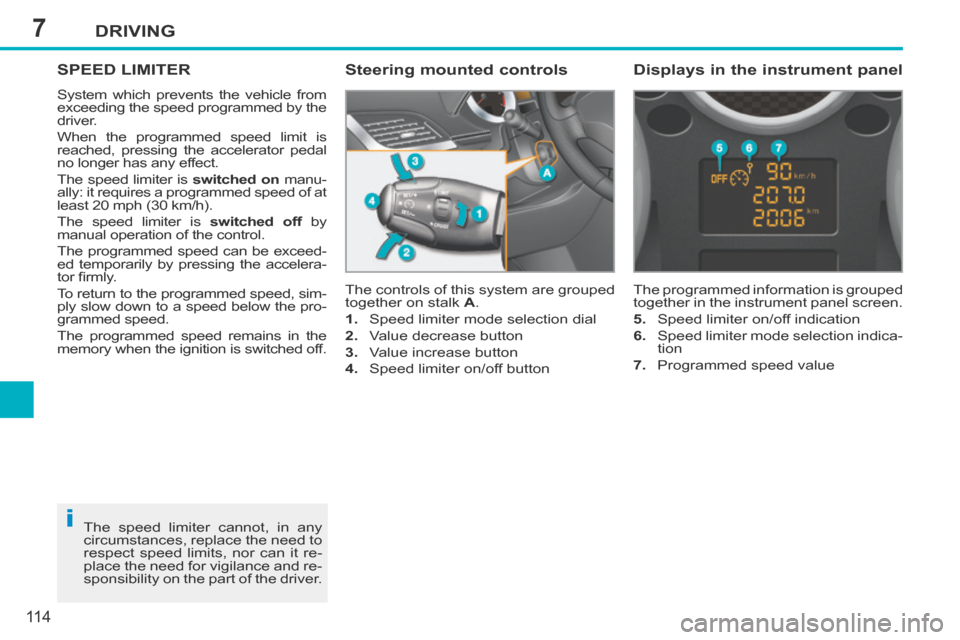
memory when the ignition is switched off. The controls of this system are grouped
together on stalk
A .
1. Speed limiter mode selection dial
2. Value decrease button
3. Value increase button
4. Speed limiter on/off button The programmed information is grouped
together in the instrument panel screen.
5. Speed limiter on/off indication
6. Speed limiter mode selection indica-
tion
7. Programmed speed value
Steering mounted controls Displays in the instrument panel
The speed limiter cannot, in any
circumstances, replace the need to
respect speed limits, nor can it re-
place the need for vigilance and re-
sponsibility on the part of the driver.
Page 118 of 232
7
i
DRIVING
11 6
207CC_EN_CHAP07_CONDUITE_ED01-2014
CRUISE CONTROL
System which automatically maintains
the speed of the vehicle at the value
programmed by the driver, without any
action on the accelerator pedal.
The cruise control is switched on
manually: it requires a minimum vehicle
speed of 25 mph (40 km/h), as well as
the engaging of:
- fourth gear on a manual gearbox,
- second gear on an automatic gear- box in sequential mode,
- position D on an automatic gearbox.
The cruise control is switched off man-
ually or by pressing the brake or clutch
pedal or on triggering of the ESP sys-
tem for safety reasons.
It is possible to exceed the programmed
speed temporarily by pressing the ac-
celerator pedal.
To return to the programmed speed,
simply release the accelerator pedal.
Switching off the ignition cancels any
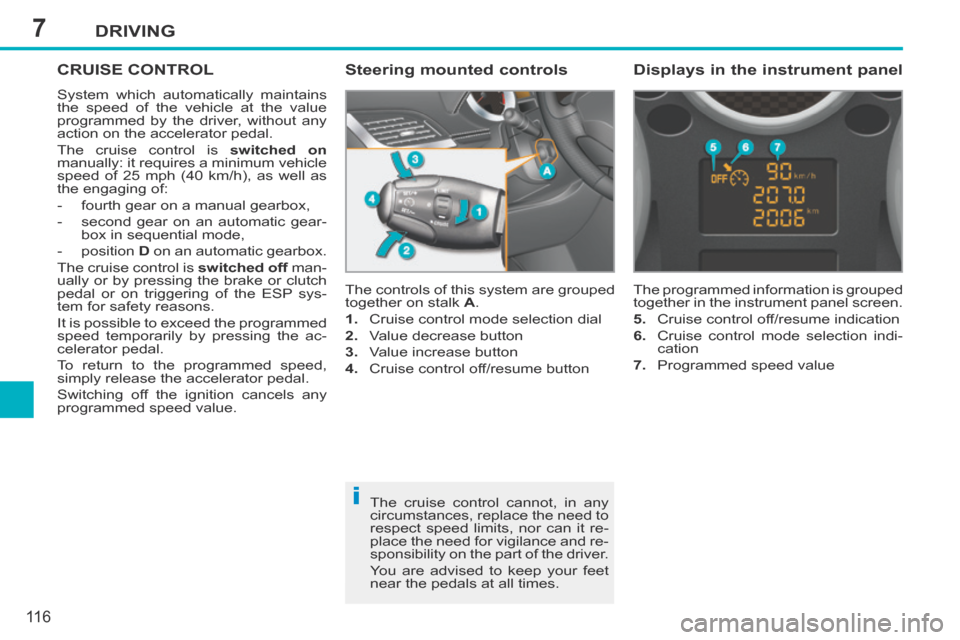
programmed speed value. The controls of this system are grouped
together on stalk
A .
1. Cruise control mode selection dial
2. Value decrease button
3. Value increase button
4. Cruise control off/resume button The programmed information is grouped
together in the instrument panel screen.
5. Cruise control off/resume indication
6. Cruise control mode selection indi-
cation
7. Programmed speed value
Steering mounted controls Displays in the instrument panel
The cruise control cannot, in any
circumstances, replace the need to
respect speed limits, nor can it re-
place the need for vigilance and re-
sponsibility on the part of the driver.
You are advised to keep your feet
near the pedals at all times.
Page 120 of 232
7
i
i
DRIVING
11 8
207CC_EN_CHAP07_CONDUITE_ED01-2014
VISUAL AND AUDIBLE
PARKING SENSORS
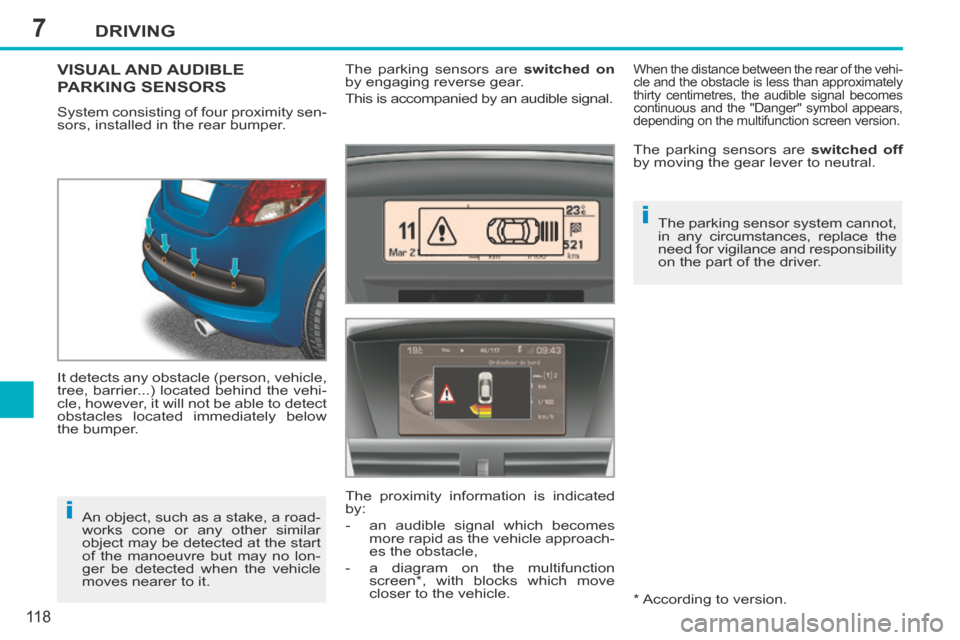
System consisting of four proximity sen-
sors, installed in the rear bumper.
It detects any obstacle (person, vehicle,
tree, barrier...) located behind the vehi-
cle, however, it will not be able to detect
obstacles located immediately below
the bumper. The parking sensors are
switched on
by engaging reverse gear.
This is accompanied by an audible signal.
* According to version.
An object, such as a stake, a road-
works cone or any other similar
object may be detected at the start
of the manoeuvre but may no lon-
ger be detected when the vehicle
moves nearer to it.
When the distance between the rear of the vehi-
cle and the obstacle is less than approximately
thirty centimetres, the audible signal becomes
continuous and the "Danger" symbol appears,
depending on the multifunction screen version.
The parking sensor system cannot,
in any circumstances, replace the
need for vigilance and responsibility
on the part of the driver.
The parking sensors are
switched off
by moving the gear lever to neutral.
The proximity information is indicated
by:
- an audible signal which becomes more rapid as the vehicle approach-
es the obstacle,
- a diagram on the multifunction screen * , with blocks which move
closer to the vehicle.
Page 123 of 232
8
i
!
CHECKS
121
207CC_EN_CHAP08_VERIFICATIONS_ED01-2014
BONNET
Protects the components of the engine
and provides access for checking levels.
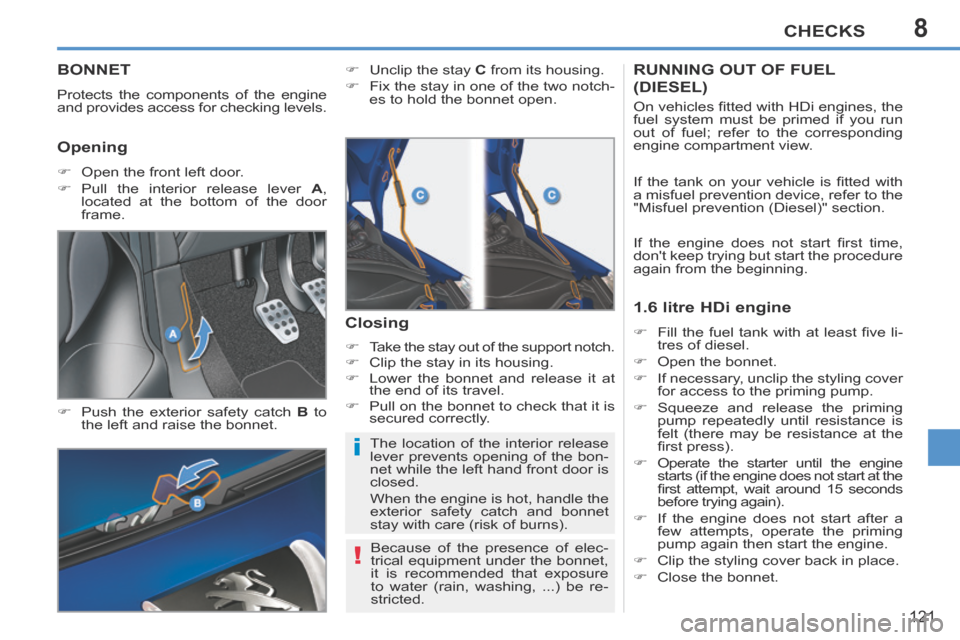
Push the exterior safety catch B to
the left and raise the bonnet. Unclip the stay
C from its housing.
Fix the stay in one of the two notch- es to hold the bonnet open.
Closing
Take the stay out of the support notch.
Clip the stay in its housing.
Lower the bonnet and release it at the end of its travel.
Pull on the bonnet to check that it is secured correctly.
RUNNING OUT OF FUEL
(DIESEL)
Opening
Open the front left door.
Pull the interior release lever A ,
located at the bottom of the door
frame.
The location of the interior release
lever prevents opening of the bon-
net while the left hand front door is
closed.
When the engine is hot, handle the
exterior safety catch and bonnet
stay with care (risk of burns).
1.6 litre HDi engine
Fill the fuel tank with at least fi ve li-tres of diesel.
Open the bonnet.
If necessary, unclip the styling cover for access to the priming pump.
Squeeze and release the priming pump repeatedly until resistance is
felt (there may be resistance at the
fi rst press).
Operate the starter until the engine
starts (if the engine does not start at the
fi rst attempt, wait around 15 seconds
before trying again).
If the engine does not start after a few attempts, operate the priming
pump again then start the engine.
Clip the styling cover back in place.
Close the bonnet. On vehicles fi tted with HDi engines, the
fuel system must be primed if you run
out of fuel; refer to the corresponding
engine compartment view.
If the tank on your vehicle is fi tted with
a misfuel prevention device, refer to the
"Misfuel prevention (Diesel)" section.
Because of the presence of elec-
trical equipment under the bonnet,
it is recommended that exposure
to water (rain, washing, ...) be re-
stricted. If the engine does not start fi rst time,
don't keep trying but start the procedure
again from the beginning.
Page 126 of 232
8CHECKS
124
207CC_EN_CHAP08_VERIFICATIONS_ED01-2014
CHECKING LEVELS
Check all of these levels regularly and
top them up if necessary, unless other-
wise indicated.
If a level drops signifi cantly, have the
corresponding system checked by a
PEUGEOT dealer or a qualifi ed work-
shop.
Take care when working under the bon-
net, as some parts of the engine can be
extremely hot (risk of burns).
Engine oil level
The check is carried out either
when the ignition is switched
on using the oil level indicator
in the instrument panel for ve-
hicles with and electric oil level gauge,
or using the dipstick.
To ensure that the reading is correct,
your vehicle must be parked on a level
surface and the engine having been off
for more than 30 minutes.
It is normal to top up the oil level be-
tween two services (or oil changes).
PEUGEOT recommends that you check
the level, and top up if necessary, every
3 000 miles (5 000 kms).
Checking using the dipstick
Refer to the "Petrol engine" or "Diesel
engine" section for the location of the
dipstick in the engine compartment of
your vehicle.
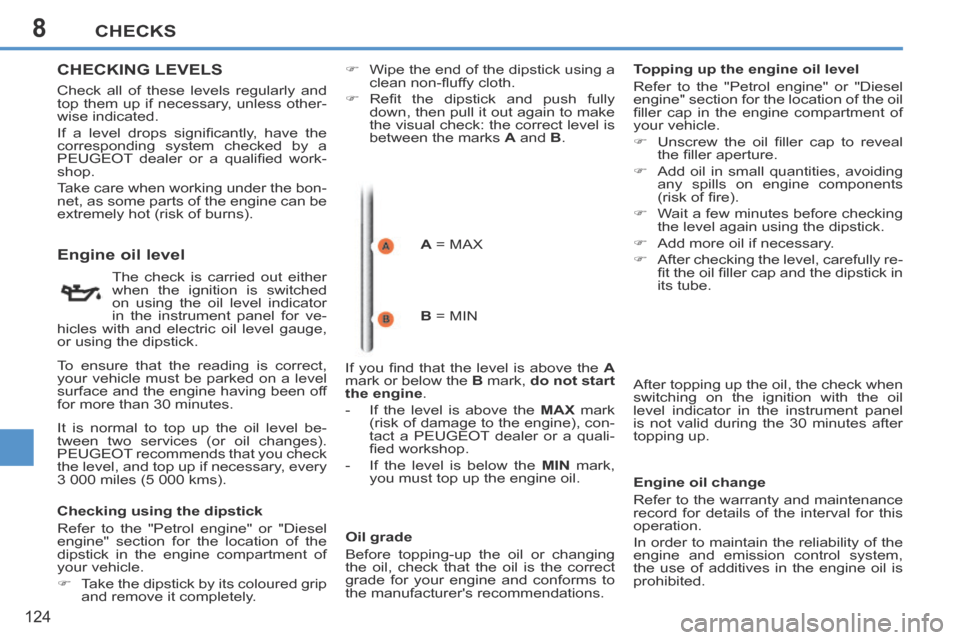
Take the dipstick by its coloured grip and remove it completely. A = MAX
B = MIN
If you fi nd that the level is above the A
mark or below the B mark, do not start
the engine .
- If the level is above the MAX mark
(risk of damage to the engine), con-
tact a PEUGEOT dealer or a quali-
fi ed workshop.
- If the level is below the MIN mark,
you must top up the engine oil.
Oil grade
Before topping-up the oil or changing
the oil, check that the oil is the correct
grade for your engine and conforms to
the manufacturer's recommendations. Topping up the engine oil level
Refer to the "Petrol engine" or "Diesel
engine" section for the location of the oil
fi ller cap in the engine compartment of
your vehicle.
Unscrew the oil fi ller cap to reveal
the fi ller aperture.
Add oil in small quantities, avoiding any spills on engine components
(risk of fi re).
Wait a few minutes before checking the level again using the dipstick.
Add more oil if necessary.
After checking the level, carefully re- fi t the oil fi ller cap and the dipstick in
its tube.
After topping up the oil, the check when
switching on the ignition with the oil
level indicator in the instrument panel
is not valid during the 30 minutes after
topping up.
Engine oil change
Refer to the warranty and maintenance
record for details of the interval for this
operation.
In order to maintain the reliability of the
engine and emission control system,
the use of additives in the engine oil is
prohibited.
Wipe the end of the dipstick using a
clean non-fl uffy cloth.
Refi t the dipstick and push fully down, then pull it out again to make
the visual check: the correct level is
between the marks A and B .
Page 141 of 232
9PRACTICAL INFORMATION
139
207CC_EN_CHAP09_INFO PRATIQUES_ED01-2014
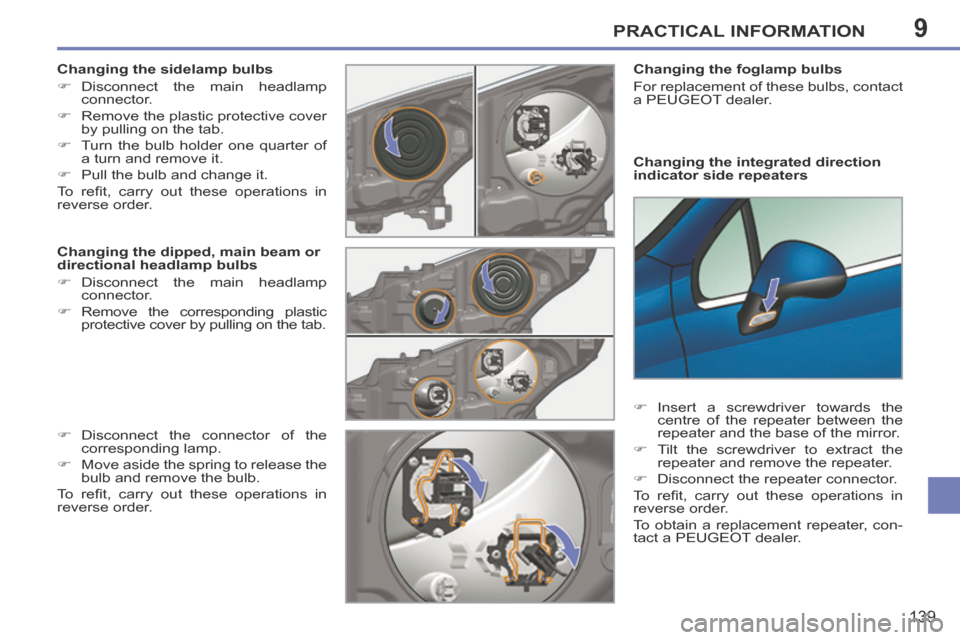
Changing the integrated direction
indicator side repeaters Changing the foglamp bulbs
For replacement of these bulbs, contact
a PEUGEOT dealer.
Insert a screwdriver towards the centre of the repeater between the
repeater and the base of the mirror.
Tilt the screwdriver to extract the repeater and remove the repeater.
Disconnect the repeater connector.
To refi t, carry out these operations in
reverse order.
To obtain a replacement repeater, con-
tact a PEUGEOT dealer.
Changing the sidelamp bulbs
Disconnect the main headlamp
connector.
Remove the plastic protective cover by pulling on the tab.
Turn the bulb holder one quarter of a turn and remove it.
Pull the bulb and change it.
To refi t, carry out these operations in
reverse order.
Changing the dipped, main beam or
directional headlamp bulbs
Disconnect the main headlamp connector.
Remove the corresponding plastic protective cover by pulling on the tab.
Disconnect the connector of the corresponding lamp.
Move aside the spring to release the bulb and remove the bulb.
To refi t, carry out these operations in
reverse order.
Page 144 of 232
9
!
i
PRACTICAL INFORMATION
142
207CC_EN_CHAP09_INFO PRATIQUES_ED01-2014
PEUGEOT does not accept any
responsibility for the costs incurred
in repairing your vehicle or for the
malfunctions resulting from the in-
stallation of additional accessories
which are not supplied or recom-
mended by PEUGEOT and which
are not installed in accordance with
its instructions, particularly when
the combined consumption of all of
the additional equipment connect-
ed exceeds 10 milliamperes. Installation of electrical acces-
sories
Your vehicle's electrical circuit
is designed to operate with the
standard or optional equipment.
Before installing other electrical
equipment or accessories in your
vehicle, contact a PEUGEOT dealer
or a qualifi ed workshop.
CHANGING A FUSE
Procedure for the replacement of a
failed fuse with a new fuse in order to
rectify a failure of the corresponding
function.
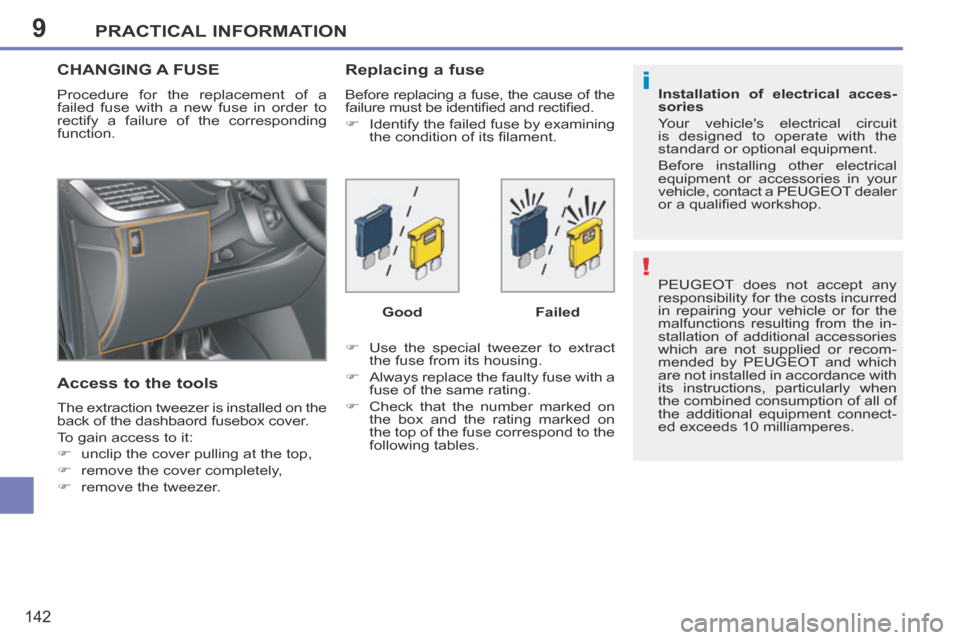
Access to the tools
The extraction tweezer is installed on the
back of the dashbaord fusebox cover.
To gain access to it:
unclip the cover pulling at the top,
remove the cover completely,
remove the tweezer.
Replacing a fuse
Before replacing a fuse, the cause of the
failure must be identifi ed and rectifi ed.
Identify the failed fuse by examining the condition of its fi lament.
Use the special tweezer to extract the fuse from its housing.
Always replace the faulty fuse with a fuse of the same rating.
Check that the number marked on the box and the rating marked on
the top of the fuse correspond to the
following tables. Good
Failed