check engine PEUGEOT 3008 HYBRID 4 2011 Owners Manual
[x] Cancel search | Manufacturer: PEUGEOT, Model Year: 2011, Model line: 3008 Hybrid 4, Model: Peugeot 3008 Hybrid 4 2011Pages: 280, PDF Size: 16.5 MB
Page 5 of 280
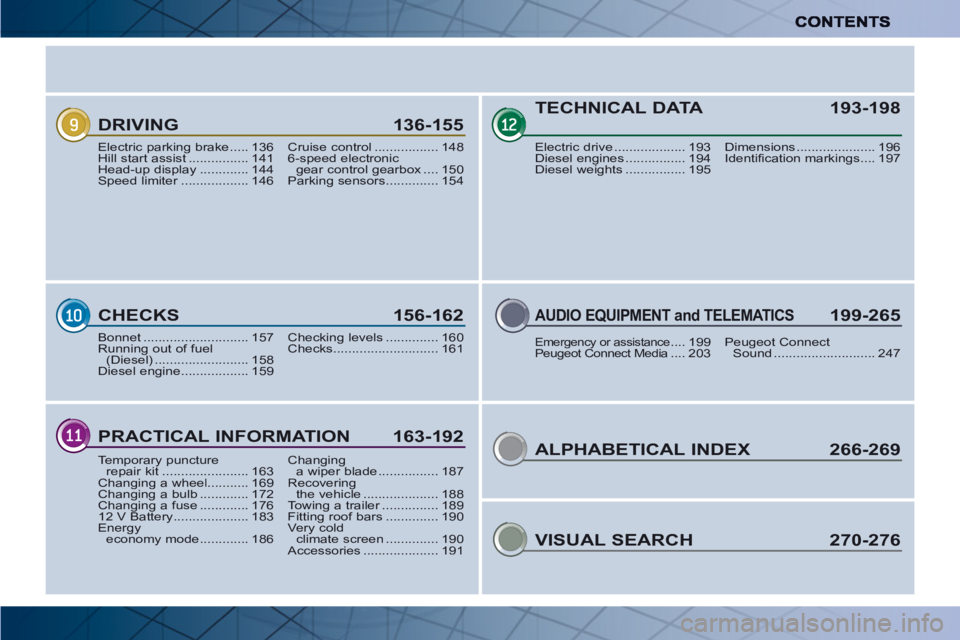
ALPHABETICAL INDEX 266-269
DRIVING 136-155
CHECKS 156-162
PRACTICAL INFORMATION 163-192
TECHNICAL DATA 193-198
AUDIO EQUIPMENT and TELEMATICS 199-265
Electric parking brake.....136Hill start assist................141Head-up display.............144Speed limiter..................r146
Cruise control .................1486-speed electronicgear control gearbox....150Parking sensors ..............154
Bonnet............................157Running out of fuel (Diesel).........................158Diesel engine..................159
Checking levels ..............160Checks............................161
Temporary puncture repair kit .......................163Changing a wheel...........169Changing a bulb.............172Changing a fuse .............17612 V Battery....................183Energy economy mode.............186
Changinga wiper blade ................187Recoveringthe vehicle....................188Towing a trailer...............r189Fitting roof bars ..............190Very cold climate screen..............190Accessories....................191
Electric drive ...................193Diesel engines................194Diesel weights................195
Dimensions .....................196Identification markings....197
VISUAL SEARCH 270-276
Emergency or assistance....199Peugeot Connect Media....203Peugeot Connect Sound ...........................247
Page 24 of 280
22
DRIVING SAFELY
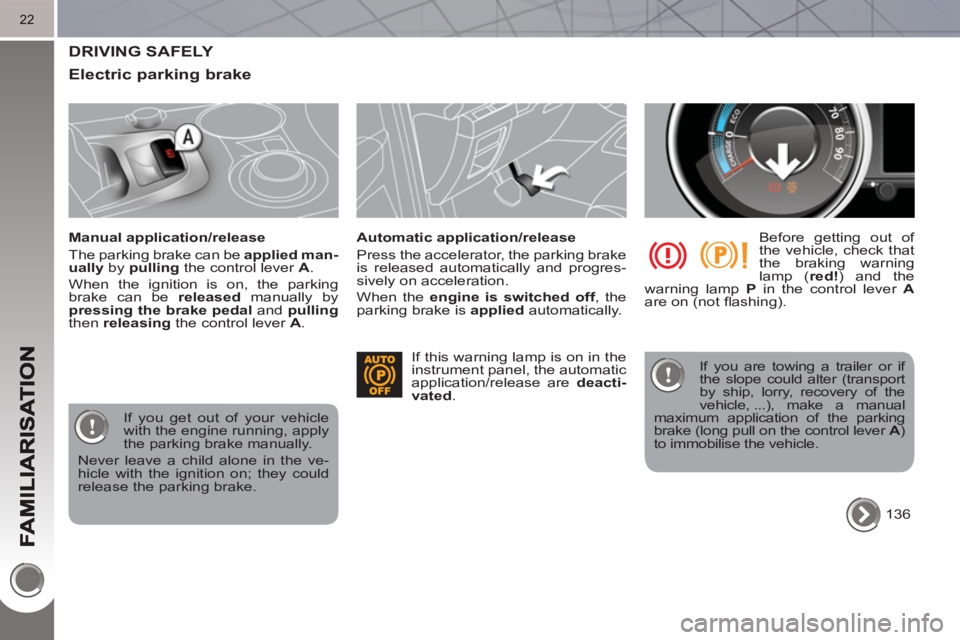
Electric parkin
g brake
Manual application/release
The parking brake can be applied man-
ually
by pulling
the control lever A
.
When the ignition is on, the parking
brake can be released
manually by
pressing the brake pedal
and pulling
then releasing
the control lever A
.
Automatic application/release
Press the accelerator, the parking brake
is released automatically and progres-
sively on acceleration.
When the engine is switched off
, the
parking brake is applied
automatically.
If you get out of your vehicle
with the engine running, apply
the parking brake manually.
Never leave a child alone in the ve-
Before getting out of
the vehicle, check that
the braking warning
lamp ( red!
) and the
warning lamp P
in the control lever A
are on (not fl ashing).
hicle with the ignition on; they could
release the parking brake.
136 If this warning lamp is on in the
instrument panel, the automatic
application/release are deacti-
vated
.
If you are towing a trailer or if
the slope could alter (transport
by ship, lorry, recovery of the
vehicle, ...), make a manual
maximum application of the parking
brake (long pull on the control lever A
)
to immobilise the vehicle.
Page 39 of 280
FOR ECONOMICAL DRIVING, CARING FOR THE ENVIRONMENT
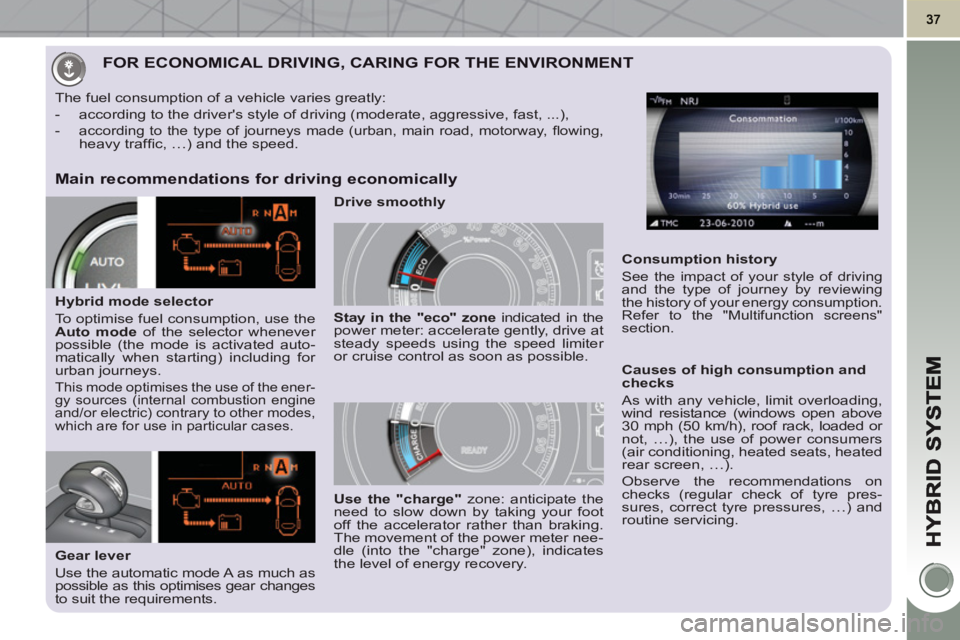
Main recommendations for driving economically
Drive smoothly
The fuel consumption of a vehicle varies greatly:
- according to the driver's style of driving (moderate, aggressive, fast, ...),
-
according to the type of journeys made (urban, main road, motorway, fl owing,
heavy traffi c, …) and the speed.
Hybrid mode selector
To optimise fuel consumption, use the
Auto
mode
of the selector whenever
possible (the mode is activated auto-
matically when starting) including for
urban journeys.
This mode optimises the use of the ener-
gy sources (internal combustion engine
and/or electric) contrary to other modes,
which are for use in particular cases.
Gear lever
Use the automatic mode A as much as
possible as this optimises gear changes
to suit the requirements.
Stay in the "eco" zone
indicated in the
power meter: accelerate gently, drive at
steady speeds using the speed limiter
or cruise control as soon as possible.
Causes of high consumption and
checks
As with any vehicle, limit overloading,
wind resistance (windows open above
30 mph (50 km/h), roof rack, loaded or
not, …), the use of power consumers
(air conditioning, heated seats, heated
rear screen, …).
Observe the recommendations on
checks (regular check of tyre pres-
sures, correct tyre pressures, …) and
routine servicing.
Use the "charge"
zone: anticipate the
need to slow down by taking your foot
off the accelerator rather than braking.
The movement of the power meter nee-
dle (into the "charge" zone), indicates
the level of energy recovery.
Consumption history
See the impact of your style of driving
and the type of journey by reviewing
the history of your energy consumption.
Refer to the "Multifunction screens"
section.
Page 53 of 280
51
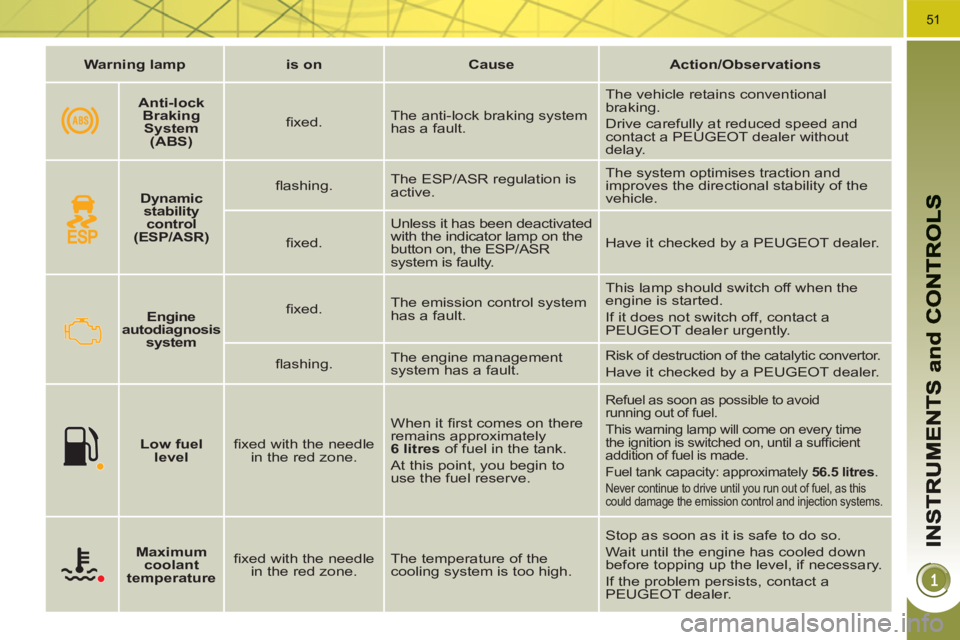
Warning lamp
is on
Cause
Action/Observations
Engine
autodiagnosis
system
fi xed. The emission control system
has a fault. This lamp should switch off when the
engine is started.
If it does not switch off, contact a
PEUGEOT dealer urgently.
fl ashing. The engine management
system has a fault.
Risk of destruction of the catalytic convertor.
Have it checked by a PEUGEOT dealer.
Low fuel
level
fi xed with the needle
in the red zone. When it fi rst comes on there
remains approximately
6 litres
of fuel in the tank.
At this point, you begin to
use the fuel reserve.
Refuel as soon as possible to avoid
running out of fuel.
This warning lamp will come on every time
the ignition is switched on, until a suffi cient
addition of fuel is made.
Fuel tank capacity: approximately 56.5 litres
.
Never continue to drive until you run out of fuel, as this
could damage the emission control and injection systems.
Maximum
coolant
temperature
fi xed with the needle
in the red zone. The temperature of the
cooling system is too high. Stop as soon as it is safe to do so.
Wait until the engine has cooled down
before topping up the level, if necessary.
If the problem persists, contact a
PEUGEOT dealer.
Dynamic
stability
control
(ESP/ASR)
fl ashing. The ESP/ASR regulation is
active. The system optimises traction and
improves the directional stability of the
vehicle.
fi xed. Unless it has been deactivated
with the indicator lamp on the
button on, the ESP/ASR
system is faulty. Have it checked by a PEUGEOT dealer.
Anti-lock
Braking
System
(ABS)
fi xed. The anti-lock braking system
has a fault. The vehicle retains conventional
braking.
Drive carefully at reduced speed and
contact a PEUGEOT dealer without
delay.
Page 54 of 280
52
Warning lamp
is on
Cause
Action/Observations
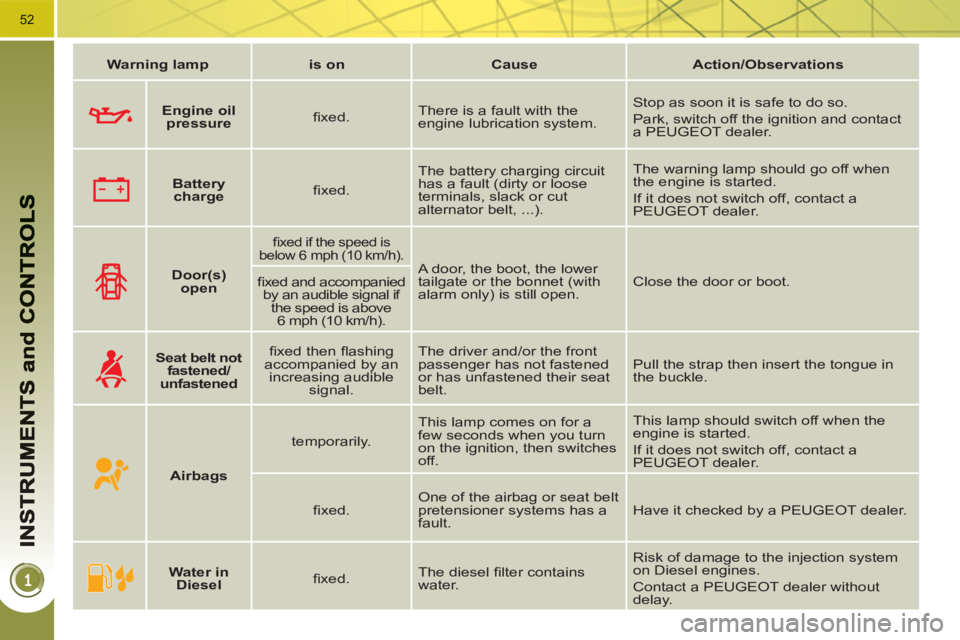
Door(s)
open
fi xed if the speed is
below 6 mph (10 km/h).
A door, the boot, the lower
tailgate or the bonnet (with
alarm only) is still open. Close the door or boot.
fi xed and accompanied
by an audible signal if
the speed is above
6 mph (10 km/h).
Seat belt not
fastened/
unfastened
fi xed then fl ashing
accompanied by an
increasing audible
signal. The driver and/or the front
passenger has not fastened
or has unfastened their seat
belt. Pull the strap then insert the tongue in
the buckle.
Airbags
temporarily. This lamp comes on for a
few seconds when you turn
on the ignition, then switches
off. This lamp should switch off when the
engine is started.
If it does not switch off, contact a
PEUGEOT dealer.
fi xed. One of the airbag or seat belt
pretensioner systems has a
fault. Have it checked by a PEUGEOT dealer.
Water in
Diesel
fi xed. The diesel fi lter contains
water. Risk of damage to the injection system
on Diesel engines.
Contact a PEUGEOT dealer without
delay.
Engine oil
pressure
fi xed. There is a fault with the
engine lubrication system. Stop as soon it is safe to do so.
Park, switch off the ignition and contact
a PEUGEOT dealer.
Battery
charge
fi xed. The battery charging circuit
has a fault (dirty or loose
terminals, slack or cut
alternator belt, ...). The warning lamp should go off when
the engine is started.
If it does not switch off, contact a
PEUGEOT dealer.
Page 58 of 280
56
The level shown will only be
correct if the vehicle is on
level ground and the engine
has been off for more than
30 minutes.
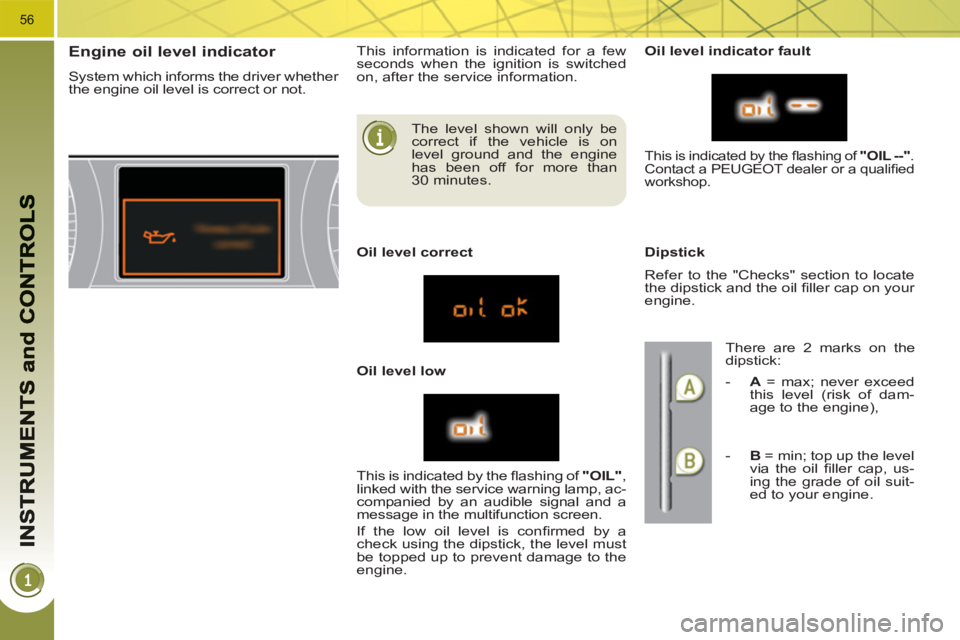
Engine oil level indicator
System which informs the driver whether
the engine oil level is correct or not. This information is indicated for a few
seconds when the ignition is switched
on, after the service information.
Oil level correct
Oil level low
Oil level indicator fault
Dipstick
This is indicated by the fl ashing of "OIL"
,
linked with the service warning lamp, ac-
companied by an audible signal and a
message in the multifunction screen.
If the low oil level is confi rmed by a
check using the dipstick, the level must
be topped up to prevent damage to the
engine.
This is indicated by the fl ashing of "OIL --"
.
Contact a PEUGEOT dealer or a qualifi ed
workshop.
Refer to the "Checks" section to locate
the dipstick and the oil fi ller cap on your
engine.
There are 2 marks on the
dipstick:
- A
= max; never exceed
this level (risk of dam-
age to the engine),
- B
= min; top up the level
via the oil fi ller cap, us-
ing the grade of oil suit-
ed to your engine.
Page 70 of 280
68
The air conditioning system does not contain chlorine and does not
present any danger to the ozone layer.
Recommendations for ventilation and air conditioning
In order for these systems to be fully effective, follow the operation and mainte-
nance guidelines below:
)
If the interior temperature remains very high after the vehicle has been parked
in the sun for a considerable time, fi rst ventilate the passenger compartment
for a few minutes.
Place the air fl ow control at a suffi cient level to provide an adequate renewal
of air in the passenger compartment.
)
To obtain an even air distribution, take care not to obstruct the exterior air
intake grilles located at the base of the windscreen, the nozzles, the vents
and the air outlets, as well as the air extractor located in the boot.
)
Use in preference the intake of exterior air as prolonged use of the air recir-
culation may cause misting of the windows and side windows.
)
Do not cover the sunshine sensor, located on the dashboard; this is used for
regulation of the automatic air conditioning system.
)
Operate the air conditioning system for 5 to 10 minutes, once or twice a
month to keep it in perfect working order.
)
Ensure that the passenger compartment fi lter is in good condition and have
the fi lter elements replaced regularly (refer to the "Checks" section).
We recommend the use of a combined passenger compartment fi lter. Thanks
to its second special active fi lter, it contributes to the purifi cation of the air
breathed by the occupants and the cleanliness of the passenger compart-
ment (reduction of allergic symptoms, bad odours and greasy deposits).
)
The air conditioning uses power from the engine while operating. This
results in an increase in the vehicle's fuel consumption.
When towing at or near maximum capacity or on steep slopes in high
ambient temperatures, switching off the air conditioning saves engine power
and so improves towing capacity.
Condensation created by the air conditioning results in a discharge of water
under the vehicle when stationary, which is perfectly normal.
)
To ensure correct operation of the air conditioning system, you are also
advised to have it checked regularly.
)
If the system does not produce cold air, do not use it and contact a PEUGEOT
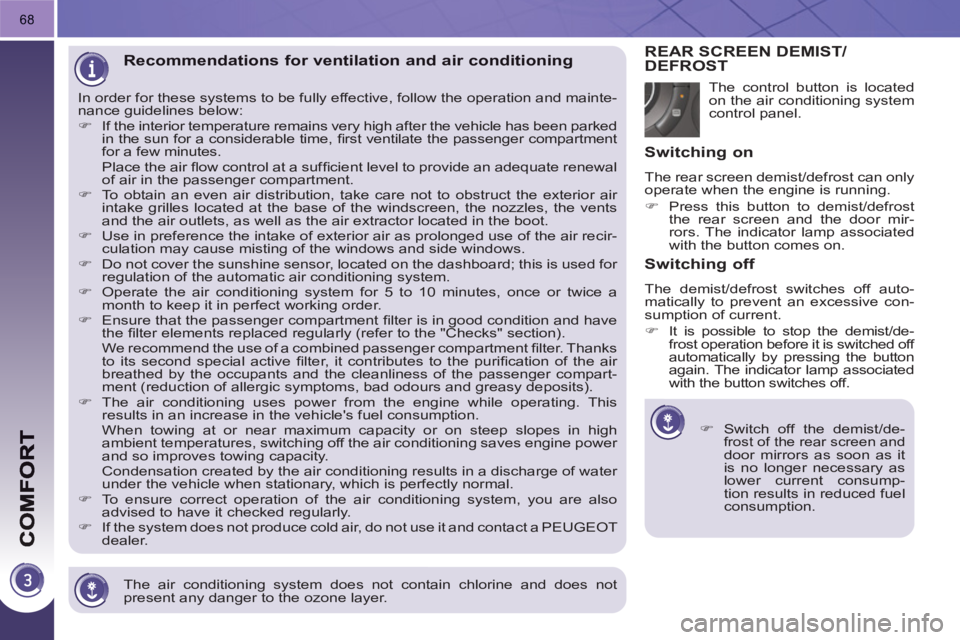
dealer. The control button is located
on the air conditioning system
control panel.
REAR SCREEN DEMIST/DEFROST
)
Switch off the demist/de-frost of the rear screen and door mirrors as soon as it
is no longer necessary as
lower current consump-
tion results in reduced fuel
consumption.
Switching on
The rear screen demist/defrost can only
operate when the engine is running.
)
Press this button to demist/defrost
the rear screen and the door mir-
rors. The indicator lamp associated
with the button comes on.
Switching off
The demist/defrost switches off auto-
matically to prevent an excessive con-
sumption of current.
)
It is possible to stop the demist/de-
frost operation before it is switched off
automatically by pressing the button
again. The indicator lamp associated
with the button switches off.
Page 96 of 280
94
The key cannot be removed
from the lock until the cap is
put back on the tank.
Opening the cap may trigger an in-
rush of air. This vacuum, which is
completely normal, is caused by the
sealing of the fuel system.
FUEL TANK
Capacity of the tank: approximately
56.5 litres.
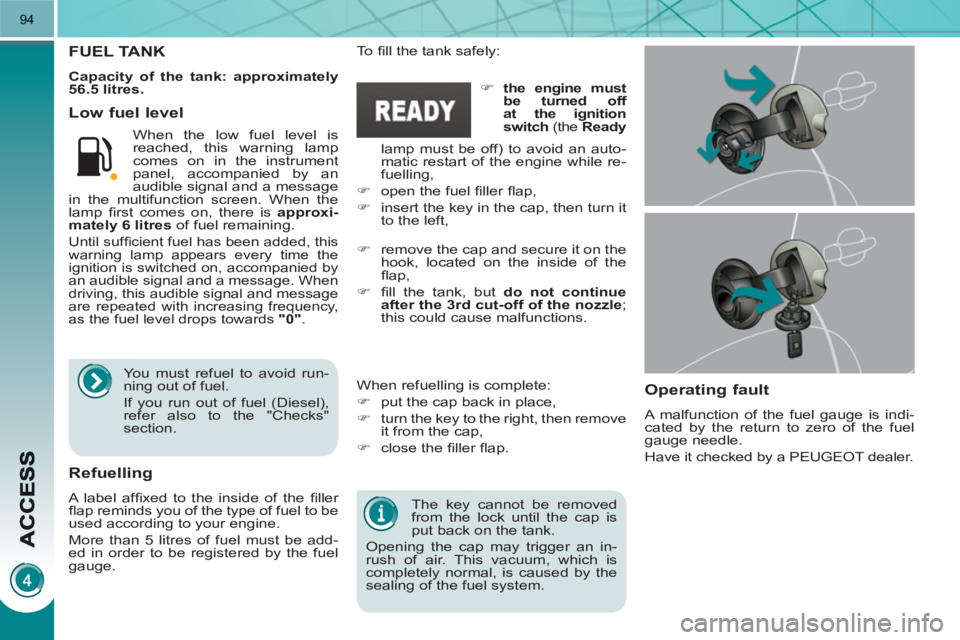
To fi ll the tank safely:
When refuelling is complete:
)
put the cap back in place,
)
turn the key to the right, then remove
it from the cap,
)
close the fi ller fl ap.
)
remove the cap and secure it on the
hook, located on the inside of the
fl ap,
)
fi ll the tank, but do not continue
after the 3rd cut-off of the nozzle
;
this could cause malfunctions.
Low fuel level
Operatin
g fault
A malfunction of the fuel gauge is indi-
cated by the return to zero of the fuel
gauge needle.
Have it checked by a PEUGEOT dealer.
Refuelling
A label affi xed to the inside of the fi ller
fl ap reminds you of the type of fuel to be
used according to your engine.
More than 5 litres of fuel must be add-
ed in order to be registered by the fuel
gauge. When the low fuel level is
reached, this warning lamp
comes on in the instrument
panel, accompanied by an
audible signal and a message
in the multifunction screen. When the
lamp fi rst comes on, there is approxi-
mately
6 litres
of fuel remaining.
Until suffi cient fuel has been added, this
warning lamp appears every time the
ignition is switched on, accompanied by
an audible signal and a message. When
driving, this audible signal and message
are repeated with increasing frequency,
as the fuel level drops towards "0"
.
You must refuel to avoid run-
ning out of fuel.
If you run out of fuel (Diesel),
refer also to the "Checks"
section.
)
the engine must
be turned off
at the ignition
switch
(the Ready
lamp must be off) to avoid an auto-
matic restart of the engine while re-
fuelling,
)
open the fuel fi ller fl ap,
)
insert the key in the cap, then turn it
to the left,
Page 130 of 280
128
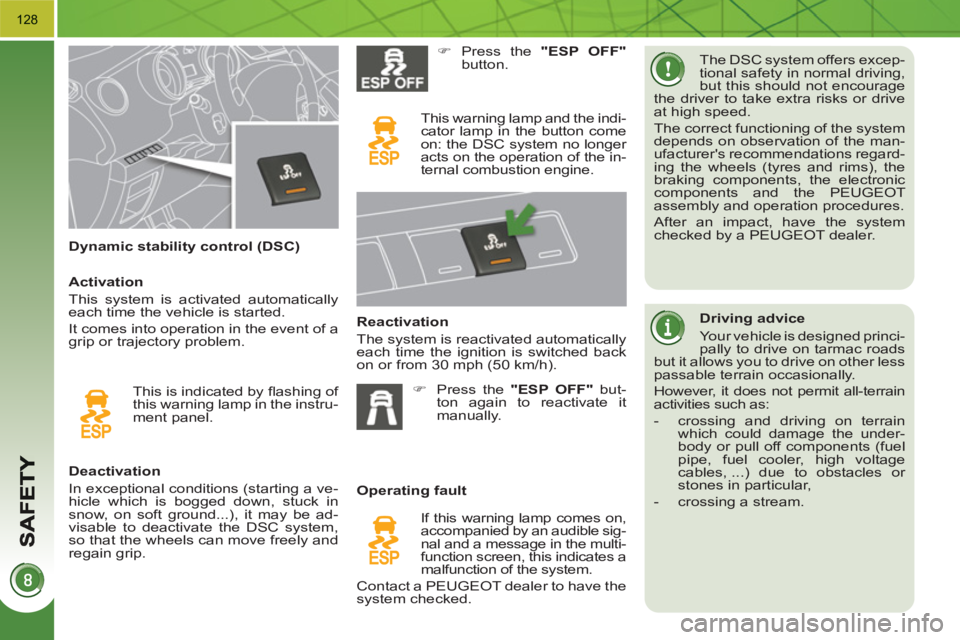
Dynamic stability control (DSC) The DSC system offers excep-
tional safety in normal driving,
but this should not encourage
the driver to take extra risks or drive
at high speed.
The correct functioning of the system
depends on observation of the man-
ufacturer's recommendations regard-
ing the wheels (tyres and rims), the
braking components, the electronic
components and the PEUGEOT
assembly and operation procedures.
After an impact, have the system
checked by a PEUGEOT dealer.
Deactivation
In exceptional conditions (starting a ve-
hicle which is bogged down, stuck in
snow, on soft ground...), it may be ad-
visable to deactivate the DSC system,
so that the wheels can move freely and
regain grip.
)
Press the "ESP OFF"
button.
This warning lamp and the indi-
cator lamp in the button come
on: the DSC system no longer
acts on the operation of the in-
ternal combustion engine.
Reactivation
The system is reactivated automatically
each time the ignition is switched back
on or from 30 mph (50 km/h).
Operating fault
If this warning lamp comes on,
accompanied by an audible sig-
nal and a message in the multi-
function screen, this indicates a
malfunction of the system.
Contact a PEUGEOT dealer to have the
system checked. This is indicated by fl ashing of
this warning lamp in the instru-
ment panel.
Activation
This system is activated automatically
each time the vehicle is started.
It comes into operation in the event of a
grip or trajectory problem.
)
Press the "ESP OFF"
but-
ton again to reactivate it
manually.
Driving advice
Your vehicle is designed princi-
pally to drive on tarmac roads
but it allows you to drive on other less
passable terrain occasionally.
However, it does not permit all-terrain
activities such as:
- crossing and driving on terrain
which could damage the under-
body or pull off components (fuel
pipe, fuel cooler, high voltage
cables, ...) due to obstacles or
stones in particular,
- crossing a stream.
Page 132 of 280
130
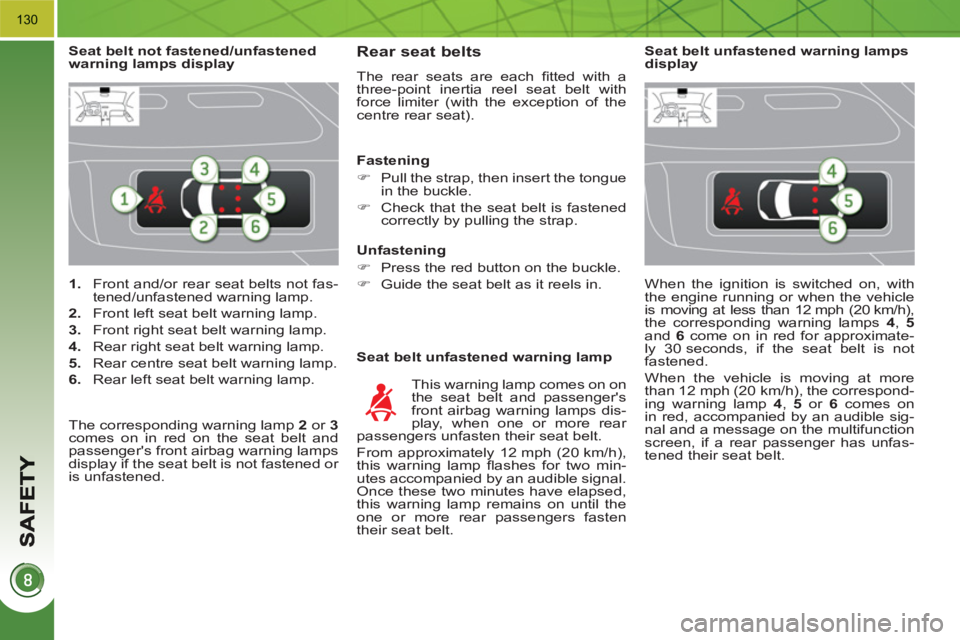
1.
Front and/or rear seat belts not fas-
tened/unfastened warning lamp.
2.
Front left seat belt warning lamp.
3.
Front right seat belt warning lamp.
4.
Rear right seat belt warning lamp.
5.
Rear centre seat belt warning lamp.
6.
Rear left seat belt warning lamp.
Seat belt not fastened/unfastened
warning lamps display
Rear seat belts
The rear seats are each fi tted with a
three-point inertia reel seat belt with
force limiter (with the exception of the
centre rear seat).
Seat belt unfastened warning lamp
This warning lamp comes on on
the seat belt and passenger's
front airbag warning lamps dis-
play, when one or more rear
passengers unfasten their seat belt.
From approximately 12 mph (20 km/h),
this warning lamp fl ashes for two min-
utes accompanied by an audible signal.
Once these two minutes have elapsed,
this warning lamp remains on until the
one or more rear passengers fasten
their seat belt.
Fastening
)
Pull the strap, then insert the tongue
in the buckle.
)
Check that the seat belt is fastened
correctly by pulling the strap.
Unfastening
)
Press the red button on the buckle.
)
Guide the seat belt as it reels in.
The corresponding warning lamp 2
or 3
comes on in red on the seat belt and
passenger's front airbag warning lamps
display if the seat belt is not fastened or
is unfastened.
When the ignition is switched on, with
the engine running or when the vehicle
is moving at less than 12 mph (20 km/h),
the corresponding warning lamps 4
, 5
and 6
come on in red for approximate-
ly 30 seconds, if the seat belt is not
fastened.
When the vehicle is moving at more
than 12 mph (20 km/h), the correspond-
ing warning lamp 4
, 5
or 6
comes on
in red, accompanied by an audible sig-
nal and a message on the multifunction
screen, if a rear passenger has unfas-
tened their seat belt.
Seat belt unfastened warning lamps
display