ESP Peugeot 308 2014 Service Manual
[x] Cancel search | Manufacturer: PEUGEOT, Model Year: 2014, Model line: 308, Model: Peugeot 308 2014Pages: 400, PDF Size: 10.05 MB
Page 196 of 400
194
Safety
308_EN_CHAP06_SECURITE_ED02-2013
Operation
Anti-lock braking system (ABS) and electronic brake force distribution (EBFD)
In emergency braking, press very firmly without releasing the pressure.
When changing wheels (tyres and rims), make sure that these are approved for your vehicle.
Normal operation of the ABS may make itself felt by slight vibrations of the brake pedal.
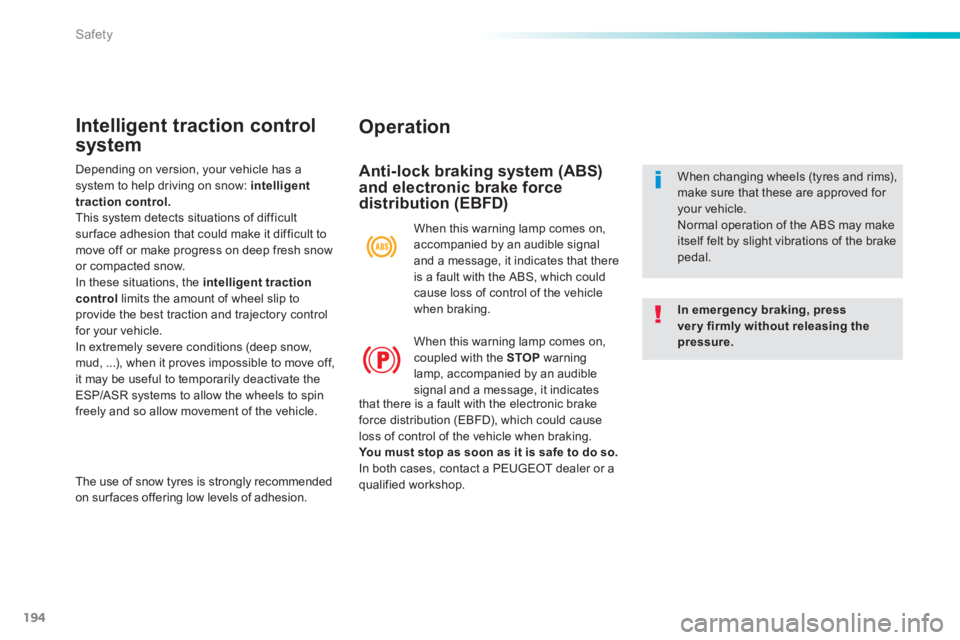
When this warning lamp comes on, accompanied by an audible signal and a message, it indicates that there is a fault with the ABS, which could cause loss of control of the vehicle when braking.
When this warning lamp comes on, coupled with the STOP warning lamp, accompanied by an audible signal and a message, it indicates
Intelligent traction control
system
The use of snow tyres is strongly recommended on sur faces offering low levels of adhesion.
that there is a fault with the electronic brake force distribution (EBFD), which could cause loss of control of the vehicle when braking. You must stop as soon as it is safe to do so. In both cases, contact a PEUGEOT dealer or a qualified workshop.
Depending on version, your vehicle has a system to help driving on snow: intelligent traction control. This system detects situations of difficult sur face adhesion that could make it difficult to move off or make progress on deep fresh snow or compacted snow. In these situations, the intelligent traction control limits the amount of wheel slip to provide the best traction and trajectory control for your vehicle. In extremely severe conditions (deep snow, mud, ...), when it proves impossible to move off, it may be useful to temporarily deactivate the ESP/ASR systems to allow the wheels to spin freely and so allow movement of the vehicle.
Page 199 of 400
197
6
Safety
308_EN_CHAP06_SECURITE_ED02-2013
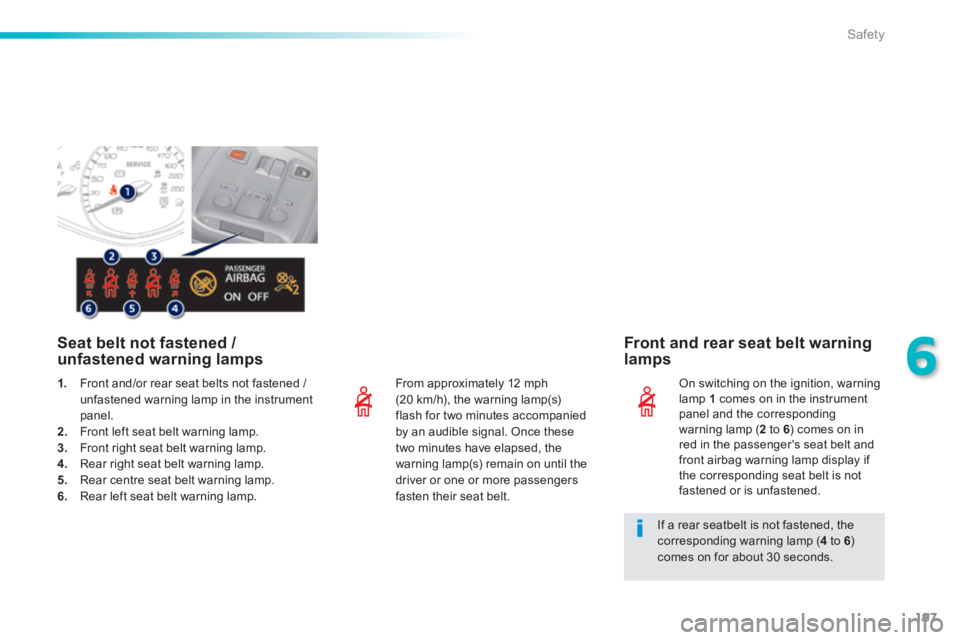
From approximately 12 mph (20 km/h), the warning lamp(s) flash for two minutes accompanied by an audible signal. Once these two minutes have elapsed, the warning lamp(s) remain on until the driver or one or more passengers fasten their seat belt.
Seat belt not fastened / unfastened warning lamps Front and rear seat belt warning lamps
On switching on the ignition, warning lamp 1 comes on in the instrument panel and the corresponding warning lamp (2 to 6 ) comes on in red in the passenger's seat belt and front airbag warning lamp display if the corresponding seat belt is not fastened or is unfastened.
1. Front and/or rear seat belts not fastened / unfastened warning lamp in the instrument panel. 2. Front left seat belt warning lamp. 3. Front right seat belt warning lamp. 4. Rear right seat belt warning lamp. 5. Rear centre seat belt warning lamp. 6. Rear left seat belt warning lamp.
If a rear seatbelt is not fastened, the corresponding warning lamp ( 4 to 6 ) comes on for about 30 seconds.
Page 204 of 400
202
Safety
308_EN_CHAP06_SECURITE_ED02-2013
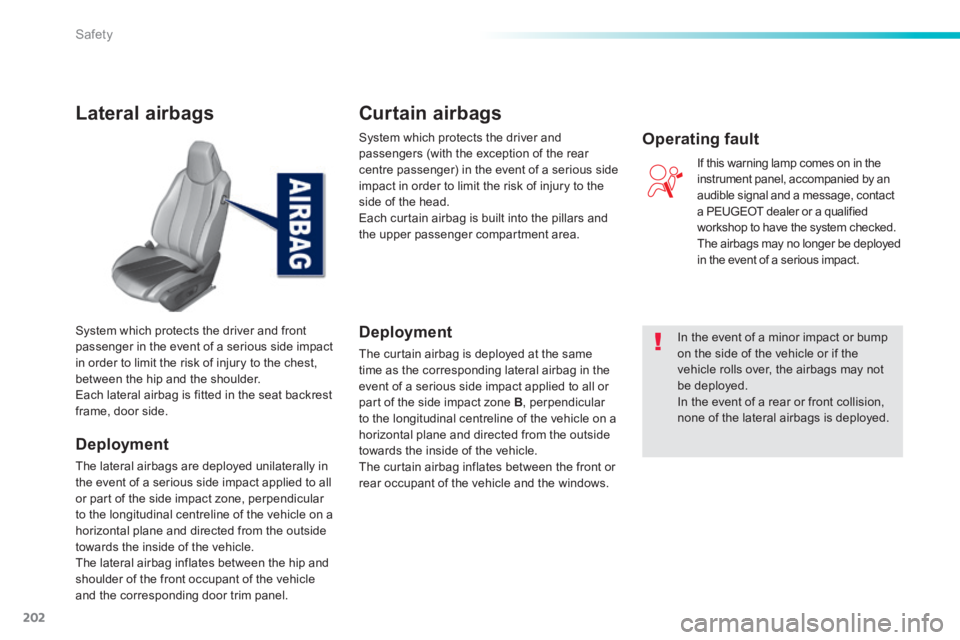
Lateral airbags
Deployment
The lateral airbags are deployed unilaterally in the event of a serious side impact applied to all or part of the side impact zone, perpendicular to the longitudinal centreline of the vehicle on a horizontal plane and directed from the outside towards the inside of the vehicle. The lateral airbag inflates between the hip and shoulder of the front occupant of the vehicle and the corresponding door trim panel.
System which protects the driver and front passenger in the event of a serious side impact in order to limit the risk of injury to the chest, between the hip and the shoulder. Each lateral airbag is fitted in the seat backrest frame, door side.
System which protects the driver and passengers (with the exception of the rear centre passenger) in the event of a serious side impact in order to limit the risk of injury to the side of the head. Each curtain airbag is built into the pillars and the upper passenger compartment area.
Deployment
The curtain airbag is deployed at the same time as the corresponding lateral airbag in the event of a serious side impact applied to all or part of the side impact zone B , perpendicular to the longitudinal centreline of the vehicle on a
horizontal plane and directed from the outside towards the inside of the vehicle. The curtain airbag inflates between the front or rear occupant of the vehicle and the windows.
In the event of a minor impact or bump on the side of the vehicle or if the vehicle rolls over, the airbags may not be deployed. In the event of a rear or front collision, none of the lateral airbags is deployed.
If this warning lamp comes on in the instrument panel, accompanied by an audible signal and a message, contact a PEUGEOT dealer or a qualified workshop to have the system checked. The airbags may no longer be deployed in the event of a serious impact.
Operating fault
Curtain airbags
Page 210 of 400
208
AR
BG
НИКОГА НЕ инсталирайте детско столче на седалка с АКТИВИРАНА предна ВЪЗДУШНА ВЪЗГЛАВНИЦ А. Това можеда причини
СМЪРТ или СЕРИОЗНО НАРАНЯВАНЕ на детето.
CSNIKDY neumisťujte dětské zádržné zařízení orientované směrem dozadu na sedadlo chráněné AKTIVOVANÝM čelním AIRBAGEM. Hrozí
nebezpečí SMRTI DÍTĚTE nebo VÁ ŽNÉHO ZR ANĚNÍ.
DABrug aldrig en bagudvendt barnestol på et sæde der er beskyttet af en aktiv airbag. Død eller alvorlig skade på barnet kan forekomme.
DEVer wenden Sie NIEMALS einen Kindersitz oder Babyschale gegen die Fahr trichtung bei AKTIVIERTEM Airbag, TOD oder ERNSTHAFTE
VERLETZUNGEN können die Folge sein.
ELΜη χρησιμοποιείτε ΠΟΤΕ παιδικό κάθισμα με την πλάτη του προς το εμπρός μέρος του αυτοκινήτου, σε μια θέση που προστατεύεται από
ΜΕΤΩΠΙΚΟ αερόσακο που είναι ΕΝΕΡΓΟΣ. Αυτό μπορεί να έχει σαν συνέπεια το ΘΑΝΑΤΟ ή το ΣΟΒΑΡΟ ΤΡΑΥΜΑΤΙΣΜΟ του ΠΑΙΔΙΟΥ
ENNEVER use a rear ward facing child restraint on a seat protected by an ACTIVE AIRBAG in front of it, DEATH or SERIOUS INJURY to the
CHILD can occur
ESNO INSTALAR NUNCA EL SISTEMA DE RETENCIÓN PAR A NIÑOS DE ESPALDAS AL SENTIDO DE LA CIRCULACIÓN SOBRE UN
ASIENTO PROTEGIDO CON UN COJÍN INFLABLE FRONTAL ( AIRBAG ) ACTIVADO. ESTO PUEDE CAUSAR LA MUERTE DEL BEBE
O HERIRLO GRAVEMENTE.
ETÄrge kasutage kunagi lapse tur vatooli seljaga sõidusuunas sõiduki istmel mis on kaitstud AKTIVEERITUD TURVAPADJAGA. See võib
põhjustada lapsele R ASKEID VIGASTUSI või SURMA.
FIÄLÄ KOSK A AN aseta lapsen tur vaistuinta selkä ajosuuntaan istuimelle, jonka edessä suojana on käyttöön aktivoitu TURVAT Y YNY. Sen
laukeaminen voi aiheuttaa LAPSEN KUOLEMAN tai VAK AVAN LOUKK A ANTUMISEN.
FRNE JAMAIS installer de système de retenue pour enfants faisant face vers l’arrière sur un siège protégé par un COUSSIN GONFLABLE
frontal ACTIVÉ.
Cela peut provoquer la MORT de l’ENFANT ou le BLESSER GR AVEMENT
HRNIK ADA ne postavljati dječju sjedalicu leđima u smjeru vožnje na sjedalo zaštićeno UKLJUČENIM prednjim ZR AČNIM JASTUKOM. To bi
moglo uzrokovati SMRT ili TEŠKU OZLJEDU djeteta.
HUSOHA ne használjon menetiránynak háttal beszerelt gyermekülést olyan ülésen, amely AKTIVÁLT ÁLLAPOTÚ (BEK APCSOLT)
FRONTLÉGZSÁKK AL van védve. Ez a gyermek halálát vagy súlyos sérülését okozhatja.
ITNON installare MAI seggiolini per bambini posizionati in senso contrario a quello di marcia su un sedile protetto da un AIRBAG frontale
ATTIVATO. Ciò potrebbe provocare la MORTE o FERITE GR AVI al bambino.
Safety
308_EN_CHAP06_SECURITE_ED02-2013
Page 235 of 400
233
7
Practical information
308_EN_CHAP07_INFO PR ATIQUES_ED02-2013
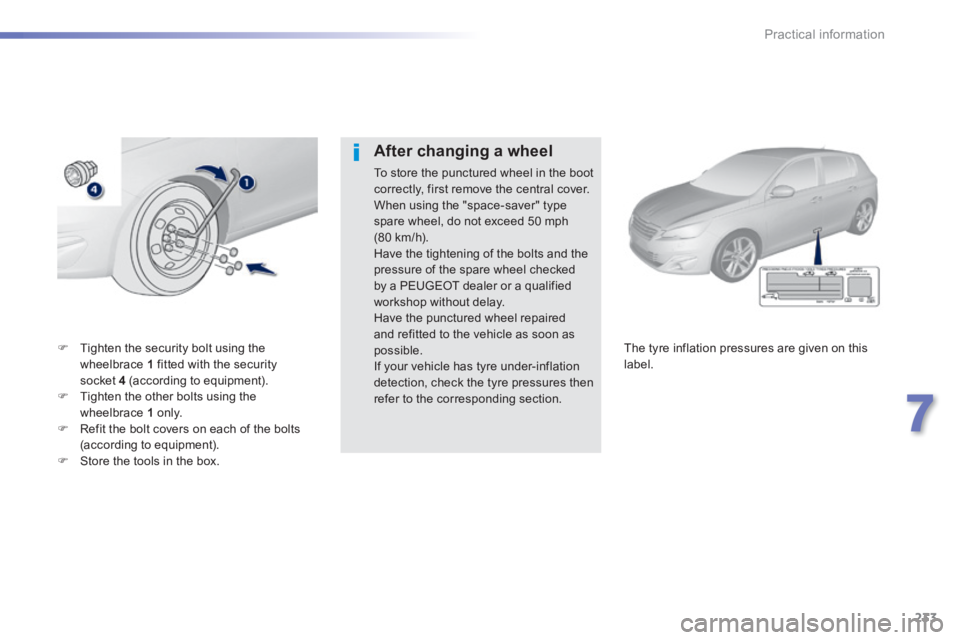
Tighten the security bolt using the wheelbrace 1 fitted with the security socket 4 (according to equipment). Tighten the other bolts using the wheelbrace 1 o n l y. Refit the bolt covers on each of the bolts
(according to equipment). Store the tools in the box.
The tyre inflation pressures are given on this label.
After changing a wheel
To store the punctured wheel in the boot correctly, first remove the central cover. When using the "space-saver" type spare wheel, do not exceed 50 mph
(80 km/h). Have the tightening of the bolts and the pressure of the spare wheel checked by a PEUGEOT dealer or a qualified workshop without delay. Have the punctured wheel repaired and refitted to the vehicle as soon as possible. If your vehicle has tyre under-inflation detection, check the tyre pressures then refer to the corresponding section.
Page 248 of 400
246
Practical information
308_EN_CHAP07_INFO PR ATIQUES_ED02-2013
PEUGEOT will not accept responsibility for the cost incurred in repairing your vehicle or for rectifying malfunctions resulting from the installation of accessories not supplied and not recommended by PEUGEOT and not installed in accordance with its instructions, in particular when the combined consumption of all of the additional equipment connected exceeds 10 milliamperes.
Installing electrical accessories
Your vehicle's electrical system is designed to operate with standard or optional equipment. Before installing other electrical equipment or accessories on your vehicle, contact a PEUGEOT dealer or a qualified workshop.
Page 251 of 400
249
7
Practical information
308_EN_CHAP07_INFO PR ATIQUES_ED02-2013
Engine compartment fuses
Access to the fuses
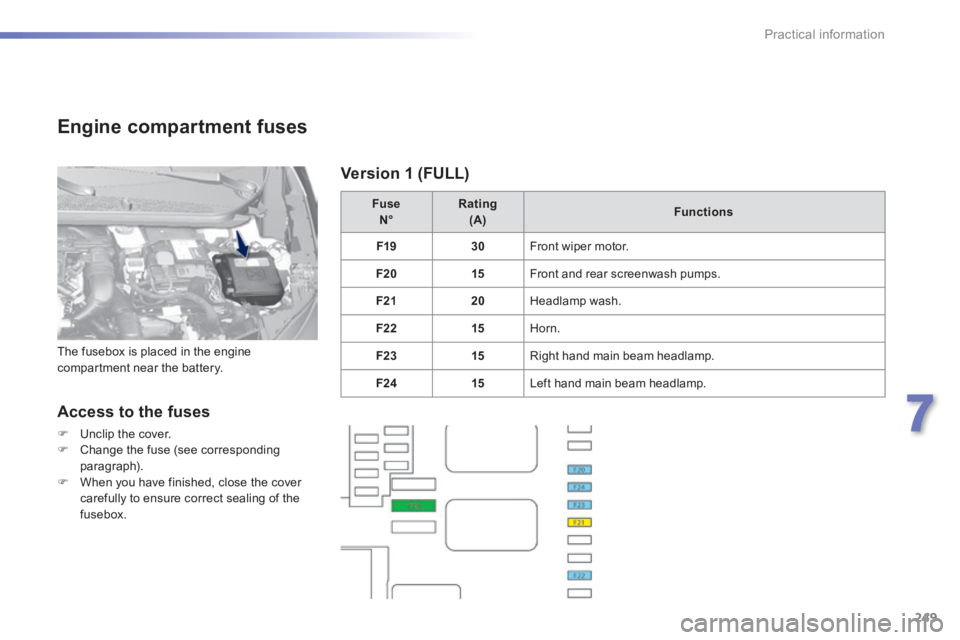
Unclip the cover. Change the fuse (see corresponding paragraph). When you have finished, close the cover carefully to ensure correct sealing of the fusebox.
Fuse N° Rating (A)Functions
F1930 Front wiper motor.
F2015 Front and rear screenwash pumps.
F2120 Headlamp wash.
F2215 Horn.
F2315 Right hand main beam headlamp.
F2415 Left hand main beam headlamp.
The fusebox is placed in the engine compartment near the battery.
Version 1 (FULL)
Page 255 of 400
253
7
Practical information
308_EN_CHAP07_INFO PR ATIQUES_ED02-2013
Starting using another
battery
First check that the slave battery has a nominal voltage of 12 V and a capacity at least equal to that of the discharged battery. Do not try to start the engine by connecting a battery charger. Do not disconnect the (+) terminal when the engine is running.
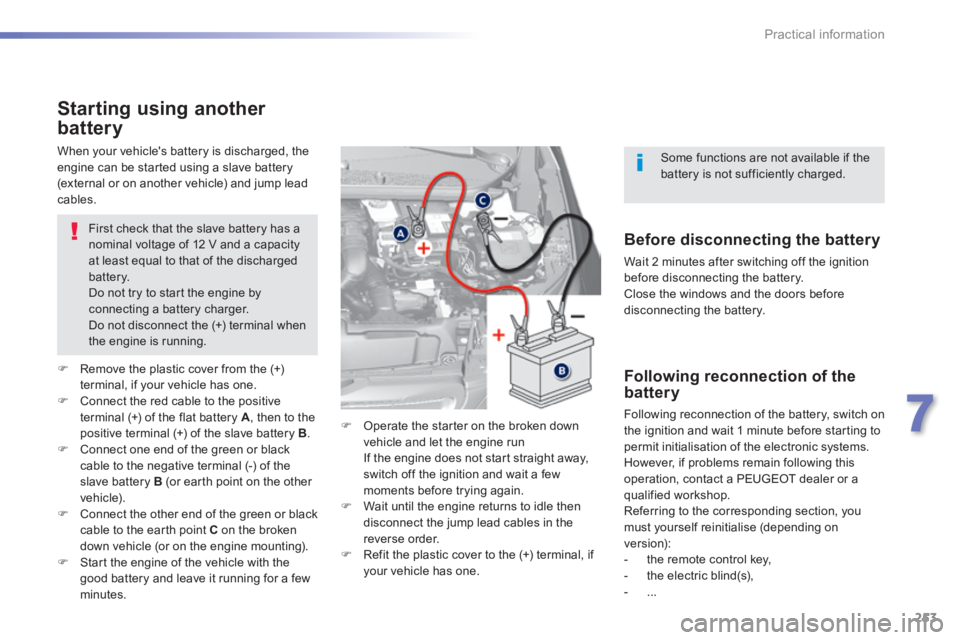
Remove the plastic cover from the (+) terminal, if your vehicle has one. Connect the red cable to the positive terminal (+) of the flat battery A , then to the
positive terminal (+) of the slave battery B . Connect one end of the green or black cable to the negative terminal (-) of the slave battery B (or earth point on the other vehicle). Connect the other end of the green or black cable to the earth point C on the broken down vehicle (or on the engine mounting). Start the engine of the vehicle with the good battery and leave it running for a few minutes.
Operate the starter on the broken down vehicle and let the engine run If the engine does not start straight away, switch off the ignition and wait a few moments before trying again. Wait until the engine returns to idle then disconnect the jump lead cables in the reverse order. Refit the plastic cover to the (+) terminal, if your vehicle has one.
When your vehicle's battery is discharged, the engine can be started using a slave battery (external or on another vehicle) and jump lead cables.
Before disconnecting the battery
Wait 2 minutes after switching off the ignition before disconnecting the battery. Close the windows and the doors before disconnecting the battery.
Following reconnection of the battery
Following reconnection of the battery, switch on
the ignition and wait 1 minute before starting to permit initialisation of the electronic systems. However, if problems remain following this operation, contact a PEUGEOT dealer or a qualified workshop. Referring to the corresponding section, you must yourself reinitialise (depending on version): - the remote control key, - the electric blind(s), - ...
Some functions are not available if the battery is not sufficiently charged.
Page 258 of 400
256
Practical information
308_EN_CHAP07_INFO PR ATIQUES_ED02-2013
Changing a wiper blade
Before removing a front
wiper blade
Removing
Fitting
After fitting a front wiper
blade
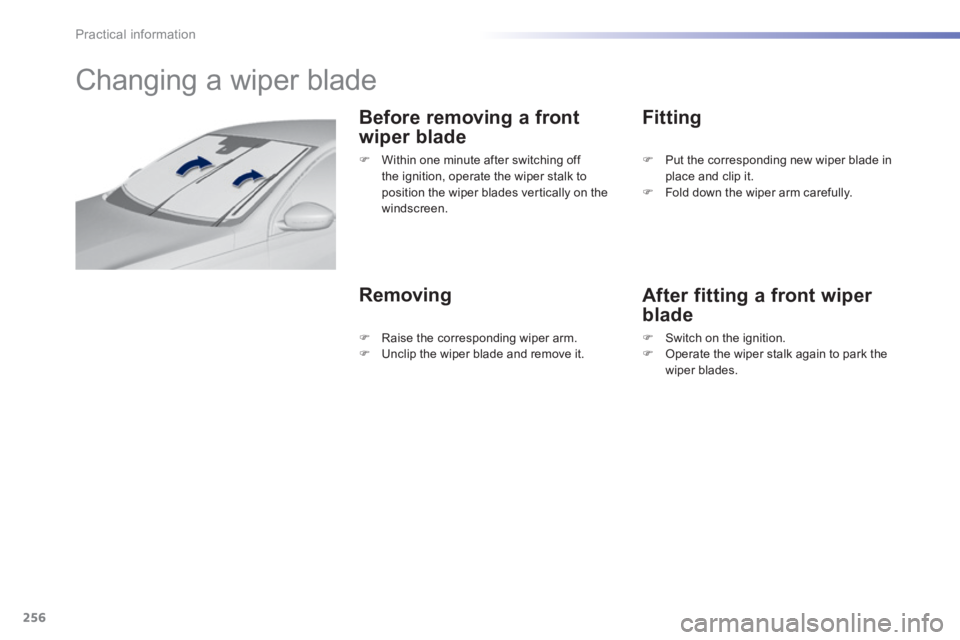
Within one minute after switching off the ignition, operate the wiper stalk to position the wiper blades vertically on the windscreen.
Put the corresponding new wiper blade in place and clip it. Fold down the wiper arm carefully.
Raise the corresponding wiper arm. Unclip the wiper blade and remove it. Switch on the ignition. Operate the wiper stalk again to park the wiper blades.
Page 272 of 400
270
Checks
308_EN_CHAP08_VERIFICATIONS_ED02-2013
On vehicles fitted with HDi engines, the fuel system must be primed if you run out of fuel; refer to the corresponding engine compartment view.
Running out of fuel (Diesel)
If the tank on your vehicle is fitted with a misfuel prevention device, refer to the "Misfuel prevention (Diesel)" section.
Fill the fuel tank with at least five litres of diesel. Open the bonnet. If necessary, unclip the styling cover for access to the priming pump. Squeeze and release the priming pump repeatedly until resistance is felt (there may be resistance at the first press). Operate the starter until the engine starts (if the engine does not start at the first attempt, wait around 15 seconds before trying again). If the engine does not start after a few attempts, operate the priming pump again then start the engine. Clip the styling cover back in place. Close the bonnet.
1.6 litre HDi engine
If the engine does not start first time, don't keep trying but start the procedure again from the beginning.