warning Peugeot 308 2014 Repair Manual
[x] Cancel search | Manufacturer: PEUGEOT, Model Year: 2014, Model line: 308, Model: Peugeot 308 2014Pages: 400, PDF Size: 10.05 MB
Page 200 of 400
198
Safety
308_EN_CHAP06_SECURITE_ED02-2013
The driver must ensure that passengers use the seat belts correctly and that they are all restrained securely before setting off. Wherever you are seated in the vehicle, always fasten your seat belt, even for short journeys. Do not interchange the seat belt buckles as they will not fulfil their role fully. The seat belts are fitted with an inertia reel permitting automatic adjustment of the length of the strap to your size. The seat belt is stowed automatically when not in use. Before and after use, ensure that the seat belt is reeled in correctly. The lower part of the strap must be positioned as low as possible on the pelvis. The upper part must be positioned in the hollow of the shoulder. The inertia reels are fitted with an automatic locking device which comes into operation in the event of a collision, emergency braking or if the vehicle rolls over. You can release the device by pulling firmly on the strap and releasing it so that it reels in slightly.
Recommendations for children
Use a suitable child seat if the passenger is less than 12 years old or shorter than one and a half metres. Never use the same seat belt to secure more than one person. Never allow a child to travel on your lap.
In order to be effective, a seat belt must: - be tightened as close to the body as possible, - be pulled in front of you with a smooth movement, checking that it does not twist, - be used to restrain only one person, - not bear any trace of cuts or fraying, - not be converted or modified to avoid affecting its performance. In accordance with current safety regulations, for all repairs on your vehicle, go to a qualified workshop with the skills and equipment needed, which a PEUGEOT dealer is able to provide. Have your seat belts checked regularly by a PEUGEOT dealer or a qualified workshop, particularly if the straps show signs of damage. Clean the seat belt straps with soapy water or a textile cleaning product, sold by PEUGEOT dealers. After folding or moving a seat or rear bench seat, ensure that the seat belt is positioned and reeled in correctly.
In the event of an impact
Depending on the nature and seriousness of the impact , the pretensioning device may be deployed before and independently of the airbags. Deployment of the pretensioners is accompanied by a slight discharge of harmless smoke and a noise, due to the activation of the pyrotechnic cartridge incorporated in the system. In all cases, the airbag warning lamp comes on. Following an impact, have the seat belts system checked, and if necessary replaced,
by a PEUGEOT dealer or a qualified
workshop.
Page 202 of 400
200
Safety
308_EN_CHAP06_SECURITE_ED02-2013
Deactivating the passenger's front airbag
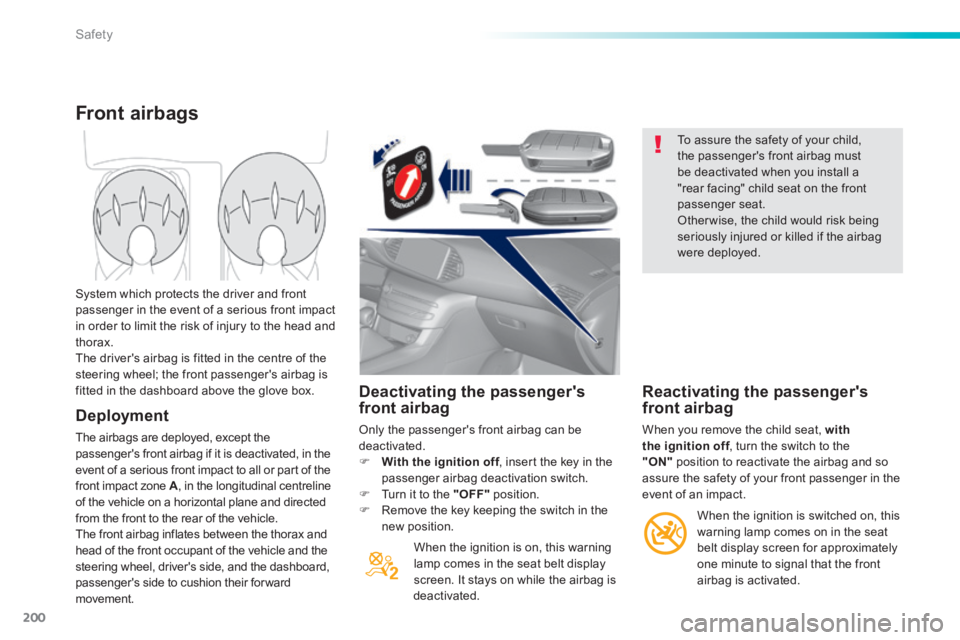
Only the passenger's front airbag can be deactivated. With the ignition off , insert the key in the With the ignition off , insert the key in the With the ignition offpassenger airbag deactivation switch. Turn it to the "OFF" position. Remove the key keeping the switch in the new position.
When the ignition is on, this warning lamp comes in the seat belt display screen. It stays on while the airbag is deactivated.
To assure the safety of your child, the passenger's front airbag must be deactivated when you install a "rear facing" child seat on the front passenger seat. Otherwise, the child would risk being seriously injured or killed if the airbag were deployed.
Reactivating the passenger's front airbag
When you remove the child seat, with the ignition off , turn the switch to the the ignition off , turn the switch to the the ignition off"ON" position to reactivate the airbag and so assure the safety of your front passenger in the event of an impact.
Front airbags
Deployment
The airbags are deployed, except the passenger's front airbag if it is deactivated, in the event of a serious front impact to all or part of the front impact zone A , in the longitudinal centreline of the vehicle on a horizontal plane and directed from the front to the rear of the vehicle. The front airbag inflates between the thorax and head of the front occupant of the vehicle and the steering wheel, driver's side, and the dashboard, passenger's side to cushion their for ward movement.
System which protects the driver and front passenger in the event of a serious front impact in order to limit the risk of injury to the head and thorax. The driver's airbag is fitted in the centre of the steering wheel; the front passenger's airbag is fitted in the dashboard above the glove box.
When the ignition is switched on, this warning lamp comes on in the seat belt display screen for approximately one minute to signal that the front airbag is activated.
Page 203 of 400
201
6
Safety
308_EN_CHAP06_SECURITE_ED02-2013
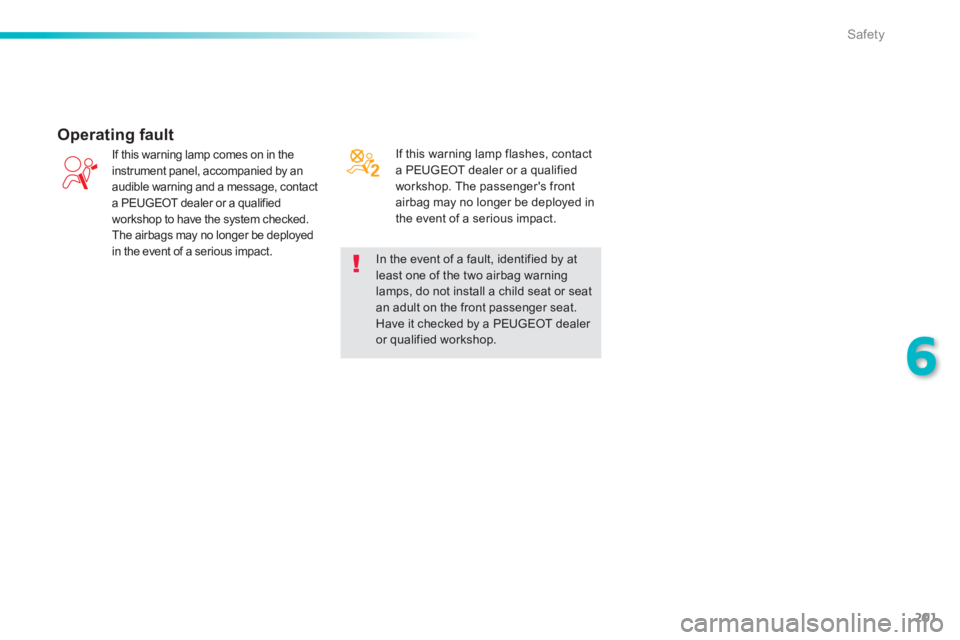
If this warning lamp flashes, contact a PEUGEOT dealer or a qualified workshop. The passenger's front airbag may no longer be deployed in the event of a serious impact.
Operating fault
If this warning lamp comes on in the instrument panel, accompanied by an audible warning and a message, contact a PEUGEOT dealer or a qualified workshop to have the system checked. The airbags may no longer be deployed in the event of a serious impact. In the event of a fault, identified by at least one of the two airbag warning lamps, do not install a child seat or seat an adult on the front passenger seat. Have it checked by a PEUGEOT dealer or qualified workshop.
Page 204 of 400
202
Safety
308_EN_CHAP06_SECURITE_ED02-2013
Lateral airbags
Deployment
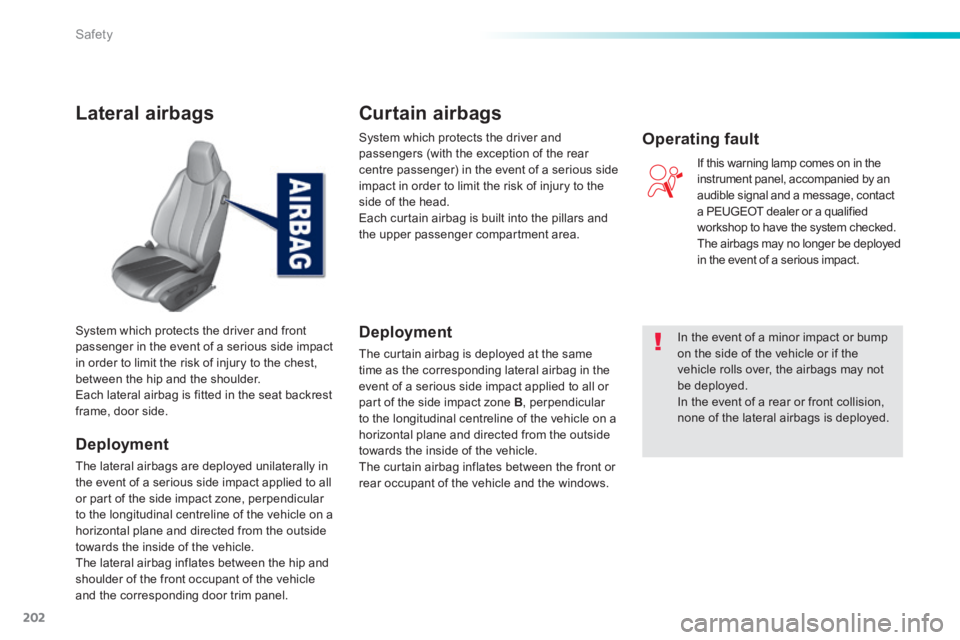
The lateral airbags are deployed unilaterally in the event of a serious side impact applied to all or part of the side impact zone, perpendicular to the longitudinal centreline of the vehicle on a horizontal plane and directed from the outside towards the inside of the vehicle. The lateral airbag inflates between the hip and shoulder of the front occupant of the vehicle and the corresponding door trim panel.
System which protects the driver and front passenger in the event of a serious side impact in order to limit the risk of injury to the chest, between the hip and the shoulder. Each lateral airbag is fitted in the seat backrest frame, door side.
System which protects the driver and passengers (with the exception of the rear centre passenger) in the event of a serious side impact in order to limit the risk of injury to the side of the head. Each curtain airbag is built into the pillars and the upper passenger compartment area.
Deployment
The curtain airbag is deployed at the same time as the corresponding lateral airbag in the event of a serious side impact applied to all or part of the side impact zone B , perpendicular to the longitudinal centreline of the vehicle on a
horizontal plane and directed from the outside towards the inside of the vehicle. The curtain airbag inflates between the front or rear occupant of the vehicle and the windows.
In the event of a minor impact or bump on the side of the vehicle or if the vehicle rolls over, the airbags may not be deployed. In the event of a rear or front collision, none of the lateral airbags is deployed.
If this warning lamp comes on in the instrument panel, accompanied by an audible signal and a message, contact a PEUGEOT dealer or a qualified workshop to have the system checked. The airbags may no longer be deployed in the event of a serious impact.
Operating fault
Curtain airbags
Page 209 of 400
207
6
Safety
308_EN_CHAP06_SECURITE_ED02-2013
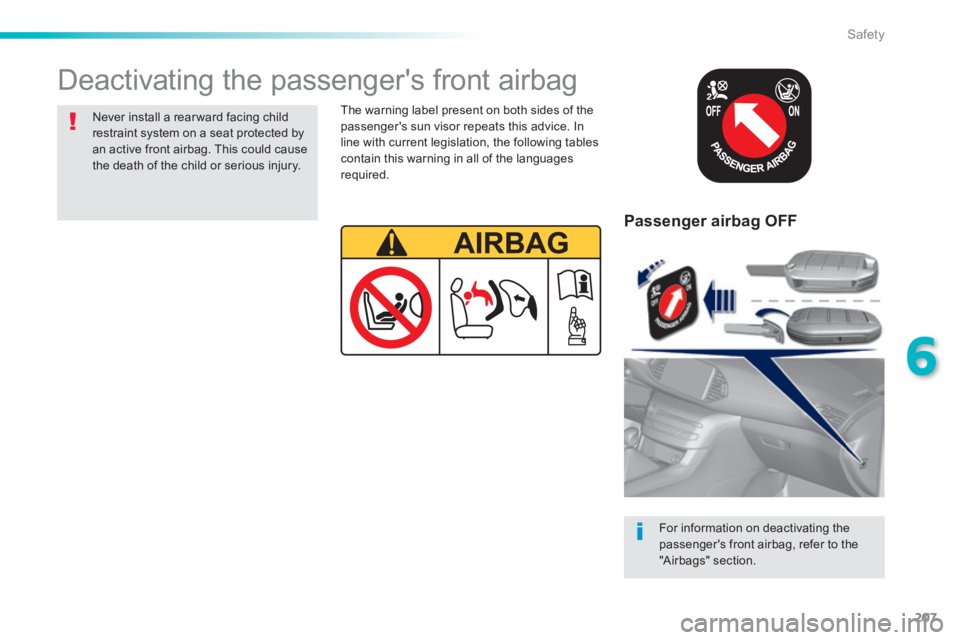
Passenger airbag OFF
For information on deactivating the
passenger's front airbag, refer to the "Airbags" section.
Deactivating the passenger's front airbag
Never install a rear ward facing child restraint system on a seat protected by an active front airbag. This could cause the death of the child or serious injury.
The warning label present on both sides of the passenger's sun visor repeats this advice. In line with current legislation, the following tables contain this warning in all of the languages required.
Page 232 of 400
230
Practical information
308_EN_CHAP07_INFO PR ATIQUES_ED02-2013
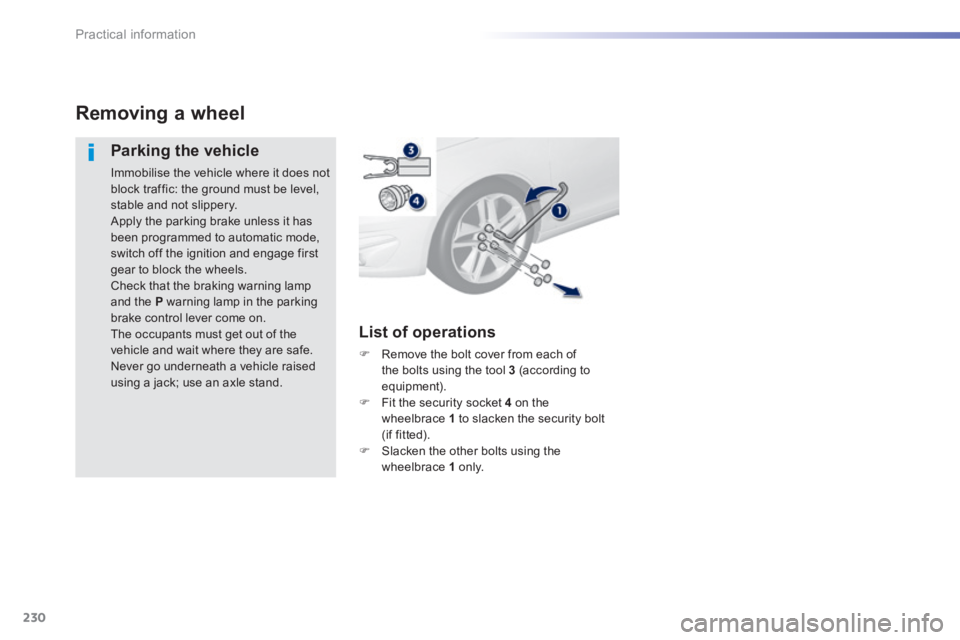
Removing a wheel
Parking the vehicle
Immobilise the vehicle where it does not block traffic: the ground must be level, stable and not slippery. Apply the parking brake unless it has been programmed to automatic mode, switch off the ignition and engage first gear to block the wheels. Check that the braking warning lamp and the P warning lamp in the parking brake control lever come on. The occupants must get out of the vehicle and wait where they are safe. Never go underneath a vehicle raised using a jack; use an axle stand.
List of operations
Remove the bolt cover from each of the bolts using the tool 3 (according to equipment). Fit the security socket 4 on the wheelbrace 1 to slacken the security bolt (if fitted). Slacken the other bolts using the wheelbrace 1 o n l y.
Page 240 of 400
238
Practical information
308_EN_CHAP07_INFO PR ATIQUES_ED02-2013
For reassembly, carry out these operations in reverse order.
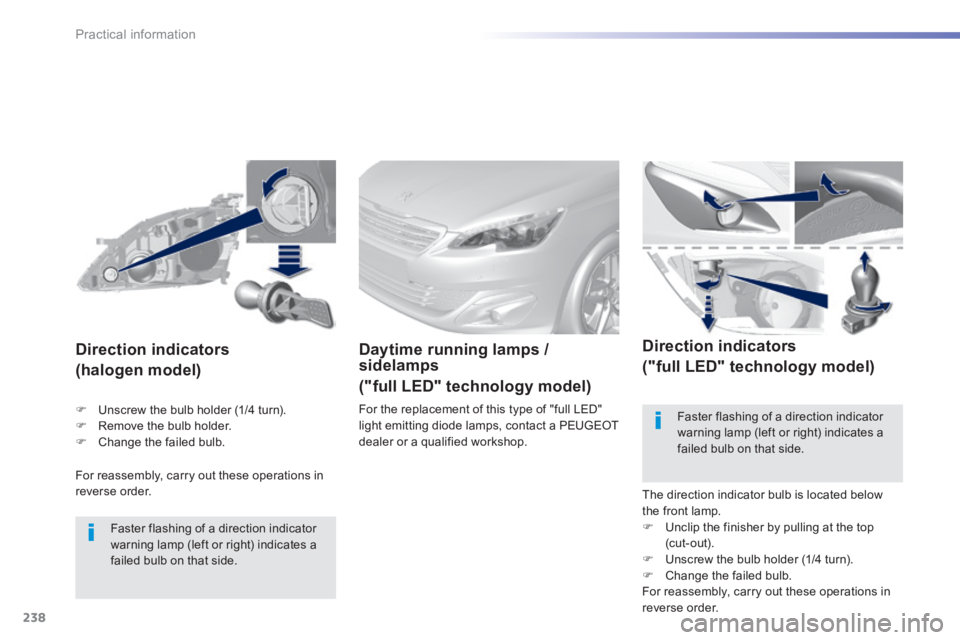
Direction indicators
(halogen model)
Faster flashing of a direction indicator warning lamp (left or right) indicates a failed bulb on that side.
Daytime running lamps / sidelamps
("full LED" technology model)
For the replacement of this type of "full LED" light emitting diode lamps, contact a PEUGEOT dealer or a qualified workshop.
Direction indicators
("full LED" technology model)
The direction indicator bulb is located below the front lamp. Unclip the finisher by pulling at the top (cut-out). Unscrew the bulb holder (1/4 turn). Change the failed bulb. For reassembly, carry out these operations in reverse order.
Faster flashing of a direction indicator
warning lamp (left or right) indicates a failed bulb on that side.
Unscrew the bulb holder (1/4 turn). Remove the bulb holder. Change the failed bulb.
Page 259 of 400
257
7
Practical information
308_EN_CHAP07_INFO PR ATIQUES_ED02-2013
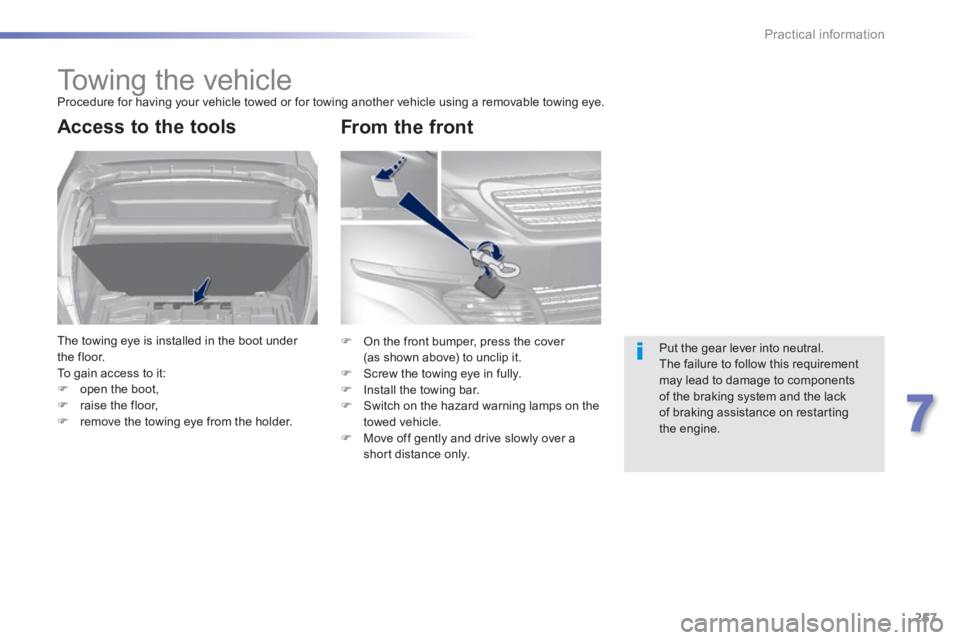
Towing the vehicle Procedure for having your vehicle towed or for towing another vehicle using a removable towing eye.
Access to the tools
The towing eye is installed in the boot under the floor. To gain access to it: open the boot, raise the floor, remove the towing eye from the holder.
Put the gear lever into neutral. The failure to follow this requirement may lead to damage to components of the braking system and the lack of braking assistance on restarting the engine.
On the front bumper, press the cover (as shown above) to unclip it. Screw the towing eye in fully. Install the towing bar. Switch on the hazard warning lamps on the towed vehicle. Move off gently and drive slowly over a short distance only.
From the front
Page 260 of 400
258
Practical information
308_EN_CHAP07_INFO PR ATIQUES_ED02-2013
General recommendations
Observe the legislation in force in your country. Ensure that the weight of the towing vehicle is higher than that of the towed vehicle. The driver must remain at the wheel of the towed vehicle and must have a valid driving licence. When towing a vehicle with all four wheels on the ground, always use an approved towing bar; rope and straps are prohibited. The towing vehicle must move off gently. When towing a vehicle with the engine off, there is no longer any power assistance for braking or steering. In the following cases, you must always call on a professional recovery service: - vehicle broken down on a motor way or fast road, - four-wheel drive vehicle, - when it is not possible to put the gearbox into neutral, unlock the steering, or release the parking brake, - towing with only two wheels on the ground, - where there is no approved towing bar available...
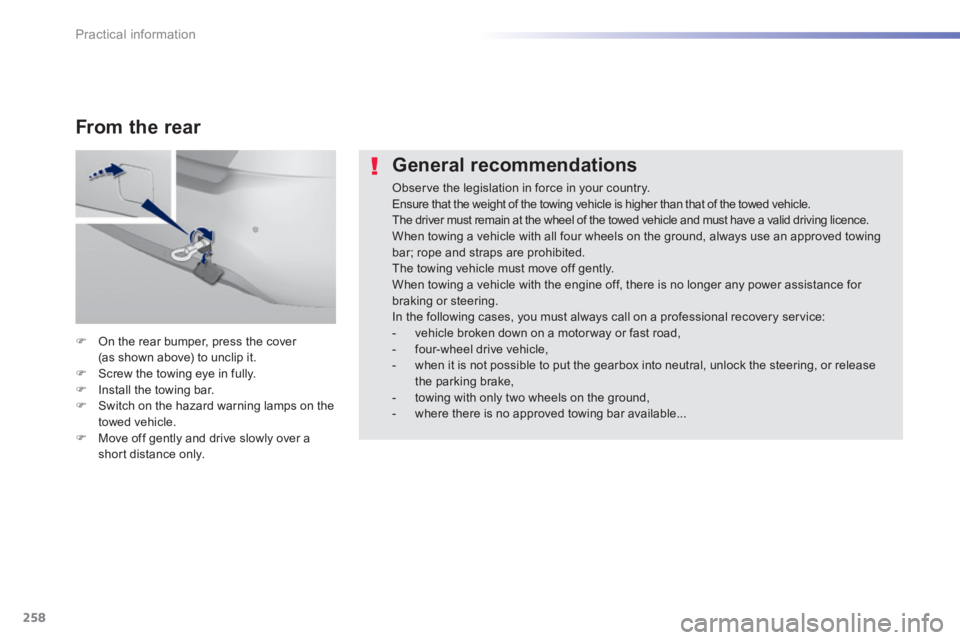
On the rear bumper, press the cover (as shown above) to unclip it. Screw the towing eye in fully. Install the towing bar. Switch on the hazard warning lamps on the towed vehicle. Move off gently and drive slowly over a short distance only.
From the rear
Page 263 of 400
261
7
Practical information
308_EN_CHAP07_INFO PR ATIQUES_ED02-2013
Driving advice
Distribution of loads
Distribute the load in the trailer so that the heaviest items are as close as possible to the axle and the nose weight approaches the maximum permitted without
exceeding it. Air density decreases with altitude, thus reducing engine performance. Above 1 000 metres, the maximum towed load must be reduced by 10 % for every 1 000 metres of altitude.
Side wind
Take into account the increased sensitivity to side wind.
Cooling
Towing a trailer on a slope increases the temperature of the coolant. As the fan is electrically controlled, its cooling capacity is not dependent on the engine speed.
To lower the engine speed, reduce your speed. The maximum towed load on a long incline depends on the gradient and the ambient temperature. In all cases, keep a check on the coolant temperature.
If the warning lamp and the STOP warning lamp come on, stop the vehicle and switch off the engine as soon as possible.
Braking
Towing a trailer increases the braking distance. To avoid overheating of the brakes on a long mountain type of descent, the use of engine braking is recommended.
Ty r e s
Check the tyre pressures of the towing vehicle and of the trailer, observing the recommended pressures.
Lighting
Check the electrical lighting and signalling on the trailer.
The rear parking sensors will be deactivated automatically if a genuine PEUGEOT towbar is used.
Refer to the "Technical data" section for details of the weights and towed loads which apply to your vehicle.