air condition PEUGEOT 308 2014 User Guide
[x] Cancel search | Manufacturer: PEUGEOT, Model Year: 2014, Model line: 308, Model: Peugeot 308 2014Pages: 389, PDF Size: 22.92 MB
Page 61 of 389
3
Comfort59
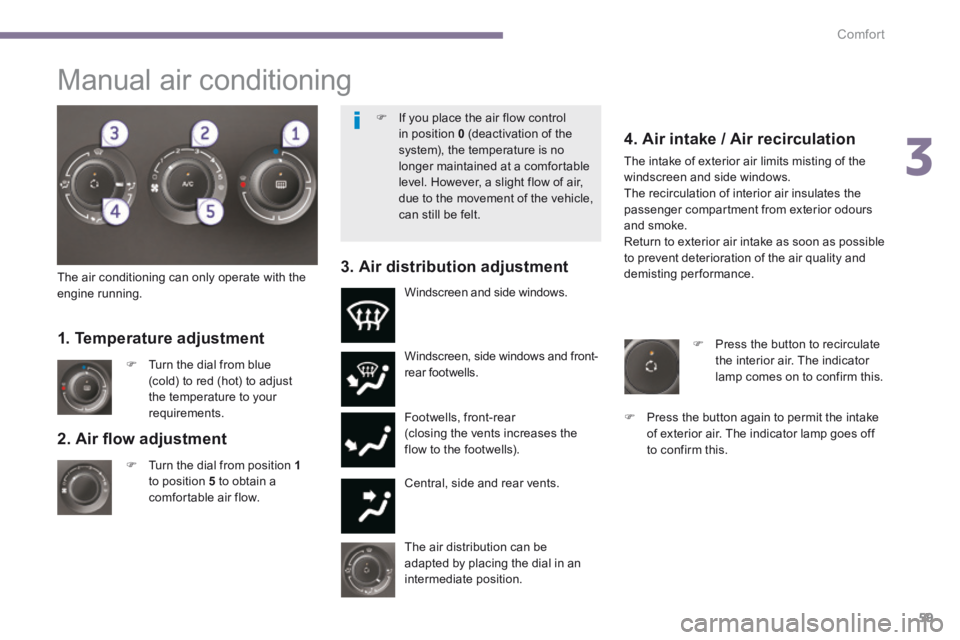
2. Air fl ow adjustment
Turn the dial from position 1to position 5 to obtain a comfortable air flow.
Windscreen, side windows and front-rear footwells.
Footwells, front-rear (closing the vents increases the flow to the footwells).
Central, side and rear vents.
Turn the dial from blue (cold) to red (hot) to adjust the temperature to your requirements.
Windscreen and side windows.
1. Temperature adjustment
The air distribution can be adapted by placing the dial in an intermediate position.
The air conditioning can only operate with the engine running.
4. Air intake / Air recirculation
The intake of exterior air limits misting of the
windscreen and side windows. The recirculation of interior air insulates the passenger compartment from exterior odours and smoke. Return to exterior air intake as soon as possible to prevent deterioration of the air quality and demisting performance. 3. Air distribution adjustment
Press the button to recirculate the interior air. The indicator lamp comes on to confirm this.
Press the button again to permit the intake of exterior air. The indicator lamp goes off to confirm this.
Manual air conditioning
If you place the air flow control in position 0 (deactivation of the system), the temperature is no longer maintained at a comfortable level. However, a slight flow of air, due to the movement of the vehicle, can still be felt.
Page 62 of 389
Comfort
60
Demisting/defrosting
5. Air conditioning On / Off
The air conditioning is designed to operate effectively in all seasons, with the windows closed.
It enables you to: - lower the temperature, in summer, - increase the effectiveness of the demisting in winter, above 3 °C.
Switching off
Press the "A /C " button again, the button's indicator lamp goes off. Switching off may affect comfort levels (humidity, condensation).
Switching on
Press the "A /C " button, the button's indicator lamp comes on. The air conditioning does not operate when the air flow adjustment control 2 is in position " 0 ". To obtain cooled air more quickly, you can use recirculation of interior air for a few moments.
Then return to fresh air intake.
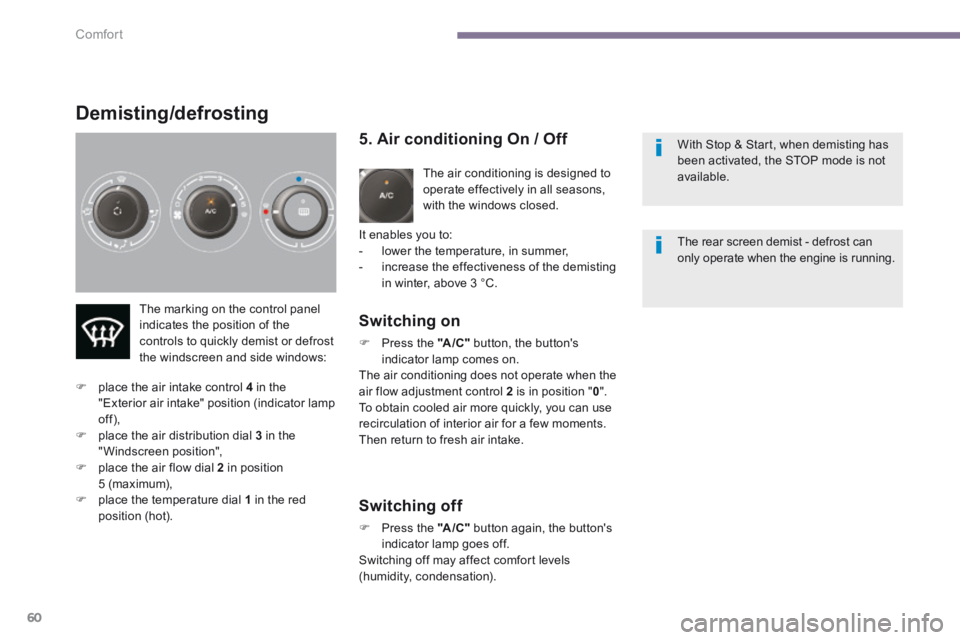
The marking on the control panel indicates the position of the controls to quickly demist or defrost the windscreen and side windows:
place the air intake control 4 in the "Exterior air intake" position (indicator lamp off), place the air distribution dial 3 in the "Windscreen position", place the air flow dial 2 in position 5 (maximum), place the temperature dial 1 in the red position (hot).
With Stop & Start, when demisting has been activated, the STOP mode is not available.
The rear screen demist - defrost can only operate when the engine is running.
Page 63 of 389
3
Comfort61
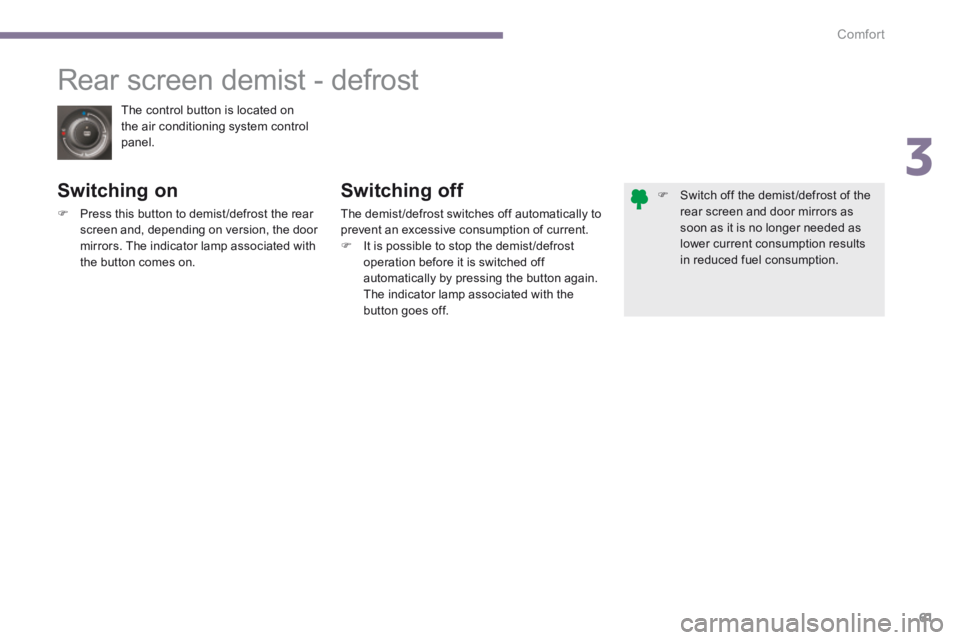
The control button is located on the air conditioning system control panel.
Rear screen demist - defrost
Switching on
Press this button to demist /defrost the rear screen and, depending on version, the door mirrors. The indicator lamp associated with the button comes on.
Switching off
The demist /defrost switches off automatically to prevent an excessive consumption of current. It is possible to stop the demist /defrost operation before it is switched off automatically by pressing the button again. The indicator lamp associated with the button goes off.
Switch off the demist /defrost of the rear screen and door mirrors as
soon as it is no longer needed as lower current consumption results in reduced fuel consumption.
Page 64 of 389
Comfort
62
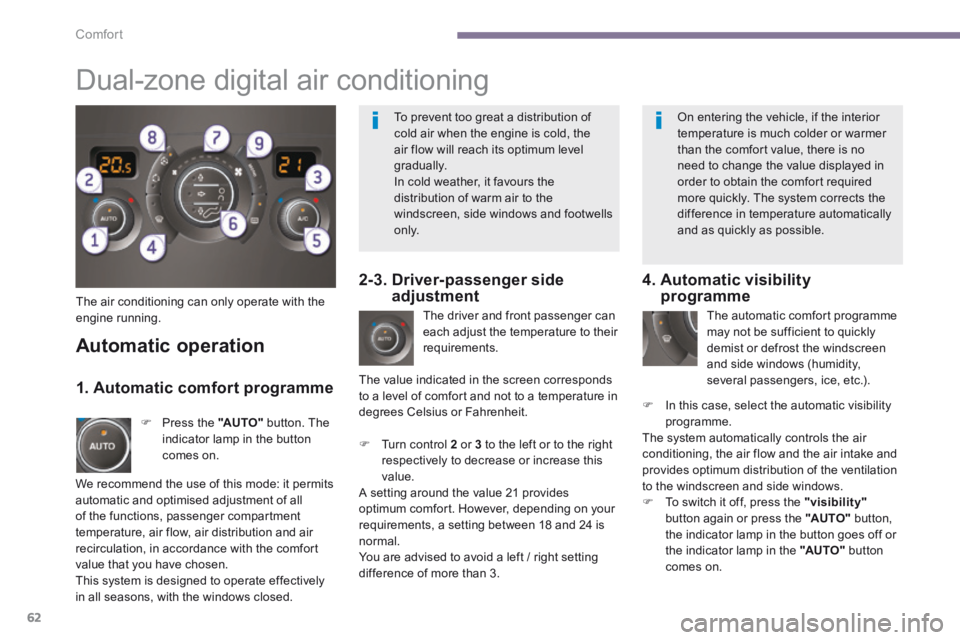
The air conditioning can only operate with the engine running. The driver and front passenger can each adjust the temperature to their requirements.
Turn control 2 or 3 to the left or to the right respectively to decrease or increase this value. A setting around the value 21 provides optimum comfort. However, depending on your requirements, a setting between 18 and 24 is normal. You are advised to avoid a left / right setting difference of more than 3.
4. Automatic visibility programme
The automatic comfort programme may not be sufficient to quickly demist or defrost the windscreen and side windows (humidity, several passengers, ice, etc.).
In this case, select the automatic visibility programme. The system automatically controls the air conditioning, the air flow and the air intake and provides optimum distribution of the ventilation to the windscreen and side windows. To switch it off, press the "visibility"button again or press the "AUTO" button, the indicator lamp in the button goes off or the indicator lamp in the "AUTO" button comes on.
Automatic operation
Press the "AUTO" button. The indicator lamp in the button comes on.
2-3. Driver-passenger side adjustment
Dual-zone digital air conditioning
We recommend the use of this mode: it permits automatic and optimised adjustment of all of the functions, passenger compartment temperature, air flow, air distribution and air recirculation, in accordance with the comfort value that you have chosen. This system is designed to operate effectively in all seasons, with the windows closed.
The value indicated in the screen corresponds to a level of comfort and not to a temperature in degrees Celsius or Fahrenheit.
1. Automatic comfort programme
To prevent too great a distribution of cold air when the engine is cold, the air flow will reach its optimum level gradually. In cold weather, it favours the distribution of warm air to the windscreen, side windows and footwells o n l y.
On entering the vehicle, if the interior temperature is much colder or warmer than the comfort value, there is no need to change the value displayed in order to obtain the comfort required more quickly. The system corrects the difference in temperature automatically and as quickly as possible.
Page 65 of 389
3
Comfort63
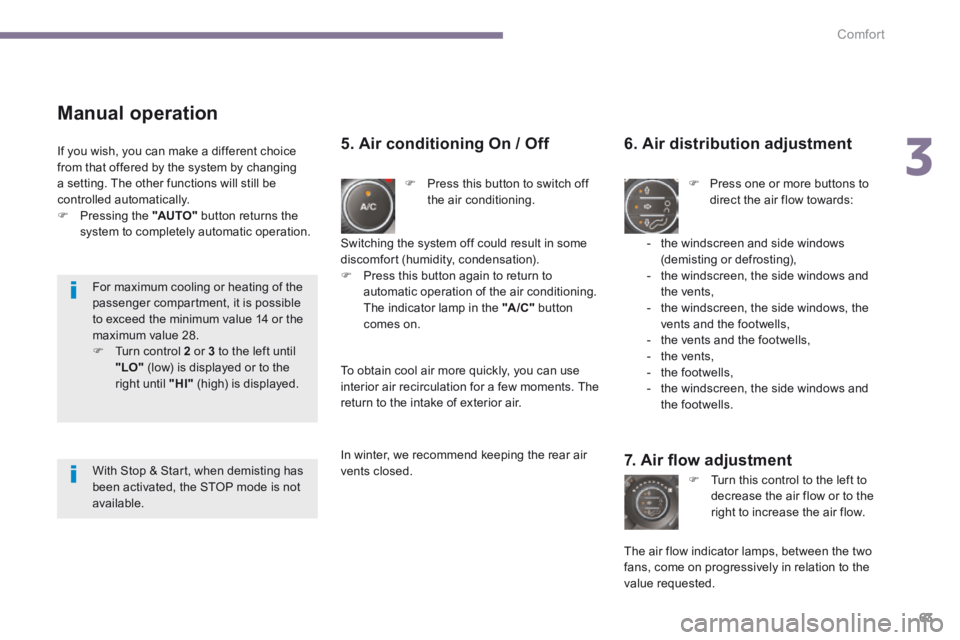
Manual operation
Press this button to switch off the air conditioning.
6. Air distribution adjustment
Press one or more buttons to direct the air flow towards:
7. Air fl ow adjustment
Turn this control to the left to decrease the air flow or to the right to increase the air flow.
5. Air conditioning On / Off
- the windscreen and side windows (demisting or defrosting), - the windscreen, the side windows and the vents, - the windscreen, the side windows, the vents and the footwells, - the vents and the footwells, - the vents, - the footwells, - the windscreen, the side windows and the footwells.
The air flow indicator lamps, between the two fans, come on progressively in relation to the value requested.
Switching the system off could result in some discomfort (humidity, condensation). Press this button again to return to automatic operation of the air conditioning. The indicator lamp in the "A /C " button comes on.
If you wish, you can make a different choice from that offered by the system by changing a setting. The other functions will still be controlled automatically. Pressing the "AUTO" button returns the
system to completely automatic operation.
To obtain cool air more quickly, you can use interior air recirculation for a few moments. The return to the intake of exterior air.
In winter, we recommend keeping the rear air vents closed.
For maximum cooling or heating of the passenger compartment, it is possible to exceed the minimum value 14 or the maximum value 28. Turn control 2 or 3 to the left until "LO" (low) is displayed or to the right until "HI" (high) is displayed.
With Stop & Start, when demisting has been activated, the STOP mode is not available.
Page 146 of 389
Safety
144
Deactivation
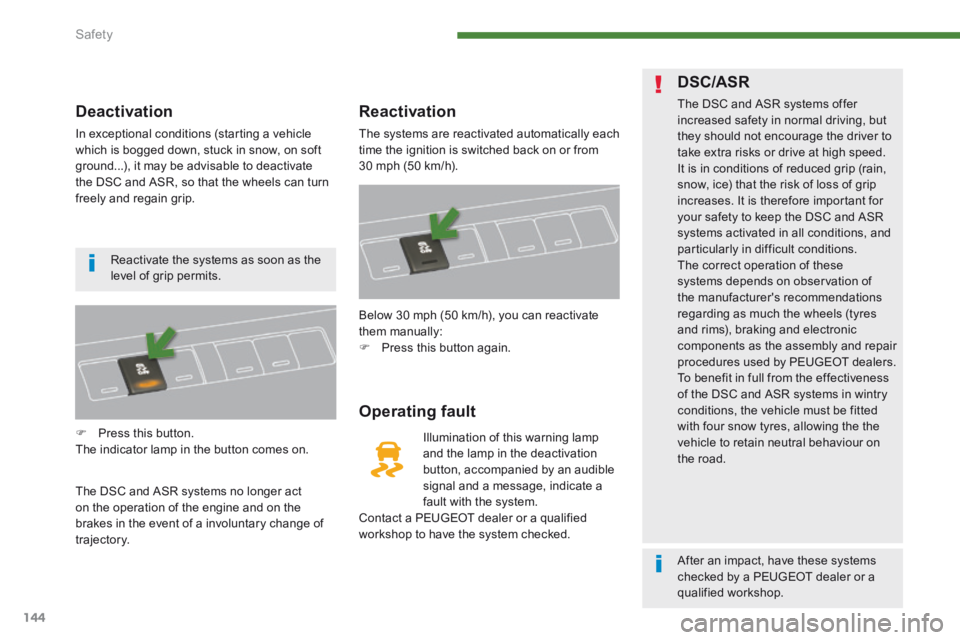
In exceptional conditions (starting a vehicle which is bogged down, stuck in snow, on soft ground...), it may be advisable to deactivate the DSC and ASR, so that the wheels can turn freely and regain grip.
Press this button. The indicator lamp in the button comes on.
The DSC and ASR systems no longer act on the operation of the engine and on the brakes in the event of a involuntary change of trajectory.
Reactivation
The systems are reactivated automatically each time the ignition is switched back on or from 30 mph (50 km/h).
Operating fault
Illumination of this warning lamp and the lamp in the deactivation button, accompanied by an audible signal and a message, indicate a fault with the system. Contact a PEUGEOT dealer or a qualified workshop to have the system checked.
Below 30 mph (50 km/h), you can reactivate them manually: Press this button again.
DSC/ASR
The DSC and ASR systems offer increased safety in normal driving, but they should not encourage the driver to take extra risks or drive at high speed. It is in conditions of reduced grip (rain, snow, ice) that the risk of loss of grip increases. It is therefore important for your safety to keep the DSC and ASR systems activated in all conditions, and particularly in difficult conditions. The correct operation of these systems depends on observation of the manufacturer's recommendations regarding as much the wheels (tyres and rims), braking and electronic components as the assembly and repair procedures used by PEUGEOT dealers. To benefit in full from the effectiveness of the DSC and ASR systems in wintry conditions, the vehicle must be fitted with four snow tyres, allowing the the vehicle to retain neutral behaviour on the road.
Reactivate the systems as soon as the level of grip permits.
After an impact, have these systems checked by a PEUGEOT dealer or a qualified workshop.
Page 152 of 389
Safety
150
Airbags
Front airbags
Deployment
The airbags are deployed, except the passenger's front airbag if it is deactivated, in the event of a serious front impact to all or part of the front impact zone A , in the longitudinal centreline of the vehicle on a horizontal plane and directed from the front to the rear of the vehicle. The front airbag inflates between the thorax and head of the front occupant of the vehicle and the steering wheel, driver's side, and the dashboard, passenger's side to cushion their forward movement.
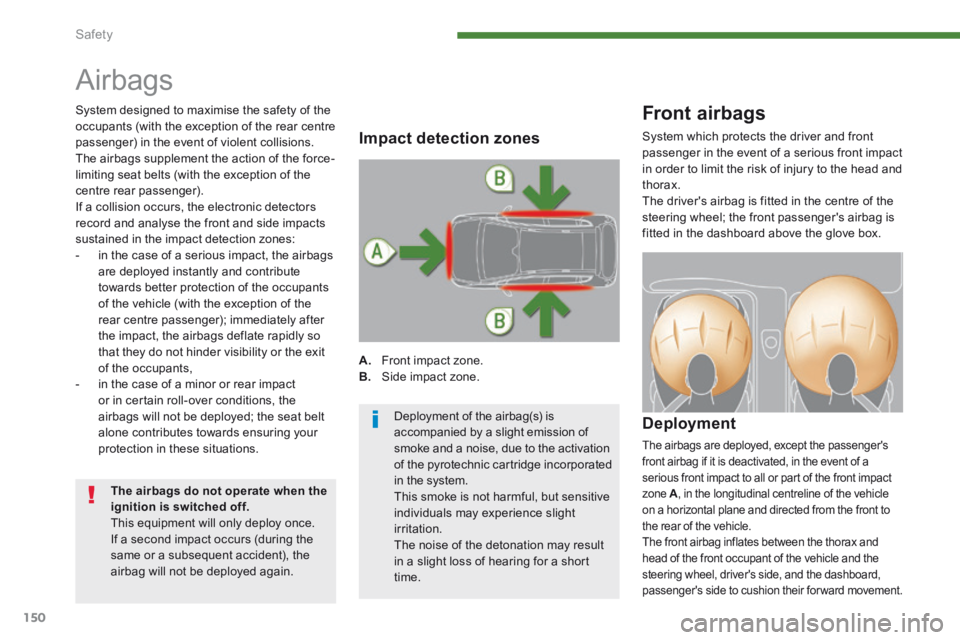
Impact detection zones
A. Front impact zone. B. Side impact zone.
System designed to maximise the safety of the occupants (with the exception of the rear centre passenger) in the event of violent collisions. The airbags supplement the action of the force-limiting seat belts (with the exception of the centre rear passenger). If a collision occurs, the electronic detectors record and analyse the front and side impacts sustained in the impact detection zones: - in the case of a serious impact, the airbags are deployed instantly and contribute towards better protection of the occupants of the vehicle (with the exception of the rear centre passenger); immediately after the impact, the airbags deflate rapidly so that they do not hinder visibility or the exit of the occupants, - in the case of a minor or rear impact or in certain roll-over conditions, the airbags will not be deployed; the seat belt alone contributes towards ensuring your protection in these situations.
System which protects the driver and front passenger in the event of a serious front impact in order to limit the risk of injury to the head and thorax. The driver's airbag is fitted in the centre of the steering wheel; the front passenger's airbag is
fitted in the dashboard above the glove box.
Deployment of the airbag(s) is
accompanied by a slight emission of smoke and a noise, due to the activation of the pyrotechnic cartridge incorporated in the system. This smoke is not harmful, but sensitive individuals may experience slight irritation. The noise of the detonation may result in a slight loss of hearing for a short time.
The airbags do not operate when the ignition is switched off. This equipment will only deploy once.
If a second impact occurs (during the same or a subsequent accident), the airbag will not be deployed again.
Page 201 of 389
10
Checks199
Checks
Unless otherwise indicated, check these components in accordance with the warranty and maintenance record and according to your engine. Other wise, have them checked by a PEUGEOT dealer or a qualified workshop.
Replace the oil filter each time the engine oil is changed. Refer to the warranty and maintenance record for details of the replacement interval for this component.
Oil filter
Refer to the warranty and maintenance record for details of the replacement intervals for these components. Depending on the environment (e.g. dusty atmosphere) and the use of the vehicle (e.g. city driving), replace them twice as often if necessary . if necessary . if necessary A clogged passenger compartment filter may have an adverse effect on the per formance of the air conditioning system and generate undesirable odours.
Air filter and passenger compartment filter
12 V battery The battery does not require any
maintenance. However, check that the terminals are clean and correctly tightened, particularly in summer and winter. When carrying out work on the battery, refer to the "12 V battery" section for details of the precautions to be taken before disconnecting the battery and following its reconnection.
Particle emission filter (Diesel)
On a new vehicle, the first particle filter regeneration operations may be accompanied by a "burning" smell, which is per fectly normal.
Following prolonged operation of the vehicle at very low speed or at idle, you may, in exceptional circumstances, notice the emission of water vapour at the exhaust on acceleration. This does not affect the behaviour of the vehicle or the environment.
The presence of this label, in particular with the Stop & Start system, indicates the use of a specific 12 V lead-acid battery with special technology and specification. The involvement of a PEUGEOT dealer or a qualified workshop is essential when replacing or disconnecting the battery.
The start of saturation of the particle filter is indicated by the temporary illumination of this warning lamp accompanied by a message in the multi-function screen. As soon as the traffic conditions permit, regenerate the filter by driving at a speed of at least 40 mph (60 km/h) until the warning lamp goes off. If the warning lamp stays on, this indicates a low additive level.
Page 224 of 389
Practical information
222
Changing a fuse
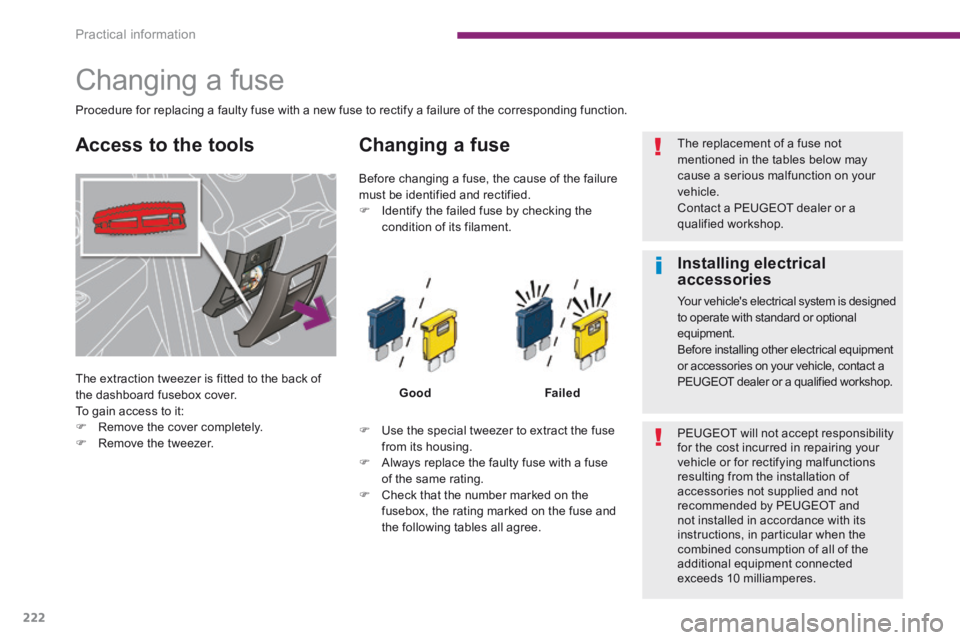
The extraction tweezer is fitted to the back of
the dashboard fusebox cover. To gain access to it: Remove the cover completely.
Remove the tweezer.
Changing a fuse
GoodFailed
Use the special tweezer to extract the fuse from its housing. Always replace the faulty fuse with a fuse of the same rating. Check that the number marked on the fusebox, the rating marked on the fuse and the following tables all agree.
Before changing a fuse, the cause of the failure must be identified and rectified. Identify the failed fuse by checking the
condition of its filament.
Procedure for replacing a faulty fuse with a new fuse to rectify a failure of the corresponding function.
The replacement of a fuse not mentioned in the tables below may cause a serious malfunction on your vehicle. Contact a PEUGEOT dealer or a qualified workshop.
PEUGEOT will not accept responsibility for the cost incurred in repairing your vehicle or for rectifying malfunctions resulting from the installation of accessories not supplied and not recommended by PEUGEOT and not installed in accordance with its instructions, in particular when the combined consumption of all of the additional equipment connected exceeds 10 milliamperes.
Access to the tools
Installing electrical accessories
Your vehicle's electrical system is designed to operate with standard or optional equipment. Before installing other electrical equipment or accessories on your vehicle, contact a PEUGEOT dealer or a qualified workshop.
Page 225 of 389
11
Practical information223
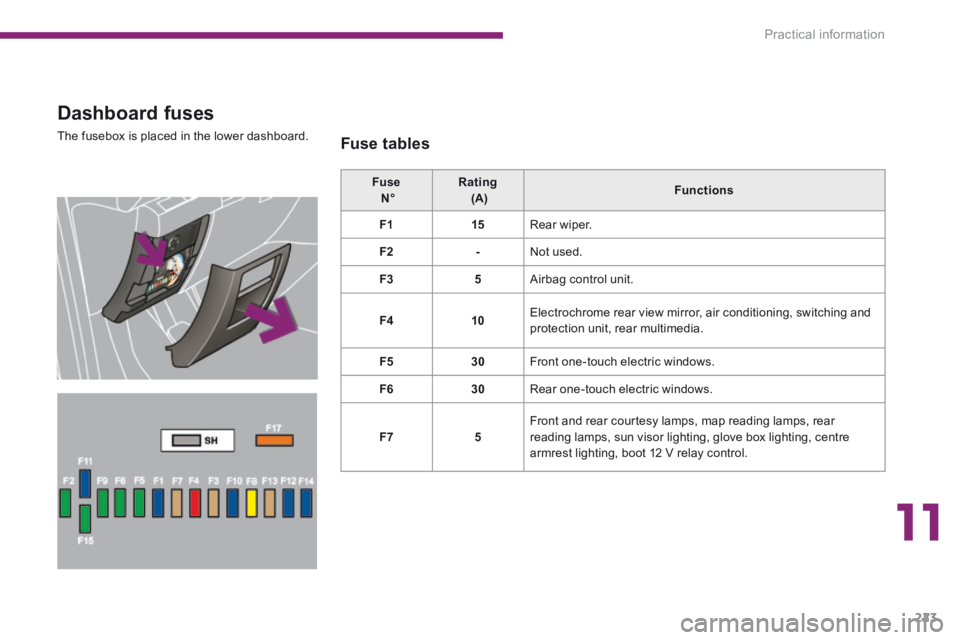
Dashboard fuses
The fusebox is placed in the lower dashboard. Fuse tables
Fuse N° Rating (A) Functions
F115 Rear wiper.
F2- Not used.
F35 Airbag control unit.
F410 Electrochrome rear view mirror, air conditioning, switching and protection unit, rear multimedia.
F530 Front one-touch electric windows.
F630 Rear one-touch electric windows.
F75 Front and rear courtesy lamps, map reading lamps, rear reading lamps, sun visor lighting, glove box lighting, centre armrest lighting, boot 12 V relay control.