warning Peugeot 308 2016 Owner's Guide
[x] Cancel search | Manufacturer: PEUGEOT, Model Year: 2016, Model line: 308, Model: Peugeot 308 2016Pages: 398, PDF Size: 9.38 MB
Page 31 of 398
29
308_en_Chap01_instruments-de-bord_ed02-2015
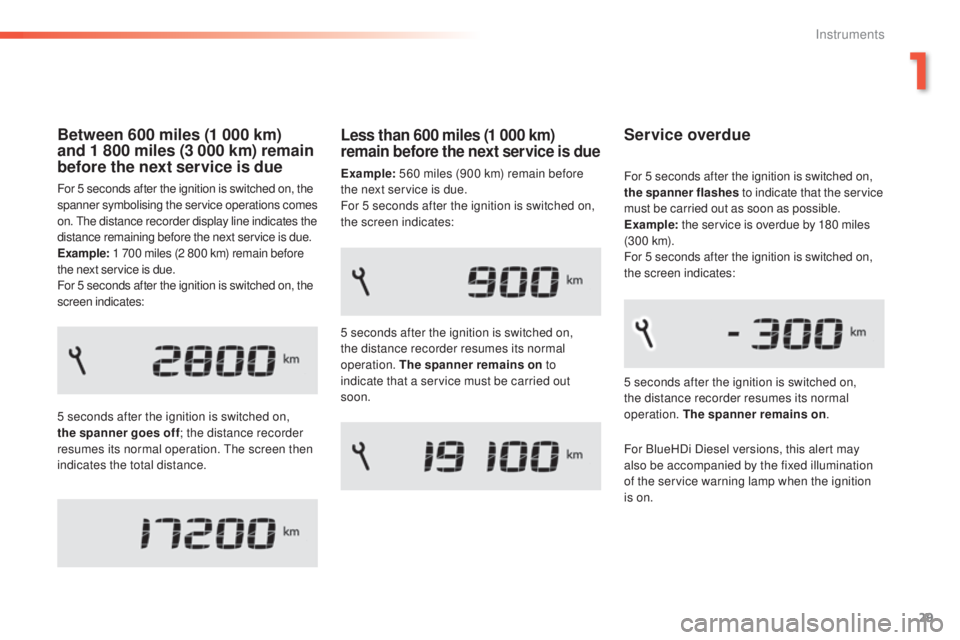
Between 600 miles (1 000 km)
and 1 800 miles (3 000 km) remain
before the next service is due
For 5 seconds after the ignition is switched on, the
spanner symbolising the service operations comes
on.
the d
istance recorder display line indicates the
distance remaining before the next service is due.
Example: 1 700 miles (2 800 km) remain before
the next service is due.
For 5 seconds after the ignition is switched on, the
screen indicates:
5 seconds after the ignition is switched on,
the spanner goes off ; the distance recorder
resumes its normal operation.
the s
creen then
indicates the total distance.
Service overdue
5 seconds after the ignition is switched on,
the distance recorder resumes its normal
operation. The spanner remains on .
For 5 seconds after the ignition is switched on,
the spanner flashes
to indicate that the service
must be carried out as soon as possible.
Example: the service is overdue by 180 miles
(3 0 0 k m).
For 5 seconds after the ignition is switched on,
the screen indicates:
Less than 600 miles (1 000 km)
remain before the next service is due
Example: 560 miles (900 km) remain before
the next service is due.
For 5 seconds after the ignition is switched on,
the screen indicates:
5 seconds after the ignition is switched on,
the distance recorder resumes its normal
operation. The spanner remains on to
indicate that a service must be carried out
soon.
For BlueHDi Diesel versions, this alert may
also be accompanied by the fixed illumination
of the service warning lamp when the ignition
is on.
1
Instruments
Page 53 of 398
51
308_en_Chap02_ouvertures_ed02-2015
Electronic engine immobiliser
the key contains an electronic chip which has
a s pecial code. When the ignition is switched
on, this code must be recognised in order for
starting to be possible.
thi
s electronic engine immobiliser locks the
engine management system a few moments
after the ignition is switched off and prevents
starting of the engine by anyone who does not
have the key.
F
Pr
ess the closed padlock on the
remote control.
Locating your vehicle
this will switch on the courtesy lamps and
t he direction indicators will flash for around
ten
se
conds.
Remote operation of lighting
A short press this button switches
on the lighting remotely (sidelamps,
dipped beam headlamps and number
plate lamps).
A second press before the end of the timed
period cancels the remote lighting.
Anti-theft protection
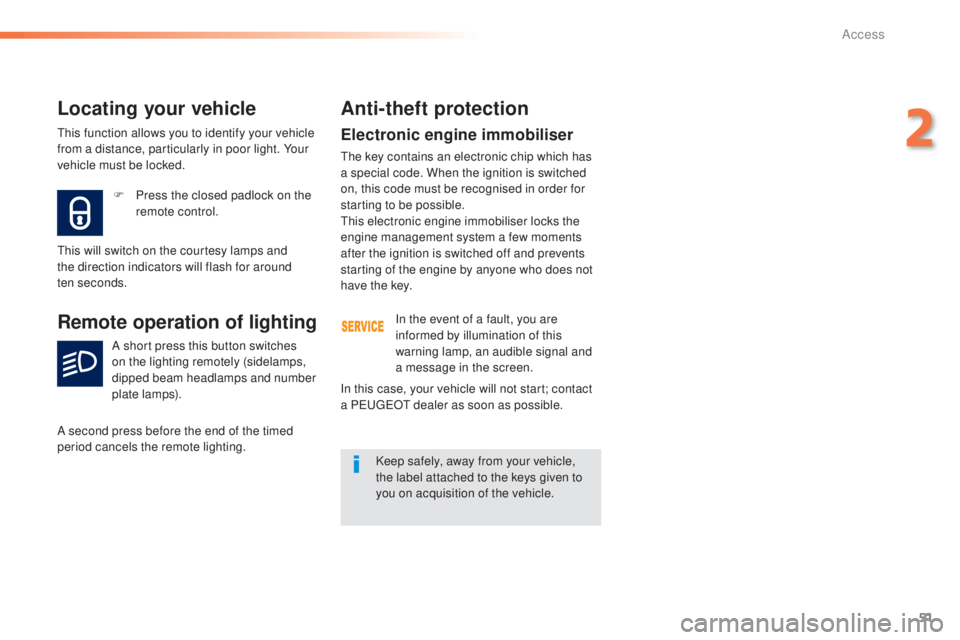
In the event of a fault, you are
informed by illumination of this
warning lamp, an audible signal and
a message in the screen.
Keep safely, away from your vehicle,
the label attached to the keys given to
you on acquisition of the vehicle.
In this case, your vehicle will not start; contact
a P
eu
ge
Ot d
ealer as soon as possible.
thi
s function allows you to identify your vehicle
from a distance, particularly in poor light. Your
vehicle must be locked.
2
Access
Page 55 of 398
53
308_en_Chap02_ouvertures_ed02-2015
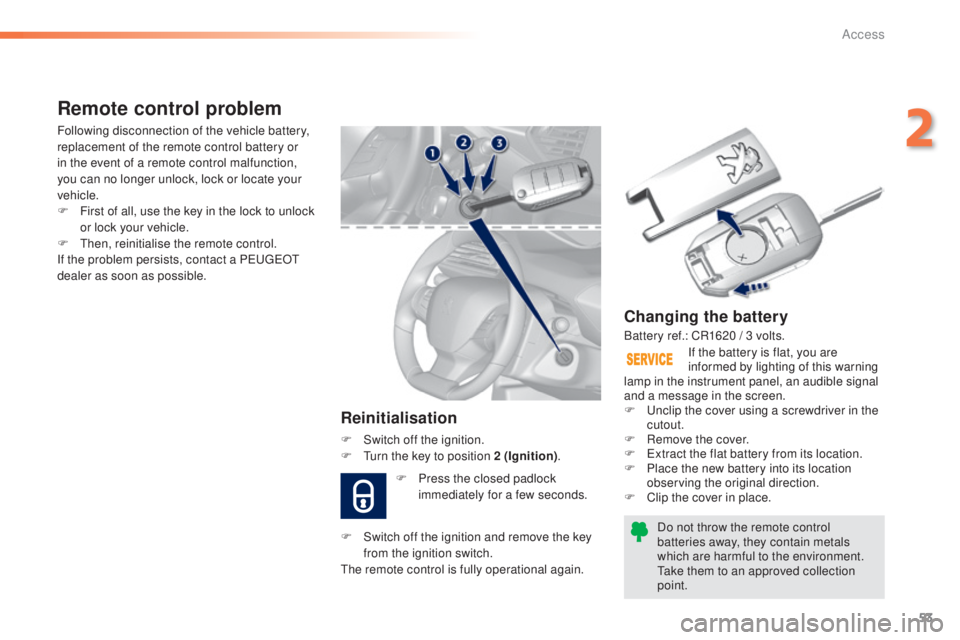
Changing the battery
Do not throw the remote control
batteries away, they contain metals
which are harmful to the environment.
tak
e them to an approved collection
point. If the battery is flat, you are
informed by lighting of this warning
lamp in the instrument panel, an audible signal
and a message in the screen.
F
u
nc
lip the cover using a screwdriver in the
cutout.
F
Re
move the cover.
F
e
xt
ract the flat battery from its location.
F
Pl
ace the new battery into its location
observing the original direction.
F
Cl
ip the cover in place.
Remote control problem
Reinitialisation
F Switch off the ignition.
F tur n the key to position 2 (Ignition) .
Following disconnection of the vehicle battery,
replacement of the remote control battery or
in the event of a remote control malfunction,
you can no longer unlock, lock or locate your
vehicle.
F
Fi
rst of all, use the key in the lock to unlock
or lock your vehicle.
F
t
hen,
reinitialise the remote control.
If the problem persists, contact a P
eu
ge
Ot
d
ealer as soon as possible.
Battery ref.: CR1620 / 3 volts.
F
Pr
ess the closed padlock
immediately for a few seconds.
F
Sw
itch off the ignition and remove the key
from the ignition switch.
the r
emote control is fully operational again.
2
Access
Page 86 of 398
84
308_en_Chap03_ergonomie-et-confort_ed02-2015
230 V / 50 Hz power socket
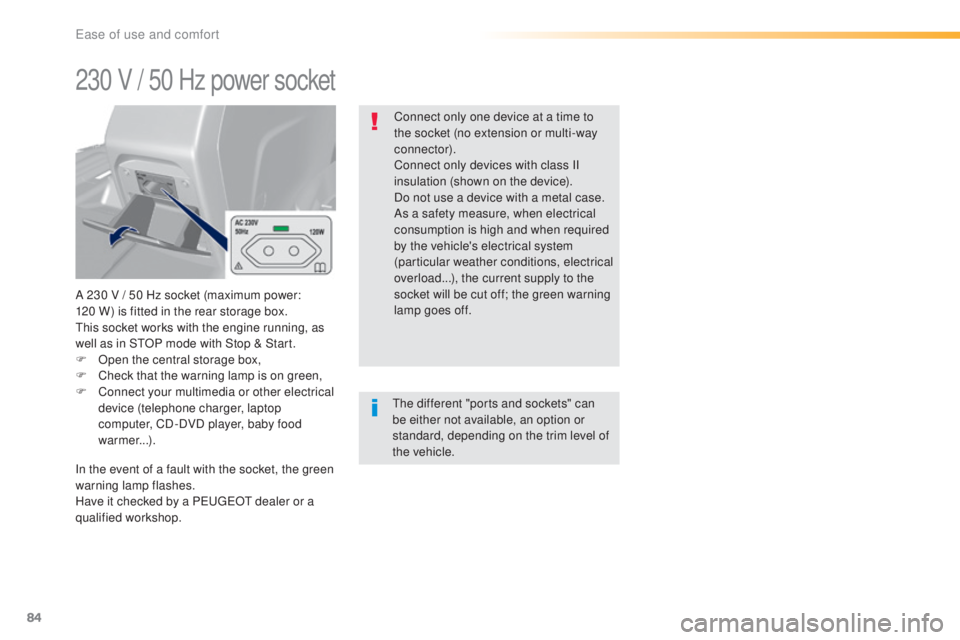
A 230 V / 50 Hz socket (maximum power:
120 W) is fitted in the rear storage box.
thi
s socket works with the engine running, as
well as in S
tOP m
ode with Stop & Start.
F
Op
en the central storage box,
F
Ch
eck that the warning lamp is on green,
F
Co
nnect your multimedia or other electrical
device (telephone charger, laptop
computer, CD-DVD player, baby food
warmer...).
In the event of a fault with the socket, the green
warning lamp flashes.
Have it checked by a P
eu
ge
Ot d
ealer or a
qualified workshop. Connect only one device at a time to
the socket (no extension or multi-way
connector).
Connect only devices with class II
insulation (shown on the device).
Do not use a device with a metal case.
As a safety measure, when electrical
consumption is high and when required
by the vehicle's electrical system
(particular weather conditions, electrical
overload...), the current supply to the
socket will be cut off; the green warning
lamp goes off.
the d
ifferent "ports and sockets" can
be either not available, an option or
standard, depending on the trim level of
the vehicle.
ease of use and comfort
Page 114 of 398
112
308_en_Chap04_eclairage-et-visibilite_ed02-2015
Front daytime running
lamps
(light-emitting diodes)
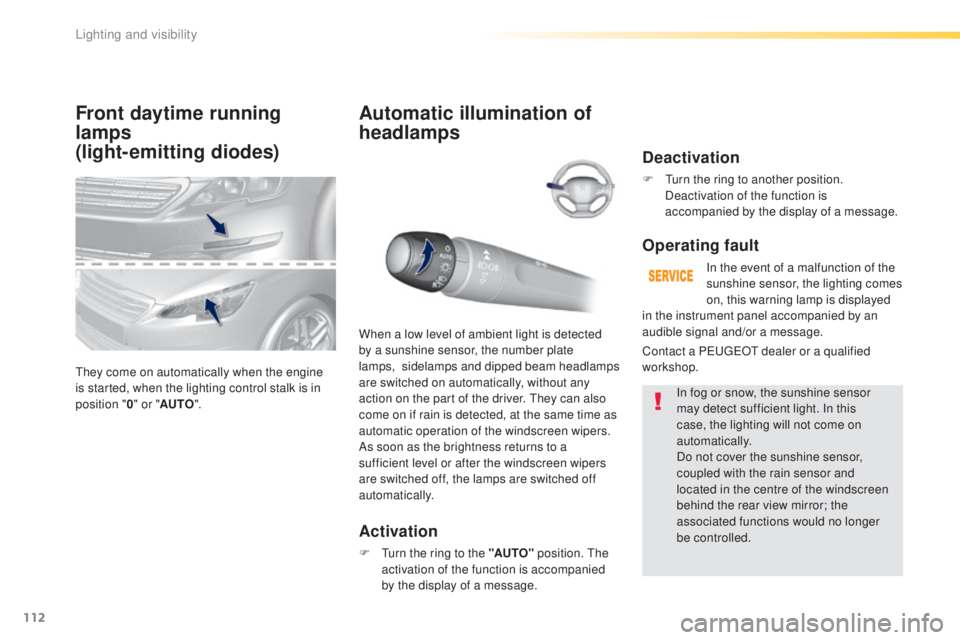
they come on automatically when the engine
i s started, when the lighting control stalk is in
position " 0" or " AUTO ".
Automatic illumination of
headlamps
Activation
F turn the ring to the "AUTO" p osition. the
a ctivation of the function is accompanied
by the display of a message.
When a low level of ambient light is detected
by a sunshine sensor, the number plate
lamps,
si
delamps and dipped beam headlamps
are switched on automatically, without any
action on the part of the driver.
the
y can also
come on if rain is detected, at the same time as
automatic operation of the windscreen wipers.
As soon as the brightness returns to a
sufficient level or after the windscreen wipers
are switched off, the lamps are switched off
automatically.
Deactivation
F turn the ring to another position.
D eactivation of the function is
accompanied by the display of a message.
Operating fault
In the event of a malfunction of the
sunshine sensor, the lighting comes
on, this warning lamp is displayed
In fog or snow, the sunshine sensor
may detect sufficient light. In this
case, the lighting will not come on
automatically.
Do not cover the sunshine sensor,
coupled with the rain sensor and
located in the centre of the windscreen
behind the rear view mirror; the
associated functions would no longer
be controlled.
Contact a P
eu
ge
Ot d
ealer or a qualified
workshop. in the instrument panel accompanied by an
audible signal and/or a message.
Lighting and visibility
Page 116 of 398
114
308_en_Chap04_eclairage-et-visibilite_ed02-2015
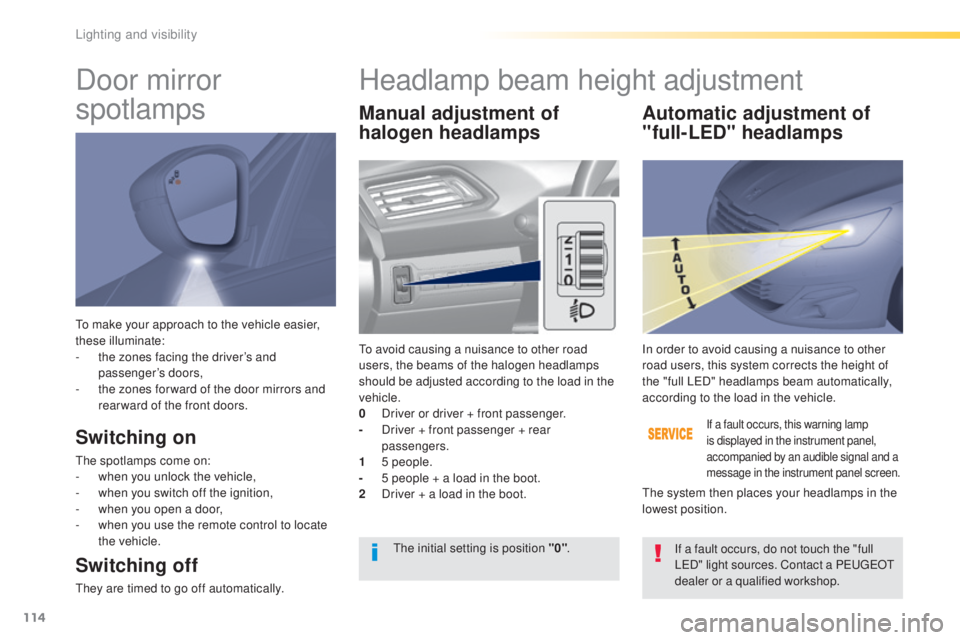
to make your approach to the vehicle easier,
t hese illuminate:
-
th
e zones facing the driver’s and
passenger’s doors,
-
th
e zones for ward of the door mirrors and
rear ward of the front doors.
Door mirror
spotlamps
Switching on
the spotlamps come on:
- wh en you unlock the vehicle,
-
wh
en you switch off the ignition,
-
wh
en you open a door,
-
wh
en you use the remote control to locate
the vehicle.
Switching off
they are timed to go off automatically.
Manual adjustment of
halogen headlamps Automatic adjustment of
"full-LED" headlamps
to avoid causing a nuisance to other road
u sers, the beams of the halogen headlamps
should be adjusted according to the load in the
vehicle.
0
Dr
iver or driver + front passenger.
-
Dr
iver + front passenger + rear
passengers.
1
5 p
eople.
-
5 pe
ople + a load in the boot.
2
Dr
iver + a load in the boot.
If a fault occurs, this warning lamp
is displayed in the instrument panel,
accompanied by an audible signal and a
message in the instrument panel screen.
In order to avoid causing a nuisance to other
road users, this system corrects the height of
the "full L
eD"
headlamps beam automatically,
according to the load in the vehicle.
the s
ystem then places your headlamps in the
lowest position.
the i
nitial setting is position "0" .
If a fault occurs, do not touch the "full
L
eD" l
ight sources. Contact a P
eu
ge
Ot
de
aler or a qualified workshop.
Headlamp beam height adjustment
Lighting and visibility
Page 119 of 398
117
308_en_Chap04_eclairage-et-visibilite_ed02-2015
Screenwash/headlamp wash
level low
In the case of vehicles fitted with headlamp
washers, when the fluid reservoir low level
is reached this warning lamp comes on in
the instrument panel, accompanied by an
audible signal and a message.
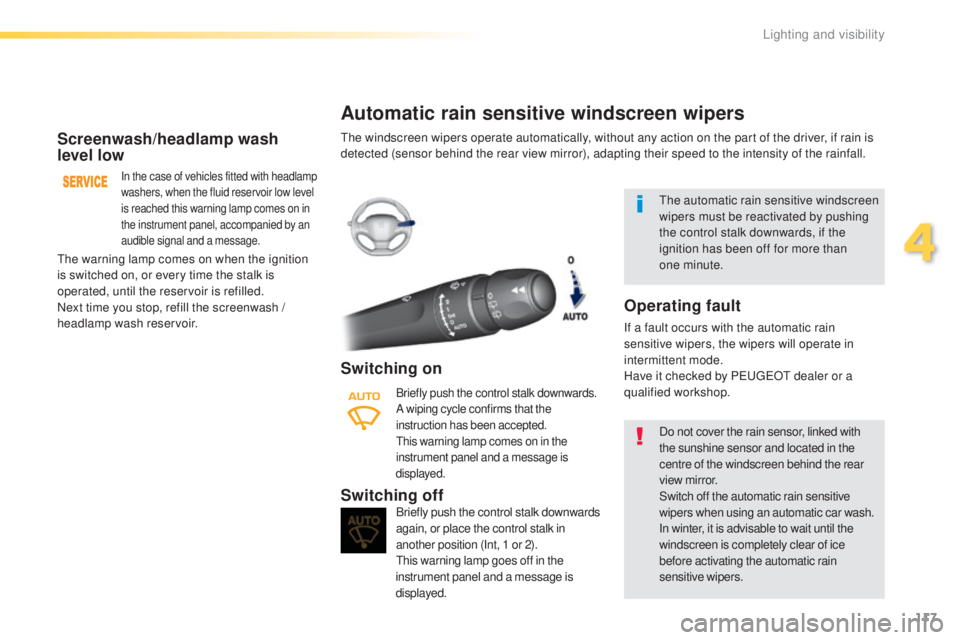
Automatic rain sensitive windscreen wipers
Switching on
Briefly push the control stalk downwards.
A wiping cycle confirms that the
instruction has been accepted.
thi
s warning lamp comes on in the
instrument panel and a message is
displayed.
Briefly push the control stalk downwards
again, or place the control stalk in
another position (Int, 1 or 2).
thi
s warning lamp goes off in the
instrument panel and a message is
displayed.Switching off
the automatic rain sensitive windscreen
w ipers must be reactivated by pushing
the control stalk downwards, if the
ignition has been off for more than
one
m
inute.
the w
arning lamp comes on when the ignition
is switched on, or every time the stalk is
operated, until the reservoir is refilled.
Next time you stop, refill the screenwash /
headlamp wash reservoir.
the w
indscreen wipers operate automatically, without any action on the part of the driver, if rain is
detected (sensor behind the rear view mirror), adapting their speed to the intensity of the rainfall.
Do not cover the rain sensor, linked with
the sunshine sensor and located in the
centre of the windscreen behind the rear
view mirror.
Switch off the automatic rain sensitive
wipers when using an automatic car wash.
In winter, it is advisable to wait until the
windscreen is completely clear of ice
before activating the automatic rain
sensitive wipers.
Operating fault
If a fault occurs with the automatic rain
sensitive wipers, the wipers will operate in
intermittent mode.
Have it checked by P
eu
ge
Ot d
ealer or a
qualified workshop.
4
Lighting and visibility
Page 121 of 398
119
308_en_Chap05_securite_ed02-2015
Automatic operation of
hazard warning lamps
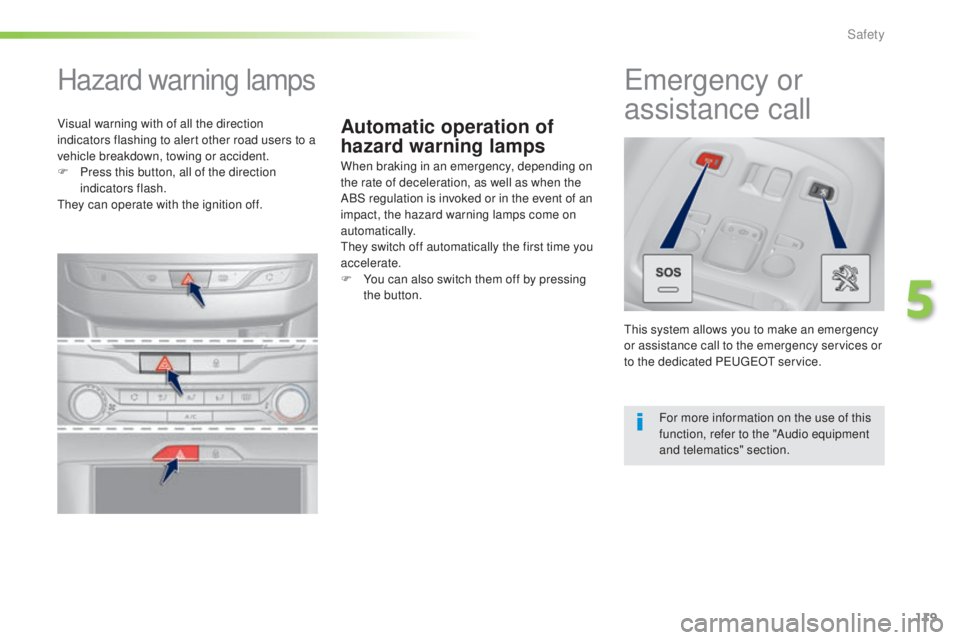
Hazard warning lamps
When braking in an emergency, depending on
the rate of deceleration, as well as when the
ABS regulation is invoked or in the event of an
impact, the hazard warning lamps come on
automatically.
the
y switch off automatically the first time you
accelerate.
F
Yo
u can also switch them off by pressing
the button.
emergency or
a ssistance call
this system allows you to make an emergency
o r assistance call to the emergency services or
to the dedicated P
eu
ge
Ot s
ervice.
For more information on the use of this
function, refer to the "Audio equipment
and telematics" section.
Visual warning with of all the direction
indicators flashing to alert other road users to a
vehicle breakdown, towing or accident.
F
Pr
ess this button, all of the direction
indicators flash.
the
y can operate with the ignition off.
5
Safety
Page 123 of 398
121
308_en_Chap05_securite_ed02-2015
Operation
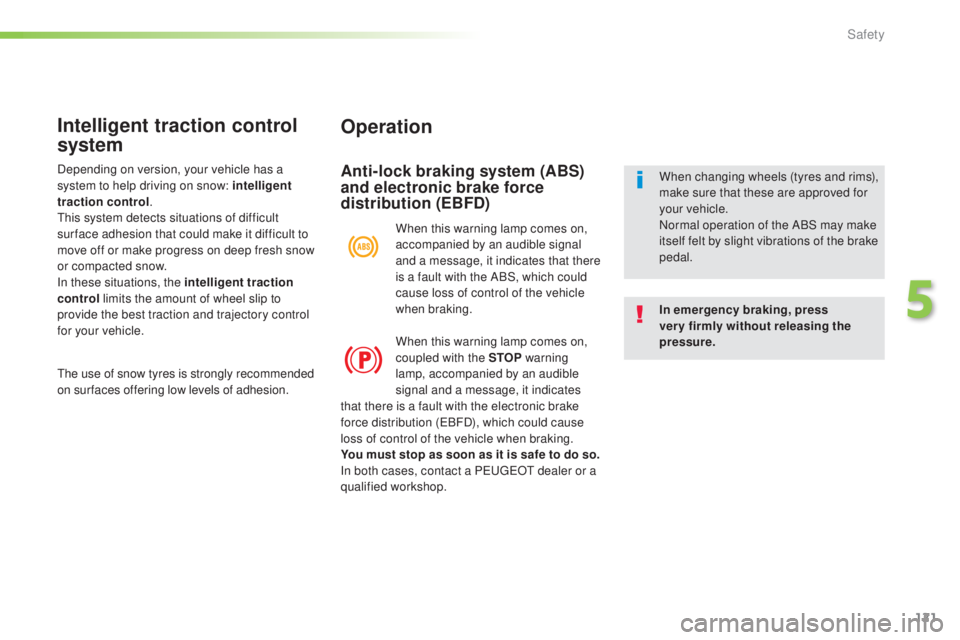
Anti-lock braking system (ABS)
and electronic brake force
distribution (EBFD)
In emergency braking, press
very firmly without releasing the
pressure. When changing wheels (tyres and rims),
make sure that these are approved for
your vehicle.
Normal operation of the ABS may make
itself felt by slight vibrations of the brake
pedal.
When this warning lamp comes on,
accompanied by an audible signal
and a message, it indicates that there
is a fault with the ABS, which could
cause loss of control of the vehicle
when braking.
When this warning lamp comes on,
coupled with the STOP
warning
lamp, accompanied by an audible
signal and a message, it indicates
Intelligent traction control
system
the use of snow tyres is strongly recommended
o n sur faces offering low levels of adhesion.
that there is a fault with the electronic brake
force distribution (
eBF
D), which could cause
loss of control of the vehicle when braking.
You must stop as soon as it is safe to do so.
In both cases, contact a P
eu
ge
Ot d
ealer or a
qualified workshop.
Depending on version, your vehicle has a
system to help driving on snow: intelligent
traction control
.
thi
s system detects situations of difficult
sur face adhesion that could make it difficult to
move off or make progress on deep fresh snow
or compacted snow.
In these situations, the intelligent traction
control limits the amount of wheel slip to
provide the best traction and trajectory control
for your vehicle.
5
Safety
Page 124 of 398
122
308_en_Chap05_securite_ed02-2015
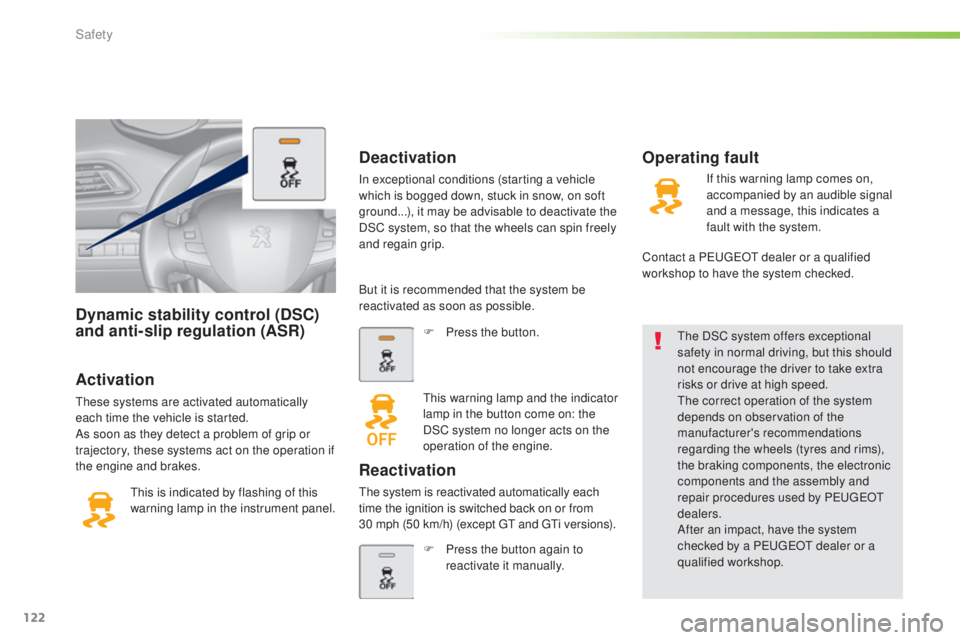
Dynamic stability control (DSC)
and anti-slip regulation (ASR)
Activation
these systems are activated automatically
e ach time the vehicle is started.
As soon as they detect a problem of grip or
trajectory, these systems act on the operation if
the engine and brakes.
thi
s is indicated by flashing of this
warning lamp in the instrument panel.
the D
SC system offers exceptional
safety in normal driving, but this should
not encourage the driver to take extra
risks or drive at high speed.the c orrect operation of the system
depends on observation of the
manufacturer's recommendations
regarding the wheels (tyres and rims),
the braking components, the electronic
components and the assembly and
repair procedures used by P
eu
ge
Ot
d
ealers.
After an impact, have the system
checked by a P
eu
ge
Ot d
ealer or a
qualified workshop.
Deactivation
In exceptional conditions (starting a vehicle
which is bogged down, stuck in snow, on soft
ground...), it may be advisable to deactivate the
DSC system, so that the wheels can spin freely
and regain grip.
Operating fault
But it is recommended that the system be
reactivated as soon as possible.
F
Pr
ess the button.
thi
s warning lamp and the indicator
lamp in the button come on: the
DSC system no longer acts on the
operation of the engine.
Reactivation
the system is reactivated automatically each
t ime the ignition is switched back on or from
30 mph (50 km/h) (except
g
t
a
nd
g
t
i ve
rsions).
F
Pr
ess the button again to
reactivate it manually. If this warning lamp comes on,
accompanied by an audible signal
and a message, this indicates a
fault with the system.
Contact a P
eu
ge
Ot d
ealer or a qualified
workshop to have the system checked.
Safety