warning Peugeot 308 2016 Repair Manual
[x] Cancel search | Manufacturer: PEUGEOT, Model Year: 2016, Model line: 308, Model: Peugeot 308 2016Pages: 398, PDF Size: 9.38 MB
Page 214 of 398
212
308_en_Chap06_conduite_ed02-2015
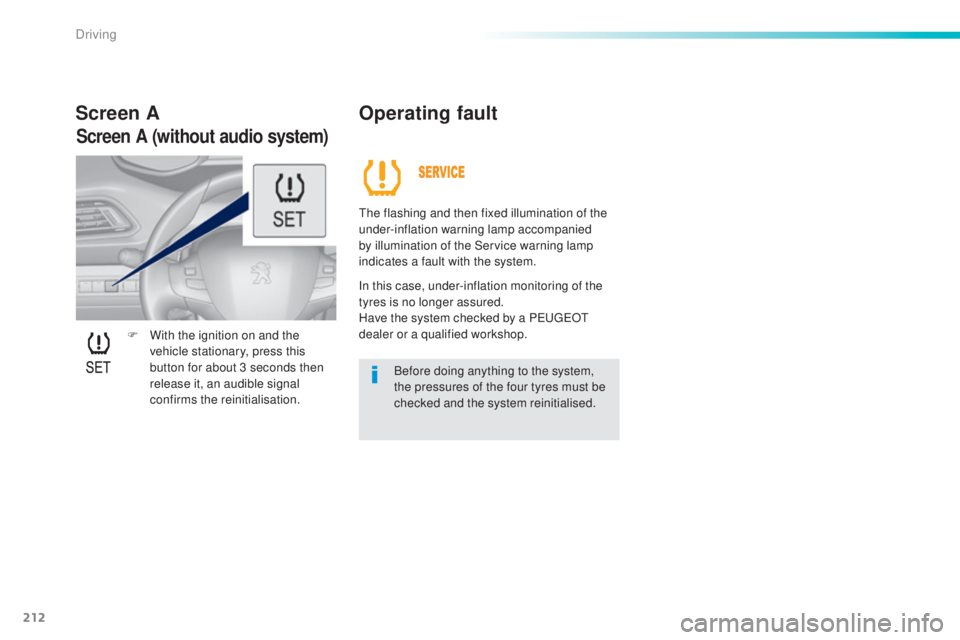
F With the ignition on and the
vehicle stationary, press this
button for about 3 seconds then
release it, an audible signal
confirms the reinitialisation.
Screen A Operating fault
the flashing and then fixed illumination of the
u nder-inflation warning lamp accompanied
by illumination of the Service warning lamp
indicates a fault with the system.
In this case, under-inflation monitoring of the
tyres is no longer assured.
Have the system checked by a P
eu
ge
Ot
d
ealer or a qualified workshop. Before doing anything to the system,
the pressures of the four tyres must be
checked and the system reinitialised.
Screen A (without audio system)
Driving
Page 216 of 398
214
308_en_Chap07_info-pratiques_ed02-2015
Low fuel level
When the low fuel level in the tank is
reached, this warning lamp comes on
in the instrument panel, accompanied
by an audible warning and a message.
Fuel supply cut-off
Your vehicle is equipped with a safety device
which cuts off the fuel supply in the event of a
collision. When it first comes on, less than 10 litres of
fuel remain in the tank.
You must refuel as soon as possible to avoid
running out.If you have put in the wrong fuel for
your vehicle, you must have have
the tank drained and refilled with
the correct fuel before you star t the
engine.
Your vehicle is fitted with a catalytic converter,
a device which helps to reduce the level of
harmful emissions in the exhaust gases.
For petrol engines, you must use unleaded
fuel only.
the f
iller neck is narrower, admitting petrol
nozzles only. It is still possible to use a fuel can to fill
the tank but this must be done slowly.
In order to ensure a good flow of fuel,
do not place the nozzle of the fuel can
in direct contact with the flap of the
misfuel prevention device.
Diesel misfuel prevention
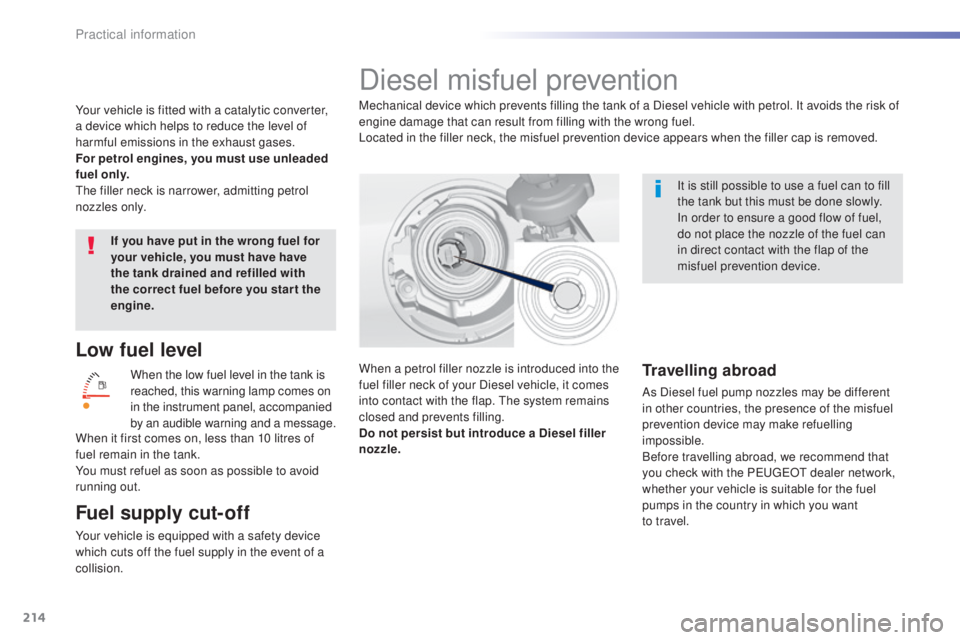
Mechanical device which prevents filling the tank of a Diesel vehicle with petrol. It avoids the risk of
engine damage that can result from filling with the wrong fuel.
Located in the filler neck, the misfuel prevention device appears when the filler cap is removed.
When a petrol filler nozzle is introduced into the
fuel filler neck of your Diesel vehicle, it comes
into contact with the flap.
the s
ystem remains
closed and prevents filling.
Do not persist but introduce a Diesel filler
nozzle.
Travelling abroad
As Diesel fuel pump nozzles may be different
in other countries, the presence of the misfuel
prevention device may make refuelling
impossible.
Before travelling abroad, we recommend that
you check with the P
eu
ge
Ot d
ealer network,
whether your vehicle is suitable for the fuel
pumps in the country in which you want
to
t
ravel.
Practical information
Page 222 of 398
220
308_en_Chap07_info-pratiques_ed02-2015
"Multimedia"
Multimedia support, hands-free kit, DVD player,
driving aids, vehicle tracking system, ...
Accessories
A wide range of accessories and genuine parts is available from the PeugeOt d ealer network.the
se accessories and parts are all suitable for your vehicle and benefit from Peu geOt's r ecommendation and warranty.
"Transport solutions"
Boot liners, roof bars, bicycle carrier on roof
bars, ski carrier, roof box, towbar harness, ...
tow b
ar, which mst be fitted by P
eu
ge
Ot
d
ealer or a qualified workshop.
Conversion kits
You can obtain an "ent erprise" kit to convert a
trade vehicle to a private car and vice-versa.
"Styling"
alloy wheels from 15 inch to 18 inch, finishers
for wheels, door sills, gear lever knobs, ...
"Ligne S": 16 and 17 inch alloy wheels, body
kit, stickers, interior and exterior mirror shells,
gear lever knob, door sills, mats*, …
"Comfort"
Door deflectors, side blinds and rear blind,
cigarette lighter, boot dividers, coat hanger
fixed to head restraint, front centre armrest,
under shelf storage, front and rear parking
sensors, styling mudflaps, window film, boot
management system, ...
*
t
o av
oid any risk of jamming of the pedals:
-
en
sure that the mat is positioned and
secured correctly,
-
ne
ver fit one mat on top of another.
"Security and safety"
Anti-theft alarm, window engraving, wheel
security bolts, child seats and booster
cushions, breathalyzer, first aid kit, warning
triangle, high visibility jacket, stolen vehicle
tracking system, temporary puncture repair kit,
snow chains, non-slip covers, front foglamps
kit, dog guard, ...
"Protection"
Mats*, seat covers compatible with lateral
airbags, mud flaps, side protection rubbing
strips, bumper protection rubbing strips,
bumper protectors, boot sill finishers, boot
mat,
...
Practical information
Page 223 of 398
221
308_en_Chap07_info-pratiques_ed02-2015
the fitting of electrical equipment
o r accessories which are not
recommended by P
eu
ge
Ot m
ay result
in a failure of your vehicle's electronic
system and excessive electrical
consumption.
Contact a P
eu
ge
Ot d
ealer
for information on the range of
recommended equipment and
accessories.
Installation of radio
communication
transmitters
Before installing any after-market radio
communication transmitter, you can
contact a P
eu
ge
Ot d
ealer for the
specification of transmitters which can
be fitted (frequency, maximum power,
aerial position, specific installation
requirements), in line with the Vehicle
ele
ctromagnetic Compatibility
Directive
(
2004/104/
eC)
. Depending on the legislation in force in
the country, certain safety equipment
may be compulsory: high visibility
safety vests, warning triangles,
breathalyzers, spare bulbs, spare fuses,
fire extinguisher, first aid kit, mud flaps
at the rear of the vehicle.
By visiting a P
eu
ge
Ot d
ealer, you can also
obtain products for cleaning and maintenance
(exterior and interior) - including ecological
products in the "
teCH
NA
tuRe" ra
nge, topping
up products (screenwash...), touch-up pens
and paint aerosols for the exact colour of your
vehicle, refills (cartridge for the temporary
puncture repair kit...), ...
7
Practical information
Page 225 of 398
223
308_en_Chap07_info-pratiques_ed02-2015
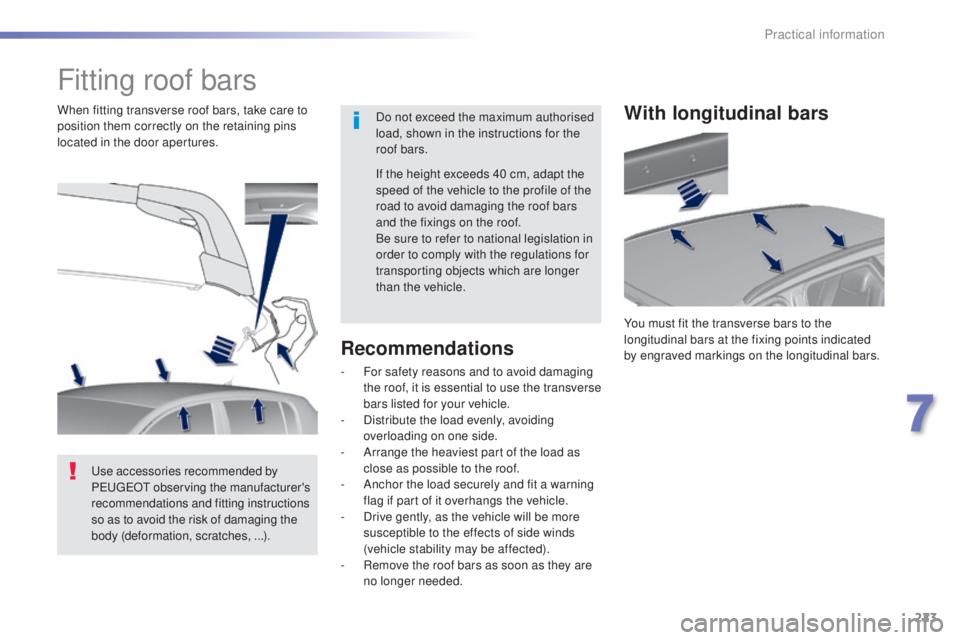
Fitting roof bars
Do not exceed the maximum authorised
load, shown in the instructions for the
roof bars.
When fitting transverse roof bars, take care to
position them correctly on the retaining pins
located in the door apertures.
use
accessories recommended by
P
eu
ge
Ot o
bserving the manufacturer's
recommendations and fitting instructions
so as to avoid the risk of damaging the
body (deformation, scratches, ...). If the height exceeds 40 cm, adapt the
speed of the vehicle to the profile of the
road to avoid damaging the roof bars
and the fixings on the roof.
Be sure to refer to national legislation in
order to comply with the regulations for
transporting objects which are longer
than the vehicle.With longitudinal bars
You must fit the transverse bars to the
longitudinal bars at the fixing points indicated
by engraved markings on the longitudinal bars.
Recommendations
- For safety reasons and to avoid damaging
t
he roof, it is essential to use the transverse
bars listed for your vehicle.
-
Di
stribute the load evenly, avoiding
overloading on one side.
-
Ar
range the heaviest part of the load as
close as possible to the roof.
-
An
chor the load securely and fit a warning
flag if part of it overhangs the vehicle.
-
Dr
ive gently, as the vehicle will be more
susceptible to the effects of side winds
(vehicle stability may be affected).
-
Re
move the roof bars as soon as they are
no longer needed.
7
Practical information
Page 234 of 398
232
308_en_Chap07_info-pratiques_ed02-2015
Avoid prolonged contact of used oil or
fluids with the skin.
Most of these fluids are harmful to
health or indeed very corrosive.
Do not discard used oil or fluids into
sewers or onto the ground.
tak
e used oil to a P
eu
ge
Ot d
ealer or
a qualified workshop (France) or to an
authorised waste disposal site.
Used products
To p p i n g u p
this additive must be topped up by a
Peu geOt d ealer or a qualified workshop
without delay.
Diesel additive level (Diesel
engine with particle filter)
A low additive level is indicated by
illumination of this warning lamp,
accompanied by an audible warning
and a message in the instrument
panel screen.
Practical information
Page 235 of 398
233
308_en_Chap07_info-pratiques_ed02-2015
Checks
12 V battery
the battery does not require any maintenance.
H owever, check that the terminals are clean
and correctly tightened, particularly in summer
and winter.Refer to the manufacturer's
service schedule for details of the
replacement intervals for these
components.
Air filter and passenger compartment filter
Replace the oil filter each time the
engine oil is changed.
Refer to the manufacturer's
service schedule for details of
the replacement interval for this
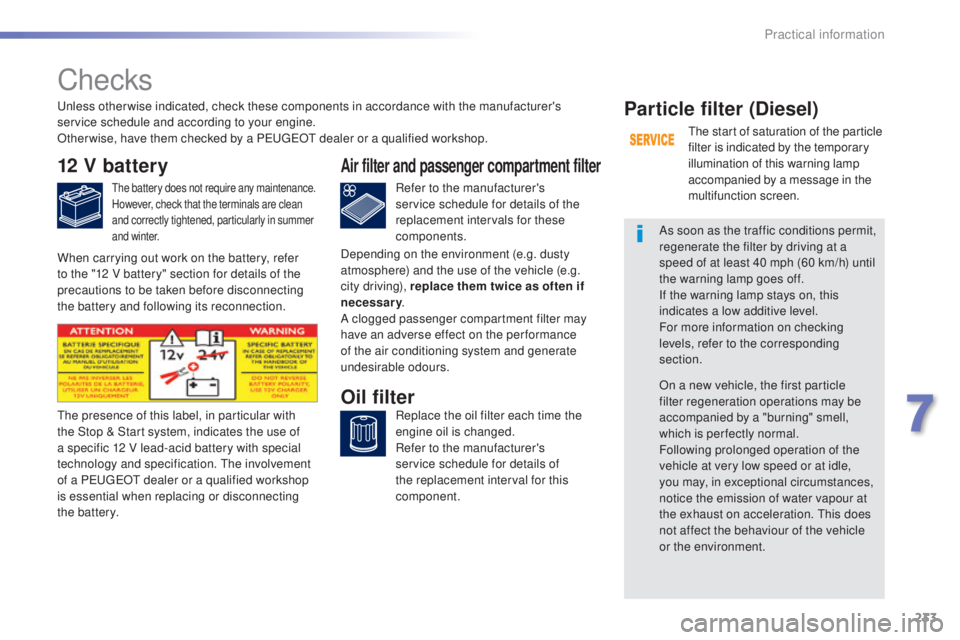
component.Oil filterthe presence of this label, in particular with
t he Stop & Start system, indicates the use of
a specific 12 V lead-acid battery with special
technology and specification.
the
involvement
of a P
eu
ge
Ot d
ealer or a qualified workshop
is essential when replacing or disconnecting
the battery.
Particle filter (Diesel)
the start of saturation of the particle
f ilter is indicated by the temporary
illumination of this warning lamp
accompanied by a message in the
multifunction screen.
As soon as the traffic conditions permit,
regenerate the filter by driving at a
speed of at least 40 mph (60 km/h) until
the warning lamp goes off.
If the warning lamp stays on, this
indicates a low additive level.
For more information on checking
levels, refer to the corresponding
section.
On a new vehicle, the first particle
filter regeneration operations may be
accompanied by a "burning" smell,
which is per fectly normal.
Following prolonged operation of the
vehicle at very low speed or at idle,
you may, in exceptional circumstances,
notice the emission of water vapour at
the exhaust on acceleration.
thi
s does
not affect the behaviour of the vehicle
or the environment.
unl
ess otherwise indicated, check these components in accordance with the manufacturer's
service schedule and according to your engine.
Other wise, have them checked by a Peu
geOt d
ealer or a qualified workshop.
When carrying out work on the battery, refer
to the "12 V battery" section for details of the
precautions to be taken before disconnecting
the battery and following its reconnection. Depending on the environment (e.g. dusty
atmosphere) and the use of the vehicle (e.g.
city driving), replace them twice as often if
necessary
.
A clogged passenger compartment filter may
have an adverse effect on the per formance
of the air conditioning system and generate
undesirable odours.
7
Practical information
Page 237 of 398
235
308_en_Chap07_info-pratiques_ed02-2015
AdBlue® additive and SCR system
for BlueHDi Diesel engines
to assure respect for the environment and
c onformity with the new eur o 6 emissions
standard, without adversely affecting the
per formance or fuel consumption of Diesel
engines, P
eu
ge
Ot h
as taken the decision to
equip its vehicles with an effective system that
associates SCR (Selective Catalytic Reduction)
with a particle filter (FAP) for the treatment of
exhaust gases.
Presentation of the SCR system
using an additive called AdBlue® containing
urea, a catalytic converter turns up to 85%
of nitrous oxides (NOx) into nitrogen and
water, which are harmless to health and the
environment.
the
AdBlue
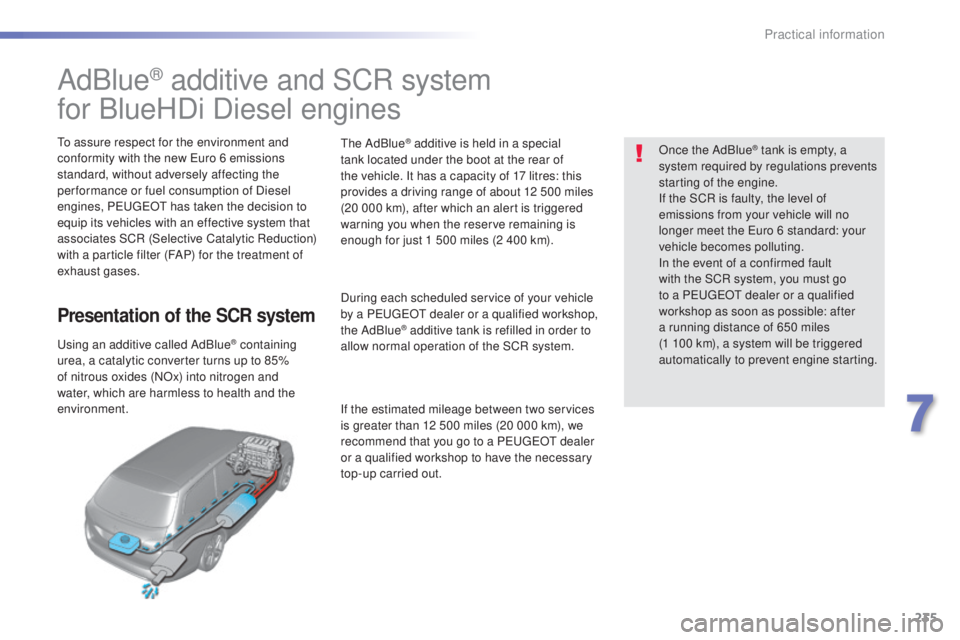
® additive is held in a special
tank located under the boot at the rear of
the vehicle. It has a capacity of 17 litres: this
provides a driving range of about 12 500 miles
(20 000 km), after which an alert is triggered
warning you when the reserve remaining is
enough for just 1 500 miles (2 400 km).
During each scheduled service of your vehicle
by a P
eu
ge
Ot d
ealer or a qualified workshop,
the AdBlue
® additive tank is refilled in order to
allow normal operation of the SCR system.
If the estimated mileage between two services
is greater than 12 500 miles (20 000 km), we
recommend that you go to a P
eu
ge
Ot d
ealer
or a qualified workshop to have the necessary
top-up carried out. Once the AdBlue
® tank is empty, a
sy
stem required by regulations prevents
starting of the engine.
If the SCR is faulty, the level of
emissions from your vehicle will no
longer meet the
eur
o 6 standard: your
vehicle becomes polluting.
In the event of a confirmed fault
with the SCR system, you must go
to a P
eu
ge
Ot d
ealer or a qualified
workshop as soon as possible: after
a running distance of 650 miles
(1
1
00 km), a system will be triggered
automatically to prevent engine starting.
7
Practical information
Page 240 of 398
238
308_en_Chap07_info-pratiques_ed02-2015
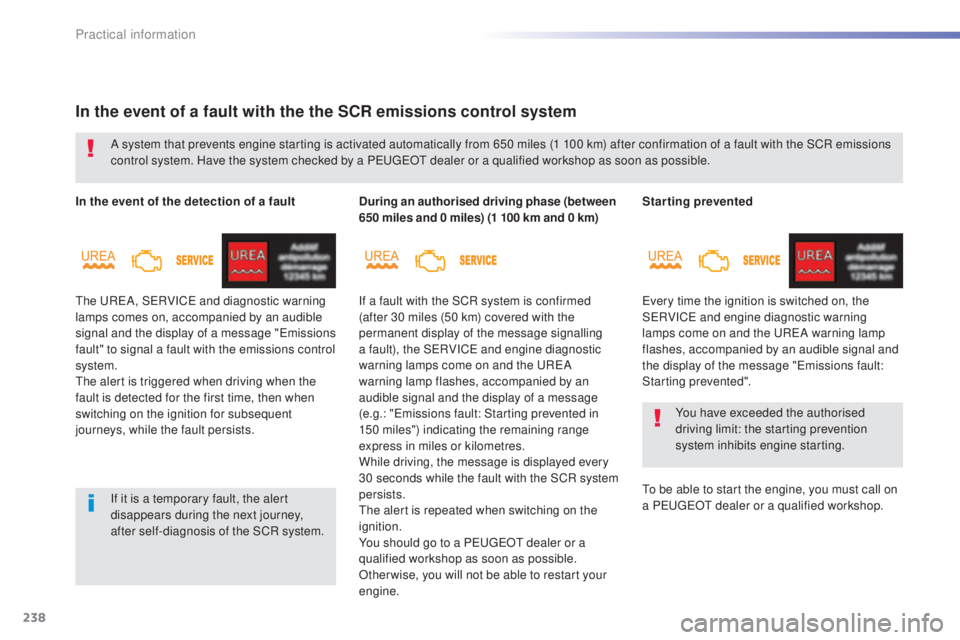
Starting prevented
eve
ry time the ignition is switched on, the
S
eRV
IC
e and
engine diagnostic warning
lamps come on and the
uReA wa
rning lamp
flashes, accompanied by an audible signal and
the display of the message "
emi
ssions fault:
Starting prevented".
You have exceeded the authorised
driving limit: the starting prevention
system inhibits engine starting.
to be a
ble to start the engine, you must call on
a P
eu
ge
Ot d
ealer or a qualified workshop.
In the event of a fault with the the SCR emissions control system
A system that prevents engine starting is activated automatically from 650 miles (1 100 km) after confirmation of a fault with the SCR emissions
co ntrol system. Have the system checked by a Peu geOt d ealer or a qualified workshop as soon as possible.
If it is a temporary fault, the alert
disappears during the next journey,
after self-diagnosis of the SCR system.
In the event of the detection of a fault
the uReA, SeRV
IC
e a
nd diagnostic warning
lamps comes on, accompanied by an audible
signal and the display of a message "
emi
ssions
fault" to signal a fault with the emissions control
system.
the a
lert is triggered when driving when the
fault is detected for the first time, then when
switching on the ignition for subsequent
journeys, while the fault persists. During an authorised driving phase (between
650 miles and 0 miles) (1 100 km and 0 km)
If a fault with the SCR system is confirmed
(after 30 miles (50 km) covered with the
permanent display of the message signalling
a fault), the S
eRV
IC
e a
nd engine diagnostic
warning lamps come on and the
uReA
war
ning lamp flashes, accompanied by an
audible signal and the display of a message
(e.g.: "
emi
ssions fault: Starting prevented in
150
m
iles") indicating the remaining range
express in miles or kilometres.
While driving, the message is displayed every
30 seconds while the fault with the SCR system
persists.
the a
lert is repeated when switching on the
ignition.
You should go to a P
eu
ge
Ot d
ealer or a
qualified workshop as soon as possible.
Other wise, you will not be able to restart your
engine.
Practical information
Page 241 of 398
239
308_en_Chap07_info-pratiques_ed02-2015
Topping-up the AdBlue® additive
Filling the AdBlue® tank is an operation
included in every routine service on your
vehicle by a P
eu
ge
Ot d
ealer or a qualified
workshop.
Nevertheless, given the capacity of the tank,
it may be necessary to top-up the additive
between services, more particularly if an alert
(warning lamps and a message) signals the
requirement.
You can got to a P
eu
ge
Ot d
ealer or a
qualified workshop.
If you envisage topping-up yourself, please
read the following warnings carefully.Precautions in use
Keep AdBlue® out of the reach of
children, in its original bottle.
Never transfer AdBlue
® to another
container: it would lose its purity.
use
only AdBlue
® additive that meets the
ISO 22241 standard.
Never dilute the additive with water.
Never pour the additive into the Diesel
fuel tank.
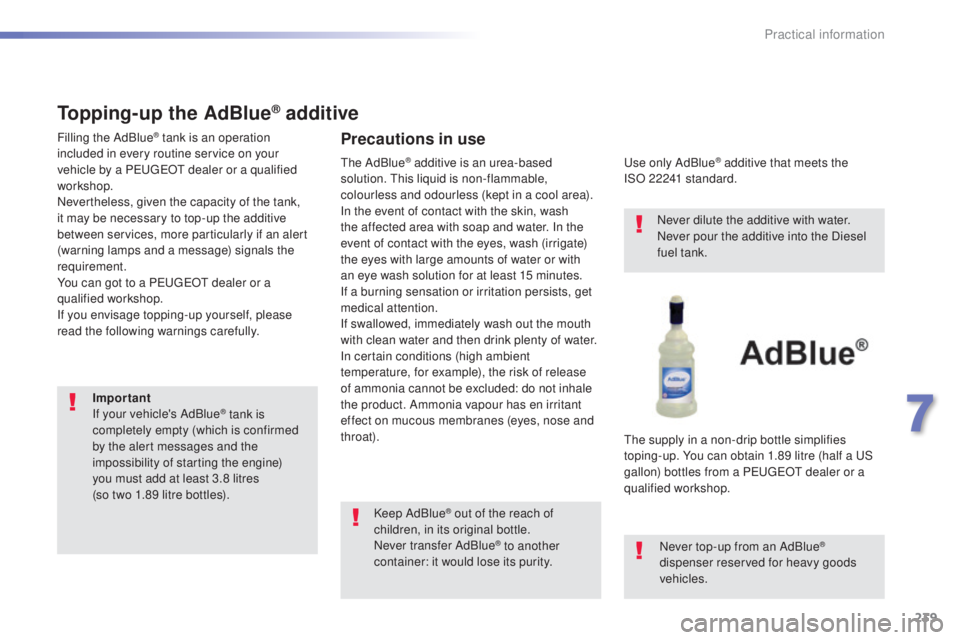
the s
upply in a non-drip bottle simplifies
toping-up. You can obtain 1.89 litre (half a
uS
ga
llon) bottles from a P
eu
ge
Ot d
ealer or a
qualified workshop.
Never top-up from an AdBlue
®
dispenser reserved for heavy goods
vehicles.
the
AdBlue
® additive is an urea-based
solution. thi
s liquid is non-flammable,
colourless and odourless (kept in a cool area).
In the event of contact with the skin, wash
the affected area with soap and water. In the
event of contact with the eyes, wash (irrigate)
the eyes with large amounts of water or with
an eye wash solution for at least 15 minutes.
If a burning sensation or irritation persists, get
medical attention.
If swallowed, immediately wash out the mouth
with clean water and then drink plenty of water.
In certain conditions (high ambient
temperature, for example), the risk of release
of ammonia cannot be excluded: do not inhale
the product. Ammonia vapour has en irritant
effect on mucous membranes (eyes, nose and
throat).
Important
If your vehicle's AdBlue
® tank is
co
mpletely empty (which is confirmed
by the alert messages and the
impossibility of starting the engine)
you must add at least 3.8 litres
(so two 1.89 litre bottles).
7
Practical information