warning Peugeot 308 2016 Owner's Guide
[x] Cancel search | Manufacturer: PEUGEOT, Model Year: 2016, Model line: 308, Model: Peugeot 308 2016Pages: 398, PDF Size: 9.38 MB
Page 126 of 398
124
308_en_Chap05_securite_ed02-2015
From approximately 12 mph
(20 km/h), the warning lamp(s)
flash for two minutes accompanied
by an audible signal. Once these
two
m
inutes have elapsed, the
warning lamp(s) remain on until the
driver or one or more passengers
fasten their seat belt.
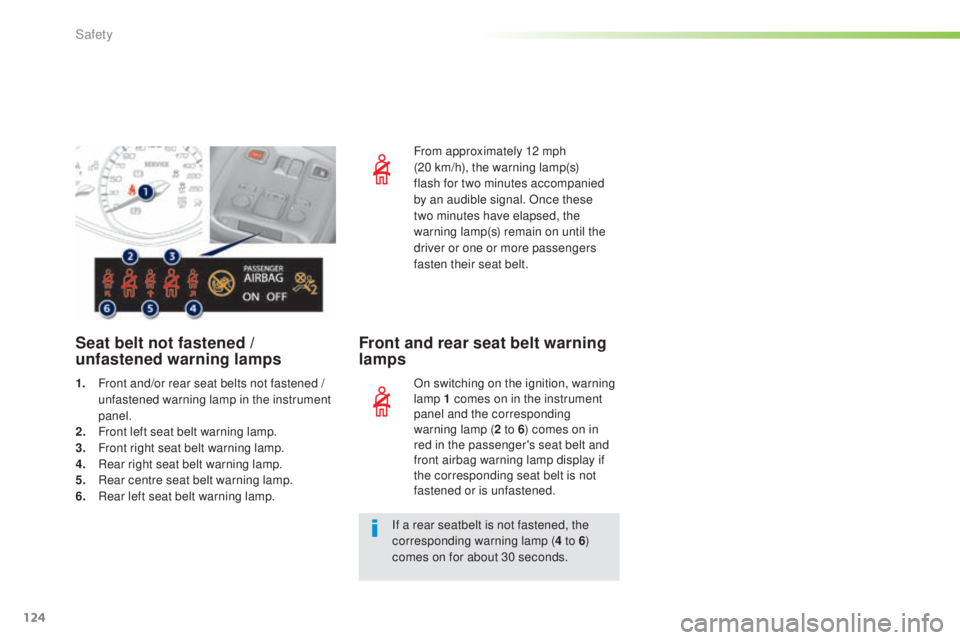
Seat belt not fastened /
un fastened warning lamps Front and rear seat belt warning
lamps
On switching on the ignition, warning
lamp 1 comes on in the instrument
panel and the corresponding
warning lamp (
2 to 6) comes on in
red in the passenger's seat belt and
front airbag warning lamp display if
the corresponding seat belt is not
fastened or is unfastened.
If a rear seatbelt is not fastened, the
corresponding warning lamp ( 4 to 6)
comes on for about 30 seconds.
1. Fr
ont and/or rear seat belts not fastened /
u
nfastened warning lamp in the instrument
panel.
2.
Fr
ont left seat belt warning lamp.
3.
Fr
ont right seat belt warning lamp.
4.
Re
ar right seat belt warning lamp.
5.
Re
ar centre seat belt warning lamp.
6.
Re
ar left seat belt warning lamp.
Safety
Page 127 of 398
125
308_en_Chap05_securite_ed02-2015
Advice
Recommendations for children
use a suitable child seat if the passenger is
l ess than 12 years old or shorter than one
and a half metres.
Never use the same seat belt to secure more
than one person.
Never allow a child to travel on your lap.
For more information on child seats, refer to
the corresponding section.
In order to be effective, a seat belt must:
- be t
ightened as close to the body as
possible,
-
be p
ulled in front of you with a smooth
movement, checking that it does not
twist,
-
be u
sed to restrain only one person,
-
no
t bear any trace of cuts or fraying,
-
no
t be converted or modified to avoid
affecting its performance.
In accordance with current safety
regulations, for all repairs on your vehicle's
seat belts, go to a qualified workshop with
the skills and equipment needed, which a
P
eug
e
Ot de
aler is able to provide.
Have your seat belts checked regularly by a
P
eu
ge
Ot d
ealer or a qualified workshop,
particularly if the straps show signs of
damage.
Clean the seat belt straps with soapy
water or a textile cleaning product, sold by
P
eu
ge
Ot dea
lers.
After folding or moving a seat or rear bench
seat, ensure that the seat belt is positioned
and reeled in correctly.
In the event of an impact
Depending on the nature and
seriousness of the impact , the
pretensioning device may be deployed
before and independently of the airbags.
Deployment of the pretensioners is
accompanied by a slight discharge of
harmless smoke and a noise, due to the
activation of the pyrotechnic cartridge
incorporated in the system.
In all cases, the airbag warning lamp
comes
on
.
Following an impact, have the seat belts
system checked, and if necessary replaced,
by a P
eu
ge
Ot d
ealer or a qualified
workshop.
the d
river must ensure that passengers use
the seat belts correctly and that they are all
fastened before setting off.
Wherever you are seated in the vehicle,
always fasten your seat belt, even for short
journeys.
Do not interchange the seat belt buckles as
they will not fulfil their role fully.
the s
eat belts are fitted with an inertia reel
permitting automatic adjustment of the
length of the strap to your size.
the s
eat belt
is stowed automatically when not in use.
Before and after use, ensure that the seat
belt is reeled in correctly.
the l
ower part of the strap must be
positioned as low as possible on the pelvis.the u
pper part must be positioned in the
hollow of the shoulder.
the i
nertia reels are fitted with an automatic
locking device which comes into operation in
the event of a collision, emergency braking
or if the vehicle rolls over. You can release
the device by pulling the strap firmly and
then releasing it so that it reels in slightly.
5
Safety
Page 129 of 398
127
308_en_Chap05_securite_ed02-2015
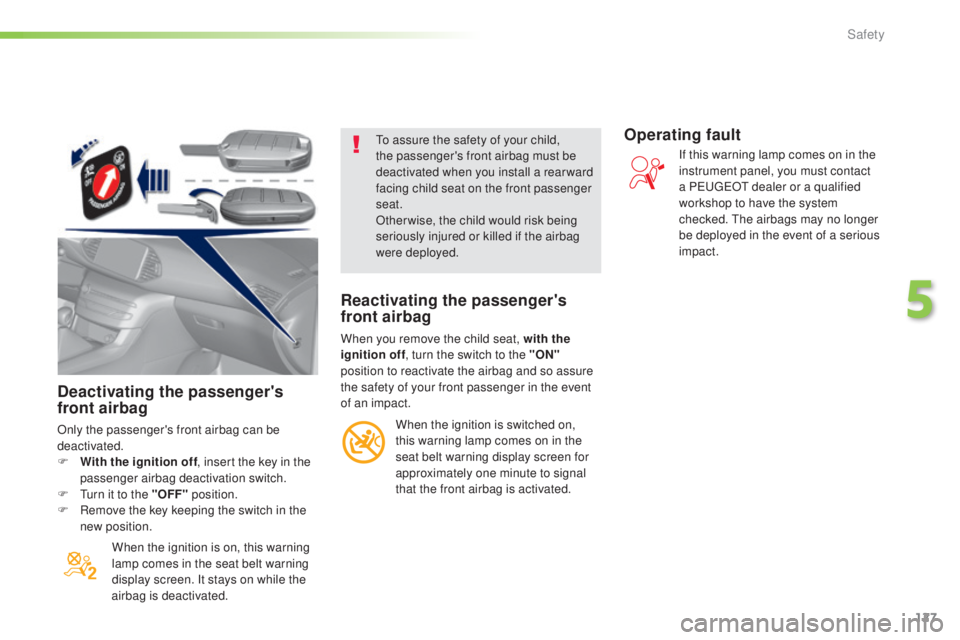
Deactivating the passenger's
front airbag
Only the passenger's front airbag can be
deactivated.
F
Wi
th the ignition off , insert the key in the
passenger airbag deactivation switch.
F
t
ur
n it to the "OFF" position.
F
Re
move the key keeping the switch in the
new position.
When the ignition is on, this warning
lamp comes in the seat belt warning
display screen. It stays on while the
airbag is deactivated.
to as
sure the safety of your child,
the passenger's front airbag must be
deactivated when you install a rear ward
facing child seat on the front passenger
seat.
Otherwise, the child would risk being
seriously injured or killed if the airbag
were deployed.
Reactivating the passenger's
front airbag
When you remove the child seat, with the
ignition off , turn the switch to the "ON"
position to reactivate the airbag and so assure
the safety of your front passenger in the event
of an impact.
When the ignition is switched on,
this warning lamp comes on in the
seat belt warning display screen for
approximately one minute to signal
that the front airbag is activated.
Operating fault
If this warning lamp comes on in the
instrument panel, you must contact
a P
eu
ge
Ot d
ealer or a qualified
workshop to have the system
checked.
the a
irbags may no longer
be deployed in the event of a serious
impact.
5
Safety
Page 130 of 398
128
308_en_Chap05_securite_ed02-2015
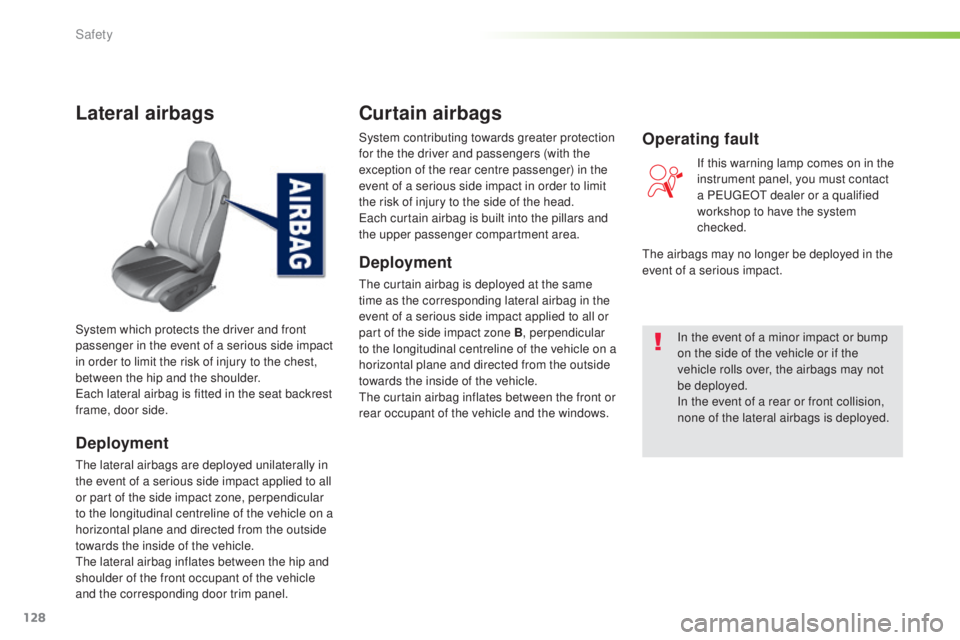
Lateral airbags
Deployment
the lateral airbags are deployed unilaterally in
t he event of a serious side impact applied to all
or part of the side impact zone, perpendicular
to the longitudinal centreline of the vehicle on a
horizontal plane and directed from the outside
towards the inside of the vehicle.
the l
ateral airbag inflates between the hip and
shoulder of the front occupant of the vehicle
and the corresponding door trim panel. System which protects the driver and front
passenger in the event of a serious side impact
in order to limit the risk of injury to the chest,
between the hip and the shoulder.
eac
h lateral airbag is fitted in the seat backrest
frame, door side. System contributing towards greater protection
for the the driver and passengers (with the
exception of the rear centre passenger) in the
event of a serious side impact in order to limit
the risk of injury to the side of the head.
eac
h curtain airbag is built into the pillars and
the upper passenger compartment area.
Deployment
the curtain airbag is deployed at the same
t ime as the corresponding lateral airbag in the
event of a serious side impact applied to all or
part of the side impact zone B, perpendicular
to the longitudinal centreline of the vehicle on a
horizontal plane and directed from the outside
towards the inside of the vehicle.
the c
urtain airbag inflates between the front or
rear occupant of the vehicle and the windows. In the event of a minor impact or bump
on the side of the vehicle or if the
vehicle rolls over, the airbags may not
be deployed.
In the event of a rear or front collision,
none of the lateral airbags is deployed.If this warning lamp comes on in the
instrument panel, you must contact
a P
eu
ge
Ot d
ealer or a qualified
workshop to have the system
checked.
Operating fault
Curtain airbags
the airbags may no longer be deployed in the
e vent of a serious impact.
Safety
Page 135 of 398
133
308_en_Chap05_securite_ed02-2015
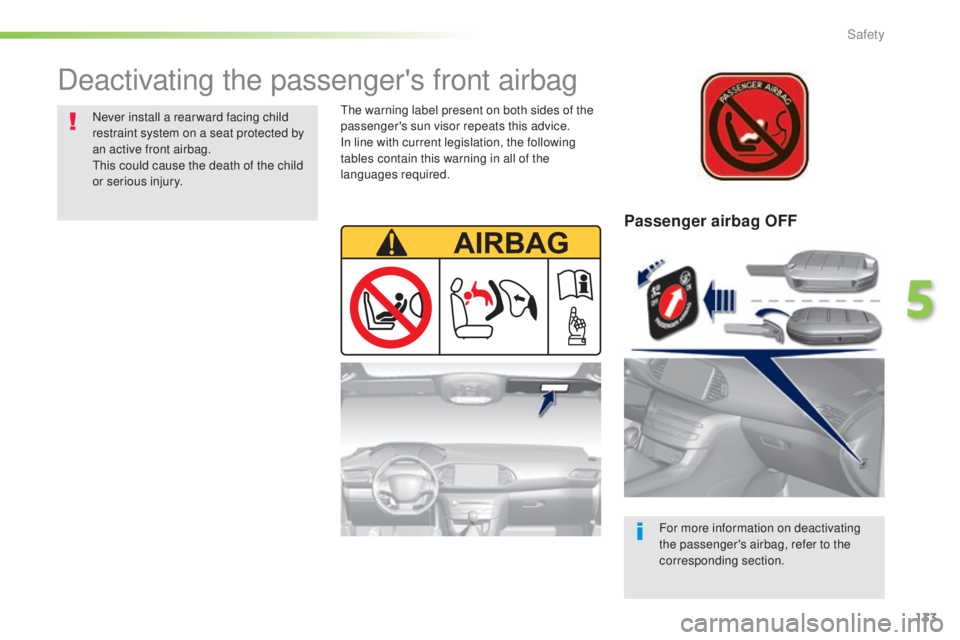
Passenger airbag OFF
For more information on deactivating
the passenger's airbag, refer to the
corresponding section.
Deactivating the passenger's front airbag
Never install a rear ward facing child
restraint system on a seat protected by
an active front airbag.
thi
s could cause the death of the child
or serious injury.the w arning label present on both sides of the
passenger's sun visor repeats this advice.
In line with current legislation, the following
tables contain this warning in all of the
languages required.
5
Safety
Page 149 of 398
147
308_en_Chap06_conduite_ed02-2015
When towing
Distribution of loads
F Distribute the load in the trailer so that the
heaviest items are as close as possible to
the axle and the nose weight approaches
the maximum permitted without
exceeding
it
.
Air density decreases with altitude, thus
reducing engine performance. Above
1
0
00
m
etres, the maximum towed load must
be reduced by 10
% f
or every 1
0
00 metres of
altitude.
Side wind
F take into account the increased sensitivity
t o side wind.
Cooling
towing a trailer on a slope increases the
t emperature of the coolant.
As the fan is electrically controlled, its cooling
capacity is not dependent on the engine speed.
F
t
o lo
wer the engine speed, reduce your
speed.
the m
aximum towed load on a long incline
depends on the gradient and the ambient
temperature.
In all cases, keep a check on the coolant
temperature.
F
If t
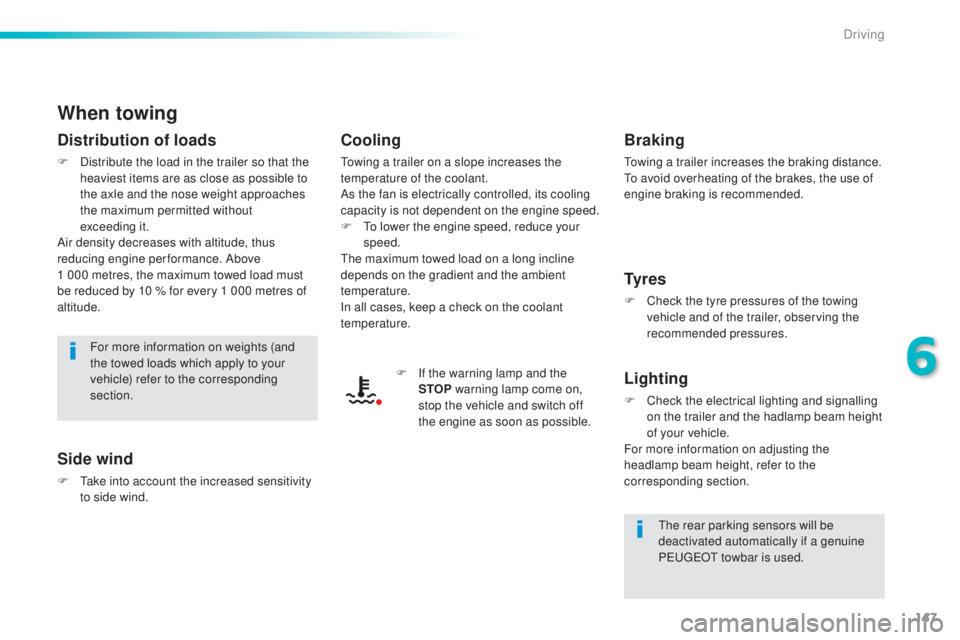
he warning lamp and the
STOP warning lamp come on,
stop the vehicle and switch off
the engine as soon as possible.
Braking
towing a trailer increases the braking distance.to av oid overheating of the brakes, the use of
engine braking is recommended.
Ty r e s
F Check the tyre pressures of the towing
v ehicle and of the trailer, observing the
recommended pressures.
Lighting
F Check the electrical lighting and signalling
o n the trailer and the hadlamp beam height
of your vehicle.
For more information on adjusting the
headlamp beam height, refer to the
corresponding section.
For more information on weights (and
the towed loads which apply to your
vehicle) refer to the corresponding
section.
the r
ear parking sensors will be
deactivated automatically if a genuine
P
eu
ge
Ot t
owbar is used.
6
Driving
Page 151 of 398
149
308_en_Chap06_conduite_ed02-2015
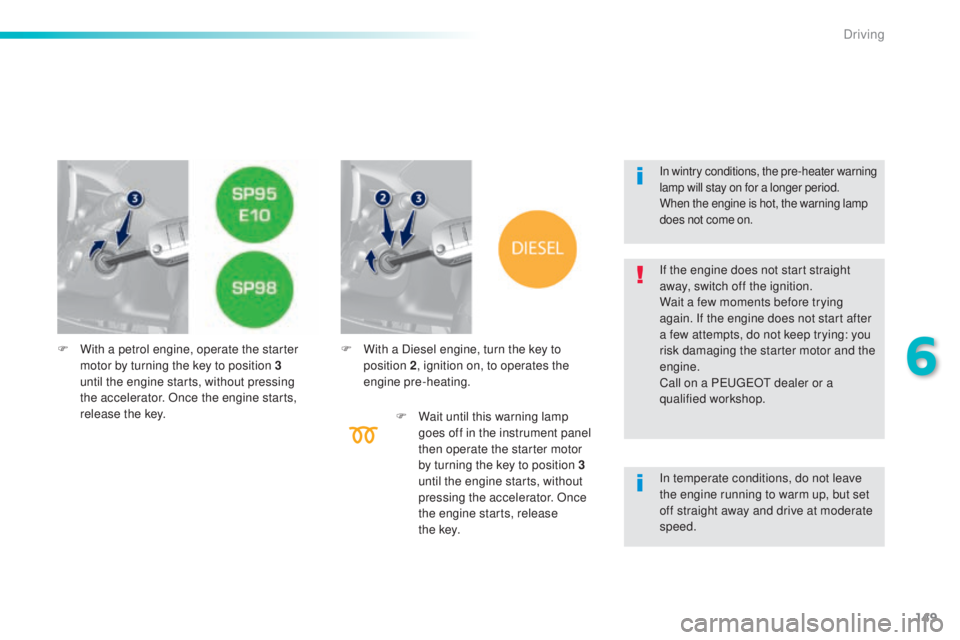
F With a petrol engine, operate the starter
motor by turning the key to position 3
until the engine starts, without pressing
the accelerator. Once the engine starts,
release the key. F Wi
th a Diesel engine, turn the key to
position 2 , ignition on, to operates the
engine pre-heating.
F
Wa
it until this warning lamp
goes off in the instrument panel
then operate the starter motor
by turning the key to position 3
until the engine starts, without
pressing the accelerator. Once
the engine starts, release
t h e
k
ey.
In wintry conditions, the pre-heater warning
lamp will stay on for a longer period.
When the engine is hot, the warning lamp
does not come on.
In temperate conditions, do not leave
the engine running to warm up, but set
off straight away and drive at moderate
speed. If the engine does not start straight
away, switch off the ignition.
Wait a few moments before trying
again. If the engine does not start after
a few attempts, do not keep trying: you
risk damaging the starter motor and the
engine.
Call on a P
eu
ge
Ot d
ealer or a
qualified workshop.
6
Driving
Page 153 of 398
151
308_en_Chap06_conduite_ed02-2015
For Diesel vehicles, in sub-
zero temperatures the engine
will not start until the pre-heater
warning lamp has gone off.
If this warning lamp comes on
after pressing the "S
tARt/
StOP
" button, press down on
the brake or clutch pedal until
the warning lamp goes off,
without pressing the "S
tARt/
StOP
" button again, until the
engine starts and runs.
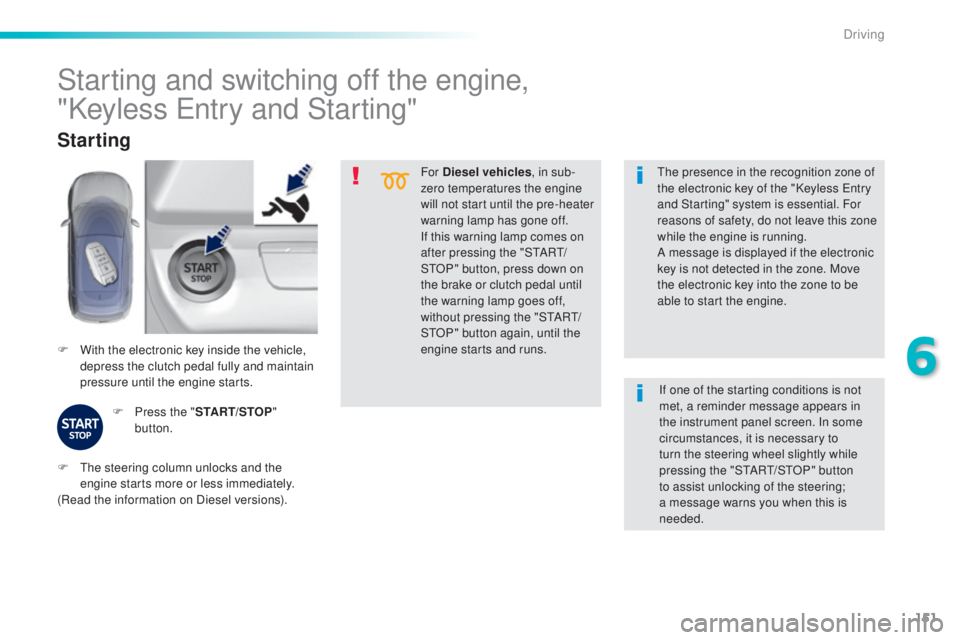
F
Wi
th the electronic key inside the vehicle,
depress the clutch pedal fully and maintain
pressure until the engine starts.
Starting
F Press the " ST ART/STOP"
button.
the p
resence in the recognition zone of
the electronic key of the "Keyless
ent
ry
and Starting" system is essential. For
reasons of safety, do not leave this zone
while the engine is running.
A message is displayed if the electronic
key is not detected in the zone. Move
the electronic key into the zone to be
able to start the engine.
Starting and switching off the engine,
"Keyless
ent
ry and Starting"
F the steering column unlocks and the
e ngine starts more or less immediately.
(Read the information on Diesel versions). If one of the starting conditions is not
met, a reminder message appears in
the instrument panel screen. In some
circumstances, it is necessary to
turn the steering wheel slightly while
pressing the "StARt/StOP
" button
to assist unlocking of the steering;
a message warns you when this is
needed.
6
Driving
Page 156 of 398
154
308_en_Chap06_conduite_ed02-2015
Manual parking brake
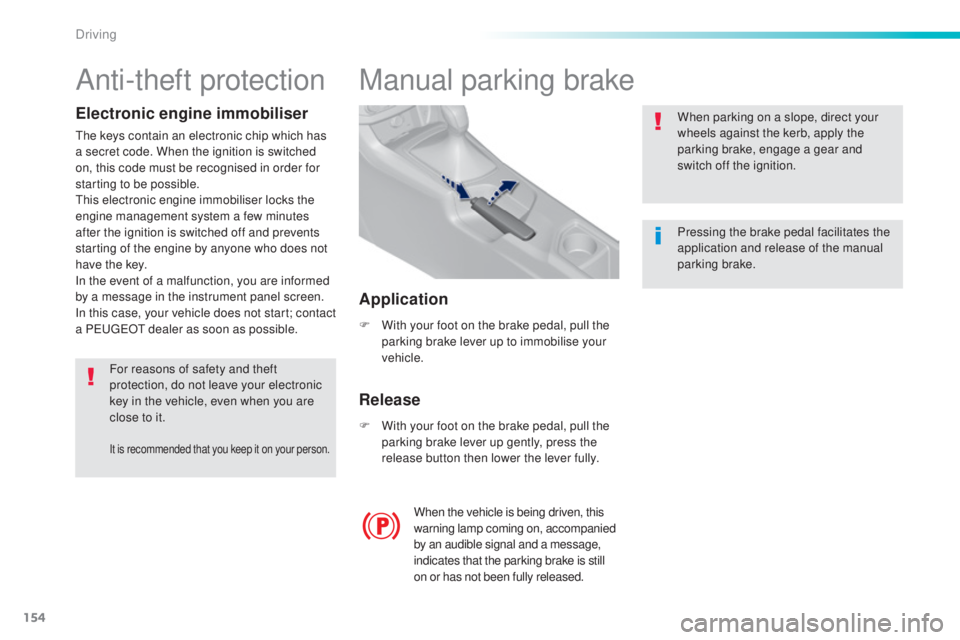
F With your foot on the brake pedal, pull the
parking brake lever up to immobilise your
vehicle.
F
Wi
th your foot on the brake pedal, pull the
parking brake lever up gently, press the
release button then lower the lever fully. When parking on a slope, direct your
wheels against the kerb, apply the
parking brake, engage a gear and
switch off the ignition.
When the vehicle is being driven, this
warning lamp coming on, accompanied
by an audible signal and a message,
indicates that the parking brake is still
on or has not been fully released. Pressing the brake pedal facilitates the
application and release of the manual
parking brake.
Release Application
Anti-theft protection
Electronic engine immobiliser
the keys contain an electronic chip which has
a s ecret code. When the ignition is switched
on, this code must be recognised in order for
starting to be possible.
thi
s electronic engine immobiliser locks the
engine management system a few minutes
after the ignition is switched off and prevents
starting of the engine by anyone who does not
have the key.
In the event of a malfunction, you are informed
by a message in the instrument panel screen.
In this case, your vehicle does not start; contact
a P
eu
ge
Ot d
ealer as soon as possible.
For reasons of safety and theft
protection, do not leave your electronic
key in the vehicle, even when you are
close to it.
It is recommended that you keep it on your person.
Driving
Page 161 of 398
159
308_en_Chap06_conduite_ed02-2015
Emergency braking
In the event of a failure of the main service
brake or in an exceptional situation (e.g. driver
taken ill, under instruction, etc) a continuous
pull on the control lever will brake the vehicle.
Braking takes place while the control lever is
being pulled. It is interrupted if the control lever
is released.
the A
BS and DSC systems provide stability of
the vehicle during emergency braking.
If the emergency braking malfunctions, the
message "Parking brake control faulty" will be
displayed.
the em
ergency braking should only be
used in an exceptional situation.
Repeat this procedure to reactivate automatic
operation.
Reactivation of automatic operation is
confirmed by the indicator lamp in the
instrument panel going off.
Deactivating automatic operation
In some situations, such as very cold weather
or towing (caravan, recovery), it may be
necessary to deactivate automatic operation of
the system.
F
St
art the engine.
F
Ap
ply the parking brake with the control
lever, if it is released.
F
t
ak
e your foot off the brake pedal.
F
Pu
sh and hold the control lever in the
release direction for at least 10 seconds
and no more than 15 seconds.
F
Re
lease the control lever.
F
Pr
ess and hold the brake pedal.
F
Pu
ll the control lever in the apply direction
for 2 seconds.
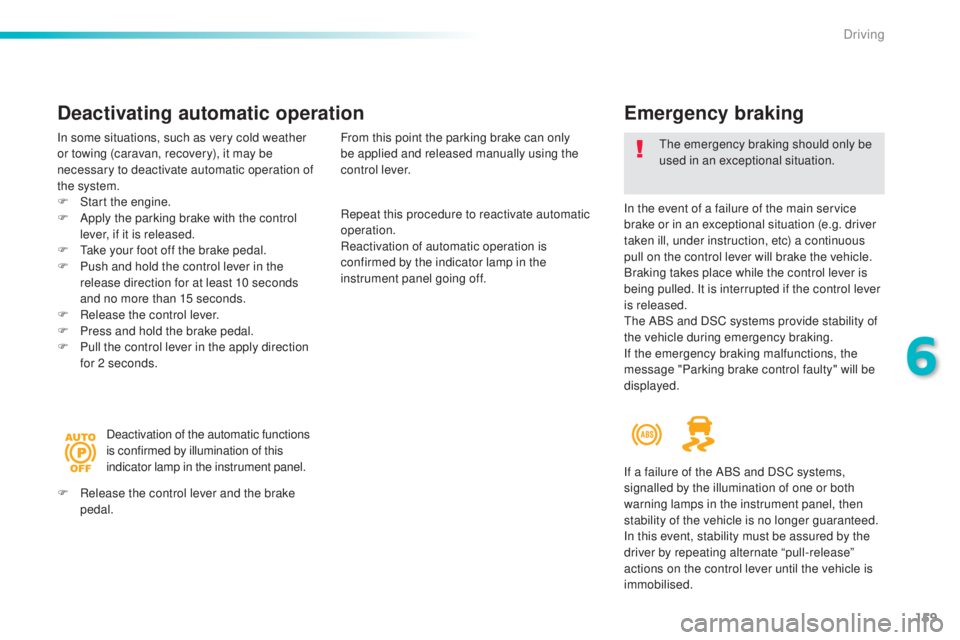
Deactivation of the automatic functions
is confirmed by illumination of this
indicator lamp in the instrument panel.
F
Re
lease the control lever and the brake
pedal. From this point the parking brake can only
be applied and released manually using the
control lever.
If a failure of the ABS and DSC systems,
signalled by the illumination of one or both
warning lamps in the instrument panel, then
stability of the vehicle is no longer guaranteed.
In this event, stability must be assured by the
driver by repeating alternate “pull-release”
actions on the control lever until the vehicle is
immobilised.
6
Driving