brake PEUGEOT 4008 2017 Owner's Guide
[x] Cancel search | Manufacturer: PEUGEOT, Model Year: 2017, Model line: 4008, Model: PEUGEOT 4008 2017Pages: 368, PDF Size: 12.22 MB
Page 186 of 368
184
4008_en_Chap07_info-pratiques_ed01-2016
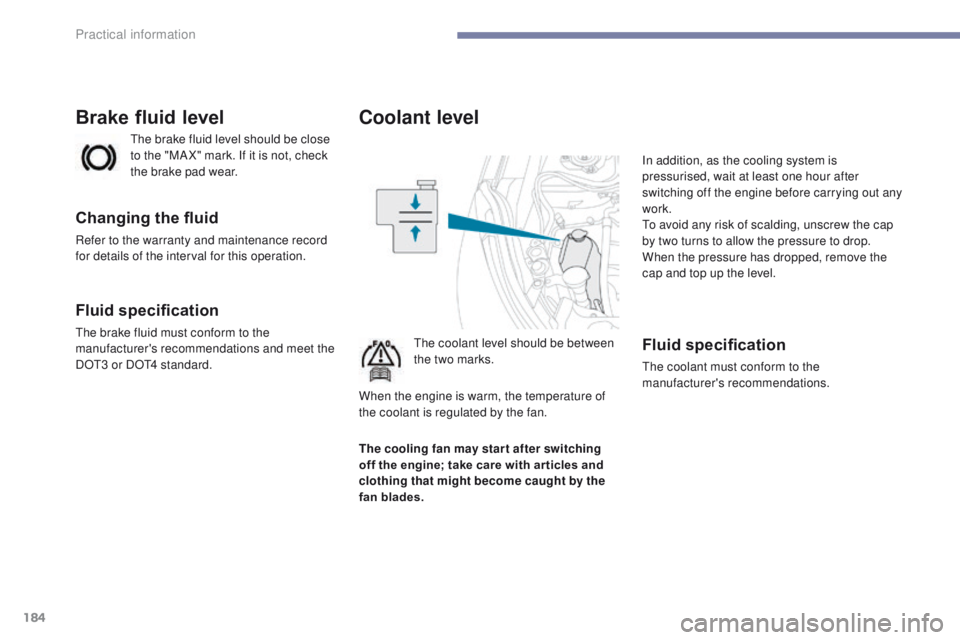
Coolant level
the coolant level should be between
the two marks.In addition, as the cooling system is
pressurised, wait at least one hour after
switching off the engine before carrying out any
work.
to a
void any risk of scalding, unscrew the cap
by two turns to allow the pressure to drop.
When the pressure has dropped, remove the
cap and top up the level.Fluid specification
the coolant must conform to the
manufacturer's recommendations.
th
e brake fluid level should be close
to the "MA X" mark. If it is not, check
the brake pad wear.
Brake fluid level
Changing the fluid
Refer to the warranty and maintenance record
for details of the interval for this operation.
Fluid specification
the brake fluid must conform to the
manufacturer's recommendations and meet the
DO
t3 o
r DO
t4 s
tandard.
The cooling fan may star t after switching
off the engine; take care with ar ticles and
clothing that might become caught by the
fan blades. When the engine is warm, the temperature of
the coolant is regulated by the fan.
Practical information
Page 187 of 368
185
4008_en_Chap07_info-pratiques_ed01-2016
Avoid prolonged contact of used oil or
fluids with the skin.
Most of these fluids are harmful to
health or indeed very corrosive.
Do not discard used oil or fluids into
sewers or onto the ground.
ta
ke used oil to a P
e
uge
Ot
dealer or
a qualified workshop (France) or to an
authorised waste disposal site.
Used products
Topping up
the reservoir must be topped up without delay
by a Pe ugeOt dealer or a qualified workshop.
Additive level
(1.6 HDi 110 Diesel versions
with particle filter)
the additive reservoir low level is indicated by
the display of this message.
Fluid specification
For optimum cleaning, this fluid must not be
topped up with or replaced with plain water.
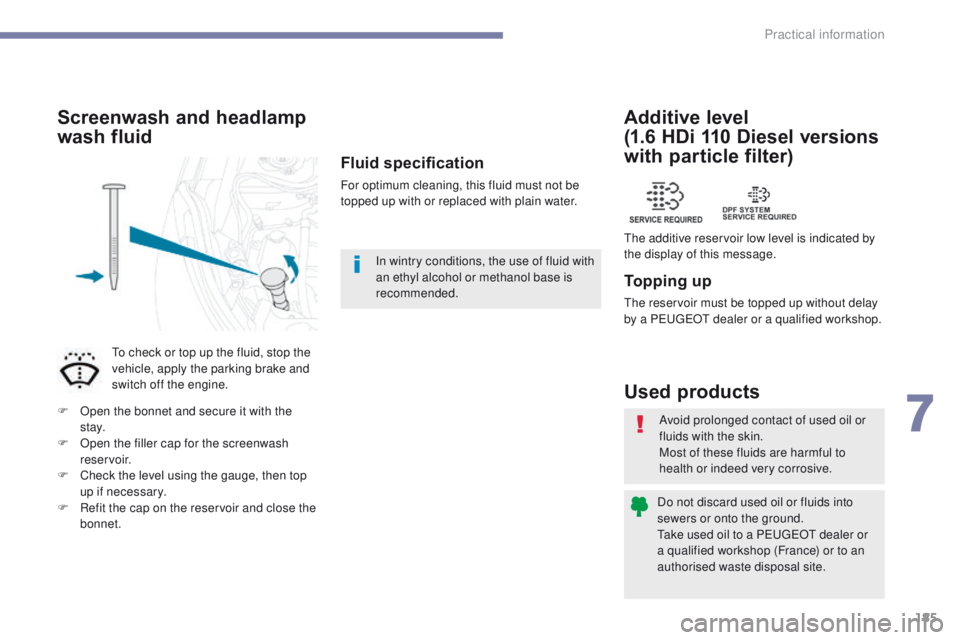
Screenwash and headlamp
wash fluid
to check or top up the fluid, stop the
vehicle, apply the parking brake and
switch off the engine.
F
O
pen the bonnet and secure it with the
st ay.
F
O
pen the filler cap for the screenwash
reservoir.
F
C
heck the level using the gauge, then top
up if necessary.
F
R
efit the cap on the reservoir and close the
bonnet. In wintry conditions, the use of fluid with
an ethyl alcohol or methanol base is
recommended.
7
Practical information
Page 190 of 368
188
4008_en_Chap07_info-pratiques_ed01-2016
Brake wear depends on the style
of driving, particularly in the case
of vehicles used in town, over short
distances. It may be necessary to have
the condition of the brakes checked,
even between vehicle services.
Brake pads
For information on checking brake
disc wear, contact a PeugeOt
dealer or a qualified workshop.
Brake disc wear Parking brake
If excessive travel or a loss of
effectiveness of this system is
noticed, the parking brake must be
checked, even between two services.
Only use products recommended by
P
e
uge
Ot
or products of equivalent
quality and specification.
In order to optimise the operation of
units as important as those in the
braking system, P
e
uge
Ot
selects and
offers very specific products.
After washing the vehicle, dampness,
or in wintry conditions, ice can form
on the brake discs and pads: braking
efficiency may be reduced. Make light
brake applications to dry and defrost
the brakes.
Checking this system must be done by a
P
e
uge
Ot
dealer or a qualified workshop.
un
less there is a leak in the circuit, a drop in
the brake fluid level indicates that the brake
pads are worn.
Practical information
Page 192 of 368
190
4008_en_Chap08_en-cas-de panne_ed01-2016
After repairing the tyre, the speed
restriction sticker should be affixed
to the centre of the vehicle's steering
wheel to remind you that this wheel
must only be used temporarily.
Do not exceed a speed of 50 mph
(80
km/h) when driving with a tyre
repaired using this type of kit.
Repair procedure
F Stop the vehicle in as safe a location as possible and on a level and stable sur face.
e
n
sure that the tyre valve is not at the
bottom of the wheel, in contact with the
ground.
F
A
pply the parking brake.
F
P
lace the gear lever in position R for
vehicles with a manual gearbox, or in
position P for vehicles with a CV
t
gearbox.
F
S
witch off the ignition.
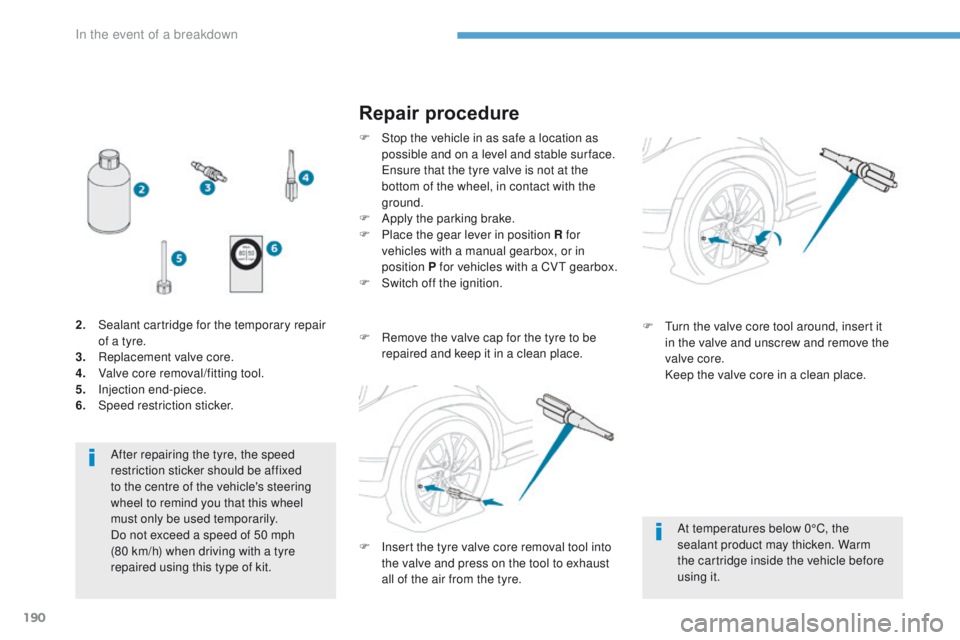
2.
S
ealant cartridge for the temporary repair
of a tyre.
3.
R
eplacement valve core.
4.
V
alve core removal/fitting tool.
5.
I
njection end-piece.
6.
Spe
ed restriction sticker. F
R
emove the valve cap for the tyre to be
repaired and keep it in a clean place.
At temperatures below 0°C, the
sealant product may thicken. Warm
the cartridge inside the vehicle before
using it.
F
t
u
rn the valve core tool around, insert it
in the valve and unscrew and remove the
valve core.
K
eep the valve core in a clean place.
F
I
nsert the tyre valve core removal tool into
the valve and press on the tool to exhaust
all of the air from the tyre.
In the event of a breakdown
Page 197 of 368
195
4008_en_Chap08_en-cas-de panne_ed01-2016
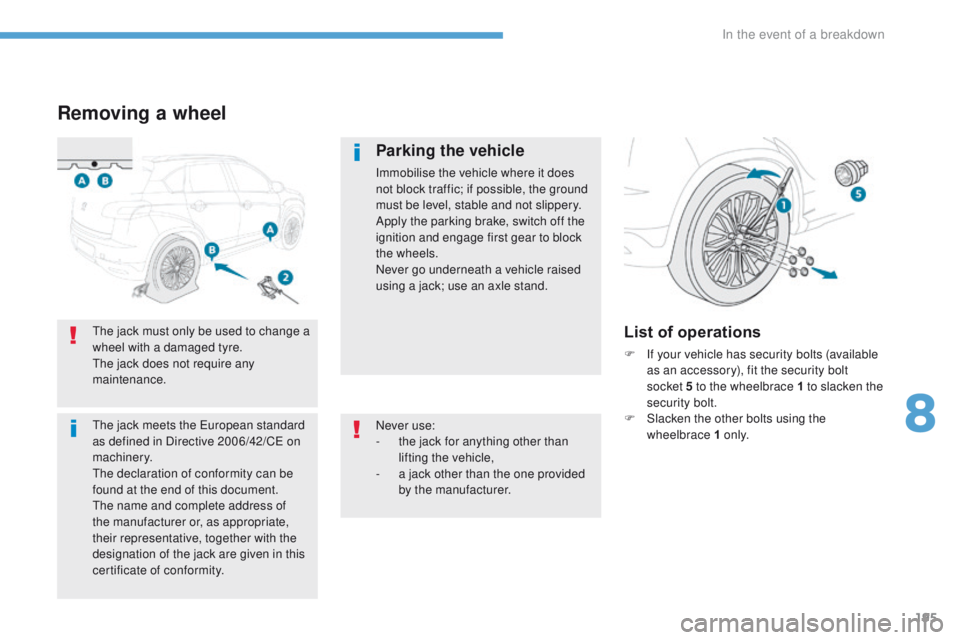
Removing a wheel
Parking the vehicle
Immobilise the vehicle where it does
not block traffic; if possible, the ground
must be level, stable and not slippery.
Apply the parking brake, switch off the
ignition and engage first gear to block
the wheels.
Never go underneath a vehicle raised
using a jack; use an axle stand.
List of operations
F If your vehicle has security bolts (available
as an accessory), fit the security bolt
socket 5 to the wheelbrace 1 to slacken the
security bolt.
F
S
lacken the other bolts using the
wheelbrace 1 o n l y.
Never use:
-
t
he jack for anything other than
lifting the vehicle,
-
a j
ack other than the one provided
by the manufacturer.
th
e jack must only be used to change a
wheel with a damaged tyre.th
e jack does not require any
maintenance.
th
e jack meets the
e
u
ropean standard
as defined in Directive 2006/42/C
e
on
machinery.
th
e declaration of conformity can be
found at the end of this document.
th
e name and complete address of
the manufacturer or, as appropriate,
their representative, together with the
designation of the jack are given in this
certificate of conformity.
8
In the event of a breakdown
Page 205 of 368
203
4008_en_Chap08_en-cas-de panne_ed01-2016
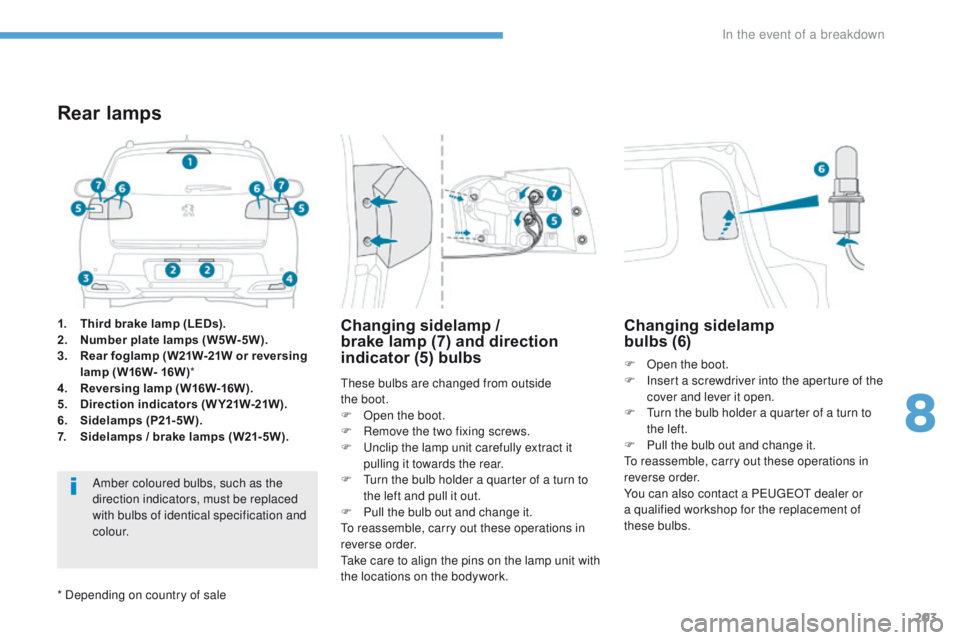
1. Third brake lamp (LEDs).
2.
N umber plate lamps (W5W-5W).
3.
R
ear foglamp (W21W-21W or reversing
lamp (W16W- 16W) *
4.
R
eversing lamp (W16W-16W).
5.
D
irection indicators (WY21W-21W).
6.
S
idelamps (P21-5W).
7.
S
idelamps / brake lamps (W21-5W).
Rear lamps
Amber coloured bulbs, such as the
direction indicators, must be replaced
with bulbs of identical specification and
c o l o u r.
th
ese bulbs are changed from outside
the
boot.
F
O
pen the boot.
F
R
emove the two fixing screws.
F u
n
clip the lamp unit carefully extract it
pulling it towards the rear.
F tu rn the bulb holder a quarter of a turn to
the left and pull it out.
F
P
ull the bulb out and change it.
to r
eassemble, carry out these operations in
reverse order.
ta
ke care to align the pins on the lamp unit with
the locations on the bodywork.
Changing sidelamp /
brake lamp (7) and direction
indicator (5) bulbs
F Open the boot.
F
I nsert a screwdriver into the aperture of the
cover and lever it open.
F
t
u
rn the bulb holder a quarter of a turn to
the left.
F
P
ull the bulb out and change it.
to r
eassemble, carry out these operations in
reverse order.
You can also contact a P
e
uge
Ot
dealer or
a qualified workshop for the replacement of
these
bulbs.
Changing sidelamp
bulbs (6)
* Depending on country of sale
8
In the event of a breakdown
Page 206 of 368
204
4008_en_Chap08_en-cas-de panne_ed01-2016
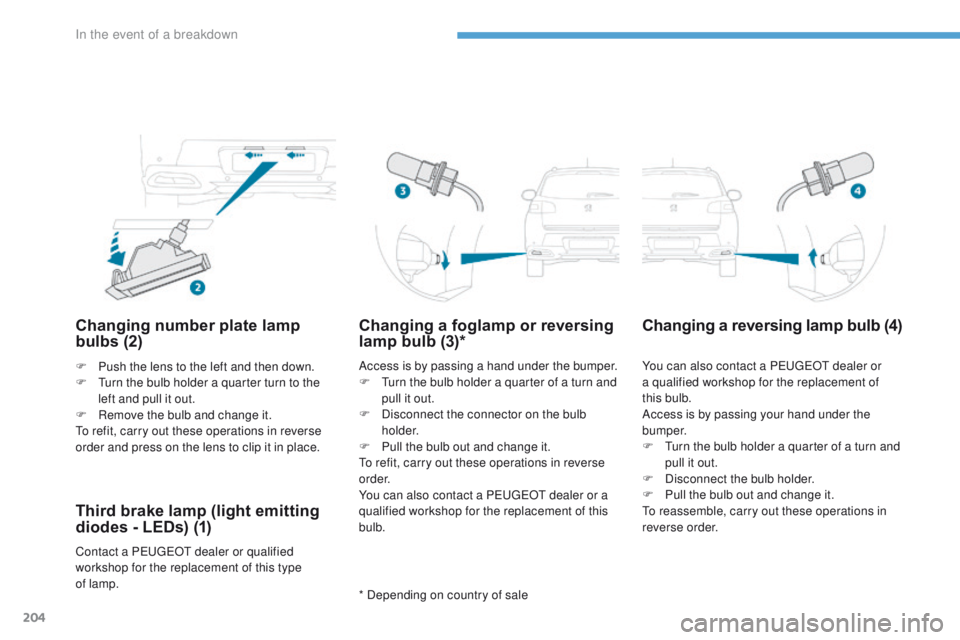
Changing number plate lamp
bulbs (2)
F Push the lens to the left and then down.
F
tu rn the bulb holder a quarter turn to the
left and pull it out.
F
R
emove the bulb and change it.
to r
efit, carry out these operations in reverse
order and press on the lens to clip it in place.
Third brake lamp (light emitting
diodes - LEDs) (1)
Contact a Pe ugeOt dealer or qualified
workshop for the replacement of this type
of
lamp.
Changing a foglamp or reversing
lamp bulb (3)*
* Depending on country of sale
Changing a reversing lamp bulb (4)
Access is by passing a hand under the bumper.
F tu rn the bulb holder a quarter of a turn and
pull it out.
F
D
isconnect the connector on the bulb
h o l d e r.
F
P
ull the bulb out and change it.
to r
efit, carry out these operations in reverse
o r d e r.
You can also contact a P
e
uge
Ot
dealer or a
qualified workshop for the replacement of this
bulb. You can also contact a Pe
ugeOt dealer or
a qualified workshop for the replacement of
this
bulb.
Access is by passing your hand under the
b u m p e r.
F
t
u
rn the bulb holder a quarter of a turn and
pull it out.
F
D
isconnect the bulb holder.
F
P
ull the bulb out and change it.
to r
eassemble, carry out these operations in
reverse order.
In the event of a breakdown
Page 208 of 368
206
4008_en_Chap08_en-cas-de panne_ed01-2016
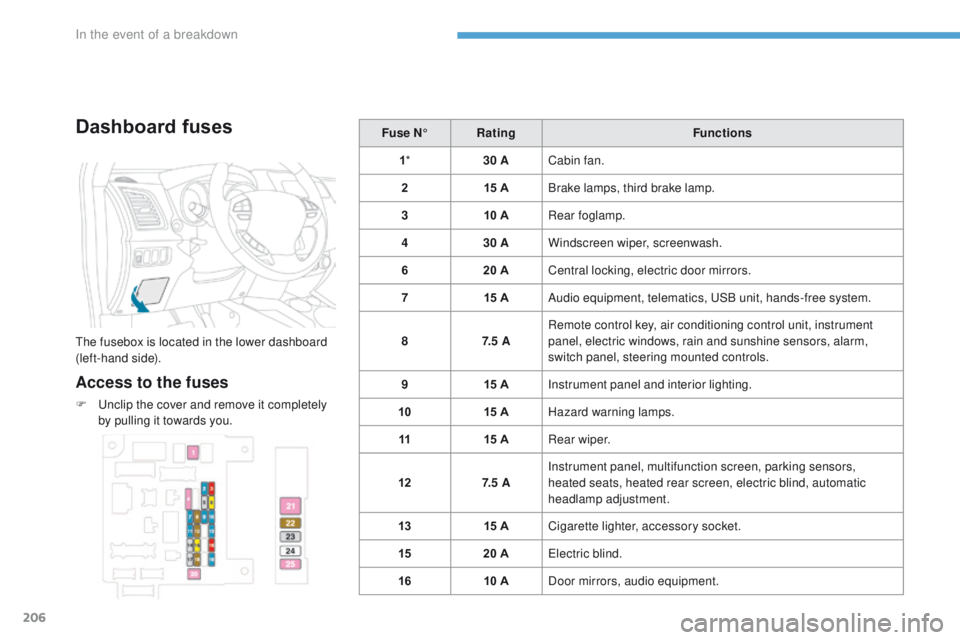
Dashboard fuses
the fusebox is located in the lower dashboard
(left-hand side).
Access to the fuses
F unclip the cover and remove it completely
by pulling it towards you. Fuse N°
Rating Functions
1 * 30 ACabin fan.
2 15 ABrake lamps, third brake lamp.
3 10 ARear foglamp.
4 30 AWindscreen wiper, screenwash.
6 20 ACentral locking, electric door mirrors.
7 15 AAudio equipment, telematics, u
S
B unit, hands-free system.
8 7. 5 ARemote control key, air conditioning control unit, instrument
panel, electric windows, rain and sunshine sensors, alarm,
switch panel, steering mounted controls.
9 15 AInstrument panel and interior lighting.
10 15 AHazard warning lamps.
11 15 ARear wiper.
12 7. 5 AInstrument panel, multifunction screen, parking sensors,
heated seats, heated rear screen, electric blind, automatic
headlamp adjustment.
13 15 ACigarette lighter, accessory socket.
15 20 A
ele
ctric blind.
16 10 ADoor mirrors, audio equipment.
In the event of a breakdown
Page 217 of 368
215
4008_en_Chap08_en-cas-de panne_ed01-2016
towing the vehicle
Towing your vehicle
2 wheel drive (2WD) versions: towing
with the wheels on the ground
General recommendations
towing with the wheels on the ground
is only possible on 2 wheel drive (2WD)
versions.
F
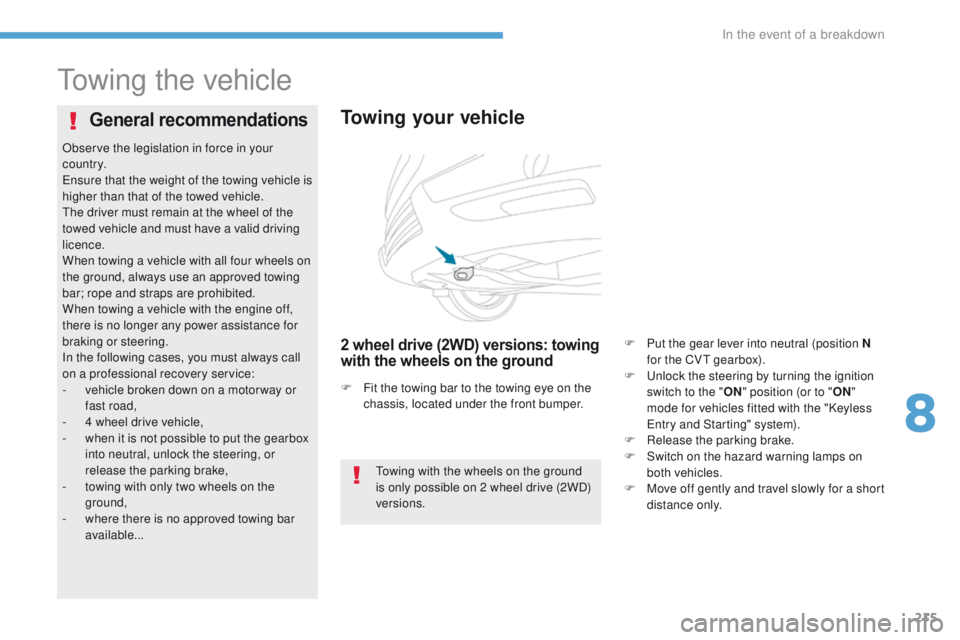
F
it the towing bar to the towing eye on the
chassis, located under the front bumper.
Observe the legislation in force in your
c o unt r y.
en
sure that the weight of the towing vehicle is
higher than that of the towed vehicle.
th
e driver must remain at the wheel of the
towed vehicle and must have a valid driving
licence.
When towing a vehicle with all four wheels on
the ground, always use an approved towing
bar; rope and straps are prohibited.
When towing a vehicle with the engine off,
there is no longer any power assistance for
braking or steering.
In the following cases, you must always call
on a professional recovery service:
-
v
ehicle broken down on a motor way or
fast road,
-
4 w
heel drive vehicle,
-
w
hen it is not possible to put the gearbox
into neutral, unlock the steering, or
release the parking brake,
-
t
owing with only two wheels on the
ground,
-
w
here there is no approved towing bar
available... F
P
ut the gear lever into neutral (position N
for the CV
t
gearbox).
F u
n
lock the steering by turning the ignition
switch to the " ON" position (or to " ON"
mode for vehicles fitted with the "Keyless
en
try and Starting" system).
F
R
elease the parking brake.
F S witch on the hazard warning lamps on
both vehicles.
F
M
ove off gently and travel slowly for a short
distance only.
8
In the event of a breakdown
Page 222 of 368
220
4008_en_Chap09_caracteristiques-techniques_ed01-2016
Petrol weights and towed loads (kg)
the values for approved towed weights vary
according to the sales zone (see the tables on
the following pages).
th
e exact values are given in your vehicle's
registration document as well as on the
manufacturer's plate.
th
ey are also mentioned in sales brochures.
For more details, contact a P
e
uge
Ot
dealer
or a qualified workshop.th e kerb weight is equal to the unladen
weight + driver (75 kg).th e gtW a nd towed load values indicated are
valid up to a maximum altitude of 1 000 metres;
the towed load mentioned must be reduced
by 10 % for each additional 1 000 metres of
altitude.
th
e speed of a towing vehicle must not exceed
62 mph (100 km/h) (comply with the legislation
in force in your country).
High exterior temperatures may result in a
reduction in the per formance of the vehicle to
protect the engine; if the exterior temperature is
above 37 °C, limit the towed load.
th
e weight of the braked trailer can be
increased, within the
gt
W l
imit, if the
gV
W of the towing vehicle is reduced
by an equal amount. Please note that
towing using a lightly loaded towing
vehicle may have an adverse effect
on its road holding .
technical data