remove seats PEUGEOT 5008 2014 Owners Manual
[x] Cancel search | Manufacturer: PEUGEOT, Model Year: 2014, Model line: 5008, Model: PEUGEOT 5008 2014Pages: 404, PDF Size: 23.34 MB
Page 21 of 404
.
75, 127
75, 127
Familiarisation19
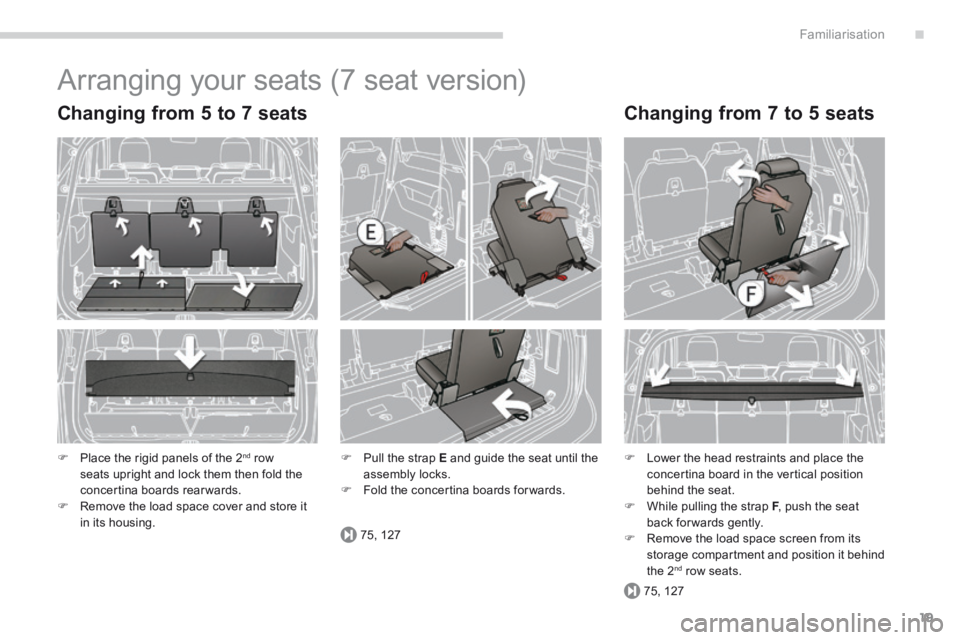
Arranging your seats (7 seat version)
Pull the strap E and guide the seat until the assembly locks. Fold the concertina boards forwards.
Lower the head restraints and place the concertina board in the vertical position behind the seat. While pulling the strap F , push the seat F , push the seat Fback for wards gently. Remove the load space screen from its storage compartment and position it behind the 2 nd row seats.
Place the rigid panels of the 2 nd row seats upright and lock them then fold the concertina boards rearwards. Remove the load space cover and store it in its housing.
Changing from 7 to 5 seats Changing from 5 to 7 seats
Page 28 of 404
Familiarisation
26
Limit the causes of excess
consumption
Spread loads throughout the vehicle; place the heaviest items in the bottom of the boot, as close as possible to the rear seats. Limit the loads carried in the vehicle and reduce wind resistance (roof bars, roof rack, bicycle carrier, trailer...). Use a roof box in preference. Remove roof bars and roof racks after use.
At the end of winter, remove snow tyres and refit your summer tyres.
Observe the recommendations on maintenance
Check the tyre pressures regularly, when cold, referring to the label in the door aperture, driver's side.
Have your vehicle serviced regularly (engine oil, oil filter, air filter...) and observe the schedule of operations recommended by the manufacturer.
Carry out this check in particular: - before a long journey, - at each change of season, - after a long period out of use. Don't forget the spare wheel and the tyres on any trailer or caravan.
When refuelling, do not continue after the third cut-off of the nozzle to avoid any over flow.
At the wheel of your new vehicle, it is only after the first 1 800 miles (3 000 kilometres) that you will see the fuel consumption settle down to a consistent average.
Page 77 of 404
3
Comfort75
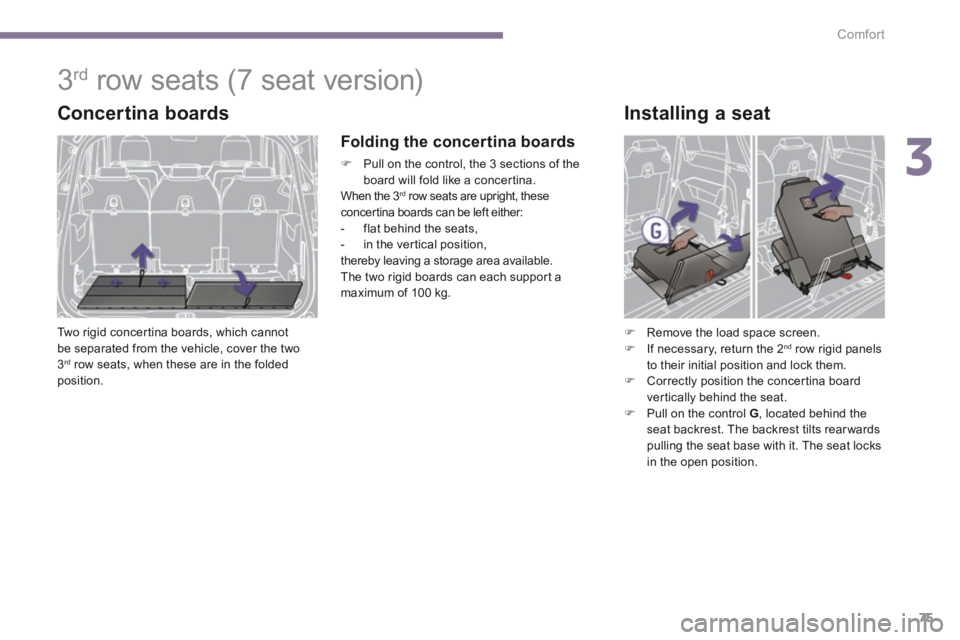
3 rd row seats (7 seat version)
Concertina boards
Two rigid concertina boards, which cannot be separated from the vehicle, cover the two 3 rd row seats, when these are in the folded position.
Folding the concertina boards
Pull on the control, the 3 sections of the board will fold like a concertina. When the 3 rd row seats are upright, these concertina boards can be left either:
- flat behind the seats, - in the vertical position, thereby leaving a storage area available. The two rigid boards can each support a maximum of 100 kg.
Installing a seat
Remove the load space screen. If necessary, return the 2 nd row rigid panels to their initial position and lock them. Correctly position the concertina board vertically behind the seat. Pull on the control G , located behind the seat backrest. The backrest tilts rear wards
pulling the seat base with it. The seat locks in the open position.
Page 129 of 404
6
Fittings127
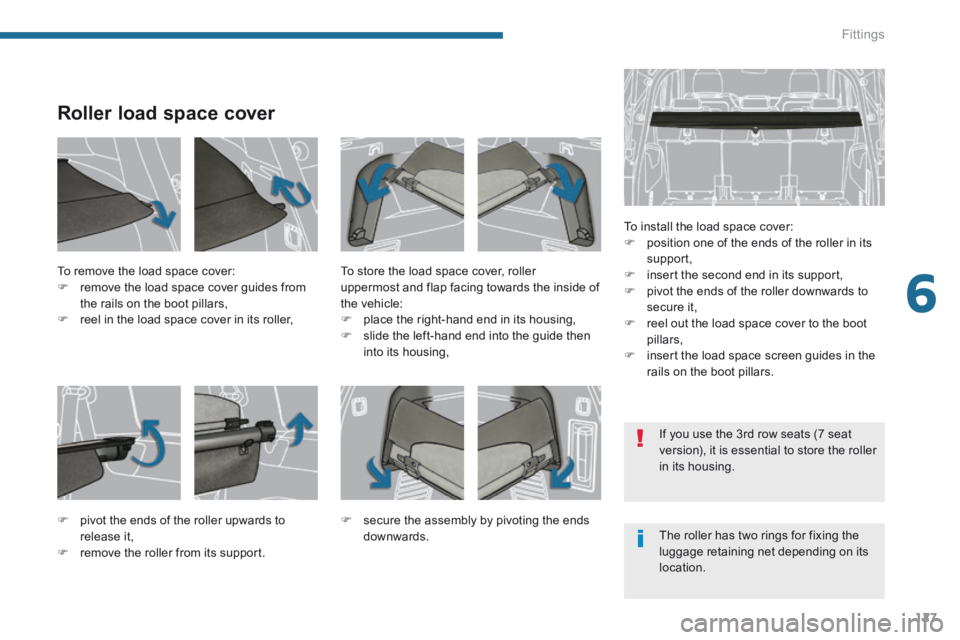
Roller load space cover
To install the load space cover: position one of the ends of the roller in its support, insert the second end in its support, pivot the ends of the roller downwards to secure it, reel out the load space cover to the boot pillars, insert the load space screen guides in the rails on the boot pillars.
To remove the load space cover: remove the load space cover guides from the rails on the boot pillars, reel in the load space cover in its roller,
To store the load space cover, roller uppermost and flap facing towards the inside of the vehicle: place the right-hand end in its housing, slide the left-hand end into the guide then into its housing,
pivot the ends of the roller upwards to release it, remove the roller from its support.
secure the assembly by pivoting the ends downwards. The roller has two rings for fixing the luggage retaining net depending on its location.
If you use the 3 rd row seats (7 seat version), it is essential to store the roller in its housing.
Page 130 of 404
Fittings
128
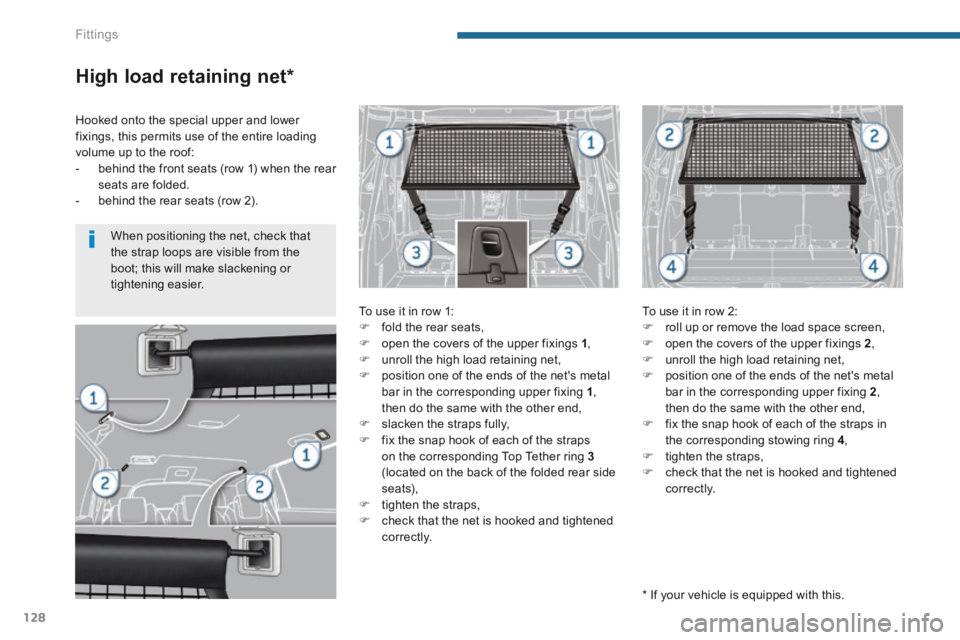
High load retaining net *
To use it in row 1: fold the rear seats, open the covers of the upper fixings 1 , unroll the high load retaining net, position one of the ends of the net's metal bar in the corresponding upper fixing 1 , then do the same with the other end, slacken the straps fully, fix the snap hook of each of the straps on the corresponding Top Tether ring 3(located on the back of the folded rear side seats), tighten the straps, check that the net is hooked and tightened
c o r r e c t l y.
To use it in row 2: roll up or remove the load space screen, open the covers of the upper fixings 2 , unroll the high load retaining net, position one of the ends of the net's metal bar in the corresponding upper fixing 2 , then do the same with the other end, fix the snap hook of each of the straps in the corresponding stowing ring 4 , tighten the straps, check that the net is hooked and tightened c o r r e c t l y.
Hooked onto the special upper and lower fixings, this permits use of the entire loading volume up to the roof: - behind the front seats (row 1) when the rear seats are folded. - behind the rear seats (row 2).
* If your vehicle is equipped with this.
When positioning the net, check that the strap loops are visible from the boot; this will make slackening or tightening easier.
Page 143 of 404
7
Child safety141
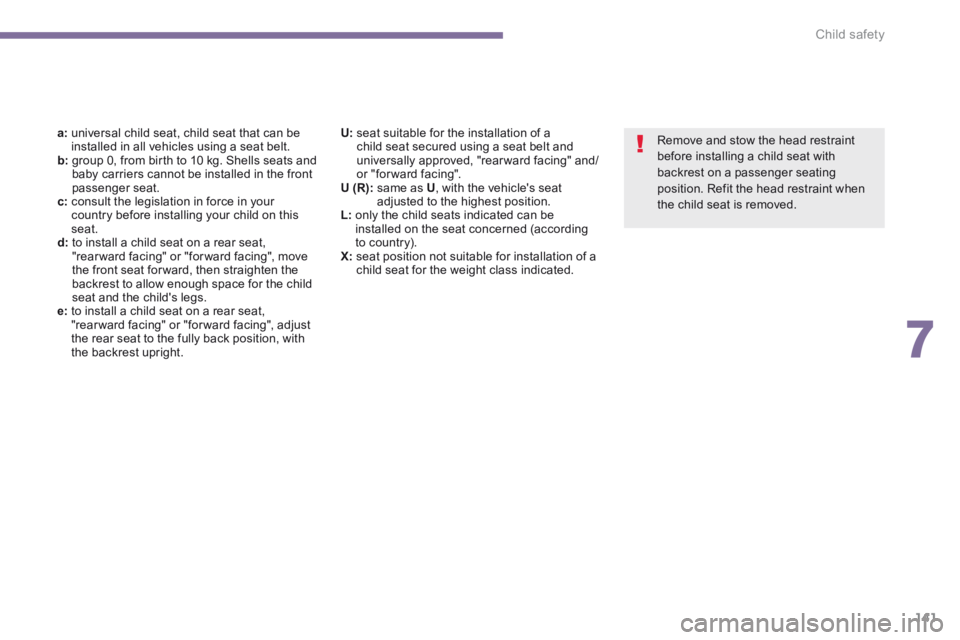
Remove and stow the head restraint before installing a child seat with backrest on a passenger seating position. Refit the head restraint when the child seat is removed.
a: universal child seat, child seat that can be installed in all vehicles using a seat belt. b: group 0, from birth to 10 kg. Shells seats and baby carriers cannot be installed in the front passenger seat. c: consult the legislation in force in your country before installing your child on this seat. d: to install a child seat on a rear seat, "rear ward facing" or "for ward facing", move the front seat for ward, then straighten the backrest to allow enough space for the child seat and the child's legs. e: to install a child seat on a rear seat, "rearward facing" or "forward facing", adjust the rear seat to the fully back position, with the backrest upright.
U: seat suitable for the installation of a child seat secured using a seat belt and universally approved, "rearward facing" and/or "for ward facing". U (R): same as U , with the vehicle's seat adjusted to the highest position. L: only the child seats indicated can be installed on the seat concerned (according to country). X: seat position not suitable for installation of a child seat for the weight class indicated.
Page 145 of 404
7
Child safety143
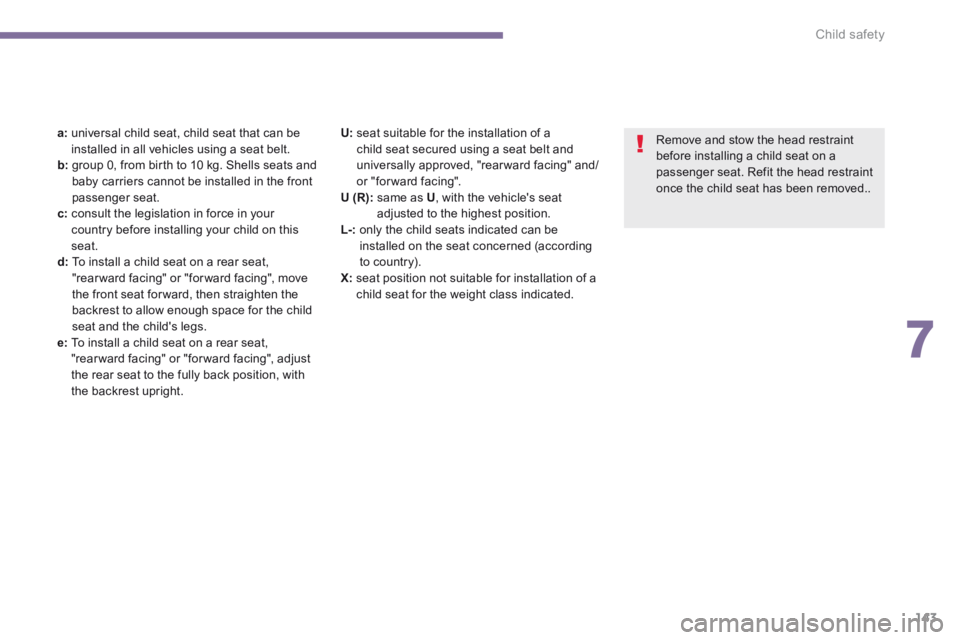
a: universal child seat, child seat that can be installed in all vehicles using a seat belt. b: group 0, from birth to 10 kg. Shells seats and baby carriers cannot be installed in the front passenger seat. c: consult the legislation in force in your country before installing your child on this seat. d: To install a child seat on a rear seat, "rear ward facing" or "for ward facing", move the front seat for ward, then straighten the backrest to allow enough space for the child seat and the child's legs. e: To install a child seat on a rear seat, "rearward facing" or "forward facing", adjust the rear seat to the fully back position, with the backrest upright.
Remove and stow the head restraint before installing a child seat on a passenger seat. Refit the head restraint once the child seat has been removed..
U: seat suitable for the installation of a child seat secured using a seat belt and universally approved, "rearward facing" and/or "for ward facing". U (R): same as U , with the vehicle's seat adjusted to the highest position. L-: only the child seats indicated can be installed on the seat concerned (according to country). X: seat position not suitable for installation of a child seat for the weight class indicated.
Page 146 of 404
Child safety
144
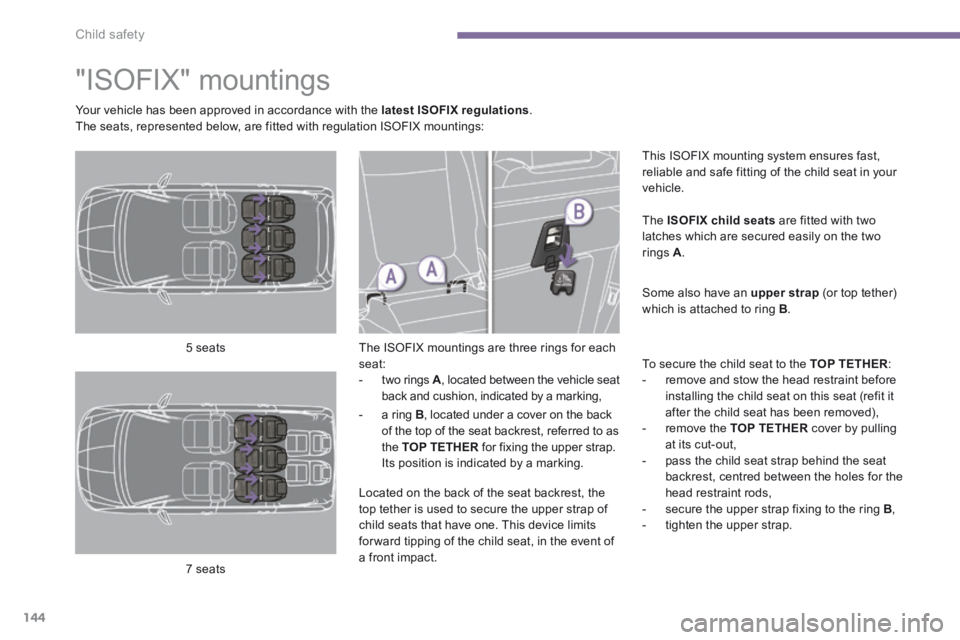
"ISOFIX" mountings
The ISOFIX mountings are three rings for each seat: - two rings A , located between the vehicle seat back and cushion, indicated by a marking,
This ISOFIX mounting system ensures fast, reliable and safe fitting of the child seat in your vehicle.
The ISOFIX child seats are fitted with two latches which are secured easily on the two rings A .
Some also have an upper strap (or top tether) which is attached to ring B .
To secure the child seat to the TOP TETHER : - remove and stow the head restraint before installing the child seat on this seat (refit it after the child seat has been removed), - remove the TOP TETHER cover by pulling at its cut-out, - pass the child seat strap behind the seat backrest, centred between the holes for the head restraint rods, - secure the upper strap fixing to the ring B , - tighten the upper strap.
5 seats
7 seats
Your vehicle has been approved in accordance with the latest ISOFIX regulations . The seats, represented below, are fitted with regulation ISOFIX mountings:
- a ring B , located under a cover on the back
of the top of the seat backrest, referred to as the TOP TETHER for fixing the upper strap. TOP TETHER for fixing the upper strap. TOP TETHER Its position is indicated by a marking.
Located on the back of the seat backrest, the top tether is used to secure the upper strap of child seats that have one. This device limits for ward tipping of the child seat, in the event of a front impact.
Page 152 of 404
Child safety
150
Advice on child seats
The incorrect installation of a child seat in a vehicle compromises the child's protection in the event of an accident. Remember to fasten the seat belts or the child seat harnesses keeping the slack in relation to the child's body to a minimum , even for short journeys. For optimum installation of the "forward facing" child seat, ensure that the back of the child seat is as close as possible to the backrest of the vehicle's seat, or in contact if possible The head restraint must be removed before installing a child seat with a backrest on the passenger seat. Ensure that the head restraint is stowed or attached securely so that it is not thrown around the vehicle in the event of sharp braking. Refit the head restraint as soon as the child seat is removed.
Children at the front
The legislation on carrying a child on the front passenger seat is specific to each country. Refer to the legislation in force in your c o unt r y. Deactivate the passenger's airbag when a "rear ward facing" child seat is installed on the front seat. Otherwise, the child would risk being seriously injured or killed if the airbag were deployed.
Installing a booster cushion
The chest part of the seat belt must be positioned on the child's shoulder without touching the neck.
Ensure that the lap part of the seat belt passes correctly over the child's thighs. PEUGEOT recommends the use of a booster seat which has a back, fitted with a seat belt guide at shoulder level.
As a safety precaution, do not leave: - one or more children alone and unsupervised in a vehicle, - a child or an animal in a vehicle which is exposed to the sun, with the windows closed, - the keys within reach of children inside the vehicle. To prevent accidental opening of the doors, use the "Child lock". Take care not to open the rear windows by more than one third. To protect young children from the rays of the sun, fit side blinds on the rear windows.
Page 167 of 404
8
Safety165
For the airbags to be fully effective, observe the following safety rules:
Sit in a normal upright position. Wear a correctly adjusted seat belt. Do not leave anything between the occupants and the airbags (a child, pet, object...). This could hamper the operation of the airbags or injure the occupants. After an accident or if the vehicle has been stolen or broken into, have the airbag systems checked. All work on the airbag system must be carried out by a PEUGEOT dealer or a qualified workshop. Even if all of the precautions mentioned are observed, a risk of injury or of minor burns to the head, chest or arms when an airbag is deployed cannot be ruled out. The bag inflates almost instantly (within a few milliseconds) then deflates within the same time discharging the hot gas via openings provided for this purpose.
Lateral airbags
Use only approved covers on the seats, compatible with the deployment the lateral airbags. For information on the range of seat covers suitable for your vehicle, you can contact a PEUGEOT dealer. Refer to the "Accessories" section. Do not fix or attach anything to the seat backs (clothing...). This could cause injury to the chest or arms if the lateral airbag is deployed. Do not sit with the upper part of the body any nearer to the door than necessary.
Front airbags
Do not drive holding the steering wheel by its spokes or resting your hands on the centre part of the wheel. Passengers must not place their feet on the dashboard. If possible, do not smoke as deployment of the airbags can cause burns or the risk of injury from a cigarette or pipe. Never remove or pierce the steering wheel or hit it violently.
Curtain airbags
Do not fix or attach anything to the roof. This could cause injury to the head if the curtain airbag is deployed. If fitted on your vehicle, do not remove the grab handles installed on the roof, they play a part in securing the curtain airbags.