driver seat adjustment PEUGEOT 5008 2017 Owners Manual
[x] Cancel search | Manufacturer: PEUGEOT, Model Year: 2017, Model line: 5008, Model: PEUGEOT 5008 2017Pages: 404, PDF Size: 15.31 MB
Page 76 of 404
74
Driving position
Adopting a good driving position helps improve
your comfort and protection.
It also optimises interior and exterior visibility
as well as access to controls.
Sitting comfortably
Whether or not your vehicle has certain seat
adjustments described in this section depends
on the trim level and country of sale.
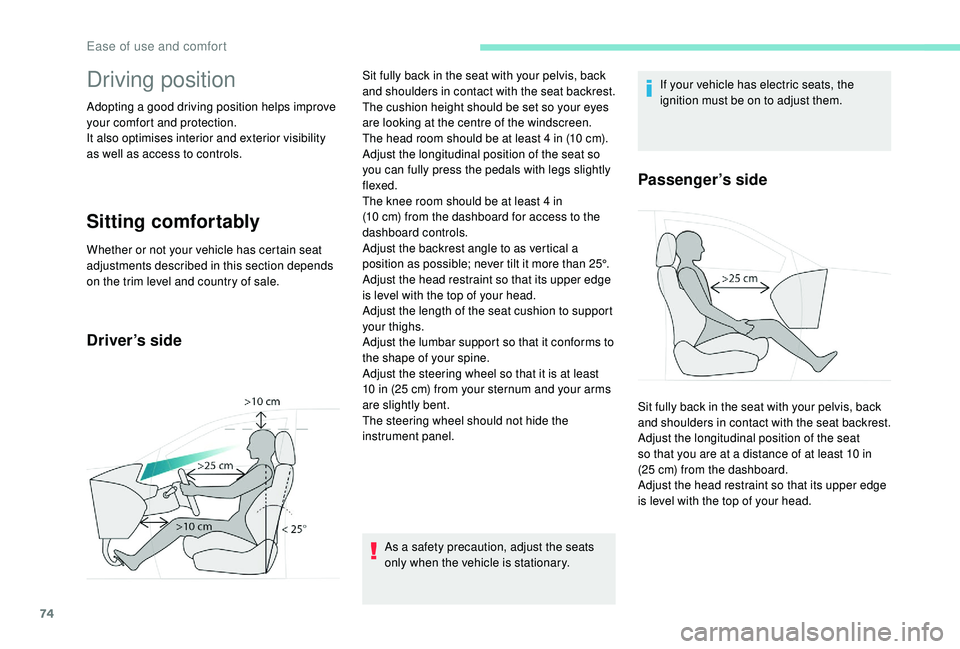
Driver’s side
As a safety precaution, adjust the seats
only when the vehicle is stationary.If your vehicle has electric seats, the
ignition must be on to adjust them.
Passenger’s side
Sit fully back in the seat with your pelvis, back
and shoulders in contact with the seat backrest.
The cushion height should be set so your eyes
are looking at the centre of the windscreen.
The head room should be at least 4
in (10 cm).
Adjust the longitudinal position of the seat so
you can fully press the pedals with legs slightly
flexed.
The knee room should be at least 4
in
(10
cm) from the dashboard for access to the
dashboard controls.
Adjust the backrest angle to as vertical a
position as possible; never tilt it more than 25°.
Adjust the head restraint so that its upper edge
is level with the top of your head.
Adjust the length of the seat cushion to support
your thighs.
Adjust the lumbar support so that it conforms to
the shape of your spine.
Adjust the steering wheel so that it is at least
10
in (25 cm) from your sternum and your arms
are slightly bent.
The steering wheel should not hide the
instrument panel. Sit fully back in the seat with your pelvis, back
and shoulders in contact with the seat backrest.
Adjust the longitudinal position of the seat
so that you are at a distance of at least 10
in
(25
cm) from the dashboard.
Adjust the head restraint so that its upper edge
is level with the top of your head.
Ease of use and comfort
Page 81 of 404
79
Front head restraints
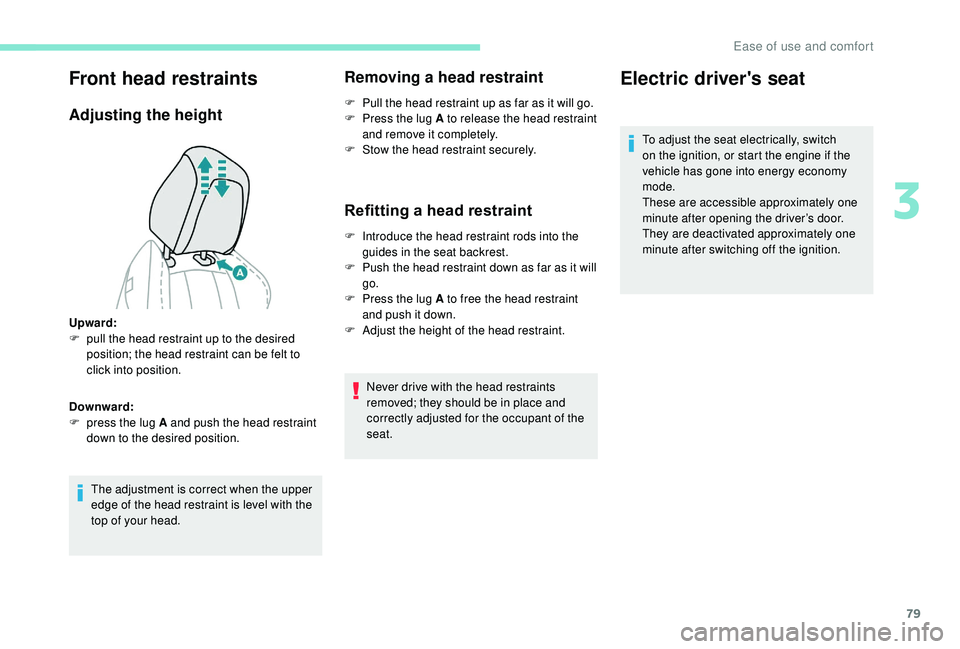
Adjusting the height
The adjustment is correct when the upper
edge of the head restraint is level with the
top of your head.
Removing a head restraint
F Pull the head restraint up as far as it will go.
F P ress the lug A to release the head restraint
and remove it completely.
F
S
tow the head restraint securely.
Refitting a head restraint
F Introduce the head restraint rods into the guides in the seat backrest.
F
P
ush the head restraint down as far as it will
go.
F
P
ress the lug A to free the head restraint
and push it down.
F
A
djust the height of the head restraint.
Never drive with the head restraints
removed; they should be in place and
correctly adjusted for the occupant of the
seat.
Upward:
F
p
ull the head restraint up to the desired
position; the head restraint can be felt to
click into position.
Downward:
F
p
ress the lug A and push the head restraint
down to the desired position.
Electric driver's seat
To adjust the seat electrically, switch
on the ignition, or start the engine if the
vehicle has gone into energy economy
mode.
These are accessible approximately one
minute after opening the driver’s door.
They are deactivated approximately one
minute after switching off the ignition.
3
Ease of use and comfort
Page 83 of 404
81
Before moving the seat backwards,
ensure that there is nothing that might
prevent the full travel of the seat.
There is a risk of trapping or pinching
passengers if present in the rear seats
or jamming the seat if large objects are
placed on the floor behind the seat.
Storing driving positions
Associated with adjustments of the electrical
driver’s seat, this function allows two driving
positions to be memorised, to make these
adjustments easier if there are frequent driver
changes.
It takes account of the electric adjustments of
the seat and the door mirrors.
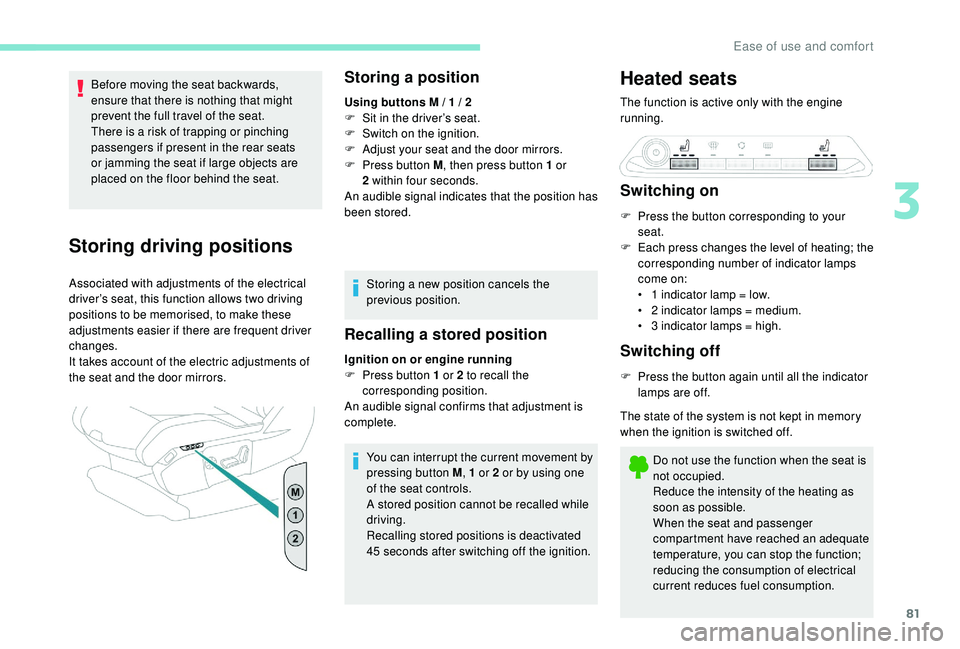
Storing a position
Using buttons M / 1 / 2
F S it in the driver’s seat.
F
S
witch on the ignition.
F
A
djust your seat and the door mirrors.
F
P
ress button M , then press button 1
or
2
within four seconds.
An audible signal indicates that the position has
been stored.
Storing a new position cancels the
previous position.
Recalling a stored position
Ignition on or engine running
F P ress button 1 or 2 to recall the
corresponding position.
An audible signal confirms that adjustment is
complete.
You can interrupt the current movement by
pressing button M , 1
or 2 or by using one
of the seat controls.
A stored position cannot be recalled while
driving.
Recalling stored positions is deactivated
45
seconds after switching off the ignition.
Heated seats
The function is active only with the engine
running.
Switching on
F Press the button corresponding to your seat.
F
E
ach press changes the level of heating; the
corresponding number of indicator lamps
come on:
•
1
indicator lamp = low.
•
2
indicator lamps = medium.
•
3
indicator lamps = high.
Switching off
F Press the button again until all the indicator lamps are off.
The state of the system is not kept in memory
when the ignition is switched off.
Do not use the function when the seat is
not occupied.
Reduce the intensity of the heating as
soon as possible.
When the seat and passenger
compartment have reached an adequate
temperature, you can stop the function;
reducing the consumption of electrical
current reduces fuel consumption.
3
Ease of use and comfort
Page 154 of 404
152
Advice
The driver must ensure that passengers use
the seat belts correctly and that they are all
fastened before setting off.
Wherever you are seated in the vehicle,
always fasten your seat belt, even for short
journeys.
Do not interchange the seat belt buckles as
they will not fulfil their role fully.
The seat belts are fitted with an inertia reel
permitting automatic adjustment of the length
of the strap to your size. The seat belt is
stowed automatically when not in use.
Before and after use, ensure that the seat belt
is reeled in correctly.
The lower part of the strap must be positioned
as low as possible on the pelvis.
The upper part must be positioned in the
hollow of the shoulder.
The inertia reels have an automatic blocking
device at the time of a collision, during
sudden braking or if the vehicle turns over.
You can release the device by pulling the
strap firmly and then releasing it so that it
reels in slightly.In order to be effective, a seat belt must:
-
b e tightened as close to the body as
possible,
-
b
e pulled in front of you with a smooth
movement, checking that it does not twist,
-
b
e used to restrain only one person,
-
n
ot show any signs of cuts or fraying,
-
n
ot be converted or modified to avoid
affecting its performance.
In accordance with current safety regulations,
for all repairs on your vehicle's seat belts, go
to a qualified workshop with the skills and
equipment needed, which a PEUGEOT dealer
is able to provide.
Have your seat belts checked regularly by a
PEUGEOT dealer or a qualified workshop,
particularly if the straps show signs of
damage.
Clean the seat belt straps with soapy water or
a textile cleaning product, sold by PEUGEOT
dealers.
After folding or moving a seat or rear bench
seat, ensure that the seat belt is positioned
and reeled in correctly. Recommendations for children
Use a suitable child seat if the passenger is
less than 12
years old or shorter than one and
a half metres.
Never use the same seat belt to secure more
than one person.
Never allow a child to travel on your lap.
For more information on Child seats , refer to
the corresponding section.
In the event of an impact
Depending on the nature and seriousness
of the impact , the pyrotechnic device may
be deployed before and independently of the
airbags. Deployment of the pretensioners
is accompanied by a slight discharge of
harmless smoke and a noise, due to the
activation of the pyrotechnic cartridge
incorporated in the system.
In all cases, the airbag warning lamp comes
on.
Following an impact, have the seat belts
system checked, and, if necessary, replaced,
by a PEUGEOT dealer or a qualified
workshop.
Safety
Page 166 of 404
164
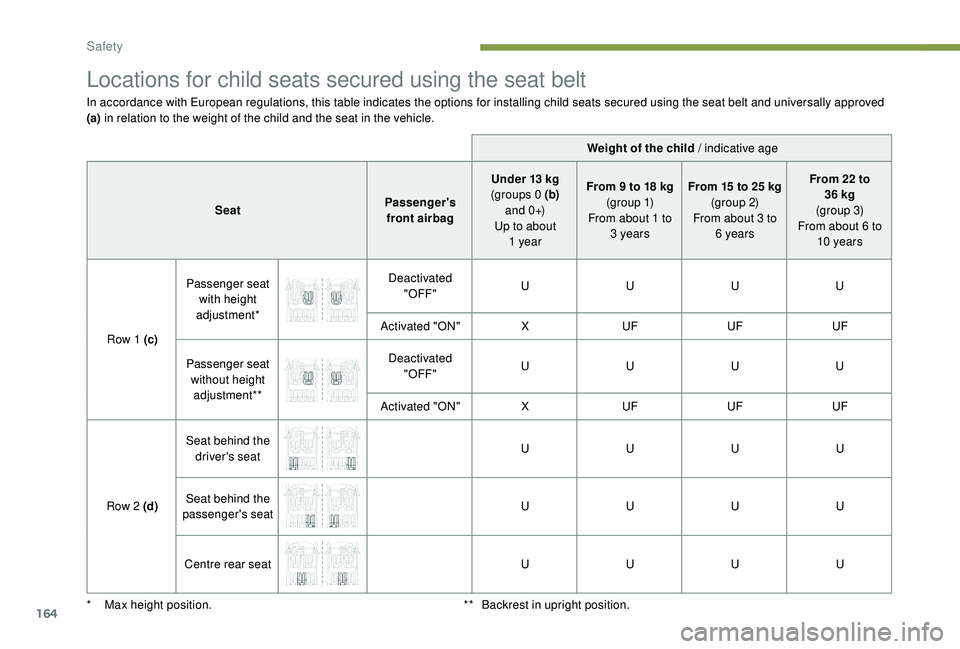
Locations for child seats secured using the seat belt
In accordance with European regulations, this table indicates the options for installing child seats secured using the seat belt and universally approved
(a) in relation to the weight of the child and the seat in the vehicle.
Weight of the child / indicative age
Seat Passenger's
front airbag Under 13
kg
(groups 0
(b)
a n d 0 +)
Up to about 1
yearFrom 9
to 18 kg
(g r o u p 1)
From about 1
to
3
yearsFrom 15
to 25 kg
(group 2)
From about 3
to
6
yearsFrom 22
to
36
kg
(group 3)
From about 6
to
10
years
Row 1
(c)Passenger seat
with height
adjustment* Deactivated
"OFF" U
UUU
Activated "ON" XUF UFUF
Passenger seat without height adjustment** Deactivated
"OFF" U
UUU
Activated "ON" XUF UFUF
Row 2
(d)Seat behind the
driver's seat U
UUU
Seat behind the
passenger's seat U
UUU
Centre rear seat UUUU
*
M
ax height position. **
B
ackrest in upright position.
Safety
Page 170 of 404
168
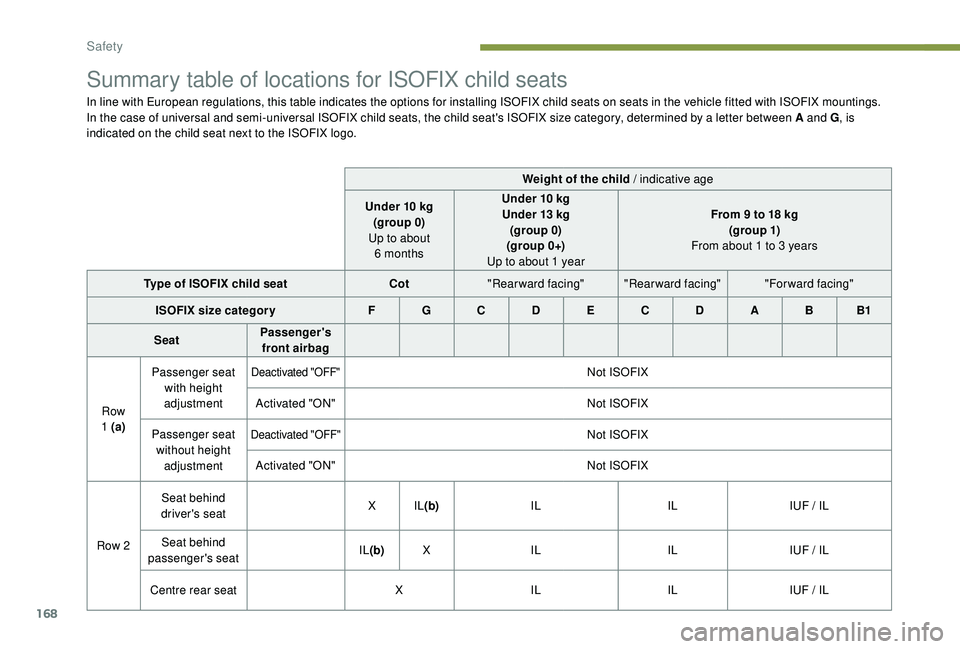
Summary table of locations for ISOFIX child seats
In line with European regulations, this table indicates the options for installing ISOFIX child seats on seats in the vehicle fitted with ISOFIX mountings.
In the case of universal and semi-universal ISOFIX child seats, the child seat's ISOFIX size category, determined by a letter between A and G, is
indicated on the child seat next to the ISOFIX logo.
Weight of the child / indicative age
Under 10
kg
(group 0)
Up to about 6
monthsUnder 10
kg
Under 13
kg
(group 0)
(group 0+)
Up to about 1
yearFrom 9
to 18 kg
(g ro up 1)
From about 1
to 3 years
Type of ISOFIX child seat Cot"Rearward facing" "Rearward facing" "Forward facing"
ISOFIX size categor y F G C D E C D A B B1
Seat Passenger's
front airbag
Row
1
(a) Passenger seat
with height
adjustment
Deactivated "OFF"Not ISOFIX
Activated "ON" Not ISOFIX
Passenger seat without height adjustment
Deactivated "OFF"Not ISOFIX
Activated "ON" Not ISOFIX
Row 2 Seat behind
driver's seat X
IL(b) IL ILIUF / IL
Seat behind
passenger's seat IL
(b) X IL ILIUF / IL
Centre rear seat XIL ILIUF / IL
Safety
Page 195 of 404
193
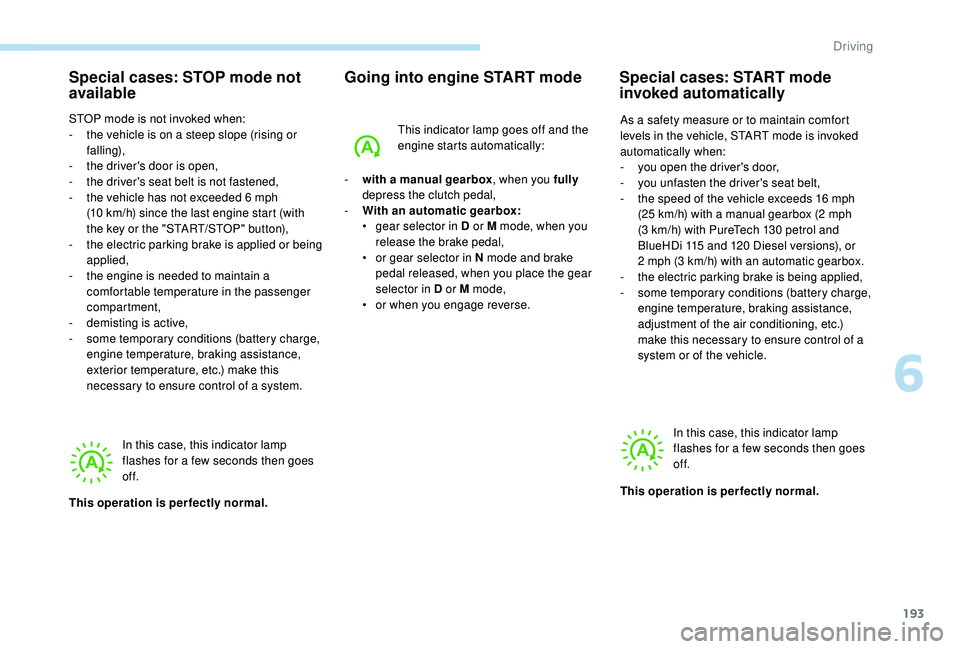
Special cases: STOP mode not
available
STOP mode is not invoked when:
- t he vehicle is on a steep slope (rising or
falling),
-
t
he driver's door is open,
-
t
he driver's seat belt is not fastened,
-
t
he vehicle has not exceeded 6 mph
(10
km/h) since the last engine start (with
the key or the "START/STOP" button),
-
t
he electric parking brake is applied or being
applied,
-
t
he engine is needed to maintain a
comfortable temperature in the passenger
compartment,
-
d
emisting is active,
-
s
ome temporary conditions (battery charge,
engine temperature, braking assistance,
exterior temperature, etc.) make this
necessary to ensure control of a system.
Going into engine START mode
In this case, this indicator lamp
flashes for a few seconds then goes
of f.
This operation is perfectly normal. -
w
ith a manual gearbox
, when you fully
depress the clutch pedal,
-
W
ith an automatic gearbox:
•
g
ear selector in D or M mode, when you
release the brake pedal,
•
o
r gear selector in N mode and brake
pedal released, when you place the gear
selector in D or M mode,
•
o
r when you engage reverse.This indicator lamp goes off and the
engine starts automatically:
Special cases: START mode
invoked automatically
As a safety measure or to maintain comfort
levels in the vehicle, START mode is invoked
automatically when:
-
y
ou open the driver's door,
-
y
ou unfasten the driver's seat belt,
-
t
he speed of the vehicle exceeds 16 mph
(25
km/h) with a manual gearbox (2 mph
(3
km/h) with PureTech 130 petrol and
BlueHDi 115
and 120 Diesel versions), or
2
mph (3 km/h) with an automatic gearbox.
-
t
he electric parking brake is being applied,
-
s
ome temporary conditions (battery charge,
engine temperature, braking assistance,
adjustment of the air conditioning, etc.)
make this necessary to ensure control of a
system or of the vehicle.
In this case, this indicator lamp
flashes for a few seconds then goes
of f.
This operation is perfectly normal.
6
Driving
Page 396 of 404
298
HHands-free access .......................................... 67
Hands-free tailgate ................................... 65, 67
Hazard warning lamps
..........................13 9, 266
Headlamp adjustment
...................................128
Headlamps, automatic dipping
........25, 131-132
Headlamps, automatic illumination ..... 124, 128 -13 0
Headlamps, dipped beam
.......... 24-25, 279-280
Headlamps, halogen
............................. 278-279
Headlamps, main beam
............. 24-25, 279-280
Head restraints, front
...................................... 79
Head restraints, rear
................................. 85, 90
Heating
........................................ 9
4, 96-98, 103
Heating, additional
........................................ 105
Heating, programmable
................................ 105
Hi-Fi system
.................................................. 11
2
Hill Assist Descent Control
.............. 23, 147-148
Hill Descent Control
............................... 147-148
Hill start assist
............................................... 19 0
GGauge, fuel.................................................... 245
Gearbox, automatic ..............18 5 -19 5, 261, 287
Gearbox, manual
..................185, 19 0 -195, 261
Gear lever, automatic gearbox
..............185 -189
Gear lever, manual gearbox
.........................185
Gear shift indicator ~ Gear efficiency indicator
..................................... 191
Glove box
...................................................... 111
G . P. S .
.............................................................. 14
Grab handles
................................................ 11 0
Control stalk, lighting
................. 24-25, 124, 127
Control stalk, wipers
.............................. 13
4 -137
Courtesy lamps
...................................... 11 6 -117
Cruise control
........................ 197-198, 200-201,
2 0 4 - 2 11, 214 -215
Cruise control by speed limit recognition
...............................
........... 200-201
Cruise control, dynamic with Stop function
......... 200-201, 2 0 7- 2 11, 214 -215
Cup holder
..................................................... 11 0
Fatigue detection
.................................. 219 -220
Filling the fuel tank
................................ 245 -247
Filter, air
........................................................ 261
Filter, oil
................
......................................... 261
Filter, particle
........................................ 260-261
Filter, passenger compartment
..................... 261
Fitting a wheel
....................................... 275 -278
Fitting roof bars
............................................. 255
Fittings, boot
................................................. 120
Fittings, interior
...................................... 11
0 -111
Fittings, rear
.................................................. 11 8
Flap, fuel filler
........................................ 245 -246
Floor, concertina
............................................. 89
Foglamps
...................................................... 125
Foglamps, front
............... 24, 125, 13 3, 279-280
Foglamps, rear
...................................... 12
5, 283
Folding the rear seats
............................... 85 - 87
Frequency (radio)
...................................... 24-25
Fuel ........................................................ 246 -247
Fuel tank ................................................ 245 -246
Fuses
..................................................... 28
4-285
F
D
DAB (Digital Audio Broadcasting) - Digital radio ..................... 25
, 9
Date (setting)
................................. 38-39, 36, 20
Daytime running lamps
.........................126, 279
Deactivating the passenger airbag .....153 -15 4, 15 8
Deadlocking
.............................................. 51, 55
Demisting - defrosting
............................ 10
3 -105
Dials and gauges
...............................
........... 8-9
Dimensions
..............................
..................... 295
Dipstick
................
............................ 30, 258-259
Direction indicators
.......... 24, 1 2 7, 279, 281-282
Display screen, instrument panel
................. 191
Distance alert ~ Collision Risk Alert
......215 -216
Door pockets
...............................
.................. 11 0
Doors
............................................................... 63
Doors, rear
.................................................... 174
Driver’s attention warning
............................. 220
Driving
........................................................ 74 -75
Driving abroad ............................................... 126
Driving positions (storing)
............................... 81
Driving time warning
............................. 219 -220
Dynamic pack
............................................... 19
1
Dynamic stability control (DSC)
............. 142-14 6
E
Economy mode ............................................. 2 52
Electronic brake force distribution (EBFD) ...142
Emergency braking assistance (EBA)
..........142
Emergency call
...................................... 13 9 -141
Emergency switching off
........................18 0 -181
Energy economy mode
................................. 2
52
Engine compartment
.................................... 2
57
Engine, Diesel
........246 -247, 2 5 7, 266, 293-294
Engine, petrol
...............................
.2 4 7, 2 5 7, 292
Engines
................................................. 291-294
Environment
.................................................... 56
Electronic stability control (ESC)
..................14
2
Alphabetical index