check engine Peugeot 508 2016 User Guide
[x] Cancel search | Manufacturer: PEUGEOT, Model Year: 2016, Model line: 508, Model: Peugeot 508 2016Pages: 371, PDF Size: 12.12 MB
Page 87 of 371
85
508_en_Chap03_ergonomie-et-confort_ed01-2016
Recommendations for ventilation and air conditioning
the air conditioning system does not contain chlorine and does not present any danger to the ozone layer. In order for these systems to be fully effective, follow the operation and maintenance guidelines below:
F
I
f the interior temperature remains very high after the vehicle has been parked in the sun for a considerable time, first ventilate the
passenger compartment for a few minutes.
P
lace the air flow control at a sufficient level to provide an adequate renewal of air in the passenger compartment.
F t
o o
btain an even air distribution, take care not to obstruct the exterior air intake grilles located at the base of the windscreen, the nozzles,
the vents and the air outlets, as well as the air extractor located in the boot.
F
I
n normal conditions, use the intake of exterior air as prolonged use of the air recirculation may cause misting of the windows and side
windows.
F
D
o not cover the sunshine sensor, located on the dashboard; this is used for regulation of the automatic air conditioning system.
F
O
perate the air conditioning system for 5 to 10 minutes, once or twice a month to keep it in good working order.
F e
n
sure that the passenger compartment filter is in good condition and have the filter elements replaced regularly (refer to the "Checks"
section).
W
e recommend the use of a combined passenger compartment filter. t
h
anks to its second special active filter, it contributes to the
purification of the air breathed by the occupants and the cleanliness of the passenger compartment (reduction of allergic symptoms, bad
odours and greasy deposits).
F t
h
e air conditioning uses power from the engine while operating. t
h
is results in an increase in the vehicle's fuel consumption.
W
hen towing at or near maximum capacity or on steep slopes in high ambient temperatures, switching off the air conditioning saves engine
power and so improves towing capacity.
C
ondensation created by the air conditioning results in a discharge of water under the vehicle when stationary, which is per fectly normal.
F t
o e
nsure correct operation of the air conditioning system, you are also advised to have it checked regularly.
F
I
f the system does not produce cold air, do not use it and contact a P
e
uge
Ot
dealer or a qualified workshop.
3
ease of use and comfort
Page 137 of 371
135
508_en_Chap05_securite_ed01-2016
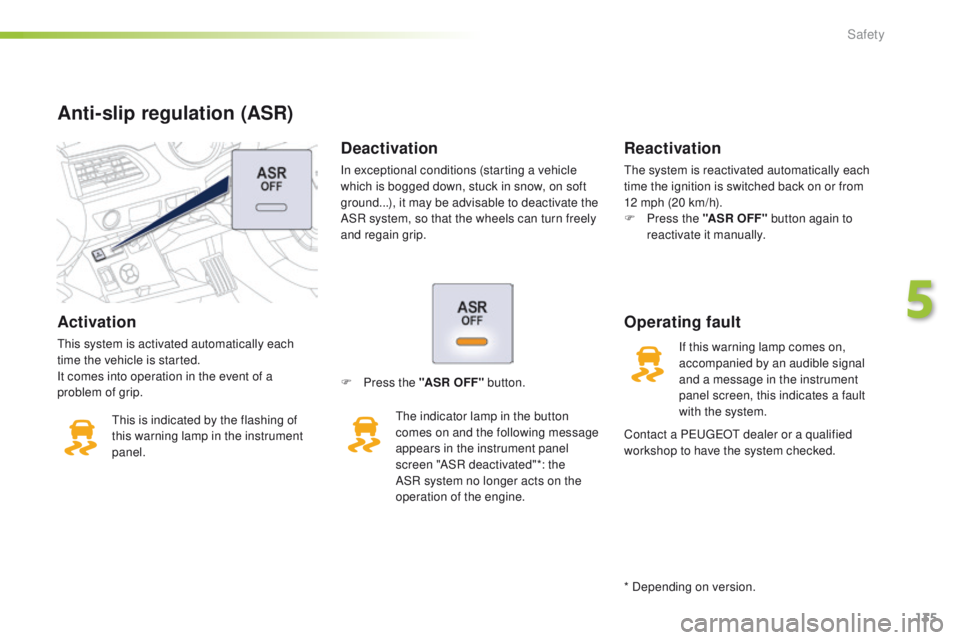
Activation
this system is activated automatically each
time the vehicle is started.
It comes into operation in the event of a
problem of grip.
th
is is indicated by the flashing of
this warning lamp in the instrument
panel.
Deactivation
In exceptional conditions (starting a vehicle
which is bogged down, stuck in snow, on soft
ground...), it may be advisable to deactivate the
ASR system, so that the wheels can turn freely
and regain grip.
Operating fault
If this warning lamp comes on,
accompanied by an audible signal
and a message in the instrument
panel screen, this indicates a fault
with the system.
Reactivation
the system is reactivated automatically each
time the ignition is switched back on or from
12
mph (20 km/h).
F
P
ress the "AS R O FF " button again to
reactivate it manually.
F
P
ress the "AS R O FF " button.
th
e indicator lamp in the button
comes on and the following message
appears in the instrument panel
screen "ASR deactivated"*: the
ASR system no longer acts on the
operation of the engine.
Anti-slip regulation (ASR)
Contact a Pe ugeOt dealer or a qualified
workshop to have the system checked.
* Depending on version.
5
Safety
Page 162 of 371
160
508_en_Chap06_conduite_ed01-2016
When towing
Distribution of loads
F Distribute the load in the trailer so that the heaviest items are as close as possible to
the axle and the nose weight approaches
the maximum permitted without
exceeding
it.
Air density decreases with altitude, thus
reducing engine performance. Above
1
000 metres, the maximum towed load must
be reduced by 10
% for every 1 000 metres of
altitude.
Side wind
F take into account the increased sensitivity to side wind.
Cooling
towing a trailer on a slope increases the
temperature of the coolant.
As the fan is electrically controlled, its cooling
capacity is not dependent on the engine speed.
F
t
o l
ower the engine speed, reduce your
speed.
th
e maximum towed load on a long incline
depends on the gradient and the ambient
temperature.
In all cases, keep a check on the coolant
temperature.
F
I
f the warning lamp and the
STOP warning lamp come on,
stop the vehicle and switch off
the engine as soon as possible.
Braking
towing a trailer increases the braking distance.to a void overheating of the brakes, the use of
engine braking is recommended.
Ty r e s
F Check the tyre pressures of the towing vehicle and of the trailer, observing the
recommended pressures.
Lighting
F Check the electrical lighting and signalling on the trailer and the hadlamp beam height
of your vehicle.
For more information on adjusting the
headlamp beam height, refer to the
corresponding section.
th
e rear parking sensors will be
deactivated automatically if a genuine
P
e
uge
Ot
towbar is used.
For more information on weights (and
the towed loads which apply to your
vehicle) refer to the corresponding
section.
Driving
Page 170 of 371
168
508_en_Chap06_conduite_ed01-2016
It is recommended that you do not
apply the parking brake in very cold
conditions (ice) and during towing
(breakdown, caravan...). Deactivate the
automatic functions and release the
parking brake manually.Before leaving the vehicle, check that
parking brake warning lamps in the
instrument panel and the control lever A
are on, not flashing.
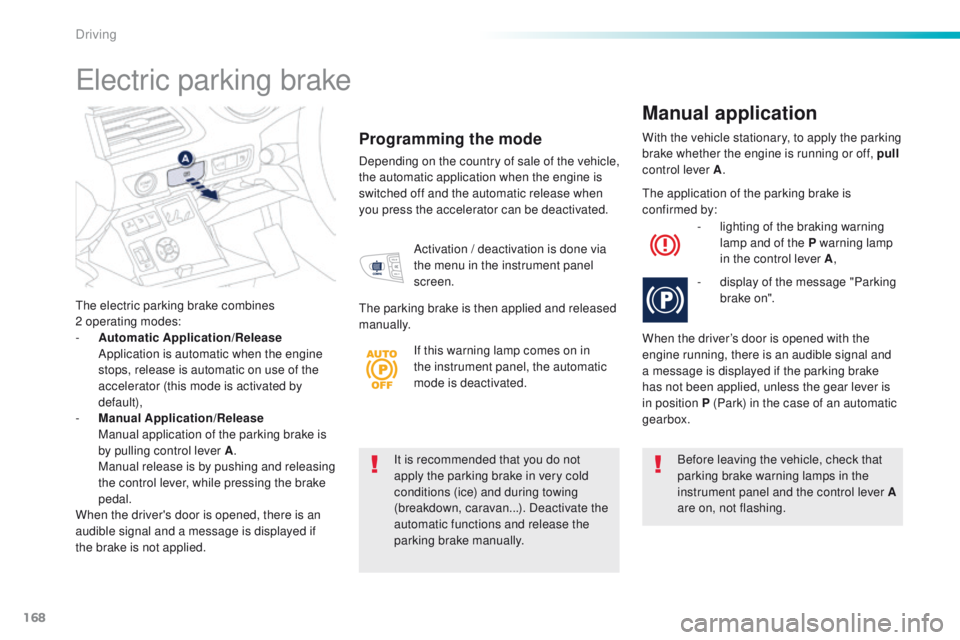
th
e electric parking brake combines
2
operating modes:
-
A
utomatic Application/Release
A
pplication is automatic when the engine
stops, release is automatic on use of the
accelerator (this mode is activated by
default),
-
M
anual Application/Release
M
anual application of the parking brake is
by pulling control lever A . M
anual release is by pushing and releasing
the control lever, while pressing the brake
pedal.
When the driver's door is opened, there is an
audible signal and a message is displayed if
the brake is not applied.
Programming the mode
Depending on the country of sale of the vehicle,
the automatic application when the engine is
switched off and the automatic release when
you press the accelerator can be deactivated. With the vehicle stationary, to apply the parking
brake whether the engine is running or off, pull
control lever A .
Manual application
Activation / deactivation is done via
t he menu in the instrument panel
screen.
th
e parking brake is then applied and released
manually.
th
e application of the parking brake is
confirmed by:
-
l
ighting of the braking warning
lamp and of the P warning lamp
in the control lever A ,
-
d
isplay of the message "Parking
brake on".
When the driver’s door is opened with the
engine running, there is an audible signal and
a message is displayed if the parking brake
has not been applied, unless the gear lever is
in position P (Park) in the case of an automatic
gearbox.
electric parking brake
If this warning lamp comes on in
the instrument panel, the automatic
mode is deactivated.
Driving
Page 171 of 371
169
508_en_Chap06_conduite_ed01-2016
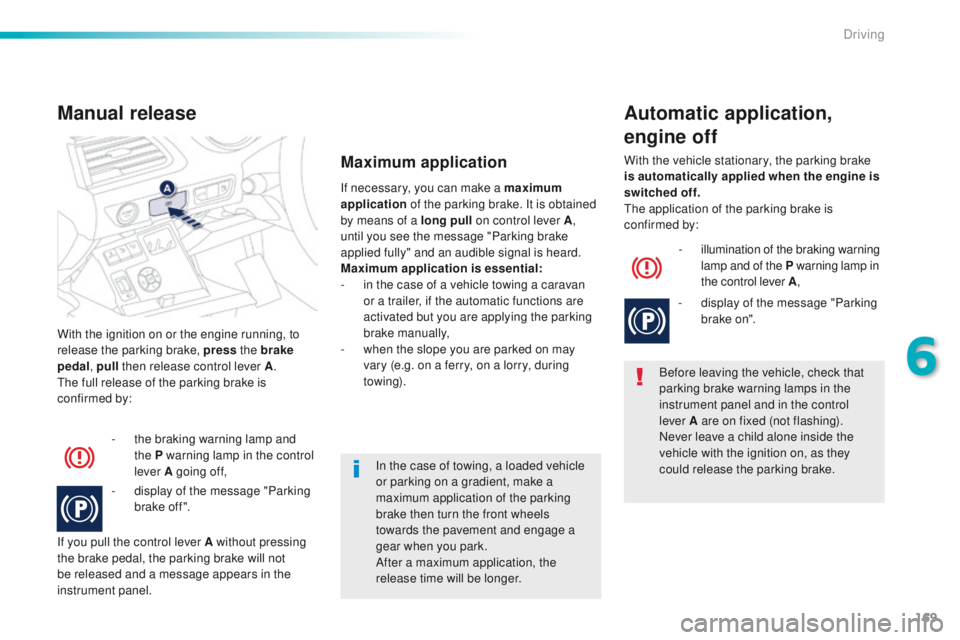
With the ignition on or the engine running, to
release the parking brake, press the brake
pedal , pull then release control lever A .
th
e full release of the parking brake is
confirmed by:
Manual release
- the braking warning lamp and the P warning lamp in the control
lever A going of f,
-
d
isplay of the message "Parking
brake of f ".
If you pull the control lever A without pressing
the brake pedal, the parking brake will not
be released and a message appears in the
instrument panel. If necessary, you can make a maximum
application
of the parking brake. It is obtained
by means of a long pull on control lever A,
until you see the message "Parking brake
applied fully" and an audible signal is heard.
Maximum application is essential:
-
i
n the case of a vehicle towing a caravan
or a trailer, if the automatic functions are
activated but you are applying the parking
brake manually,
-
w
hen the slope you are parked on may
vary (e.g. on a ferry, on a lorry, during
towing).
Maximum application
Before leaving the vehicle, check that
parking brake warning lamps in the
instrument panel and in the control
lever
A are on fixed (not flashing).
Never leave a child alone inside the
vehicle with the ignition on, as they
could release the parking brake.
Automatic application,
engine off
- illumination of the braking warning lamp and of the P warning lamp in
the control lever A ,
-
d
isplay of the message "Parking
brake on".
With the vehicle stationary, the parking brake
is automatically applied when the engine is
switched off.
th
e application of the parking brake is
confirmed by:
In the case of towing, a loaded vehicle
or parking on a gradient, make a
maximum application of the parking
brake then turn the front wheels
towards the pavement and engage a
gear when you park.
After a maximum application, the
release time will be longer.
6
Driving
Page 172 of 371
170
508_en_Chap06_conduite_ed01-2016
Automatic release
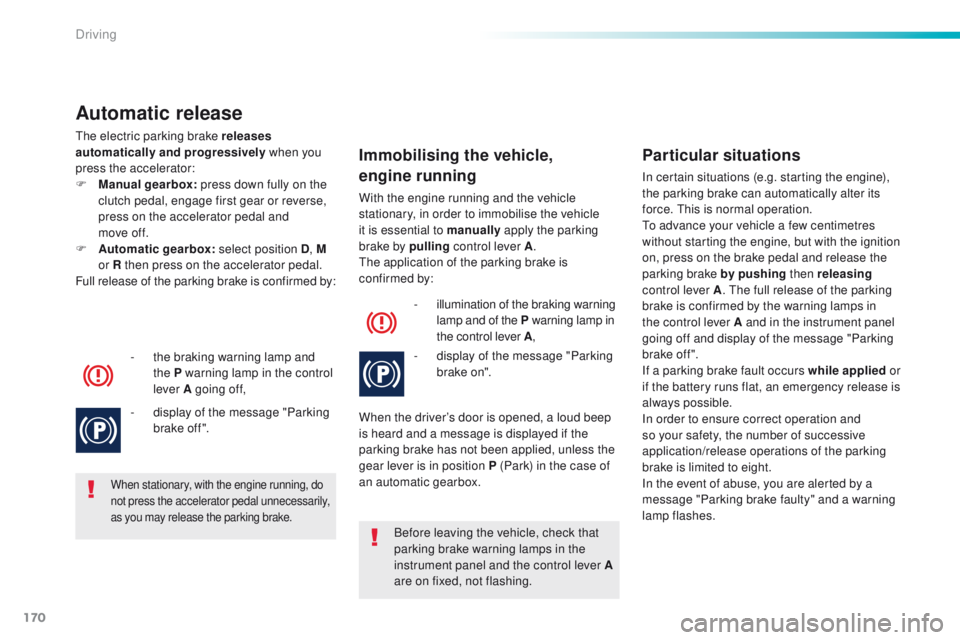
the electric parking brake releases
automatically and progressively when you
press the accelerator:
F
M
anual gearbox: press down fully on the
clutch pedal, engage first gear or reverse,
press on the accelerator pedal and
move
off.
F
A
utomatic gearbox: select position D, M
or R then press on the accelerator pedal.
Full release of the parking brake is confirmed by:
-
t
he braking warning lamp and
the P warning lamp in the control
lever A going of f,
-
d
isplay of the message "Parking
brake of f ".
When stationary, with the engine running, do
not press the accelerator pedal unnecessarily,
as you may release the parking brake.
Before leaving the vehicle, check that
parking brake warning lamps in the
instrument panel and the control lever A
are on fixed, not flashing.
Immobilising the vehicle,
engine running
With the engine running and the vehicle
stationary, in order to immobilise the vehicle
it is essential to manually apply the parking
brake by pulling control lever A.
th
e application of the parking brake is
confirmed by:
-
i
llumination of the braking warning
lamp and of the P warning lamp in
the control lever A ,
-
d
isplay of the message "Parking
brake on".
When the driver’s door is opened, a loud beep
is heard and a message is displayed if the
parking brake has not been applied, unless the
gear lever is in position P (Park) in the case of
an automatic gearbox.
Particular situations
In certain situations (e.g. starting the engine),
the parking brake can automatically alter its
force. t
h
is is normal operation.
to a
dvance your vehicle a few centimetres
without starting the engine, but with the ignition
on, press on the brake pedal and release the
parking brake by pushing then releasing
control lever A .
t
h
e full release of the parking
brake is confirmed by the warning lamps in
the control lever A and in the instrument panel
going off and display of the message "Parking
brake of f ".
If a parking brake fault occurs while applied or
if the battery runs flat, an emergency release is
always possible.
In order to ensure correct operation and
so your safety, the number of successive
application/release operations of the parking
brake is limited to eight.
In the event of abuse, you are alerted by a
message "Parking brake faulty" and a warning
lamp flashes.
Driving
Page 175 of 371
173
508_en_Chap06_conduite_ed01-2016
SituationsConsequences
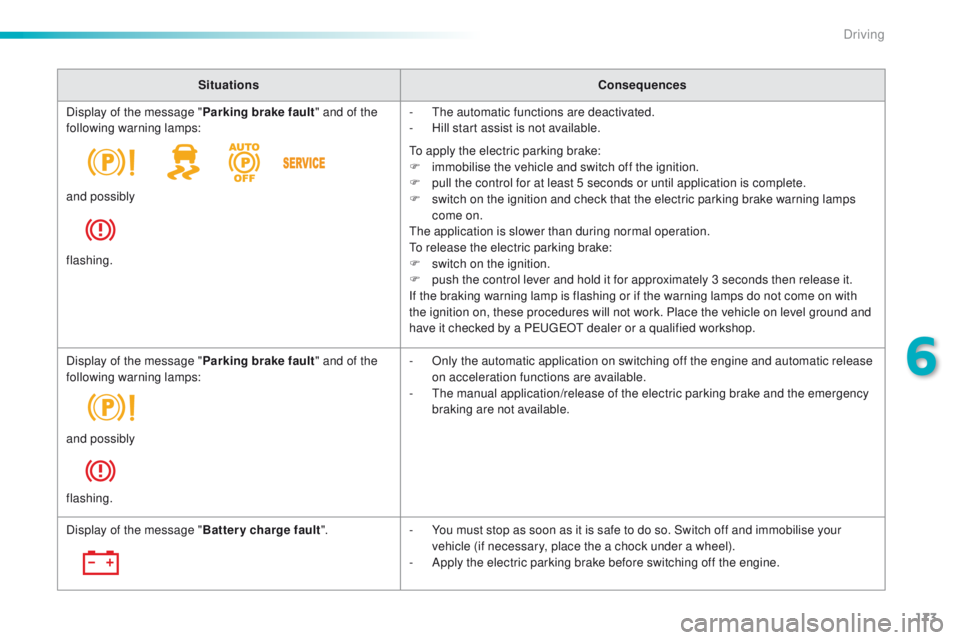
Display of the message " Parking brake fault" and of the
following warning lamps: -
t
h
e automatic functions are deactivated.
-
H
ill start assist is not available.
to a
pply the electric parking brake:
F
i
mmobilise the vehicle and switch off the ignition.
F
p
ull the control for at least 5 seconds or until application is complete.
F
s
witch on the ignition and check that the electric parking brake warning lamps
come on.
th
e application is slower than during normal operation.
to r
elease the electric parking brake:
F
s
witch on the ignition.
F
p
ush the control lever and hold it for approximately 3 seconds then release it.
If the braking warning lamp is flashing or if the warning lamps do not come on with
the ignition on, these procedures will not work. Place the vehicle on level ground and
have it checked by a P
e
uge
Ot
dealer or a qualified workshop.
and possibly
flashing.
Display of the message "
Parking brake fault" and of the
following warning lamps: -
O
nly the automatic application on switching off the engine and automatic release
on acceleration functions are available.
-
t
h
e manual application/release of the electric parking brake and the emergency
braking are not available.
and possibly
flashing.
Display of the message " Battery charge fault".-
Y
ou must stop as soon as it is safe to do so. Switch off and immobilise your
vehicle (if necessary, place the a chock under a wheel).
-
A
pply the electric parking brake before switching off the engine.
6
Driving
Page 181 of 371
179
508_en_Chap06_conduite_ed01-2016
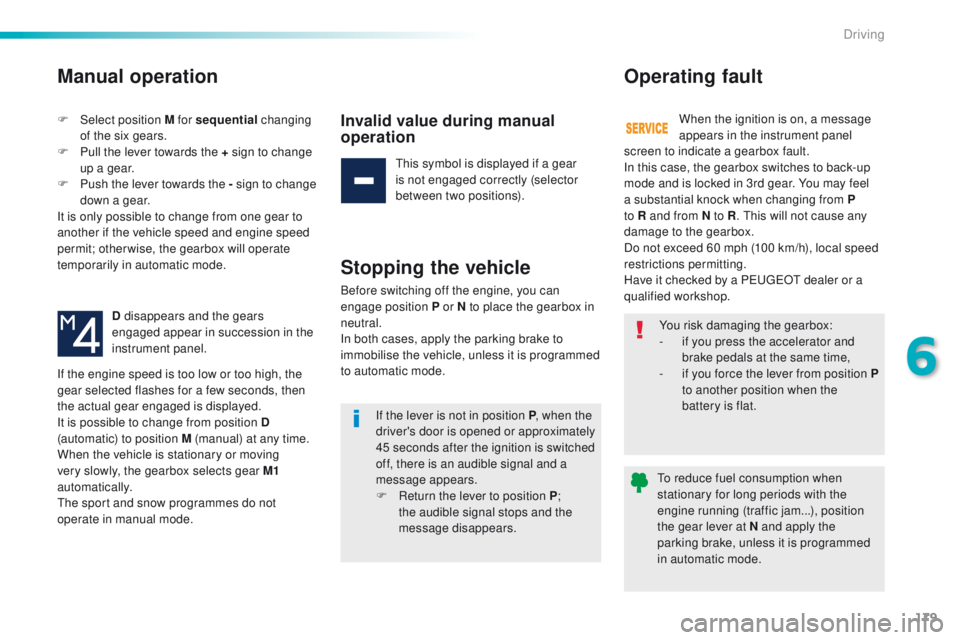
Manual operation
F Select position M for sequential changing
of the six gears.
F
P
ull the lever towards the + sign to change
up a gear.
F
P
ush the lever towards the - sign to change
down a gear.
It is only possible to change from one gear to
another if the vehicle speed and engine speed
permit; otherwise, the gearbox will operate
temporarily in automatic mode.
D disappears and the gears
engaged appear in succession in the
instrument panel.Invalid value during manual
operation
this symbol is displayed if a gear
is not engaged correctly (selector
between two positions).
Stopping the vehicle
Before switching off the engine, you can
engage position P or N to place the gearbox in
neutral.
In both cases, apply the parking brake to
immobilise the vehicle, unless it is programmed
to automatic mode.
Operating fault
When the ignition is on, a message
appears in the instrument panel
If the engine speed is too low or too high, the
gear selected flashes for a few seconds, then
the actual gear engaged is displayed.
It is possible to change from position D
(automatic) to position M (manual) at any time.
When the vehicle is stationary or moving
very slowly, the gearbox selects gear M1
automatically.
th
e sport and snow programmes do not
operate in manual mode. You risk damaging the gearbox:
-
i
f you press the accelerator and
brake pedals at the same time,
-
i
f you force the lever from position P
to another position when the
battery is flat.
If the lever is not in position P , when the
driver's door is opened or approximately
45 seconds after the ignition is switched
off, there is an audible signal and a
message appears.
F
R
eturn the lever to position P ;
the audible signal stops and the
message disappears.
to r
educe fuel consumption when
stationary for long periods with the
engine running (traffic jam...), position
the gear lever at N and apply the
parking brake, unless it is programmed
in automatic mode.
screen to indicate a gearbox fault.
In this case, the gearbox switches to back-up
mode and is locked in 3rd gear. You may feel
a substantial knock when changing from P
to R and from N to R
.
t
h
is will not cause any
damage to the gearbox.
Do not exceed 60 mph (100 km/h), local speed
restrictions permitting.
Have it checked by a P
e
uge
Ot
dealer or a
qualified workshop.
6
Driving
Page 184 of 371
182
508_en_Chap06_conduite_ed01-2016
the system is reactivated automatically
at every new start using the key.
Reactivation
Press the "ECO OFF" switch again.the system is active again; this is confirmed by
the indicator lamp in the switch going off and a
message in the screen.
Operating fault
In the event of a fault with the system, the
indicator lamp in the "ECO OFF" switch
flashes then comes on continuously.
Have it checked by a P
e
uge
Ot
dealer or a
qualified workshop.
In the event of a fault in S
tO
P mode, the
vehicle may stall: all the instrument panel
warning lamps come on. It is then necessary
to switch off the ignition and start the engine
again using the key.
If the system has been deactivated
in S
tO
P mode, the engine restarts
immediately.
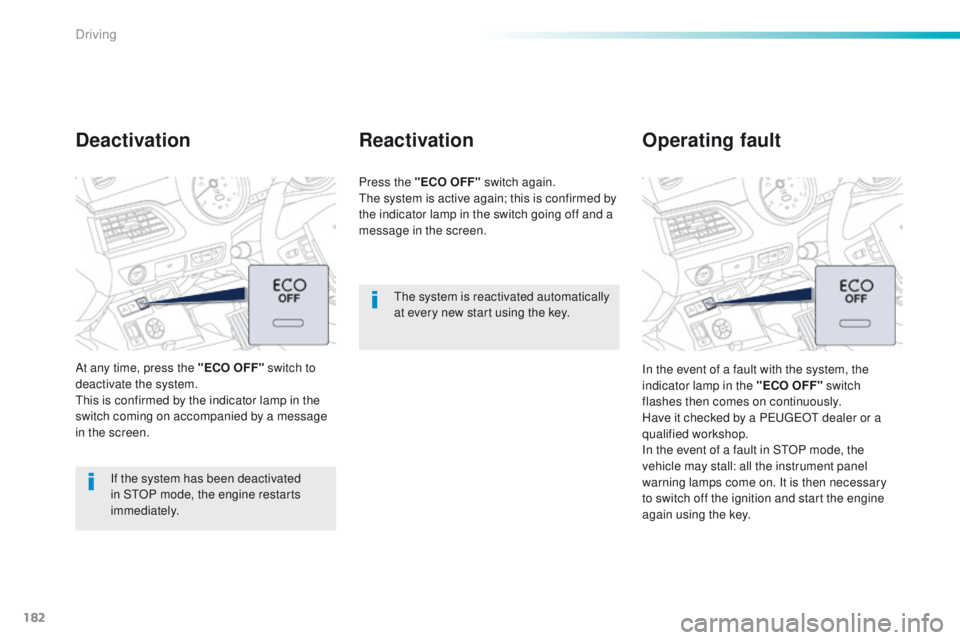
At any time, press the "ECO OFF"
switch to
deactivate the system.
th
is is confirmed by the indicator lamp in the
switch coming on accompanied by a message
in the screen.
Deactivation
Driving
Page 185 of 371
183
508_en_Chap06_conduite_ed01-2016
Hill start assist
System which keeps your vehicle immobilised
temporarily (approximately 2 seconds) when
starting on a gradient, the time it takes to
move your foot from the brake pedal to the
accelerator pedal.
th
is system only operates when:
-
t
he vehicle is completely stationary, with
your foot on the brake pedal,
-
c
ertain gradient conditions are met,
-
w
ith the driver’s door closed.
th
e hill start assist system cannot be
deactivated.
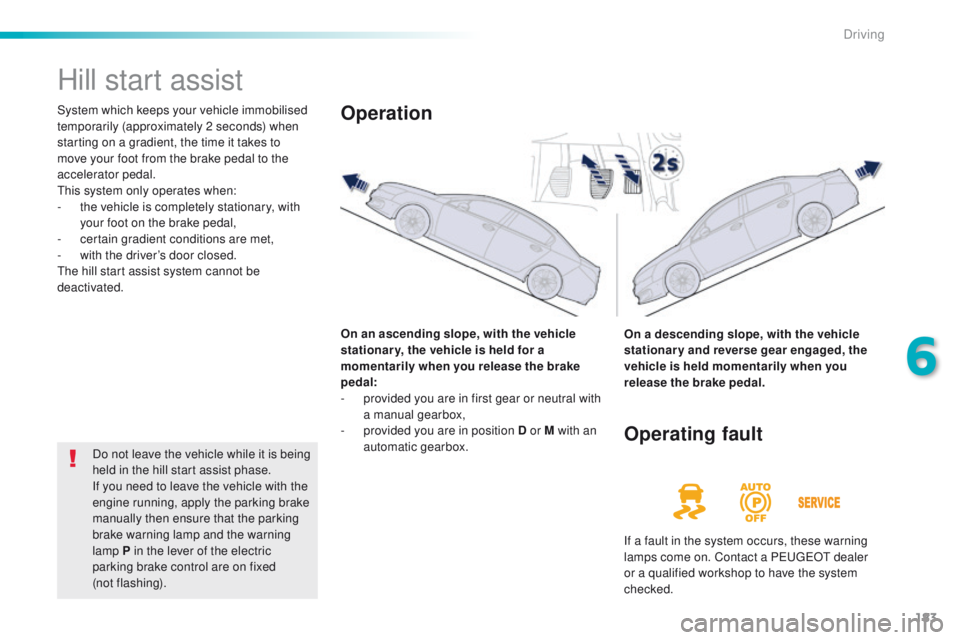
On an ascending slope, with the vehicle
stationar y, the vehicle is held for a
momentarily when you release the brake
pedal:
-
p
rovided you are in first gear or neutral with
a manual gearbox,
-
p
rovided you are in position D or M with an
automatic gearbox.Operation
On a descending slope, with the vehicle
stationary and reverse gear engaged, the
vehicle is held momentarily when you
release the brake pedal.
Do not leave the vehicle while it is being
held in the hill start assist phase.
If you need to leave the vehicle with the
engine running, apply the parking brake
manually then ensure that the parking
brake warning lamp and the warning
lamp P in the lever of the electric
parking brake control are on fixed
(not
flashing).
Operating fault
If a fault in the system occurs, these warning
lamps come on. Contact a Pe ugeOt dealer
or a qualified workshop to have the system
checked.
6
Driving