check engine Peugeot 508 2016 Owner's Guide
[x] Cancel search | Manufacturer: PEUGEOT, Model Year: 2016, Model line: 508, Model: Peugeot 508 2016Pages: 371, PDF Size: 12.12 MB
Page 203 of 371
201
508_en_Chap07_info-pratiques_ed01-2016
Low fuel level
When the low fuel level in the tank is
reached, this warning lamp comes on
in the instrument panel, accompanied
by an audible warning and a message
in the instrument panel screen.
Fuel supply cut-off
Your vehicle is equipped with a safety device
which cuts off the fuel supply in the event of
a
collision. It is still possible to use a fuel can to fill
the tank but this must be done slowly.
In order to ensure a good flow of fuel,
do not place the nozzle of the fuel can
in direct contact with the flap of the
misfuel prevention device.
Diesel misfuel prevention
Travelling abroad
As Diesel fuel pump nozzles may be different
in other countries, the presence of the misfuel
prevention device may make refuelling
impossible.
Not all Diesel vehicles are fitted with misfuel
protection, so before travelling abroad, we
recommend that you check with the P
e
uge
Ot
dealer network, whether your vehicle is suitable
for the fuel pumps in the country in which you
want to travel.
When it first comes on, around 7 litres of fuel
remain in the tank.
You must refuel as soon as possible to avoid
running out.
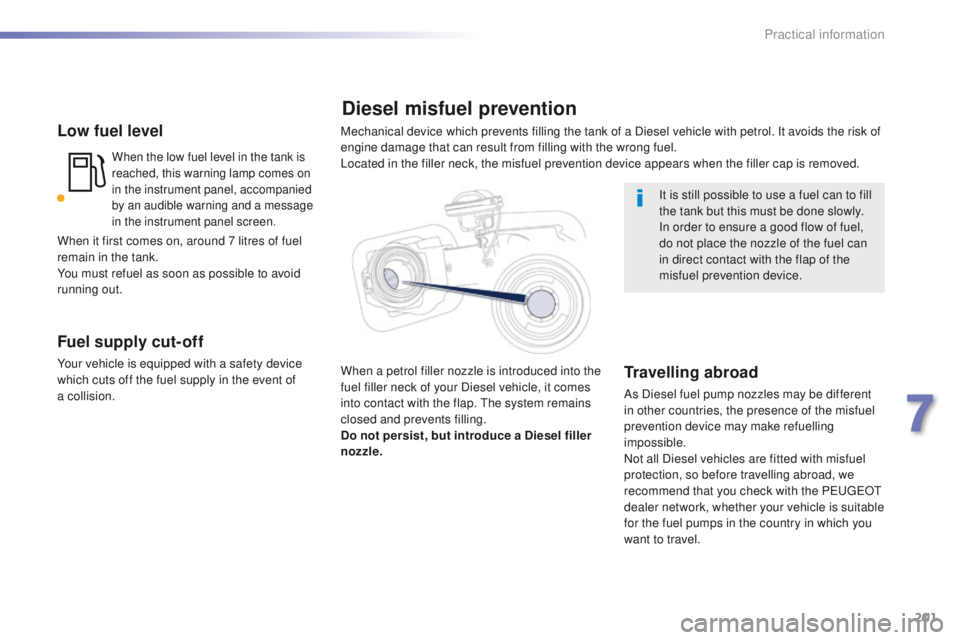
Mechanical device which prevents filling the tank of a Diesel vehicle with petrol. It avoids the risk of
engine damage that can result from filling with the wrong fuel.
Located in the filler neck, the misfuel prevention device appears when the filler cap is removed.
When a petrol filler nozzle is introduced into the
fuel filler neck of your Diesel vehicle, it comes
into contact with the flap.
th
e system remains
closed and prevents filling.
Do not persist, but introduce a Diesel filler
nozzle.
7
Practical information
Page 220 of 371
218
508_en_Chap07_info-pratiques_ed01-2016
Checking levels
take care when working under the
bonnet, as certain areas of the engine
may be extremely hot (risk of burns) and
the cooling fan could start at any time
(even with the ignition off).
Engine oil level
the check is carried out either when
the ignition is switched on using the
oil level indicator in the instrument
panel for vehicles so equipped, or
using the dipstick.
to e
nsure that the reading is correct,
your vehicle must be parked on a level
sur face with the engine having been off
for more than 30 minutes.
It is normal to top up the oil level between
two services (or oil changes). P
e
uge
Ot
recommends that you check the level, and top
up if necessary, every 3 000 miles (5 000 kms). Check all of these levels regularly, in line with the manufacturer's service schedule. t
o
p them up if necessary, unless other wise indicated.
If a level drops significantly, have the corresponding system checked by a P
e
uge
Ot
dealer or a qualified workshop.
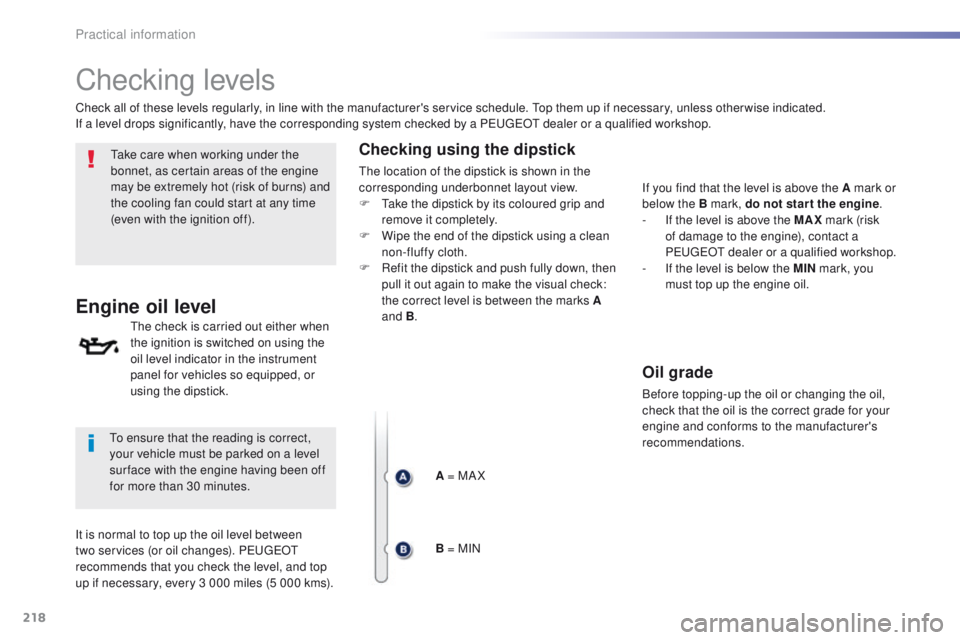
Checking using the dipstick
the location of the dipstick is shown in the
corresponding underbonnet layout view.
F
t
a
ke the dipstick by its coloured grip and
remove it completely.
F
W
ipe the end of the dipstick using a clean
non-fluffy cloth.
F
R
efit the dipstick and push fully down, then
pull it out again to make the visual check:
the correct level is between the marks A
and B .
A = MA X
B = MIN If you find that the level is above the A mark or
below the B mark, do not star t the engine
.
-
I
f the level is above the MAX mark (risk
of damage to the engine), contact a
P
e
uge
Ot
dealer or a qualified workshop.
-
I
f the level is below the MIN mark, you
must top up the engine oil.
Oil grade
Before topping-up the oil or changing the oil,
check that the oil is the correct grade for your
engine and conforms to the manufacturer's
recommendations.
Practical information
Page 221 of 371
219
508_en_Chap07_info-pratiques_ed01-2016
Power steering fluid level
the power steering fluid level should
be close to the "MA X" mark. With
the engine cold, unscrew the cap to
check the level.
th
e brake fluid level should be close
to the "MA X" mark. If it is not, check
the brake pad wear.
Brake fluid level
Changing the fluid
Refer to the manufacturer's service schedule
for details of the interval for this operation.
Fluid specification
the brake fluid must conform to the
manufacturer's recommendations.
Topping-up the engine oil level
the location of the oil filler cap is shown in the
corresponding underbonnet layout view.
F
u
n
screw the oil filler cap to reveal the filler
aperture.
F
A
dd oil in small quantities, avoiding any
spills on engine components (risk of fire).
F
W
ait a few minutes before checking the
level again using the dipstick.
F
A
dd more oil if necessary.
F
A
fter checking the level, carefully refit the
oil filler cap and the dipstick in its tube.
After topping-up the oil, the check when
switching on the ignition with the oil level
indicator in the instrument panel is not valid
during the 30 minutes after topping up.
Engine oil change
Refer to the manufacturer's service schedule
for details of the interval for this operation.
In order to maintain the reliability of the engine
and emission control system, never use
additives in the engine oil.
7
Practical information
Page 223 of 371
221
508_en_Chap07_info-pratiques_ed01-2016
Checks
12 V battery
the battery does not require any
maintenance.
However, check regularly that the
terminals are correctly tightened (versions
without quick release terminals) and that
the connections are clean.Refer to the manufacturer's
service schedule for details of the
replacement intervals for these
components.
Air filter and passenger compartment filter
Replace the oil filter each time the
engine oil is changed.
Refer to the manufacturer's
service schedule for details of
the replacement interval for this
component.
Oil filter
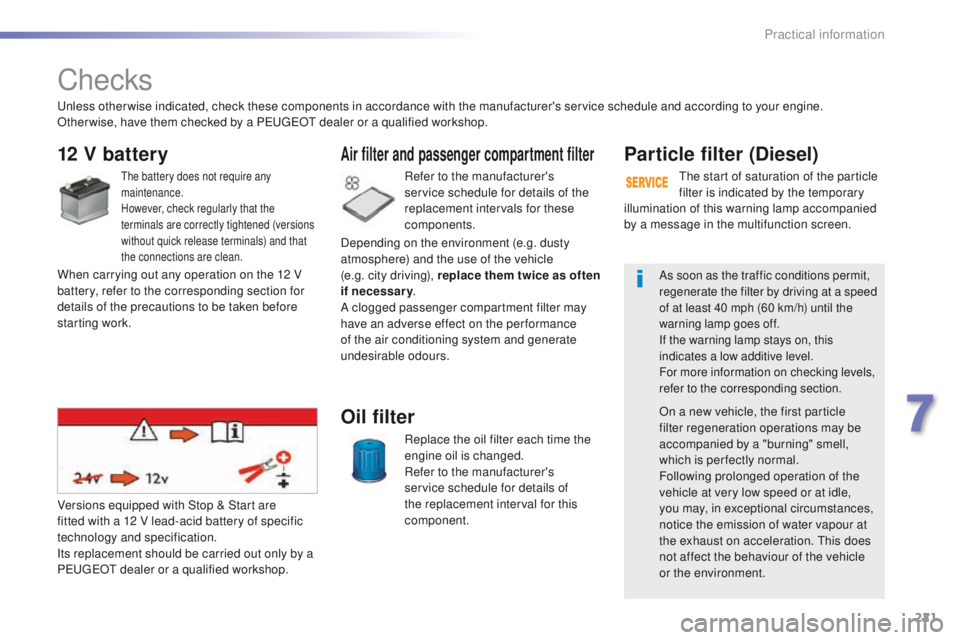
Versions equipped with Stop & Start are
fitted with a 12 V lead-acid battery of specific
technology and specification.
Its replacement should be carried out only by a
P
e
uge
Ot
dealer or a qualified workshop.
Particle filter (Diesel)
the start of saturation of the particle
filter is indicated by the temporary
As soon as the traffic conditions permit,
regenerate the filter by driving at a speed
of at least 40 mph (60 km/h) until the
warning lamp goes off.
If the warning lamp stays on, this
indicates a low additive level.
For more information on checking levels,
refer to the corresponding section.
On a new vehicle, the first particle
filter regeneration operations may be
accompanied by a "burning" smell,
which is per fectly normal.
Following prolonged operation of the
vehicle at very low speed or at idle,
you may, in exceptional circumstances,
notice the emission of water vapour at
the exhaust on acceleration.
t
h
is does
not affect the behaviour of the vehicle
or the environment.
un
less otherwise indicated, check these components in accordance with the manufacturer's service schedule and according to your engine.
Other wise, have them checked by a P
e
uge
Ot
dealer or a qualified workshop.
When carrying out any operation on the 12 V
battery, refer to the corresponding section for
details of the precautions to be taken before
starting work. Depending on the environment (e.g. dusty
atmosphere) and the use of the vehicle
(e.g.
city driving), replace them twice as often
if necessary .
A clogged passenger compartment filter may
have an adverse effect on the per formance
of the air conditioning system and generate
undesirable odours. illumination of this warning lamp accompanied
by a message in the multifunction screen.
7
Practical information
Page 228 of 371
226
508_en_Chap07_info-pratiques_ed01-2016
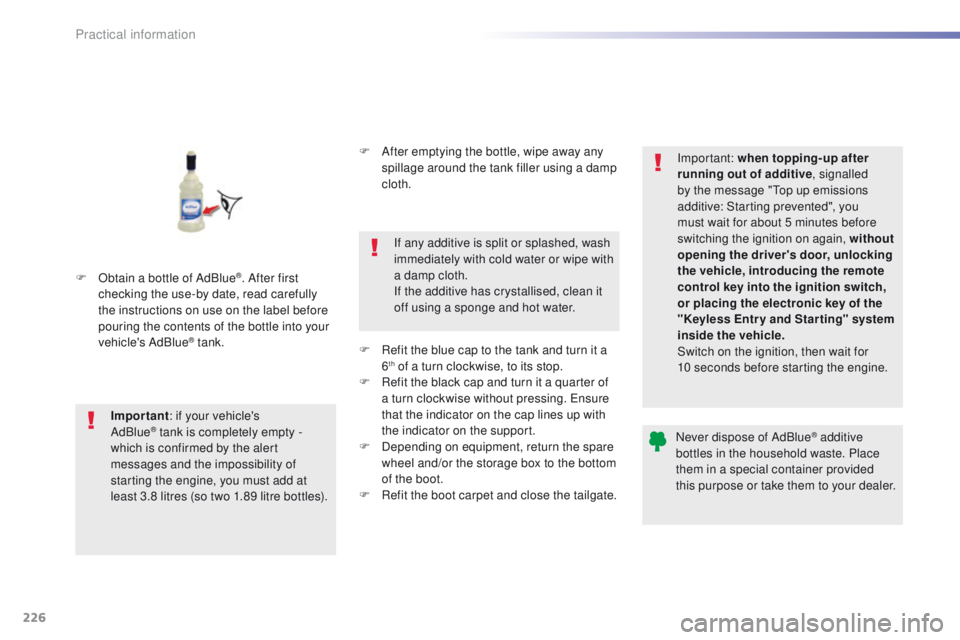
F Obtain a bottle of AdBlue®. After first
checking the use-by date, read carefully
the instructions on use on the label before
pouring the contents of the bottle into your
vehicle's AdBlue
® tank.
Important : if your vehicle's
AdBlue
® tank is completely empty -
w
hich is confirmed by the alert
messages and the impossibility of
starting the engine, you must add at
least 3.8 litres (so two 1.89 litre bottles). F
A
fter emptying the bottle, wipe away any
spillage around the tank filler using a damp
cloth.
If any additive is split or splashed, wash
immediately with cold water or wipe with
a damp cloth.
If the additive has crystallised, clean it
off using a sponge and hot water.
F
R
efit the blue cap to the tank and turn it a
6
th of a turn clockwise, to its stop.
F
R
efit the black cap and turn it a quarter of
a turn clockwise without pressing.
e
n
sure
that the indicator on the cap lines up with
the indicator on the support.
F
D
epending on equipment, return the spare
wheel and/or the storage box to the bottom
of the boot.
F
R
efit the boot carpet and close the tailgate. Important: when topping-up after
running out of additive
, signalled
by the message "
to
p up emissions
additive: Starting prevented", you
must wait for about 5 minutes before
switching the ignition on again, without
opening the driver's door, unlocking
the vehicle, introducing the remote
control key into the ignition switch,
or placing the electronic key of the
"Keyless Entr y and Star ting" system
inside the vehicle.
Switch on the ignition, then wait for
10 seconds before starting the engine.
Never dispose of AdBlue
® additive
bottles in the household waste. Place
them in a special container provided
this purpose or take them to your dealer.
Practical information
Page 236 of 371
234
508_en_Chap08_en-cas-de-pannes_ed01-2016
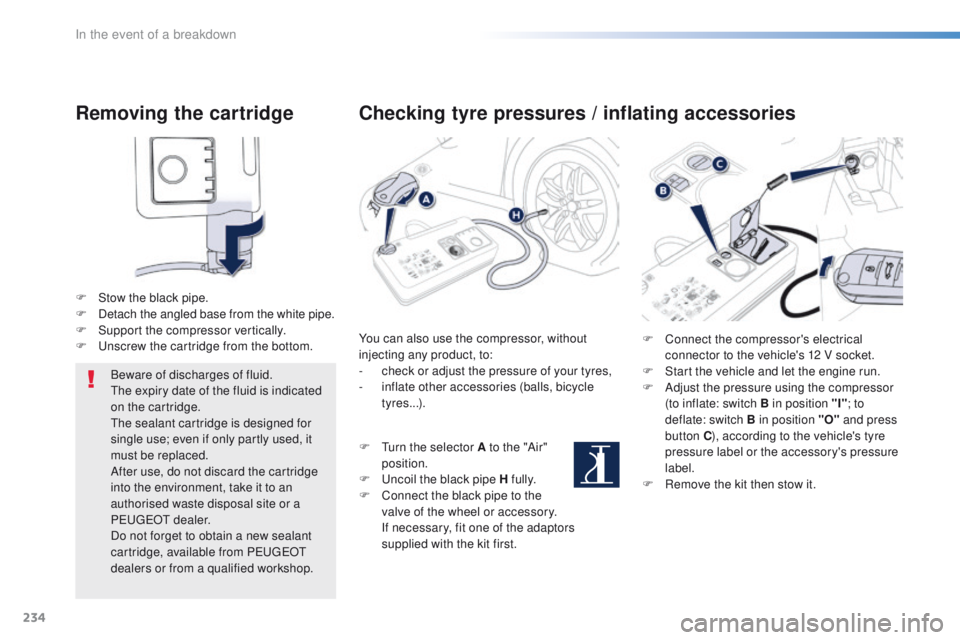
Removing the cartridge
F Stow the black pipe.
F D etach the angled base from the white pipe.
F
S
upport the compressor vertically.
F
u
n
screw the cartridge from the bottom.
Beware of discharges of fluid.
th
e expiry date of the fluid is indicated
on the cartridge.
th
e sealant cartridge is designed for
single use; even if only partly used, it
must be replaced.
After use, do not discard the cartridge
into the environment, take it to an
authorised waste disposal site or a
P
e
uge
Ot d
ealer.
Do not forget to obtain a new sealant
cartridge, available from P
e
uge
Ot
dealers or from a qualified workshop.
Checking tyre pressures / inflating accessories
You can also use the compressor, without
injecting any product, to:
-
c
heck or adjust the pressure of your tyres,
-
i
nflate other accessories (balls, bicycle
tyres...).
F
t
u
rn the selector A to the "Air"
position.
F
u
n
coil the black pipe H fully.
F
C
onnect the black pipe to the
valve of the wheel or accessory.
I
f necessary, fit one of the adaptors
supplied with the kit first. F
C onnect the compressor's electrical
connector to the vehicle's 12 V socket.
F
S
tart the vehicle and let the engine run.
F
A
djust the pressure using the compressor
(to inflate: switch B in position "I" ; to
deflate: switch B in position "O" and press
button C ), according to the vehicle's tyre
pressure label or the accessory's pressure
label.
F
R
emove the kit then stow it.
In the event of a breakdown
Page 256 of 371
254
508_en_Chap08_en-cas-de-pannes_ed01-2016
Some functions, including Stop & Start,
are not available if the battery is not
sufficiently charged.
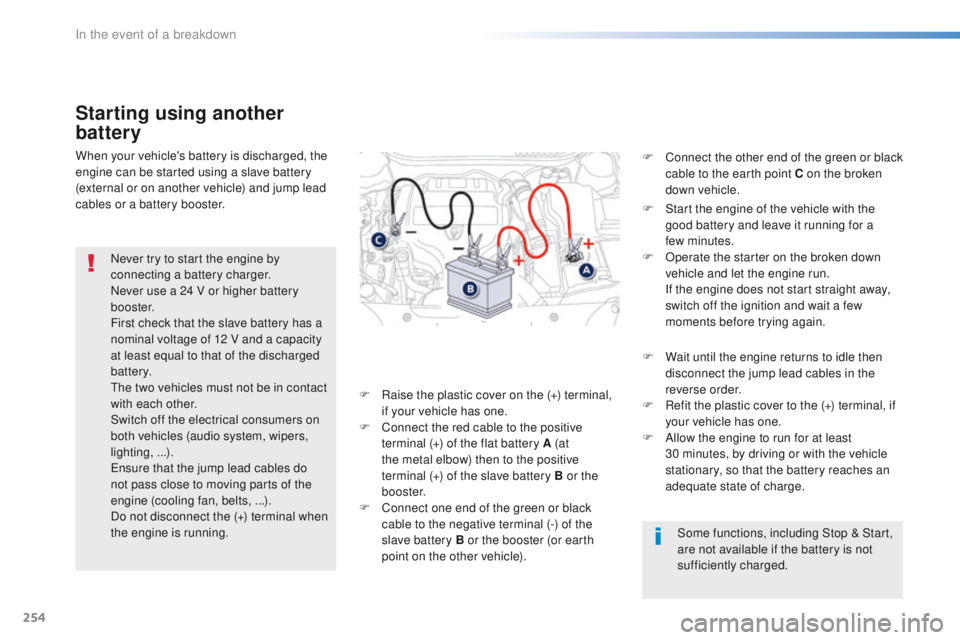
F
C
onnect the other end of the green or black
cable to the earth point C on the broken
down vehicle.
F
S
tart the engine of the vehicle with the
good battery and leave it running for a
few
minutes.
F
O
perate the starter on the broken down
vehicle and let the engine run.
I
f the engine does not start straight away,
switch off the ignition and wait a few
moments before trying again.
When your vehicle's battery is discharged, the
engine can be started using a slave battery
(external or on another vehicle) and jump lead
cables or a battery booster.
Starting using another
battery
Never try to start the engine by
connecting a battery charger.
Never use a 24 V or higher battery
b o o s t e r.
First check that the slave battery has a
nominal voltage of 12 V and a capacity
at least equal to that of the discharged
battery.
th
e two vehicles must not be in contact
with each other.
Switch off the electrical consumers on
both vehicles (audio system, wipers,
lighting, ...).
en
sure that the jump lead cables do
not pass close to moving parts of the
engine (cooling fan, belts, ...).
Do not disconnect the (+) terminal when
the engine is running. F
R
aise the plastic cover on the (+) terminal,
if your vehicle has one.
F
C
onnect the red cable to the positive
terminal (+) of the flat battery A (at
the metal elbow) then to the positive
terminal
(+) of the slave battery B or the
b o o s t e r.
F
C
onnect one end of the green or black
cable to the negative terminal (-) of the
slave battery B or the booster (or earth
point on the other vehicle). F
W
ait until the engine returns to idle then
disconnect the jump lead cables in the
reverse order.
F
R
efit the plastic cover to the (+) terminal, if
your vehicle has one.
F
A
llow the engine to run for at least
30
minutes, by driving or with the vehicle
stationary, so that the battery reaches an
adequate state of charge.
In the event of a breakdown
Page 262 of 371
260
508_en_Chap08_en-cas-de-pannes_ed01-2016
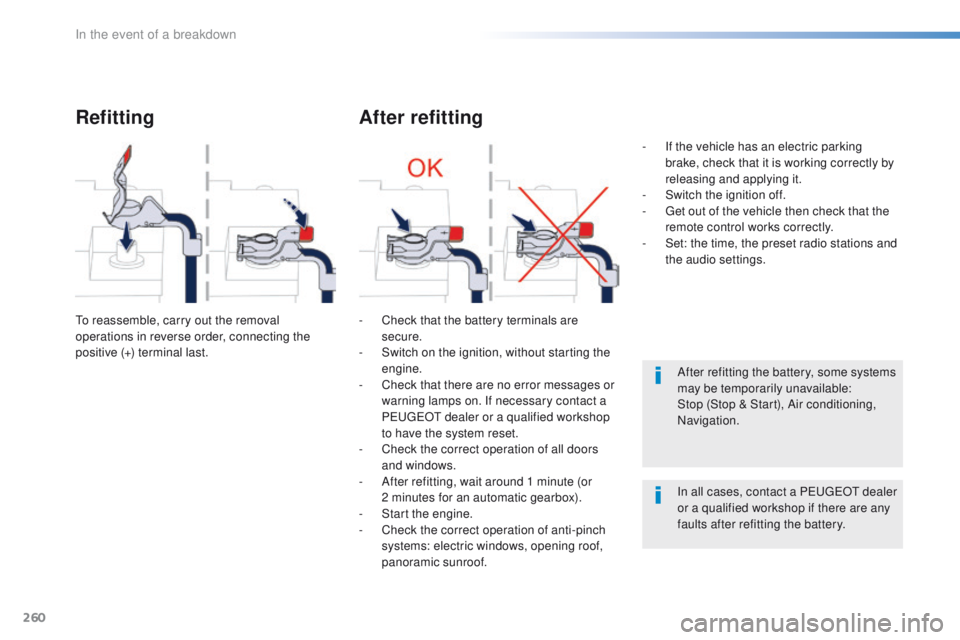
Refitting
to reassemble, carry out the removal
operations in reverse order, connecting the
positive (+) terminal last.
After refitting
- Check that the battery terminals are secure.
-
S
witch on the ignition, without starting the
engine.
-
C
heck that there are no error messages or
warning lamps on. If necessary contact a
P
e
uge
Ot
dealer or a qualified workshop
to have the system reset.
-
C
heck the correct operation of all doors
and windows.
-
A
fter refitting, wait around 1 minute (or
2
minutes for an automatic gearbox).
-
S
tart the engine.
-
C
heck the correct operation of anti-pinch
systems: electric windows, opening roof,
panoramic sunroof. -
I
f the vehicle has an electric parking
brake, check that it is working correctly by
releasing and applying it.
-
S
witch the ignition off.
- g
e
t out of the vehicle then check that the
remote control works correctly.
-
S
et: the time, the preset radio stations and
the audio settings.
After refitting the battery, some systems
may be temporarily unavailable:
Stop (Stop & Start), Air conditioning,
Navigation.
In all cases, contact a P
e
uge
Ot
dealer
or a qualified workshop if there are any
faults after refitting the battery.
In the event of a breakdown
Page 336 of 371
334
508_en_Chap10c_SMegplus_ed01-2016
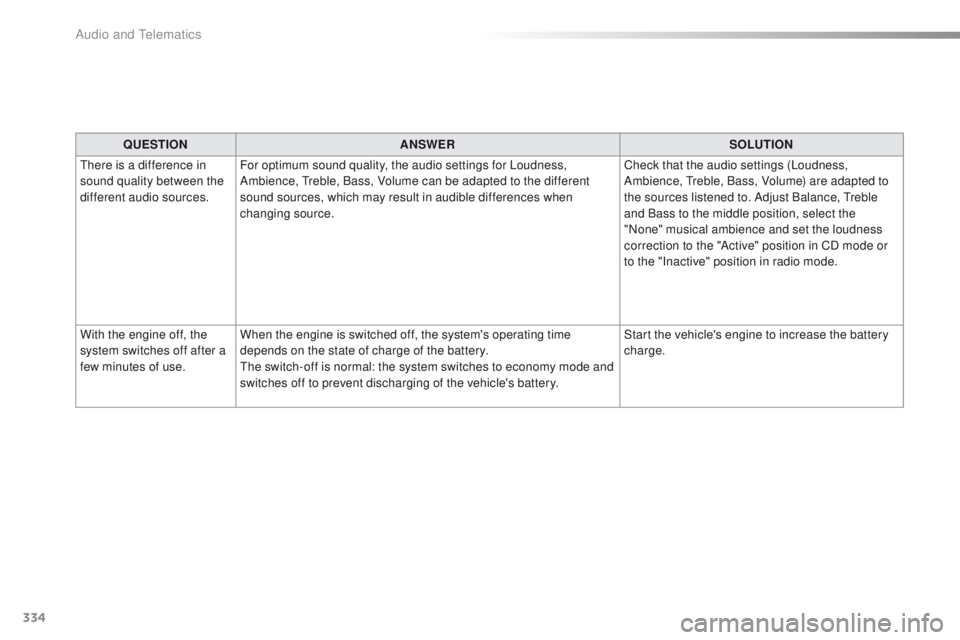
QUESTIONANSWER SOLUTION
th
ere is a difference in
sound quality between the
different audio sources. For optimum sound quality, the audio settings for Loudness,
Ambience,
t
r
eble, Bass, Volume can be adapted to the different
sound sources, which may result in audible differences when
changing source. Check that the audio settings (Loudness,
Ambience,
t
r
eble, Bass, Volume) are adapted to
the sources listened to. Adjust Balance,
t
r
eble
and Bass to the middle position, select the
"None" musical ambience and set the loudness
correction to the "Active" position in CD mode or
to the "Inactive" position in radio mode.
With the engine off, the
system switches off after a
few minutes of use. When the engine is switched off, the system's operating time
depends on the state of charge of the battery.
th
e switch-off is normal: the system switches to economy mode and
switches off to prevent discharging of the vehicle's battery. Start the vehicle's engine to increase the battery
charge.
Audio and telematics
Page 355 of 371
353
508_en_Chap11_index-alpha_ed01-2016
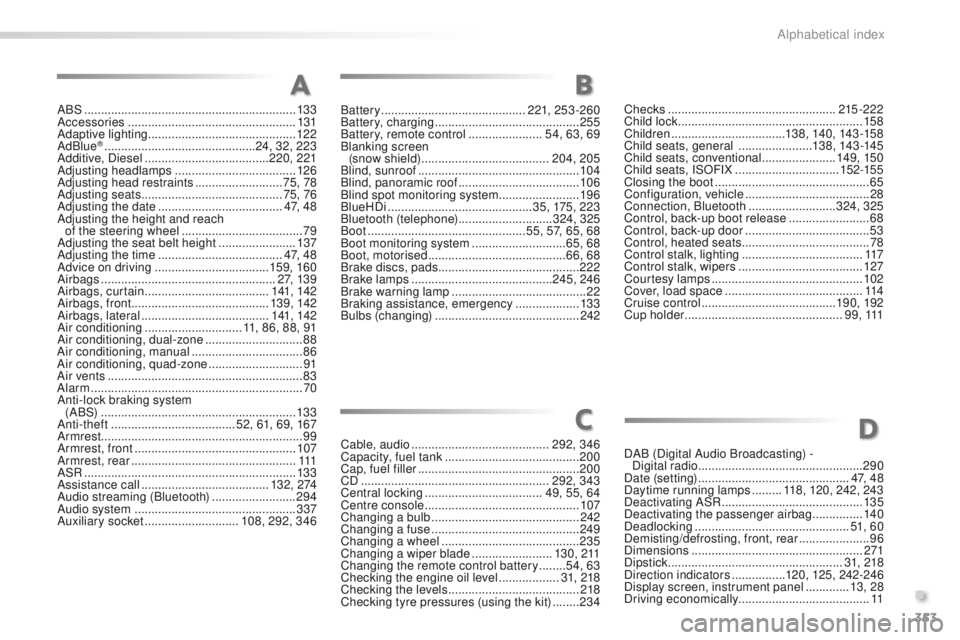
ABS ...............................................................13 3
Accessories .................................................. 131
Adaptive lighting
............................................ 12 2
AdBlue
® ............................... ..............24, 32, 223
Additive, Diesel ..................................... 220, 221
Adjusting headlamps
.................................... 126
Adjusting head restraints
..........................75, 78
Adjusting seats
.......................................... 75, 76
Adjusting the date
..................................... 4 7, 4 8
Adjusting the height and reach of the steering wheel
.................................... 79
Adjusting the seat belt height
.......................137
Adjusting the time
..................................... 4 7, 4 8
Advice on driving
.................................. 159, 16 0
Airbags
.................................................... 2 7, 1 3 9
Airbags, curtain
..................................... 14
1, 142
Airbags, front ......................................... 13 9, 142
Airbags, lateral
...................................... 141, 142
Air conditioning
............................. 11, 86, 88, 91
Air conditioning, dual-zone
............................. 88
A
ir conditioning, manual
................................. 86
Air conditioning, quad-zone
............................91
Air vents
.......................................................... 83
Alarm
............................................................... 70
Anti-lock braking system (A BS)
...............
........................................... 13 3
Anti-theft
..................................... 52, 61, 69, 167
Armrest
............................................................ 99
Armrest, front
................................................ 107
Armrest, rear
................................................. 111
AS
R
............................................................... 13 3
Assistance call
...................................... 13 2 , 2 74
Audio streaming (Bluetooth)
......................... 29
4
Audio system
................................................ 337
Auxiliary socket
............................ 108, 292, 346 Cable, audio
.........................................292, 346
Capacity, fuel tank
..............................
..........200
Cap, fuel filler
................................................200
CD
........................................................292, 343
Central locking
...................................49, 55, 64
Centre console
..............................................107
Changing a bulb
............................................242
Changing a fuse
............................................249
Changing a wheel
.........................................235
Changing a wiper blade
........................13 0 , 2 11
Changing the remote control battery
........54, 63
Checking the engine oil level
..................31, 218
Checking the levels
.......................................218
Checking tyre pressures (using the kit)
........234 DAB (Digital Audio Broadcasting) -
Digital radio
.................................................290
Date (setting)
...............................
..............4 7, 4 8
Daytime running lamps
.........118, 120, 242, 243
Deactivating ASR
..........................................13 5
Deactivating the passenger airbag
...............140
Deadlocking
..............................................51, 6 0
Demisting/defrosting, front, rear
.....................96
Dimensions
...................................................271
Dipstick
................
....................................31, 218
Direction indicators
................120, 125, 242-24 6
Display screen, instrument panel
.............13, 28
Driving economically ....................................... 11
Checks
...............
...................................
215-222
Child lock
...............................
........................
15 8
Children ............................... ...
13 8, 140, 143 -15 8
Child seats, general ......................
13 8, 143 -145
Child seats, conventional ......................149, 15 0
Child seats, ISOFIX
...............................15
2-155
Closing the boot
..............................................65
Configuration, vehicle
.....................................28
Connection, Bluetooth
..........................324, 325
Control, back-up boot release
........................68
Control, back-up door
.....................................53
Control, heated seats
......................................78
Control stalk, lighting
.................................... 11
7
Control stalk, wipers
.....................................127
Courtesy lamps
.............................................102
Cover, load space
.........................................11
4
Cruise control
........................................ 19
0, 192
Cup holder
...............................
................9 9 , 111
A
CD
B
Battery ........................................... 221, 253-260
Battery, charging ........................................... 255
Battery, remote control
...................... 5
4, 63, 69
Blanking screen (snow shield)
...............................
.......204, 205
Blind, sunroof
................................................ 104
Blind, panoramic roof
.................................... 10 6
Blind spot monitoring system
........................19 6
BlueHDi
........................................... 35, 175, 223
Bluetooth (telephone)
............................324, 325
Boot
............................................... 55, 57, 65, 68
Boot monitoring system
............................65, 68
Boot, motorised
......................................... 66, 68
Brake discs, pads
...............................
...........222
Brake lamps
...............................
...........245, 246
Brake warning lamp
........................................ 22
Braking assistance, emergency
...................13 3
Bulbs (changing)
...............................
............242
.
Alphabetical index