ECO mode Peugeot 508 2016 Owner's Guide
[x] Cancel search | Manufacturer: PEUGEOT, Model Year: 2016, Model line: 508, Model: Peugeot 508 2016Pages: 371, PDF Size: 12.12 MB
Page 184 of 371
182
508_en_Chap06_conduite_ed01-2016
the system is reactivated automatically
at every new start using the key.
Reactivation
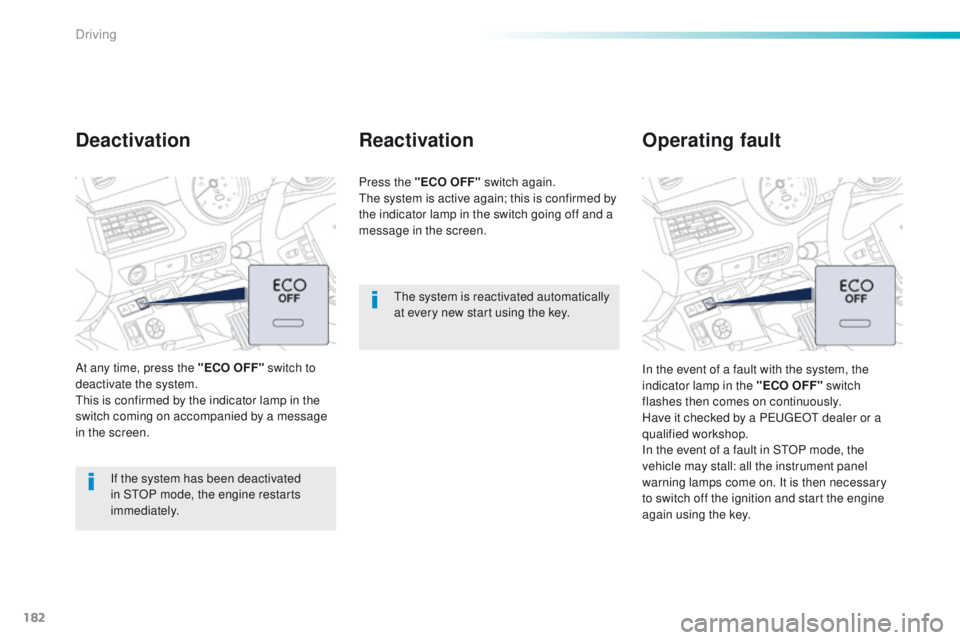
Press the "ECO OFF" switch again.the system is active again; this is confirmed by
the indicator lamp in the switch going off and a
message in the screen.
Operating fault
In the event of a fault with the system, the
indicator lamp in the "ECO OFF" switch
flashes then comes on continuously.
Have it checked by a P
e
uge
Ot
dealer or a
qualified workshop.
In the event of a fault in S
tO
P mode, the
vehicle may stall: all the instrument panel
warning lamps come on. It is then necessary
to switch off the ignition and start the engine
again using the key.
If the system has been deactivated
in S
tO
P mode, the engine restarts
immediately.
At any time, press the "ECO OFF"
switch to
deactivate the system.
th
is is confirmed by the indicator lamp in the
switch coming on accompanied by a message
in the screen.
Deactivation
Driving
Page 193 of 371
191
508_en_Chap06_conduite_ed01-2016
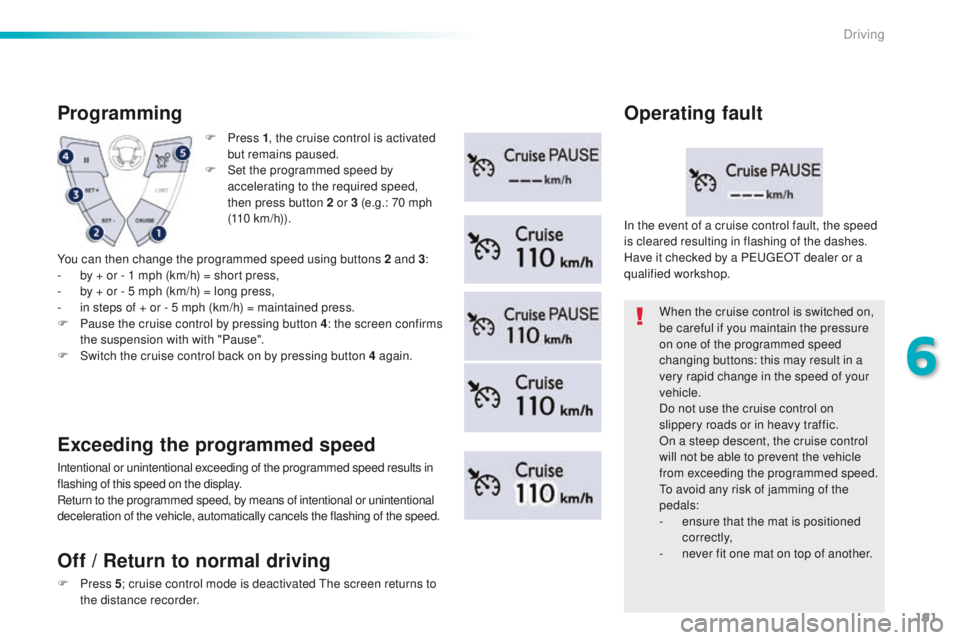
F Press 1, t he cruise control is activated
but remains paused.
F
S
et the programmed speed by
accelerating to the required speed,
then press button 2 or 3 (e.g.: 70 mph
(110
km/h)).
Programming
You can then change the programmed speed using buttons 2 and 3 :
- b y + or - 1 mph (km/h) = short press,
-
b
y + or - 5 mph (km/h) = long press,
-
i
n steps of + or - 5 mph (km/h) = maintained press.
F
P
ause the cruise control by pressing button 4 : the screen confirms
the suspension with with "Pause".
F
S
witch the cruise control back on by pressing button 4 again.
Exceeding the programmed speed
Intentional or unintentional exceeding of the programmed speed results in
flashing of this speed on the display.
Return to the programmed speed, by means of intentional or unintentional
deceleration of the vehicle, automatically cancels the flashing of the speed. When the cruise control is switched on,
be careful if you maintain the pressure
on one of the programmed speed
changing buttons: this may result in a
very rapid change in the speed of your
vehicle.
Do not use the cruise control on
slippery roads or in heavy traffic.
On a steep descent, the cruise control
will not be able to prevent the vehicle
from exceeding the programmed speed.
to a
void any risk of jamming of the
pedals:
-
e
nsure that the mat is positioned
c o r r e c t l y,
-
n
ever fit one mat on top of another.
In the event of a cruise control fault, the speed
is cleared resulting in flashing of the dashes.
Have it checked by a P
e
uge
Ot
dealer or a
qualified workshop.
Operating fault
Off
/ Return to normal driving
F Press 5; c ruise control mode is deactivated th e screen returns to
the distance recorder.
6
Driving
Page 263 of 371
261
508_en_Chap08_en-cas-de-pannes_ed01-2016
System which manages the duration of use of certain functions to conserve a sufficient level of
charge in the battery.
After the engine has stopped, you can still use functions such as the audio and telematics
system, windscreen wipers, dipped beam headlamps, courtesy lamps, etc. for a maximum
combined duration of about forty minutes.
energy economy mode
Switching to economy
mode
A message then appears in the instrument
panel screen indicating that the vehicle has
switched to economy mode and the active
functions are put on standby.
If a telephone call is being made at this time, it
will be maintained for around 10 minutes with
the Bluetooth hands-free system of your audio
system.
Exiting economy mode
these functions are reactivated automatically
next time the vehicle is driven.
In order to restore the use of these functions
immediately, start the engine and let it run:
-
f
or less than ten minutes, to use the
equipment for approximately five minutes,
-
f
or more than ten minutes, to use the
equipment for up to approximately
thirty
minutes.
Let the engine run for the duration specified to
ensure that the battery charge is sufficient.
Do not repeatedly and continuously restart the
engine in order to charge the battery.
A flat battery prevents the engine from starting.
For more information on the battery, refer to the
corresponding section.
Load reduction mode
System which manages the use of certain
functions according to the level of charge
remaining in the battery.
When the vehicle is being driven, the load
reduction function temporarily deactivates
certain functions, such as the air conditioning,
the heated rear screen...
th
e deactivated functions are reactivated
automatically as soon as conditions permit.
8
In the event of a breakdown
Page 267 of 371
265
508_en_Chap09_caracteristiques-techniques_ed01-2016
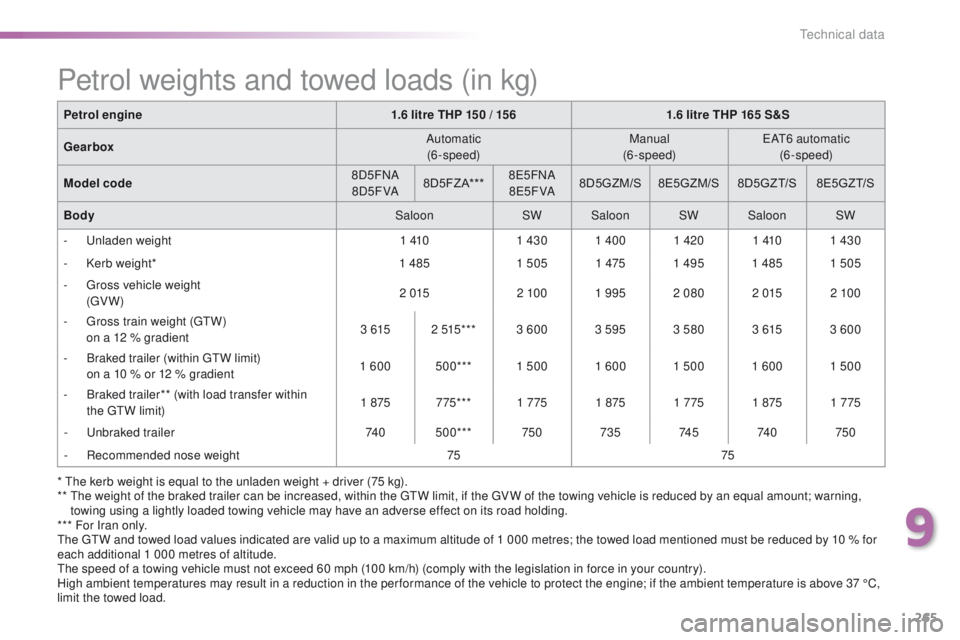
* the kerb weight is equal to the unladen weight + driver (75 kg).
** th e weight of the braked trailer can be increased, within the gtW l imit, if the gV W of the towing vehicle is reduced by an equal amount; warning,
towing using a lightly loaded towing vehicle may have an adverse effect on its road holding.
Petrol weights and towed loads (in kg)
Petrol engine 1.6 litre THP 150 / 1561.6 litre THP 165 S&S
Gearbox Automatic
(6-speed) Manual
(6-speed)
eAt6
automatic
(6-speed)
Model code 8D5FNA
8 D5 F VA 8D5FZA*** 8
e5
FNA
8
e5
F VA8D5GZM/S 8E5GZM/S
8 D5G Z T/S8E5GZT/S
Body SaloonSWSaloon SWSaloon SW
-
u
n
laden weight 1 4101 430 1 400 1 4201 4101 430
-
K
erb weight* 1 4851 5051 4751 495 1 485 1 505
-
g
r
oss vehicle weight
(
g
V
W) 2 015
2 10 01 995 2 080 2 0152 10 0
-
g
r
oss train weight (
g
t
W
)
o
n a 12 % gradient 3 615
2 515*** 3 600 3 595 3 580 3 6153 600
-
B
raked trailer (within gt
W l
imit)
o
n a 10 % or 12 % gradient 1 600
500*** 1 500 1 600 1 500 1 600 1 500
-
B
raked trailer** (with load transfer within
the
gt
W l
imit) 1 875
775*** 1 7751 8751 775 1 8751 775
-
u
nb
raked trailer 74 0500*** 750735 74 5 74 0 750
-
R
ecommended nose weight 7575
*** For Iran only.
th
e gt
W a
nd towed load values indicated are valid up to a maximum altitude of 1 000 metres; the towed load mentioned must be reduced by 10 % for
each additional 1 000 metres of altitude.
th
e speed of a towing vehicle must not exceed 60 mph (100 km/h) (comply with the legislation in force in your country).
High ambient temperatures may result in a reduction in the per formance of the vehicle to protect the engine; if the ambient temperature is above 37 °C,
limit the towed load.
9
technical data
Page 270 of 371
268
508_en_Chap09_caracteristiques-techniques_ed01-2016
* the kerb weight is equal to the unladen weight + driver (75 kg).
** th e weight of the braked trailer can be increased, within the gtW l imit, if the gV W of the towing vehicle is reduced by an equal amount; warning,
towing using a lightly loaded towing vehicle may have an adverse effect on its road holding.
th
e gt
W a
nd towed load values indicated are valid up to a maximum altitude of 1 000 metres; the towed load mentioned must be reduced by 10 % for
each additional 1 000 metres of altitude.
th
e speed of a towing vehicle must not exceed 60 mph (100 km/h) (comply with the legislation in force in your country).
High ambient temperatures may result in a reduction in the per formance of the vehicle to protect the engine; if the ambient temperature is above 37 °C,
limit the towed load.
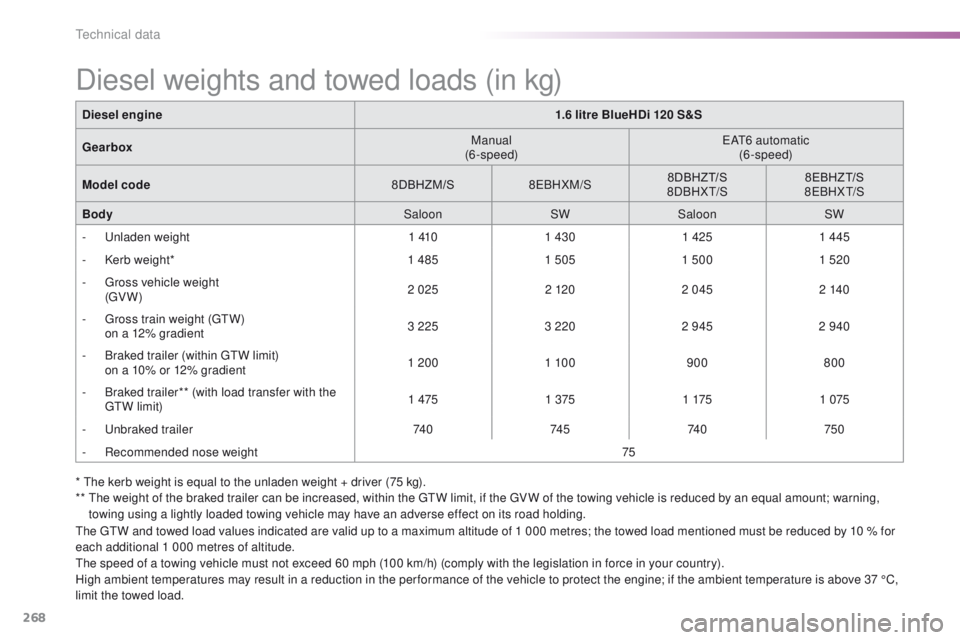
Diesel weights and towed loads (in kg)
Diesel engine 1.6 litre BlueHDi 120 S&S
Gearbox Manual
(6-speed)
eAt6
automatic
(6-speed)
Model code 8DBHZM/S8
eB
HXM/S8 D BHZ T/S
8 D BH X
t
/S8 EBHZ T/S
8
eB
H X
t
/S
Body SaloonSWSaloon SW
-
u
n
laden weight 1 4101 430 1 4251 445
-
K
erb weight* 1 4851 5051 500 1 520
-
g
r
oss vehicle weight
(
g
V
W) 2 025
2 1202 045 2 140
-
g
r
oss train weight (
g
t
W
)
o
n a 12% gradient 3 225
3 2202 945 2 940
-
B
raked trailer (within gt
W l
imit)
o
n a 10% or 12% gradient 1 200
1 10 0 900800
-
B
raked trailer** (with load transfer with the
g
t
W
limit) 1 475
1 375 1 1751 075
-
u
nb
raked trailer 74 074 5 74 0750
-
R
ecommended nose weight 75
technical data
Page 271 of 371
269
508_en_Chap09_caracteristiques-techniques_ed01-2016
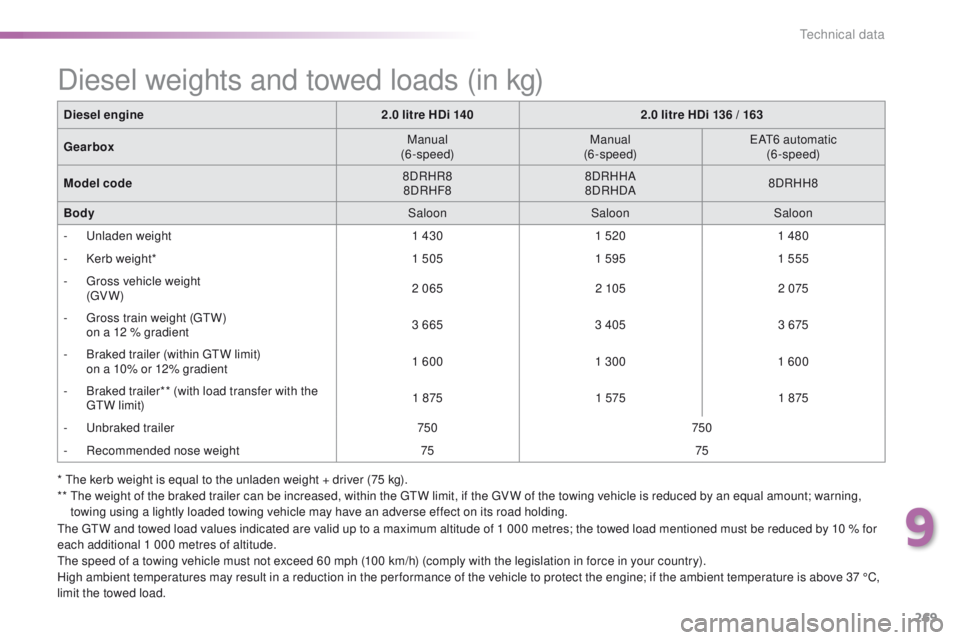
Diesel engine2.0 litre HDi 1402.0 litre HDi 136 / 163
Gearbox Manual
(6-speed) Manual
(6-speed)
eAt6
automatic
(6-speed)
Model code 8DRHR8
8DRHF8 8DRHHA
8DRHDA 8DRHH8
Body SaloonSaloonSaloon
-
u
n
laden weight 1 4301 5201 480
-
K
erb weight* 1 5051 5951 555
-
g
r
oss vehicle weight
(
g
V
W) 2 065
2 1052 075
-
g
r
oss train weight (
g
t
W
)
o
n a 12 % gradient 3 665
3 405 3 675
-
B
raked trailer (within gt
W l
imit)
o
n a 10% or 12% gradient 1 600
1 3001 600
-
B
raked trailer** (with load transfer with the
g
t
W
limit) 1 875
1 575 1 875
-
u
nb
raked trailer 750750
-
R
ecommended nose weight 7575
*
t
h
e kerb weight is equal to the unladen weight + driver (75 kg).
**
t
h
e weight of the braked trailer can be increased, within the gt
W l
imit, if the g
V
W of the towing vehicle is reduced by an equal amount; warning,
towing using a lightly loaded towing vehicle may have an adverse effect on its road holding.
th
e gt
W a
nd towed load values indicated are valid up to a maximum altitude of 1 000 metres; the towed load mentioned must be reduced by 10 % for
each additional 1 000 metres of altitude.
th
e speed of a towing vehicle must not exceed 60 mph (100 km/h) (comply with the legislation in force in your country).
High ambient temperatures may result in a reduction in the per formance of the vehicle to protect the engine; if the ambient temperature is above 37 °C,
limit the towed load.
Diesel weights and towed loads (in kg)
9
technical data
Page 272 of 371
270
508_en_Chap09_caracteristiques-techniques_ed01-2016
* the kerb weight is equal to the unladen weight + driver (75 kg).
** th e weight of the braked trailer can be increased, within the gtW l imit, if the gV W of the towing vehicle is reduced by an equal amount; warning,
towing using a lightly loaded towing vehicle may have an adverse effect on its road holding.
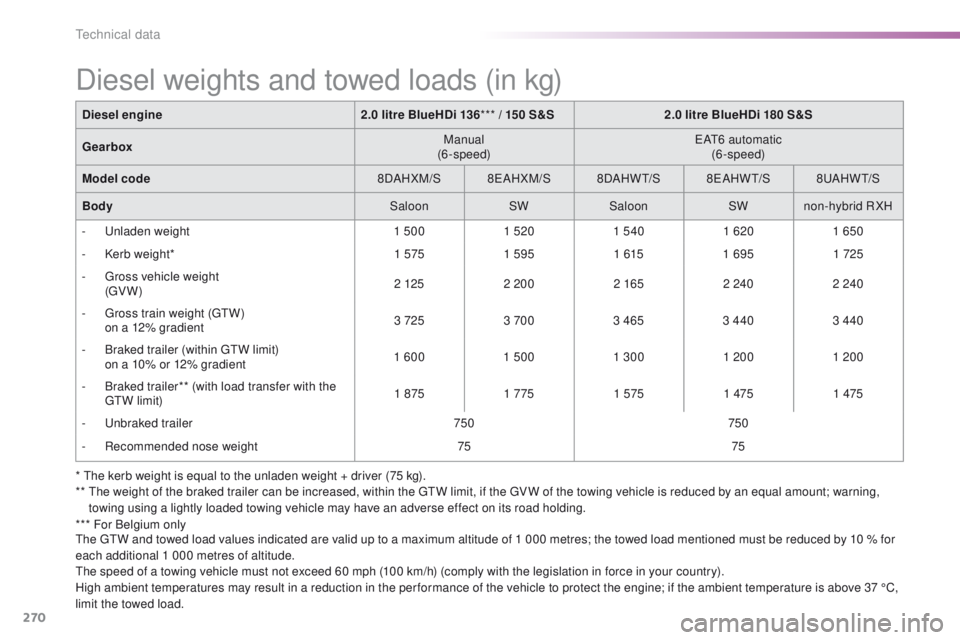
Diesel weights and towed loads (in kg)
Diesel engine 2.0 litre BlueHDi 136*** / 150 S&S 2.0 litre BlueHDi 180 S&S
Gearbox Manual
(6-speed)
eAt6
automatic
(6-speed)
Model code 8DAHXM/S 8
eAH
XM/S 8DAHW
t/
S8
eA
HW
t
/S 8
uA
HW
t
/S
Body SaloonSWSaloon SWnon-hybrid RXH
-
u
n
laden weight 1 5001 5201 540 1 6201 650
-
K
erb weight* 1 5751 595 1 6151 695 1 725
-
g
r
oss vehicle weight
(
g
V
W) 2 125
2 200 2 1652 240 2 240
-
g
r
oss train weight (
g
t
W
)
o
n a 12% gradient 3 725
3 700 3 465 3 440 3 440
-
B
raked trailer (within gt
W l
imit)
o
n a 10% or 12% gradient 1 600
1 5001 300 1 2001 200
-
B
raked trailer** (with load transfer with the
g
t
W
limit) 1 875
1 775 1 575 1 4751 475
-
u
nb
raked trailer 750750
-
R
ecommended nose weight 7575
*** For Belgium only
th
e gt
W a
nd towed load values indicated are valid up to a maximum altitude of 1 000 metres; the towed load mentioned must be reduced by 10 % for
each additional 1 000 metres of altitude.
th
e speed of a towing vehicle must not exceed 60 mph (100 km/h) (comply with the legislation in force in your country).
High ambient temperatures may result in a reduction in the per formance of the vehicle to protect the engine; if the ambient temperature is above 37 °C,
limit the towed load.
technical data
Page 279 of 371
277
508_en_Chap10c_SMegplus_ed01-2016
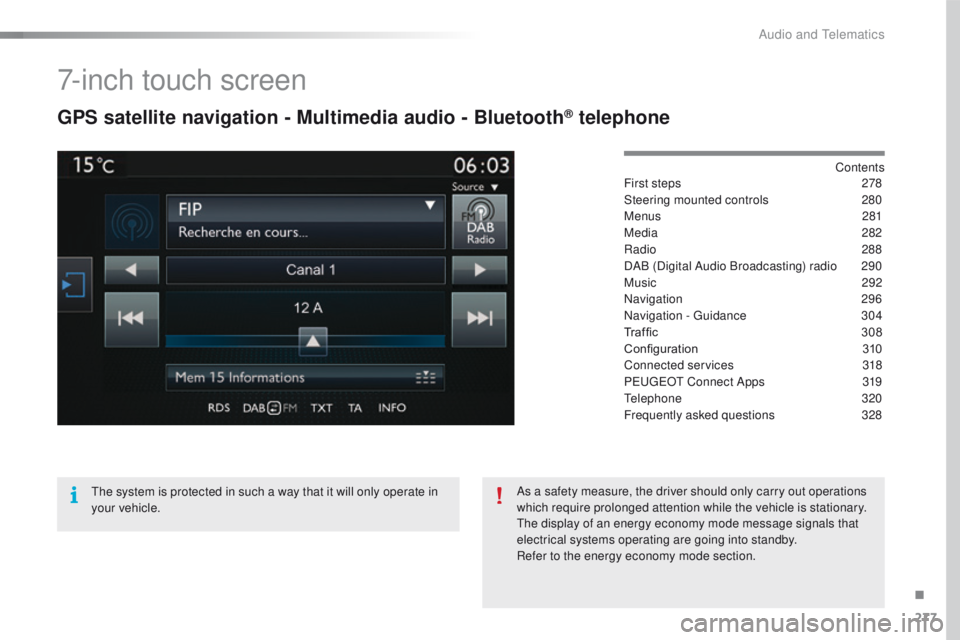
7-inch touch screen
GPS satellite navigation - Multimedia audio - Bluetooth® telephone
Contents
First steps
2 78
Steering mounted controls
2
80
Menus
281
Media
282
Radio
288
DAB (Digital Audio Broadcasting) radio
2
90
Music
292
Navigation
296
Navigation -
g
u
idance
3
04
Traffic
3
08
Configuration
3
10
Connected services
3
18
P
e
uge
Ot
Connect Apps
3
19
te
lephone
320
Frequently asked questions
3
28
th
e system is protected in such a way that it will only operate in
your vehicle. As a safety measure, the driver should only carry out operations
which require prolonged attention while the vehicle is stationary.
th
e display of an energy economy mode message signals that
electrical systems operating are going into standby.
Refer to the energy economy mode section.
.
Audio and telematics
Page 290 of 371
288
508_en_Chap10c_SMegplus_ed01-2016
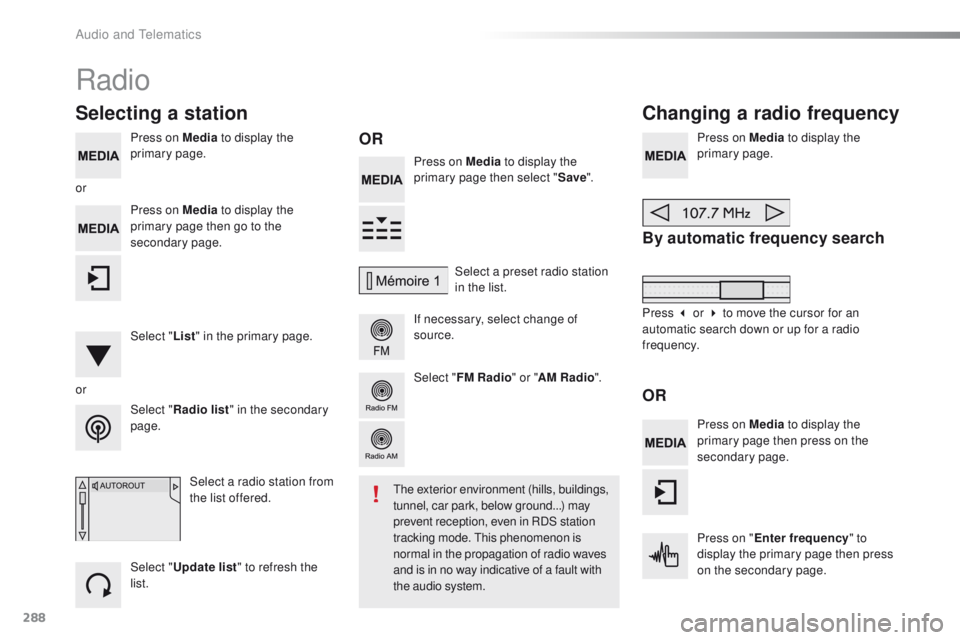
Press on Media to display the
primary page. Press on Media to display the
primary page then select " Save".
If necessary, select change of
source. Press on Media
to display the
primary page.
By automatic frequency search
Select " Radio list " in the secondary
page. Select a preset radio station
in the list.
Select " FM Radio " or "AM Radio ".
Select a radio station from
the list offered.
Select " Update list " to refresh the
list. Press on Media to display the
primary page then go to the
secondary page.
Select " List" in the primary page.
Radio
Changing a radio frequency
Selecting a station
OR
orOR
the exterior environment (hills, buildings,
tunnel, car park, below ground...) may
prevent reception, even in RDS station
tracking mode.
t
h
is phenomenon is
normal in the propagation of radio waves
and is in no way indicative of a fault with
the audio system.
or
Press 3 or 4 to move the cursor for an
automatic search down or up for a radio
frequency.Press on Media to display the
primary page then press on the
secondary page.
Press on " Enter frequency " to
display the primary page then press
on the secondary page.
Audio and telematics
Page 295 of 371
293
508_en_Chap10c_SMegplus_ed01-2016
the audio equipment will only play audio
files with ".wma, .aac, .flac, .ogg and. mp3"
file extensions and with a bit rate of between
32 Kbps and 320 Kbps.
It also supports VBR (Variable Bit Rate) mode.
No other type of file (.mp4, ...) can be played.
".wma" files must be of the standard wma 9 type.
th
e sampling rates supported are 32, 44 and
48 KHz.
It is advisable to restrict file names to
20
characters, without using of special
characters (e.g.: " " ?
; ù) to avoid any playing
and displaying problems.
Information and advice
use only uS B memory sticks formatted FAt 32
(file allocation table).
th
e system supports
u
S
B mass
storage devices, BlackBerry
® devices
or Apple® players via uS B ports. th e
adaptor cable not supplied.
Control of the peripheral device is with
the audio system controls.
Other peripherals, not recognised on
connection, must be connected to the
auxiliary socket using a Jack cable (not
supplied). It is recommended that the
u
S
B cable
for the portable device is used.
th
e system does not support the
simultaneous connection of two
identical devices (two memory sticks,
two Apple
® players) but it is possible
to connect one memory stick and one
Apple
® player at the same time.
In order to be able to play a recorded CDR or
CDRW, when recording it is preferable to select
the ISO 9660 level 1, 2 or Joliet standard.
If the disc is recorded in another format it may
not be played correctly.
It is recommended that the same recording
standard is always used for an individual disc,
with as low a speed as possible (4x maximum)
for optimum sound quality.
In the particular case of a multi-session CD, the
Joliet standard is recommended.
.
Audio and telematics