light Peugeot 508 2016 Workshop Manual
[x] Cancel search | Manufacturer: PEUGEOT, Model Year: 2016, Model line: 508, Model: Peugeot 508 2016Pages: 371, PDF Size: 12.12 MB
Page 227 of 371
225
508_en_Chap07_info-pratiques_ed01-2016
Never store bottles of AdBlue® in your
vehicle.
Recommendations on storage
AdBlue® freezes at about -11°C and
deteriorates above 25°C. It is recommended
that bottles be stored in a cool area and
protected from direct sunlight.
und
er these conditions, the additive can be
kept for at least a year.
If the additive has frozen, it can be used once it
has completely thawed out.
Procedure
Before topping-up, ensure that the vehicle is
parked on a flat and level sur face.
In wintry conditions, ensure that the
temperature of the vehicle is above -11°C.
Otherwise the AdBlue
® may be frozen and
so cannot be poured into its tank. Park your
vehicle in a warmer area for a few hours to
allow the top-up to be carried out.
F
S
witch off the ignition and remove the
key, or if your vehicle has one, press the
S
tA
R
t/
S
tO
P button to switch off the
engine. F
F
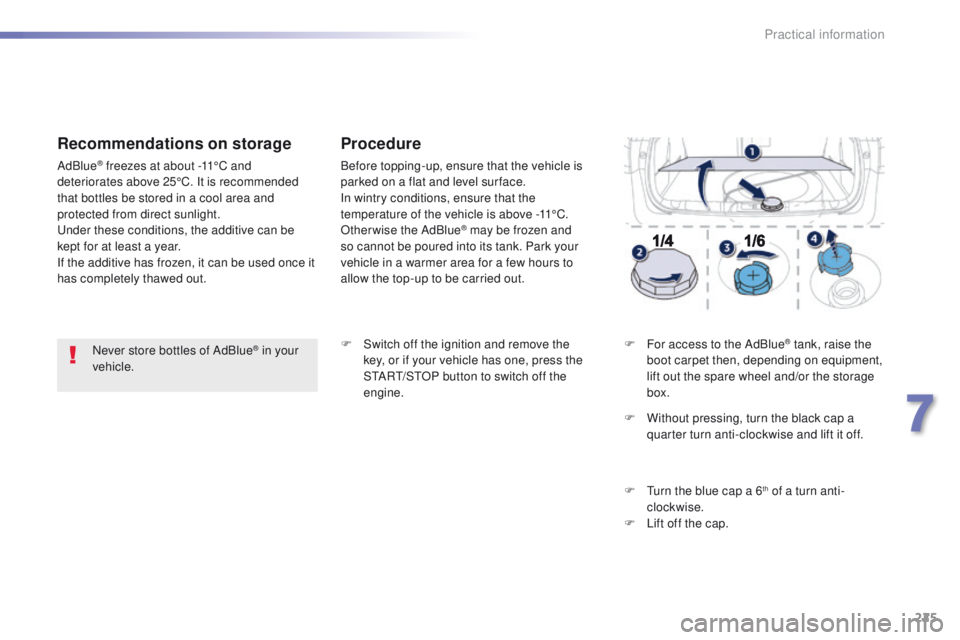
or access to the AdBlue
® tank, raise the
boot carpet then, depending on equipment,
lift out the spare wheel and/or the storage
box.
F
W
ithout pressing, turn the black cap a
quarter turn anti-clockwise and lift it off.
F
t
u
rn the blue cap a 6
th of a turn anti-
clockwise.
F
L
ift off the cap.
7
Practical information
Page 244 of 371
242
508_en_Chap08_en-cas-de-pannes_ed01-2016
Changing a bulb
Front lamps
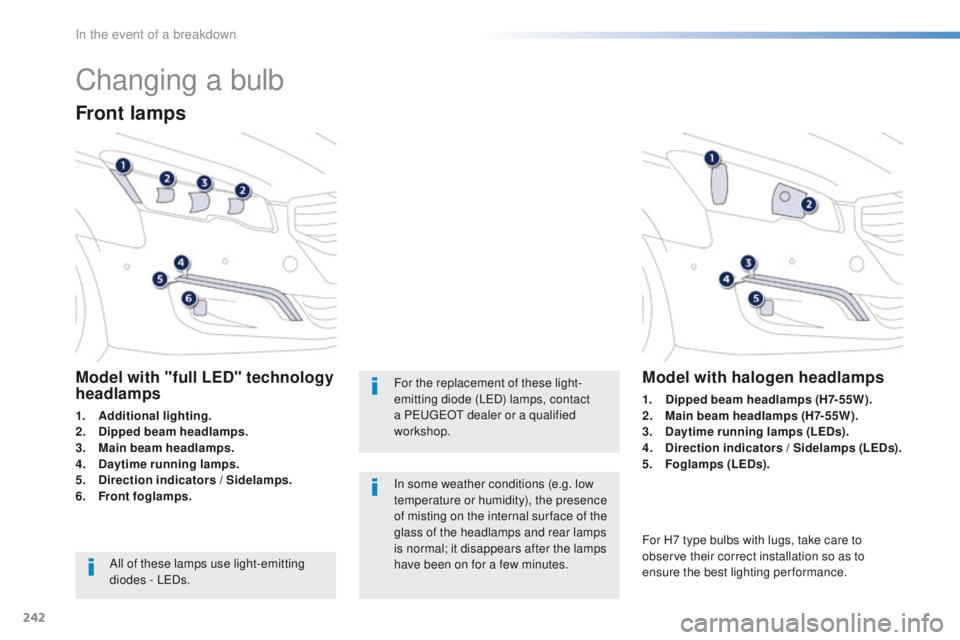
Model with "full LED" technology
headlamps
1. Additional lighting.
2. Dipped beam headlamps.
3.
M
ain beam headlamps.
4.
D
aytime running lamps.
5.
D
irection indicators / Sidelamps.
6.
F
ront foglamps. In some weather conditions (e.g. low
temperature or humidity), the presence
of misting on the internal sur face of the
glass of the headlamps and rear lamps
is normal; it disappears after the lamps
have been on for a few minutes. For the replacement of these light-
emitting diode (L
eD
) lamps, contact
a Pe ugeOt dealer or a qualified
workshop.
All of these lamps use light-emitting
diodes - L
eD
s.
Model with halogen headlamps
1. Dipped beam headlamps (H7-55W).
2. Main beam headlamps (H7-55W).
3.
D
aytime running lamps (LEDs).
4.
D
irection indicators / Sidelamps (LEDs).
5.
F
oglamps (LEDs).
For H7 type bulbs with lugs, take care to
observe their correct installation so as to
ensure the best lighting performance.
In the event of a breakdown
Page 246 of 371
244
508_en_Chap08_en-cas-de-pannes_ed01-2016
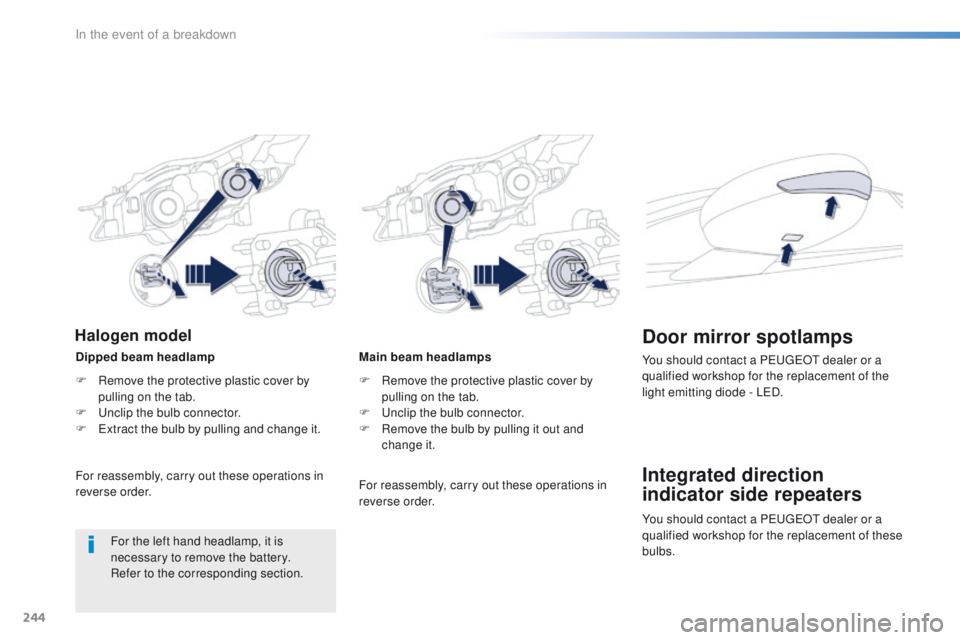
Main beam headlamps
F
R
emove the protective plastic cover by
pulling on the tab.
F
u
n
clip the bulb connector.
F
R
emove the bulb by pulling it out and
change it.
Integrated direction
indicator side repeaters Door mirror spotlamps
You should contact a Pe ugeOt dealer or a
qualified workshop for the replacement of the
light emitting diode - L
eD
.
For reassembly, carry out these operations in
reverse order.
Dipped beam headlamp
Halogen model
F Remove the protective plastic cover by
pulling on the tab.
F
u
n
clip the bulb connector.
F
e
x
tract the bulb by pulling and change it.
For reassembly, carry out these operations in
reverse order.
For the left hand headlamp, it is
necessary to remove the battery.
Refer to the corresponding section. You should contact a P
e
uge
Ot
dealer or a
qualified workshop for the replacement of these
bulbs.
In the event of a breakdown
Page 247 of 371
245
508_en_Chap08_en-cas-de-pannes_ed01-2016
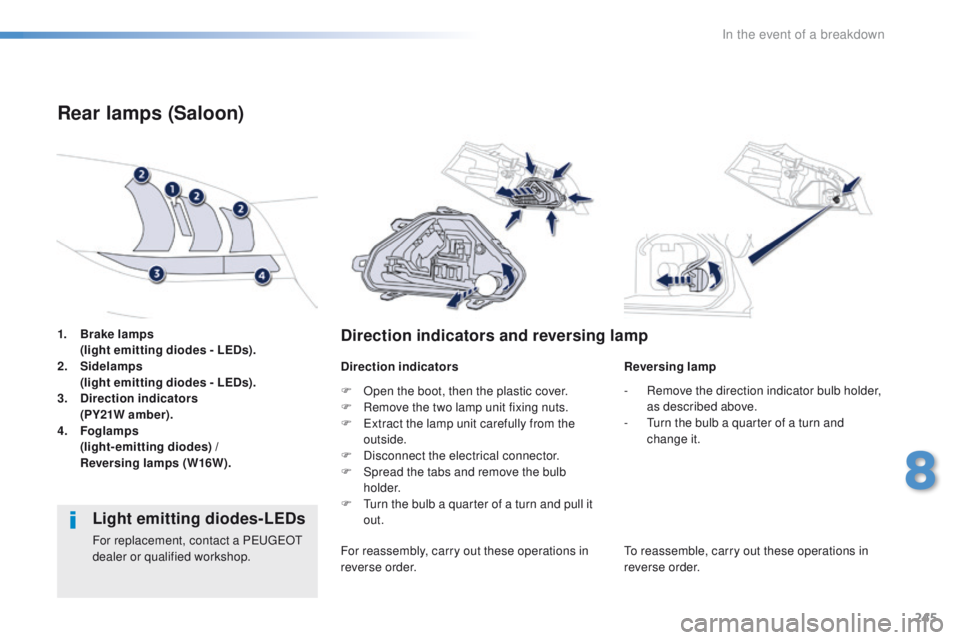
1. Brake lamps
( light emitting diodes - LEDs).
2.
Si
delamps
(
light emitting diodes - LEDs).
3.
D
irection indicators
(
PY21W amber).
4.
Fo
glamps
(
light-emitting diodes) /
R
eversing lamps (W16W).
Rear lamps (Saloon)
Direction indicators and reversing lamp
Direction indicators Reversing lamp
Light emitting diodes-LEDs
For replacement, contact a PeugeOt
dealer or qualified workshop. F
O
pen the boot, then the plastic cover.
F
R
emove the two lamp unit fixing nuts.
F e
x
tract the lamp unit carefully from the
outside.
F
D
isconnect the electrical connector.
F
S
pread the tabs and remove the bulb
h o l d e r.
F t
u
rn the bulb a quarter of a turn and pull it
out.
For reassembly, carry out these operations in
reverse order. -
R
emove the direction indicator bulb holder,
as described above.
- t
u
rn the bulb a quarter of a turn and
change it.to r eassemble, carry out these operations in
reverse order.
8
In the event of a breakdown
Page 248 of 371
246
508_en_Chap08_en-cas-de-pannes_ed01-2016
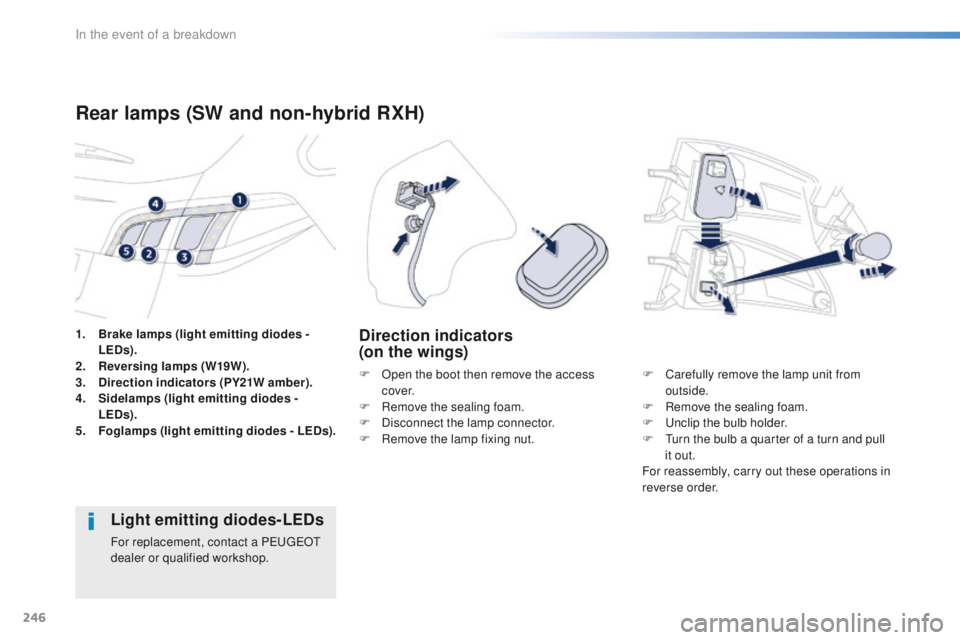
1. Brake lamps (light emitting diodes - LEDs).
2.
R
eversing lamps (W19W).
3.
D
irection indicators (PY21W amber).
4.
S
idelamps (light emitting diodes -
LEDs).
5.
F
oglamps (light emitting diodes - LEDs).
Rear lamps (SW and non-hybrid RXH)
F Open the boot then remove the access c ove r.
F
R
emove the sealing foam.
F
D
isconnect the lamp connector.
F
R
emove the lamp fixing nut.
Direction indicators
(on the wings)
F Carefully remove the lamp unit from
outside.
F
R
emove the sealing foam.
F
u
n
clip the bulb holder.
F
t
u
rn the bulb a quarter of a turn and pull
it
out.
For reassembly, carry out these operations in
reverse order.
Light emitting diodes-LEDs
For replacement, contact a Pe ugeOt
dealer or qualified workshop.
In the event of a breakdown
Page 250 of 371
248
508_en_Chap08_en-cas-de-pannes_ed01-2016
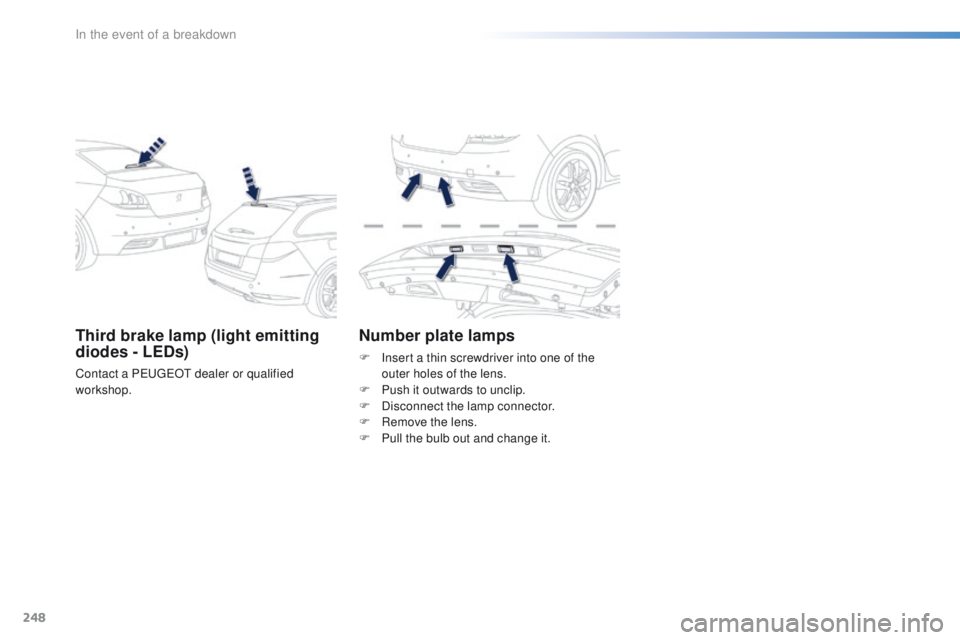
Third brake lamp (light emitting
diodes - LEDs)
Contact a PeugeOt dealer or qualified
workshop.
Number plate lamps
F Insert a thin screwdriver into one of the outer holes of the lens.
F
P
ush it outwards to unclip.
F
D
isconnect the lamp connector.
F
R
emove the lens.
F
P
ull the bulb out and change it.
In the event of a breakdown
Page 252 of 371
250
508_en_Chap08_en-cas-de-pannes_ed01-2016
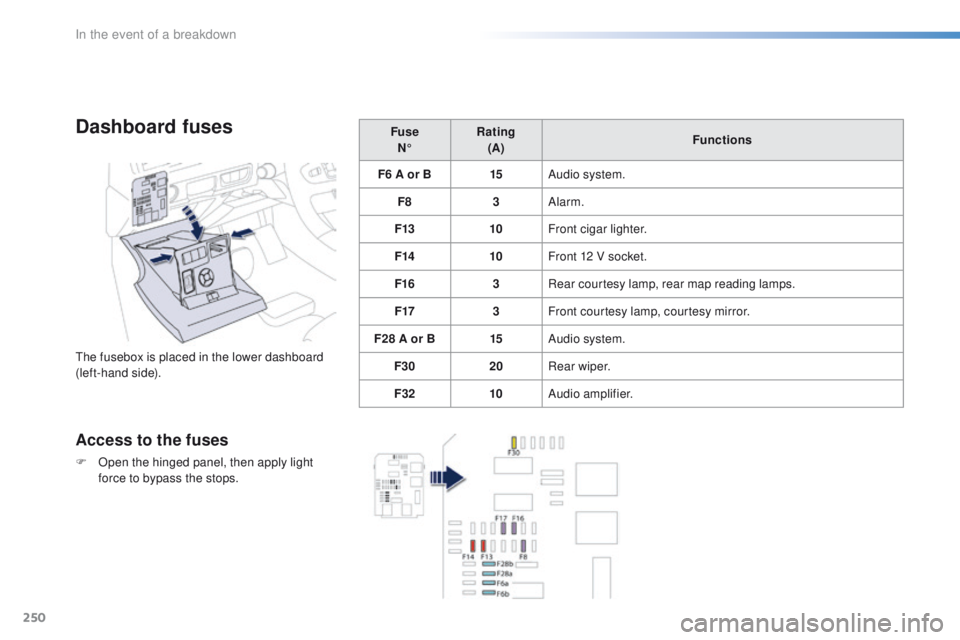
Dashboard fuses
the fusebox is placed in the lower dashboard
(left-hand side).
Access to the fuses
F Open the hinged panel, then apply light force to bypass the stops. Fuse
N° Rating
(A) Functions
F6 A or B 15Audio system.
F8 3Alarm.
F13 10Front cigar lighter.
F14 10Front 12 V socket.
F16 3Rear courtesy lamp, rear map reading lamps.
F17 3Front courtesy lamp, courtesy mirror.
F28 A or B 15Audio system.
F30 20Rear wiper.
F32 10Audio amplifier.
In the event of a breakdown
Page 256 of 371
254
508_en_Chap08_en-cas-de-pannes_ed01-2016
Some functions, including Stop & Start,
are not available if the battery is not
sufficiently charged.
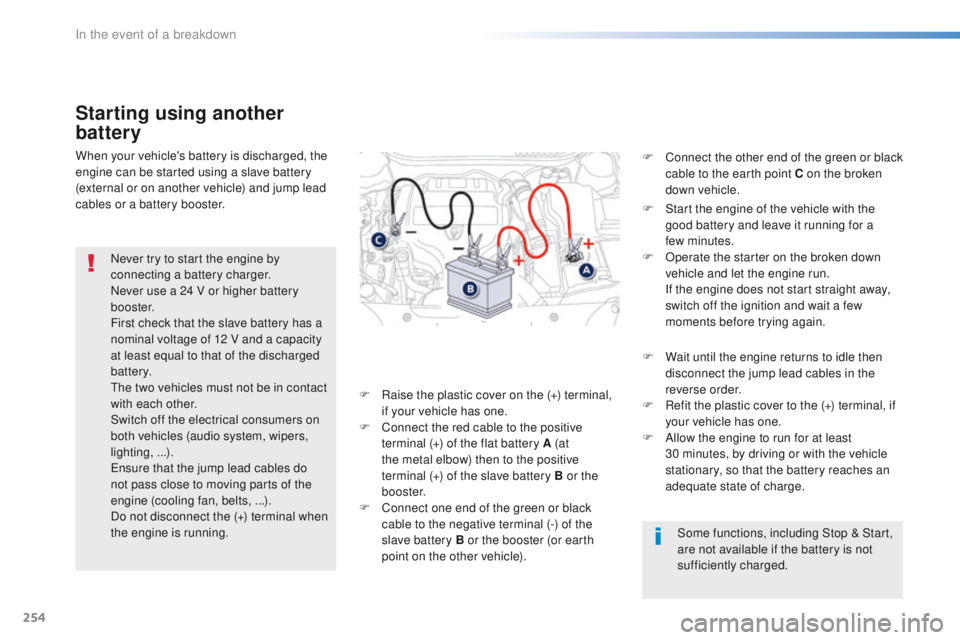
F
C
onnect the other end of the green or black
cable to the earth point C on the broken
down vehicle.
F
S
tart the engine of the vehicle with the
good battery and leave it running for a
few
minutes.
F
O
perate the starter on the broken down
vehicle and let the engine run.
I
f the engine does not start straight away,
switch off the ignition and wait a few
moments before trying again.
When your vehicle's battery is discharged, the
engine can be started using a slave battery
(external or on another vehicle) and jump lead
cables or a battery booster.
Starting using another
battery
Never try to start the engine by
connecting a battery charger.
Never use a 24 V or higher battery
b o o s t e r.
First check that the slave battery has a
nominal voltage of 12 V and a capacity
at least equal to that of the discharged
battery.
th
e two vehicles must not be in contact
with each other.
Switch off the electrical consumers on
both vehicles (audio system, wipers,
lighting, ...).
en
sure that the jump lead cables do
not pass close to moving parts of the
engine (cooling fan, belts, ...).
Do not disconnect the (+) terminal when
the engine is running. F
R
aise the plastic cover on the (+) terminal,
if your vehicle has one.
F
C
onnect the red cable to the positive
terminal (+) of the flat battery A (at
the metal elbow) then to the positive
terminal
(+) of the slave battery B or the
b o o s t e r.
F
C
onnect one end of the green or black
cable to the negative terminal (-) of the
slave battery B or the booster (or earth
point on the other vehicle). F
W
ait until the engine returns to idle then
disconnect the jump lead cables in the
reverse order.
F
R
efit the plastic cover to the (+) terminal, if
your vehicle has one.
F
A
llow the engine to run for at least
30
minutes, by driving or with the vehicle
stationary, so that the battery reaches an
adequate state of charge.
In the event of a breakdown
Page 257 of 371
255
508_en_Chap08_en-cas-de-pannes_ed01-2016
Follow the instructions for use provided
by the manufacturer of the charger.
Never reverse polarities.
For optimum service life of the battery, it is
essential to maintain an adequate state of
charge.
In some circumstances it may be necessary to
charge the battery:
-
i
f you use your vehicle essentially for short
journeys,
-
i
f the vehicle is to be taken off the road for
several weeks.
Contact a P
e
uge
Ot
dealer or a qualified
workshop.
Charging the battery using
a battery charger
If you envisage charging your vehicle's
battery yourself, use only a charger
compatible with lead-acid batteries of a
nominal voltage of 12 V.
If this label is present, it is essential
to use only a 12 V charger, to avoid
causing irreversible damage to the
electrical components related to the
Stop & Start system. Never try to charge a frozen battery.
If the battery has been frozen, have it
checked by a P
e
uge
Ot
dealer or a
qualified workshop, who will check that
the internal components have not been
damaged and the casing is not cracked,
which could cause a leak of toxic and
corrosive acid.
It is not necessary to disconnect the
battery.
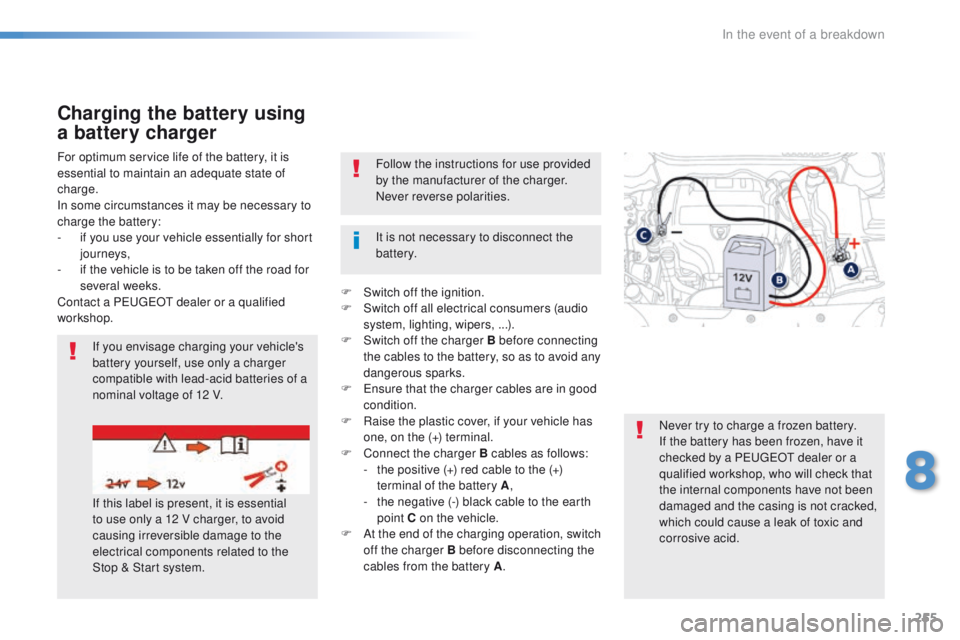
F
S
witch off the ignition.
F
S
witch off all electrical consumers (audio
system, lighting, wipers, ...).
F S witch off the charger B before connecting
the cables to the battery, so as to avoid any
dangerous sparks.
F
e
n
sure that the charger cables are in good
condition.
F
R
aise the plastic cover, if your vehicle has
one, on the (+) terminal.
F
C
onnect the charger B cables as follows:
-
t
he positive (+) red cable to the (+)
terminal of the battery A ,
-
t
he negative (-) black cable to the earth
point C on the vehicle.
F
A
t the end of the charging operation, switch
off the charger B before disconnecting the
cables from the battery A .
8
In the event of a breakdown
Page 258 of 371
256
508_en_Chap08_en-cas-de-pannes_ed01-2016
Do not force the lever as locking will
not be possible if the clamp is not
positioned correctly; start the procedure
again.
Disconnecting the battery
In order to maintain an adequate state
of charge for starting the engine, it is
recommended that the battery be disconnected
if the vehicle is taken out of service for a long
period.
Wait 2 minutes after switching off the ignition
before disconnecting the battery.
F
c
lose the windows and the doors before
disconnecting the battery,
F
s
witch off all electrical consumers (audio
system, wipers, lighting, ...),
F
s
witch off the ignition and wait for
four
minutes.
Having exposed the battery, it is only
necessary to disconnect the (+) terminal.Following reconnection of
the battery
After reconnecting the battery, switch on the
ignition and wait 1 minute before starting to
allow initialisation of the electronic systems.
However, if minor problems persist following
this operation, contact a P
e
uge
Ot
dealer or a
qualified workshop.
Referring to the corresponding section, you
must yourself reinitialise or reset certain
systems, such as:
-
t
he remote control or electronic key
(depending on version),
-
t
he electric blind(s),
-
t
he electric windows
-
t
he date and time,
-
t
he radio preset stations.
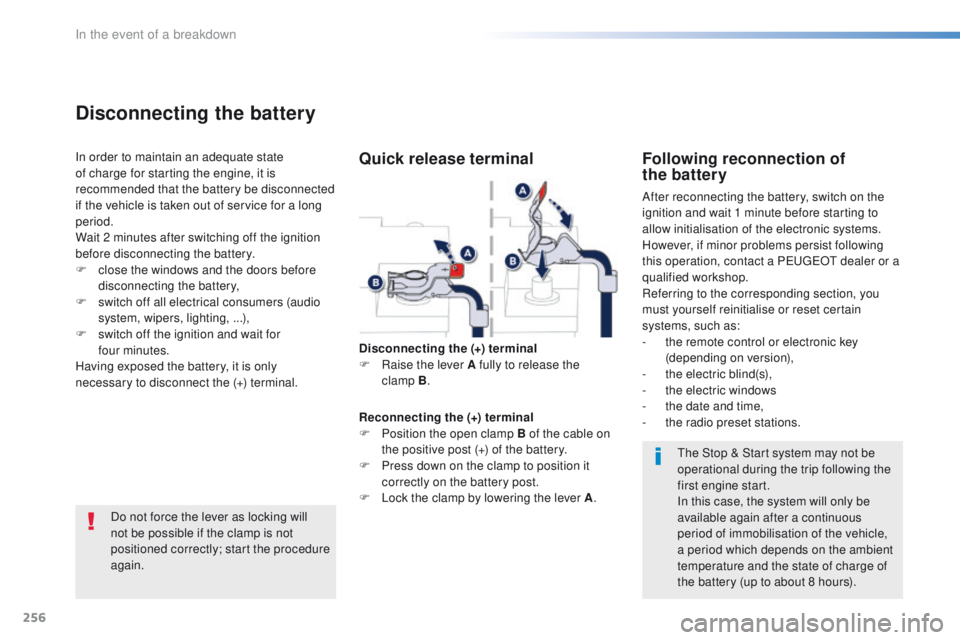
Quick release terminal
Disconnecting the (+) terminal
F Ra ise the lever A fully to release the
clamp
B.
Reconnecting the (+) terminal
F
P
osition the open clamp B of the cable on
the positive post (+) of the battery.
F
P
ress down on the clamp to position it
correctly on the battery post.
F
L
ock the clamp by lowering the lever A .
th
e Stop & Start system may not be
operational during the trip following the
first engine start.
In this case, the system will only be
available again after a continuous
period of immobilisation of the vehicle,
a period which depends on the ambient
temperature and the state of charge of
the battery (up to about 8 hours).
In the event of a breakdown