ignition Peugeot 508 2016 Repair Manual
[x] Cancel search | Manufacturer: PEUGEOT, Model Year: 2016, Model line: 508, Model: Peugeot 508 2016Pages: 371, PDF Size: 12.12 MB
Page 172 of 371
170
508_en_Chap06_conduite_ed01-2016
Automatic release
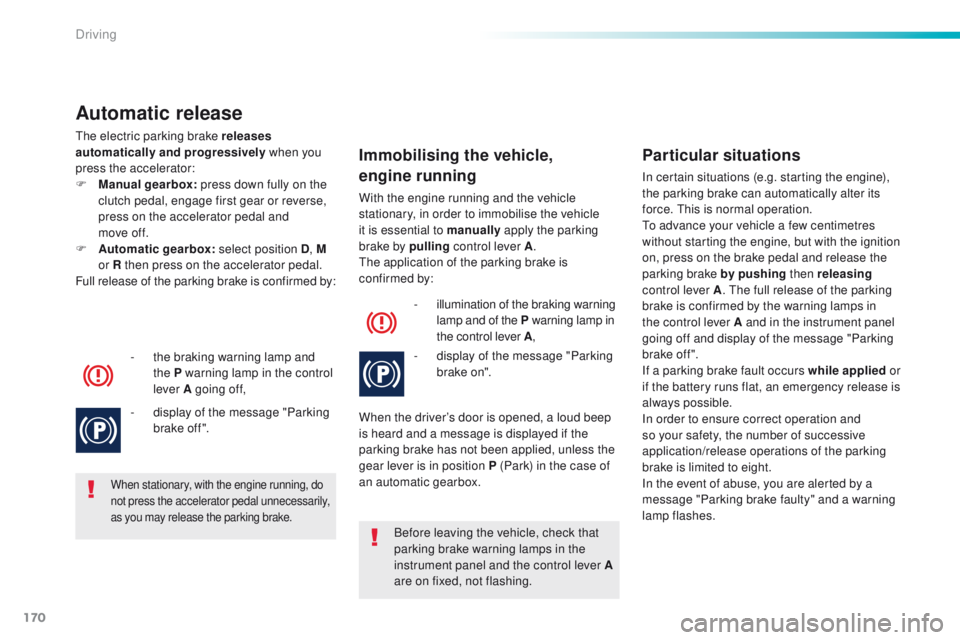
the electric parking brake releases
automatically and progressively when you
press the accelerator:
F
M
anual gearbox: press down fully on the
clutch pedal, engage first gear or reverse,
press on the accelerator pedal and
move
off.
F
A
utomatic gearbox: select position D, M
or R then press on the accelerator pedal.
Full release of the parking brake is confirmed by:
-
t
he braking warning lamp and
the P warning lamp in the control
lever A going of f,
-
d
isplay of the message "Parking
brake of f ".
When stationary, with the engine running, do
not press the accelerator pedal unnecessarily,
as you may release the parking brake.
Before leaving the vehicle, check that
parking brake warning lamps in the
instrument panel and the control lever A
are on fixed, not flashing.
Immobilising the vehicle,
engine running
With the engine running and the vehicle
stationary, in order to immobilise the vehicle
it is essential to manually apply the parking
brake by pulling control lever A.
th
e application of the parking brake is
confirmed by:
-
i
llumination of the braking warning
lamp and of the P warning lamp in
the control lever A ,
-
d
isplay of the message "Parking
brake on".
When the driver’s door is opened, a loud beep
is heard and a message is displayed if the
parking brake has not been applied, unless the
gear lever is in position P (Park) in the case of
an automatic gearbox.
Particular situations
In certain situations (e.g. starting the engine),
the parking brake can automatically alter its
force. t
h
is is normal operation.
to a
dvance your vehicle a few centimetres
without starting the engine, but with the ignition
on, press on the brake pedal and release the
parking brake by pushing then releasing
control lever A .
t
h
e full release of the parking
brake is confirmed by the warning lamps in
the control lever A and in the instrument panel
going off and display of the message "Parking
brake of f ".
If a parking brake fault occurs while applied or
if the battery runs flat, an emergency release is
always possible.
In order to ensure correct operation and
so your safety, the number of successive
application/release operations of the parking
brake is limited to eight.
In the event of abuse, you are alerted by a
message "Parking brake faulty" and a warning
lamp flashes.
Driving
Page 175 of 371
173
508_en_Chap06_conduite_ed01-2016
SituationsConsequences
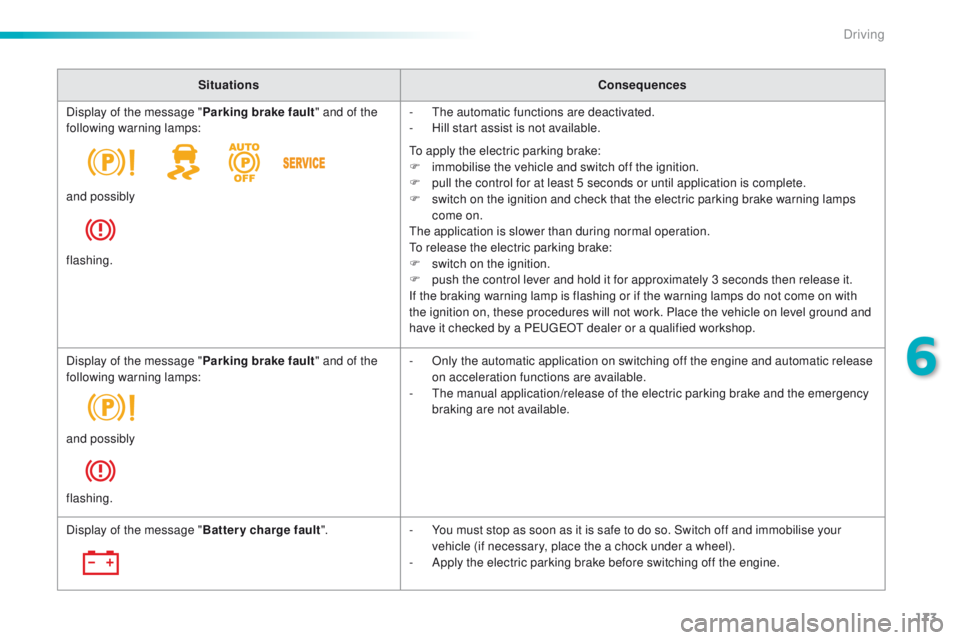
Display of the message " Parking brake fault" and of the
following warning lamps: -
t
h
e automatic functions are deactivated.
-
H
ill start assist is not available.
to a
pply the electric parking brake:
F
i
mmobilise the vehicle and switch off the ignition.
F
p
ull the control for at least 5 seconds or until application is complete.
F
s
witch on the ignition and check that the electric parking brake warning lamps
come on.
th
e application is slower than during normal operation.
to r
elease the electric parking brake:
F
s
witch on the ignition.
F
p
ush the control lever and hold it for approximately 3 seconds then release it.
If the braking warning lamp is flashing or if the warning lamps do not come on with
the ignition on, these procedures will not work. Place the vehicle on level ground and
have it checked by a P
e
uge
Ot
dealer or a qualified workshop.
and possibly
flashing.
Display of the message "
Parking brake fault" and of the
following warning lamps: -
O
nly the automatic application on switching off the engine and automatic release
on acceleration functions are available.
-
t
h
e manual application/release of the electric parking brake and the emergency
braking are not available.
and possibly
flashing.
Display of the message " Battery charge fault".-
Y
ou must stop as soon as it is safe to do so. Switch off and immobilise your
vehicle (if necessary, place the a chock under a wheel).
-
A
pply the electric parking brake before switching off the engine.
6
Driving
Page 181 of 371
179
508_en_Chap06_conduite_ed01-2016
Manual operation
F Select position M for sequential changing
of the six gears.
F
P
ull the lever towards the + sign to change
up a gear.
F
P
ush the lever towards the - sign to change
down a gear.
It is only possible to change from one gear to
another if the vehicle speed and engine speed
permit; otherwise, the gearbox will operate
temporarily in automatic mode.
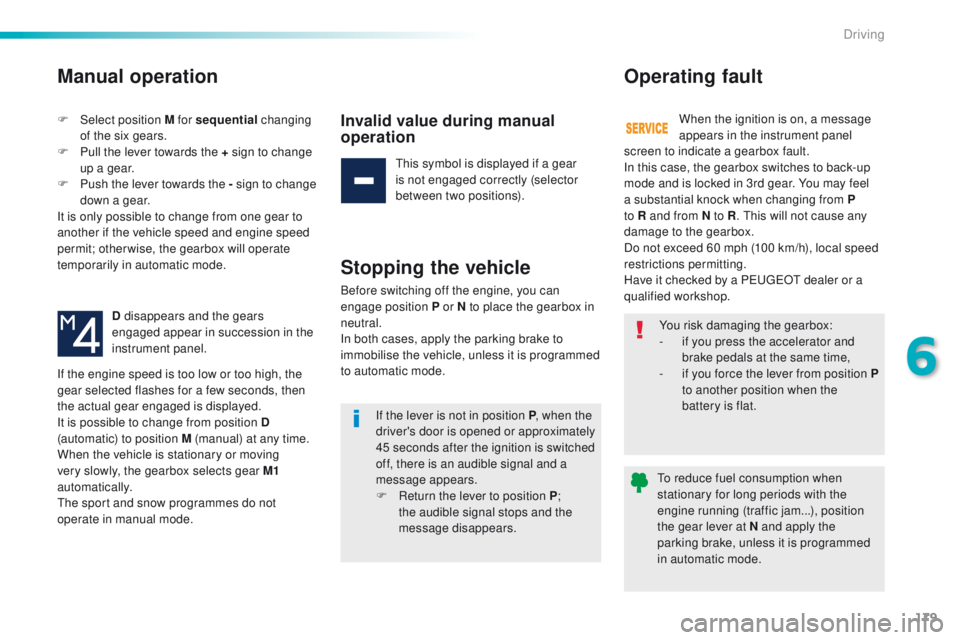
D disappears and the gears
engaged appear in succession in the
instrument panel.Invalid value during manual
operation
this symbol is displayed if a gear
is not engaged correctly (selector
between two positions).
Stopping the vehicle
Before switching off the engine, you can
engage position P or N to place the gearbox in
neutral.
In both cases, apply the parking brake to
immobilise the vehicle, unless it is programmed
to automatic mode.
Operating fault
When the ignition is on, a message
appears in the instrument panel
If the engine speed is too low or too high, the
gear selected flashes for a few seconds, then
the actual gear engaged is displayed.
It is possible to change from position D
(automatic) to position M (manual) at any time.
When the vehicle is stationary or moving
very slowly, the gearbox selects gear M1
automatically.
th
e sport and snow programmes do not
operate in manual mode. You risk damaging the gearbox:
-
i
f you press the accelerator and
brake pedals at the same time,
-
i
f you force the lever from position P
to another position when the
battery is flat.
If the lever is not in position P , when the
driver's door is opened or approximately
45 seconds after the ignition is switched
off, there is an audible signal and a
message appears.
F
R
eturn the lever to position P ;
the audible signal stops and the
message disappears.
to r
educe fuel consumption when
stationary for long periods with the
engine running (traffic jam...), position
the gear lever at N and apply the
parking brake, unless it is programmed
in automatic mode.
screen to indicate a gearbox fault.
In this case, the gearbox switches to back-up
mode and is locked in 3rd gear. You may feel
a substantial knock when changing from P
to R and from N to R
.
t
h
is will not cause any
damage to the gearbox.
Do not exceed 60 mph (100 km/h), local speed
restrictions permitting.
Have it checked by a P
e
uge
Ot
dealer or a
qualified workshop.
6
Driving
Page 182 of 371
180
508_en_Chap06_conduite_ed01-2016
Stop & Start
Operation
Going into engine STOP mode
the "ECO" indicator lamp comes
on in the instrument panel and the
engine goes into standby:
-
w
ith a manual gearbox, at speeds below
12 mph (20 km/h), or vehicle stationary
with the e-
tH
P 165 version, when you put
the gear lever into neutral and release the
clutch pedal,
-
w
ith an automatic gearbox, vehicle
stationary, when you press the brake pedal
or you put the gear selector in position N .
If your vehicle is fitted with the system, a time
counter calculates the sum of the periods in
S
tO
P mode during a journey. It rests itself to
zero every time the ignition is switched on with
t h e key. Never refuel with the engine in
S
tO
P mode; you must switch off the
ignition with the key. For your comfort, during parking
maoeuvres, S
tO
P mode is not
available for a few seconds after
coming out of reverse gear.
S
tO
P mode does not affect the
functionality of the vehicle, such as for
example, braking, power steering...
th
e Stop & Start
system puts the engine
temporarily into standby - S
tO
P mode -
during stops in the traffic (red lights, traffic
jams, or other...).
t
h
e engine restarts
automatically
-
StA
Rt
mode - as soon as
you want to move off.
th
e restart takes place
instantly, quickly and silently.
Per fect for urban use, the Stop & Start system
reduces fuel consumption and exhaust
emissions as well as the noise level when
stationary.
Driving
Page 184 of 371
182
508_en_Chap06_conduite_ed01-2016
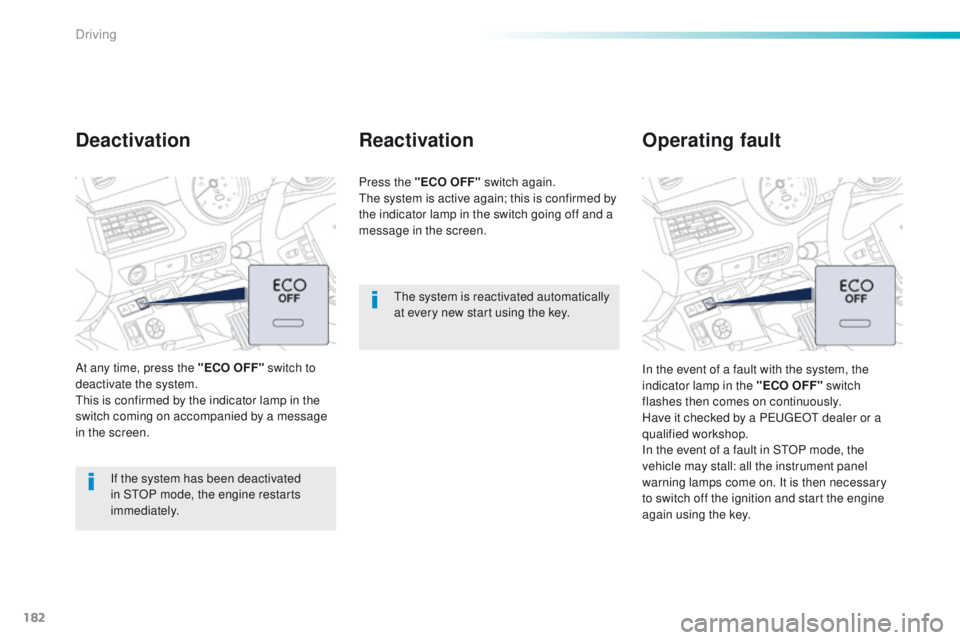
the system is reactivated automatically
at every new start using the key.
Reactivation
Press the "ECO OFF" switch again.the system is active again; this is confirmed by
the indicator lamp in the switch going off and a
message in the screen.
Operating fault
In the event of a fault with the system, the
indicator lamp in the "ECO OFF" switch
flashes then comes on continuously.
Have it checked by a P
e
uge
Ot
dealer or a
qualified workshop.
In the event of a fault in S
tO
P mode, the
vehicle may stall: all the instrument panel
warning lamps come on. It is then necessary
to switch off the ignition and start the engine
again using the key.
If the system has been deactivated
in S
tO
P mode, the engine restarts
immediately.
At any time, press the "ECO OFF"
switch to
deactivate the system.
th
is is confirmed by the indicator lamp in the
switch coming on accompanied by a message
in the screen.
Deactivation
Driving
Page 186 of 371
184
508_en_Chap06_conduite_ed01-2016
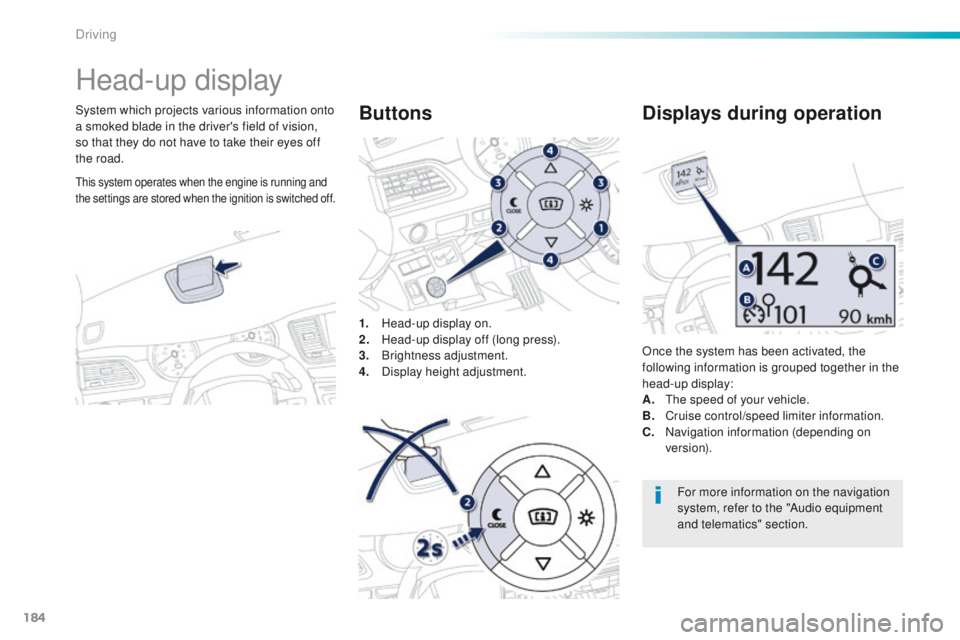
Head-up display
System which projects various information onto
a smoked blade in the driver's field of vision,
so that they do not have to take their eyes off
the road.1.
H
ead-up display on.
2.
H
ead-up display off (long press).
3.
Br
ightness adjustment.
4.
D
isplay height adjustment.Buttons
Once the system has been activated, the
following information is grouped together in the
head-up display:
A.
t
h
e speed of your vehicle.
B.
C
ruise control/speed limiter information.
C.
N
avigation information (depending on
ve r s i o n).
Displays during operation
For more information on the navigation
system, refer to the "Audio equipment
and telematics" section.
this system operates when the engine is running and
the settings are stored when the ignition is switched off.
Driving
Page 190 of 371
188
508_en_Chap06_conduite_ed01-2016
Speed limiter
System which prevents the vehicle from
exceeding the speed programmed by the
driver.
When the programmed speed limit is reached,
pressing the accelerator pedal no longer
has any effect unless it is pressed firmly,
which allows you to temporarily exceed the
programmed speed.
to r
eturn to the programmed speed, simply
slow down to a speed below the programmed
speed by releasing the accelerator.
th
e speed limiter is switched on manually:
it requires a programmed speed of at least
20
mph (30 km/h).
th
e speed limiter is switched off by manual
operation of the control.
th
e programmed speed remains in the memory
when the ignition is switched off.
th
e speed limiter cannot, in any
circumstances, replace the need to
observe speed limits, nor can it replace
the need for vigilance and responsibility
on the part of the driver.
th
is information also appears in the
head-up display.
For more information, refer to the
"Head-up display" section.
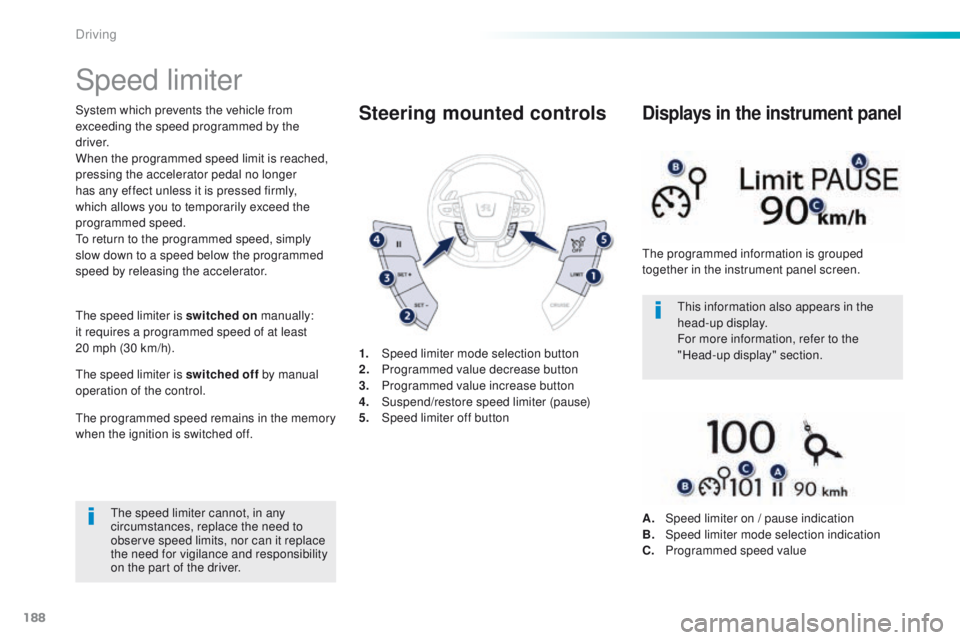
1.
Spe
ed limiter mode selection button
2.
P
rogrammed value decrease button
3.
P
rogrammed value increase button
4.
S
uspend/restore speed limiter (pause)
5.
Spe
ed limiter off buttonSteering mounted controls
the programmed information is grouped
together in the instrument panel screen.
Displays in the instrument panel
A. Speed limiter on / pause indication
B. Spe ed limiter mode selection indication
C.
P
rogrammed speed value
Driving
Page 192 of 371
190
508_en_Chap06_conduite_ed01-2016
Cruise control
System which automatically maintains the
speed of the vehicle at the value programmed
by the driver, without any action on the
accelerator pedal.
th
e cruise control is switched on manually: it
requires a minimum vehicle speed of 25 mph
(40 km/h) and the engagement of:
-
4
th gear or higher with a manual gearbox,
-
2nd gear or higher with an automatic
gearbox,
-
position D with an automatic gearbox.
th
e cruise control is switched off manually
or by pressing the brake or clutch pedal or
on triggering of the
e SC system for safety
reasons.
It is possible to exceed the programmed speed
temporarily by pressing the accelerator pedal.
to r
eturn to the programmed speed, simply
release the accelerator pedal.
Switching off the ignition cancels any
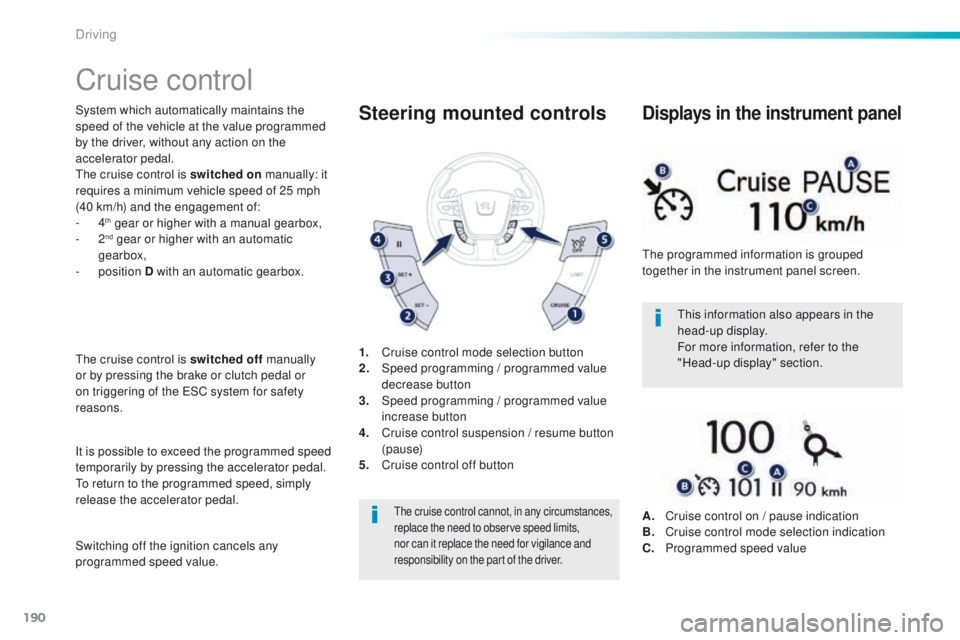
programmed speed value. 1.
C
ruise control mode selection button
2.
S
peed programming
/ programmed value
decrease button
3.
S
peed programming
/ programmed value
increase button
4.
C
ruise control suspension / resume button
(pause)
5.
C
ruise control off button
Steering mounted controls
the cruise control cannot, in any circumstances,
replace the need to observe speed limits,
nor can it replace the need for vigilance and
responsibility on the part of the driver.
this information also appears in the
head-up display.
For more information, refer to the
"Head-up display" section.
th
e programmed information is grouped
together in the instrument panel screen.
Displays in the instrument panel
A. Cruise control on / pause indication
B. C ruise control mode selection indication
C.
P
rogrammed speed value
Driving
Page 199 of 371
197
508_en_Chap06_conduite_ed01-2016
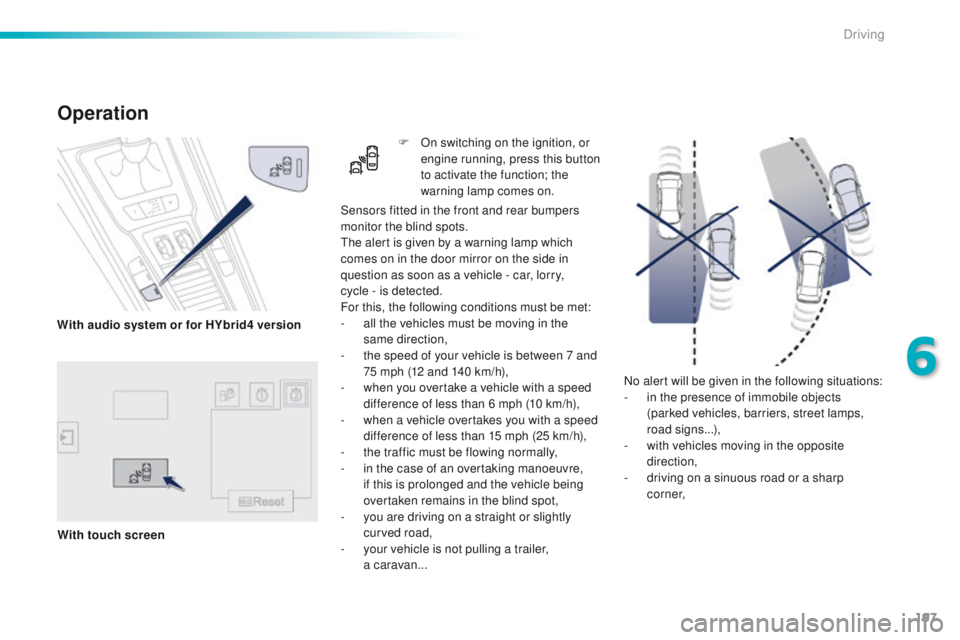
No alert will be given in the following situations:
- i n the presence of immobile objects
(parked vehicles, barriers, street lamps,
road signs...),
-
w
ith vehicles moving in the opposite
direction,
-
d
riving on a sinuous road or a sharp
c o r n e r,
Sensors fitted in the front and rear bumpers
monitor the blind spots.
th
e alert is given by a warning lamp which
comes on in the door mirror on the side in
question as soon as a vehicle - car, lorry,
cycle
- is detected.
For this, the following conditions must be met:
-
a
ll the vehicles must be moving in the
same direction,
-
t
he speed of your vehicle is between 7 and
75 mph (12 and 140 km/h),
-
w
hen you overtake a vehicle with a speed
difference of less than 6 mph (10 km/h),
-
w
hen a vehicle overtakes you with a speed
difference of less than 15 mph (25 km/h),
-
t
he traffic must be flowing normally,
-
i
n the case of an overtaking manoeuvre,
if this is prolonged and the vehicle being
overtaken remains in the blind spot,
-
y
ou are driving on a straight or slightly
curved road,
-
y
our vehicle is not pulling a trailer,
a
caravan...
Operation
F On switching on the ignition, or engine running, press this button
to activate the function; the
warning lamp comes on.
With audio system or for HYbrid4 version
With touch screen
6
Driving
Page 200 of 371
198
508_en_Chap06_conduite_ed01-2016
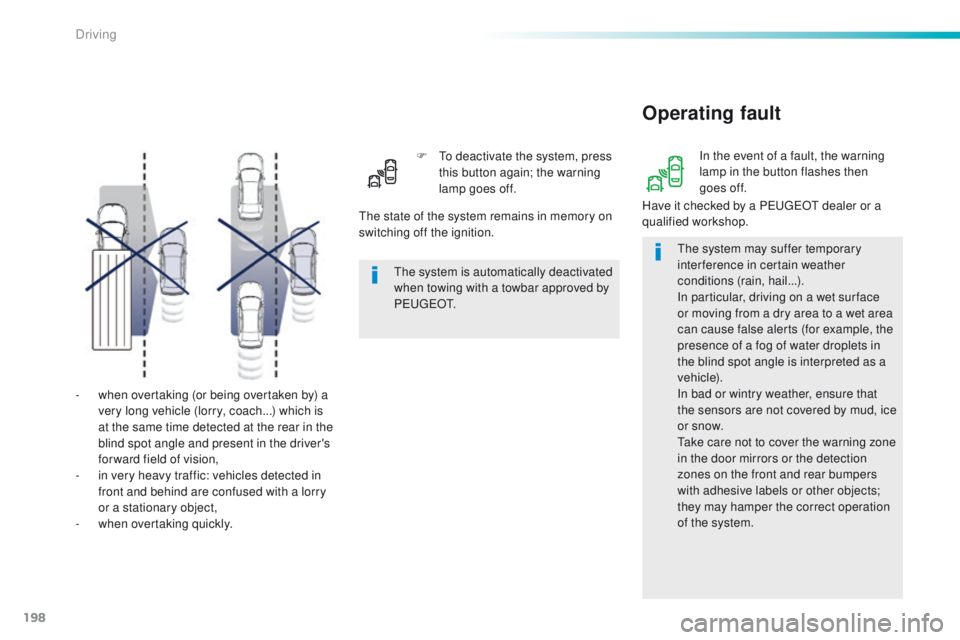
- when overtaking (or being overtaken by) a very long vehicle (lorry, coach...) which is
at the same time detected at the rear in the
blind spot angle and present in the driver's
forward field of vision,
-
i
n very heavy traffic: vehicles detected in
front and behind are confused with a lorry
or a stationary object,
-
w
hen overtaking quickly. F
t
o d
eactivate the system, press
this button again; the warning
lamp goes off.
Operating fault
the system may suffer temporary
interference in certain weather
conditions (rain, hail...).
In particular, driving on a wet sur face
or moving from a dry area to a wet area
can cause false alerts (for example, the
presence of a fog of water droplets in
the blind spot angle is interpreted as a
vehicle).
In bad or wintry weather, ensure that
the sensors are not covered by mud, ice
or snow.
ta
ke care not to cover the warning zone
in the door mirrors or the detection
zones on the front and rear bumpers
with adhesive labels or other objects;
they may hamper the correct operation
of the system. In the event of a fault, the warning
lamp in the button flashes then
goes
off.
Have it checked by a P
e
uge
Ot
dealer or a
qualified workshop.
th
e state of the system remains in memory on
switching off the ignition.
th
e system is automatically deactivated
when towing with a towbar approved by
P
e
u g e
Ot
.
Driving