ignition Peugeot 508 2016 Service Manual
[x] Cancel search | Manufacturer: PEUGEOT, Model Year: 2016, Model line: 508, Model: Peugeot 508 2016Pages: 371, PDF Size: 12.12 MB
Page 121 of 371
119
508_en_Chap04_eclairage-et-visibilite_ed01-2016
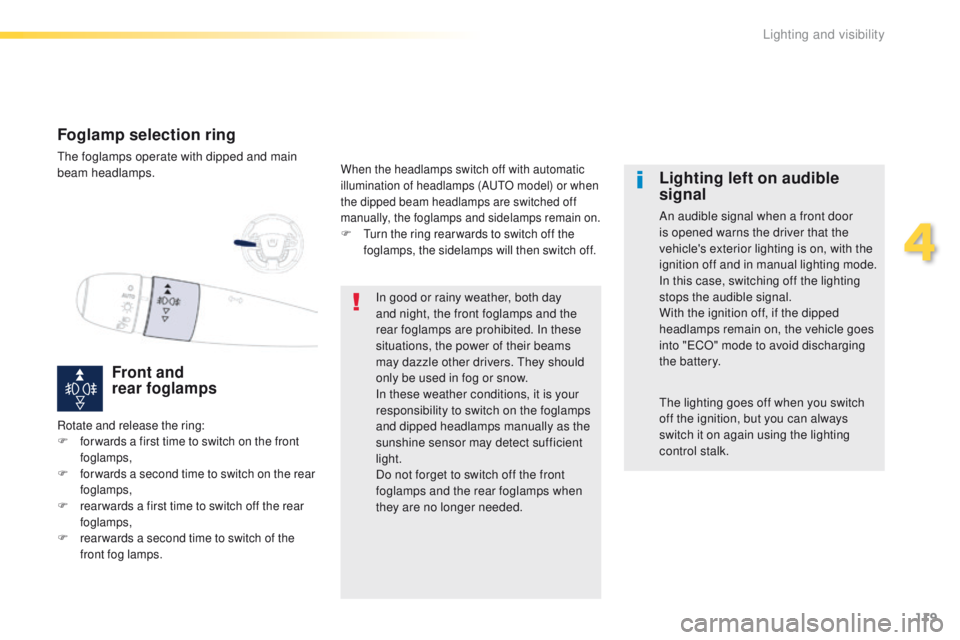
Foglamp selection ring
the foglamps operate with dipped and main
beam headlamps.
Front and
rear foglamps
When the headlamps switch off with automatic
illumination of headlamps (AutO m odel) or when
the dipped beam headlamps are switched off
manually, the foglamps and sidelamps remain on.
F turn the ring rear wards to switch off the foglamps, the sidelamps will then switch off.
In good or rainy weather, both day
and night, the front foglamps and the
rear foglamps are prohibited. In these
situations, the power of their beams
may dazzle other drivers.
t
he
y should
only be used in fog or snow.
In these weather conditions, it is your
responsibility to switch on the foglamps
and dipped headlamps manually as the
sunshine sensor may detect sufficient
light.
Do not forget to switch off the front
foglamps and the rear foglamps when
they are no longer needed.
Rotate and release the ring:
F f or wards a first time to switch on the front
foglamps,
F
f
or wards a second time to switch on the rear
foglamps,
F
r
ear wards a first time to switch off the rear
foglamps,
F
r
ear wards a second time to switch of the
front fog lamps.
Lighting left on audible
signal
An audible signal when a front door
is opened warns the driver that the
vehicle's exterior lighting is on, with the
ignition off and in manual lighting mode.
In this case, switching off the lighting
stops the audible signal.
With the ignition off, if the dipped
headlamps remain on, the vehicle goes
into "
eC
O" mode to avoid discharging
the battery.
th
e lighting goes off when you switch
off the ignition, but you can always
switch it on again using the lighting
control stalk.
4
Lighting and visibility
Page 124 of 371
122
508_en_Chap04_eclairage-et-visibilite_ed01-2016
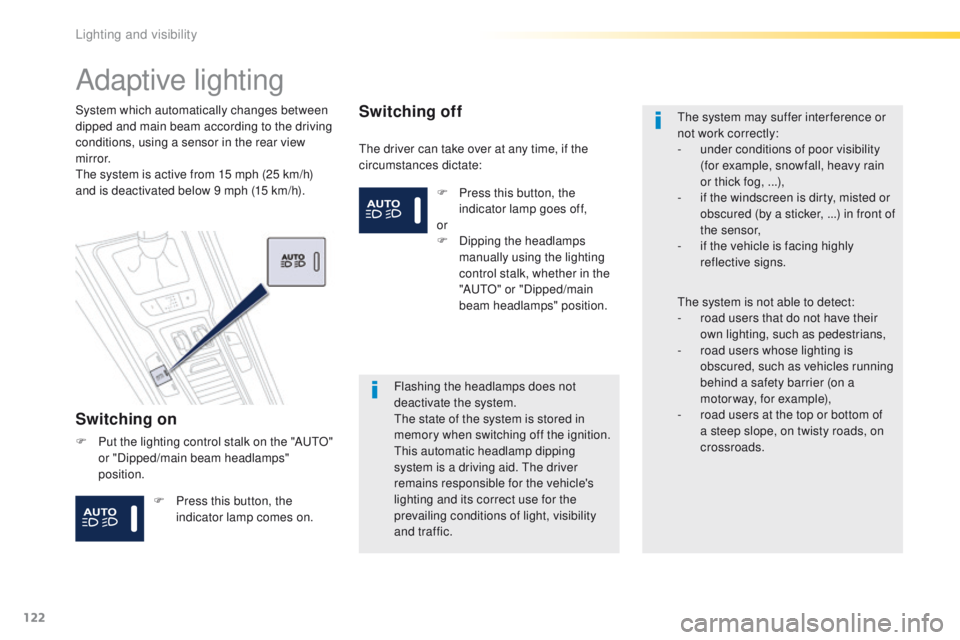
Adaptive lighting
Switching on
the driver can take over at any time, if the
circumstances dictate:
System which automatically changes between
dipped and main beam according to the driving
conditions, using a sensor in the rear view
m i r r o r.
th
e system is active from 15 mph (25 km/h)
and is deactivated below 9 mph (15 km/h).
F
P
ut the lighting control stalk on the "A
u
t
O
"
or "Dipped/main beam headlamps"
position.
Switching off
Flashing the headlamps does not
deactivate the system.
th
e state of the system is stored in
memory when switching off the ignition.
th
is automatic headlamp dipping
system is a driving aid.
t
h
e driver
remains responsible for the vehicle's
lighting and its correct use for the
prevailing conditions of light, visibility
and traffic.
the
system may suffer interference or
not work correctly:
-
u
nder conditions of poor visibility
(for example, snowfall, heavy rain
or thick fog, ...),
-
i
f the windscreen is dirty, misted or
obscured (by a sticker, ...) in front of
the sensor,
-
i
f the vehicle is facing highly
reflective signs.
th
e system is not able to detect:
-
r
oad users that do not have their
own lighting, such as pedestrians,
-
r
oad users whose lighting is
obscured, such as vehicles running
behind a safety barrier (on a
motorway, for example),
-
r
oad users at the top or bottom of
a steep slope, on twisty roads, on
crossroads.
F
P
ress this button, the
indicator lamp goes off,
or
F
D
ipping the headlamps
manually using the lighting
control stalk, whether in the
"A
u
t
O
" or "Dipped/main
beam headlamps" position.
F
P
ress this button, the
indicator lamp comes on.
Lighting and visibility
Page 126 of 371
124
508_en_Chap04_eclairage-et-visibilite_ed01-2016
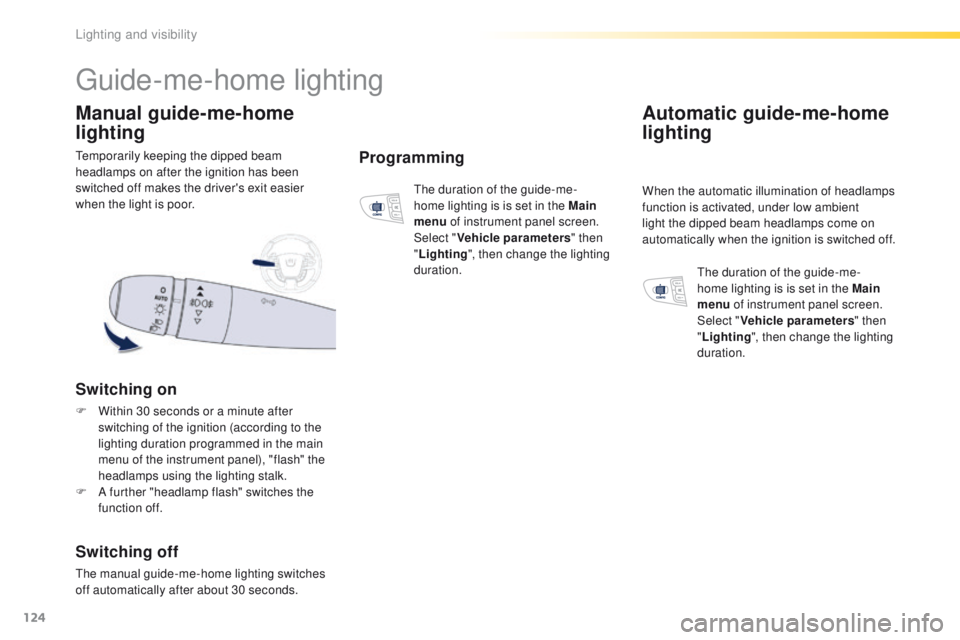
temporarily keeping the dipped beam
headlamps on after the ignition has been
switched off makes the driver's exit easier
when the light is poor.
Manual guide-me-home
lighting
Switching on
F Within 30 seconds or a minute after switching of the ignition (according to the
lighting duration programmed in the main
menu of the instrument panel), "flash" the
headlamps using the lighting stalk.
F
A f
urther "headlamp flash" switches the
function off.
Switching off
the manual guide-me-home lighting switches
off automatically after about 30 seconds.
Programming
the duration of the guide-me-
home lighting is is set in the Main
menu of instrument panel screen.
Select " Vehicle parameters " then
" Lighting ", then change the lighting
duration.
guide-me-home lighting
Automatic guide-me-home
lighting
When the automatic illumination of headlamps
function is activated, under low ambient
light the dipped beam headlamps come on
automatically when the ignition is switched off.
th
e duration of the guide-me-
home lighting is is set in the Main
menu of instrument panel screen.
Select " Vehicle parameters " then
" Lighting ", then change the lighting
duration.
Lighting and visibility
Page 127 of 371
125
508_en_Chap04_eclairage-et-visibilite_ed01-2016
Exterior welcome lighting
Remote switching on of the lighting makes your
approach to the vehicle easier in poor light. th e
lighting comes on or not depending on the the
level of ambient light detected by the sunshine
sensor.
Switching off
the exterior welcome lighting
switches off automatically after a set
time, when the ignition is switched on
or on locking the vehicle.
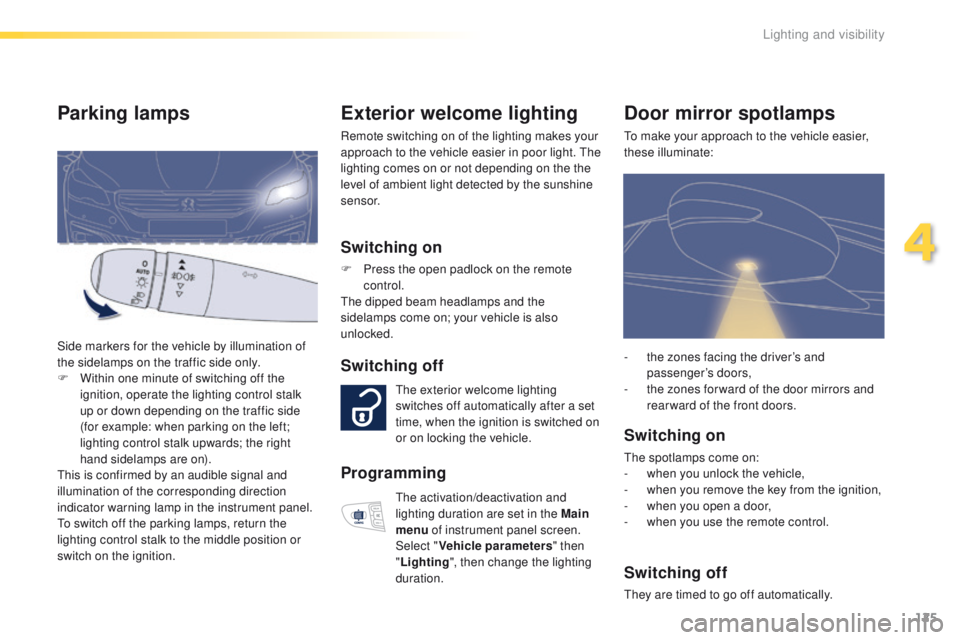
Door mirror spotlamps
to make your approach to the vehicle easier,
these illuminate:
Switching on
the spotlamps come on:
- w hen you unlock the vehicle,
-
w
hen you remove the key from the ignition,
-
w
hen you open a door,
-
w
hen you use the remote control.
Switching off
they are timed to go off automatically. -
t
he zones facing the driver’s and
passenger’s doors,
-
t
he zones for ward of the door mirrors and
rear ward of the front doors.
Switching on
F Press the open padlock on the remote control.
th
e dipped beam headlamps and the
sidelamps come on; your vehicle is also
unlocked.
Parking lamps
Side markers for the vehicle by illumination of
the sidelamps on the traffic side only.
F
W
ithin one minute of switching off the
ignition, operate the lighting control stalk
up or down depending on the traffic side
(for example: when parking on the left;
lighting control stalk upwards; the right
hand sidelamps are on).
th
is is confirmed by an audible signal and
illumination of the corresponding direction
indicator warning lamp in the instrument panel.
to s
witch off the parking lamps, return the
lighting control stalk to the middle position or
switch on the ignition.
Programming
the activation/deactivation and
lighting duration are set in the Main
menu of instrument panel screen.
Select " Vehicle parameters " then
" Lighting ", then change the lighting
duration.
4
Lighting and visibility
Page 131 of 371
129
508_en_Chap04_eclairage-et-visibilite_ed01-2016
Screenwash/headlamp wash
level low
In the case of vehicles fitted with
headlamp washers, when the fluid
reservoir low level is reached this warning
lamp comes on in the instrument panel,
accompanied by an audible signal and a
message in the instrument panel screen.
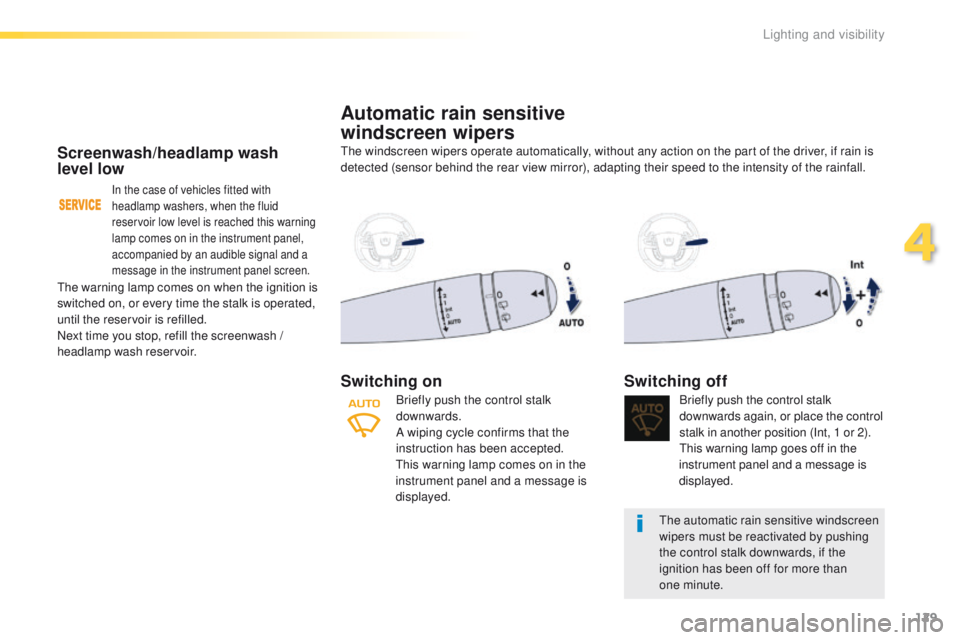
Automatic rain sensitive
windscreen wipers
Switching on
Briefly push the control stalk
downwards.
A wiping cycle confirms that the
instruction has been accepted.
th
is warning lamp comes on in the
instrument panel and a message is
displayed. Briefly push the control stalk
downwards again, or place the control
stalk in another position (Int, 1 or 2).
th
is warning lamp goes off in the
instrument panel and a message is
displayed.
Switching off
the automatic rain sensitive windscreen
wipers must be reactivated by pushing
the control stalk downwards, if the
ignition has been off for more than
one
minute.
th
e windscreen wipers operate automatically, without any action on the part of the driver, if rain is
detected (sensor behind the rear view mirror), adapting their speed to the intensity of the rainfall.
the warning lamp comes on when the ignition is
switched on, or every time the stalk is operated,
until the reservoir is refilled.
Next time you stop, refill the screenwash /
headlamp wash reservoir.
4
Lighting and visibility
Page 132 of 371
130
508_en_Chap04_eclairage-et-visibilite_ed01-2016
Do not cover the rain sensor, linked with
the sunshine sensor and located in the
centre of the windscreen behind the rear
view mirror.
Switch off the automatic rain sensitive
wipers when using an automatic car wash.
In winter, it is advisable to wait until the
windscreen is completely clear of ice
before activating the automatic rain
sensitive wipers.
Operating fault
If a fault occurs with the automatic rain
sensitive wipers, the wipers will operate in
intermittent mode.
Have it checked by P
e
uge
Ot
dealer or a
qualified workshop.
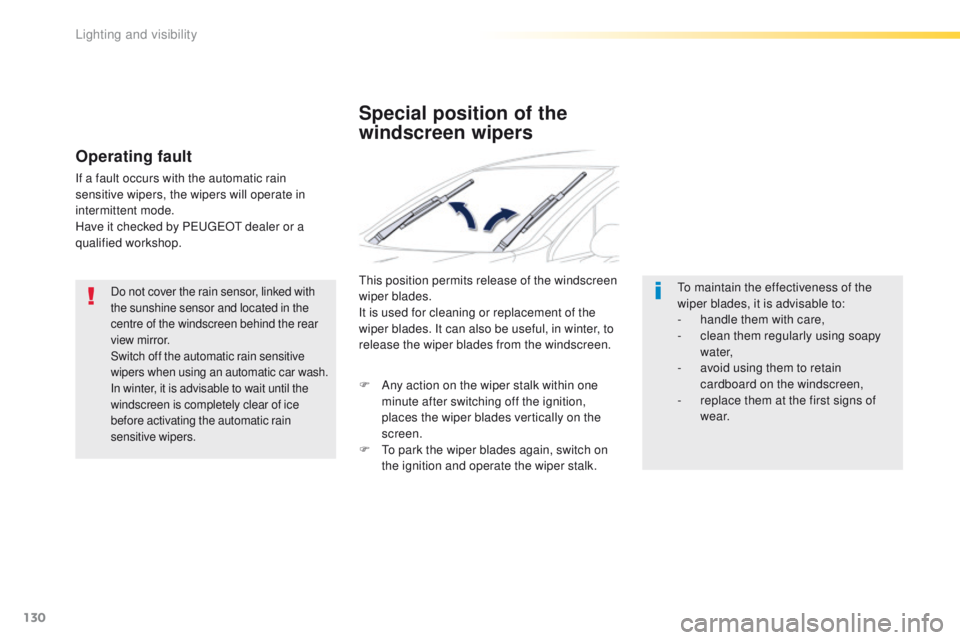
Special position of the
windscreen wipers
this position permits release of the windscreen
wiper blades.
It is used for cleaning or replacement of the
wiper blades. It can also be useful, in winter, to
release the wiper blades from the windscreen.to m aintain the effectiveness of the
wiper blades, it is advisable to:
-
h
andle them with care,
-
c
lean them regularly using soapy
water,
-
a
void using them to retain
cardboard on the windscreen,
-
r
eplace them at the first signs of
w e a r.
F
A
ny action on the wiper stalk within one
minute after switching off the ignition,
places the wiper blades vertically on the
screen.
F
t
o p
ark the wiper blades again, switch on
the ignition and operate the wiper stalk.
Lighting and visibility
Page 134 of 371
132
508_en_Chap05_securite_ed01-2016
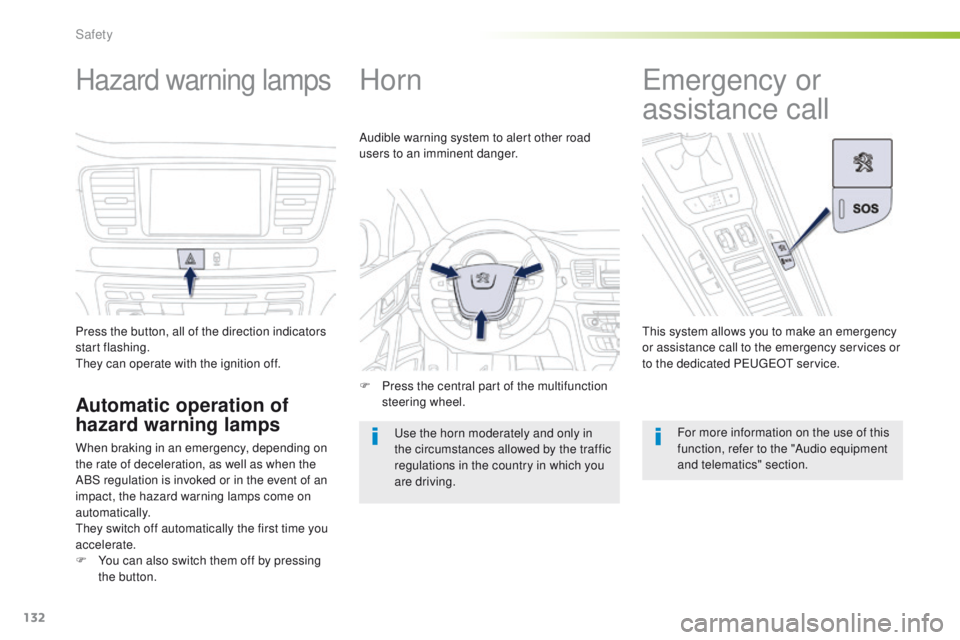
Hazard warning lamps
Press the button, all of the direction indicators
start flashing.
th
ey can operate with the ignition off.
Automatic operation of
hazard warning lamps
When braking in an emergency, depending on
the rate of deceleration, as well as when the
ABS regulation is invoked or in the event of an
impact, the hazard warning lamps come on
automatically.
th
ey switch off automatically the first time you
accelerate.
F
Y
ou can also switch them off by pressing
the button.
Horn
F Press the central part of the multifunction steering wheel.
Audible warning system to alert other road
users to an imminent danger.
us
e the horn moderately and only in
the circumstances allowed by the traffic
regulations in the country in which you
are driving.
emergency or
assistance call
this system allows you to make an emergency
or assistance call to the emergency services or
to the dedicated P
e
uge
Ot
service.
For more information on the use of this
function, refer to the "Audio equipment
and telematics" section.
Safety
Page 137 of 371
135
508_en_Chap05_securite_ed01-2016
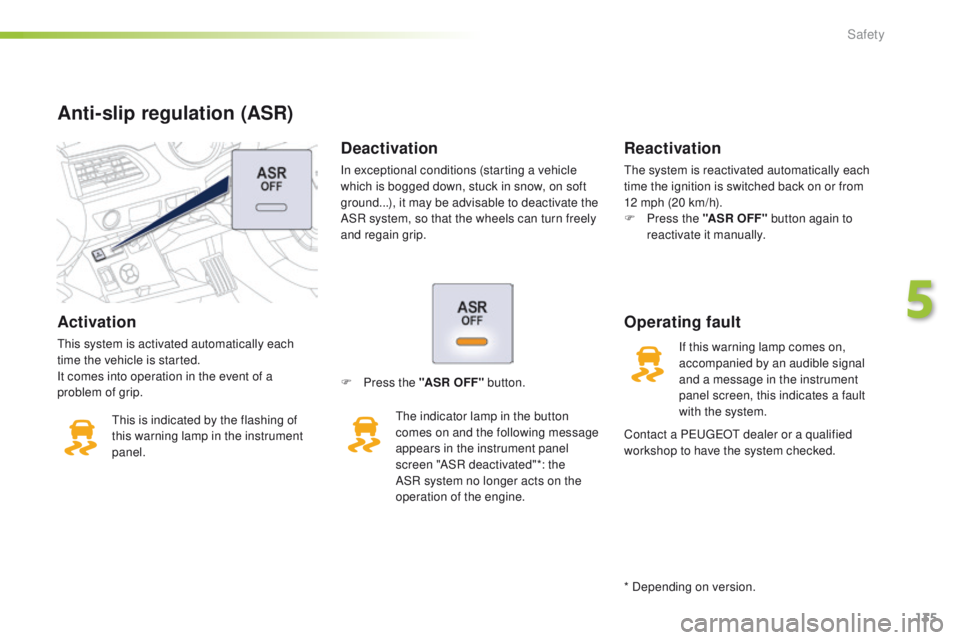
Activation
this system is activated automatically each
time the vehicle is started.
It comes into operation in the event of a
problem of grip.
th
is is indicated by the flashing of
this warning lamp in the instrument
panel.
Deactivation
In exceptional conditions (starting a vehicle
which is bogged down, stuck in snow, on soft
ground...), it may be advisable to deactivate the
ASR system, so that the wheels can turn freely
and regain grip.
Operating fault
If this warning lamp comes on,
accompanied by an audible signal
and a message in the instrument
panel screen, this indicates a fault
with the system.
Reactivation
the system is reactivated automatically each
time the ignition is switched back on or from
12
mph (20 km/h).
F
P
ress the "AS R O FF " button again to
reactivate it manually.
F
P
ress the "AS R O FF " button.
th
e indicator lamp in the button
comes on and the following message
appears in the instrument panel
screen "ASR deactivated"*: the
ASR system no longer acts on the
operation of the engine.
Anti-slip regulation (ASR)
Contact a Pe ugeOt dealer or a qualified
workshop to have the system checked.
* Depending on version.
5
Safety
Page 138 of 371
136
508_en_Chap05_securite_ed01-2016
Seat belts
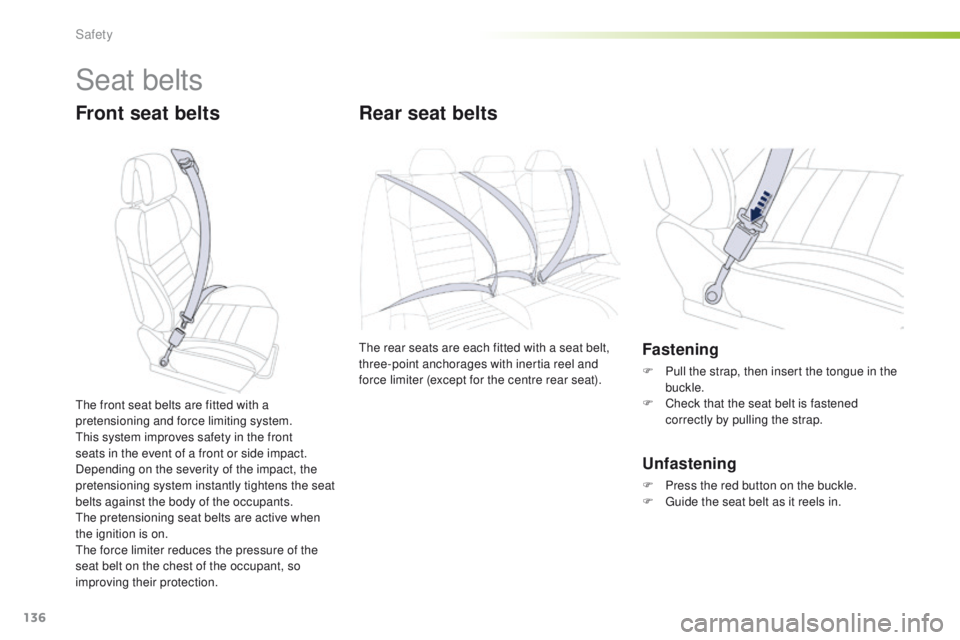
Front seat beltsRear seat belts
the rear seats are each fitted with a seat belt,
three-point anchorages with inertia reel and
force limiter (except for the centre rear seat).Fastening
F Pull the strap, then insert the tongue in the
buckle.
F
C
heck that the seat belt is fastened
correctly by pulling the strap.
Unfastening
F Press the red button on the buckle.
F gu ide the seat belt as it reels in.
th
e front seat belts are fitted with a
pretensioning and force limiting system.
th
is system improves safety in the front
seats in the event of a front or side impact.
Depending on the severity of the impact, the
pretensioning system instantly tightens the seat
belts against the body of the occupants.
the
pretensioning seat belts are active when
the ignition is on.
th
e force limiter reduces the pressure of the
seat belt on the chest of the occupant, so
improving their protection.
Safety
Page 139 of 371
137
508_en_Chap05_securite_ed01-2016
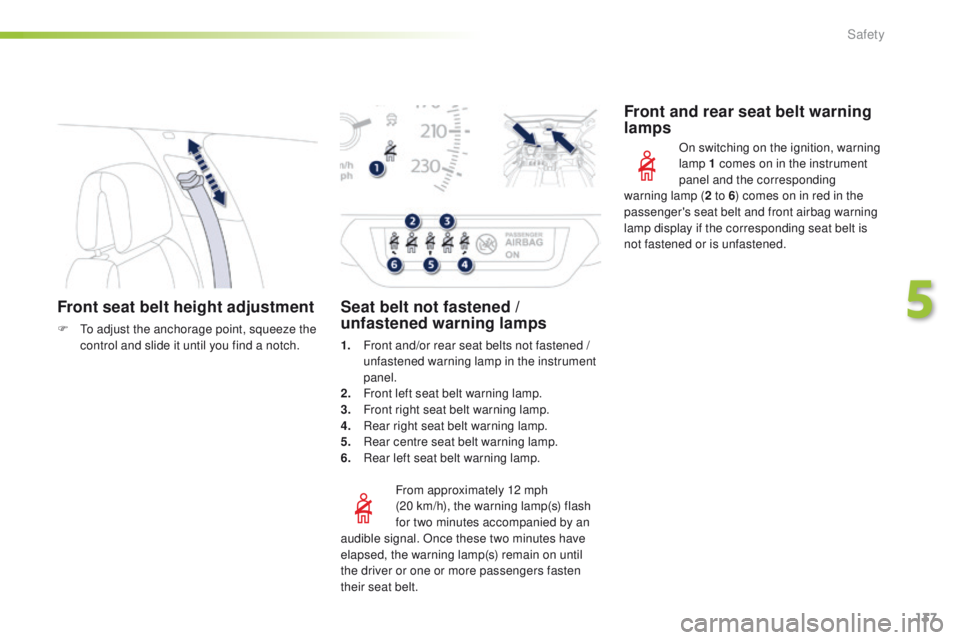
Front seat belt height adjustment
F to adjust the anchorage point, squeeze the control and slide it until you find a notch.
From approximately 12 mph
(20
km/h), the warning lamp(s) flash
for two
minutes accompanied by an
Seat belt not fastened /
unfastened warning lamps
1. Front and/or rear seat belts not fastened / unfastened warning lamp in the instrument
panel.
2.
F
ront left seat belt warning lamp.
3.
F
ront right seat belt warning lamp.
4.
R
ear right seat belt warning lamp.
5.
R
ear centre seat belt warning lamp.
6.
R
ear left seat belt warning lamp.
Front and rear seat belt warning
lamps
On switching on the ignition, warning
lamp 1 comes on in the instrument
panel and the corresponding
audible signal. Once these two minutes have
elapsed, the warning lamp(s) remain on until
the driver or one or more passengers fasten
their seat belt. warning lamp (
2 to 6) comes on in red in the
passenger's seat belt and front airbag warning
lamp display if the corresponding seat belt is
not fastened or is unfastened.
5
Safety