ignition Peugeot 508 2016 Workshop Manual
[x] Cancel search | Manufacturer: PEUGEOT, Model Year: 2016, Model line: 508, Model: Peugeot 508 2016Pages: 371, PDF Size: 12.12 MB
Page 141 of 371
139
508_en_Chap05_securite_ed01-2016
Airbags
General information
System designed to contribute towards
improving the safety of the occupants (with
the exception of the rear centre passenger)
in the event of violent collisions. t
h
e airbags
supplement the action of the seat belts fitted
with force limiters (all except the centre rear
passenger belt).
If a collision occurs, the electronic detectors
record and analyse the front and side impacts
sustained in the impact detection zones:
-
i
n the case of a serious impact, the airbags
are deployed instantly and contribute
towards better protection of the occupants
of the vehicle (with the exception of the
rear centre passenger); immediately after
the impact, the airbags deflate rapidly so
that they do not hinder visibility or the exit
of the occupants,
-
i
n the case of a minor or rear impact or in
certain roll-over conditions, the airbags
may not be deployed; the seat belt
alone contributes towards ensuring your
protection in these situations.
The airbags do not operate when the
ignition is switched off. Deployment of one or more of the
airbags is accompanied by a slight
emission of smoke and a noise, due
to the activation of the pyrotechnic
cartridge incorporated in the system.
th
is smoke is not harmful, but sensitive
individuals may experience slight
irritation.
th
e noise of detonation associated with
the deployment of one or more airbags
may result in a slight loss of hearing for
a short time.
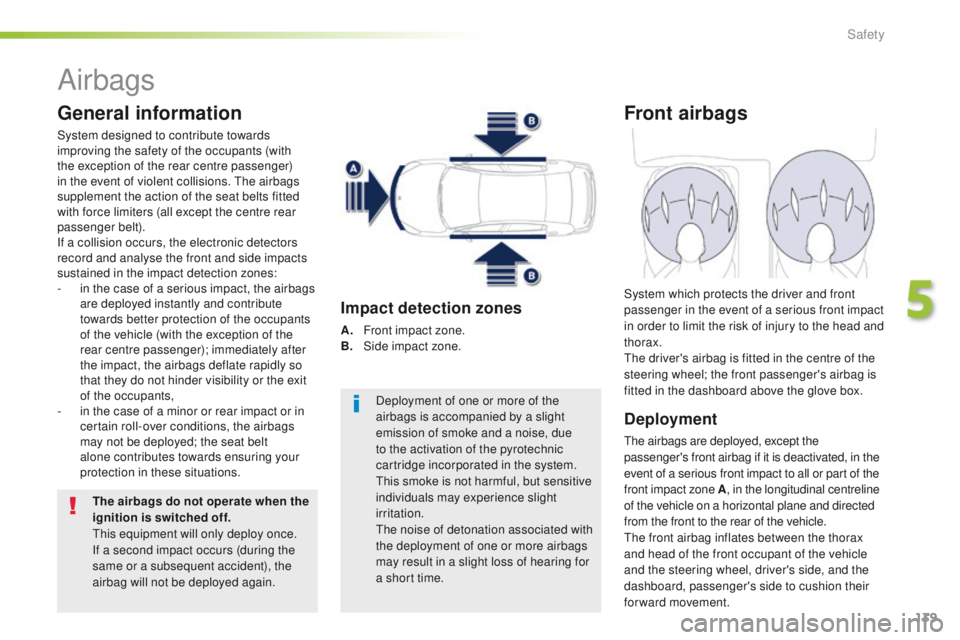
Impact detection zones
A. Front impact zone.
B. S ide impact zone.
Front airbags
Deployment
the airbags are deployed, except the
passenger's front airbag if it is deactivated, in the
event of a serious front impact to all or part of the
front impact zone A , in the longitudinal centreline
of the vehicle on a horizontal plane and directed
from the front to the rear of the vehicle.
th
e front airbag inflates between the thorax
and head of the front occupant of the vehicle
and the steering wheel, driver's side, and the
dashboard, passenger's side to cushion their
for ward movement. System which protects the driver and front
passenger in the event of a serious front impact
in order to limit the risk of injury to the head and
thorax.
th
e driver's airbag is fitted in the centre of the
steering wheel; the front passenger's airbag is
fitted in the dashboard above the glove box.
th
is equipment will only deploy once.
If a second impact occurs (during the
same or a subsequent accident), the
airbag will not be deployed again.
5
Safety
Page 142 of 371
140
508_en_Chap05_securite_ed01-2016
Deactivation
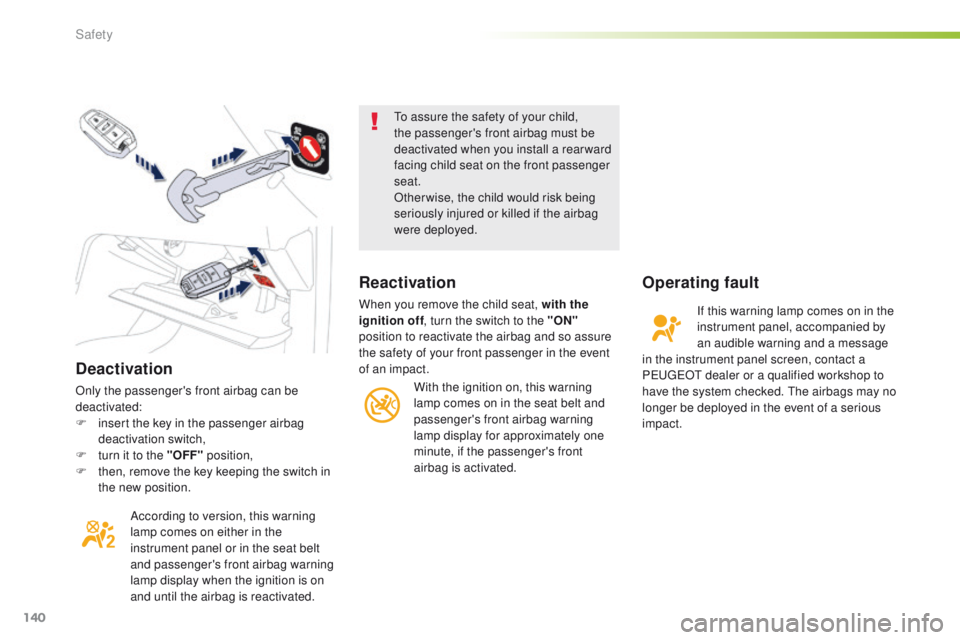
Only the passenger's front airbag can be
deactivated:
F
i
nsert the key in the passenger airbag
deactivation switch,
F
t
urn it to the "OFF" position,
F
t
hen, remove the key keeping the switch in
the new position.
According to version, this warning
lamp comes on either in the
instrument panel or in the seat belt
and passenger's front airbag warning
lamp display when the ignition is on
and until the airbag is reactivated.
to a
ssure the safety of your child,
the passenger's front airbag must be
deactivated when you install a rear ward
facing child seat on the front passenger
seat.
Otherwise, the child would risk being
seriously injured or killed if the airbag
were deployed.
Reactivation
When you remove the child seat, with the
ignition off , turn the switch to the "ON"
position to reactivate the airbag and so assure
the safety of your front passenger in the event
of an impact.
With the ignition on, this warning
lamp comes on in the seat belt and
passenger's front airbag warning
lamp display for approximately one
minute, if the passenger's front
airbag is activated.
Operating fault
If this warning lamp comes on in the
instrument panel, accompanied by
an audible warning and a message
in the instrument panel screen, contact a
P
e
uge
Ot
dealer or a qualified workshop to
have the system checked.
t
h
e airbags may no
longer be deployed in the event of a serious
impact.
Safety
Page 160 of 371
158
508_en_Chap05_securite_ed01-2016
electric child lock
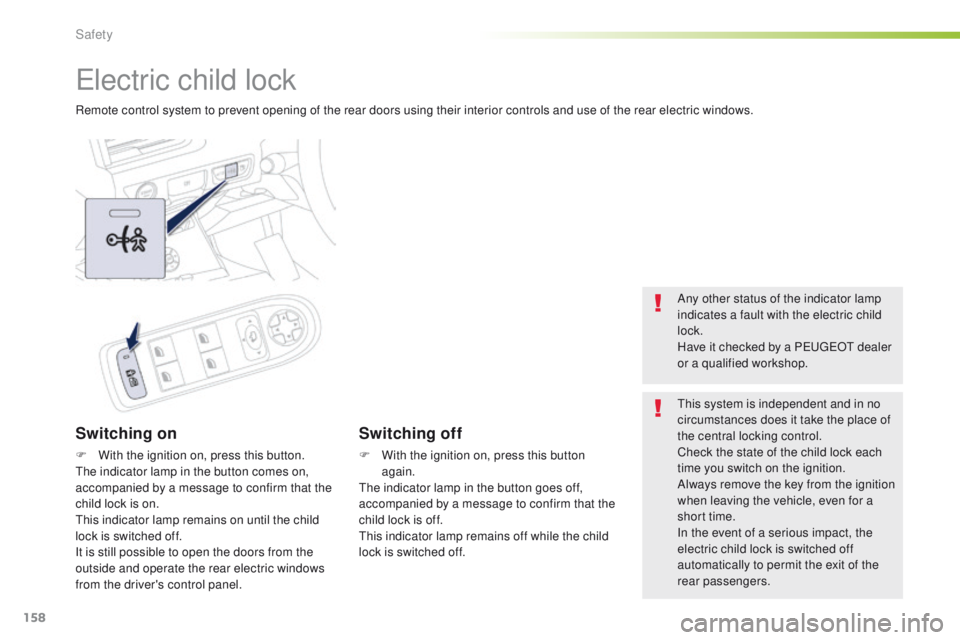
Remote control system to prevent opening of the rear doors using their interior controls and use of the rear electric windows.
Switching on
F With the ignition on, press this button.the indicator lamp in the button comes on,
accompanied by a message to confirm that the
child lock is on.
th
is indicator lamp remains on until the child
lock is switched off.
It is still possible to open the doors from the
outside and operate the rear electric windows
from the driver's control panel.
Switching off
F With the ignition on, press this button again.
th
e indicator lamp in the button goes off,
accompanied by a message to confirm that the
child lock is off.
th
is indicator lamp remains off while the child
lock is switched off. Any other status of the indicator lamp
indicates a fault with the electric child
lock.
Have it checked by a P
e
uge
Ot
dealer
or a qualified workshop.
th
is system is independent and in no
circumstances does it take the place of
the central locking control.
Check the state of the child lock each
time you switch on the ignition.
Always remove the key from the ignition
when leaving the vehicle, even for a
short time.
In the event of a serious impact, the
electric child lock is switched off
automatically to permit the exit of the
rear passengers.
Safety
Page 163 of 371
161
508_en_Chap06_conduite_ed01-2016
Starting-switching off the engine using the remote control key
the parking brake must be applied.
Starting
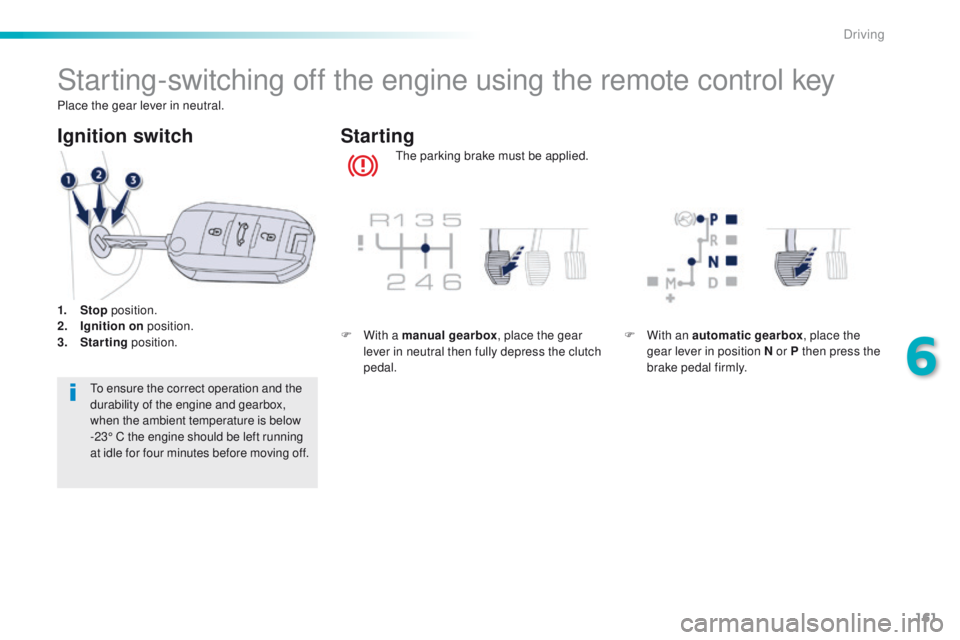
Ignition switch
to ensure the correct operation and the
durability of the engine and gearbox,
when the ambient temperature is below
-23° C the engine should be left running
at idle for four minutes before moving off.
Place the gear lever in neutral.
1.
Sto
p
position.
2.
I
gnition on
position.
3.
S
tarting
position. F
W
ith a manual gearbox
, place the gear
lever in neutral then fully depress the clutch
pedal. F
W
ith an automatic gearbox
, place the
gear lever in position N or P then press the
brake pedal firmly.
6
Driving
Page 164 of 371
162
508_en_Chap06_conduite_ed01-2016
In certain circumstances, you may have
to apply some force to turn the wheels
(if the wheels are against a kerb, for
example).
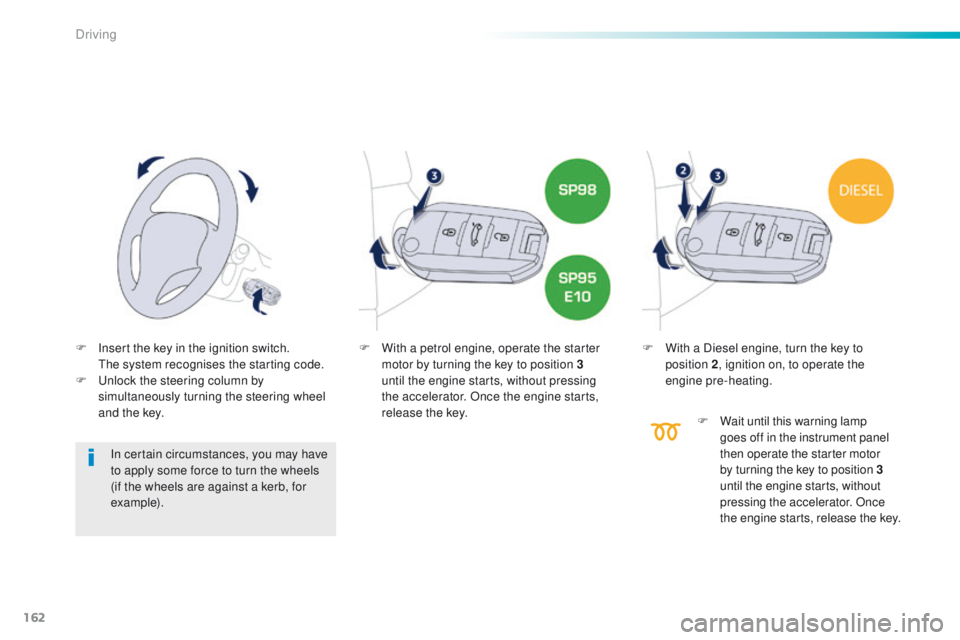
F
I
nsert the key in the ignition switch.
t
h
e system recognises the starting code.
F
u
n
lock the steering column by
simultaneously turning the steering wheel
and the key. F
W
ith a petrol engine, operate the starter
motor by turning the key to position 3
until the engine starts, without pressing
the accelerator. Once the engine starts,
release the key. F
W
ith a Diesel engine, turn the key to
position 2 , ignition on, to operate the
engine pre-heating.
F
W
ait until this warning lamp
goes off in the instrument panel
then operate the starter motor
by turning the key to position 3
until the engine starts, without
pressing the accelerator. Once
the engine starts, release the key.
Driving
Page 165 of 371
163
508_en_Chap06_conduite_ed01-2016
If the engine does not start straight
away, switch off the ignition.
Wait a few moments before trying
again. If the engine does not start after
a few attempts, do not keep trying: you
risk damaging the starter motor and the
engine.
Call on a P
e
uge
Ot
dealer or a
qualified workshop.
In wintry conditions, the pre-heater warning
lamp will stay on for a longer period.
When the engine is hot, the warning lamp
does not come on.Never leave the engine running in
an enclosed area without adequate
ventilation: internal combustion
engines emit toxic exhaust gases,
such as carbon monoxide. Danger of
intoxication and death.
In very severe wintry conditions
(temperatures below -23°C), to ensure
the correct operation and the durability
of the mechanical components of your
vehicle, the engine and gearbox, it is
necessary to leave the engine running
for 4 minutes before moving off.
In temperate conditions, do not leave
the engine running to warm up, but set
off straight away and drive at moderate
speed.
6
Driving
Page 166 of 371
164
508_en_Chap06_conduite_ed01-2016
Switching off
Never switch off the ignition until the vehicle
has been brought to a complete stop.
to facilitate unlocking of the steering
wheel, it is recommended that you
place the wheels in the straight ahead
position before switching off the engine.When leaving the vehicle, remove the
key and lock the doors.
F
C
heck that the parking brake is correctly
applied, particularly when parking on a
slope.
●
W
ith a manual parking brake, the
lever must be pulled up.
●
W
ith an electric parking brake,
the indicator lamp in the control
lever must be on. Switching off the engine leads to a loss
of braking assistance.
Key left in the ignition switch
there is an audible signal on opening
the driver's door if the key has been left
in the ignition switch. Avoid attaching heavy objects to the
key, which would weigh down on its
blade in the ignition switch and could
cause a malfunction.
F
Imm
obilise the vehicle.
F
t
u
rn the key fully towards you to position 1
(Stop) .
F
R
emove the key from the ignition switch.
F
t
o l
ock the steering column, turn the
steering wheel until it locks.
Driving
Page 167 of 371
165
508_en_Chap06_conduite_ed01-2016
For Diesel vehicles, in very cold
weather the engine will not start
until the pre-heater warning
lamp has gone off.
If this warning lap comes on
after pressing the "S TA R T/
STOP " button, you should
maintain pressure on the brake
or clutch pedal until the warning
lamp goes off and not press the
" START/STOP " button, until the
engine starts. If the vehicle is not immobilised, the
engine will not stop.
Switching off
F Immobilise the vehicle.
F
W
ith the electronic key inside
the vehicle, press the " S TA R T/
STOP " button.
th
e engine stops and the steering column is
locked.
Ignition on (accessory) position
With the electronic key inside the vehicle,
press the "StA Rt/ StO P" button, with no
action on the pedals, to switch the ignition
on or off and so allow the use of the ancillary
equipment.
If one of the starting conditions is not
met, a reminder message appears in
the instrument panel screen. In some
circumstances, it is necessary to turn
the steering wheel slightly while pressing
the "S
tA
R
t/
S
tO
P" button to assist
unlocking of the steering; a message
warns you when this is needed.
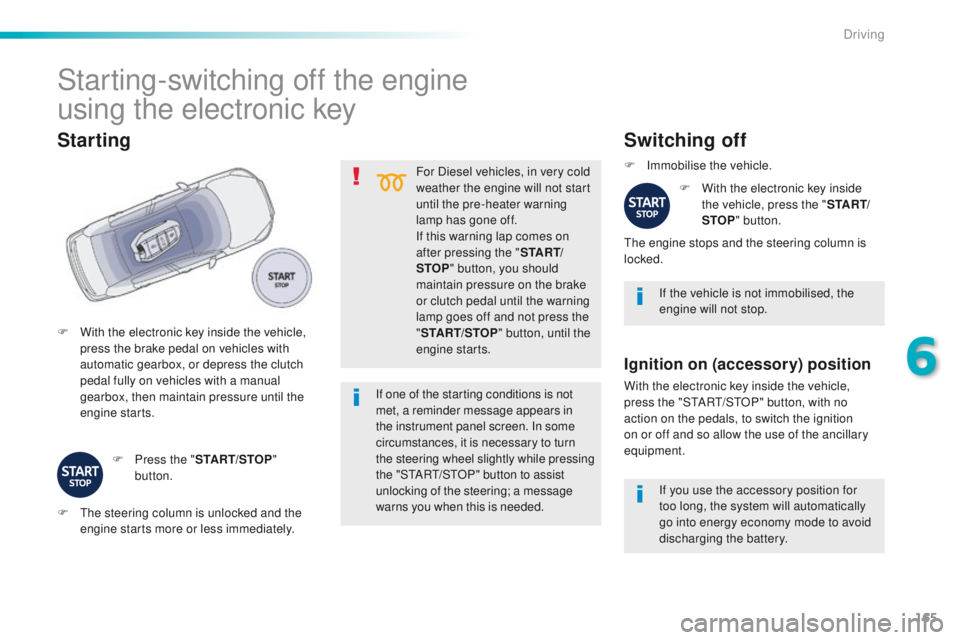
F
W
ith the electronic key inside the vehicle,
press the brake pedal on vehicles with
automatic gearbox, or depress the clutch
pedal fully on vehicles with a manual
gearbox, then maintain pressure until the
engine starts.
Starting
F Press the " START/STOP"
button.
Starting-switching off the engine
using the electronic key
F the steering column is unlocked and the engine starts more or less immediately. If you use the accessory position for
too long, the system will automatically
go into energy economy mode to avoid
discharging the battery.
6
Driving
Page 169 of 371
167
508_en_Chap06_conduite_ed01-2016
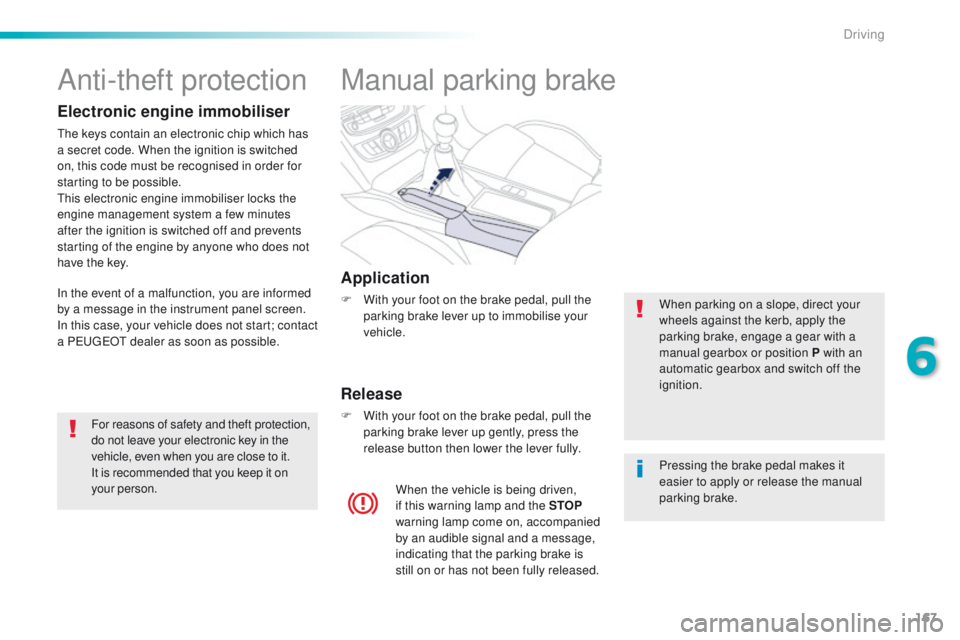
Manual parking brake
Application
F With your foot on the brake pedal, pull the parking brake lever up to immobilise your
vehicle.
Release
F With your foot on the brake pedal, pull the parking brake lever up gently, press the
release button then lower the lever fully. When parking on a slope, direct your
wheels against the kerb, apply the
parking brake, engage a gear with a
manual gearbox or position P with an
automatic gearbox and switch off the
ignition.
When the vehicle is being driven,
if this warning lamp and the STOP
warning lamp come on, accompanied
by an audible signal and a message,
indicating that the parking brake is
still on or has not been fully released. Pressing the brake pedal makes it
easier to apply or release the manual
parking brake.
Anti-theft protection
Electronic engine immobiliser
the keys contain an electronic chip which has
a secret code. When the ignition is switched
on, this code must be recognised in order for
starting to be possible.
th
is electronic engine immobiliser locks the
engine management system a few minutes
after the ignition is switched off and prevents
starting of the engine by anyone who does not
have the key.
In the event of a malfunction, you are informed
by a message in the instrument panel screen.
In this case, your vehicle does not start; contact
a P
e
uge
Ot
dealer as soon as possible.
For reasons of safety and theft protection,
do not leave your electronic key in the
vehicle, even when you are close to it.
It is recommended that you keep it on
your person.
6
Driving
Page 171 of 371
169
508_en_Chap06_conduite_ed01-2016
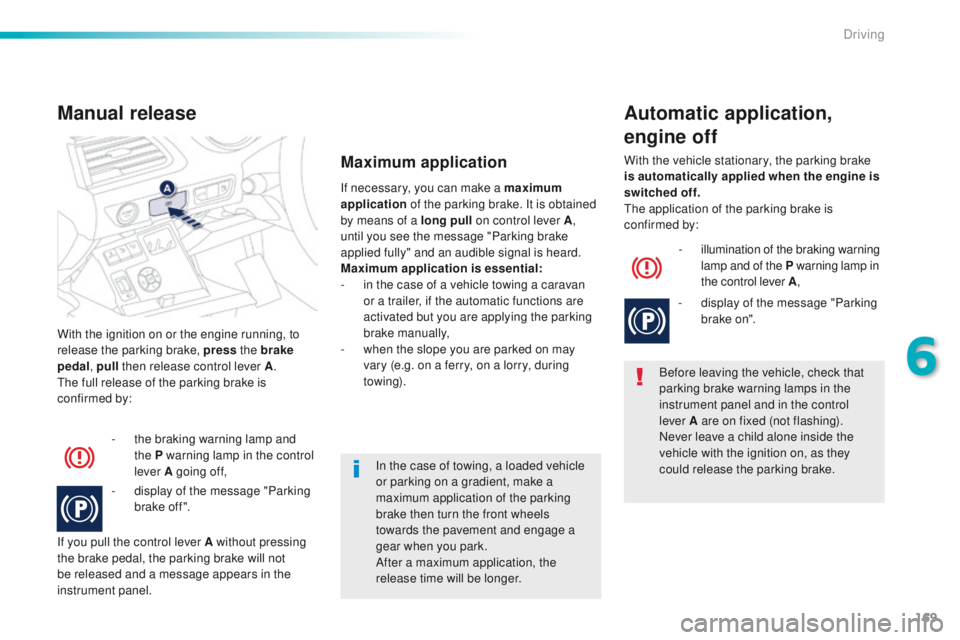
With the ignition on or the engine running, to
release the parking brake, press the brake
pedal , pull then release control lever A .
th
e full release of the parking brake is
confirmed by:
Manual release
- the braking warning lamp and the P warning lamp in the control
lever A going of f,
-
d
isplay of the message "Parking
brake of f ".
If you pull the control lever A without pressing
the brake pedal, the parking brake will not
be released and a message appears in the
instrument panel. If necessary, you can make a maximum
application
of the parking brake. It is obtained
by means of a long pull on control lever A,
until you see the message "Parking brake
applied fully" and an audible signal is heard.
Maximum application is essential:
-
i
n the case of a vehicle towing a caravan
or a trailer, if the automatic functions are
activated but you are applying the parking
brake manually,
-
w
hen the slope you are parked on may
vary (e.g. on a ferry, on a lorry, during
towing).
Maximum application
Before leaving the vehicle, check that
parking brake warning lamps in the
instrument panel and in the control
lever
A are on fixed (not flashing).
Never leave a child alone inside the
vehicle with the ignition on, as they
could release the parking brake.
Automatic application,
engine off
- illumination of the braking warning lamp and of the P warning lamp in
the control lever A ,
-
d
isplay of the message "Parking
brake on".
With the vehicle stationary, the parking brake
is automatically applied when the engine is
switched off.
th
e application of the parking brake is
confirmed by:
In the case of towing, a loaded vehicle
or parking on a gradient, make a
maximum application of the parking
brake then turn the front wheels
towards the pavement and engage a
gear when you park.
After a maximum application, the
release time will be longer.
6
Driving